Article
0103 - 5053 $6.00+0.00
*e-mail: [email protected]
Stripping Voltammetric Determination of Copper (II) on an Overoxidized Polypyrrole
Functionalized with Nitroso-R
Alireza Mohadesi,*
,aAshraf Salmanipour,
aSayed Ziae Mohammadi,
aAli Pourhatami
band Mohammad Ali Taher
ca Department of Chemistry, Payame Noor University, PO Box 76175-559, Kerman, Iran
b Department of Chemistry, Azad University of Yazd, Yazad, Iran
c Department of Chemistry, Shahid Bahonar University, PO Box 76175-133, Kerman, Iran
No presente trabalho é apresentado um método para a determinação de Cu em amostras de cabelo humano e água por voltametria de redissolução anódica de pulso diferencial. Foi provado que a eletropolimerização do pirrol ocorre em presença do ânion dopante Nitroso-R. O polipirrol dopado com Nitroso-R foi deposido sobre a superfície da platina, e reage com Cu(II) em pHs neutros, originando um complexo. Essa complexação entre o Nitroso-R e o Cu(II) produz o acúmulo de Cu(II) na superfície a partir de a circuito aberto. O eletrodo resultante com Cu(II) complexado foi então transferido para um tampão de acetato, e submetido a voltametria de redissolução anódica, promovendo o aparecimento de um pico de corrente a +0,08 V. Depois da avaliação do comportamento funcional analítico foi construído um gráfico de calibração a partir de 1,2 a 243,9 ng mL-1 e o limite de detecção foi de 0,7 ng mL-1. O método foi utilizado para
a determinação de íons cobre em amostras de água e cabelo humano. Os resultados indicam a capacidade do método para a determinação deste íon em amostras reais. Além disso, a rápida e conveniente regeneração do eletrodo permite sua utilização em várias análises.
In the present paper a method for the determination of Cu in human hair and water samples by differential pulse anodic stripping voltammetry is presented. It has been proven that pyrrole electropolymerizes in present of Nitroso-R as dopant anion. Nitroso-R doped in polypyrrole film coated on platinum surface then reacts with Cu(II) in neutral pHs giving rise to a complex. This complexation between Nitroso-R and Cu(II) achieves the accumulation of Cu(II) from the sample solutions to the electrode surface at open circuit condition. The resulting electrode with complexed Cu(II) can then transfer to an acetate buffer and subject to anodic stripping voltammetry which promotes the appearance of a peak at +0.08 V. After the evaluation of the analytical performance a calibration graph was constructed from 1.2 to 243.9 ng mL-1 and the detection limit was 0.7 ng mL-1.
The method was used for determination of copper ions in water and human hair samples. The results indicate the ability of method for the determination of this ion in real samples. Also, the rapid and convenient regeneration of electrode allows the use of a single modified electrode in multiple analyses.
Keywords: polypyrrole, Nitroso-R,copper, stripping analysis
Introduction
Copper is a metal of prime environmental concern.1
Voltammetric techniques are known to show unique advantages both economical, i.e. low initial and running costs, and strictly analytical like the ability to determine low levels of metal in different matrixes ranging from seawater to melted snow. In particular, stripping techniques are perfectly suited
for trace and ultratrace metal determination.2 The application
of voltammetric techniques in the determination of trace copper has been reviewed.3 Of these methods, anodic stripping
Recently, because of these advantageous, there has been a growing interest in the use of chemically modified electrodes (CME) for trace metal stripping analysis. With this process, accumulation usually occurs by reactions between an analyte and an immobilized modifier at the solid state electrode surface.3,4
Electrically conducting polymers (ECPs), such as polyaniline or polypyrrole (PPy), can be used for the immobilization of complexing reagents for trace metal complexation/accumulation with voltammetric detection of the complexed metal ion.5,6 The application of anionic
ligands as functional dopant incorporated into a PPy matrix for the stripping analysis of metal ions has been reviewed.7
The preparation of these functional PPy films is very simple, controllable and reproducible by electrochemical oxidizing pyrrole monomers in the presence of the target anionic reagents. However, a major limitation lies in the high background currents typically encountered with modified PPy films. These currents mask the relatively smaller metal–chelate binding, thereby making metal detection difficult. One solution of this problem is to overoxidize PPy to decrease these background currents.8-11
The aim of this work was to develop a simple, selective and sensitive system for determination of Cu(II) by stripping voltammetry on platinum electrode modified with overoxidized PPy (OPPy) doped with Nitroso-R. The results obtained led to the development of a voltammetric method for the determination of copper with a wide linear range and low detection limit. The resulting modified electrode does not use mercury and therefore, has a positive environmental benefit. The method, which is reasonably sensitive and selective, has been successfully applied to the determination of trace amount of copper in water and human hair samples.
Experimental
Reagents
Pyrrole (Fluka) was distilled under reduced pressure before use. Nitroso-R (Merck) was used as received. Metal ion solutions in selectivity section were prepared from their nitrate salts and were purchased from Merck and were of analytical grade. All aqueous solutions were prepared with double-distillated water.
Apparatus
Voltammetric experiments were performed using Metrohm electroanalyzer Model 797 VA computrace. The measurements recorded using VA computrace version
1.2 (Metrohm) running under windows XP. Working electrodes were 3 mm diameter platinum disks constructed in–house. The counter electrode was a platinum wire and the reference electrode was Ag/AgCl, both from Metrohm. A Metrohm pH meter, Model 710, was used for pH measurements.
Film preparation
PPy/Nitroso-R films were prepared potentiostatically by holding the potential at +0.75 V for 50 s. The growth solution was an aqueous pyrrole and Nitroso-R mixture, at 0.2 mol L-1 pyrrole and 10 mmol L-1 Nitroso-R. The
overoxidation of the PPy/Nitroso-R films was carried out in 0.1 mol L-1 NaOH by cycling the potential between 0
and 1.2 V at 50 mV s-1 for two cycles.
Stripping voltammetric determination of copper (II)
For accumulation, an OPPy/Nitroso-R modified electrode was immersed in a 0.2 mol L-1 ammonia buffer
(pH 7) containing Cu(II), and stirred for 8 min; the electrode was then washed with water and transferred into a deaerated 0.1 mol L-1 acetate buffer (pH 3.5). After
accumulation on the electrode surface, preconcentrated copper ions were reduced at -0.5 V for 10 s. The potential was then scanned in the positive direction by cyclic voltammetry (scan rate, 50 mV s-1) between –0.5 and
+0.4 V or differential pulse voltammetry (pulse amplitude, 50 mV; pulse interval 1 s; and scan rate, 50 mV s-1)
between –0.3 and +0.3 V.
Pretreatment of real samples
The procedure of wet ashing of human hair has been described by Mohadesi et al.12 The hair sample was
Results and Discussion
Voltammetric behavior of copper(II) in OPPy/Nitroso-R films
Since the Nitroso-R (Figure 1) was the only anion present in the electropolymerized solution, it was incorporated with the growing cationic PPy film to maintain electroneutrality in the polymer matrix.
This PPy/Nitroso-R film was examined for metal-ion complexing ability by medium-exchange voltammetry. As was shown in Figure 2, results from experiments on PPy films for trace Cu(II) deposition and stripping did not indicate noticeable current change after accumulation in a solution containing copper metal ions. This is probably due to the inaccessibility of the complexing agent (Nitroso-R) to the copper metal ions. Also, the large background currents resulting from the conducting and electroactive PPy that is likely to mask the relatively smaller current that may result from the copper-chelate complex.8-12 For these small currents
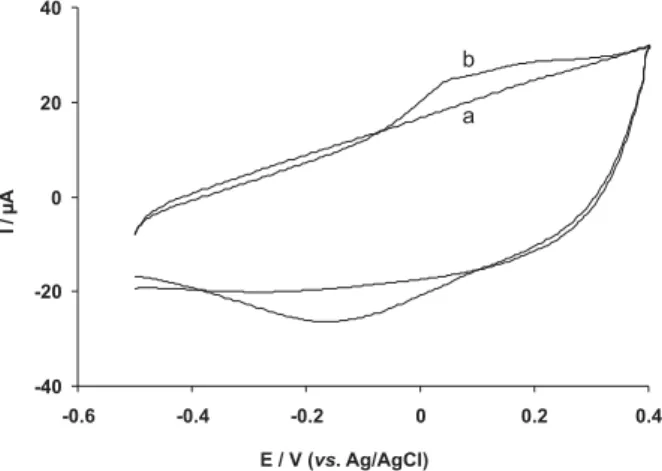
to appear obtained by stripping preconcentrated metal ions, large background currents may decrease. This decrease can be obtained by the overoxidation of PPy films. Figure 3 shows the overoxidation process of PPy/Nitroso-R film using two cycles in a 0.1 mol L-1 NaOH solution. In the first
scan, two anodic peaks are observed over the whole potential range. These two peaks are ascribed to the overoxidation of PPy film.13 As can be seen in Figure 3, no cathodic peak can
be observed on the reverse scan, which indicates that the overoxidation process is electrochemically irreversible. A strong decrease in the current in duration second cycle was shown to decrease conductivity of PPy film because of an irreversible electrochemical transformation of the polymer film during the first cycle. This overoxidation is caused by a nucleophilic attack on the pyrrole units by a solvent or OH–, which results in a loss of the conjugated structure of
the polymer.13,14
CVs of PPy/Nitroso-R film were recorded and compared in acetate buffer (pH 3.5) before and after the overoxidation process. Results indicate that overoxidation of the PPy film decreased the background current. Although not electrochemically active, the polymer can still allow the complexation of copper, if the Nitroso-R still exists in the OPPy film.
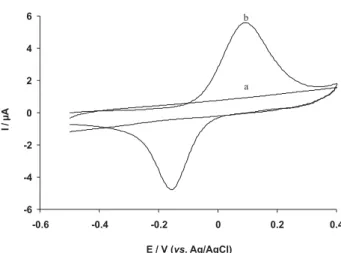
Figure 4b shows typical cyclic voltammograms for the detection of Cu(II) following open-circuit accumulation onto OPPy/Nitroso-R film. An anodic peak at +0.95 V and a cathodic peak at –0.16 V can be observed, which are related to the oxidation and reduction of accumulated copper, respectively. To prove further the importance of Nitroso-R as a chelator reagent in the PPy matrix, overoxidized PPy films doped with NO3– and SO
4 2– were
prepared, and used for the accumulation and stripping of Cu(II). The results were showed no significant peaks in the case of OPPy/Br and OPPy/SO4. These results show the importance of doping Nitroso-R in PPy film for the preconcentration of Cu(II).
From the above observations, under the conditions of the experiments, the possible pathways for the analysis cycle are postulated below (“aq” or “surf” subscript means compound is in aqueous solution or electrode surface): Figure 1. Nitroso-R as an anion/chelator.
Figure 2. Cyclic voltammograms in acetate buffer at pH 3.5 after open-circuit accumulation in ammonia buffer pH 7. (a) PPy/Nitroso-R electrode, no Cu(II) in accumulation medium, (b) PPy/Nitroso-R electrode, with 0.5 mg L-1 Cu(II) in accumulation medium. The accumulation time was
10 min and the scan rate was 50 mV s-1.
Figure 3. Cyclic voltammograms (scan rate 50 mV s-1) for the
overoxidation of PPy/Nitroso-R in 0.1 mol L-1 NaOH. (a) first cycle and
PPy Film preparation from solution containing nitroso-R and pyrrole:7,8
Overoxidation of PPy film in NaOH solution:8
Accumulation of Cu(II) from sample solutions containing Cu(II):15
Reduction of accumulated Cu(II) in clean acetate buf-fer:16,17
Stripping of reduced copper in clean acetate buffer:16,17
pH of the accumulation and stripping medium
The chelating properties of Nitroso-R with metal cations have been demonstrated to be pH dependent.15,18,19
Therefore, the effect of the pH on the stripping peak current was studied in the range of 4.5-9.5. The stripping peak currents were found to increase as the pH of the accumulation solution (ammonia buffer) was increased. The maximum stripping currents are to be expected at pHs between 6-7.5. A similar behavior for the best pH for
complexion between Nitroso-R and copper(II) previously reported using other methods.15 pH 7 was applied as the
pH of the accumulation medium for copper determination. Also, the effect of the stripping medium on both the voltammogram shape and the stripping current was studied. The best choice for the ability to give the best shape and the highest current was an acetate buffer with pH 3.5.
Reduction potential and reduction time
The best reduction potential for copper determination was studied. No significant changes in the anodic stripping peak current were observed for more negative reduction potentials of copper than –0.3 V. Also, potentials more negative than –0.6 V led to decreased peak currents. This is mainly due to co-hydrogen evolution at such high potentials. Hence, –0.5 V was employed as an optimum reduction potential for copper(II) determination.
Also the effect of the reduction time on the anodic peak current of copper was estimated. The anodic stripping peak currents were found to increase linearly, increasing the reduction time by up to 9 s. After this time, the peak currents remained constant. Therefore, reduction times of 10 s were used for all subsequent measurements.
Preconcentration time
The dependence of the anodic stripping peak current on the preconcentration time for two different copper(II) concentrations (5 and 225 ng mL-1) was studied. The peak
current was found to increase with increasing preconcentration time, indicating an enhancement of the Cu(II) uptake at the electrode surface. Normally, the increase in the response current continues until the maximum signal level (presumably corresponding to an equilibrium time) is attained. The thus-obtained results indicated that the attainment of a steady state accumulation level of Cu(II) at the electrode surface requires an exposure time of 5 min for 225 ng mL-1 and 8 min for
5 ng mL-1 Cu(II). Hence, a 8 min preconcentration time was
employed in all subsequent experiments.
Calibration curve, detection limit and reproducibility
After optimization of all the variables of differential pulse (DP) voltammetry for the determination of Cu(II), the variation in the peak current with the Cu(II) concentration was studied. Some of the resulting DP voltammograms obtained at various Cu(II) concentrations and the corresponding current-concentration plot are shown in Figure 5. A linear calibration graph was obtained in the concentration range of 1.2-243.9 ng mL-1 Cu(II).
Figure 4. Cyclic voltammograms in acetate buffer at pH 3.5 after open-circuit accumulation in ammonia buffer pH 7. (a) OPPy/Nitroso-R electrode, no Cu(II) in accumulation medium, (b) OPPy/Nitroso-R electrode, with 0.5 mg L-1 Cu(II) in accumulation medium. The
The limit of detection was calculated by making replicate current measurements at 0.08 V for a blank solution. The detection limit based on three-times of their standard deviation per slope of the calibration curve gave a value of 0.7 ng mL-1 Cu(II).
For five successive detections of 5 and 200 ng mL-1
Cu(II), the relative standard deviations were 1.8 and 1.1%, respectively.
Effect of interferences
The ability of Nitroso-R to complex with metal ions has been reported based on various studies. The stability of these complexes is pH dependent.15,18,19 The presence of other metal
ions could interfere with Cu(II) determination if they compete for complexation at the Nitroso-R complexing sites in OPPy film. When the developed procedure was exployed for the determination of 50 µg L-1 Cu(II) with optimum conditions,
no interference was encountered for additions of 500 µg L-1 each of Mg(II), Ca(II), Pb(II), Mn(II), Zn(II), Cd(II),
Na(I), Au(III), K(I). However the presence of 500 µg L-1
Co(II), Hg(II), Ag(I), Ni(II) and Fe(III) caused 10, 13, 17, 9 and 21% depressions of the Cu(II) peak , respectively. These depressions are due to the ability of Nitroso-R for complexation with these metal ions.
Real samples
The concentration of Cu(II) in sample solutions (human hair, river water and tap water) was determined by the experimental method mentioned above. As presented in Table 1, the concentration of Cu in human hair sample obtained in the present procedure (11.16 µg g-1) is in the same range as
the levels of Mohadesiet al.12 (12.41 µg g-1), Ramakrishna et
al.20 (13.90 µg g-1), Bertazzo et al.21 (14.89-15.29 µg g-1) and
Sreenivasa Rao et al. 22(4.90-22.54 µg g-1) reported. Also, the
results show the presence of Cu(II) in natural water samples. These amounts are around of the median concentration of copper in natural water samples (4-10 ng mL-1) reported
by Environmental Protection Agency.23 The reliability of
the method was also checked by spiking the samples, and the accuracy of the method was examined by recovery experiments. Samples were analyzed using an independent technique (flame atomic absorption spectroscopy, FAAS). As presented, the results and recoveries were good.
Regeneration of electrode
The ability of copper ions to form stable complexes with EDTA forms the basis of the regeneration step. Due to the high concentration of EDTA (0.2 mol L-1) employed, the copper
ions bound to the electrode surface dissolved in solution as EDTA–Cu(II) chelates, which are presumably more stable than Nitroso-R–Cu(II) chelates. The idea here is to reuse the same OPPy/Nitroso-R electrode for several experiments.
The results gave in Figure 6 shows that an used electrode can be completely regenerated after at least 2 min in EDTA solution. There is no significant difference in the response of a regenerated electrode compared to a new one (compare voltammograms b and d in Figure 6). Regeneration of electrode in EDTA solution can be showed by below reaction:24
Figure 5. Differential pulse anodic stripping voltammograms of copper(II) accumulated OPPy/Nitroso-R modified electrode, concentrations of (a-f) 1.2, 24.3, 61.7, 121.9, 196.1 and 243.9 ng mL-1 Cu(II). Inset: Related
calibration graph. Other conditions: Accumulation medium = ammonia buffer pH 7, Accumulation time = 8 min, Reduction potential = –0.5 V, Reduction time = 10 s, scan rate = 50 mV s-1, pulse amplitude = 50 mV,
pulse interval = 1 s and stripping medium = acetate buffer pH 3.5.
Table 1. Determination of Cu(II) in natural water and human hair samples
Sample Present method /
(ng mL-1) a
AAS method /
(ng mL-1) a Recovery/(%)
Spiked Cu(II) / (ng mL-1)
Found Cu(II) /
(ng mL-1) a Recovery/(%)
River water 6.63 ± 0.18 6.84 ± 0.08 b 96.92 100 106.52 ± 2.35 99.89
Tap water 3.19 ± 0.05 3.22 ± 0.10 b 99.06 100 100.03 ± 1.94 99.75
Human hair c 13.02 ± 0.48 12.89 ± 0.05 101.00 - -
Conclusions
We have demonstrated that OPPy film doped with Nitroso-R can be used for the stripping voltammetry of copper(II). Overoxidation of PPy film improves the ability of doped Nitroso-R to extract copper ions into the OPPy film. The analyte ions may be preconcentrated by a chemical interaction with the electrode at the open-circuit potential. This method showed a high selectivity, because of the complexation and the exchange of the medium. The calibration graph of copper(II) was shown to ideally be a linear relationship over 1.2-243.9 ng mL-1, with a slope
factor of 0.018 µA (ng mL-1)-1 and a correlation factor of
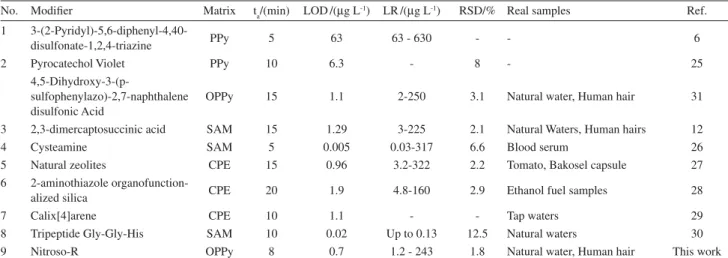
0.999. We also compared the obtained results in this project Table 2.Comparison of some properties of the present work with other studiesa
No. Modifier Matrix ta/(min) LOD /(Mg L-1) LR /(Mg L-1) RSD/% Real samples Ref.
1
3-(2-Pyridyl)-5,6-diphenyl-4,40-disulfonate-1,2,4-triazine PPy 5 63 63 - 630 - - 6
2 Pyrocatechol Violet PPy 10 6.3 - 8 - 25
4,5-Dihydroxy-3-(p-sulfophenylazo)-2,7-naphthalene disulfonic Acid
OPPy 15 1.1 2-250 3.1 Natural water, Human hair 31
3 2,3-dimercaptosuccinic acid SAM 15 1.29 3-225 2.1 Natural Waters, Human hairs 12
4 Cysteamine SAM 5 0.005 0.03-317 6.6 Blood serum 26
5 Natural zeolites CPE 15 0.96 3.2-322 2.2 Tomato, Bakosel capsule 27
6 2-aminothiazole
organofunction-alized silica CPE 20 1.9 4.8-160 2.9 Ethanol fuel samples 28
7 Calix[4]arene CPE 10 1.1 - - Tap waters 29
8 Tripeptide Gly-Gly-His SAM 10 0.02 Up to 0.13 12.5 Natural waters 30
9 Nitroso-R OPPy 8 0.7 1.2 - 243 1.8 Natural water, Human hair This work
a t
a = accumulation time, LOD = limit of detection, LR = linear range, SAM=self assembled monolayers, CPE=carbon paste electrodes.
Figure 6. Differential pulse voltammograms of (a) new OPPy/Nitroso-R without accumulation of Cu(II), (b) new OPPy/Nitroso-R after 8 min accumulation in 200 ng mL-1 Cu(II), (c) used OPPy/Nitroso-R after 2 min
immersing in 0.2 mol L-1 EDTA, (d) regenerated OPPy/Nitroso-R after
8 min accumulation in 200 ng mL-1 Cu(II). All other conditions were the
same as in Figure 5.
with earlier studies reported about stripping voltammetric determination of copper(II) with chemically modified (non-Hg) electrodes. As can be seen from Table 2, The OPPy/ Nitroso-R modified electrode prepared in this study could be used for the determination of copper(II) in human hair and natural water samples with good results. This present work had a good detection limit (0.7 ng mL-1). It is better
than some other reports.6,12,25,27-29,31 Reproducibility of this
work was also very good. Accumulation time was lower compared to some last reports.12,25,27-31 Time spent for the
preparation of the electrode was very lower than some other techniques.12,26,30 This work also shows wider linear range
compared to some other reports.6,12,27-28
Acknowledgments
The authors acknowledge with thanks the financial support of Payame Noor University of Kerman (P.N.U.K.) under a research project (No. 0413/4190) in its Chemistry Department.
References
1. Mahajan, R. K.; Walia, T. P. S.; Lobana, T. S.; Talanta 2005, 67, 755.
2. Monticelli, D.; Ciceri, E.; Dossi, C.; Anal. Chim. Acta2007, 594, 192.
3. Gill, E. P.; Garcia, R. M.; Misiego, A. S.; Anal. Chim. Acta
1995,69, 315.
4. Gholivand, M. B.; Nassab, H. R.; Fazeli, H.; Talanta2005,65, 62.
5. Trojanowicz, M.; Microchim. Acta2003,143, 75.
7. Bobacka, J.; Ivaska, A.; Lewenstam, A.; Electroanalysis2003, 15, 366.
8. Wanekaya, A.; Sadik, O. A.; J. Electroanal. Chem.2002,537, 135.
9. Arrigan, D. W. M.; Gray, D. S.; Anal. Chim. Acta1999,402, 157.
10. Shiigi, H.; Yakabe, H.; Kishimoto, M.; Kijima, D.; Zhang, Y.; Sree, U.; Deore, B. A.; Nagaoka, T.; Microchim. Acta2003, 143, 155.
11. Shiigi, H.; Kijima, D.; Ikenaga, Y.; Hori, H.; Fukazawa, S.; Nagaoka, T.; J. Electrochem. Soc.2005,152, 129.
12. Mohadesi, A.; Taher, M. A.; Talanta2007,72, 95.
13. Gao, Z.; Zi, M.; Chen, B.; J.; Electroanal. Chem.1994,373, 141.
14. Chen, Z.; Okamura, K.; Hanaki, M.; Nagaoka, T.; Anal. Sci.
2002,18, 417.
15. Taher, M. A.; Mobarakeh, S.Z.M.; Mohadesi, A.; Turk. J. Chem.
2005,29, 1.
16. Shiu, K. K.; Pang, S.K.; Cheung, H. K.; J. Electroanal. Chem.
1994,367, 367.
17. Shiu, K. K.; Chan, O.Y.; Pang, S.; Anal. Chem. 1995,67, 2828.
18. Taher, M. A.; Anal. Chim. Acta2000,408, 153. 19. Taher, M. A.; Talanta1999,50, 559.
20. Ramakrishna, V. V. S.; Singh, V.; Garg, A. N.; Sci. Total Environ.
1996,192, 259.
21. Bertazzo, A.; Costa, C.; Biasiolo, M.; Allegri, G.; Cirrincione, G.; Presti, G.; Biol. Trace Elem. Res.1996,52, 37.
22. Rao, K. S.; Balaji, T.; Prasada Rao, T.; Babu, Y.; Naidu, G. R. K.;Spectrochim. Acta Part B2002,57, 1333.
23. Gad, S. C.; Encyclopedia of Toxicology, Academic Press: San Diego, CA, 2005, pp. 665-667.
24. Brajter, K.; Zlotorzysk, E. D.; Talanta1986,33, 149. 25. Nateghi, M. R.; Bagheri, A.; Massoumi, A.; Kazemeini, M. H.;
Synth. Met.1998,96, 209.
26. Shervedani, R. K.; Mozaffari, S.A.; Anal. Chem.2006,78, 4957.
27. Kilinc Alpat, S.; Yuksel, U.; Akcay, H.; Electrochem.Commun. 2005,7, 130.
28. Takeuchi, R. M.; Santos, A. L.; Padilha, P. M.; Stradiotto, N. R.;Talanta2006,71, 771.
29. Canpolat, E. C.; Sar, E.; Coskun, N.Y.; Cankurtaran, H.; Electroanalysis2007,19, 1109.
30. Liu, G.; Nguyen, Q. T.; Chow, E.; Bocking, T.; Hibbert, D. B.; Gooding, J. J.; Electroanalysis2006,18, 1141.
31. Mohadesi, A.; Taher, M. A.; Anal. Sci.2007,23, 969
Received: September 2, 2007