Width-weight relationship and condition factor of
Ucides cordatus
(Crustacea, Decapoda, Ucididae) at tropical mangroves of Northeast Brazil
Marina S.L.C. Araújo¹, Daniela S. Castiglioni² & Petrônio A. Coelho¹,³†
1 Laboratório de Carcinologia, Museu de Oceanografia, Universidade Federal de Pernambuco (UFPE). Av. Arquitetura, s/n, Cidade Universitária, 50740-550 Recife, PE, Brazil. ([email protected]) 2 Departamento de Zootecnia e Ciências Biológicas, Centro Superior de Educação Norte do RS (CESNORS), Universidade Federal de Santa Maria (UFSM). Av. Independência, 3751, Vista Alegre, 98300-000, Palmeira das Missões, RS, Brazil. ([email protected])
3 Laboratório de Carcinologia, Universidade Federal de Alagoas (UFAL). Av. Divaldo Suruagy, s/n, Centro, 57200-000, Penedo, AL, Brazil.
ABSTRACT. The present contribution aims at evaluating the carapace width vs. humid weight relationship and the condition factor of Ucides cordatus (Linnaeus, 1763), in the mangrove forests of the Ariquindá and Mamucabas rivers, state of Pernambuco, Brazil. These two close areas
present similar characteristics of vegetation and substrate, but exhibit different degrees of environmental conservation: the Ariquindá River is the preserved area, considered one of the last non-polluted of Pernambuco, while the Mamucabas River suffers impacts from damming, deforestation and deposition of waste. A total of 1,298 individuals of U. cordatus were collected. Males were larger and heavier than females, what is commonly
observed in Brachyura. Ucides cordatus showed allometric negative growth (p < 0.05), which is probably related to the dilatation that this species
develops in the lateral of the carapace, which stores six pairs of gills. The values of b were within the limit established for aquatic organisms.
Despite of the condition factor being considered an important feature to confirm the reproductive period, since it varies with cyclic activities, in the present study it was not correlated to the abundance of ovigerous females. However, it was considered a good parameter to evaluate environmental impacts, being significantly lower at the impacted area.
KEYWORDS. Allometric constant, carapace width, caranguejo-uçá, growth, humid weight.
RESUMO. Relação largura-peso e fator de condição de Ucides cordatus (Crustacea, Decapoda, Ucididae) em manguezais tropicais do
Nordeste do Brasil. A presente contribuição visa avaliar a relação largura de carapaça vs. peso úmido e o fator de condição de Ucides cordatus
(Linnaeus, 1763), nos manguezais dos rios Ariquindá e Mamucabas, Estado de Pernambuco, Brasil. Essas duas áreas próximas apresentam características similares de vegetação e substrato, mas exibem diferentes níveis de conservação ambiental: o rio Ariquindá é a área preservada, considerado um dos últimos rios não poluídos de Pernambuco, enquanto o rio Mamucabas sofre impactos de represamento, desmatamento e deposição de lixo. Um total de 1.298 indivíduos de U. cordatus foi coletado. Machos foram mais largos e mais pesados que as fêmeas, o
que é comumente observado em Brachyura. Ucides cordatus mostrou crescimento alométrico negativo (p < 0.05), o que está provavelmente
relacionado à dilatação que esta espécie desenvolve na lateral da carapaça, que abriga seis pares de brânquias. Os valores de b estiveram dentro
do limite estabelecido para organismos aquáticos. Apesar do fator de condição ser considerado um importante aspecto para confirmar o período reprodutivo, visto que varia com atividades cíclicas, no presente estudo ele não esteve correlacionado com a abundância de fêmeas ovígeras. Entretanto, foi considerado um bom parâmetro para avaliar impactos ambientais, sendo significativamente menor na área impactada.
PALAVRAS-CHAVE. Constante alométrica, largura de carapaça, caranguejo-uçá, crescimento, peso úmido.
The studies of relative growth in Crustacea enable the interconversion between variables and the detection of morphological changes that appear with sexual maturity (Pinheiro & Fransozo, 1993). Among
the studies of biometric relationships, the size vs.
weight one has been used for many species, being better represented by the power function (y = axb) (h
uxley,
1950), the same typically used in allometric studies (le
Cren, 1951; Pinheiro & FisCarelli, 2009). The constant a represents the condition factor and the coefficient b
means the allometric constant that expresses the analogy between the two variables, y (dependent variable, the
weight) and x (independent variable, the size) (Pinheiro
& FisCarelli, 2009).
The condition factor acts as a parameter of the general “well-being” of a given species, indicating its degree of adjustment to the environment, since it varies with seasonal changes in the environmental conditions (Bragaet al., 1985). It’s an easy and rapid
manner to study the individuals of natural or in captivity populations (santos, 1978), or in the estimates of the
stand crop in bioecological studies (lotriCh, 1973).
It is correlated to the reproductive period, parasitic infections and susceptibility to diseases, rates of feeding
and growth, and may also vary seasonally and spatially (le Cren, 1951; Pinheiro & Fransozo, 1993; Froese,
2006). Vazzoler (1996) cites that the condition factor is
an important indicator of the healthiness of an individual and its value reflects the recent feeding conditions and/ or spending of energy (fat) in cyclic activities, as the reproduction, as well as the behavioral aspects of a given
species.
The size vs. weight relationship is important for
the elaboration of plans for sustainable exploitation of species with socio-economical value (le Cren,
1951; Froese, 2006), including brachyuran decapod
crustaceans, since the knowledge of the growth rates is important to comprehend the life cycle of a given species, as well as to diagnose alterations due to environmental impacts, as pollution, deforestation or overexploitation, by comparing with populations subjected to few or none anthropic impacts (Castiglioniet al.,2006). Many
species of this taxon are commonly found in estuaries and mangrove forests, and they are very exploited in the Brazilian coast.
1988). Among those species, stands out the semiterrestrial mangrove crab Ucides cordatus (Linnaeus, 1763), in
the American coast of the Atlantic Ocean. In Brazil, U. cordatus is popularly known as “caranguejo-uçá” or
“caranguejo-verdadeiro” (true crab). The growth of U. cordatus was studied by geraldes & CalVenti (1983),
ostrensky et al. (1995) and diele & koCh (2010a).
These authors have concluded that this species has a slow growth, but according to field studies accomplished in Northeast Brazil, fast growth rate has also been reported (Botelhoet al., 1999; iVo & gesteira, 1999;
iVoet al., 1999; VasConCeloset al., 1999). It’s known
that time, place and environmental factors may influence the growth rates of brachyuran species (BaPtista-Metri et al., 2005). Such facts highlight the importance of
performing more studies on growth, even if a given
species has been studied in other regions.
The growth, considering the carapace width vs.
humid weight, as well as the condition factor, are aspects not well studied of the biology of the true crab, standing out
the paper published by Pinheiro & FisCarelli (2009), at
Southeast Brazil. Studies on other topics of the life history
of U. cordatus were accomplished, as hattori & Pinheiro
(2003) (fertility), dalaBona & loyola e silVa (2005)
(sexual maturity), Pinheiro & hattori (2006) (relative
growth), nordhaus et al. (2009) (burrowing behavior),
nordi et al. (2009) (gathering techniques) and in the
Northeast of Brazil, stands out those published by Mota
-alVes (1975) (reproduction), alCantara-Filho (1978)
(population ecology), Botelhoet al. (1999) (population
ecology, growth), iVo & gesteira (1999) (a review on
many aspects of its fisheries and life cycle), VasConCelos et al. (1999) (population ecology and growth) and araújo
& Calado (2008) (population ecology and reproduction).
At the Ariquindá and Mamucabas Rivers, state of Pernambuco, Brazil, Castiglioni & Coelho (2011) and
Castiglioniet al. (2011) have studied reproductive aspects
of this species. Due to the socio-economic importance of the given species, more studies on the growth and condition factor are needed, especially if considered its current status of overexploited species, according to Ministériodo Meio aMBiente (2004).
Despite of the papers written by Botelho et al.
(1999), iVoet al. (1999), VasConCeloset al. (1999) and
araújo & Calado (2008) show some information on the
relationship carapace width (CW) vs. humid weight (HW)
for Northeastern Brazilian mangroves, no detail is given to the condition factor. The present study aims at contributing to the biological knowledge of U. cordatus, through the
following specific objectives: to describe the crab biometry (CW and HW), the growth for the relationship between these two variables, the condition factor and its correlation with the reproductive period, as well as to evaluate the sexual and seasonal variations, and to compare two areas with different degrees of conservation, the Ariquindá and Mamucabas Rivers, important estuaries of the state of Pernambuco, Northeast Brazil.
MATERIAL AND METHODS
Sampling areas. The samples of Ucidescordatus
were accomplished in the mangrove forests of the Ariquindá (8°46’43.69”S and 35°06’25.87”W) and Mamucabas River (8°41’28.48”S and 35°06’09.32”W), both located in the Municipality of Tamandaré, State of Pernambuco, Brazil. The region has a climate within the As’ type of Köppen system, i.e. hot and humid, with mean temperatures that vary between 25 and 30 ºC, and mean rainfall around 2.000 mm (Moura &
PassaVante, 1995). Besides, this area exhibits two well
defined seasons according to the level of rainfall: dry (from September to December) and rainy (from January to July) (Moura & PassaVante, 1995). These two close
areas present similar characteristics of vegetation and substrate, but exhibit different degrees of conservation, as follows.
The Ariquindá River is inserted in the Guadalupe APA (Area of Environmental Preservation), with an extension of 7 km and, together with its tributary, União River, composes the Formoso River basin (CPRH, 1999). It is considered one of the last non polluted rivers of the state of Pernambuco (gregoet al., 2009). The
chosen mangrove area of Ariquindá River is located near its confluence with Formoso River, at Carneiros Beach, and in the field expeditions it could be noticed a dominance of the plant species Rhizophora mangle
L., followed by Laguncularia racemosa (L.) Gaertn.
f. and Avicennia schaueriana Stapf and Leechman ex
Moldenke, the last one less frequent. The substratum was visually characterized as muddy sand.
The Mamucabas River is located, almost completely, in the Municipality of Tamandaré. This river rises at the west of the Saltinho Biological Reserve, being dammed after entering in the Reserve, forming a reservoir that supplies Tamandaré. From the spring until
the coastal plain it runs in the surrounding areas of the
municipality, meeting the Ilhetas River and together they disembogue (CPRH, 2003). It is considered an impacted estuary due to the housing occupation in the surrounding areas (santos et al., 2001), with great
deposition of waste and deforestation. The sampling area is located near the mouth of these rivers, and in the field expeditions it could be noticed a dominance of the
plant species L.racemosa, followed by R.mangle and, in less abundance, A.schaueriana. The substratum was
also visually characterized as muddy sand.
ChristoFoletti et al. (2012) performed a field
experiment to evaluate the feeding preferences of U. cordatus,and found that this species of crab shows no
FisCarelli, 2001; dieleet al.,2005;araújo & Calado,
2008), in three 5 m2 plots in each mangrove. All the area
was explored. These plots were located parallel to the river and 20 m distant from each other. Sampling was carried out during low tide around the full or new moon; since the forest is flooded only during spring high tides, the crabs can be caught more easily in the softened sediment at these times. After the samples, the crabs were kept in plastic bags and transported to laboratory in coolers.
Laboratory activities. The crabs were separated
by sex, and from each one, the carapace width (CW) was measured using a vernier caliper of 0.01 mm of precision. The CW was taken considering the widest dimension. The humid weight (HW) of each crab was obtained with an electronic balance of 0.01g of precision. The ovigerous condition of females was also noted.
Statistical analysis. The minimum, mean (±
standard deviation) and maximum values of CW and HW were determined for each sex and estuary. The Mann-Whitney-Wilcoxon U test was applied to compare the CW
and HW between sexes and estuaries (α = 0.05; zar, 1996).
The growth of U. cordatus was described for
each sex and estuary through the potency equation HW = aCWb, where HW is the humid weight, CW is
the carapace width, b is the slope, and a is the intercept.
The fit was evaluated by the coefficient of determination (r²). An Analysis of Covariance (ANCOVA) was used to compare the slopes and intercepts of the lines between sexes, to verify the possibility of grouping males and females by the same equation (α = 0.05; zar, 1996). The
type of weight increase was defined by the coefficient
b (isometric, b = 3; positively allometric, b > 3; and
negatively allometric, b < 3), which had its significance
tested by the Student t test (α = 0.05; zar, 1996).
The condition factor (CF) was calculated by the formula a = HW/CWb (l
e Cren, 1951). This formula
was applied by each estuary and by seasons (Summer = January to March; Autumn = April to June; Winter = July to September; and Spring = October to December) for each sex. The minimum, mean (± standard deviation) and maximum values of the CF were estimated for each sex. The Mann-Whitney-Wilcoxon U test was applied
to compare the CF between sexes and estuaries, and the Kruskal-Wallis test, to compare the CF among seasons,
followed by Dunn’s a posteriori test when significant
differences were detected (α = 0.05; zar, 1996).
To verify the effectiveness of the CF as a determinant of the reproductive period (the period when the females incubate their eggs), the Pearson’s linear coefficient (r) was applied to correlate the CF and the number of ovigerous females by seasons of the year (α = 0.05; zar, 1996). The
values of r vary from -1 to +1 and the nearest to these values, the strongest is the association between the examined variables. The zero score of this coefficient indicates the absence of correlation (ayreset al., 2007).
RESULTS
A total of 1,298 individuals of U. cordatus were
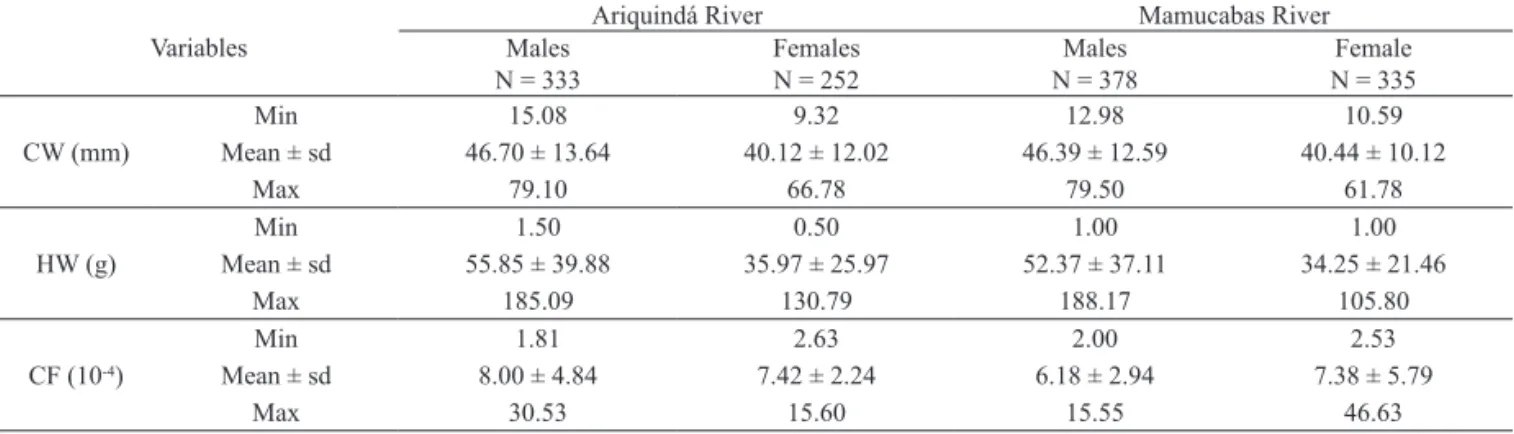
collected. In both estuaries (Ariquindá and Mamucabas), male crabs showed larger CW and HW (p < 0.05) than
females (Tab. I). At the Ariquindá River, males were 6.58 mm larger and 19.88 g heavier than females; at the Mamucabas River, males were 5.95 mm larger and 18.12 g heavier than females. Comparing both populations, no difference was observed in the size or weight (p > 0.05).
The species U. cordatus showed allometric
negative growth (p < 0.05), tending to isometry, in both
estuaries and sexes (Figs 1-4).
Regarding the sexual variations of the CF, there was no statistically significant difference between sexes at Ariquindá River (p > 0.05), while at Mamucabas
River, the CF was significantly higher in females than in males (p < 0.05). Regarding the spatial variations, the
CF of males and females varied significantly between estuaries (p < 0.05),both being higher at the Ariquindá
River (Tab. I). Regarding the seasonal variations, there was significant differences (p < 0.05), with the lowest
values of the CF occurring in the winter, for both sexes and estuaries (Tab. II).
The number of ovigerous females by seasons of the year is presented in Tab. III. At Ariquindá River, they represent 13.09% of all captured females, and at Mamucabas River, 10.44%. They were only found in the summer and in the autumn, and the most expressive number was found in the summer. Their abundance and the CF weren’t correlated, both in the Ariquindá (r = 0.34; t = 0.51) and in the Mamucabas Rivers (r = 0.06; t = 0.08) (p > 0.05). Tab. I. Minimum, mean (± standard deviation) and maximum values of carapace width (CW, mm), humid weight (HW, g) and condition factor (CF, 10-4) of Ucides cordatus males and females sampled at the Ariquindá and Mamucabas Rivers estuaries, Northeast Brazil (N, number of
individuals; Min, minimum; Max, maximum).
Variables
Ariquindá River Mamucabas River
Males Females Males Female
N = 333 N = 252 N = 378 N = 335
CW (mm)
Min 15.08 9.32 12.98 10.59
Mean ± sd 46.70 ± 13.64 40.12 ± 12.02 46.39 ± 12.59 40.44 ± 10.12
Max 79.10 66.78 79.50 61.78
HW (g)
Min 1.50 0.50 1.00 1.00
Mean ± sd 55.85 ± 39.88 35.97 ± 25.97 52.37 ± 37.11 34.25 ± 21.46
Max 185.09 130.79 188.17 105.80
CF (10-4)
Min 1.81 2.63 2.00 2.53
Mean ± sd 8.00 ± 4.84 7.42 ± 2.24 6.18 ± 2.94 7.38 ± 5.79
DISCUSSION
In the present study, sexual dimorphism in relation to size and weight was detected, with males showing larger carapace width (CW) and humid weight (HW) than females. Such phenomenon is commonly observed in brachyuran crabs (Warner, 1967; díaz & Conde,
1989; araújo et al., 2012) and registered by several
authors for U. cordatus (alCântara-Filho, 1978; iVoet al., 1999; VasConCeloset al.,1999). According to iVo et al. (1999), in U. cordatus the sexual dimorphism is
related to the reproductive function, standing out the larger size and weight of the chelipods of males due to the role they develop during mating, entwining the
female. Warner (1967) and díaz & Conde (1989) cite
that this sexual dimorphism in size may be related to differential growth rates between the sexes, which were observed herein. Sexual differences in feeding rates, behavior and migratory phenomenon are factors that may influence on these differential growth rates (giesel,
1972; WolFet al.,1975; Montague, 1980). Bliss (1968)
emphasizes that the presence of the androgen gland in males is responsible for the weight gain right after maturity, influencing the sexual dimorphism. Since the feeding preferences and consumption rates of males and females are similar (nordhauset al., 2006), we believe
that the main factor acting in the sexual dimorphism of this population is the fact that the females invest more
Tab. II. Power equations of the relationship between the carapace width (CW) vs. humid weight (HW) of Ucides cordatus males and females
sampled in four different seasons at the Ariquindá and Mamucabas Rivers estuaries, Northeast Brazil. (1)For the same sex and river, the same letter
indicates that the condition factor did not differ significantly among seasons (p < 0.05). Condition factor in scientific notation (10-4).
Seasons Ariquindá River Mamucabas River
Males Females Males Females
Autumn HW = 11.60CW2.87a HW = 7.55CW2.86a HW = 5.36CW2.96a HW = 9.09CW2.82a
Winter HW = 4.14CW2.99b HW = 6.32CW2.92a HW = 3.09CW3.03b HW = 4.26CW2.97b
Spring HW = 6.85CW2.88c HW = 7.01CW2.86a HW = 8.65CW2.84c HW = 8.09CW2.83ab
Summer HW = 7.11CW2.91ac HW = 9.53CW2.83b HW = 6.12CW2.92a HW = 4.64CW2.97b
Tab. III. Number of ovigerous females of Ucides cordatus sampled in four different seasons at the Ariquindá and Mamucabas Rivers estuaries,
Northeast Brazil.
Seasons Ariquindá RiverNumber of ovigerous femalesMamucabas River
Autumn 10 7
Winter 0 0
Spring 0 0
Summer 23 28
Figs 1, 2. Regression between the carapace width (CW) and humid weight (HW) for Ucides cordatus males (1) and females (2) at the
Ariquindá River estuary, Northeast Brazil.
Figs 3, 4. Regression between the carapace width (CW) and humid weight (HW) for Ucides cordatus males (3) and females (4) at the
energy in reproduction than in growth (hartnoll, 1985;
diele & koCh, 2010b), once the oocytes are cells greater
than the spermatozoids. However, araújo & Calado
(2008), studying an impacted mangrove at Northeast Brazil, found no difference in size and weight between sexes in a population of U. cordatus at the area, probably
as a result of the selective capture of males.
In both sexes and estuaries, the CW vs. HW
relationship showed a significant positive relation, with high values of r², as also observed by Pinheiro
& FisCarelli (2009). Ucides cordatus showed
negative allometric growth tending to isometry in this relationship. Similar results were also observed by iVoet al. (1999) and araújo & Calado (2008). These findings
reflect the fact that, during its ontogeny, the crab grows more in width than in weight. Such fact may be related to the dilatation that this species develops in the lateral of the carapace, which stores six pairs of gills (Pinheiro
& FisCarelli, 2009). That dilatation, very expressive in
the adult phase, allows a greater storage of atmospheric air, giving the species a better resistance to dehydration and allowing it to spend more time out of the water than aquatic brachyuran species (santoset al., 1986).
The development of the gills chamber is also found in other semiterrestrial species, as Cardisoma guanhumi
(Latreille, 1825) (Gecarcinidae), which makes the U. cordatus very similar to other semiterrestrial crabs
(santoset al.,1985).
The values of b, which represents the weight
increase, were within the established limit for aquatic organisms, which varies from two to four (le Cren,
1951; hartnoll, 1982). Such a result was observed
in the swimming crabs Callinectes ornatus Ordway,
1863 (BranCo & FraCasso, 2004; BaPtista-Metri et al., 2005) and C. danae Smith, 1869 (BranCo et al.,
1992; BaPtista-Metri et al., 2005), in the freshwater
crab Dilocarcinus pagei Stimpson, 1861 (Pinheiro &
taddei, 2005), and in the semiterrestrial crabs Armases angustipes (Dana, 1852) (koWalCzuk & Masunari,
2000) and U. cordatus (Pinheiro & FisCarelli, 2009;
goeset al., 2010). That allows inferring that this rule
may be extended to semiterrestrial crabs. Besides, such amplitude gives indicatives of changes in weight of the animal between different phases of growth and in the onset of sexual maturity (Mantelatto & Fransozo,
1992; Pinheiro & Fransozo, 1993).
The rates of growth were different according to the sex, being significantly higher in males. Such differences are related to the larger size and weight attained by males, as discussed before, and by the growth of their chelipods that, according to Pinheiro &
hattori (2006), show a positive allometric pattern from
the puberty molt towards.
In brachyuran species, generally the condition factor (CF) is higher in females, as observed in
Dilocarcinus pagei (Pinheiro & taddei, 2005) and
in U. cordatus (Pinheiro & FisCarelli, 2009), due
to the larger size and weight attained by the ovaries after maturity. This may explain the higher CF of females at Mamucabas River. However, at Ariquindá River, there was no significant difference between the sexes, probably because other biological factors, as metabolism, nutritional aspects, stage of sexual maturity, time of recruitment, or a combination of them (rodríguez, 1987), may be influencing the values
of the CF, besides the gonads. The absence of sexual dimorphism in the CF was also observed in Arenaeus cribrarius (Lamarck, 1818) by Pinheiro & Fransozo
(1993). Spatial differences may occur even at a local scale, since place may influence the rates of growth of brachyuran species (BaPtista-Metriet al.,2005).
Many studies have related a decrease of the condition factor during the reproductive season (Vazzoler, 1996; Pinheiro & taddei, 2005; Pinheiro &
FisCarelli, 2009), as a result of the spawning. However,
in the present study, no correlation was found between the CF and the abundance of ovigerous females. In general, lower CF is associated with the spawning period (agostinho et al., 1990; dutil et al., 2003;
Pinheiro & taddei, 2005), but in the present the lowest
value of the CF was observed in the winter, a season where no ovigerous females were recorded. Probably, some animals were captured when the energy stored in the hepatopancreas was reverted to the maturity of the gonads or to their reorganization after spawning, phenomena that lead to an increase of the CF, while others were collected during spawning itself, which leads to a reduction of the CF. Thus, no clear pattern could be distinguished. Besides the reproductive period, it’s well known that the molt leads to low condition factors (Pinheiro & taddei, 2005), and possibly the
molting cycle is influencing in the present population. This assumption can be confirmed by the literature:
according to Pinheiro & FisCarelli (2009), the low
CF of U. cordatus observed in the winter is related to
the fact that this period precedes the months with the highest frequency of ecdysis. Such result suggests that the condition factor by itself cannot be used as a single parameter for the determination of the reproductive period, but it has to be used in association with the monthly frequency in which ovigerous females are
found during an annual range, and the data obtained
from the macroscopic observation of the gonads and the observation of the copula (Pillay & ono, 1978; Choy,
1988; suMPton, 1990). Besides, the gonadosomatic index
may be used for this purpose, since it also considers the weight of the ovaries (Vazzoler, 1996).
The low abundance of ovigerous females is commonly observed in brachyuran species, as C. ornatus
(Mantelatto & Fransozo, 1997), Ocypode quadrata
(Fabricius, 1787) (negreiros-Fransozo et al., 2002), Goniopsis cruentata (Latreille, 1803) (silVa & oshiro,
2002; CoBo & Fransozo, 2003), Armases rubripes
1870) (Castiglioni et al., 2007), Uca uruguayensis
(Nobili, 1901) and Neohelice granulata (Dana, 1851)
(Césaret al., 2007), as well as U. cordatus (araújo &
Calado, 2008; present study). Probably these females
may have a cryptic habit when compared to the non-ovigerous females.
Some papers have reported on populations of U. cordatus under fisheries overexploitation, resulting in
the diminution of the carapace width of the population (Botelho et al., 1999; aMaral & jaBlonski, 2005).
araújo & Calado (2008) related that the deforestation
of the mangrove, as well as the industrial and domestic sewage that spills onto the Mundaú/Manguaba Estuarine Lagoon Complex (CELMM, state of Alagoas) also affect negatively the local population of
U. cordatus. In the present study both populations of
this speciesshowed similar values of size and weight. This could suggest that the population of U. cordatus at
Mamucabas River isn’t suffering with the impacts that this estuary is currently receiving, being adapted to the habitat. However, the CF of both males and females differed between estuaries, being lower at Mamucabas River. Some environmental impacts cannot be detected just taking into account the external aspects of a given organism. A deviation from the normal status is more likely to be detected with the use of bioindicators, including bioindicators at individual level, as the condition factor (arias et al., 2007). Considering
the body morphology, specimens with the same size can apparently demonstrate the same healthiness, but internally, their physiology may be affected, which can be detected through a diminution of the CF. The mangrove in Mamucabas has been reduced by the housing occupation, deposition of waste and deforestation (santos et al., 2001), with many trees
had been cut. This may reduce the food resource for this herbivorous crab, and these lower rates of feeding probably may reduce the CF.
The evaluation of the sexual variations of the CW
vs. HW relationship and the condition factor proved to
be good parameters for the study of the biology of U. cordatus, especially regarding the sexual dimorphism
of the growth, as well as evidencing the environmental impacts. Indeed, more studies are needed on the growth and condition factor for this species, as well as for other freshwater, estuarine and marine Brachyura with socio-economic importance. The data obtained in these studies are important for management plans, since they allow monitoring and evidencing environmental impacts, as observed herein.
Acknowledgements. The authors are grateful to the Fundação de Amparo à Ciência e Tecnologia do Estado de Pernambuco (FACEPE), for financial support for fieldwork to D.S.C (APQ: 0108-2.04/07), to CNPq for a fellowship to D.S.C. and to CAPES for a fellowship to M.S.L.C.A. We are grateful to Adriano Martins for his help during fieldwork. All sampling in this study was conducted in compliance with current applicable state and federal laws (ICMBio 14340-1).
REFERENCES
agostinho, A. A.; BarBieri, G.; Verano, J. R. & hahn, N. S. 1990.
Variação do fator de condição e do índice hepatossomático e suas relações com o ciclo reprodutivo em Rhinelepis aspera (Agassis,
1829) (Osteichthyes, Loricariidae) no rio Paranapanema, Porecatu, PR. Ciência e Cultura42:711-714.
alCântara-Filho, P. 1978. Contribuição ao estudo da biologia e
ecologia do caranguejo-uçá Ucides cordatus cordatus (Linnaeus,
1763) (Decapoda, Brachyura) no manguezal do Rio Ceará (Brasil). Arquivos de Ciências do Mar 18:1-41.
aMaral, A. C. Z. & jaBlonski, S. 2005. Conservação da biodiversidade
marinha e costeira no Brasil. Megadiversidade 1:43-51.
araújo, M. S. L. C & Calado, T. C. S. 2008. Bioecologia do
caranguejo-Uçá Ucides cordatus (Linnaeus) no Complexo
Estuarino Lagunar Mundaú/Manguaba (CELMM), Alagoas, Brasil. Revista da Gestão Costeira Integrada 8:169-181.
araújo, M. S. L. C.; Barreto, A. V.; negroMonte, A. O. & sChWaMBorn,
R. 2012. Population ecology of the blue crab Callinectes danae
(Crustacea: Portunidae) in a Brazilian tropical estuary. Anais da Academia Brasileira de Ciências 84(1):129-138.
arias, A. R. L.; Buss, D. F.; alBurquerque, C.; ináCio, A. F.; Freire,
M. M.; egler, M.; Mugnai, R. & BaPtista, D. F. 2007. Utilização
de bioindicadores na avaliação de impacto e no monitoramento da contaminação de rios e córregos por agrotóxicos. Ciência e saúde coletiva 12:61-72.
ayres, M.; ayres jr, M.; ayres, d. l. & santos, a. a. s. 2007. Bioestat – Aplicações estatísticas nas áreas da ciências bio-médicas. Belém, Sociedade Civil Mamirauá. 324p.
BaPtista-Metri, C.; Pinheiro, M. A. A.; Blankensteyn, A. & Borzone,
C. A. 2005. Biologia populacional e reprodutiva de Callinectes danae Smith (Crustacea: Portunidae), no Balneário Shangri-lá,
Pontal do Paraná (PR), Brasil. Revista Brasileira de Zoologia 22:446-453.
Bliss, D.E. 1968. Transition from Water to Land in Decapod
Crustaceans. American Zoologist 8:355-392.
Botelho, E. R. O.; dias, A. F. & iVo, C. T. C. 1999. Estudo sobre a
biologia do caranguejo uçá Ucides cordatus cordatus (Linnaeus,
1763) capturado nos Estuários dos Rios Formoso (Rio Formoso) e Ilhetas (Tamandaré), no Estado de Pernambuco. Boletim Técnico Científico do CEPENE 7:117-145.
Braga, F. M. S.; Braga, M. A. S. & goitein, R. 1985. Fator de condição
e alimentação de Paralonchurus brasiliensis (Osteichthyes,
Sciaenidae) na região da ilha Anchieta (lat. 23°33’S - long. 45°05’W), Ubatuba, Estado de São Paulo. Naturalia 10:1-11.
BranCo, J. O. & FraCasso, H. A. A. 2004. Biologia populacional de Callinectes ornatus (Ordway) na Armação do Itapocoroy, Penha,
Santa Catarina, Brasil. Revista Brasileira de Zoologia 21:91-96.
BranCo, J. O.; lunardón, M. J.; aVila, M. G. & Miguel, C. F. 1992.
Interação entre fator de condição e índice gonadossomático como indicadores do período de desova em Callinectes danae Smith
(Crustacea, Portunidae) da Lagoa da Conceição, Florianópolis, Santa Catarina, Brasil. Revista Brasileira de Zoologia 9:175-180.
Castiglioni, D. S. & Coelho, P. A. 2011. Determinação da maturidade
sexual de Ucides cordatus (Crustacea, Brachyura, Ucididae) em
duas áreas de manguezal do litoral sul de Pernambuco, Brasil. Iheringia, Série Zoologia 101(1-2):138-144.
Castiglioni, D. S.; negreiros-Fransozo, M. l. & Cardoso, C. F. 2007. Breeding season and molt cycle of the fiddler crab Uca rapax (Brachyura: Ocypodidae) in a subtropical estuary, Brazil,
South America. Gulf and Caribbean Research 19:11-20.
Castiglioni D. S.; negreiros-Fransozo, M. L. & Mortari, R. C. 2006.
Biologia populacional do caranguejo violinista Uca rapax (Smith,
1870) (Crustacea, Ocypodoidea) proveniente de uma área de manguezal degradado em Paraty, RJ, Brasil. Atlântica 28:73-86.
Castiglioni, D. S.; silVa, J. V. C. L. & azeVedo, D. S. 2011. Relative
growth and its use to determine the morphological sexual maturity of Ucides cordatus (Linnaeus, 1763) (Decapoda, Brachyura,
Ucididae) from two mangrove areas on the Northeastern Brazilian coast. Crustaceana 84:1221-1241.
César, I. I.; arMendariz, l. C. & BeCerra, r. V. 2007. Fecundity of
Uca uruguayensis and Chasmagnathus granulatus (Decapoda,
Choy, S. C. 1988. Reproductive biology of Liocarcinus puber and
Liocarcinus holsatus (Decapoda, Brachyura, Portunidae) from the
Gower Peninsula, South Wales. Marine Ecology 9:227-241.
ChristoFoletti, r. a.; hattori, g. y. & Pinheiro, M. a. a. 2012. Food
selection by a mangrove crab: temporal changes in fasted animals. Hydrobiologia 1-10 (online first).
CoBo, V. J. & Fransozo, a. 2003. External factors determining breeding
season in the red mangrove crab Goniopsis cruentata (Latreille)
(Crustacea: Brachyura: Grapsidae) on the São Paulo state northern coast, Brazil. Revista Brasileira de Zoologia 20:213-217. CPRH (CoMPanhia PernaMBuCana do Meio aMBiente). 1999.
Diagnóstico sócio-ambiental e ZEEC - Zoneamento Ecológico Econômico Costeiro Litoral sul de Pernambuco. Recife, CPRH/GERCO. 91p.
_____. 2003. Diagnóstico Sócio-Ambiental do litoral sul de Pernambuco. Recife, CPRH/GERCO. 87p.
dalaBona, G. & loyola e silVa, j. 2005. Período reprodutivo de
Ucides cordatus (Linnaeus, 1763) (Brachyura, Ocypodidae) na
Baía de Laranjeiras. Acta Biologica 34:115-126.
díaz, H. & Conde, J. E. 1989. Population dynamics and life of
mangrove crab Aratus pisonii (Brachyura, Grapsidae) in a marine
environment. Bulletin of Marine Science 45:148-163.
diele, K. & koCh, V. 2010a. Comparative population dynamics and
life history strategies of mangrove crabs, genera Uca and Ucides. In: saint-Paul, U. & sChneider, H. eds. Mangrove dynamics
and management in north Brazil. Ecological Studies. Berlin- Heidelberg, Springer. v. 211, p. 275-285.
______. 2010b. Growth and mortality of the exploited mangrove crab
Ucides cordatus (Ucididae) in N-Brazil. Journal of Experimental
Marine Biology and Ecology 395:171-180.
diele, K.; koCh, V. & saint-Paul, u. 2005. Population structure, catch
composition and CPUE of the artisanally harvested mangrove crab
Ucides cordatus (Ocypodidae) in the Caeté estuary, North Brazil:
Indications for overfishing? Aquatic Living Resource 18:169-178.
dutil, J. D.; laMBert, Y. & denis, C. 2003. Winter and spring changes
in condition factor and energy reserves of wild cod compared with changes observed during food-deprivation in the laboratory. ICES Journal of Marine Science 60:780-786.
Froese, R. 2006. Cube law, condition factor, and weight-length
relationships: history, meta–analysis and recommendations. Journal of Applied Ichthyology 22:241-253.
geraldes, M. G. & CalVenti, I. B. 1983. Estudios experimentales para
el mantenimiento en cautiverio del cangrejo Ucides cordatus.
Ciencia Interamericana 23:41-53.
giesel, J. T. 1972. Sex ratio, rate of evolution, and environmental
heterogeneity. American Naturalist 106:380-387.
goes, P.; BranCo, J. O.; Pinheiro, M. A. A.; BarBieri, E; Costa, D.
& Fernandes, L. L. 2010. Bioecology of the uçá-crab, Ucides cordatus (Linnaeus, 1763), in Vitória Bay, Espírito Santo State,
Brazil. Brazilian Journal of Oceanography 58(2):153-163.
grego, C. k. s.; Feitosa, F. a. n.; silVa, M. h.; Cunha, M. g. g.
s. & nasCiMento-Filho, g. a. 2009. Fitoplâncton do ecossistema
estuarino do Rio Ariquindá (Tamandaré, Pernambuco, Brasil): variáveis ambientais, biomassa e produtividade primária. Atlântica 31:183-198.
hartnoll, R. G. 1982. Growth. In: Bliss, d. e. ed.The biology of
Crustacea: embryology, morphology and genetic. New York, Academic Press. p. 111-196.
______. 1985. Growth, sexual maturity and reproductive output. In:
Wenner, a. M. ed. Factors in adult growth. Rotterdam, A. A. Balkema. p. 101-123.
hattori, G. Y. & Pinheiro, M. A. A. 2003. Fertilidade do caranguejo
de mangue Ucides cordatus (Linnaeus) (Crustacea, Brachyura,
Ocypodidae), em Iguape (São Paulo, Brasil). Revista Brasileira de Zoologia 20(2):309-313.
huxley, J. S. 1950. Relative growth and form transformation.
Proceedings of the Zoological Society of London 137:465-469.
iVo, C. T. C. & gesteira, T. C. V. 1999. Sinopse das observações
do Caranguejo uçá, Ucides cordatus cordatus (Linnaeus, 1763)
capturado em estuários de sua ocorrência no Brasil. Boletim Técnico Científico do CEPENE 7:9-51.
iVo, C. T. C.; dias, a. F. & Mota, r. i. 1999. Estudo sobre a biologia
do caranguejo uçá Ucides cordatus cordatus (Linnaeus, 1763)
capturado no Delta do Parnaíba, Estado do Piauí. Boletim Técnico-Científico do CEPENE 7(1):53-84.
koWalCzuk, V. g. l. & Masunari, S. 2000. Crescimento relativo e
determinação da idade na fase juvenil de Armases angustipes
(Dana) (Decapoda, Brachyura, Grapsidae). Revista Brasileira de Zoologia 17:17-24.
leCren, E. D. 1951. The lenght-weight relationship and seasonal
cycle in gonad weight and condition factor in the perch (Perca
fluviatilis). Journal of Animal Ecology 20:201-219.
liMa, G. V.; soares, M. r. s. & oshiro, l. M. y. 2006. Reproductive
biology of the sesarmid crab Armases rubripes (Decapoda:
Brachyura) from an estuarine area of the Sahy river, Sepetiba Bay, Rio de Janeiro, Brazil. Iheringia, Série Zoologia 96:47-52.
lotriCh, V. A. 1973. Growth, production, and community composition
of fishes inhabiting a first-second, and third-order stream of eastern Kentucky. Ecological Monographs 43(3):377-397.
MaCintosh, D. J. 1988. The ecology and physiology of decapods
of mangrove swamps. Symposia of the Zoological Society of London 59:315-341.
Mantelatto, F. L. M. & Fransozo, A. 1992. Relação peso/largura
da carapaça no caranguejo Hepatus pudibundus (Herbst, 1785)
(Crustacea, Decapoda, Calappidae) na região de Ubatuba, SP, Brasil. Arquivos de Biologia e Tecnologia 35(4):719-724.
_____. 1997. Fecundity of the crab Callinectes ornatus Ordway, 1863
(Decapoda, Brachyura, Portunidae) from the Ubatuba region, São Paulo, Brazil. Crustaceana 70(2):214-226.
MMA (Ministériodo Meio aMBiente). 2004. Instrução Normativa
nº 5, Anexo II: Lista Nacional das espécies de invertebrados aquáticos e peixes sobrexplotadas ou ameaçadas de sobrexplotação. Disponível em: <http://www4.icmbio.gov.br/ cepsul/legislacao.php?id_arq=267>. Acesso em: 16.01.2012.
Montague, C. L. 1980. A natural history of temperate western Atlantic
fiddler crabs. Contributions in Marine Science 23:25-55.
Moura, R. T. & PassaVante, J. Z. O. 1995. Biomassa fitoplanctônica na
baía de Tamandaré, Rio Formoso – Pernambuco, Brasil. Trabalhos Oceanográficos da Universidade Federal de Pernambuco 23:1-15.
Mota-alVes, M. I. 1975. Sobre a reprodução do caranguejo-uçá, Ucides cordatus (Linnaeus), em mangues do Estado do Ceará
(Brasil). Arquivos de Ciências do Mar 15(2):85-91.
negreiros-Fransozo, M. L.; Fransozo, a. & Bertini, g. 2002. Reproductive cycle and recruitment period of Ocypode quadrata
(Decapoda: Ocypodidae) at a Sandy beach in southeastern Brazil. Journal of Crustacean Biology 22:157-161.
nordhaus, I.; diele, K. & WolFF, M. 2009. Activity patterns, feeding
and burrowing behaviour of the crab Ucides cordatus (Ucididae)
in a high intertidal mangrove forest in North Brazil. Journal of Experimental Marine Biology and Ecology 374:104-112.
nordhaus, I.; WolFF, M. & diele, K. 2006. Litter processing and
population food intake of the mangrove crab Ucides cordatus in a high intertidal forest in northern Brazil. Estuarine, Coastal and Shelf Science 67:239-250.
nordi, N.; nishida, A. K. & alVes, R. R. N. 2009. Effectiveness of
two gathering techniques for Ucides cordatus in Northeast Brazil:
implications for the sustainability of mangrove ecosystems. Human Ecology 37:121-127.
ostrensky, A.; sternhain, U. S.; Brun, E.; WegBeCher, F. X. & Pestana, D. 1995. Análise da viabilidade técnico-econômica dos cultivos do caranguejo-uçá Ucides cordatus (Linnaeus, 1763) no litoral
paranaense. Arquivos de Biologia e Tecnologia 38(3):939-947.
Pillay, K. K. & ono, Y. 1978. The breeding cycles of two species
of grapsidae crabs (Crustacea, Decapoda) from the north coast of Kyushu, Japan. Marine Biology 45:237-248.
Pinheiro, M. A. A. & FisCarelli, A. G. 2001. Manual de apoio à fiscalização do caranguejo-uçá (Ucides cordatus). Florianópolis,
UNESP/IBAMA/CEPSUL. 43p.
______. 2009. Length–weight relationship and condition factor of
the mangrove crab Ucides cordatus (Linnaeus, 1763) (Crustacea,
Brachyura, Ucididae). Brazilian Archives of Biology and Technology 52:397-406.
Pinheiro, M. A. A. & Fransozo, A. 1993. Relative growth of the
speckled swimming crab Arenaeus cribrarius (Lamarck, 1818)
(Brachyura, Portunidae), near Ubatuba, State of São Paulo, Brazil. Crustaceana 65:365-376.
Pinheiro, M. A. A. & hattori, G. Y. 2006. Relative growth of the
mangrove crab Ucides cordatus (Linnaeus, 1763) (Crustacea,
1
Recebido em 17 de janeiro de 2012. Aceito em 18 de setembro de 2012. ISSN 0073-4721 Artigo disponível em: www.scielo.br/isz
Pinheiro, M. A. A. & taddei, F. G. 2005. Relação peso/largura
da carapaça e fator de condição em Dilocarcinus pagei
Stimpson (Crustacea, Trichodactylidae), em São José do Rio Preto, São Paulo, Brasil. Revista Brasileira de Zoologia 22:825-829.
rodríguez, A. 1987. Biologia del langostino Penaeus kerathurus
(Forskal, 1775) del golfo de Cádiz. III. Biometría, edad y crecimiento. Investigaciones Pesqueras 51:23-38.
santos, M. C. F.; Botelho, E. R. O. & iVo, C. T. C. 2001. Biologia
populacional e manejo da pesca de aratu, Goniopsis cruentata
(Latreille, 1803) (Crustacea: Decapoda: Grapsidae) no litoral sul de Pernambuco–Brasil. Boletim Técnico Científico do CEPENE 9:87-123.
santos, M. C. F.; engelFtein, M. & gaBrielli, M. a. 1985.
Relationships concerning respiratory devices in crabs from different habitats. Compared Biochemestry and Physiology 81(3):567-570.
santos, M. C. F.; suadiCani, S. O.; Martinez, C. B. R. & loBo,
E. S. 1986. Rates of water loss in four crabs from different habitats. Comparative Biochemestry and Physiology Part A: Physiology 85:309-312.
silVa, Z. S. & oshiro, l. M. y. 2002. Aspectos reprodutivos de
Goniopsis cruentata (Latreille) (Crustacea, Brachyura, Grapsidae)
na Baía de Sepetiba, Rio de Janeiro, Brasil. Revista Brasileira de Zoologia 19:907-914.
suMPton, W. D. 1990. Morphometric growth and fisheries biology of
the crab Charybdis natator (Herbst) in Moreton Bay, Australia
(Decapoda, Brachyura). Crustaceana 59:113-120.
VasConCelos, E. M. S.; VasConCelos, J. A. & iVo, C. T. C. 1999.
Estudo sobre a biologia do caranguejo uçá Ucides cordatus cordatus (Linnaeus, 1763) capturado no Estuário do Rio
Curimatau (Canguaretama) no Estado do Rio Grande do Norte. Boletim Técnico Científico do CEPENE 7:85-116.
Vazzoler, A. E. A. M. 1996. Biologia da reprodução de peixes teleósteos: teoria e prática. Maringá, Nupelia. 169p.
Warner, G. F. 1967. The life history of the mangrove tree crab, Aratus pisonii. Journal of Zoology 153:321-335.
WolF, P.; shanholtaer, S. F. & reiMold, R. J. 1975. Population
estimates for Uca pugnax on Duplin estuary marsh. Georgia,
USA. Crustaceana 29:79-91.
zar J. H. 1996. Biostatistical analysis. Upper Saddle River,