online | memorias.ioc.fiocruz.br Leishmaniasis ranks second among the six most
common infectious and parasitic diseases in the world and approximately 350 million people are at risk for in-fection. As many as 12 million people are believed to be currently infected, with approximately one-two million estimated new cases occurring every year (WHO 2010).
With the exception of Oceania and Antarctica, all continents have reported human cases of leishmania-sis. Cutaneous leishmaniasis constitutes a public health problem in 88 countries on four continents (the Ameri-cas, Europe, Africa and Asia) (WHO 2010). In Brazil, American cutaneous leishmaniasis (ACL) is a dermato-logical disease that calls for special attention due to the consequent risk of deformities and psychological effects. ACL affects both the social and economic lives of pa-tients. ACL is widespread in Brazil and cases have been reported in all regions of the country. It affects both sex-es and all age groups; however, 90% of ACL cassex-es occur in patients over 10 years old and 74% in males. ACL is considered an occupational disease (MS 2007).
A total of 260,486 ACL cases were reported in Brazil between 2000-2009: 6,625 (2.6%) occurred in the south-ern region and 6,010 (90.7%) of those occurred in the state of Paraná (PR) [Health Informatics Department of the Brazilian Ministry of Health (datasus.gov.br/DATA-SUS/index.php)] (MS 2010). In this state, the majority of
the cases have been concentrated in the northern areas since 1940 when an extensive clearing of native vegeta-tion (dense and transivegeta-tional tropical/subtropical forest) began (Teodoro et al. 1991). More recently, the disease has been associated with areas of intense soybean, corn and sugar cane cultivation and pastures near vestigial forests (Lonardoni et al. 2006).
Studies of the sandfly fauna in PR have been under-taken more extensively in the northern region, where the greatest numbers of ACL cases have been registered (Gomes & Galati 1977, Teodoro et al. 1991, 1993a, b, 2001, 2006, Teodoro & Kuhl 1997, Oliveira et al. 2000, Massafera et al. 2005). Nyssomyia neivai (Pinto, 1926), Nyssomyia whitmani (Antunes & Coutinho, 1939), Pin-tomyia pessoai (Coutinho & Barretto, 1940), Pintomyia fischeri (Pinto, 1926) and Migonemyia migonei (França, 1920) are the most commonly suspected vectors of Leish-mania sp. found in PR (Zanzarine et al. 2005). Ny. neivai (denoted as Lutzomyia intermedia, s.lat. in many studies) and Ny. whitmani are consistently present in high num-bers in peridomestic and domestic areas in most parts of northern PR (Teodoro et al. 1993a, b, Teodoro & Kuhl 1997, Oliveira et al. 2000, Massafera et al. 2005).
The high urban prevalence of ACL cases (81/123; 66%) between 2000-2009 in the municipality of Bandeirantes (Cruz 2010) created the need to investigate the behaviours of these insects in both urban and rural environments to better understand the epidemiology of the disease.
MATERIALS AND METHODS
Area of study - The municipality of Bandeirantes is located in northern PR (“Old North”). The town of Ban-deirantes is located at 23º06’36”S 50º27’28”W and 420 m above sea level (asl). In 2010, the municipality had 32,182 inhabitants and the urban population was 28,382 Financial support: CAPES
+ Corresponding author: [email protected] Received 19 August 2012
Accepted 22 November 2012
Sandflies (Diptera: Psychodidae) in rural and urban environments
in an endemic area of cutaneous leishmaniasis in southern Brazil
Carolina Fordellone Rosa Cruz1,2/+, Mariza Fordellone Rosa Cruz2, Eunice A Bianchi Galati1
1Departamento de Epidemiologia, Faculdade de Saúde Pública, Universidade de São Paulo, São Paulo, SP, Brasil 2Centro de Ciências Biológicas, Universidade Estadual do Norte do Paraná, Bandeirantes, PR, Brasil
The high proportion of cases of cutaneous leishmaniasis reported amongst residents in the city of Bandeirantes, in the state of Paraná, Brazil, led the authors to investigate the phlebotomine fauna in both urban and rural environ-ments. The sandflies were captured with automatic light traps from 07:00 pm-07:00 am fortnightly in 11 urban peri-domiciles from April 2008-March 2009 and monthly in three ecotopes within four rural localities from April 2009-March 2010. In one of these latter localities, sandfly capture was conducted with white/black Shannon traps during each of three seasons: spring, summer and fall. A total of 5,729 sandflies of 17 species were captured. Nyssomyia neivai (46.7%) and Nyssomyia whitmani (35.3%) were the predominant species. In this study, 3,865 specimens were captured with automatic light traps: 22 (0.083 sandflies/trap) in the urban areas and 3,843 (26.69 sandflies/trap) in the rural areas. Ny. neivai was predominant in urban (68.2%) and rural (42.8%) areas. A total of 1,864 specimens were captured with the white/black Shannon traps and Ny. neivai (54.5%) and Ny. whitmani (31.4%) were the pre-dominant species captured. The small numbers of sandflies captured in the urban areas suggest that the transmis-sion of Leishmania has occurred in the rural area due to Ny. neivai and Ny. whitmani as the probable vectors.
Sandflies in southern Brazil • Carolina Fordellone Rosa Cruz et al.
304
[Brazilian Institute of Geography and Statistics (IBGE) (ibge.gov.br/cidadesat/topwindow.htm?1)].
The municipality has an area of 446,301 km², includ-ing the urban area of 12 km². The soil is a ferruginous clay composed of basalt, also known as red soil (Pan-choni et al. 2008).
The annual rainfall ranges from 1,300-1,400 mm, with approximately 150-200 mm in January and ap-proximately 50-75 mm in June and July. The prevailing winds vary from southwesterly to northwesterly with an average speed of 2.5 m/s. The climate is subtropi-cal with hot summers and infrequent frosts during the winter in the lowlands. High levels of rainfall occur in the summer months, but there is no clearly defined dry season. The average annual temperature is 21ºC, the monthly average in the summer is between 22-28ºC and the monthly average during the winter is between 14-18ºC (Panchoni et al. 2008).
The residual native vegetation of Bandeirantes con-sists of Atlantic semideciduous forest [Secretary of En-vironment (sema.pr.gov.br/)]. The basis of the municipal economy is sugar cane cultivation [IBGE (ibge.gov.br/ cidadesat/topwindow.htm?1)].
Capture sites – Cases of cutaneous leishmaniasis were reported between 2000-2009 in all of the sampling sites.Eleven urban sites were sampled: (1) Itapeva small-holding (near the old piggery), (2) Souto smallsmall-holding (henhouse), (3) União suburb (a tree in the backyard and several dogs), (4) Lordani neighbourhood (deposit of recyclable materials), (5) Humberto Teixeira neigh-bourhood (jaboticaba tree close to dwelling), (6) house in front of the cemetery, (7) Clubhouse of the Athletic Association of the Bank of Brazil (avocado tree near the house of the caretaker), (8) Bela Vista neighbourhood (guava tree in the peridomicile near a sugarcane planta-tion), (9) Faculties Luis Meneghel (FALM) (tree next to the Nursing department), (10) rural village one(avocado tree) and (11) rural village two (pigsty). Although points 10 and 11 are called “rural villages”, both are included in the urban area of Bandeirantes and are located approxi-mately 3 km from the city centre. In the rural area, three ecotopes in each of the following four neighbourhoods were investigated. (1) Jacutinga locality - the ecotopes sampled are situated in a fishing are (a large leisure area open to visitors from Tuesday-Sunday; on weekends the number of visitors is higher and they usually remain un-til late at night): (1.1) pigsty (10 m from the house and 130 m from the forest edge), (1.2) forest edge (under a guava tree, 120 m from the dwelling and 200 m from the lake) and (1.3) peridomicile. (2) Tabuleta - this locality consists of a small social centre with a church, soccer field and several plots of land where sugar cane, cof-fee, alfalfa, soybeans and corn, among other crops, are cultivated; the residence of an ACL case is also located there. The ecotopes sampled were: (2.1) a tree close to the veranda of a dwelling, (2.2) peridomicile, an avocado tree used as a perch by chickens and (2.3) peridomicile, a tree close to the pigsty. (3) Perobinha - in this local-ity there is a village with approximately 40 plots of land (5,000 m2) where families grow fruits and vegetables
and breed pigs, poultry and cattle. This locality also has a social centre with a primary school, church, meeting hall and soccer field and the dwelling of an ACL case is also found there. The ecotopes sampled were: (3.1) peri-domicile, under a jaboticaba tree close to the house, (3.2) under an orange tree close to a pigsty and a dwelling and (3.3) a bamboo grove 10 m from the dwelling and next to a pasture, a pond and a small forest. Lastly, (4) Cabiúna - where there are settlements and a small social centre with a bar, school, church and soccer field. The ecotopes sampled were: (4.1) a pigsty close to a dwelling, (4.2) a pigsty situated at the forest edge (50 m from the same dwelling) and (4.3) the forest edge (under a tree and 50 m away from point 4.2).
Collection and identification of sandflies - Sandflies were captured in the urban areas using automatic light traps (Galati et al. 2010) installed fortnightly between 06:00 pm-07:00 am from April 2008-March 2009 in 11 peridomiciles. In the rural areas, two techniques were used: automatic light traps installed one day per month at the 12 points sampled from 06:00 pm-07:00 am from April 2009-March 2010 and at one of these sites (Jacu- tinga neighbourhood - forest edge of the fishing area), a modified black and white Shannon trap was also used (Galati et al. 2001). This trap was used once during each of the following seasons: spring 2009 (06:00 pm-03:00 am), summer 2010 (06:00 pm-04:00 am) and fall 2010 (06:00 pm-06:00 am). The captures in the spring and summer were interrupted before 06.00 am due to heavy rains with winds.
The insects were sacrificed with chloroform and packed into entomological boxes. At the Public Health Entomology Laboratory/Phlebotominae of the Depart-ment of Epidemiology, School of Public Health, Uni-versity of São Paulo, the sandflies were separated from the other insects captured. After clarification, they were identified in accordance with Galati’s keys (Ga-lati 2003).
Statistical analysis - The numerical abundance ac-cording to the spatial distribution of sandfly species was calculated based on the Standardized Index of Species Abundance (SISA) (Roberts & Hsi 1979) and the val-ues that are closest to 1.0 represent the most abundant species. The index was calculated for all the species collected using the CDC traps in rural localities. The Williams’ geometric average (Haddow 1960), which reflects the frequency and regularity of the species in the collections, was used to evaluate the activity of the most abundant sandfly species. The Shannon diversity index, which indicates the diversity and frequency of the sandfly species at particular capture sites, and Pielou’s evenness index were obtained in accordance with the formulas presented by Service (1993).
RESULTS
Using the two techniques (automatic light and Shan-non traps) in the urban (11 sites) and rural environments (13 sites), 5,729 sandflies belonging to 17 species of four subtribes were captured: Brumptomyiina - Brumpto-myia brumpti (Larrousse, 1920), Brumptomyia cunhai (Mangabeira, 1942) and Brumptomyia nitzulescui (Costa Lima, 1932), Lutzomyiina - Evandromyia correalimai (Martins, Coutinho & Luz, 1970 ), Evandromyia cor-telezzii (Brèthes, 1923), Expapillata firmatoi (Barretto, Martins & Pellegrino, 1956), Mg. migonei, Pintomyia christenseni (Young & Duncan, 1994), Pi. fischeri, Pi. pessoai and Sciopemyia sordellii (Shannon & Del Ponte, 1927), Psychodopygina - Ny. neivai, Ny.whitmani and Psathyromyia sp. (Floch & Chassignet, 1947) and Sergentomyiina - Micropygomyia ferreirana (Barretto, Martins & Pellegrino, 1956) and Micropygomyia longi-pennis (Barretto, 1946) (Table I).
In the urban area, 264 collections with automatic light traps were performed, but only 22 specimens (0.083
sandflies/trap) belonging to six species were captured: Br. brumpti, Ev. cortelezzii, Ny. neivai, Ny. whitmani, Pi. pessoai and Sc. sordellii. Ny. neivai predominated (65%) (Table I). Of the 11 sites sampled, no sandflies were obtained at two locations (the henhouse on the Souto smallholding and jaboticaba tree in the Humberto Teixeira neighbourhood). The sites with the largest num-ber of sandflies (three specimens each) were the “rural village” suburb, the Itapeva smallholding, the house in front of the cemetery and FALM.
A total of 3,843 specimens were captured with auto-matic light traps (144 traps installed) in the rural area, yielding an average of 26.69 sandflies/trap. The most prevalent species were: Ny. neivai (42.83%), Ny. whitmani (37.34%), Br. brumpti (8.07%) and Pi. pessoai (6.12%). Ny neivai was the most abundant (SISA = 0.897), fol-lowed by Ny. whitmani (0.862), Pi. pessoai (0.710), Pi. fischeri (0.399) and Mg. migonei (0.339). Of the total of sandflies captured in the rural areas, 65.31% were col-lected in Jacutinga (96.2% of which were colcol-lected at the
TABLE I
Numbers and percentages of sandflies captured with automatic light and Shannon traps by species, sex and period, rural and urban areas of the municipality of Bandeirantes, state of Paraná, April 2008-April 2010
Period Dec 2009-Feb, Apr 2010 April 2008-March 2009 April 2009-March 2010
Total Method of capture Shannon trap Automatic light trap
Environment Rural Urban Rural
Sex M F M F M F
Species n (%) n (%) n (%) n (%) n (%) n (%) n (%)
Brumptomyia brumpti - 1 (0.1) 2 (15.4) - 167 (8.6) 143 (7.5) 313 (5.5)
Brumptomyia cunhai - - - - 18 (0.9) 14 (0.7) 32 (0.5
Brumptomyia nitzulescui - - - - 4 (0.2) 1 (0.1) 5 (0.1)
Brumptomyia sp.a - - - - 0 3 (0.2) 3 (0.1)
Evandromyia correalimai - - - 1 (0.1) 1 (0)
Evandromyia cortelezzii - - 1 (7.7) 1 (11.1) 1 (0.1) 10 (0.5) 13 (0.2)
Expapillata firmatoi 7 (0.7) 25 (3) - - 20 (1) 78 (4) 130 (2.3)
Migonemyia migonei 3 (0.3) 8 (1) - - 5 (0.3) 22 (1.1) 38 (0.7)
Pintomyia christenseni - 1 (0.1) - - - 1 (0)
Pintomyia fischeri 1 (0.1) 3 (0.4) - - 15 (0.7) 12 (0.6) 31 (0.5)
Pintomyia mamedei - 1 (0.1) - - - 1 (0)
Pintomyia pessoai 149 (14.3) 59 (7.1) 1 (7.7) - 164 (8.5) 71 (3.7) 444 (7.7)
Sciopemyia sordellii - - - 1 (11.1) 1 (0.1) 2 (0.1) 4 (0.1)
Micropygomyia ferreirana - - - 4 (0.2) 4 (0.1)
Micropygomyia longipennis - 2 (0.3) - - 1 (0.1) 3 (0.2) 6 (0.1)
Nyssomyia neivai 565 (54.5) 451 (54.5) 9 (69.2) 6 (66.7) 826 (42.8) 820 (42.9) 2,677 (46.7)
Nyssomyia sp.a - - - - - 2 (0.1) 2 (0)
Nyssomyia whitmani 312 (30.1) 274 (33.1) - 1 (11.1) 708 (36.7) 727 (38) 2,022 (35.3)
Psathyromyia sp. - 2 (0.3) - - - - 2 (0)
Total 1,037 (100) 827 (100) 13 (100) 9 (100) 1,930 (100) 1,913 (100) 5,729 (100)
Sandflies in southern Brazil • Carolina Fordellone Rosa Cruz et al.
306
forest edge), 24% in Perobinha, 10.3% in Cabiúna and 0.4% in Tabuleta. Notably, 62.8% of the specimens were collected at the Jacutinga forest edge and the most pre-dominant species were Ny. neivai (28.2%) and Ny. whit-mani (17.5%). The highest level of species richness was obtained in Jacutinga (14), followed by Perobinha (9), Cabiúna (7) and Tabuleta (4). The highest diversity in-dex values were observed in Jacutinga at the forest edge under a guava tree (1.45) and in the pigsty (1.42). This index was zero in a tree close to the pigsty in the Tabu-leta neighbourhood and this index was very low (0.48) in the jaboticaba tree close to the home at the Perobinha. In the ecotopes of the Tabuleta neighbourhood, the small-est numbers of insects were captured, but these speci-mens had the highest diversity indices (0.91-0.96). Two ecotopes in Perobinha (an orange tree close the pigsty and a bamboo grove) yielded the second and third great-est frequencies of sandflies captured (13.2% and 10.4%, respectively); however their diversity indices were the lowest of all the samples sites (0.45 and 0.43) and had a predominance of the two Nyssomyia species (Table II).
Amongst the most abundant species, Ny. neivai and Ny. whitmani predominated throughout the study period. Ny. whitmani showed higher monthly averages than Ny. neivai from January-May and in August. Pi. pessoai was the third most frequent species, with the highest ages captured in February and March. The highest aver-age captures of Ny. neivai ranged from 4.28-2.31 insects/ month and the highest average captures of Ny. whitmani ranged from 4.34-2.67 insects/month. The lowest aver-age captures for both species occurred in July (Fig. 1).
The seasonal distribution by site and ecotope of Ny. neivai and Ny. whitmani is presented in Table III. For the Ny. neivai captured in Jacutiga, the lowest Williams’ av-erages were observed in all of the ecotopes during the fall and the highest Williams’ averages were obtained in the spring. In Perobinha, the averages were remarkably higher in the summer on the edge of the forest and in the pigsty. In Cabiuna, the averages were generally low, with the exception of the pigsty and peridomicile during the summer. Concerning Ny. whitmani captured in Jacutinga, the lowest Williams’ averages occurred in the fall for all the ecotopes and the highest occurred during the summer at the forest edge. In Perobinha, the averages were much higher in the summer for all of the ecotopes. In Cabiuna, the highest average occurred in the fall along the edge of the forest and in the summer the highest averages were found in the pigsty and the peridomicile.
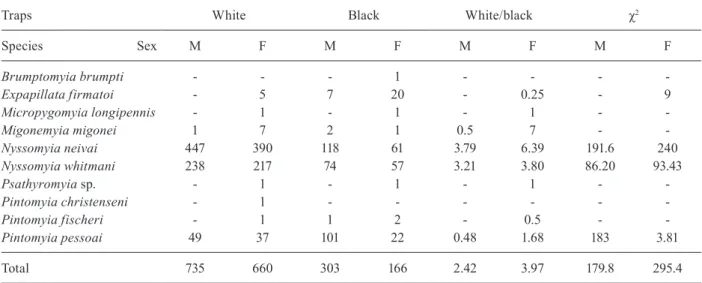
Ten species were captured using the Shannon traps. The most frequently captured species were Ny. neivai (56.9%) and Ny. whitmani (32.8%) and the white trap cap-tured significantly more specimens of these two taxa than the black trap (Table IV). In April 2010, the capture was conducted from 06:00 pm-06:00 am, but the other two captures were interrupted before 06:00 am due to heavy rain and rough winds. During the common capture pe-riod (06:00 pm-03:00 am), the highest average capture of Ny. neivai and Ny. whitmani, for both sexes, occurred us-ing the white trap between 11:00 pm-12:00 am. Usus-ing the black trap, the females of these two species were most fre-quently captured between 09:00 pm-11:00 pm (Fig. 2).
DISCUSSION
The frequencies of the specimens of the subtribes Psychodopygina (83.2%), Lutzomyiina (10.5%), Brump-tomyiina (6.1%) and SergenBrump-tomyiina (0.2%) found in this present study are in agreement with those found in this same municipality by Massafera et al. (2005). However, after capturing 38,662 sandfly specimens in 37 munici-palities, da Silva et al. (2008) found that 86.1% of the sandflies belonged to Psychodopygina, 12.7% to Lutzo-myiina, 0.8% to Sergentomyiina and 0.4% to Brumpto-myiina; the two last subtribes inverted their positions in the ranking. However, within the subtribe Psychodopy-gina, the da Silva et al. (2008) study found that Ny. neivai (47.4%) predominated over Ny. whitmani (35.8%) and the frequency of Pi. pessoai (6.5%) was also close to that observed in the present study. These three species are considered vectors of ACL(Pessôa & Coutinho 1941, de Queiroz et al. 1994, Rangel & Lainson 2003, Pita-Pereira et al. 2005, Andrade Filho et al. 2007, Cruz et al. 2012). The predominance of Ny. neivai and its greater abundance have also been observed in the municipality of Itambaracá, which borders Bandeirantes (Cruz et al. 2012). In other studies, different results have been found for PR, where Ny. whitmani prevailed in the northwest-ern region (67.82%) (Teodoro et al. 1991), in the northnorthwest-ern region (76.3%, 70%) (Teodoro et al. 1993a, Muniz et al. 2006) and even in Bandeirantes (58.9%) (Massafera et al. 2005). Ny. neivai and Ny. whitmani were also found to be the predominate species in 10 municipalities in the northwestern region of PR (Teodoro et al. 2006).
The sandflies captured in urban areas in Brazil have frequently demonstrated the ability of some species to adapt to anthropogenic environments (Teodoro et al. 1998). These authors also demonstrated the presence of nine sandfly species in the residual forests within the ur-ban perimeter of Maringá and Ny. whitmani was over-whelmingly dominant. In the present study Ny. neivai was observed, although at a much lower frequency, to oc-cupy urban environments. This species is also prevalent in the city of Piçarras in the state of Santa Catarina, near the homes of patients with ACL, where female sandflies naturally infected with Leishmania (Viannia) sp. have been found (Marcondes et al. 2009); this sandfly species has also been found in a periurban area of Porto Alegre in the state of Rio Grande do Sul (Pita-Pereira et al. 2009).
The high prevalence of Ny. whitmani in altered resid-ual forests in urban environments in PR (Teodoro et al. 2001, Zanzarine et al. 2005) and in many rural regions of northern PR (da Silva et al. 2008) demonstrate that this species is adapting to the anthropic environment.
3
0
7
Mem Inst Oswaldo Cruz
, Rio de Janeiro, V
ol.
108
(3), May 2013
Numbers of phlebotomines by sex captured with automatic light traps in each site of the rural localities sampled and Shannon diversity and Pielou evenness indices and standardised index of species abundance (SISA), municipality of Bandeirantes, state of Paraná, April 2009-March 2010
Locality 1. Jacutinga 2. Tabuleta 3. Perobinha 4. Cabiúna
Total SISA
Site 1.1 1.2 1.3 2.1 2.2 2.3 3.1 3.2 3.3 4.1 4.2 4.3
Species Sex M F M F M F M F M F M F M F M F M F M F M F M F M/F % M/F
Brumptomyia brumpti - - 165 141 - - - 1 - - - 1 2 - - 310 87 0.187
Brumptomyia cunhai 1 3 16 11 - - - 1 - - - 32 0.83 0.170
Brumptomyia nitzulescui - - 4 1 - - - 5 0.13 043
Brumptomyia sp. - - - 3 - - - 3 08 020
Evandromyia correalimai - - - 1 - - - 1 03 006
Evandromyia cortelezzii - 5 1 3 - - - 2 - - - 11 0.29 0.155
Expapillata firmatoi 1 - 18 77 - - - 1 1 - - - - 98 2.55 0.167
Micropygomyia ferreirana - - - 4 - - - 4 0.10 032
Micropygomyia longipennis - - 1 3 - - - 4 0.10 032
Migonemyia migonei - 1 3 13 - - - 1 2 - - - 4 1 1 - 1 27 0.70 0.339
Nyssomyia neivai 22 13 567 516 2 15 2 - 4 - - - 9 4 80 80 79 146 27 16 24 20 10 10 1,646 42.83 0.897
Nyssomyia sp. - - - 1 - - - 1 2 05 0.123
Nyssomyia whitmani 8 10 369 307 4 3 1 - - 2 - - 2 1 197 132 38 125 65 106 13 28 11 13 1,435 37.34 0.862
Pintomyia fischeri - - - 2 - - - 1 - - - 5 - 3 1 - 13 1 1 - 27 0.70 0.399
Pintomyia pessoai 4 1 136 51 - 2 2 - 2 - - - 3 4 3 3 11 7 1 2 2 1 235 6.12 0.710
Sciopemyia sordellii 1 - - 1 - - - 1 - - - 3 08 0.109
Total 37 33 1,280 1,134 6 20 5 - 6 4 - - 11 5 281 225 122 278 105 134 53 54 24 26 3,843 100
-Shannon diversity 1.42 1.45 0.83 1.33 1.27 - - 0.48 0.80 0.83 0.89 1.27 1.12 - -
-Pielou evenness 0.68 0.54 0.75 0.96 0.91 - - 0.69 0.45 0.43 0.50 0.71 0.63 - -
Sandflies in southern Brazil • Carolina Fordellone Rosa Cruz et al.
308
The greatest species richness and highest diversity in-dex were observed in a rural district in Jacutinga, near the forest edge and a pigsty, possibly due to the following characteristics: the presence of dense forest near the do-mestic animal shelters and the presence of orchards and the accumulation of organic matter. These factors are con-sidered favourable for sandfly breeding sites. The high species balance in Tabuleta can be explained by the simi-lar frequencies amongst the species. The low frequency of specimens and low level of species richness at this site may be attributed to the absence of dense forest and the constant presence of strong winds. However, sandfly vec-tors are still present, which explains the occurrence of cu-taneous leishmaniasis in a resident of this site.
The proximity of domestic animal shelters to dwell-ings, the accumulation of organic matter (leaves and fall-en fruit, agricultural waste, animal droppings and house-hold food scraps), wet soil due to the discharge of water from domestic use and the shade of trees are favourable
for the formation of outdoor sandfly breeding sites (Mas-safera et al. 2005). These conditions are observed in rural areas of PR and were also present in the area studied, resulting in large numbers of sandflies collected around the dwellings and in domestic animal shelters.
The increased attractiveness of the Shannon traps (310 sandflies/trap/person) compared with the automatic light traps (26.6 sandflies/trap) may be an indication of the high anthropophily of the two predominant species. The significantly increased attractiveness of the white Shannon trap compared with that of the black trap was observed for both Ny. neivai and Ny. whitmani. A simi-lar result was found in the Ribeira Valley in SP for Ny. neivai (Galati et al. 2010); however, the black trap at-tached significantly more Ny. whitmani than the white trap on the Bodoquena Range in the state of Mato Gros-so do Sul (MS) (Galati et al. 2001). The monthly varia-tion of Ny. neivai and Ny. whitmani show that they have great plasticity; although they predominated during the
TABLE III
Williams’ average of Nyssomyia neivai and Nyssomyia whitmani captured with automatic light traps in rural area by site, season and ecotope, municipality of Bandeirantes, state of Paraná, April 2009-March 2010
Species Ny. neivai Ny. whitmani
Site Season Forest edge Pigsty Peridomicile Forest edge Pigsty Peridomicile
Jacutinga Fall 14.8 0.6 0.26 14.1 0.26 0
Winter 59.4 2.8 0.44 28.1 1.71 0
Spring 121.8 3.1 18 46.9 1.47 0.82
Summer 116.7 2.3 0.91 65.3 18 0.44
Perobinha Fall 23 4.42 0.26 1 4.42 0
Winter 1.41 1.41 1.15 0.44 1.41 0.26
Spring 3.16 0.71 0 1.15 0.71 0
Summer 35.31 35.25 0.81 41.38 35.25 0.44
Cabiuna Fall 1.57 0.91 0.71 2.53 1.15 1.71
Winter 0 0.91 0.82 0 1.22 2.68
Spring 0.58 0.26 1.88 0.44 0 2.82
Summer 0.44 2.96 2.53 0 3.76 10.2
rainy periods, they also peaked during the dry season. This trend was also observed for the Ny. neivai by Galati et al. (2010), but not for the either species by Massafera et al. (2005), whose peaks occurred only during the rainy season. On the other hand, Ny. whitmani only peaked during the dry periods in MS (Galati et al. 1996).
Using the white Shannon traps, both sexes of Ny. neivai were captured at the greatest frequencies from 10:00 pm-02:00 am. In the Ribeira Valley, SP (Galati et
al. 2010) and in Bandeirantes (Massafera et al. 2005), the peak frequencies of Ny. neivai capture occurred from 07:00 pm-11:00 am. For Ny. whitmani captured using the white trap, there were two peaks for the females and the last peak was at a time close to that found in Maringá, PR (12:00 am-01:00 am) (Teodoro et al. 2003), but differed from that in Bandeirantes (08:00 pm-10:00 pm) (Mas-safera et al. 2005) and in the municipality of Corguinho, MS (06:00 pm-07:00 pm) (Galati et al. 1996).
TABLE IV
Numbers of sandfly specimens by species and sex captured
with modified white and black Shannon trap and chi-square obtained between the numbers of insects on the two colour Shannon traps, Jacutinga neighbourhood, municipality of Bandeirantes, state of Paraná, 2009-2010
Traps White Black White/black χ2
Species Sex M F M F M F M F
Brumptomyia brumpti - - - 1 - - -
-Expapillata firmatoi - 5 7 20 - 0.25 - 9
Micropygomyia longipennis - 1 - 1 - 1 -
-Migonemyia migonei 1 7 2 1 0.5 7 -
-Nyssomyia neivai 447 390 118 61 3.79 6.39 191.6 240
Nyssomyia whitmani 238 217 74 57 3.21 3.80 86.20 93.43
Psathyromyia sp. - 1 - 1 - 1 -
-Pintomyia christenseni - 1 - - -
-Pintomyia fischeri - 1 1 2 - 0.5 -
-Pintomyia pessoai 49 37 101 22 0.48 1.68 183 3.81
Total 735 660 303 166 2.42 3.97 179.8 295.4
F: female; M: male.
Sandflies in southern Brazil • Carolina Fordellone Rosa Cruz et al.
310
Although seasonality studies of sandflies are still needed, the results obtained in this present study sug-gest that the spring and summer are the seasons of great-est risk of human infection by Leishmania. A high fre-quency of sandflies was found in domiciliary areas and the observation that the highest frequencies occur late at night when people are resting suggests that the infection occurs at home. Some people may have been infected during leisure or occupational activities associated with the forest, especially in the Jacutinga neighbourhood; for example, people may have been infected at the fishing area, where the highest vector density occurred. Epi-demiological research to investigate the probable sites where people acquire Leishmania infection is required to guide the entomological surveillance and control measures to diminish the sandfly population and educa-tional activities to alert the public to the risks of infec-tion should be implemented in Bandeirantes.
REFERENCES
Andrade Filho JD, Galati EAB, Falcão AL 2007. Nyssomyia intermedia
(Lutz & Neiva, 1912) and Nyssomyia neivai (Pinto, 1926) (Diptera: Psychodidae: Phlebotominae) geographical distribution and epide-miological importance. Mem Inst Oswaldo Cruz 102: 481-487.
Córdoba-Lanús E, de Grosso ML, Piñero JE, Valladares B, Salomón OD 2006. Natural infection of Lutzomyia neivai with Leishmania
spp in northwestern Argentina. Acta Trop 98: 1-5.
Cruz CFR 2010. Cutaneous leishmaniasis (ACL) in Bandeirantes, Paraná, between 2000 and 2009, MSc Thesis, Faculty of Public Health/University of São Paulo, São Paulo, 131 pp.
Cruz MFR, Galati EAB, Cruz CFR 2012. Ecological aspects of the sandfly fauna (Diptera, Psychodidae) in an American cutaneous leishmaniasis endemic area under the influence of hydroelectric plants in Paranapanema River, state of Paraná, Brazil. Rev Soc Bras Med Trop 45: 430-436.
da Silva AM, de Camargo NJ, dos Santos DR, Massafera R, Ferreira AC, Postai C, Cristóvão EC, Konolsaisen JF, Bisetto Jr A, Peri-nazo R, Teodoro U, Galati EAB 2008. Diversidade, distribuição e abundância de flebotomíneos (Diptera: Psychodidae) no Paraná.
Neotrop Entomol 37: 209-225.
da Silva OS, Grunewald J 1999. Contribution to the sand fly fauna (Diptera: Phlebotominae) of Rio Grande do Sul, Brazil and Leish-mania (Viannia) infections. Mem Inst Oswaldo Cruz 94: 579-582.
de Queiroz RG, Vasconcelos IA, Vasconcelos AW, Pessoa FA, de Sou-sa RN, David JR 1994. Cutaneous leishmaniasis in Ceará state in northeastern Brazil: incrimination of Lutzomyia whitmani (Dip-tera: Psychodidae) as a vector of Leishmania braziliensis in Batu-rité municipality. Am J Trop Med Hyg 50: 693-698.
Galati EAB 2003. Morfologia e taxonomia. In EF Rangel, R Lainson,
Flebotomíneos do Brasil, Fiocruz, Rio de Janeiro, p. 53-175.
Galati EAB, Marassá AM, Gonçalves-Andrade RM, Consales CA, Bueno EMF, Paiva BR, Malafronte RS 2010. Nyssomyia inter-media (Lutz & Neiva, 1912) and Nyssomyia neivai (Pinto, 1926) (Diptera, Psychodidae, Phlebotominae) in a sympatric area: seasonal and nocturnal hourly rhythm of the species in captures made on black and white modified Shannon traps. Rev Bras En-tomol 54: 677-686.
Galati EAB, Nunes VLB, Dorval MEC, Cristaldo G, Rocha HC, Gon-çalves-Andrade RM, Naufel G 2001. Attractiveness of black Shan-non trap for Phlebotomines. Mem Inst Oswaldo Cruz 96: 641-647.
Galati EAB, Nunes VLB, Dorval MEC, Oshiro ET, Cristaldo G, Es-píndola MA, Rocha HC, Garcia WB 1996. Estudo dos
flebotomí-neos (Diptera: Psychodidae) em área de leishmaniose tegumen-tar, no estado de Mato Grosso do Sul, Brasil. Rev Saude Publica 30:115-128.
Gomes AC, Galati EAB 1977. Flebotomíneos de Londrina, Paraná (Brasil) e observações ecológicas sobre algumas espécies. Rev Saude Publica 11: 284-287.
Haddow AJ 1960. Studies on the biting habits and medical impor-tance of East African mosquitoes in the genus Aedes. I. Subgen-era Aedimorphus, Banksinella and Nunnius. Bull Entomol Res 50: 759-779.
Lonardoni MVC, Silveira TGV, Alves WA, Maia-Elkoury ANS, Membrive UA, Membrive NA, Rodrigues G, Reis N, Zanzarini PD, Ishikawa E, Teodoro U 2006. Leishmaniose tegumentar americana e canina no município de Mariluz, estado do Paraná, Brasil. Cad Saude Publica 22: 2713-2716.
Luz E, Membrive N, Castro EA, Dereure J, Pratlong J, Dedet A, Pan-dey A, Thomaz-Soccol V 2000. Lutzomyia whitmani (Diptera: Psychodidae) as vector of Leishmania (V.) braziliensis in Paraná state, southern Brazil. Ann Trop Med Parasitol 94: 623-631.
Marcondes CB, Bittencourt IA, Stoco PH, Eger I, Grisard EC, Stein-del M 2009. Natural infection of Nyssomyia neivai (Pinto, 1926) (Diptera: Psychodidae, Phlebotominae) by Leishmania (Viannia) spp in Brazil. Trans R Soc Trop Med Hyg 103: 1093-1097.
Margonari C, Soares RP, Andrade Filho JD, Xavier DC, Saraiva L, Fonseca AL, Silva RA, Oliveira ME, Borges EC, Sanguinette CC, Melo MN 2010. Phlebotomine sand flies (Diptera: Psychodi-dae) and Leishmania infection in Gafanhoto Park, Divinópolis, Brazil. J Med Entomol47: 1212-1219.
Massafera R, Silva AM, Carvalho AP, Santos DR, Galati EAB, Te-odoro U 2005. Fauna de flebotomíneos do município de Bandei-rantes, no estado do Paraná. Rev Saude Publica 39: 571-577.
MS - Ministério da Saúde Brasil 2007. Manual de controle da leish-maniose tegumentar americana. Available from: portal.saude. gov.br/portal/arquivos/pdf/manual_lta_2ed.pdf.
MS - Ministério da Saúde Brasil 2010. Leishmaniose tegumentar americana. Available from: dtr2004.saude.gov.br/sinanweb.
Muniz LHG, Rossi RM, Neitzke HC, Monteiro WM, Teodoro U 2006. Estudo dos hábitos alimentares de flebotomíneos em área rural no sul do Brasil. Rev Saude Publica 40: 1087-1093.
Oliveira FJA, Costa IC, Nunes VO, Oliveira BP, Oliveira N, Oliveira JE 2000. Leishmaniose tegumentar americana: flebotomíneos de área de transmissão do Parque Arthur Thomas na região de Lon-drina - PR. Biosaúde 2: 81-87.
Panchoni LC, Otênio MH, Guerra NMM, Santos V 2008. Avaliação físico-química e bioquímica de efluente infiltrado de laticínio. Available from: cnpgl.embrapa.br/nova/publicacoes/boletim/ BOP25.pdf.
Pessôa SB, Coutinho JO 1941. Infecção natural e experimental dos flebótomos pela Leishmania braziliensis no estado de São Paulo.
Hospital 20: 25-35.
Pita-Pereira D, Alves CR, Souza MB, Brazil RP, Bertho AL, Barbosa AF, Britto C 2005. Identifications of naturally infected Lutzomy-ia intermedLutzomy-ia and Lutzomyia migonei with Leishmania(Viannia) braziliensis in Rio de Janeiro (Brazil) revealed by a PCR multi-plex non-isotopic hybridization assay. Trans R Soc Trop Med Hyg 99: 905-913.
multiplex polymerase chain reaction assay. Am J Trop Med Hyg 80: 593-595.
Rangel E, Lainson R 2003. Ecologia das leishmanioses. In EF Rangel, R Lainson, Flebotomíneos do Brasil, Rio de Janeiro, Fiocruz, p. 291-311.
Roberts DR, Hsi BP 1979. An index of species abundance for use with mosquito surveillance data. Environ Entomol 8: 1007-1013.
Rocha LS, Santos CB, Falqueto A, Grimaldi JR, Cupolillo E 2010. Molecular biological identification of monoxenous trypanoso-matids and Leishmania from anthropophilic sand flies (Diptera: Psychodidae) in Southeast Brazil. Parasitol Res 107: 465-468.
Service MW 1993. Mosquito ecology: field sampling methods, 2nd ed., Chapman & Hall, London, 988 pp.
Teodoro U, Alberton D, Kuhl JB, Santos ES, Santos DR, Santos AR, Oliveira O, Silveira TGV, Lonardoni MVC 2003. Ecologia de
Lutzomyia (Nyssomyia)whitmani em área urbana do município de Maringá, Paraná. Rev Saude Publica 37: 651-656.
Teodoro U, dos Santos DR, dos Santos AR, de Oliveira O, Poiani LP, da Silva AM, Neitzke HC, Monteiro WM, Lonardoni MVC, Sil-veira TGV 2006. Informações preliminares sobre flebotomíneos do norte do Paraná. Rev Saude Publica 40: 327-330.
Teodoro U, Kuhl JB, Rodrigues M, Santos ES, Santos DR, Maróstica LM 1998. Flebotomíneos coletados em matas remanescentes e abrigos de animais silvestres de zoológico no perímetro urbano de Maringá, Sul do Brasil. Estudo preliminar. Rev Soc Bras Med Trop 31: 517-522.
Teodoro U, Kuhl M 1997. Interação flebotomíneos, animais domésti-cos e dominância de Lutzomyia(Nyssomyia)intermedia (Lutz &
Neiva, 1912) em área com alto grau de antropia, no Sul do Brasil.
Rev Saude Publica 31: 512-516.
Teodoro U, Salvia Filho LV, Lima EM, Spinosa RP, Barbosa OC, Fer-reira MEMC, Lonardoni MVC 1993a. Observações sobre o com-portamento de flebotomíneos em ecótopos florestais e extraflo-restais em área endêmica de leishmaniose tegumentar americana no norte do estado do Paraná, sul do Brasil. Rev Saude Publica 27: 242-249.
Teodoro U, Salvia Filho LV, Lima EM, Spinosa RP, Barbosa OC, Ferreira MEMC, Silveira TGV 1993b. Flebotomíneos em área de transmissão de leishmaniose tegumentar na região norte do estado do Paraná - Brasil: variação sazonal e atividade noturna.
Rev Saude Publica 27: 190-194.
Teodoro U, Silveira TGV, Santos DR, Santos AR, de Oliveira O, Kuhl JB 2001. Freqüência da fauna de flebotomíneos no domicílio e em abrigos de animais domésticos no peridomicílio, nos municí-pios de Cianorte e Doutor Camargo - estado do Paraná - Brasil.
Rev Patol Trop 30: 209-223.
Teodoro U, Spinoza RP, La Salvia Filho V, Guilherme ALF, Lima AP, Junqueira GMB, Misuta NM, Nerilo Sobrinho A, Lima EM 1991. Da necessidade de se adotar e divulgar esquemas terapêuticos para tratamento de leishmaniose tegumentar no Paraná. Rev Inst Med Trop Sao Paulo 33: 199-204.
WHO - World Health Organization 2010. Control of the leishmania-sis. WHO Tech Rep Ser 949: 1-202.