Clinical course and prognostic factors of children with Burkitt’s lymphoma in a
developing country: the experience of a single centre in Brazil
Keyla Christy Christine Mendes Sampaio Cunha
Maria Christina Lopes Araujo Oliveira Ana Cecília Silva Gomes
Lucia Porto Fonseca de Castro Marcos Borato Viana
Universidade Federal de Minas Gerais – UFMG, Belo Horizonte, MG, Brazil
Conlict-of-interest disclosure:
The authors declare no competing inancial interest
Submitted: 4/17/2012 Accepted: 6/25/2012
Corresponding author:
Maria Christina Lopes Araujo Oliveira Departamento de Pediatria - Unidade de Hematologia Pediátrica. Hospital das Clínicas, Universidade Federal de Minas Gerais – UFMG
Av. Prof. Alfredo Balena, 190 30130-100 Belo Horizonte, MG, Brazil [email protected]
www.rbhh.org or www.scielo.br/rbhh
DOI: 10.5581/1516-8484.20120093
Introduction
The most frequent immunophenotype of non-Hodgkin lymphoma in children and adolescents is B-cell lymphomas (NHL-B). Burkitt’s lymphoma (BL) is the most common subtype, corresponding to approximately 40% of cases(1); it occurs worldwide and has endemic, sporadic and immunodeiciency-associated phenotypes(2). The endemic form classically presents as a jawbone tumor in children of African descendency. Its incidence is high at 50–100 cases per million during the irst 15 years of life(3). Sporadic BL has a low incidence and occurs without speciic geographic or climatic associations. In contrast to adults, lymph node involvement is less common among children with extranodal sites being the most frequent presentation(4). Immunodeiciency-associated BL mainly occurs in patients infected with human virus immunodeiciency (HIV) but also occurs in allograft recipients and in individuals with congenital immunodeiciencies(5).
The pathogenesis of BL is universally associated with speciic chromosomal translocations that lead to deregulation of the c-Myc oncogene. Other cellular genetic changes have been implicated in the pathogenesis including abnormalities of the p53-ARF pathways and environmental factors such as infection with Epstein-Barr virus (EBV) and malaria(6). The interactions between these cellular and environmental events continue to fascinate the scientiic community(7).
Among human neoplasms, BL has the shortest doubling time. Its unequalled proliferation rate creates special challenges for diagnosis and treatment(4).In addition, although BL is a highly aggressive lymphoma, 80% to 90% of children on risk-adapted chemotherapy are cured in the developed world(8,9).
The aim of this study was to contribute to the knowledge about the clinical course and identiication of prognostic factors related to death in 45 children and adolescents followed up at a single teaching hospital over a 26-year period.
Methods
In this retrospective cohort study, the medical charts of 50 consecutive cases of children and adolescents aged 16 years or less with de novo BL were reviewed. The patients were admitted to the Pediatric Hematology Unit, University Hospital, UFMG between January 1981 and December 2007. Five patients were excluded because of previous treatment at other institutions (n = 1), severe concomitant immunodeiciency (post-transplantation lymphoma; Objective: Burkitt’s lymphoma is the most common subtype of non-Hodgkin lymphoma in children. The aim of this study was to characterize the clinical course and prognostic factors of children and adolescents with Burkitt’s lymphoma treated in the Hematology Unit of Hospital das Clínicas,Universidade Federal de Minas Gerais (UFMG).
Methods: A retrospective cohort study was made of 50 consecutive cases of children and adolescents aged 16 years or less with Burkitt’s lymphoma admitted between January 1981 and December 2007. Prognostic factors associated with death were evaluated using the Kaplan-Meier method and compared by the two-tailed log-rank test.
Results: The median age at diagnosis was 4.7 years. Most patients had abdominal tumors (66.7%) and
advanced disease (68.9%) at diagnosis. Thirty-eight patients (84.4%) achieved complete clinical remission and
33 (73.3%) were alive at the irst remission. Twelve children (26.7%) died. The median follow-up was 35 months
with the probability of overall survival being 73% (89.2% and 35.7% for patients with uric acid < 7 mg/dL and
≥ 7.0 mg/dL, respectively - p-value < 0.001). Uric acid was the only signiicant prognostic factor at diagnosis.
Conclusion: Our indings conirm the favorable prognosis of children with Burkitt’s lymphoma even when
treated with intermediate doses of methotrexate (500 mg/m2). Survival was signiicantly lower for individuals
with concentrations of uric acid ≥ 7 mg/dL.
n = 1), bone marrow involvement (≥ 25% L3-morphology blasts; n = 2), and an erroneous initial diagnosis (n = 1). In this latter case, the patient was initially diagnosed as BL on morphological grounds. After complete immunophenotyping characterization, the diagnosis was changed to lymphoblastic B-cell lymphoma.
The medical records were reviewed to collect demographic data (age, gender), clinical data (medical history, physical examination, nutritional status, clinical presentation), diagnostic procedures (imaging studies, bone marrow aspiration, cerebrospinal luid - CSF analysis), staging, laboratory data (lactate dehydrogenase - LDH levels, blood counts, serum electrolytes, liver and kidney proile), treatment, and outcome. Diagnosis was made by incisional or excisional biopsy, or cytological examination of pleural or abdominal effusions. Karyotype studies were not available at the time.
All the diagnoses were conirmed according to the morphologic and immunohistochemistry criteria deined by the World Health Organization (WHO) classiication(2). Immunohistochemistry was performed using monoclonal antibodies CD20, CD10, CD79a, CD30, CD3, CD15, TdT, CD45, and CD45RO. Conirmation of B-cell lineage by immunophenotyping required 50% or more neoplastic cells to express CD45, CD10, CD20, and CD79a. Pleural or abdominal effusions were examined by low cytometry.
Clinical staging was based on the St. Jude Children’s Research Hospital staging system(10). Central nervous system (CNS) disease was diagnosed by the presence of morphologically identiiable lymphoma cells (regardless of quantity) in CSF, an intracerebral mass or cranial nerve palsy not caused by an extracranial mass. To evaluate malnutrition, Z-scores of weight for age (WAZ) and height for age (HAZ) were used(11). The chosen cutoff point to discriminate undernourished from well-nourished status was a Z-score of less than 1.28 (10th percentile). Although less speciic, it is more sensitive than the cutoff point of Z = -2.
The variables studied for a possible association with prognosis were gender, age, staging, nutritional status, serum LDH and kidney function.
Treatment
Patients admitted between 1981 and 1987 were treated according to the modiied LSA2L2protocolof the Memorial Sloan-Kettering Cancer Center(12). After 1987, the patients were treated with a BFM-83-based protocol (Berlin-Frankfurt-Münster)(13). The irst cycle of treatment was modiied in patients with severe clinical events at diagnosis, such as a high tumor burden associated with pleural and peritoneal effusions, tumor lysis syndrome and sepsis. At diagnosis, all patients were vigorously hydrated and alkalized with NaHCO3 associated with allopurinol. Treatment of parasitic infection was performed before the beginning of chemotherapy.
Response criteria
Complete remission (CR) was deined as the disappearance of all tumor masses conirmed by clinical examination and imaging investigations, when necessary one month after therapy. After the end of treatment, the patients were followed at 30-day
intervals during the irst year, at 60-day intervals during the second year and at 3- to 6-month intervals up to ive years. Progression of the local tumor was deined if the tumor site showed no decrease in size after the initiation of chemotherapy.Relapse was deined as the recurrence of lymphoma with the same histological or immunophenotypic features as the initial one at any site after CR was achieved. Local relapse was diagnosed when it involved a previously involved site (except bone marrow and CSF).
Statistical analysis
The time limit for the current study was the end of March 2008. The overall survival (OS) was deined as the time from diagnosis to date of death due to any cause or date of last follow-up contact for patients who were alive. The OS was analyzed using the Kaplan–Meier method. The analysis of prognostic factors was based on the OS and the comparison of curves by the log-rank test(14). Data are reported as medians and interquartile range (IQ) or means and standard deviation (SD), when appropriate. The Mann-Whitney or Kruskal-Wallis tests were used to compare nonparametric continuous variables. Dichotomous variables were compared by the two-tailed chi-square test or Fisher exact test. The level of signiicance was set for a p-value ≤ 0.05. Statistical analysis was performed using the SPSS software (version 10.0). EPI INFO 6.0 was used to assess the scores of height for age (HAZ) and weight for age (WAZ).
Ethical issues
The study was approved by the Research Ethics Committee of UFMG. Written informed consent was obtained from the guardians of the patients and, when appropriate, from the patients themselves, according to the Helsinki Declaration.
Results
Patient characteristics
phase of chemotherapy and two after recurrence of the tumor in the CNS. The deaths were attributed to infection (n = 4), tumor lysis syndrome, refractory disease (n = 3) and “malignant hyperthermia” (n = 1). No information about the immediate cause of death was available for three patients. The estimated OS for all patients was 73% (Figure 1). The likelihood of OS for patients with localized disease and advanced disease was 92.3% and 67.7 %, respectively (p-value = 0.1 - Figure 2). Age, gender, LDH, potassium, urea, creatinine and nutritional indices were not signiicantly associated with patient outcome(Table 2). OS was 89.2% for patients with uric acid of less than 7.0 mg/dL at diagnosis and 35.7% for patients with uric acid levels of 7 mg/dL or higher (p-value < 0.001 - Figure 3).
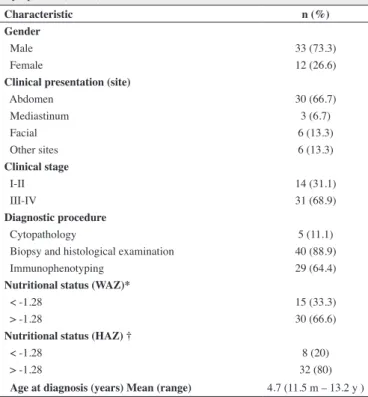
more than one site of involvement; two had the involvement of abdomen and thorax and one had the involvement of the abdomen and paravertebral region. Of the patients with abdominal tumors, 18 underwent laparotomy, with total resection of tumor in 12 (26.7%) and partial resection in six (13.3%). Most patients had advanced disease (31 patients - 68.9%). Stage was reported for 44 patients: 13 were Stage II (28.9%), 28 Stage III (62.2%) and three Stage IV (6.7%). Serum LDH levels at diagnosis were available for 22 of the 45 patients with mean serum LDH being 676.5 IU/L (range: 112 to 7407 IU/L). Serum uric acid levels were available for 42 patients with a mean value of 5.4 mg/dL (range: 0.8 to 41.0 mg/dL). For 40 patients, the mean serum urea and creatinine levels were 23.5 mg/dL and 0.6 mg/dL, respectively. Serum potassium was available for 29 patients, with a mean value of 4.2 mEq/L (range: 3.0 to 5.2 mEq/L). Eleven patients (24.4%) received the LSA2L2 protocol and 30 patients (66.7%) the BFM-83 protocol. The other two patients were treated with other protocols and two patients died before the start of chemotherapy.
Table 1 - Baseline clinical characteristics of 45 children with Burkitt’s lymphoma (n = 45)
Characteristic n (%)
Gender
Male 33 (73.3)
Female 12 (26.6)
Clinical presentation (site)
Abdomen 30 (66.7)
Mediastinum 3 (6.7)
Facial 6 (13.3)
Other sites 6 (13.3)
Clinical stage
I-II 14 (31.1)
III-IV 31 (68.9)
Diagnostic procedure
Cytopathology 5 (11.1)
Biopsy and histological examination 40 (88.9)
Immunophenotyping 29 (64.4)
Nutritional status (WAZ)*
< -1.28 15 (33.3)
> -1.28 30 (66.6)
Nutritional status (HAZ) †
< -1.28 8 (20)
> -1.28 32 (80)
Age at diagnosis (years) Mean (range) 4.7 (11.5 m – 13.2 y )
* WAZ: Z score for weight in relation to age
† HAZ: Z score for height in relation to age; there was no record of height at admission for 5 children
Outcome
Complete remission was observed in 38 patients (84.4%). During follow-up (median: 35 months; range: 1 to 60 months), 33 patients (73.3%) were alive at the irst CR. Twelve children (26.7%) died, two of them soon after admission without receiving anticancer treatment. Eight died during the initial
Figure 1 - Survival of 45 patients with Burkitt’s lymphoma. Small vertical lines on the curve represent patients alive at follow-up (Kaplan-Meier)
Figure 2 - Survival of 45 patients with Burkitt’s lymphoma, stratiied by
localized versus advanced clinical stage. Small vertical lines on the curve represent patients alive at follow-up (Kaplan-Meier; log-rank test for comparison between survival curves)
Figure 3 - Survival of 45 patients with Burkitt’s lymphoma, stratiied
Discussion
In Brazil, despite well-established nationwide collaborative studies for the treatment of acute leukemia and several solid tumors, the majority of children who have B-NHL are treated according to local experience and single-institution protocols. This retrospective cohort study reports the results of a single service in the State of Minas Gerais, Brazil. Most of the characteristics of BL that presented in the children studied here were similar to those reported for the sporadic forms of BL. The mean age at diagnosis of our cohort was 4.7 years, similar to that reported for the US and Europe, which ranged from 5 to 9 years(9,15). As also reported in previous studies, there was a clear predominance of males. This fact may raise the question of whether a tumor-suppressor gene for BL might be located on the X chromosome(15,16).
The main clinical presentation reported among patients with sporadic BL is the presence of abdominal tumors(15). In the present study, this was also the most frequent clinical manifestation. The predominance of intra-abdominal sites, mainly in the right ileocecal region, was similar to another Brazilian study (75%) (17). In areas of endemic BL, jaw tumor is more common and
may affect as many as 60% of children with one third of them
having involvement of the CNS at diagnosis. Outside endemic areas, the frequency of jaw involvement is around 15% and CNS involvement is uncommon, except if there is concomitant HIV infection(5,18). In our study only one patient had CNS-positive disease at diagnosis; no inherited or acquired immune deiciencies were present and this patient remains in irst clinical remission.
Because of high tumor growth fraction, in general, patients show up with advanced disease. So, approximately 70% to 90% of patients present widespread disease at diagnosis(4,18,19), as observed in this series.
Many studies have contributed to the identiication of possible risk factors for a bad prognosis, such as age, gender, response to treatment, CNS or marrow involvement, and chromosomal abnormalities, such as del(13q) and +7q(20,21). Bulky disease, estimated through staging systems, resection status and serum LDH levels, seems to be an important adverse prognostic factor(15,16,19,22). Thus, it has been shown that a high LDH concentration has a negative impact on prognosis(15,22). Among our patients, LDH was not a statistically signiicant factor, but LDH values were registered in only half of the patients’ records. It has also been considered that a staging system that incorporates the situation of tumor resection and LDH levels seems to be a better indicator of prognosis than disease stage alone(22).
Another way of estimating bulky disease, although uncommonly used, is based on uric acid concentration at diagnosis. Advanced clinical stage, the presence of antibodies to EBV early antigen (anti-EA) and high concentrations of uric acid and LDH were associated with a signiicantly poorer outcome in African children with BL. The authors concluded that the tumor burden, evaluated by the high concentrations of uric acid and LDH, was the most important prognostic factor in BL(23).
In a study of Buyukpamukçu et al. high levels of creatinine and urea had a signiicant negative impact on the survival of 104 children with NHL, 59 of whom were NHL-B(24). However, our indings did not corroborate these results. On the other hand, a high concentration of uric acid at diagnosis was a strong predictor of adverse outcome in our patients. Therefore, tumor lysis syndrome also occurs prior to starting chemotherapy and uric acid can be another good marker of tumor burden.
In this study, 12 patients (26.7%) died, a very similar situation to that reported for African children (23.8%)(25). However, this rate is much higher than that recorded in developed countries, which is around 2.8%(15). The higher mortality rate for patients treated in low-income countries may be due to a lack of supportive care required by the chemotherapy scheme employed. Another problem is malnutrition. These children are probably at increased risk for therapy-related toxicity, including life-threatening infections(26). In the present cohort of patients, one third had malnutrition at admission, a rate similar to that reported among African children with BL (38.6%)(25).
In most treatment regimens currently used for childhood and adolescent B-NHL the key component is HD-MTX in both developed(8,9) and developing countries(27). However, dose and administration schedules vary considerably. Some low-income countries such as Brazil, Argentina, Lebanon and Iraq have reported improved survival rates of children with B-NHL, although the MTX dose did not exceed 2 g/m2(17,18,28). The present study demonstrates that it is possible to obtain satisfactory results
Table 2 - Factors associated with death of children with Burkitt’s lymphoma
Variable Dead Surviving p-value (log-rank) Gender
Male 9 24
0.99
Female 3 9
Age at diagnosis (months)
< 48 3 10
0.90
≥ 48 9 23
LDH (IU/L)*
< 500 0 7
0.22
≥ 500 3 12
Uric Acid (mg/dL)**
< 7 3 25
< 0.001
≥ 7 9 5
Potassium (mEq/L)†
< 4.2 3 15
0.96
≥ 4.2 3 14
Serum creatinine (mg/dL)#
< 0.8 8 25
0.34
≥ 0.8 4 7
Weight-age Z-score
< -1.28 3 12
0.50
≥ -1.28 9 21
Height-age Z score)
< -1.28 1 7
0.50
≥ -1.28 7 25
Clinical stage††
I-II 1 12
0.50
III-IV 10 21
*Available for only 22 patients at diagnosis **Available for 42 patients at diagnosis † Available for 29 patients at diagnosis
with the use of MTX at a dose of 0.5 g/m2, because only two patients relapsed and the other ten died of infectious or metabolic complications before or at the beginning of treatment.
In African countries, the limited availability of drugs, insuficient supportive measures, low social and cultural levels, distance from the referral hospital, and political instability have an adverse impact on patient compliance and inevitably on the outcome of treatment(29). The survival of children with B-cell NHL living in these regions ranges from 50.5% to 79% depending on the intensity of treatment(3). Although the overall outcomes do not compare with the experience of centers in Europe and the US using more intensive regimens, the results remain impressive. It is noteworthy that some of these countries provided a minimum of therapy such as cyclophosphamide monotherapy(26). This also underscores the need to fully understand biological and socioeconomic differences within the same disease group in an attempt to tailor therapy and minimize toxicity. It is possible that the poorer outcome in underdeveloped nations is not just a relection of socioeconomic factors, but also of unique biological differences. It becomes increasingly clear that understanding the molecular and genetic signatures of NHL-B can lead to novel therapies and better survival(30).
Conclusion
Our indings conirm a favorable prognosis for a signiicant number of children who are survivors of BL after treatment with an intermediate dose of MTX. The challenge remains to identify those patients who are at a higher risk of relapsing, because they may require more aggressive therapy. In countries with limited resources, the challenge is to plan treatment intensity so that morbidity is manageable, without signiicantly decreasing the survival rate. The observation of a signiicantly lower survival in children and adolescents with uric acid concentrations of 7 mg/dL or higher at diagnosis is also very interesting, suggesting that the concentration of the metabolite may be a good marker of tumor burden, but further studies are needed to corroborate this inding.
Acknowledgements
The authors wish to thank FAPEMIG for a grant to ACSCG, a medical student. MBV is a level 2 CNPq researcher.
References
1. Cairo MS, Raetz E, Lim MS, Davenport V, Perkins SL. Childhood and
adolescent non-Hodgkin lymphoma: new insights in biology and critical challenges for the future. Pediatr Blood Cancer. 2005;45(6):753-69.
2. Swerdlow SH, Campo E, Harris NL, Jaffe ES, Pieleri SA, Stein H, et al.
WHO classiication of tumors of haematopoietic and lymphoid tissues.
4th ed. Lyon: IARC; 2008. (IARC WHO Classiication of tumours, n.2).
3. Traoré F, Coze C, Atteby JJ, André N, Moreira C, Doumbe P, et al. Cyclophosphamide monotherapy in children with Burkitt lymphoma: a study from the French-African Pediatric Oncology Group (GFAOP). Pediatr Blood Cancer. 2011;56(1):70-6.
4. Ferry JA. Burkitt’s lymphoma: clinicopathologic features and differential diagnosis. Oncologist. 2006;11(4):375-83.
5. Toren A, Mandel M, Shahar E, Rimmoni E, Roizin H, Neuman Y, et al. Primary central nervous system Burkitt’s lymphoma presenting as Guillain-Barre syndrome. Med Pediatr Oncol. 1994;23(4):372-5.
6. Kelly GL, Rickinson AB. Burkitt lymphoma: revisiting the pathogenesis of a virus-associated malignancy. Hematology Am Soc Hematol Educ Program 2007:277-84.
7. Ribeiro RC, Sandlund JT. Burkitt lymphoma in African children: a priority for the global health agenda? Pediatr Blood Cancer. 2008;50(6):1125-6.
8. Woessmann W, Seidemann K, Mann G, Zimmermann M, Burkhardt B, Oschlies I, Ludwig WD, Klingebiel T, Graf N, Gruhn B, Juergens H, Niggli F, Parwaresch R, Gadner H, Riehm H, Schrappe M, Reiter A; BFM Group. The impact of the methotrexate administration schedule and dose in the treatment of children and adolescents with B-cell neoplasms: a report of the BFM Group Study NHL-BFM95. Blood. 2005;105(3):948-58.
9. Cairo MS, Gerrard M, Sposto R, Auperin A, Pinkerton CR, Michon J, Weston C, Perkins SL, Raphael M, McCarthy K, Patte C; FAB LMB96 International Study Committee. Results of a randomized international study of high-risk central nervous system B non-Hodgkin lymphoma and B acute lymphoblastic leukemia in children and adolescents. Blood. 2007;109(7):2736-43.
10. Murphy SB. Classiication, staging and end results of treatment of
childhood non-Hodgkin’s lymphomas: dissimilarities from lymphomas in adults. Semin Oncol. 1980;7(3):332-9.
11. Monteiro CA. Critérios antropométricos no diagnóstico da desnutrição em programas de assistência à criança. Rev Saúde Pública 1984;18(3):209-17.
12. Wollner N, Wachtel AE, Exelby PR, Centore D. Improved prognosis in children with intra-abdominal non-Hodgkin’s lymphoma following LSA2L2 protocol chemotherapy. Cancer. 1980;45(12):3034-9.
13. Reiter A, Schrappe M, Ludwig WD, Lampert F, Harbott J, Henze G, et al. Favorable outcome of B-cell acute lymphoblastic leukemia in childhood: a report of three consecutive studies of the BFM group. Blood. 1992;80(10):2471-8.
14. kaplan EL, Meier P. Nonparametric estimation from incomplete observations. J Am Stat Assoc. 1958;53(282):457-81.
15. Patte C, Auperin A, Michon J, Behrendt H, Leverger G, Frappaz D, Lutz P, Coze C, Perel Y, Raphaël M, Terrier-Lacombe MJ; Société Française d’Oncologie Pédiatrique. The Societe Francaise d’Oncologie Pediatrique LMB89 protocol: highly effective multiagent chemotherapy tailored to the tumor burden and initial response in 561 unselected children with B-cell lymphomas and L3 leukemia. Blood. 2001;97(11):3370-9.
16. Burkhardt B, Zimmermann M, Oschlies I, Niggli F, Mann G, Parwaresch R, Riehm H, Schrappe M, Reiter A; BFM Group. The impact of age and gender on biology, clinical features and treatment outcome of non-Hodgkin lymphoma in childhood and adolescence. Br J Haematol. 2005;131(1):39-49
17. Klumb CE, Schramm MT, De Resende LM, Carriço MK, Coelho AM, de Meis E, et al. Treatment of children with B-cell non-Hodgkin’s lymphoma in developing countries: the experience of a single center in Brazil. J Pediatr Hematol Oncol. 2004;26(7):462-8.
18. Muwakkit SA, Razzouk BI, Shabb NS, Hancock ML, Dabbous I, Firzli S, et al. Clinical presentation and treatment outcome of children with Burkitt lymphoma in Lebanon: a single institution’s experience. J Pediatr Hematol Oncol. 2004;26(11):749-53.
xxx
20. Nelson M, Perkins SL, Dave BJ, Coccia PF, Bridge JA, Lyden ER, et al.
An increased frequency of 13q deletions detected by luorescence in situ
hybridization and its impact on survival in children and adolescents with Burkitt lymphoma: results from the Children’s Oncology Group study CCG-5961. Br J Haematol. 2010;148(4):600-10.
21. Poirel HA, Cairo MS, Heerema NA, Swansbury J, Aupérin A, Launay E, Sanger WG, Talley P, Perkins SL, Raphaël M, McCarthy K, Sposto R, Gerrard M, Bernheim A, Patte C ; FAB/LMB 96 International
Study Committee. Speciic cytogenetic abnormalities are associated with a signiicantly inferior outcome in children and adolescents with
mature B-cell non-Hodgkin’s lymphoma: results of the FAB/LMB 96 international study. Leukemia. 2009;23(2):323-31.
22. Reiter A, Schrappe M, Tiemann M, Ludwig WD, Yakisan E, Zimmermann M, et al. Improved treatment results in childhood
B-cell neoplasms with tailored intensiication of therapy: A report
of the Berlin-Frankfurt-Munster Group Trial NHL-BFM 90. Blood. 1999;94(10):3294-306.
23. Magrath I, Lee YJ, Anderson T, Henle W, Ziegler J, Simon R, et al. Prognostic factors in Burkitt’s lymphoma: importance of total tumor burden. Cancer. 1980;45(6):1507-15.
24. Buyukpamukçu M, Varan A, Aydin B, Kale G, Akata D, Yalçin B, et al.
Renal involvement of non-Hodgkin’s lymphoma and its prognostic effect in childhood. Nephron Clin Pract. 2005;100(3):c86-91.
25. Harif M, Barsaoui S, Benchekroun S, Bouhas R, Doumbé P, Khattab M,
et al. Treatment of B-cell lymphoma with LMB modiied protocols in
Africa -report of the French-African Pediatric Oncology Group (GFAOP). Pediatr Blood Cancer. 2008;50(6):1138-42. Comment in: Pediatr Blood Cancer. 2008;50(6):1125-6.
26. Kazembe P, Hesseling PB, Grifin BE, Lampert I, Wessels G. Long
term survival of children with Burkitt lymphoma in Malawi after cyclophosphamide monotherapy. Med Pediatr Oncol. 2003;40(1):23-5.
27. Acquatella G, Insausti CL, García R, Gómez R, Hernández M, Carneiro
M, et al. Outcome of children with B cell lymphoma in Venezuela with
the LMB-89 protocol. Pediatr Blood Cancer. 2004;43(5):580-6.
28. Moleti ML, Al-Hadad SA, Al-Jadiry MF, Al-Darraji AF, Al-Saeed RM, De
Vellis A, et al. Treatment of children with B-cell non-Hodgkin lymphoma
in a low-income country. Pediatr Blood Cancer. 2011;56(4):560-7.
29. Naresh KN, Advani S, Adde M, Aziz Z, Banavali S, Bhatia K, et al. Report of an International Network of Cancer Treatment and Research workshop on non-Hodgkin’s lymphoma in developing countries. Blood Cells Mol Dis. 2004;33(3):330-7.