S T U D Y P R O T O C O L
Open Access
Promoting health equity in European children:
Design and methodology of the prospective
EPHE (Epode for the Promotion of Health Equity)
evaluation study
Krystallia Mantziki
1*, Achilleas Vassilopoulos
2, Gabriella Radulian
3, Jean-Michel Borys
4, Hugues du Plessis
4,
Maria João Gregório
5, Pedro Graça
5,6, Stefaan de Henauw
7, Svetoslav Handjiev
8, Tommy LS Visscher
1,9and Jacob C Seidell
1Abstract
Background: Reducing health inequalities is a top priority of the public health agendas in Europe. The EPHE project aims to analyse the added value of a community-based interventional programme based on EPODE methodology, adapted for the reduction of socio-economic inequalities in childhood obesity. The interventions that will be implemented by this project focus on four energy balance-related behaviours (fruit and vegetable consumption, tap water intake, physical inactivity, sleep duration) and their determinants. This article presents the design of the effect evaluation of the EPHE project.
Methods/Design: This is a prospective two-year follow-up evaluation study, which will collect data on the energy balance-related behaviours and potential environmental determinants of 6–8 year olds, depending on the socio-economic status of the parents. For this purpose a parental self-reported questionnaire is constructed. This assesses the socio-economic status of the parents (5 items) and the dietary (12 items), sedentary (2 items) and sleeping (4 items) behaviour of the child. Alongside potential family-environmental determinants are assessed. The EPHE parental questionnaire will be disseminated in schools of a selected medium-sized city in seven European countries (Belgium, Bulgaria, France, Greece, Portugal, Romania, The Netherlands).
Discussion: This study will evaluate the effects of the EPHE community-based interventional programmes. Furthermore, it will provide evidence for children’s specific energy balance-related behaviours and family environmental determinants related to socio-economic inequalities, in seven European countries.
Keywords: Health inequalities, Childhood obesity, EPODE, Dietary intake, Sedentary lifestyle, Sleep Background
Health inequalities between different population groups worldwide and in Europe exist due differences in factors that influence health, such as health related-behaviours, occupational class, education and income [1-3]. Apart from the health impacts of such disparities, the stakes are high even from an economic standpoint. According to the European Parliament, the estimated losses linked
to health inequalities had cost around 1.4% of GDP within the European Union in 2011 [4].
Pronounced socio-economic inequalities in non-communicable diseases exist between and within coun-tries in Europe [2,3,5-9], and even at the local level (within-community/neighbourhood) [2,3,5,7,8,10]. Indi-viduals of middle and lower income, occupation class and/or educational level are more likely to develop non-communicable diseases and are more exposed to related risk factors [1-3,5,6,9]. The rates of obesity are higher and increasing more rapidly in those with relatively lower socio-economic status [5-7,9,11,12]. Furthermore,
* Correspondence:[email protected]
1
Department of Health Sciences, VU University Amsterdam, De Boelelaan 1085, Amsterdam 1081HV, The Netherlands
Full list of author information is available at the end of the article
© 2014 Mantziki et al.; licensee BioMed Central Ltd. This is an Open Access article distributed under the terms of the Creative Commons Attribution License (http://creativecommons.org/licenses/by/4.0), which permits unrestricted use, distribution, and reproduction in any medium, provided the original work is properly credited. The Creative Commons Public Domain Dedication waiver (http://creativecommons.org/publicdomain/zero/1.0/) applies to the data made available in this article, unless otherwise stated.
unhealthy dietary habits and less active lifestyle are more common amongst subgroups with a relatively low socio-economic status [8-10,13].
Tackling inequalities in overweight, obesity and related determinants has become a top priority for the European research and policy agendas over the last few years, stressing out the mandatory for action [6,7,9,11,14]. Nevertheless, evidence for the effectiveness of interven-tions in reducing inequalities in obesity are needed [5,9].
The EPHE project
Based on the rational above, Epode for the Promotion of Health Equity (EPHE) project was designed. EPHE is a European project running from 2012 to 2015 with the support of the European Commission DG Health and Consumers. Its overall objective is to analyse the added value of community-based approaches based on the EPODE methodology [15,16] in order to reduce inequi-ties associated to childhood obesity and related determi-nants. In the basis of scientific evidence [10,17-19], four determinants of obesity and overweight will be ad-dressed by the EPHE interventions: promotion of fruit and vegetable intake, tap water intake, active lifestyle and adequate sleep duration. The project involves seven different community-based programmes across Europe (EPODE in France, HEALTHY KIDS in Bulgaria, JOGG in The Netherlands, Maia in Portugal, PAIDEIATROFI in Greece, SETS in Romania, VIASANO in Belgium) and is guided by an EPHE Scientific Advisory Board composed of representatives from 6 European Univer-sities. Based on the results of the baseline measure-ments, the interventions will focus on the energy balance-related behaviours and their associated environ-mental determinants where there is the largest gap be-tween high and low socio-economic groups.
The EPHE evaluation study aims (1) to identify the en-ergy balance-related behaviours and explore environmental determinants which are associated with inequalities in childhood obesity and overweight in seven European coun-tries, (2) to assess the effectiveness of EPODE methodology to tackle inequalities in obesity and overweight, (3) to assess the sustainability of potential effects, a year after the ter-mination of the interventions and (4) to provide evidence-based results concerning the inequalities in childhood obesity and overweight across seven European countries. This article aims to describe the design and methodology of the effect evaluation of the EPHE project, which will assess the outcomes of the EPHE selected community-based programmes.
Methods/Design
The EPHE evaluation plan consists of a prospective two-year follow-up study. It will assess the behavioural change in some energy balance-related behaviours and their
associated environmental determinants in children, accord-ing to their socio-economic status, and its sustainability over time. The evaluation study will be performed in three measurement periods; baseline (May-June 2013), after the end of the EPHE interventions (May-June 2014) and a year after (May-June 2015). All countries will follow this time-line, with exception of the baseline measurements of France that will be conducted on September 2013, due to practical restrains. The study will include only self-reported mea-surements by means of a parental questionnaire.
The survey obtained formal declaration from the Medical Ethics Committee of the VU University Medical Centre, that it does not fall under the scope of the Medical Sciences people research Act (WMO). In addition, permission to re-search in schools was acquired from local community and/ or school authorities, where necessary.
City/Town selection
Each country is represented by a member of its EPHE National Coordination Team, which is a member of the EPHE Operational Board. The National Coordination Team is responsible to guide the Local Project Managers, which are in charge of the data collection in the community level. All the countries will follow a standardised protocol for the selection of the EPHE-city and the data collection, which will be described further in this article.
The evaluation study, as well as the interventions, will be implemented in a medium-sized city/town, where the population shall belong in a wide range of socio-economic statuses. The selected city/town should prefer-ably not have implemented many interventions relevant to nutrition and physical activity addressed to the EPHE target group, in order to prevent of not detecting differ-ences between the socio-economic groups.
To ensure the comparability among the participant communities, the National Coordination Teams must provide a description of the city they will select, before the baseline measurements are conducted. The descrip-tion will include socio-economic informadescrip-tion and health promotion programmes/campaigns conducted in the city/town, along with general information of the selected school(s), including infrastructure.
Sampling and recruitment
We aim at recruiting at least 150 families with children aged between 6 to 9 years old in every selected city/town with a similar variation regarding age and ethnicity per site, and a preferably low number of different ethnicities (other than the local) per site.
The families will be approached through schools. Every National Coordination Team and Local Team is in charge of committing teachers in the selected schools to enable the distribution and collection of the question-naires. Teachers, acting as mediators, will approach the
families. The National Coordination Teams and Local Project Managers of every country are responsible to en-gage and guide school directors and teachers in order to recruit the participants. Parents will be provided with an informed consent, describing the purpose of the study.
School selection
Of major importance is to account for the variability of the socio-economic status and ethnicity of the sample, both within and between communities. For that reason, the schools should be selected from different neighbour-hoods of various socio-economic statuses that assure re-cruitment of higher and lower socio-economic statuses sample. This should be monitored in the city monitoring at the baseline.
Socio-economic assessment
Education, social class and income are the most com-monly used indicators to assess the socio-economic sta-tus in nutritional research [12]. In this study educational level, employment status and income position will be used in order to distinguish the socio-economic status of the parents. Given the current challenging economic in-stability of European Union, employment status will be assessed instead of the social class. As for some coun-tries it is difficult to evaluate or to obtain quality data, we used the concept of perceived income position, ask-ing parents to self-report their current financial status. Two socio-economic groups will be distinguished based on classification for each indicator: education (low-high), employment status (employed-not employed), income position (good-not good).
Data collection
In order to ensure the confidentiality of the data, a process to warrant the anonymity will be applied. Each city/town will receive the edited questionnaires labelled with the country’s abbreviation and a three-digit code, indicating the subject’s number. This number will re-spect to the family name of the subject, indicated in a document that will be kept by the National Coordination Team of every country. As such, only the National Co-ordination Team will be aware of the subject’s identity, for follow-up purposes. The filled out questionnaires, will be returned sealed up in a provided envelope. The parents will be informed in advance for the process of confidentiality through an information letter, which will include the informed consent as well. Only the children that will return the informed consent indicating agree-ment of the parent will participate to the study.
The questionnaires will be distributed through schools. More specifically, the teachers will be provided with the labelled questionnaires and envelopes, which will be dis-seminated by them to the participant children in the
class. Following, the children will give them to their par-ents. The number of distributed questionnaires has to be noted down, in order to monitor the response rates after the collection.
Similarly, after a specified period of one to two weeks, the questionnaires shall be returned back to the teachers. Finally the Local Project Managers will be re-sponsible to collect the returned questionnaires and de-liver them to their National Coordination Team. Every National Coordination Team has to keep at least one hard copy of each document, for safety reasons. As men-tioned earlier, each local University will have access to their national data.
Development of questionnaire
A self-reported questionnaire (Additional file 1) is devel-oped, with questions addressed to the parents. The ques-tionnaire will assess information relevant to (1) the family’s socio-economic status and household’s food security level, (2) the child’s energy balance-related be-haviours and associated environmental determinants and (3) the parental perception of a healthy body of a child. Based on those measures, it is expected that potential behavioural changes of the child and/or parents will be detected, which will reflect the EPHE- interventions.
The EPHE parental questionnaire was developed using items from relevant, validated questionnaires addressed in European populations. Items derived from validated ques-tionnaires of large European socio-economic surveys [20,21] were chosen to define the socio-economic status. For the assessment of the energy balance-related behav-iours and their environmental determinants, items from the ENERGY parent and child questionnaires [22], the Pro-children child questionnaire [23] and its updated version PRO-GREENS [24], were used. These tools have been translated and validated [23,25] in several European languages including some of our interest. Items with intraclass correlation coefficient (ICC) classified as “poor” (ICC < 0.5) were excluded [23,25]. Concerning the house-hold food security level, a short form of the househouse-hold food security scale developed from the United States Depart-ment of Agriculture [26] was used. In order to assess the parent’s perception of their child’s body weight, the pictorial instrument and related questions developed by Collins [27] were used. All items derived from validated questionnaires were adapted for the needs of the EPHE parental question-naire, where necessary. Additional items were constructed in the cases that no validated items or questionnaires existed to our knowledge.
The questionnaire will be translated in every language, respective to the participant countries and back-translated to English. It is mandatory for all participant countries to use the same version, layout and format of questionnaire.
Data handling
The questionnaires from all countries will be shipped to the coordinating University in the Netherlands (Vrije University of Amsterdam), where the general analyses will be conducted. A scanned process from the same scanning company will facilitate the data transfer into SPSS files, for all three stages of the evaluation. All the national data will be made available to the national participant-University of country for further analysis.
Data cleaning and analysis plan
All the data sets will be checked for missing and double-crossed values. The missing values will be treated by the multiple imputation method, if necessary. The sample will be divided in two groups, according to the socio-economic indicator used in the assessment. Descriptive analysis will include appropriate non-parametric tests for comparing means, in order to detect differences in behaviours and determinants between the two socio-economic groups. The SPSS software 21.0 (IBM Corp., Armonk, NY, USA) will be used for all the analyses.
Description of selected cities
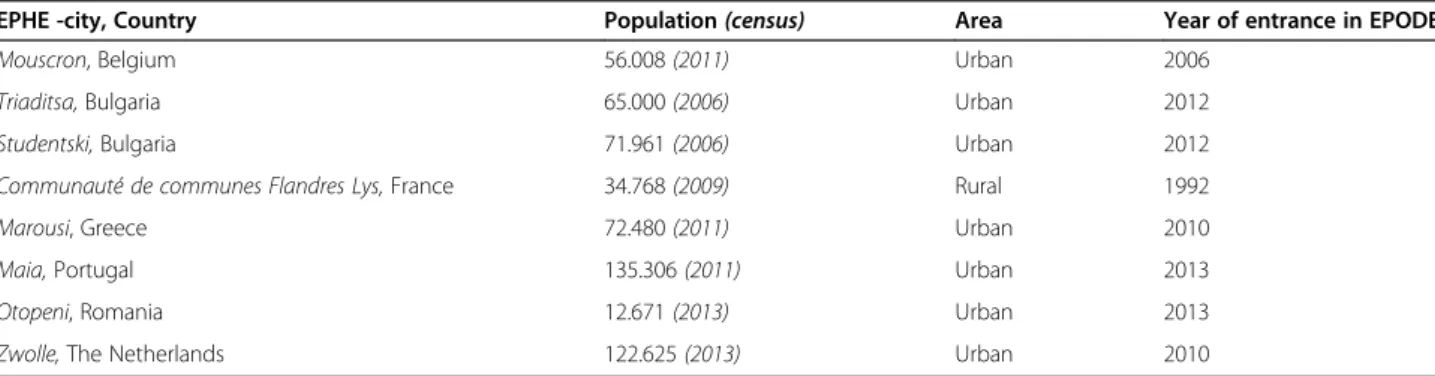
In each country, EPODE municipality(ies) were selected by the local representatives (National Coordination Team) to participate. Table 1 illustrates the descriptive characteristics of the EPHE cities. All countries are rep-resented by one city, with exceptions to France and Bulgaria where two towns\cities participate.
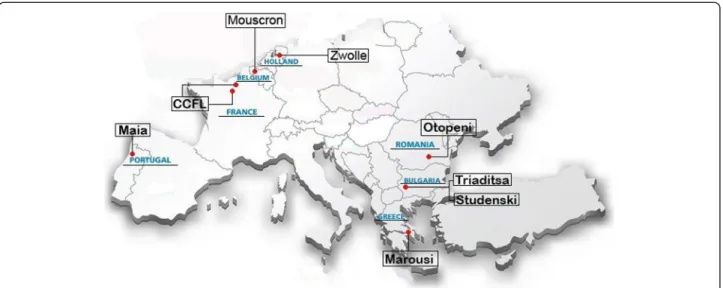
All cities are considered as medium-sized for the country-specific standards. With exception of France, the selected cities are located in urbanised areas. In the cases of Bulgaria, Greece and Portugal, the cities belong to the metropolitan areas of the big cities, in contrary to the rest of the EPHE-cities. Figure 1 illustrates their lo-cation. Mouscron (Belgium) is positioned in the west of Belgium, in the French speaking part close to the bor-ders with France. The towns of Triaditsa and Studenski (Bulgaria) belong to the metropolitan area of the capital city Sofia, located in the west of Bulgaria. Communauté de communes Flandres Lys (CCFL) (France) is located
in the north-east of France. Marousi town (Greece) is part of the metropolitan of the capital city Athens, posi-tioned in the centre of Greece. Maia city (Portugal) is situated northern to Porto city, in the north of Portugal. Otopeni (Romania) is located in the south of Romania, 15 kilometres northern to the capital, Bucharest. Zwolle (The Netherlands) is positioned in the north part of The Netherlands, 120 kilometres northeast of Amsterdam.
As shown in Table 1, three out of the nine participant municipalities began the implementation of EPODE methodology during the last year, whereas the other six were already committed to an EPODE-like programme. Health campaigns launched by programmes other than EPODE-like, are taking place to the majority of the en-gaged municipalities. However, these do not always over-lap with the target group or the themes of EPHE.
Description of schools
The sample for the evaluation study will be recruited through schools, selected by the local coordinators of each country. The schools’ selection took into account the need to obtain a mixed sample with children and families from different socioeconomic statuses. In some countries we found these socio-economic variation in the same school, but in other countries, schools belong-ing to different socioeconomic areas were selected. In Belgium, four schools (three public and one private) from low to medium\high socio-economic areas partici-pate. In Bulgaria ten schools are recruited (nine public and one private) from nine socio-economically mixed areas and one with higher socio-economic status. Greece recruits two public schools, from mixed socio-economic areas, alike to Portugal.
In Romania one public school participates, including students from a broad range of socio-economic statuses. In contrary, in The Netherlands two public schools par-ticipate, located in the neighbourhoods from the lowest and the highest socio-economic statuses. Finally, in France two public schools are included, one from a low socio-economic area and the other on from an area with mixed socio-economic status.
Table 1 Descriptive characteristics of the EPHE cities
EPHE -city, Country Population (census) Area Year of entrance in EPODE
Mouscron, Belgium 56.008 (2011) Urban 2006
Triaditsa, Bulgaria 65.000 (2006) Urban 2012
Studentski, Bulgaria 71.961 (2006) Urban 2012
Communauté de communes Flandres Lys, France 34.768 (2009) Rural 1992
Marousi, Greece 72.480 (2011) Urban 2010
Maia, Portugal 135.306 (2011) Urban 2013
Otopeni, Romania 12.671 (2013) Urban 2013
Questionnaire constructs
A total number of 105 items are included in the EPHE parental questionnaire. The average time to fill it out will be approximately 45 minutes.
Descriptive and socio-economic variables
Descriptive and socio-economic information are assessed by ten items (Table 2). The descriptive information include age and gender of parent and child. In addition, the size of the household is assessed by two items. For the socio-economic assessment the years of education, labour status and type of working sector of both parents are asked. Alongside, the perception of the household income and its main source are assessed, given ethical restrictions to ask for the exact income. The six-item USDA questionnaire was used to examine the food security level of the house-hold over the past year [26].
Energy balance related behaviours
Dietary intake and determinants are assessed by sixty-five items, whereas sedentary lifestyle is assessed by fif-teen items. Table 3 demonstrates the items of the energy balance-related behaviours of the child (i.e. dietary, sed-entary and sleeping behaviours) as indicated in the EPHE parental questionnaire. The consumption of fruits and vegetables is assessed by food frequency questions, referring to a usual week. These items are derived from the Pro children questionnaire [23]. A separate item for the potatoes was added in the questionnaire to avoid misleading information, that these are included in the cooked vegetables [23]. Additionally, two items assessing the portions of fruit and vegetables consumed daily are included. The consumption of fruit juices, soft drinks and diet soft drinks is assessed by means of weekly
frequency, based on the ENERGY child questionnaire [22,25].
In order to measure water consumption two frequency questions were constructed, assessing daily intake. Sed-entary behaviour is assessed by means of time spent daily in television viewing and time of computer playing, for the week and the weekend days separately. These questions are derived from the ENERGY child question-naire [22,25]. Furthermore, four questions, partly in-formed by the ENERGY parent questionnaire and partly constructed, assess the sleeping habits of the child [22]. Finally, three items- one informed by the ENERGY par-ent questionnaire and the other two by Collins- along with the pictorial instrument created by Collins (1991) [27], assess the parent’s perception of their child’s body weight.
Assessment of family environment
The description and questionnaire items of the family environmental variables, mentioned also as determinants of the energy balance-related behaviours, are demon-strated in the Additional file 2. With reference to the Pro Children child questionnaire [23], and its updated version PRO-GREENS [24], and the ENERGY parental questionnaire [22], the family environmental variables can be discriminated into social, physical (i.e. home availability, situation specific habit) and economic (price influence) correlates. Given that the three reference questionnaires make use of slightly different correlates, here they are aggregated into one framework. Therefore, the social correlates include the following mediators for fruit and vegetable consumption: parental demand, par-ental allowing, active encouragement, facilitating, paren-tal knowledge on recommendations; and the following mediators for fruit juice\soft drink consumption and TV
viewing\computer time: paying attention\monitoring, parental allowance, negotiating, communicating health beliefs, avoid negative modelling, parental self-efficacy to manage child’s intake, rewarding\comforting practice. All family environmental variables were assessed by one or two items, using a five response category format. De-pending on the item the response categories range a. from (−2) I fully disagree to (2) I fully agree, b. from (1) never to (5) (yes) always, c. from (1) never to (5) every day. Exemptions are the variables assessing the situation of specific habit and the TV availability, where binary re-sponse categories are used (i.e. 1.yes, 2. no).
Discussion
This article describes the methodology of the effect evalu-ation of the EPHE project, aimed to reduce the socio-economic inequalities in selected energy balance-related
behaviours. The EPHE evaluation study is a two-year pro-spective follow-up survey, which will collect self-reported data of the energy balance-related behaviours of 6–8 year olds and their potential family environmental determinants, depending on the socio-economic level of the parents.
Little research has been conducted to associate childhood obesity and relevant behavioural determinants with socio-economic inequalities in the country level [10]. Neverthe-less, obesogenic environments seem to influence more the energy balance-related behaviours of lower socio-economic populations [12,28,29]. Screen exposure of children is in-versely associated with parental education [30], whereas lower fruit and vegetable intake is observed more frequently in children with low educated parents [31,32]. However, specific behaviours and determinants of childhood obesity in relation to parental socio-economic status have yet to be identified. The current study will provide evidence for the
Table 2 Descriptive and socio-economic variables measured in the EPHE parental questionnaire
Variable Questionnaire item Response categories
Descriptive Questionnaire
respondenta This questionnaire is filled in by: (1) The mother (2) The stepmother (3) The father(4) The stepfather (5) The grandmother (6) The grandfather
(7) The caregiver
Age of child How old is your child? (1) 6 (2) 7 (3) 8 (4) 9 and above
Age of parent
(respondent)b Which age group do you belong to? (1) 20 and below (2) 20and above –24 (3) 25–30 (4) 31–35 (5) 36–40 (6) 41
Size of the householdb
1. How many persons live in your household, including yourself? 1. (1) 2 persons (2) 3–4 persons (3) 5–6 persons (4) More than 6 persons
2. How many children (below 18 years old) live in your household?
2. (1) 1 child (2) 2 children (3) 3 children (4) a children (5) more than 4 children
Socio-economic
Educationb How many years have you/your partner spend in full time study including school?
(1) Less than 6 years (2) 6–8 years (3) 9–11 years (4) 12–14 years (5) 15–17 years (6) More than 17 years (7) I don’t have a spouse/ partner
Labour
statusb How would you define your/your partners’ current labour status? (1) Carry out a job or profession, including unpaid work for afamily business or holding, including an apprenticeship or paid
traineeship etc.
(2) Unemployed (3) Student, further training, unpaid work experience (4) In retirement or early retirement or has given up business (5) Permanently disabled (6) In compulsory military or community service (7) Fulfilling domestic tasks (8) Other inactive person (9) I don’t have a spouse/partner
Sector of
employmentc Which of the types of organisation you/your spouse work/worked for? (1) Central or local government (2) Other public sector (such aseducation and health) (3) A state-owned enterprise (4) A private
firm (5) Self-employed (6) Other (7) I don’t have a spouse/partner Perception of
incomec Which of the description below comes closest to how you feelabout your household’s income nowadays? (1) Living comfortably on present income (2) Coping on presentincome (3) Finding it difficult on present income (4) Finding it
very difficult on present income Main source
of incomec Please consider the income of all household members and anyincome which may be received by the household as a whole.
What is the main source of income in your household?
(1) Wages or salaries (2) Income from self-employment (excluding farming) (3) Income from farming (4) Pensions (5) Unemployment/ redundancy benefit (6) Any other social benefits or grants (7) Income from investment, savings, insurance property (8) Income from other sources
a
Item retrieved from the ENERGY parental questionnaire [22].
b
Item retrieved or adopted from the European Health Survey questionnaire [21].
c
existence of socio-economic inequalities related to chil-dren’s energy balance-related behaviours and potential fam-ily environmental determinants, specifically regarding fruit and vegetable consumption, beverage consumption, seden-tary lifestyle and sleeping behaviour.
This is one of the few evaluation studies that will as-sess the effectiveness of interventions in children from lower socio-economic statuses, considering the lack of
such evidence [11]. The assessment of potential family environmental correlates, influential to children’s health behaviour, in the socio-economic context is one of the strengths of this study. Furthermore, the use of three dif-ferent indicators to assess the socio-economic status of the while the most relevant studies use the educational level [30-32], is another strong element. Worth it to mention that these correlates have shown moderate to
Table 3 Dietary, sedentary and sleeping behaviour measured in the EPHE parental questionnaire
Energy balance-related behaviour
Questionnaire item Response categories
Dietary Behaviour Fruit
consumptiona 1. How often does your child usually eat fresh fruit? 8-point scale; (1) Never (2) Less than 1 day/week (3) 1 day/week(4) 2–4 days a week (5) 5–6 days a week (6) Every day, once/day
(7) Every day, twice a day (8) Every day, more than twice/day Vegetable
consumptiona
1. How often does your child usually eat salad or grated vegetables?
2. How often does your child usually eat other raw vegetables?
3. How often does your child usually eat cooked vegetables (incl. vegetable soup)?
Water consumption
1. How many times a day does your child usually drink water?
6-point scale; (1) Never (2) Less than once a day (3) Once a day (4) 2–4 times a day (5) 5–6 times a day (6) More than 6 times a day 2. When your child drinks water, how many glass(es)
does (s)he drink? Fruit juices
consumptionb 1. How many times a week does your child usually drinkfruit juices? 7-point scale; (1) Never (2) Less than once a week (3) Once a week(4) 2–4 days a week (5) 5–6 days a week (6) Every day, once a day
(7) Every day, more than once a day 2. On a day that your child drinks fruit juices, how many
glass(es), carton(s), bottle(s) or can(s) does (s)he drink? Soft drinks
consumptionb 1. How many times a week does your child usually drinksoft drinks?
2. On a day that your child drinks soft drinks, how many glass(es), can(s) or bottle(s) does (s)he drink?
Diet soft drinks 1. How many times a week does your child usually drink diet soft drinks?
2. On a day that your child drinks diet soft drinks, how many glasses, cans or bottles does (s)he drink? Sedentary
behaviour
9-point scale; (1) None at all (2) 30 minutes/day (3) 1.0 hour/day (4) 1.5 hours/day (5) 2.0 hours/day (6) 2,5 hours/day (7) 3.0 hours/day (8) 3.5 hours/day (9) 4.0 or more hours/day
Television viewingb 1. About how many hours a day does your child usually
watch television in his/her free time?
Computer timeb 1. About how many hours a day does your child usually plays computer games or uses the computer for leisure activities?
Sleeping behaviour
1. Does your child have a set daily routine for bedtime?b (1) yes (2) no
2. How many hours a night does your child sleep?b (1) 6–7 hours (2) 8–9 hours (3) 10–11 hours (4) 12 or more hours
3. What time does your child usually goes to bed? (1) At 18.00 o’clock (2) At 19.00 o’clock (3) At 20.00 o’clock (4) At 21.00 o’clock (5) At 22.00 o’clock (6) At 23.00 o’clock (7) After 23.00 o’clock
4. What time does your child usually wake up? (1) At 05.00 o’clock or earlier (2) At 06.00 o’clock at 07.00 o’clock (3) At 08.00 o’clock (4) At 09.00 o’clock (5) After 09.00 o’clock
a
Items based on the Pro children child questionnaire [23].
b
good reliability and validity in European populations [23,25]. To our knowledge, this is the first study to make use of such correlates in order to evaluate community-based interventions. Next to this, the cross-cultural character of the sample will enable the exploration of in-equalities in childhood obesity across different European countries.
However, this study has some limitations. EPODE methodology is conventionally implemented according to the needs and available resources of the community [15,16]. Although this flexibility is an advantage for the implementation of EPODE methodology itself, it compli-cates the establishment of a robust evaluation framework common for all communities [16]. Considering these, the capacity of the current evaluation study to account for the variations of the local practices and interventions that can influence the effect of the program is limited. Additionally, relative differences (i.e. country-specific) by means of three indicators will approximately determine the socio-economic inequalities within-countries, instead of using more indicators. This reduces the strength of the study to detect absolute inequalities. Self-reported behaviours and determinants may lead to recall bias and eventual socially desirable answers. Furthermore, errors from the constructed items are possible, given that they are not validated. Considering that the family environ-mental correlates are assessed mostly by one item each, the reliability of the instrument may be violated [22]. Another weakness is the lack of a comparison group, which may result to biased effect size. Finally, this is an observational study and consequently, no conclusions about causality will be drawn.
Considering the strengths and limitations of this evalu-ation study design, we believe that this study will con-tribute to the knowledge to explore and describe the health inequalities in sedentary lifestyle, dietary intake and sleep and relevant family environmental across European countries, especially now during the economic crisis in Europe.
Additional files
Additional file 1: Parental questionnaire for the child’s energy balance-related behaviour.
Additional file 2: Measurement items of each determinant per energy balance-related behaviour of the EPHE parental questionnaire.
Competing interests
This manuscript arises from the project EPHE– Epode for the Promotion of Health Equity- which has received funding from the European Union, in the framework of the Health Programme, agreement number: 2011 12 09. The study protocol has undergone peer-review from the funding body. The EPHE Project is funded by the DG SanCO. Additional funding is contributed by Ferrero, Mars, Orangina-Schweppes together with Danone. The authors declare no competing interests.
Authors’ contributions
All authors contributed to the design of the study. KM prepared the initial draft of the manuscript. All authors contributed to the writing of the manuscript and approved the final version of the manuscript. Acknowledgements
We acknowledge the significant contribution of the EPHE Operational Board to the data acquisition and all related processes. We would like to thank the involved school personnel of all countries for permitting and assisting the data collection. In addition, we would like to thank all parents/caretakers for their participation to the study.
Author details
1Department of Health Sciences, VU University Amsterdam, De Boelelaan
1085, Amsterdam 1081HV, The Netherlands.2Department of Agricultural Economics and Rural Development, Agricultural University of Athens, Athens, Greece.3“Carol Davila” University of Medicine and Pharmacy, Bucharest, Romania.4EPODE European Network Coordinating Team, Proteines, Paris,
France.5Faculty of Nutrition and Food Sciences, University of Porto, Porto, Portugal.6Directorate General of Health, Lisbon, Portugal.7Department of
Public Health, Ghent University, Ghent, Belgium.8Bulgarian Association for the study of Obesity and related diseases, Sofia, Bulgaria.9Research Centre
for the Prevention of Overweight, Windesheim University of Applied Sciences Zwolle & VU University, Zwolle, The Netherlands. Received: 12 February 2014 Accepted: 26 March 2014 Published: 2 April 2014
References
1. European Commission: Commission staff working document. Report on Health Inequalities in the European Union (SWD(2013) 328 final). Brussels: Commission of the European Communities; 2013.
2. European Commission: Communication from the Commission to the European Parliament, the Council, the European Economic and Social Committee and the Committee of the Regions. Solidarity in health: Reducing health inequalities in the EU (COM(2009) 567 final). Brussels: Commission of the European Communities; 2009.
3. Marmot M, Allen J, Bell R, Bloomer E, Goldblatt P: WHO European review of social determinants of health and the health divide. Lancet 2012, 380(9846):1011–1029.
4. European Parliament: European Parliament resolution of 8 March 2011 on reducing health inequalities in the EU (2010/2089(INI); 2011. http://www. europarl.europa.eu/sides/getDoc.do?pubRef=-//EP//NONSGML+REPORT+A7-2011-0032+0+DOC+PDF+V0//EN.
5. Bambra CL, Hillier FC, Moore HJ, Cairns-Nagi JM, Summerbell CD: Tackling inequalities in obesity: a protocol for a systematic review of the effectiveness of public health interventions at reducing socioeconomic inequalities in obesity among adults. Syst Rev 2013, 2:27.
6. Devaux M, Sassi F: Social inequalities in obesity and overweight in 11 OECD countries. Eur J Public Health 2013, 23(3):464–469.
7. Di Cesare M, Khang YH, Asaria P, Blakely T, Cowan MJ, Farzadfar F, Guerrero R, Ikeda N, Kyobutungi C, Msyamboza KP, Oum S, Lynch JW, Marmot MG, Ezzati M: Inequalities in non-communicable diseases and effective responses. Lancet 2013, 381(9866):585–597.
8. Roberts K, Cavill N, Hancock C, Rutter H: Social and economic inequalities in diet and physical activity. Oxford: Public Health England Obesity Knowledge and Intelligence; 2013.
9. Robertson A, Lobstein T, Knai C: Obesity and socio-economic groups in Europe: Evidence review and implications for action. Brussels: European Commission, report for DG Sanco; 2007.
10. de Jong E, Stocks T, Visscher TL, HiraSing RA, Seidell JC, Renders CM: Association between sleep duration and overweight: the importance of parenting. Int J Obes (Lond) 2012, 36(10):1278–1284.
11. Prepared by the European Office for Investment for Health & Development VWHO, Reional Office for Europe: Obesity & inequities. Guidance for addressing inequities in oveweight and obesity. In Unpublished draft for consultation; 2013.
12. Giskes K, Avendano M, Brug J, Kunst AE: A systematic review of studies on socioeconomic inequalities in dietary intakes associated with weight gain and overweight/obesity conducted among European adults. Obes Rev 2010, 11(6):413–429.
13. Tiffin R, Salois M: Inequalities in diet and nutrition. Proc Nutr Soc 2012, 71(1):105–111.
14. World Health Oranization: Vienna Declaration on Nutrition and Noncommunicable Diseases in the Context of Health 2020. Vienna: World Health Oranization; 2013.
15. Borys JM, Le Bodo Y, Jebb SA, Seidell JC, Summerbell C, Richard D, De Henauw S, Moreno LA, Romon M, Visscher TL, Raffin S, Swinburn B: EPODE approach for childhood obesity prevention: methods, progress and international development. Obes Rev 2012, 13(4):299–315.
16. Van Koperen TM, Jebb SA, Summerbell CD, Visscher TL, Romon M, Borys JM, Seidell JC: Characterizing the EPODE logic model: unravelling the past and informing the future. Obes Rev 2013, 14(2):162–170.
17. Olafsdottir S, Berg C, Eiben G, Lanfer A, Reisch L, Ahrens W, Kourides Y, Molnar D, Moreno LA, Siani A, Veidebaum T, Lissner L, on behalf of the IDEFICS consortium: Young children’s screen activities, sweet drink consumption and anthropometry: results from a prospective European study. Eur J Clin Nutr 2013, 68(2):223–228.
18. Roblin L: Childhood obesity: food, nutrient, and eating-habit trends and influences. Appl Physiol Nutr Metab 2007, 32(4):635–645.
19. Santaliestra-Pasias AM, Rey-Lopez JP, Moreno Aznar LA: Obesity and sedentarism in children and adolescents: what should be bone? Nutr Hosp 2013, 28(Suppl 5):99–104.
20. European Social Survey: ESS Round 6 Source Questionnaire. London: Centre for Comparative Social Surveys, City University London; 2012.
21. Tolonen H: EHES Manual. Part B. Fieldwork procedures. In National Institute for Health and Welfare; 2013. http://urn.fi/URN:ISBN:978-952-245-843-8.
22. van Stralen MM, te Velde SJ, Singh AS, De Bourdeaudhuij I, Martens MK, van der Sluis M, Manios Y, Grammatikaki E, Chinapaw MJ, Maes L, Bere E, Jensen J, Moreno L, Jan N, Molnar D, Moore H, Brug J: EuropeaN Energy balance Research to prevent excessive weight Gain among Youth (ENERGY) project: Design and methodology of the ENERGY cross-sectional survey. BMC Public Health 2011, 11:65.
23. De Bourdeaudhuij I, Klepp KI, Due P, Rodrigo CP, de Almeida M, Wind M, Krolner R, Sandvik C, Brug J: Reliability and validity of a questionnaire to measure personal, social and environmental correlates of fruit and vegetable intake in 10-11-year-old children in five European countries. Public Health Nutr 2005, 8(2):189–200.
24. Fischer C, Brug J, Tak NI, Yngve A, te Velde SJ: Differences in fruit and vegetable intake and their determinants among 11-year-old schoolchildren between 2003 and 2009. Int J Behav Nutr Phys Act 2011, 8:141.
25. Singh AS, Chinapaw MJ, Uijtdewilligen L, Vik FN, van Lippevelde W, Fernandez-Alvira JM, Stomfai S, Manios Y, van der Sluijs M, Terwee C, Brug J: Test-retest reliability and construct validity of the ENERGY-parent questionnaire on parenting practices, energy balance-related behaviours and their potential behavioural determinants: the ENERGY-project. BMC Res Notes 2012, 5:434.
26. United States DoA, Economic Research Service: U.S. Household Food Security Survey Module: Six-Item Short Form Economic Research Service, USDA; 2012. http://www.ers.usda.gov/media/476115/youth2006.pdf.
27. Collins ME: Body figure perceptions and preferences among preadolescent children. Int J Eat Disord 1991, 10:199–208. 28. Chalkias C, Papadopoulos AG, Kalogeropoulos K, Tambalis K, Psarra G,
Sidossis L: Geographical heterogeneity of the relationship between childhood obesity and socio-environmental status: Empirical evidence from Athens, Greece. Applied Geography 2013, 37:34–43.
29. Santana P, Santos R, Nogueira H: The link between local environment and obesity: a multilevel analysis in the Lisbon Metropolitan Area, Portugal. Soc Sci Med 2009, 68(4):601–609.
30. Fernandez-Alvira JM, te Velde SJ, De Bourdeaudhuij I, Bere E, Manios Y, Kovacs E, Jan N, Brug J, Moreno LA: Parental education associations with children’s body composition: mediation effects of energy balance-related behaviors within the ENERGY-project. Int J Behav Nutr Phys Act 2013, 10:80.
31. Hilsen M, van Stralen MM, Klepp KI, Bere E: Changes in 10–12 year old’s fruit and vegetable intake in Norway from 2001 to 2008 in relation to gender and socioeconomic status - a comparison of two cross-sectional groups. Int J Behav Nutr Phys Act 2011, 8:108.
32. Sandvik C, Gjestad R, Samdal O, Brug J, Klepp KI: Does socio-economic status moderate the associations between psychosocial predictors and fruit intake in schoolchildren? The Pro Children study. Health Educ Res 2010, 25(1):121–134.
doi:10.1186/1471-2458-14-303
Cite this article as: Mantziki et al.: Promoting health equity in European children: Design and methodology of the prospective EPHE (Epode for the Promotion of Health Equity) evaluation study. BMC Public Health 2014 14:303.
Submit your next manuscript to BioMed Central and take full advantage of:
• Convenient online submission
• Thorough peer review
• No space constraints or color figure charges
• Immediate publication on acceptance
• Inclusion in PubMed, CAS, Scopus and Google Scholar
• Research which is freely available for redistribution
Submit your manuscript at www.biomedcentral.com/submit