AbstrAct
Chronic kidney disease (CKD) is higher in elderly, but mortality outweighs the risk of end-stage renal disease (ESRD). Our aim was to identify prognostic markers for ESRD or death in elderly CKD, within a competing-risk analysis. This is a longitudinal study of consecutive newly referred patients with CKD ages 65 years, followed until the time of the first event (ESRD or death), using a competing-risk analysis. A modified Charlson Comorbidity Index (mCCI) was subdivided into subgroups (0-2, 3-4, ≥5). Patients were followed for hospitalizations that occurred prior to the outcomes. Among 416 patients, age 76±8 years, 52% male, median estimated glomerular filtration rate of 32 mL/ min per 1.73 m2, 50% had diabetes, and 67% cardiovascular disease. Over a median follow-up of 3.6 years, 36 patients progressed to ESRD (8.7%) and 103 died (24.8%). Older age (subdistribution HR (sHR)=1. 06; p<0.001), creatinine≥1.6 mg/ dL (sHR=2.03, p=0.004), hemoglobin <11 g/dL (sHR=1.91, p=0.003), mCCI score≥5 (sHR=3.01, p<0.001) and having one or more hospitalizations (sHR=1.73, p<0.001) were associated with death before ESRD. The independent predictors for ESRD with competing risk of death were: lower age (sHR=0.94; p=0.009), creatinine≥1.6 mg/ dL (sHR=3.26, p=0.006), hemoglobin <11 g/dL (sHR=2.15, p=0.027), peripheral vascular disease (sHR=3.45, p=0.001) and having one or more hospitalizations (sHR=1.56, p=0.031). Elderly referred patients with CKD are near threefold more likely to die than progress to ESRD. A competing-risk framework based on available clinical and laboratory data may discriminate between those outcomes and could be used as a decision-making tool.
IntroductIon
The world’s population is aging, and by demo-graphic projections, in 2050, about 32% of the Portuguese population is projected to be aged 65 and over, meaningfully above the European Union average of 25.7%.1
Parallel to this, the prevalence of chronic kidney disease (CKD) is rising worldwide, and the elderly represent the most rapidly growing segment of the end-stage renal disease (ESRD)
population requiring renal replacement therapy (RRT) in wealthier countries.2 3 Portugal has the
highest unadjusted incidence and prevalence of ESRD among European countries4 and 67.7%
of the incident dialysis patients, in 2015, were over 65 years with a mean age of prevalent patients of 66.7 years.5
Despite the growing number of older patients initiating dialysis, another problem stands out in this group: mortality, mainly from cardiovascular disease, outweighs the risk
End-stage renal disease versus death in a
Portuguese cohort of elderly patients: an
approach using competing event analysis
Josefina Santos,
1,2Isabel Fonseca,
1,2,3Jorge Malheiro,
1,2Idalina Beirao,
1,2Luisa Lobato,
1,2Pedro Oliveira,
3,4Antonio Cabrita
1to cite: Santos J, Fonseca I, Malheiro J, et al. J Investig Med 2017;65:1041–1048. 1Nephrology Department, Hospital de Santo António, Centro Hospitalar e Universitário do Porto (CHUP), Porto, Portugal 2Unit for Multidisciplinary Research in Biomedicine, Instituto de Ciências Biomédicas Abel Salazar Porto, Universidade do Porto, Porto, Portugal
3ISPUP5EPI Unit,
Universidade do Porto, Porto, Portugal
4Department of Population Studies, Instituto de Ciências Biomédicas Abel Salazar Porto, Universidade do Porto, Porto, Portugal
correspondence to Josefina Santos, Nephrology Department, Hospital de Santo António, Centro Hospitalar e Universitário do Porto, Largo Prof. Abel Salazar, 40995001 Porto, Portugal;
josefina. sts@ gmail. com Accepted 29 May 2017 Published Online First 19 July 2017
significance of this study
What is already known about this subject? ► Prevalence of chronic kidney disease
(CKD) is rising worldwide, and the elderly represent the most rapidly growing segment of the end-stage renal disease (ESRD) population requiring renal replacement therapy.
► Mortality, mainly from cardiovascular disease, outweighs the risk of progression to ESRD in older patients with CKD. What are the new findings?
► Our study includes the rigorous exploration of the first Portuguese CKD cohort that included patients aged 65 years over, newly referred to nephrology.
► We demonstrated that peripheral vascular disease was an independent predictor for ESRD, but was not associated with increased pre-ESRD mortality. ► We implemented a competing risk
framework for the statistical analysis to examine risk factors based on available clinical and laboratory data, for ESRD and differentiating them from those that increase mortality.
How might these results change the focus of research or clinical practice?
► Identifying predictors of death and ESRD within a competing-risk approach may allow us to use them as a decision-making tool, enabling more targeted therapeutic intervention, in elderly patients with CKD.
of progression to ESRD.6 7 One of the major challenges to
clinicians caring for older patients with CKD is to identify each patient’s risk for progressive CKD and likelihood for requiring RRT in relation to the competing risk of death. This may involve important clinical decisions, such as referrals and procedures for dialysis access placement or transplant decision or on the contrary the possibility to identify patients with higher comorbid conditions at high risk of early death for which conservative management may be the best option.
Our aim was to characterize elderly patients with CKD who were newly referred to our outpatient department to determine the independent predictors of ESRD or death through a competing-risk analysis. Furthermore, we sought to identify potential variables that may indicate a higher likelihood of death before ESRD or of attaining first ESRD status.
MetHods
study design and population
This longitudinal retrospective study included consec-utive patients aged ≥65 years with CKD (non-dialyzed and non-transplanted), newly referred to our outpatient Nephrology department in Hospital de Santo António, CHUP, between January 1, 2012 and December 31, 2012, followed until the occurrence of the first event (ESRD or death) or until the end of the study (April 30, 2016). Hospital de Santo António is a tertiary-care hospital affili-ated with the Abel Salazar Institute of Biomedical Sciences, University of Porto, which serves a diverse population of 500,000 inhabitants in the North region of country.
The study was performed in accordance with the Decla-ration of Helsinki and approved by the Institutional Review Board of CHP.
The diagnosis of CKD was done by the KDIGO 2012 criteria.8 ESRD was defined as the need for RRT initiation
or transplantation.
Baseline data included gender, age, weight, height, body mass index (BMI), CKD stage, proteinuria level, medi-cation use, and associated comorbid conditions, such as diabetes, dyslipidemia, hypertension, smoking status, and cardiovascular disease (coronary artery disease, peripheral artery disease, and cerebrovascular accident). Coronary artery disease was defined as a previous myocardial infarc-tion, angina pectoris, coronary artery bypass grafting, or coronary stent implantation. Peripheral artery disease was defined as the presence of intermittent claudication or with the need of peripheral revascularization or amputation.
Glomerular filtration rate (GFR) was estimated using the Chronic Kidney Disease Epidemiology (CKD-EPI) 2009 creatinine equation.9 Etiological diagnosis of CKD
was based on the patient’s history, proteinuria, kidney ultrasound, and kidney biopsy, when available. Data blood and urine routine measurements were collected: hemoglobin, platelet, serum albumin, urea nitrogen, creatinine, sodium, potassium, bicarbonate, chloride, calcium, phosphorus, intact parathyroid hormone (PTH), glucose, hemoglobin A1c, uric acid, lipid profile, iron, unsaturated iron binding capacity, ferritin, urinary sedi-ment, and urine protein-to-creatinine ratio in spot urine sample.
Cognitive status was evaluated and screened using the Mini Mental State Examination,10 and classified as
cogni-tive impairment if the score was 23 or lower.
Functional dependency was defined as the requiring of assistance in the activities of daily living and classified as totally dependent, partially dependent, and autonomous.
A modified version of the Charlson Comorbidity Index (mCCI),11 12 that is, by excluding subject’s age and presence
or absence of kidney disease, was calculated to assess severity of comorbidities and subdivided into three subgroups (0–2, 3–4, and ≥5).
During the follow-up, number and reasons for hospi-talizations were registered, all-cause hospitalization and cardiovascular-related hospitalization, defined as hospital-ization secondary to cardiovascular events (coronary artery disease, congestive heart failure, stroke or transient isch-emic attack, peripheral artery disease). The cause of death was categorized as cardiovascular (defined as death due to cardiac, cerebrovascular, atherosclerotic or other vascular causes), malignancy, infection, other, and unknown causes. statistical analysis
Baseline characteristics for the all sample and by primary outcomes of interest are presented as medians with IQRs for continuous non-normally distributed variables and as proportions for categorical variables. Subgroups were compared using the χ2 for categorical and Mann-Whitney
test for continuous variables.
Unadjusted incidence rates for progression of ESRD (defined as renal failure requiring RRT or transplant) and all-cause mortality before any RRT (pre-ESRD death) were calculated per 100 person-years.
Hospitalization rate was calculated as the number of hospital admissions, divided by years at risk, expressed as hospitalizations per patient-year, using Poisson regression.
Survival analysis was performed and the two outcomes of interest were progression of ESRD and all-cause mortality before any RRT (pre-ESRD death). These two events were considered as competing risks. Patients without any of these outcomes were censored at the date of their last recorded visit or at the end of the study period.
Regression models taking competing risks into account were carried out to analyze the independent effect of covari-ates on each of two competing endpoints. This analysis was performed considering two types of hazards: cause-specific hazard and subdistribution hazard. Proportional cause-spe-cific hazard regression models were performed using the standard Cox (cause-specific hazard regression model), censoring all patients without the event of interest. If a patient initiated dialysis, then the endpoint of mortality was censored. If a patient died, then the outcome of dialysis initiation was censored. An alternative model proposed by Fine and Gray13 was the approach used in the current study
to model the subdistribution hazard.
An exploratory analysis was performed to examine the unadjusted effect of the potential predictors of ESRD progression and patient death by fitting univariable models. The cause-specific HR and the subdistribution HR for ESRD or for patient death before any RRT were then estimated in multivariable analyses. The covariates were selected on the basis of univariate analysis and because of their potential
biological plausibility to predict progression of ESRD and/ or death.
The variables included in the univariate competing-risk model were baseline age, gender, baseline serum creat-inine (<1.6 or ≥1.6 mg/dL, the median value for this sample), serum hemoglobin (<11 or ≥11 g/dL),14 BMI
(<18.5, 18.5–24.9, 25–29.9, or ≥30), estimated GFR (eGFR) (continuous or categorized as <60 or ≥60 mL/ min), tobacco use (never, former, or current), dyslipidemia, hypertension, diabetes, coronary artery disease, peripheral vascular disease, cerebrovascular disease, number of antihy-pertensive drugs, referral from primary care versus another hospital appointment, CKD etiology (diabetes vs others), cognitive status, functional dependency, mCCI score at baseline, and the occurrence of hospitalizations during the follow-up period. For both outcomes, the occurrence of hospitalizations during the follow-up period was used as a time-varying covariate.
Statistical analyses were performed using SPSS V.22.0 and STATA V.13.0 software packages. A significance level of 0.05 was considered.
results
baseline characteristics
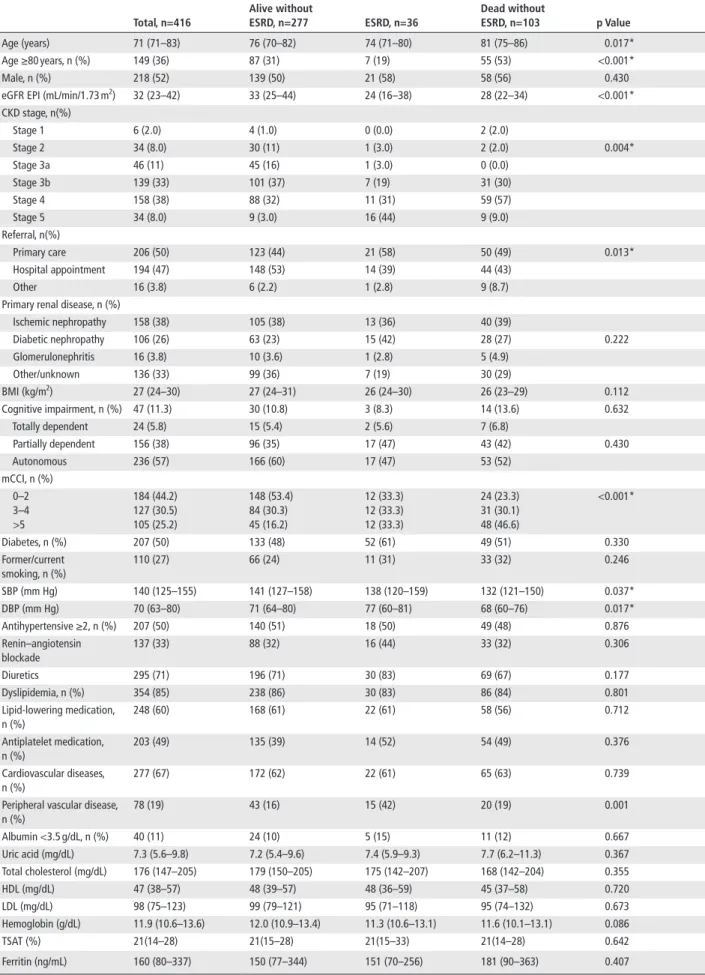
Among 416 patients newly referred, 52% were male, with a mean age of 76 years, and 36% of them aged 80 years or more. Their baseline characteristics are summarized in
table 1.
Fifty per cent of the patients were referred by primary care physicians. At baseline, they had a median eGFR of 32 mL/min per 1.73 m2. The most frequent etiologies of
renal disease were ischemic nephropathy (38%), diabetic nephropathy (25.5%) and unknown causes (13.5%).
Most of the patients were non-smokers (74%) and 22% were obese (BMI >30 kg/m2). About 50% were diabetic, and
96% presented hypertension, of which 50% were receiving more than two antihypertensive drugs, renin–angiotensin blockade in 33% of them; 63% of the patients had a systolic blood pressure >130 mm Hg. Dyslipidemia was present in 85% of the patients, 60% were under lipid-lowering medi-cation. An active or previous malignancy was present in 15% of the patients. Cardiovascular disease was present in 67% of the patients, including coronary artery disease in 25%, peripheral vascular disease in 19% and cerebrovas-cular disease in 23% of the patients.
Regarding functional dependency, 5% of the patients were totally dependent and 38% were partially dependent. Cognitive impairment was present in 11% of the patients.
Most patients had a hemoglobin level ≥11 g/dL (71%), with no iron deficiency (ferritin level ≥100 ng/mL: 75%; transferrin saturation ≥20%: 62%).
Intact PTH was elevated in 81% of the patients, despite good control of calcium–phosphorus levels.
Follow-up and outcomes
During a median follow-up of 3.6 years (min–max: 0.02– 4.3 years), 36 patients progressed to ESRD (8.7%) and 103 patients died (24.8%) prior to ESRD, giving an ESRD rate of 2.7/100 patient-years and a mortality rate of 7.8/100 patient-years, respectively. Figure 1 shows the cumulative incidences of events, considering competing risks.
The leading causes of death prior to ESRD were cardio-vascular (35%), infection (29%), malignancy (21%), other causes (8%), and unknown (7%).
Concerning the 36 patients who initiated RRT, all of them hemodialysis, 18 patients started treatment with an arteriovenous fistula and 18 patients with a venous cath-eter. It should be mentioned that eight patients of overall cohort (1.9%) that underwent fistula died without receiving dialysis.
Hospitalizations
During the follow-up period, 222 patients (53%) were hospitalized for any reason, with a global hospitalization rate of 0.38 per patient-year. Stratifying for the competing events, the hospitalization rate was 1.27 per patient-year in the patients with ESRD, and 1.06 hospitalizations per patient-year in the patients who died before ESRD.
Cardiovascular-related hospitalization accounted for almost 40% of the hospitalization events during the same period. The global cardiovascular hospitalization rate was 0.15 hospitalizations per patient-year, being 0.56 cardio-vascular hospitalizations per patient-year in the patients with ESRD and 0.39 hospitalizations per patient-year in the patients who died before ESRD.
competing-risk analysis of death and esrd
The Cox proportional hazards model indicated that base-line younger age, creatinine higher than 1.6 mg/dL, hemo-globin lower than 11 g/dL, peripheral vascular disease diagnosis, and the occurrence of one or more hospitaliza-tions (all-cause hospitalizahospitaliza-tions) during the follow-up were associated with higher risk of ESRD (table 2). Diabetes mellitus (vs other CKD etiologies) and mCCI score at base-line were not associated with higher risk of ESRD.
Older age, creatinine higher than 1.6 mg/dL, hemoglobin lower than 11 g/dL, mCCI score ≥5, and the occurrence of hospitalizations during the follow-up were associated with death before ESRD.
Conversely, subhazard ratios estimated from compet-ing-risk regression necessarily discriminated between endpoints. Significant risk factors for ESRD included younger age, creatinine higher than 1.6 mg/dL, hemo-globin lower than 11 g/dL, peripheral vascular disease, and the occurrence of one or more hospitalizations during the follow-up (table 3).
Risk factors for pre-ESRD death included older age, creatinine higher than 1.6 mg/dL, hemoglobin lower than 11 g/dL, mCCI score ≥5, and the occurrence of one or more hospitalizations during the follow-up. By adjusting for these competing risks, we show that peripheral vascular disease increases the cumulative incidence of ESRD, but is not associated with increased pre-ESRD mortality. Simi-larly, a mCCI score ≥5 increased the hazard for pre-ESRD death, but not for RRT initiation.
dIscussIon
In our cohort, newly referred patients aged over 65 years with CKD were near threefold more likely to die than progress to ESRD. These results were consistent with those found in previous studies confirming that elderly CKD are
table 1 Baseline clinical characteristics of patients divided by outcomes total, n=416 Alive without esrd, n=277 esrd, n=36 dead without esrd, n=103 p Value Age (years) 71 (71–83) 76 (70–82) 74 (71–80) 81 (75–86) 0.017* Age ≥80 years, n (%) 149 (36) 87 (31) 7 (19) 55 (53) <0.001* Male, n (%) 218 (52) 139 (50) 21 (58) 58 (56) 0.430 eGFR EPI (mL/min/1.73 m2) 32 (23–42) 33 (25–44) 24 (16–38) 28 (22–34) <0.001*
CKD stage, n(%) Stage 1 6 (2.0) 4 (1.0) 0 (0.0) 2 (2.0) Stage 2 34 (8.0) 30 (11) 1 (3.0) 2 (2.0) 0.004* Stage 3a 46 (11) 45 (16) 1 (3.0) 0 (0.0) Stage 3b 139 (33) 101 (37) 7 (19) 31 (30) Stage 4 158 (38) 88 (32) 11 (31) 59 (57) Stage 5 34 (8.0) 9 (3.0) 16 (44) 9 (9.0) Referral, n(%) Primary care 206 (50) 123 (44) 21 (58) 50 (49) 0.013* Hospital appointment 194 (47) 148 (53) 14 (39) 44 (43) Other 16 (3.8) 6 (2.2) 1 (2.8) 9 (8.7) Primary renal disease, n (%)
Ischemic nephropathy 158 (38) 105 (38) 13 (36) 40 (39) Diabetic nephropathy 106 (26) 63 (23) 15 (42) 28 (27) 0.222 Glomerulonephritis 16 (3.8) 10 (3.6) 1 (2.8) 5 (4.9) Other/unknown 136 (33) 99 (36) 7 (19) 30 (29) BMI (kg/m2) 27 (24–30) 27 (24–31) 26 (24–30) 26 (23–29) 0.112 Cognitive impairment, n (%) 47 (11.3) 30 (10.8) 3 (8.3) 14 (13.6) 0.632 Totally dependent 24 (5.8) 15 (5.4) 2 (5.6) 7 (6.8) Partially dependent 156 (38) 96 (35) 17 (47) 43 (42) 0.430 Autonomous 236 (57) 166 (60) 17 (47) 53 (52) mCCI, n (%) 0–2 3–4 >5 184 (44.2) 127 (30.5) 105 (25.2) 148 (53.4) 84 (30.3) 45 (16.2) 12 (33.3) 12 (33.3) 12 (33.3) 24 (23.3) 31 (30.1) 48 (46.6) <0.001* Diabetes, n (%) 207 (50) 133 (48) 52 (61) 49 (51) 0.330 Former/current smoking, n (%) 110 (27) 66 (24) 11 (31) 33 (32) 0.246 SBP (mm Hg) 140 (125–155) 141 (127–158) 138 (120–159) 132 (121–150) 0.037* DBP (mm Hg) 70 (63–80) 71 (64–80) 77 (60–81) 68 (60–76) 0.017* Antihypertensive ≥2, n (%) 207 (50) 140 (51) 18 (50) 49 (48) 0.876 Renin–angiotensin blockade 137 (33) 88 (32) 16 (44) 33 (32) 0.306 Diuretics 295 (71) 196 (71) 30 (83) 69 (67) 0.177 Dyslipidemia, n (%) 354 (85) 238 (86) 30 (83) 86 (84) 0.801 Lipid-lowering medication, n (%) 248 (60) 168 (61) 22 (61) 58 (56) 0.712 Antiplatelet medication, n (%) 203 (49) 135 (39) 14 (52) 54 (49) 0.376 Cardiovascular diseases, n (%) 277 (67) 172 (62) 22 (61) 65 (63) 0.739 Peripheral vascular disease,
n (%) 78 (19) 43 (16) 15 (42) 20 (19) 0.001 Albumin <3.5 g/dL, n (%) 40 (11) 24 (10) 5 (15) 11 (12) 0.667 Uric acid (mg/dL) 7.3 (5.6–9.8) 7.2 (5.4–9.6) 7.4 (5.9–9.3) 7.7 (6.2–11.3) 0.367 Total cholesterol (mg/dL) 176 (147–205) 179 (150–205) 175 (142–207) 168 (142–204) 0.355 HDL (mg/dL) 47 (38–57) 48 (39–57) 48 (36–59) 45 (37–58) 0.720 LDL (mg/dL) 98 (75–123) 99 (79–121) 95 (71–118) 95 (74–132) 0.673 Hemoglobin (g/dL) 11.9 (10.6–13.6) 12.0 (10.9–13.4) 11.3 (10.6–13.1) 11.6 (10.1–13.1) 0.086 TSAT (%) 21(14–28) 21(15–28) 21(15–33) 21(14–28) 0.642 Ferritin (ng/mL) 160 (80–337) 150 (77–344) 151 (70–256) 181 (90–363) 0.407 Continued
total, n=416 Alive without esrd, n=277 esrd, n=36 dead without esrd, n=103 p Value iPTH (pg/mL) 100 (61–155) 98 (61–161) 115 (69–140) 99 (61–156) 0.446 Calcium (mg/dL) 2.4 (2.3–2.5) 2.4 (2.3–2.5) 2.4 (2.3–2.5) 2.3 (2.2–2.5) 0.158 Phosphate (mg/dL) 1.1 (0.99–1.25) 1.1 (0.99–1.24) 1.1 (0.90–1.17) 1.2 (1.00–1.33) 0.292 uPCr (g/g) 0.25 (0.1–1.0) 0.28 (0.11–1.11) 0.19 (0.07–0.47) 0.19 (0.10–0.85) 0.147
Note: Data expressed as medians and IQRs or n (%) when appropriate. Comparisons between continuous variables were done using a non-parametric test (Kruskal-Wallis); associations between categorical variables were analyzed using the χ2 test; *p<0.05.
BMI, body mass index; CKD, chronic kidney disease; DBP, diastolic blood pressure; eGFR, estimated glomerular filtration rate; ESRD, end-stage renal disease; HDL, high density lipoprotein; iPTH, intact parathyroid hormone; LDL, low density lipoprotein; mCCI, modified Charlson Comorbidity Index; SBP, systolic blood pressure; TSAT, transferrin saturation; uPCr, urinary protein-to-creatinine ratio.
table 1 Continued
Figure 1 Cumulative incidence rates for the competing
endpoints of end-stage renal disease or death.
far less likely to develop kidney failure than to die, espe-cially from cardiovascular disease, even with higher CKD stage.6 7 15 16
However, our results differ from others, also from patients with CKD referred for nephrologist care,17 18 who
have been showed to have either similar or even higher risk of ESRD compared with death. We can speculate about the reasons for these differences, namely our patients were older, with a higher burden of comorbidity and frailty. In fact, 25% of our patients have a severe mCCI score (CCI ≥5), 43% have some degree of functional dependency and 11% had a cognitive impairment.
Our cohort fits the frailty phenotype associated with CKD and geriatric syndrome,19 20 in contrast with other
elderly CKD European cohorts newly referred to nephrol-ogists,16 that despite older than our patients, had a good
health status, reflecting a selection bias in referring patients for nephrology care, not found in our group.
To better understand the chances associated with the competing risks between mortality and ESRD, in elderly patients with CKD, where the supply of conservative management is weighed against the benefits and costs of RRT, we have applied a competing-risks model13 that looks
at the cumulative incidence of ESRD or death before ESRD while also taking into consideration competing risk of the alternate outcome. We believe that such approach better identifies prognostic factors for a particular event in the
presence of competing risks and provide an important tool for better decision-making.21
In the competing-risk framework, patients who are younger, with creatinine higher than 1.6 mg/dL, hemoglobin lower than 11 g/dL, had previous peripheral vascular disease and one or more hospitalizations during the follow-up, are more likely to reach ESRD. Those who are older, with creatinine higher than 1.6 mg/dL, hemoglobin lower than 11 g/dL, mCCI score ≥5 and one or more hospitalizations during the follow-up, are more likely to die.
Our findings confirm that renal function at baseline was an important predictor for both ESRD and mortality6 22–25
although this association was stronger for ESRD than for death, still reinforce the importance of early nephrology referral. In fact, in our cohort a shorter time between referral and ESRD was also associated with RRT initiation by catheter as primary access.
We found, as others,26 that anemia (hemoglobin <11 g/
dL) was a predictor of mortality and ESRD, undoubtedly related with adverse cardiovascular effects and the potential role of hypoxia on CKD progression, particularly important in this elderly population. This highlights the importance of anemia treatment although the target hemoglobin is still a matter of debate.14 27
The occurrence of one or more hospitalizations was common in our cohort and it was associated with both outcomes (ESRD and death). The increased risk for mortality among patients with hospitalization is consis-tent with other studies, assuming that the majority of those hospitalizations were cardiovascular-related,28 29 or
associ-ated with an infection event, also known a risk factor for increased cardiovascular events and mortality in patients with CKD.30
The occurrence of hospitalizations events during the follow-up was also associated with ESRD. In our group the global and cardiovascular hospitalization rate was higher in patients with ESRD, than in the patients who died before RRT initiation. These findings are consistent with other studies,29 31 32 as cardiovascular admissions may have served
as a marker for patients who had more progressive isch-emic nephropathy, or more important, related to a superim-posed acute kidney injury (AKI) episode on the underlying CKD.29 33 AKI episodes, frequent in elderly population,
may accelerate progression of renal disease.34 35
We demonstrated that peripheral vascular disease was an independent predictor for ESRD, but was not associated with increased pre-ESRD mortality. These findings extend
table 2 Risk factors associated with death and ESRD (Cox regression analysis)
esrd death
csHr (95% cI) p Value csHr (95% cI) p Value Baseline Age, years 0.95 (0.91 to 1.00) 0.049 1.04 (1.01 to 1.07) 0.004 Creatinine (>1.6 vs <1.6 mg/dL) 3.64 (1.58 to 8.38) 0.002 2.27 (1.44 to 3.57) <0.001 Hb (<11.0 vs >11.0 g/dL) 2.72 (1.35 to 5.49) 0.005 2.20 (1.49 to 3.26) <0.001 CCI score (3–4 vs 1–2) (≥5 vs 1–2) 0.55 (0.22 to 1.39) 0.80 (0.33 to 1.96) 0.205 0.626 1.35 (0.80 to 2.29) 2.82 (1.70 to 4.67) 0.258 <0.001 Peripheral vascular disease
(yes vs no)
3.60 (1.70 to 7.60) 0.001 1.03 (0.64 to 1.68) 0.890 DM vs other CKD etiologies 1.75 (0.85 to 3.58) 0.127 1.02 (0.67 to 1.55) 0.930 During the follow-up
Hospitalizations (yes vs no) 1.72 (1.17 to 2.52) 0.006 1.84 (1.44 to 2.36) <0.001 Note: Values given as csHR (95% CI) for risk factors associated with ESRD and death prior to ESRD.
CCI, Charlson Comorbidity Index; CKD, chronic kidney disease; csHR, cause-specific HR; DM, diabetes mellitus; ESRD, end-stage renal disease; Hb, hemoglobin.
table 3 Risk factors associated with death and ESRD (Fine and Gray model13)
esrd death
sHr (95% cI) p Value sHr (95% cI) p Value Baseline
Age, years 0.94 (0.89 to 0.98) 0.009 1.06 (1.03 to 1.09) <0.001 Creatinine (>1.6 vs <1.6 mg/dL) 3.26 (1.40 to 7.60) 0.006 2.03 (1.25 to 3.29) 0.004 Peripheral vascular disease (yes vs no) 3.45 (1.68 to 7.10) 0.001 0.82 (0.49 to 1.34) 0.435 CCI score (3–4 vs 1–2) (≥5 vs 1–2) 0.57 (0.24 to 1.35) 0.54 (0.23 to 1.28) 0.202 0.164 1.53 (0.87 to 2.69) 3.01 (1.75 to 5.19) 0.137 <0.001 Hb (<11.0 vs >11.0 g/dL) 2.15 (1.09 to 4.24) 0.027 1.91 (1.25 to 2.92) 0.003 DM vs other CKD etiologies 1.72 (0.84 to 3.53) 0.139 0.84 (0.54 to 1.32) 0.447 During the follow-up
Hospitalizations (yes vs no) 1.56 (1.04 to 2.35) 0.031 1.73 (1.33 to 2.25) <0.001 Note: Values given as sHR (95% CI) for risk factors associated with ESRD and death prior to ESRD.
CCI, Charlson Comorbidity Index; CKD, chronic kidney disease; DM, diabetes mellitus; ESRD, end-stage renal disease.; Hb, hemoglobin; sHR, subdistribution HR.
the association between vascular disease and CKD progres-sion founded in other studies,31 36 37 given that peripheral
vascular disease is the result of an atherosclerotic process similar to that one seen in cardiovascular disease. As we know, atherosclerosis is a potentially important mechanism of kidney disease in older persons38 39 and increases the
susceptibility for AKI and CKD progression.40 A study in
European cohort,41 also using a competing risks modeling
approach, showed that the endogenous inhibitor of nitric oxide synthase, asymmetric dimethylarginine, considered one of the strongest markers of atherosclerosis, was an independent predictor of progression to dialysis and death in patients with CKD.
A reduced ankle–brachial index reflects peripheral arterial disease, and some studies demonstrated that this atherosclerotic disease marker predicted accelerated renal function decline, in general population,42 and also in
peri-toneal dialysis patients.43
Given that finding, our study suggests that the presence of peripheral arterial disease, although reflecting an athero-sclerotic systemic process also involving the kidneys, may be a potential marker for renal function decline in patients
with CKD, through other mechanisms, in addition to the traditional association of CKD with vascular damage.
The higher burden of CV risk factors, and prevalent vascular disease, present in our cohort, and the association between peripheral vascular disease and ESRD that we found, may partially explain the highest incidence of ESRD of Portuguese population among European countries,4
because data from the PREVADIAB Study44 have shown
that the prevalence of CKD stages 3–5 was 6.1%, which is similar to that in other Western countries. The reasons for this disparity are still a matter of debate. Although socio-economic and political factors still play a part in RRT rates around the world, other important factors are genetics, birth weight, dietary habits, and diabetes prevalence. Another important issue is the age pattern at beginning of RRT. In countries with lower RRT incidence, the median age at start of RRT appears to be lower, suggesting that countries with higher RRT incidence, like Portugal, start older patients in RRT and this may contribute to differ-ences in RRT epidemiology between countries.45 In this
respect, there is an urgent need for concrete evidence on the relative benefit of conservative treatment versus RRT
in the elderly as well as on the optimal timing of RRT initiation.
Finally, we found that mCCI score ≥5 was an inde-pendent predictor for pre-ESRD death, but not for RRT initiation. The CCI has been widely used and validated in patients with ESRD and seemed to be significantly more predictive for mortality than other comorbidity scoring systems46 47 This is evidenced by studies demonstrating
that elderly patients with CKD are likely to have a higher burden of comorbidity and frailty, which are markers of worst survival.46
Old age alone should not be used as an absolute barrier to treatment when considering the benefits of dialysis in elderly patients with CKD.48 However, in the elderly
patients with CKD with a high burden of comorbidity, conservative management may be a therapeutic option, as dialysis is unlikely to prolong or improve quality of life.49–51
Also, considering the likelihood of death prior to ESRD makes preparation for RRT, as the placement of an arterio-venous access unnecessary and potentially harmful.52
The strengths of our study include the rigorous explo-ration of the first Portuguese CKD cohort that included patients aged 65 years over, newly referred to nephrology, reflecting current clinical practice. We implemented a competing-risk framework for the statistical analysis to examine risk factors based on available clinical and labo-ratory data, for ESRD and differentiating them from those that increase mortality, which is an important tool to guide clinical decision process.
The effect of peripheral vascular disease as an inde-pendent predictor for ESRD in our cohort, although it deserves more research, reinforces the importance of stra-tegic targeting vascular risk screening and reduction in this population.
There are certain limitations to our research. First, this is a single-center retrospective study. Second, due to the overall small number of patients who initiated RRT (n=36), it is not possible to identify the risk factors for progression within each CKD stage. In the stages 3 and 4, only 8 and 11 patients progressed to dialysis, respectively. Thus, we do not have sufficient number of events for performing a reli-able survival analysis using mortality as a competing event.
Third, defining ESRD as the RRT initiation has the disadvantage of being dependent on local clinical practice. Fourth, proteinuria could not be included in the multivari-able models due to the percentage of missings and, there-fore, we could not analyze the effect of proteinuria on the risk of ESRD or death. Finally, because this cohort only comprised patients attending nephrology outpatient clinic, which can introduce a bias of referral, the results may not be generalizable to a non-referred population.
conclusIon
In summary, we found that newly referred older patients with CKD are substantially more likely to die than to reach ESRD. By using a competing-risk approach based on avail-able clinical and laboratory data, we could identify risk factors predictors of CKD progression and distinguishing them from those that increase mortality, which may allow us to use them as a decision-making tool to guide clinical decision process.
contributors JS, IF and JM were involved in research design, writing and in data collection. IB, LL, PO and AC were involved in editing.
competing interests None declared.
ethics approval The study was performed in accordance with the Declaration of Helsinki and approved by the Institutional Review Board of Centro Hospitalar Universitário do Porto.
Provenance and peer review Not commissioned; externally peer reviewed. © American Federation for Medical Research (unless otherwise stated in the text of the article) 2017. All rights reserved. No commercial use is permitted unless otherwise expressly granted.
RefeRences
1 OECD and EU. A good life in Old Age?: monitoring and improving Quality in Long-term care, OECD Health Policy Studies. Paris: OECD Publishing, 2013. 2 Saran R, Li Y, Robinson B, et al. US Renal Data System 2014 Annual data
Report: epidemiology of Kidney Disease in the United States. Am J Kidney Dis
2015;66:A7–S306.
3 Pippias M, Stel VS, Abad Diez JM, et al. Renal replacement therapy in Europe: a summary of the 2012 ERA-EDTA Registry Annual Report. Clin Kidney J
2015;8:248–61.
4 Kramer A, Pippias M, Stel VS, et al. Renal replacement therapy in Europe: a summary of the 2013 ERA-EDTA Registry Annual Report with a focus on diabetes mellitus. Clin Kidney J 2016;9:457–69.
5 Macário F. Gabinete De Registo Da Sociedade Portuguesa Nefrologia. http:// www. spnefro. pt/ comissoesgabinetes/ Gabinete_ registo2015/ registo_ 2015. pdf
6 O’Hare AM, Choi AI, Bertenthal D, et al. Age affects outcomes in chronic kidney disease. J Am Soc Nephrol 2007;18:2758–65.
7 Dalrymple LS, Katz R, Kestenbaum B, et al. Chronic kidney disease and the risk of end-stage renal disease versus death. J Gen Intern Med 2011;26:379–85. 8 Kidney Disease: Improving Global Outcomes (KDIGO) CKD Work Group. KDIGO
clinical practice guideline for the evaluation and management of chronic kidney disease. Kidney Int 2013;3:1–150.
9 Levey SA, Stevens LA, Schmid CH, et al. CKD-EPI (Chronic kidney disease Epidemiology Collaboration). A new equation to estimate glomerular filtration rate. Ann Intern Med 2009;150:604–12.
10 Folstein MF, Folstein SE, McHugh PR. "Mini-mental state". A practical method for grading the cognitive state of patients for the clinician. J Psychiatr Res
1975;12:196–8.
11 Charlson ME, Pompei P, Ales KL, et al. A new method of classifying prognostic comorbidity in longitudinal studies: development and validation. J Chronic Dis
1987;40:373–83.
12 Rattanasompattikul M, Feroze U, Molnar MZ, et al. Charlson comorbidity score is a strong predictor of mortality in hemodialysis patients. Int Urol Nephrol
2012;44:1813–23.
13 Fine JP, Gray RJ. A proportional hazards Model for the subdistribution of a competing risk. J Am Stat Assoc 1999;94:496–509.
14 Locatelli F, Aljama P, Bárány P, et al. Revised European best practice guidelines for the management of anaemia in patients with chronic renal failure. Nephrol Dial Transplant 2004;19 Suppl 2:ii1–47.
15 Demoulin N, Beguin C, Labriola L, et al. Preparing renal replacement therapy in stage 4 CKD patients referred to nephrologists: a difficult balance between futility and insufficiency. A cohort study of 386 patients followed in Brussels.
Nephrol Dial Transplant 2011;26:220–6.
16 Faller B, Beuscart JB, Frimat L, et al. Competing-risk analysis of death and dialysis initiation among elderly (≥80 years) newly referred to nephrologists: a French prospective study. BMC Nephrol 2013;14:103–14.
17 Agarwal R, Bunaye Z, Bekele DM, et al. Competing risk factor analysis of end-stage renal disease and mortality in chronic kidney disease. Am J Nephrol
2008;28:569–75.
18 Levin A, Djurdjev O, Beaulieu M, et al. Variability and risk factors for kidney disease progression and death following attainment of stage 4 CKD in a referred cohort. Am J Kidney Dis 2008;52:661–71.
19 Shlipak MG, Stehman-Breen C, Fried LF, et al. The presence of frailty in elderly persons with chronic renal insufficiency. Am J Kidney Dis 2004;43:861–7. 20 Roshanravan B, Khatri M, Robinson-Cohen C, et al. A prospective study
of frailty in nephrology-referred patients with CKD. Am J Kidney Dis
2012;60:912–21.
21 Kim HT. Cumulative incidence in competing risks data and competing risks regression analysis. Clin Cancer Res 2007;13:559–65.
22 Landray MJ, Emberson JR, Blackwell L, et al. Prediction of ESRD and death among people with CKD: the chronic renal impairment in Birmingham (CRIB) prospective cohort study. Am J Kidney Dis 2010;56:1082–94.
23 Foley RN, Murray AM, Li S, et al. Chronic kidney disease and the risk for cardiovascular disease, renal replacement, and death in the United States Medicare population, 1998 to 1999. J Am Soc Nephrol 2005;16:489–95. 24 Coresh J, Turin TC, Matsushita K, et al. Decline in estimated glomerular filtration
rate and subsequent risk of end-stage renal disease and mortality. JAMA
2014;311:2518–31.
25 Hallan SI, Matsushita K, Sang Y, et al. Chronic kidney disease Prognosis Consortium. Age and association of kidney measures with mortality and end-stage renal disease. JAMA 2012;308:2349–60.
26 Thorp ML, Johnson ES, Yang X, et al. Effect of anaemia on mortality, cardiovascular hospitalizations and end-stage renal disease among patients with chronic kidney disease. Nephrology 2009;14:240–6.
27 Mimura I, Tanaka T, Nangaku M. How the Target Hemoglobin of Renal Anemia Should Be. Nephron 2015;131:202–9.
28 Lee DS, Austin PC, Stukel TA, et al. Dose-dependent impact of recurrent cardiac events on mortality in patients with heart failure. Am J Med 2009;122:162. e1–162.e9.
29 Sud M, Tangri N, Pintilie M, et al. Risk of end-stage renal disease and death after cardiovascular events in chronic kidney disease. Circulation
2014;130:458–65.
30 Cheikh Hassan HI, Tang M, Djurdjev O, et al. Infection in advanced chronic kidney disease leads to increased risk of cardiovascular events, end-stage kidney disease and mortality. Kidney Int 2016;90:897–904.
31 Elsayed EF, Tighiouart H, Griffith J, et al. Cardiovascular disease and subsequent kidney disease. Arch Intern Med 2007;167:1130–6.
32 Kalra PA, Guo H, Kausz AT, et al. Atherosclerotic renovascular disease in United States patients aged 67 years or older: risk factors, revascularization, and prognosis. Kidney Int 2005;68:293–301.
33 Johnson ES, Smith DH, Thorp ML, et al. Predicting the risk of end-stage renal disease in the population-based setting: a retrospective case-control study.
BMC Nephrol 2011;12:17–24.
34 Ishani A, Xue JL, Himmelfarb J, et al. Acute kidney injury increases risk of ESRD among elderly. J Am Soc Nephrol 2009;20:223–8.
35 Schmitt R, Coca S, Kanbay M, et al. Recovery of kidney function after acute kidney injury in the elderly: a systematic review and meta-analysis. Am J Kidney Dis 2008;52:262–71.
36 Shlipak MG, Katz R, Kestenbaum B, et al. Clinical and subclinical cardiovascular disease and kidney function decline in the elderly. Atherosclerosis
2009;204:298–303.
37 Kuo TH, Yang DC, Lin WH, et al. Compliance Index, a Marker of Peripheral Arterial Stiffness, may Predict Renal Function Decline in Patients with Chronic Kidney Disease. Int J Med Sci 2015;12:530–7.
38 Kasiske BL. Relationship between vascular disease and age-associated changes in the human kidney. Kidney Int 1987;31:1153–9.
39 Bleyer AJ, Shemanski LR, Burke GL, et al. Tobacco, hypertension, and vascular disease: risk factors for renal functional decline in an older population. Kidney Int 2000;57:2072–9.
40 Mittalhenkle A, Stehman-Breen CO, Shlipak MG, et al. Cardiovascular risk factors and incident acute renal failure in older adults: the cardiovascular health study. Clin J Am Soc Nephrol 2008;3:450–6.
41 Ravani P, Tripepi G, Malberti F, et al. Asymmetrical dimethylarginine predicts progression to Dialysis and death in patients with chronic kidney disease: a competing risks modeling approach. J Am Soc Nephrol 2005;16:2449–55. 42 Foster MC, Ghuman N, Hwang SJ, et al. Low ankle-brachial index and the
development of rapid estimated GFR decline and CKD. Am J Kidney Dis
2013;61:204–10.
43 Tian SL, Tian XK, Han QF, et al. Presence of peripheral arterial disease predicts loss of residual renal function in incident CAPD patients. Perit Dial Int
2012;32:67–72.
44 Vinhas J, Gardete-Correia L, Boavida JM, et al. Prevalence of chronic kidney disease and associated risk factors, and risk of end-stage renal disease: data from the PREVADIAB study. Nephron Clin Pract 2011;119:c35–c40. 45 Gonzalez-Espinoza L, Ortiz A. 2012 ERA-EDTA Registry Annual Report: cautious
optimism on outcomes, concern about Persistent inequalities and data black-outs. Clin Kidney J 20152015;8:243–7.
46 Pugh J, Aggett J, Goodland A, et al. Frailty and comorbidity are independent predictors of outcome in patients referred for pre-dialysis education. Clin Kidney J 2016;9:324–9.
47 van Manen JG, Korevaar JC, Dekker FW, et al. How to adjust for comorbidity in survival studies in ESRD patients: a comparison of different indices. Am J Kidney Dis 2002;40:82–9.
48 Jassal SV, Trpeski L, Zhu N, et al. Changes in survival among elderly patients initiating Dialysis from 1990 to 1999. CMAJ 2007;177:1033–8.
49 Chandna SM, Da Silva-Gane M, Marshall C, et al. Survival of elderly patients with stage 5 CKD: comparison of conservative management and renal replacement therapy. Nephrol Dial Transplant 2011;26:1608–14.
50 Kurella Tamura M, Covinsky KE, Chertow GM, et al. Functional status of elderly adults before and after initiation of Dialysis. N Engl J Med 2009;361:1539–47. 51 Carson RC, Juszczak M, Davenport A, et al. Is maximum conservative
management an equivalent treatment option to Dialysis for elderly patients with significant comorbid disease? Clin J Am Soc Nephrol 2009;4:1611–9. 52 O’Hare AM, Bertenthal D, Walter LC, et al. When to refer patients with chronic
kidney disease for vascular access surgery: should age be a consideration?