Procedia - Social and Behavioral Sciences 217 ( 2016 ) 1203 – 1209
ScienceDirect
1877-0428 © 2016 Published by Elsevier Ltd. This is an open access article under the CC BY-NC-ND license (http://creativecommons.org/licenses/by-nc-nd/4.0/).
Peer-review under responsibility of Future Academy® Cognitive Trading doi: 10.1016/j.sbspro.2016.02.149
Future Academy®’s Multidisciplinary Conference
Psychological Features Associated with Health in Undergraduate
Students
Madalena Cunha
a, Carlos Albuquerque
a*, Rosa Martins
a, António Madureira
a, Isabel
Bica
a, Cristina Oliveira Albuquerque
ba
Instituto Politécnico de Viseu, CI&DETS, ESSV, R. D. João Crisóstomo Gomes de Almeida, n.º 102
3500-843 Viseu, Portugal
b
Centro Hospitalar Tondela-Viseu, EPE, Av. Rei Dom Duarte, 3504-509 , Viseu, Portugal
Abstract
Background: The social and human sciences have enormously contributed to the study of health and well being of populations
as well as to the risk factors and individual resilience that are associated to them. Thus, it is a general thought that one of the main functions of health professionals is to promote healthy behaviours in people. Aim: To verify if some psychological characteristics (Self-Esteem, Locus of Control, Internal Sense of Coherence) are associated to health( lifestyle, health state, general health perception) in higher education students. Method: The sample was made up by 548 students, men and women, who were attending Nursing School (n= 322) and other graduations without any health studies- Management, Languages, Secretarial and Administration (n=226). The protocol included: Inventory "My Lifestyle" Scale "State of Health"; To measure psychological variables: Sense of Coerence Questionnaire; Self-Esteem Clinical Inventory; Self-Esteem Physical Inventory; and Locus of Control Questionnaire. Results: There is an association, statistically significant between health variables and psychological variables, in the expected sense. Also, the results suggest that the Internal Sense of Coherence factors - understanding(ß= .336) and generalised significance(ß= .294)- are, in interaction with General Health Perception, predictors in a positive and highly significant way, for Health State, specifically in Nursing School Students. Conclusion: We believe this study points to a growing need of a bigger participation of psychologists (along with other health professionals) in the development of programs related to public health. Apart from an involvement in primary health care it will also be important for these professionals to participate in differentiated care.
© 2016 The Authors. Published by Elsevier Ltd.
Peer-review under responsibility of Future Academy® Cognitive Trading. Keywords: Self-Esteem, Locus of Control, Internal Sense of Coherence, Health, Students
* Corresponding author. Tel.: +351966177002.
E-mail address: [email protected]
© 2016 Published by Elsevier Ltd. This is an open access article under the CC BY-NC-ND license (http://creativecommons.org/licenses/by-nc-nd/4.0/).
1. Introduction
Recently, social and human sciences have enormously contributed to the study of health and well being of populations as well as to the risk factors and individual resilience that are associated to them (Albuquerque, 2012).
Thus, it is a general thought that one of the main functions of health professionals is to promote healthy behaviours in people. However, many of these professionals when they are suggesting people that they should not smoke, should exercise or shouldn't share needles, soon realise that their well intentioned efforts have no satisfactory result, as often no significant changes are observed in individuals (Wardle, et al., 2004).
So, good will and sensibility are not enough in promoting healthy lifestyle learning. One has to understand health-disease dynamics in people. One has to know which factors- biological, social and psychological- emphasise vulnerability and how to act to reinforce individual resilience.
This research has appeared within this context. In it is emphasised the importance of making a multi-subject approach to Health, for which Psychology can give an important contribution in the understanding of some personal factors involved in the processes of health promotion and maintenance.
2. Problem
The social and human sciences have enormously contributed to the study of health and well being of populations as well as to the risk factors and individual resilience that are associated to them.
3. Question
Will certain psychological variables determine the health status in higher education students?
4. Purpose of the Study
This investigation was intended to study if some psychological characteristics( Self-Esteem, Locus of Control, Internal Sense of Coherence) are associated to health( lifestyle, health state, general health perception) in undergraduate students, more precisely Nursing School students. That is to say, the main goal of the investigation was focused in the study of psychological characteristics that can be associated with health practices and risk behaviours, that are believed to be, respectively, beneficial and prejudicial to health. The other two goals were related with the possibility of determining the influence of the year attended and the area of studies( health versus non health) in health variables being studied.
5. Methodology
The sample was made up by 548 students, men and women, who were attending Nursing School (n= 322) and other graduations without any health studies- Management, Languages, Secretarial and Administration (n=226). Empirical Studies: (i) Empirical Study 1: study of the relation between psychological variables and health variables. Statistical tests used were Multiple Regression Analysis; (ii) Empirical Study 2: study of the relation between the graduation year attended by students, and health and psychological variables being studied. In the study were used Discriminant Function Analysis; (iii) Empirical Study 3: study of the relation between the students' graduation subject, and health and psychological variables being studied. For this multivaried study were used multivaried variance analysis- MANOVA.
The protocol the quantitative study (descriptive-correlational), included: (i) To measure health variables: Inventory "O Meu Estilo de Vida"- OMEV (Ribeiro, 1993); Scale "Estado de Saúde"- ES (Albuquerque, 1999); Questionnaire "A Minha Saúde"- MAS (Ribeiro, 1993); (ii) To measure psychological variables: Sense of Coerence Questionnaire- SOC (Antonovsky, 1992); Self- Esteem Clinical Inventory- ICAC; Self- Esteem Physical Inventory- IACF; Locus of Control Questionnaire- "O que Penso da Saúde"- OQPS (Ribeiro, 1993).
6. Results
1- First Empirical Study: Relation Between Psychosocial Variables and Health Variables
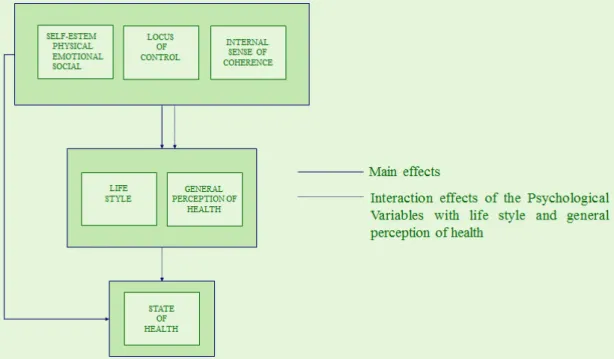
It was our intention to study the effect of psychosocial variables in the prediction of health variables using the regression model. We have studied the main effect, as well as the interaction effect, of psychosocial variables with Lifestyle and General Perception of Health, in the prediction of State of Health in Nursing School Students( Fig.1). A results summary of Regression Analysis made is described in Tables 1 and 2.
Fig. 1 - Studied relations between psychological variables and Life Style, State of Health and General Perception of Health.
1.1- "Main Effects" Study
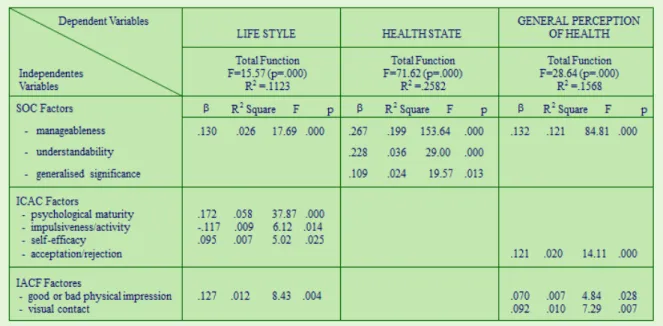
The study has revealed that there is an association, statistically significant (Table 1), between health variables and psychological variables, in the expected sense, that is to say, students whose psychological variables have higher values express, generally, higher health.
Table 1- Step by step Multiple Regression Analysis Results summary – main effects study psychological variables in the prediction of health variables
1.1.1- Dependent Variable: LIFESTYLE
Results let us conclude that Self-Esteem( physical, emotional and social) was the best predictor of Lifestyle, in the Regression Analysis. Apart from this, we have also verified that the most important Self-Esteem factors, for their predictive value, were "psychological maturity" (ß=.172), "good or bad physical impression"(ß=.127)," impulsiveness/activity"(ß=.117) and " self-efficacy"(ß= .095).
These results are in accordance with the majority of studies revised (Muhlenkamp and Sayles, 1986; Duffy, 1988; Essex and Klein, 1989; Ribeiro, 1993) and show that Self-Esteem is a psychological variable related to the health variable Lifestyle.
1.1.2- Dependent Variable: HEALTH STATE
The only predictor of Health State was Internal Sense of Coherence. Its three factors- control( ß= .267), understanding( ß= .228), generalised significance(ß= .109)- have contributed in a positive way to the increase of Health State levels( Table 1). This is in accordance with results obtained by other empirical investigations (Antonovsky, 1992; Geada, 1996).
1.1.3- Dependent Variable: GENERAL HEALTH PERCEPTION
Regression equation results allowed to conclude that the best predictor for General Health Perception has been the factor "control" in the Internal Sense of Coherence which alone, and in a positive way( ß= .132), explains 12.10% (p=.000) of the total variance explained by the regression model( 15.68%).
We can conclude that Nursing School students that do not feel victims of events, generally show a higher General Health Perception, which is in accordance with results from other empirical studies( Wardle et al.,1994).
1.2- "Interaction Effects" Study
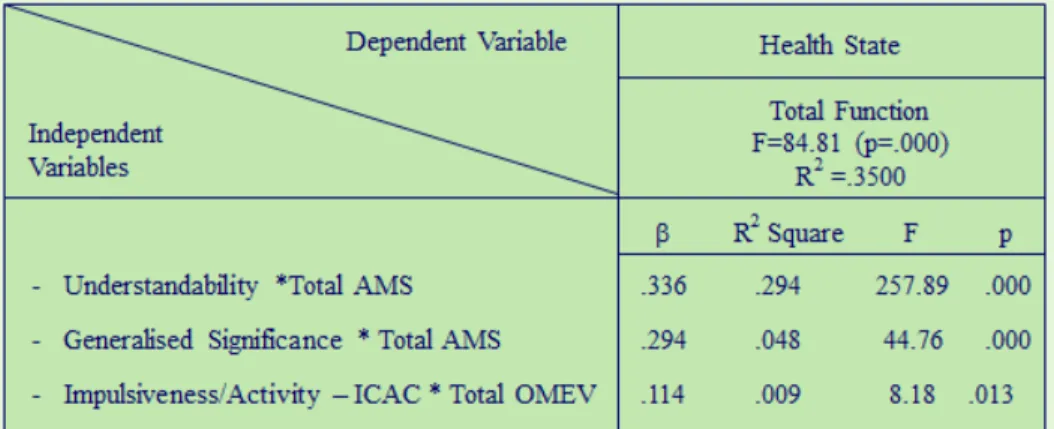
The results (Table 2) suggest that the Internal Sense of Coherence factors - understanding(ß= .336) and generalised significance(ß= .294)- are, in interaction with General Health Perception, predictors in a positive and highly significant way, for Health State in Nursing School Students. This alone explains 34.20% (p=.000) of the total variance explained by regression model( 35.00%)- ( Table 1). We also emphasise that interaction of factor 4
from ICAC - impulsiveness/activity- with the rate of Total Lifestyle has also proved to have significant additive effects.
Our effects are once more in accordance with other empirical investigations ( Antonovsky et al., 1992), which confirm that Internal Sense of Coherence is directly related with State of Health, not only in a correlative way but also in a predictive one. More, they are in accordance with what Slater and Linder defend when they state that "... the adherence of health behaviours, or risk behaviours, influenced by Health State, can have important consequences in health levels, present or future, in individuals".
Table 2- Step by step Multiple Regression Results summary – interaction effects study of psychological variables with Life Style, General Health Perception in the prediction of Health State.
2- Second Empirical Study - Relation between graduation year attended by Nursing School students and the Health Variables being Studied.
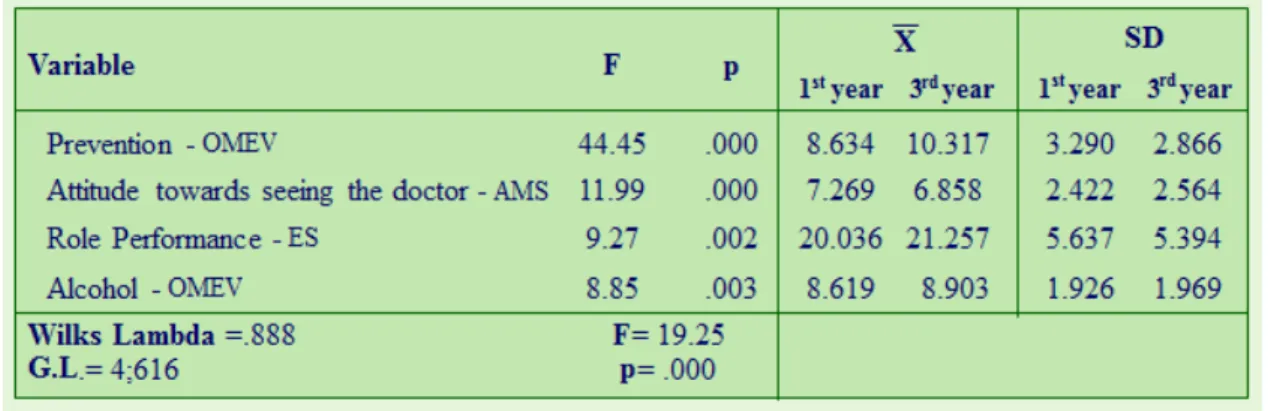
When analysing the results of this empirical study we verified that when comparing the two groups of students from Nursing School( first year versus third year) these were significantly differentiated by four variables accepted in the Discriminant Function Analysis (Table 3). Students attending third year showed generally better rates in those health variables. More precisely, when comparing the means of descriminant variables (Table 4) we observe that differentiation between students in the first year and their colleagues in the third year is made by the existence in the former of: a) lower values in the prevention dimension, shown by a less preventive attitude towards prejudicial health aspects; b) a predisposition to drinking more and paying less attention to alcohol effects; c) a bigger interference of health in their daily activities( at school or other); d) better attitude towards seeing the doctor.
Table 3 - Differences between groups of nursing students attending 1st year versus 3rd year, in Health variables.
We would like to make reference to the fact that these results confirm indications from Beck et al.(1993) that the level of education could influence health and risk behaviours. The results of this investigation leed us to the conclusion, even if taking some risks, that the level of education in Nursing School has a direct and positive relation with some health behaviours. More precisely, as students progress in the course they have a tendency to show better health behaviour. This is understandable because students in this degree absorb knowledge in health areas.
3- Third Empirical Study: Comparing groups attending Nursing School versus groups without any health studies, in the health variables being studied.
The analysis of area of studies effect on health variables being studied (global notes) has shown that( Fig. 2) the groups of students with versus without health studies only showed differences in Lifestyle ( F(1;944)= 30.625, p=.000). Thus, considering the means values obtained by the group of students attending Nursing School (x= 1000.45) and by the group of students attending other degrees not related with health(x=95.10), we can conclude that the former show better Lifestyle.
We believe that for this difference can contribute the fact that Nursing School Students, contrary to students attending other degrees without any studies related to Health, receive scientific training (theory and practice) during the three year course duration, which is specifically directed to health promotion and disease prevention in a biopsicosocial context.
7. Conclusion
To conclude we would like to stress that, according to the results found, psychological variables (self-esteem, locus of control, internal sense of coherence) are related to health variables (lifestyle, health state, general health perception) in a sample made up by undergraduate students. On the other hand, it was possible to observe that the course year attended by students as well as the area of studies differentiate the groups of students according to the health variables being studied.
This way, we believe this study points to a growing need of a bigger participation of psychologists (along with other health professionals) in the development of programs related to public health (e.g. promoting correct food habits and prevention of substance abuse). Apart from an involvement in primary health care it will also be important for these professionals to participate in differentiated care. Thus, Psychology of Health can contribute in an important way in interventions to reduce risk behaviours, in modifying inadequate health representations and in implementing quality of life in sick people.
We believe this study points to a growing need of a bigger participation of psychologists (along with other health professionals) in the development of programs related to public health. Apart from an involvement in primary health care it will also be important for these professionals to participate in differentiated care.
References
Albuquerque, C. (2012). Características Psicológicas Associadas à Saúde em Estudantes do Ensino Superior. Escola Superior de Saúde de Viseu - Portugal.
Antonovsky, A. (1992). Can attitudes contributes to health?. Advances, 8 (4) 33-49.
Beck, A., Wright, F., Newman, C., & Liese, B. (1993). Cognitive therapy of substance abuse. New York: The Guilford Press.
Duffy, M.E. (1988). Determinants of health promotion in midlife women. Nursing Research, 37 (6), 358-362. Essex, M.J., & Klein, M.H. (1989). The importance of the self-concept and coping responses in explaining physical
health status and depression among older women. Journal of Aging and Health, 1 (3), 327-348.
Geada, M. (1996). Mecanismos de defesa e de coping e níveis de saúde em adultos. Análise Psicológica, 14 (2/3), 191-201.
Muhlenkamp, A., & Sayles, J. (1986). Self-esteem, social support, and positive health practices. Nursing Research, 35 (6), 334-338.
Ribeiro, J.L. (1993). Características Psicológicas Associadas à Saúde em Estudantes, Jovens, da Cidade do Porto. Dissertação de Doutoramento. Universidade do Porto.
Slater, C., & Linder, S. (1988). A reassessment of the additive scoring of health practices. Medical Care, 26 (12), 1216-1227.
Wardle, J., Geada, M., Justo, J., Santos, S., & Steptoe, A. (2004). Hábitos de saúde, comportamentos de risco e níveis de saúde física e psicológica em estudantes universitários. In T.M. MacIntyre (Ed.), Psicologia da saúde: