The Hyperbolic Forest Owner
Maria M. Ducla-Soares, Clara Costa-Duarte, and Maria A. Cunha-e-Sá
October 19, 2001
Faculdade de Economia, Universidade Nova de Lisboa. Address: Campus de Campolide, 1099-032 PT
Lisboa. Telephone: 351-21-3801600; Fax: 351-213886073. E-mail: [email protected]. Financial support from FCT Program Sapiens 99 is gratefully acknowledged.
Abstract
This paper examines the implications of quasi-hyperbolic inter-temporal preferences to the Faustman model. The use of decreasing discount rates leads to dynamically inconsistent behavior. To solve this problem a two-stages optimization decision model is developed. The resulting actual cutting time will be anticipated compared to the Faustman optimal cutting time. If, alternatively, the equivalent constant rate of discount is the empirically observed discount rate, then the optimal cutting time is the same, but the present value of profits for the hyperbolic forest owner is always higher than the one resulting from the equivalent constant discount rate. All these results apply to both the single and the multiple rotation problems.
Keywords: Hyperbolic discounting; time preference; dynamic inconsistency; Faustman model; optimal rotation.
1. Introduction
Economic analyses of inter-temporal choice have extensively used the discounted utility model in which agents discount the future at a constant exponential rate. Recently, the discounted utilitarian framework has been questioned, mainly because it imposes an asymmetry between present and future generations. Society is worried about issues such as global warming, nuclear waste, species extinction and other long-run phenomena, whose consequences may be felt only in the long-term future. This concern about the future is not captured by discounted utilitarianism.
In many circumstances, observed preference patterns run counter the predictions of the discounted utility framework. Among the preference patterns creating difficulties for the discounted utility model, and perhaps the most important one, there is the sensitivity to time delay. And there is experimental evidence now that individuals considering inter-temporal decisions display, in fact, a discount rate that declines with the future.1 People are more sensitive to a given time delay if it occurs earlier rather than later. This possibility of non-constant discounting is suggested by a number of studies that include experiments involving the discounting of monetary payoffs (Thaler, 1981; Lowenstein and Thaler, 1989), and also individuals’ attitudes with respect to the life-saving activities of government (Cropper et al., 1994). Typically, studies that have examined individual inter-temporal preferences for health
1 The idea of a hyperbolic discounting was first proposed by psychologists and goes back to Chung and Herrnstein (1961) to characterize animal behavior and later applied to humans. Economists used hyperbolic discounting to intergenerational utility flows (Phelps and Pollak, 1968; Harvey, 1986), as well as intrapersonal utility flows (Laibson, 1996)
outcomes (Cairns, 1994; Olsen, 1993), have rejected the discounted utility model. These studies indicate that a high discount rate for more proximate years and a lower discount rate for more distant years better describe the individual time preferences in the health decision process.
More recently, Laibson (1996) examined the relationship between hyperbolic discount functions, undersaving, and saving policy. Barro (1997) explored the consequences of nonconstant rates of time preferences for the standard results on consumer behavior and economic growth that emerge from the neoclassical growth model.
The use of decreasing discount rates is not without problems. In particular, they lead to dynamically inconsistent behavior. The individual is involved with a decision that raises an intra-personal conflict; he, now, reveals a patient attitude regarding future trade-offs, but reverses this attitude when the future becomes today. In other words, from today’s perspective, the discount rate between two distant periods t and t+1 is a long-run low discount rate; from the time t perspective the discount rate between t and t+1 is a short-run high discount rate. Laibson (2001) has modeled the dynamic choices of hyperbolic consumers in the context of an intrapersonal game where the players are autonomous temporal “selves”.
In this paper, we will examine the implications of introducing quasi-hyperbolic preferences for the standard results in forestry economics. In all forestry problems dealing with long-run decisions the models have typically assumed constant discount rates and, here, as in other areas of economics, nonconstant discounting schemes, particularly the quasi-hyperbolic model, help to analyze and provide new insights to these problems.
In the context of forestry economics, the use of decreasing discount rates may contribute to a better understanding of the decision making process that characterizes private forest owners. Often, we observe that forest owners do not behave as expected, anticipating the cutting time, and, thus, frustrating the predictions of the Faustman model based on constant discounting. The results obtained in this paper suggest that one possible explanation for the observed behavior relies on the fact that individuals may have a tendency to act myopically, in the sense that rates of time preference are very high in the short-run but much lower in future
dates. Ultimately, this is an empirical problem which requires further research, and which is not the purpose of this paper.2
We will, first, contrast the optimal harvesting schedule in the traditional exponential approach to a model embedding a quasi-hyperbolic discount rate (hence decreasing with the time delay). The relationship between them depends on the behavior of the growth function over time as well as on the definition of the “equivalent” constant rate of return. It is shown that for similar long-run discount rates, quasi-hyperbolic discounting will most likely decrease the value of the forest investment.
Second, the time inconsistency raised by the quasi-hyperbolic discounting is addressed by formalizing differently the problem of the forest owner. The optimal decision is derived, both in the single and multiple rotation cases. Here, and in contrast to the present value results, the optimal cutting time is always anticipated, and for equivalent discount rates the value of the forest investment is higher.
The remainder of the paper is organized as follows. Section 2 compares constant and nonconstant discount schemes. In Section 3, the timber rotation problem is examined, while in Section 4 the implications of time inconsistent behavior are addressed for the single rotation case. Section 5 extends the results in Section 4 for the multiple rotation case. Finally, Section 6 concludes the paper. All technical details are presented in the appendices.
2. Non constant versus constant discounting
Constant rate discounting utility models are widely used in the context of economic evaluations. Constant exponential discounting implies that the discount factor Φ(t) applied to equal time intervals is the same, that is, Φ(t)=δt, where the discount rate –ln(δ) is constant.
However, there is a generalized impression that this representation of individual inter-temporal preferences is far from realistic. In fact, empirical evidence suggests that the discount rate should fall over time. In other words, the discount rate applied to near-term benefits is
higher than the discount rate applied to long-term benefits. Also, concern about the long-run future implies that the future discount factor should be higher than the one implied by constant discounting. To model this type of change in preferences, we will examine the discrete time quasi-hyperbolic discount function, contrasting thisdiscounting scheme to the exponential one.3
The discrete time quasi-hyperbolic discount function refers to the discount factors
...}
,
,
,
,
1
{
βδ
βδ
2βδ
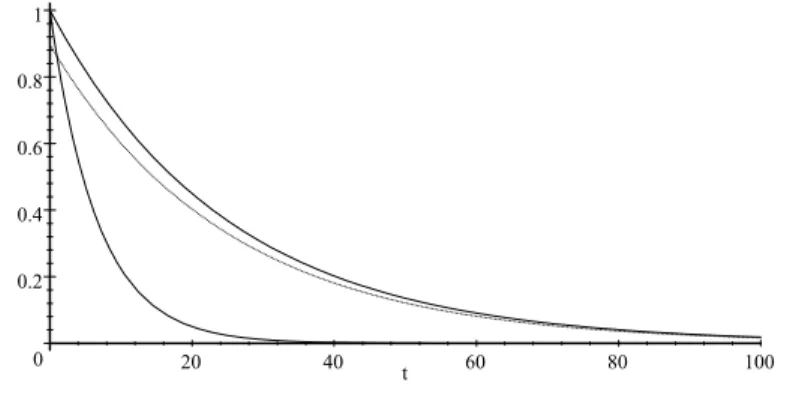
3 corresponding to periods t=0,1,2,3,…. For 0<β<1, this discount scheme maintains the nice tractability properties of the exponential discount function, and, at the same time, captures the qualitative properties of the hyperbolic function, namely that discount rates decline overtime. In fact, the short-run discount rate, -ln(βδ), is greater than the long-run discount rate, -ln(δ). This discrete function has the normalization property that for t=0 it assumes the value 1.Obviously, the two parameters β and δ play an important role regarding the representation of different preference structures. The constant factor δ reflects time preference (myopia). The constant factor β applied equally to all future benefits measures the different intensity with which the immediate benefits are valued relatively to the future ones. Therefore, the combination of different values of the coefficients β and δ reflect different individual tradeoffs between present and future. Figure 1 compares the quasi-hyperbolic discount factor with the corresponding constant short-run and long-run discount functions.
3 All the results derived in this paper can be also obtained using a generalized hyperbolic discount
Figure 1 - Discount factors
---Quasi-hyperbolic; β=0.89; δ=e-0.04
Exponential 0.04; 0.15
In the next section we will discuss the quasi-hyperbolic discounting and its consequences to the theory of forestry economics.
3. The timber rotation problem
In forestry economics, the simplest economic problem is to choose the appropriate time of harvest (rotation period) so as to maximize the present value of profits of the forest owner (the value of the trees). It is common in this literature to examine the optimal rotation problem in the cases of (i) a single rotation period and (ii) multiple rotations, considering that: (i) in the single rotation, the trees are not going to be replaced after the existing ones are cut, and (ii) in the multiple rotation, infinite rotation cycles are possible. The current planting decision depends on the value now of the future harvest. This value is linked to the discount scheme adopted to convert the value of the trees from one point in time to another.
By using the traditional exponential discount, the simplest forest owner problem can be formalized for the single rotation and the multiple rotations, respectively, as:
T
δ
δ
δ
−
=
=
1
G(T)
V(T)
Max
ii)
G(T)
V(T)
Max
i)
T T T T 0 0.2 0.4 0.6 0.8 1 20 40 t 60 80 100where T is the harvest age, V(T) is the present value of profits G(T) at time T, and
δ
Tis the discount factor. The solutions of these problems are the values of t=T*, such that:
*
1
)
ln(
)
G(T
)
(T
G
ii)
)
ln(
)
G(T
)
(T
G
i)
* * * * T
δ
δ
δ
−
−
=
′
−
=
′
(1)where –ln(δ) is the discount rate which is assumed constant over all future periods, and T* is the cutting time that maximizes the present value of profits of the forest owner V(T*) in either case.
Using a quasi-hyperbolic discount factor, the forest owner problem for the two cases can be stated as follows:
T T qh T T qh T
1
G(T)
(T)
V
Max
ii)
G(T)
(T)
V
Max
i)
δ
−
βδ
=
βδ
=
where
V
qh(T)
represents the present value of G(T) associated to the quasi hyperbolic discount. The first order conditions are:* qh T * qh * qh * qh * qh
1
)
(
ln
)
G(T
)
(T
G
ii)
)
(
ln
)
G(T
)
(T
G
i)
δ
−
δ
−
=
′
δ
−
=
′
(2)where Tqh* is the optimal time to cut in this case, and V(Tqh* ) the corresponding present value of potential profits.4
The question now is to compare the quasi-hyperbolic optimal decision with the exponential one. The problem arising when we need to compare the decisions implied by the
two types of discounting is how to define an equivalent constant discount rate. The recent literature dealing with hyperbolic discounting presents several ways of establishing equivalence with the constant discount rate. One possibility is to define an equivalence based on a previously defined short-run (for example, t=1) and a long-run rate of discount. Another possibility is to establish the equivalence with the rate of discount implicit in the relevant economic decision under analysis, that is, the empirically observed discount rate. We will adopt this last one and, therefore, the equivalent constant discount rate is
r
=
−
ln(
δ
)
. As the first-order conditions (1) and (2) are similar, the solutionsT
*and Tqh* are equal. In other words, the optimal cutting time is the same in both cases. However, as β<1, the present value of profits is lower in the case of the quasi-hyperbolic discount, either for the single rotation case or the multiple rotations one.This result does not reflect a higher concern for the future, as we would expect with a quasi-hyperbolic discounting, since for the equivalent constant discount rate the present value of the forestry investment is lower. However, as we will see in the next section, if the forest owner behaves as an hyperbolic discounting agent, the optimal cutting time, as defined in this section, will be in most cases anticipated. This is due to the inter-temporal inconsistency problem that characterizes the behavior of the forest owner in the quasi-hyperbolic case. In fact, the above results are valid only if the forest owner commits himself at the initial period, t=0, to the optimal cutting time, t=
T
*, which, in this context, is not a credible assumption.4. The time-inconsistency problem: the single rotation case
As we mentioned above, one of the main consequences of using decreasing discount rates without commitment at the initial period is the presence of dynamic inconsistent behavior. In Section 3, the forest owner problem is set as if he decides at present, once and for all, the optimal time to cut. In other words, the optimal cutting time is t=T* that maximizes the present
4 In the single rotation case,
=
<
βδ
=
− * * * * t T * qh tT
for t
,
)
T
(
G
T
for t
),
T
(
G
)
T
(
V
*value of profits of the forest owner. With a constant discount rate, the optimal cutting time is consistently kept the same over the time horizon; however, this is not the case if a decreasing discount rate is considered. In fact, the marginal condition defining the optimal cutting time when the forest owner makes plans at t=0 (given by equations (2)) will not be consistent with the short-run marginal condition when the forest owner actually decides to cut.
One possible way to overcome this inconsistency problem is to formalize the forest owner problem in a different way. Instead of considering that the forest owner decides at present, once and for all, the optimal cutting time, we let him review and update his decision period after period. We will start by restricting our analysis to the case of a single rotation because since it provides intuition to the problem and, besides, it represents a benchmark.
Let us assume that, at each moment t, the forest owner faces two types of investment decision: a short-run type decision (cutting the trees) and a long-run type decision (buying or selling the forest land). At each time t, the forest owner compares the value of the timber that he receives if he decides to cut, with the maximum amount that he could get in the future if he decides to delay the cutting time.5 This value is the current potential value of future profits, implying that his decision, at each time t, is forward-looking. When the forest owner decides to cut the trees, the problem ends,6 and he receives the value of the timber at the cutting time, which is also the maximum that he can get from selling the forested land.
Let us consider first the case of the constant discounting. At each time t, the problem of the forest owner can be stated as follows:
Current Value t=0
Max
{
G
(
0
),
V
( )
T
G
( )
T
*}
0 T * 0 0 * 0δ
=
…5
Note that this second alternative of delaying the cutting time is equivalent to selling the forested land at t.
t=t
Max
{
G
(
t
),
V
( )
T
G
( )
T
*}
t t T * t t * t−δ
=
…where Vt (.) represents the current value at t (t=0,1,2,…) of the forested land, and
T
t* is the solution of the following problem:)
T
(
G
)
T
(
V
Max
T t t t t T t t −δ
=
satisfying the first order condition
).
ln(
)
T
(
G
)
T
(
G
* t * t=
−
δ
′
The problem presented above involves two optimization stages. In the first stage, at each moment t, the optimal cutting time is determined. In this case, the optimal cutting time
T
t* is the same for every period t. Let us call itT
*. This is the common optimization problem in forestry economics known as the Fisher principle.In the second stage, the comparison between the current value of the timber,
G
(
t
)
, and the current potential value of the land by delaying the cut untilT
*,V
(
T
*)
t , is carried out. If
)
T
(
V
)
t
(
G
* t<
, the cut is delayed. Otherwise, the forest owner cuts the trees and the problemends. In this case, the decision rule is as follows: For : *
T
t
0
<
<
—G
(
t
)
V
(
T
*)
t<
, and, therefore, it is in the owner’s interest to delay the cut —do*
T
t
>
— it is not in the owner’s interest to delay the cut beyondT
*, because the value of the timber at t,G
(
t
)
, is less than what he gets by investingG
(
T
*)
in the bank — cut the trees.*
T
t
=
— the balance between the two motivations (to delay or not delay) is only met atT
*, whereG
(
t
)
V
(
T
*)
t
=
; the owner is indifferent between the two, and, therefore, it is optimal toharvest at this time — cut the trees.7
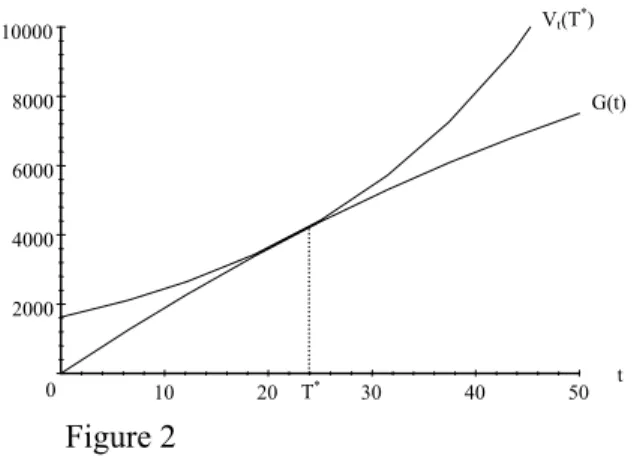
Figure 2 illustrates the shape of the two functions
G
(
t
)
, andV
(
T
*)
t for a given
G
(
t
)
function. As it can be seen, the current value of the land is always above the current value of timber, except atT
*where the curvesG
(
t
)
andV
(
T
*)
t are tangent. To show that, the examination of the properties of the function
V
(
T
*)
t is required (See Appendix A1).
Figure 2
In summary, in the case of an exponential discount scheme, both ways of looking at the forest owner problem lead exactly to the same optimal solution. The advantages of the new approach developed here will become clear in the case of the quasi-hyperbolic discounting.
7
It is useful now to clarify the meaning of
V
t(
T
*)
for values of t below and beyondT
*: For0
<
t
<
T
*,V
(
T
*)
t represents the current value of the timber considering that the cut is going to be delayed until
T
*. We will refer to it as the “current potential value of the land”. In fact, the value is related to a future cut;For
t
>
T
*, V (T*)t is the current capitalized value of the harvested trees at
*
T
. It is the same notion as the valueG
(
T
*)
growing in the bank.0 2000 4000 6000 8000 10000 10 20 T* 30 40 50 t Vt(T*) G(t)
Quasi-hyperbolic discounting
Let us assume now that the forest owner adopts a quasi-hyperbolic discounting. Denoting by
V
(
T
*)
t qh
t the current value of net receipts G
(
T
)
*t at time t, the corresponding problem can be stated as follows:
Current Value t=0
Max
{
G
(
0
),
V
( )
T
G
( )
T
*}
0 T * 0 qh 0 * 0βδ
=
… t=tMax
{
G
(
t
),
V
( )
T
G
( )
T
*}
t t T * t qh t * t−βδ
=
….where
T
t*, for t=0,1,2,… is the solution of the following problem)
T
(
G
)
T
(
V
Max
T t t t qh t T t t −βδ
=
with
T
t>
t
, satisfying the first order condition).
ln(
)
T
(
G
)
T
(
G
* t * t=
−
δ
′
(4)Again, at each t, the forest owner solves the two stages optimization problem. First, he maximizes the current value of future profits, choosing the optimal cutting time *
t
T
. Similarly to the exponential case,T
t* is the same for every t, and it is denoted by T*. This would be the observed cutting time if the forest owner is committed to previous decisions.We show, however, that in the optimization second stage a forest owner with quasi-hyperbolic preferences will choose a cutting time
T
qh, such thatT
qh<
T
*, anticipating thecutting time relative to the one implied by the constant long-run discount rate –ln(δ). Moreover, we can also show that
T
qh>
T
**, whereT
**represents the optimal cutting time implied by the constant short-run discount rate−
ln(
βδ
)
.8 The optimal cutting rule of the quasi-hyperbolic forest owner is summarized in Proposition 1.Proposition 1: Assuming that G(t) is differentiable and concave, and that the forest owner has
quasi-hyperbolic preferences, there exists a
t
=
T
qh , withT
**<
T
qh<
T
*, such thattrees. the cut ) T ( V ) t ( G T T t ; cut not do ) T ( V ) t ( G T t * qh t * qh * qh t qh ⇒ = ⇒ ≤ = ⇒ 〈 ⇒ <
Therefore, the forest owner anticipates the cutting time.
Proof. See Appendix A2.
This result is illustrated in Figure 3:9
8
T
**is the solution of the following problem:) T ( G ) ( ) T ( V Max T t t T − βδ = satisfying the first order condition:
).
ln(
)
T
(
G
)
T
(
G
* * * *βδ
−
=
′
9Figure 3
As shown, the quasi-hyperbolic forest owner always anticipates the cutting time compared to the one that maximizes the present value of profits. Therefore, the equivalent constant discount rate implicit in the relevant economic decision (at the actual cutting time) is different from the one that maximizes the present value of profits denoted by r.
As in Section 3, for the one rotation period case, the long-run discount rate is given by
)
T
(
G
)
T
(
'
G
)
ln(
r
* *=
δ
−
=
. If the forest owner cuts the trees atT
qh<
T
*, the implicit discount rateµ at
T
qhis such that:r
)
ln(
)
T
(
G
)
T
(
'
G
qh qh>
µ
=
λ
−
=
,where λ is associated to the corresponding discount factor. The difference between both rates is given by: 10
10This expression is similar to that derived in Harris and Laibson (2001) for the effective discount factor,
except that in this case the weighted average is calculated in terms of the short-run and long-run discount factors instead.
)
(
)
(
'
)
(
'
* * *T
G
T
G
T
G
r
qh T T qh−
=
−
βδ
−µ
0 2000 4000 6000 8000 10000 10 20 30 40 50 t T* Tqh T** G(t) Vqh(T*) Vt(T*) Vt(T**)Proposition 2 compares the value of the trees in the quasi-hyperbolic case with the equivalent constant case.
Proposition 2: Assuming that r is the long-run discount rate and µ is the observed discount rate at the cutting time, then, for
t
≤
T
qh, we haveV
(
T
)
V
(
T
qh)
t * qh
t
≥
, that is, the value of the trees in the quasi-hyperbolic case is larger than the value of trees evaluated at the equivalent constant observed discount rate. Moreover,V
(
T
)
V
(
T
*)
t * qh
t
<
.Proof: See Appendix A3.
This result is illustrated in Figure 4.
Figure 4
5. Multiple rotation problem
The above analysis can be easily extended to an infinite horizon. Taking the case of the constant discounting as the benchmark, at each time t, the problem of the forest owner can be stated as follows: 1000 2000 3000 4000 5000 6000 0 5 10 15 20 25 G(t) Tqh Vt(Tqh) Vqh(T*)
Current Value t=0
( ) ( )
1
( )
}
T
G
T
V
,
T
V
)
0
(
G
{
Max
* 0 * 0 T * 0 T * 0 0 * 0 0δ
−
δ
=
+
… t=t( ) ( )
( )
}
1
T
G
T
V
,
T
V
)
t
(
G
{
Max
* t * t T * t t T * t t * 0 0δ
−
δ
=
+
− …where
T
t*, for t=0,1,2,… is the solution of the following problemt t t T t t T t t T
1
)
T
(
G
)
T
(
V
Max
δ
−
δ
=
−satisfying the first order condition
* t T * t * t
1
)
ln(
)
T
(
G
)
T
(
G
δ
−
δ
−
=
′
(5)In this case, the optimal cutting time * t
T
is also the same for every period t but smaller than in the single rotation case. In the optimization second stage, the forest owner compares the value he obtains by cutting at t, G(t), plus the value from starting a new rotation, V0( )
T*, with
the value at t of waiting and cutting at T*, starting then a new cycle, Vt( )
T* . The solution to this problem is stated in Proposition 3.Proposition 3: For any t<T*,
G
(
t
)
+
V
0( ) ( )
T
*≤
V
tT
*,
where the equality holds only for t=0. Therefore, do not cut the trees. If t=T*,( )
( )
*T * 0 T V T V ) t (
G + = * . Hence, cutting the
trees and replanting is optimal, and a new rotation period starts.
Proof: See Appendix A4.
Again, and as expected in the exponential discounting, the optimal rotation period is equivalent to the one derived in the traditional model.
Quasi-hyperbolic discounting
Assuming now that the forest owner adopts a quasi-hyperbolic discounting, the corresponding problem, at each time t, can be stated as follows:
Current Value t=0
( )
( )
1
( )
}
T
G
T
V
,
T
V
)
0
(
G
{
Max
* 0 * 0 T * 0 T * 0 qh 0 * 0 qh 0δ
−
βδ
=
+
… t=t( )
( )
( )
}
1
T
G
T
V
,
T
V
)
t
(
G
{
Max
* ´' * t T * t t T * t qh t * 0 qh 0δ
−
βδ
=
+
− …where
T
t*, for t=0,1,2,… is the solution of the following problemt t t T t t T t qh t T
1
)
T
(
G
)
T
(
V
Max
δ
−
βδ
=
−satisfying the first order condition
* t T * t * t
1
)
ln(
)
T
(
G
)
T
(
G
δ
−
δ
−
=
′
(6)Here,
T
t* is also the same for any t, that is,T
*. Again, in the second stage of the optimization process, the forest owner compares the value he obtains by cutting at t, G(t), and starting a new rotation, qh( )
*0 T
V , with the present value, at t, of waiting and cutting at T*,
starting then a new cycle. The solution to this problem is stated in Proposition 4.
Proposition 4: There exists a
t
=
T
qh where, G(t)+V0qh( )
T* =VTqhqh( )
T*,
and the optimalcutting rule is as follows:
trees.
the
cut
T
T
t
;
cut
not
do
T
t
* qh qh⇒
≤
=
⇒
<
Proof: See Appendix A5.
As well, in this case, the forest owner will anticipate the cutting time, relative to the multiple rotation optimal long-run cutting time. Again, the equivalent constant discount rate implicit in the relevant economic decision (at the actual cutting time) is different from the one that is implicit when maximizing the present value of profits.
As in Section 3, for the multiple rotation case, the long-run discount rate is given by
* T * *
1
)
ln(
)
T
(
G
)
T
(
'
G
such that
)
ln(
r
δ
−
δ
−
=
δ
−
=
. If the forest owner cuts the trees atT
qh<
T
*, theimplicit discount rate µ at
T
qhis then:r
)
ln(
where
1
)
ln(
)
T
(
G
)
T
(
'
G
qh T qh qh>
λ
−
=
µ
λ
−
λ
−
=
,Proposition 5 compares the value of the forest in the quasi-hyperbolic case with the equivalent constant case.
Proposition 5: Assuming that r is the long-run discount rate and µ is the observed discount rate at the cutting time, then, for
t
≤
T
qh, we haveV
(
T
)
V
(
T
qh)
t * qh
t
≥
, that is, the value of the trees in the quasi-hyperbolic case is larger than the value of trees evaluated at the equivalent constant observed discount rate. Moreover,V
(
T
)
V
(
T
*)
t * qh
t
<
.Proof: See Appendix A6.
6. Conclusion
This paper examines the implications of quasi-hyperbolic inter-temporal preferences in forestry economics, providing new insights to the decision problem of the private forest owner. To model this type of inter-temporal preferences, the discrete time quasi-hyperbolic discount function is used, contrasting thisdiscounting scheme to the exponential one.
Some problems arise when comparing these two types of discounting. One problem is how to define an equivalent constant rate of discount. Another problem results from the fact that decreasing discount rates lead to dynamically inconsistent behavior. The individual reveals a patient attitude regarding future trade-offs, but reverses this attitude when the future becomes today.
We begin by addressing the traditional optimal rotation problem in both cases of a single rotation period, and multiple rotations. The optimal rotation period is defined as the one that maximizes the net present value of profits. For the quasi-hyperbolic discount, the optimal cutting time is the same as the one resulting from the long-run constant rate, but the present value of profits is lower.
As shown, in the presence of nonconstant rates of time preference, the solution of the forest owner problem is not time consistent without commitment. Therefore, an alternative economic decision model is proposed. In fact, at each moment t, the forest owner faces two types of investment decision: a short-run type decision (cutting the trees), and a long-run type decision (buying or selling the forest land). While in the case of the constant discount scheme both ways of looking at the forest owner problem lead exactly to the same optimal solution, the
new approach developed here allows us to capture the trade-off between the short-run and long-run decisions. The solution to this problem is the actual cutting time when using quasi-hyperbolic discounting.
Since hyperbolic discounting implies that discount rates are greater in the short-run than in the long-run, the forest owner may have an incentive to anticipate the cutting time, as, in the short-run, the potential value of the forested land is undervalued. In fact, for the nonconstant discount scheme considered, the actual cutting time will be anticipated compared with the optimal cutting time that maximizes the present value of profits.
If, instead, the equivalent constant rate of discount is the empirically observed discount rate, then the optimal cutting time is the same, but the present value of profits for the quasi-hyperbolic forest owner is always higher than the one resulting from the equivalent constant discount rate. All these results apply to both the single and the multiple rotation problems.
In summary, if agents adopt quasi-hyperbolic preferences, anticipating the cutting time is an optimal decision which is consistent with observed behavior. However, as at the observed discount rate the present value of profits is always higher, the investment in forested land becomes more attractive, creating an additional incentive to preservation. Therefore, the Faustman model overvalues the value of the investment in forested land at the initial planting decision time, but undervalues it at the empirically observed discount rate.
Appendix A1 The function
V
(
T
*)
t is characterized as follows: 1)(
ln
)
G
(
T
)
0
t
)
T
(
V
* T t * t=
−
δ
δ
*〉
∂
∂
− , implying thatV
(
T
*)
t is an increasing function of t; 2)(ln
)
G
(
T
)
0
t
)
T
(
V
2 T t * 2 * t 2 *〉
δ
δ
=
∂
∂
− , implying thatV
(
T
*)
t increases with t at an increasing rate;
3) For
t
=
T
*,(
T
)
t
G
t
)
T
(
V
t * *∂
∂
=
∂
∂
,11 implying thatV
(
T
*)
t and G(t) are tangent at *
T
t
=
.Appendix A2
Proposition 1: Assuming that
G(t) is differentiable and concave, and that the forest owner has
quasi-hyperbolic preferences, there exists at
=
T
qh, withT
**<
T
qh<
T
*, such thattrees. the cut ) T ( V ) t ( G T T t ; cut not do ) T ( V ) t ( G T t * h t * qh * qh t qh ⇒ = ⇒ ≤ = ⇒ 〈 ⇒ <
Therefore, the forest owner anticipates the cutting time.
Proof:
By examining the second stage in the optimization process, we will show that a forest owner with quasi-hyperbolic preferences will choose a cutting time
T
qh, such that* qh *
*
T
T
T
<
<
. In the second stage the value of the timber G(t) is compared with the potential value of the forested landV
qh(
T
*)
t . We will show first that
T
qh<
T
*, and then, that qh*
*
T
T
<
. Finally, we show that the forest owner has no incentive to go beyondT
qh.1) For any
t
<
T
*, sinceT
*maximizesV
t(
T
)
, we have tG(t) T*G(T*)δ < δ , or ) T ( G ) t ( G T∗−t * δ < . As β< 1, T∗−tG(T*) T∗−tG(T*) δ <
βδ and, given the properties of the functions G(t) and
V
(
T
*)
t ,
there
exists a
T
qh<
T
* such thatG
(
T
)
G
(
T
)
V
qh(
T
*)
T * T T qh qh qh=
βδ
=
∗− . For qhT
t
<
,G
(
t
)
V
qh(
T
*)
t<
.2) Secondly, we show that
T
qh>
T
**. Suppose, on the contrary, thatT
qh<
T
**. This implies that ( )T** TqhG(T**) T** TqhG(T**) T* TqhG(T*) G(Tqh) = βδ < βδ < βδ − − − .12 This is a contradiction, since G(Tqh) ( )T**−TqhG(T**) βδ < . Therefore,T
**<
T
qh.3) In order to show that the forest owner has no incentive to postpone the cutting to the next period
T
qh+
1
, we have to show that, in units of periodT
qh,G
(
T
qh)
〉
βδ
G
(
T
qh+
1
)
, that is, the value of the timber atT
qh is larger than the current value of timber atT
qh+
1
. In fact, as G(Tqh) T∗−TqhG(T*) βδ = , we have 1) G(T ) T ( G ) 1 T ( G ) T ( G ) 1 T ( G ) T ( G qh qh T Tqh qh T Tqh 1 qh + δ > δ ⇔ + βδ 〉 βδ ⇔ + βδ 〉 ∗− ∗ ∗ ∗ +12 The first inequality follows from the fact that β<1 and
T
**>
T
qh implies that βT**−Tqh <β. The second inequality derives from optimality.
The last inequality is verified, because
T
* is optimal.Appendix A3
Proposition 2: Assuming that r is the long run discount rate and µ is the observed discount rate at the cutting time, then, for
t
≤
T
qh, we haveV
(
T
)
V
(
T
qh)
t * qh
t
≥
, that is, the value of the trees in the quasi-hyperbolic case is larger than the value of trees evaluated at the equivalent constant observed discount rate. Moreover,V
(
T
)
V
(
T
*)
t * qh t
<
. Proof: 1) Ast
=
T
qh=>G
(
T
)
V
qh(
T
*)
T TG
(
T
*)
T qh * qh qh=
βδ
−=
, then, TqhG(Tqh) T*G(T*) βδ = δ . Multiplyingboth sides by
δ
−t, we obtain Tqh−tG(Tqh) T*−tG(T*)βδ = δ . Since λ<δ, Tqh−tG(Tqh) Tqh−tG(Tqh) T*−tG(T*) βδ = δ <
λ . Therefore, the first inequality
)
T
(
V
)
T
(
V
qh * t qh t<
holds.2) The second inequality follows from β <1.
Appendix A4
Proposition 3: For any t<T*,
( ) ( )
* t * 0T
V
T
V
)
t
(
G
+
≤
,
where the equality holds only for t=0. Therefore, do not cut the trees. If t=T*,( )
( )
*T * 0 T V T V ) t (
G + = * . Hence, cutting the
trees and replanting is optimal, and a new rotation period starts.
Proof:
1) According to the maximization principle, for any
t
<
T
*,( )
( )
1 T G 1 t G * * T * T t t δ − δ < δ − δ . Therefore,
( )
( )
( )
( )
( )
1
T
G
1
T
G
G(t)
1
T
G
1
T
G
G(t)
)
1
(
1
T
G
G(t)
* * * * * * * * * * T * t T T * T T * T T * t T t T * t Tδ
−
δ
<
δ
−
δ
+
⇒
δ
−
δ
−
δ
−
δ
<
⇒
δ
−
δ
−
δ
<
− − − ; 2) Fort
=
T
*,( ) ( )
* * * T * T * t T * t 1 T G 1 T G ) T ( V δ − = δ − δ = − . Also, fort
=
T
*,( )
( ) ( )
V(T ) 1 T G 1 T G T G * t T * T * T * * * * = δ − = δ − δ + . Appendix A5Proposition 4: There exists a
t
=
T
qh where, G(t) V( )
T VTqh( )
T* *qh
0 = qh
+
, and the optimal
cutting rule is as follows:
trees.
the
cut
T
T
t
;
cut
not
do
T
t
* qh qh⇒
≤
=
⇒
<
Proof:1) According to the maximization principle, for any
t
<
T
*,( )
( )
1 T G 1 t G * * T * T t t δ − βδ < δ − βδ . Therefore,
( )
( )
( )
( )
( )
1
T
G
1
T
G
G(t)
1
T
G
1
T
G
G(t)
)
1
(
1
T
G
G(t)
* * * * * * * * * * T * t T T * T T * T T * t T t T * t Tδ
−
δ
<
δ
−
δ
+
⇒
δ
−
δ
−
δ
−
δ
<
⇒
δ
−
δ
−
δ
<
− − − ;2) As β< 1, there exists a
0
<
T
qh<
T
* such that
( )
( )
( )
)
1
T
G
1
T
G
(
T
G
* * * qh * T * T T * T T qhδ
−
δ
−
δ
−
δ
β
=
− . Appendix A6Proposition 5: Assuming that r is the long run discount rate and µ is the observed discount rate at the cutting time, then, for
t
≤
T
qh, we haveV
(
T
)
V
(
T
qh)
t * qh
t
≥
, that is, the value of the trees in the quasi-hyperbolic case is larger than the value of trees evaluated at the equivalent constant observed discount rate. Moreover,V
(
T
)
V
(
T
*)
t * qh
t
<
.1) For
t
=
T
qh=> G(T ) 1 ) T ( V 1 ) T ( G ) T ( G 1 ) T ( G * T T T * qh T T qh * T T qh * qh * qh qh * * δ − βδ = = λ − = δ − βδ + − . Then, G(T ) 1 ) T ( G 1 * T T qh T T * * qh qh δ − βδ = λ − δ. Multiplying both sides by
δ
−t we obtainG(T ) 1 ) T ( G 1 * T t T qh T t T * * qh qh δ − βδ = λ − δ − − . Since λ<δ, G(T ) 1 ) T ( G 1 * T t T qh T t T * * qh qh δ − βδ < λ − λ − − ; 2) The second inequality follows from β <1.
References
Ainslie, George (1991). “Derivation of”Rational” Economic Behavior from Hyperbolic Discount Curves,” The American Economic Review 81, 334-340.
Barro, R. (1997). “Myopia and Inconsistency in the Neoclassical Growth Model,” NBER Working Paper 6317. Cambridge, Massachussetts: National Bureau of Economic Research, Inc. Cairns, J, (1994). “Valuing Future Benefits”, Health Economics 3, 221-229.
Chung, S., and R. Herrnstein (1967). “Choice and Delay of Reinforcement”, Journal of the
Experimental Analysis of Behavior, X, 67-74.
Cropper, M., Sema K. Aydede, and Paul R. Portney (1994). “Preferences for Life Saving Programs: How the Public Discounts Time and Age,” Journal of Risk and Uncertainty 8: 243-65.
Harvey, Charles M. (1986). “Value Functions for Infinite-Period Planning,” Management
Science 32, 1123-1139.
Harris, C., and D. Laibson (2001). “Dynamic Choices of Hyperbolic Consumers”,
Econometrica (forthcoming).
Laibson, D. (1996). “Hyperbolic Discount Functions, Undersaving, and Savings Policy,” NBER Working Paper 5635. June. Cambridge, Massachussetts: National Bureau of Economic Research, Inc.
Lowenstein, G., and Richard Thaler. (1989). “Anomalies: Intertemporal Choice”, Journal of
Economic Perspectives (Fall) 3, 181-193.
Olsen,J.A. (1993). “On what basis should health be discounted”, Journal of Health Economics 12, 39-53.
Phelps, E., and R. Pollak, (1968). “On Second-Best National Saving and Game-Equilibrium Growth”, Review of Economic Studies, XXXV,201-08.
Read, D. (2001), Is Time-Discounting Hyberbolic or Subadditive?, Journal of Risk and
Uncertainty, 23:1, 5-32.
Thaler, Richard. (1981). “Some Empirical Evidence on Dynamic Inconsistency,” Economics