EUROPEAN ORGANIZATION FOR NUCLEAR RESEARCH (CERN)
CERN-EP/2016-161 2016/11/24
CMS-BPH-13-009
Observation of the decay B
+
→
ψ
(
2S
)
φ
(
1020
)
K
+
in pp
collisions at
√
s
=
8 TeV
The CMS Collaboration
∗Abstract
The decay B+ → ψ(2S)φ(1020)K+ is observed for the first time using data col-lected from pp collisions at √s = 8 TeV by the CMS experiment at the LHC, cor-responding to an integrated luminosity of 19.6 fb−1. The branching fraction of this decay is measured, using the mode B+ → ψ(2S)K+ as normalization, to be
(4.0±0.4 (stat)±0.6 (syst)±0.2(B)) ×10−6, where the third uncertainty is from the measured branching fraction of the normalization channel.
Published in Physics Letters B as doi:10.1016/j.physletb.2016.11.001.
c
2016 CERN for the benefit of the CMS Collaboration. CC-BY-3.0 license
∗See Appendix A for the list of collaboration members
1
1
Introduction
The large cross section for b quark production at the CERN LHC and the high luminosity of the accelerator provide the possibility to study rare B meson decays. Recently, several ex-periments have reported the likely presence of structures in the J/ψφ(1020) mass spectrum from B± → J/ψφ(1020)K± decays [1–7]. A natural extension of these results is to study the ψ(2S)φ(1020)K± and the ψ(2S)φ(1020) mass spectra. As part of that investigation, we re-port the first observation of the decay B± → ψ(2S)φ(1020)K±, with ψ(2S) → µ+µ− and φ(1020) → K+K−. We measure the corresponding branching fraction using data collected at the LHC with the CMS detector in proton-proton (pp) collisions at√s =8 TeV, corresponding to an integrated luminosity of 19.6 fb−1. Possible contributions from nonresonant K+K− and f0(980)states in the signal are also studied, and an upper limit is determined in the fraction of events that do not correspond to φ(1020) → K+K− in the B± →
ψ(2S)K±K∓K± channel. In what follows, φ is used to represent the φ(1020)meson, and all results are combined in the investigation of the two charge-conjugate states.
2
The CMS detector
The central feature of the CMS apparatus is a 13 m long superconducting solenoid of 6 m in-ternal diameter, providing a magnetic field of 3.8 T. A silicon pixel and strip tracker, a lead tungstate crystal electromagnetic calorimeter, and a brass and scintillator hadron calorimeter, each composed of a barrel and two endcap sections, reside within the volume of the solenoid. Muons are measured in gas-ionization detectors embedded in the steel flux-return yoke out-side the solenoid. Extensive forward calorimetry complements the coverage provided by the barrel and endcap detectors.
The main subdetectors used in the present analysis are the silicon tracker and the muon detec-tion system. Muons are identified within the pseudorapidity range|η| < 2.4, using detection planes based on three technologies: drift tubes, cathode-strip chambers, and resistive-plate chambers. The silicon tracker measures charged particles within the range|η| <2.5. It consists of 66 million 100×150 µm2 silicon pixels and more than 9 million silicon strips. For recon-structed particles with transverse momenta 1 < pT < 10 GeV and|η| < 1.4, the track resolu-tions are typically 1.5% in pT, and the transverse and longitudinal impact parameters are in the respective ranges of 25–90 and 45–150 µm [8].
The first level of the CMS trigger system, constructed from specialized hardware processors, uses information from the calorimeters and muon detectors to select the most interesting events in a time interval of less than 4 µs. The high-level trigger (HLT) processor farm further de-creases the event rate from around 100 kHz to less than 1 kHz, before data storage. At the HLT stage, there is full access to all event information, including tracking, and therefore selection criteria similar to those applied offline can be implemented.
A more detailed description of the CMS detector, together with a definition of its coordinate system and relevant kinematic variables, can be found in Ref. [9].
3
Data and event selection
Monte Carlo (MC) simulated events are generated using PYTHIA6.4 [10] for particle produc-tion,EVTGEN1.3.0 [11] for particle decays, and GEANT4 [12] for tracing the particles through a detailed model of the CMS detector. These samples are generated using the conditions
appro-2 3 Data and event selection
priate for the data analyzed, including the effects of alignment, efficiency, and average number of additional pp collisions and their multiple reconstructed vertices per beam crossing (pileup). The events in the analysis were collected with a trigger based on the invariant mass and pT of the dimuon system. The following criteria are applied in the HLT: (i) the dimuon pTis required to be greater than 4.9 GeV, (ii) the two muons must be oppositely charged, (iii) the dimuon invariant mass is required to be in the range of 3.35–4.05 GeV, and (iv) the dimuon tracks must form a three-dimensional (3D) vertex with a χ2probability greater than 0.5%.
The two muons from the triggered event are required to be within 5 σMψ(2S) of the nominal ψ(2S)mass [13], where the standard deviation σMψ(2S)is obtained from fits to signal MC events in four bins of dimuon pseudorapidity. The value of σMψ(2S)varies from 23 MeV for|η| <0.6 to 45 MeV for|η| > 1.8. The B+ → ψ(2S)φK+candidates are reconstructed by combining three additional charged particle tracks consistent with originating from the ψ(2S)vertex, and have a total charge of 1. These tracks are assigned the kaon mass. The B+decay vertex is reconstructed using a kinematic fit to a common 3D vertex constraining the invariant mass of the two muons to the nominal ψ(2S)mass. For multiple candidates, the one with the highest B+vertex prob-ability is retained. The overall efficiencies in selecting the correct candidate obtained from MC studies are 96.8% and 99.4% for the B+ →ψ(2S)φK+and B+ →ψ(2S)K+events, respectively. The pTof each kaon track is required to be greater than 1 GeV. Only tracks passing the standard CMS high-purity requirements [14] are used. There are two K+K− combinations for the three charged kaon tracks, and the combination with invariant mass closest to the nominal φ meson mass [13] is used as the φ candidate. This selection yields the correct K+K−pair (94±1)% of the time, as determined from simulation. The mass of the φ candidate is not constrained to its nominal value because the experimental K+K− mass resolution (1.3 MeV, obtained from our MC simulation) is less than the natural width of the φ meson (4.3 MeV) [13].
Additional requirements are placed on the resulting sample to optimize the sensitivity to the signal mode. The signal region is defined to lie within ±5 σMB of the nominal B+ mass [13], where σMB is determined to be 3 MeV in a fit to simulated signal events using a single Gaussian function. Five quantities are chosen to optimize a 5 standard deviation discovery Punzi figure-of-merit (FOM), defined as NS/(5/2+
√
NB)[15], where NS is the number of B+ candidates in the simulated sample, and NB is the number of background candidates within±5 σBMof the B+ mass peak. The background contribution is obtained from a fit to the sideband events in the ψ(2S)φK+ invariant mass spectrum, where the lower and upper sidebands are defined as 5.220–5.264 and 5.294–5.330 GeV, respectively. The five quantities used to optimize the FOM are as follows: (i) the B+vertex probability; (ii) the significance of the transverse displacement, defined as the ratio of the transverse distance Lxy of the B+ secondary vertex relative to the center of the beam spot and its uncertainty σLxy, with the latter being the sum in quadrature of the uncertainty in the transverse position of the secondary vertex and the transverse size of the beam spot; (iii) the cosine of the pointing angle θ, defined as the angle between the reconstructed B+ momentum vector and its flight direction, as determined from the vector connecting the primary vertex [8] to the B+ secondary vertex, where the primary vertex is chosen so that this angle is closest to zero; (iv) the pTof the dimuon system; and (v) the φ mass window, defined as the difference between the invariant mass of the K+K− system and the mass of the φ meson [13]. The selection criteria derived from the optimization procedure are shown in Table 1. The overall efficiency of the offline signal selection is(1.91±0.01) ×10−3.
3
Table 1: The selection criteria derived from the optimization procedure.
Quantity Requirement
B vertex probability >10% Lxy/σLxy >4
cos θ >0.99
Dimuon pT >7 GeV
φmass window <8 MeV
4
Observation of B
+→
ψ
(
2S
)
φK
+decay
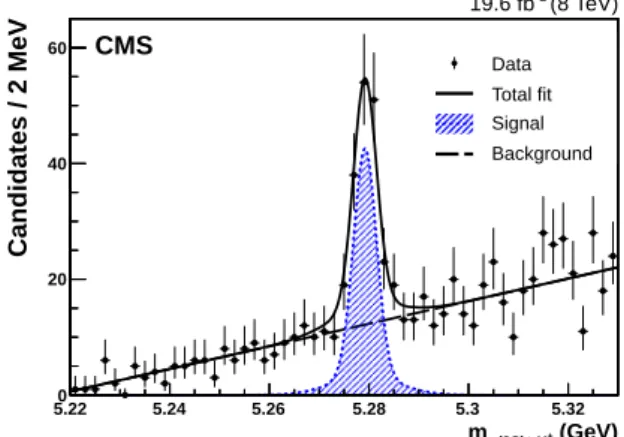
The invariant mass spectrum of the selected ψ(2S)φK+ candidates is shown in Fig. 1. An ex-tended unbinned maximum-likelihood estimator from RooFit [16] is used to perform the fit to the data, using two Gaussian functions for the signal and a first-order polynomial for the back-ground. The two Gaussian functions share a common mean fixed to the nominal B+mass [13], while their widths and relative fractions are fixed to the values obtained in the MC simulation. The goodness of fit is checked using a χ2test, which returns a χ2per degree of freedom (dof) of 23.0/24, with a corresponding probability of 52%. The fit gives a B+yield of 140±15 events, where the uncertainty is statistical.
(GeV) + K φ (2S) ψ m 5.22 5.24 5.26 5.28 5.3 5.32 Candidates / 2 MeV 0 20 40 60 Data Total fit Signal Background (8 TeV) -1 19.6 fb CMS
Figure 1: The ψ(2S)φK+ mass distribution after the selection requirements. The solid curve shows the result of fitting this distribution to a signal represented by two Gaussian functions and a first-order polynomial for the background. The shaded area represents the signal com-ponent, while the black dashed line shows the fitted background contribution.
The small amount of available phase space, only 80 MeV, in the B+ →ψ(2S)φK+decay makes it difficult to model the expected ψ(2S)φ invariant mass distribution. This, and the limited number of signal events, precludes any search for ψ(2S)φresonances in the current data sam-ple.
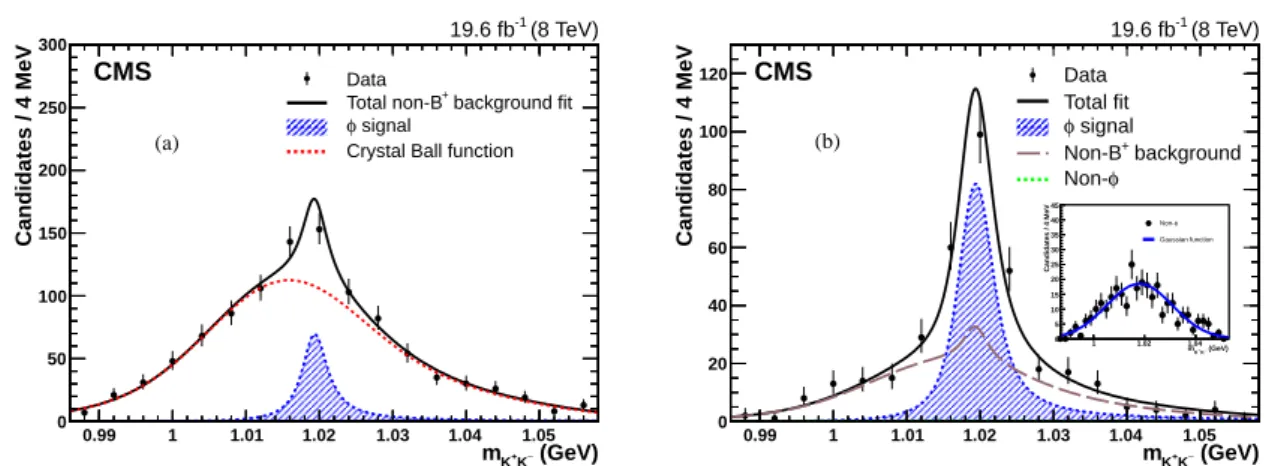
Possible contamination from the decays of the f0(980)meson and nonresonant K+K−is stud-ied through a simultaneous fit of the K+K−invariant mass distributions for the combinations closest to the nominal φ mass inside and outside of an 18 MeV mass window centered around the nominal B+mass, not using the±8 MeV φ mass window listed in Table 1. The distributions of the nonresonant K+K− and f0 background invariant mass contributions are obtained from dedicated B+ → ψ(2S)K+K−K+and B+ → ψ(2S)f0K+MC simulations generated usingEVT
-GEN [11], which models the f0 distribution as a coupled-channel Breit–Wigner function [17]. Both the nonresonant K+K− and f0 contributions are distorted through the selection of the K+K−pair closest to the nominal φ mass. We parametrize these forms using Gaussian func-tions that are very similar for the two components. Their correlation coefficients show that the
4 5 B+→ψ(2S)K+decay (GeV) − K + K m 0.99 1 1.01 1.02 1.03 1.04 1.05 Candidates / 4 MeV 0 50 100 150 200 250 300 Data background fit + Total non-B signal φ
Crystal Ball function
(8 TeV) -1 19.6 fb CMS (a) (GeV) − K + K m 0.99 1 1.01 1.02 1.03 1.04 1.05 Candidates / 4 MeV 0 20 40 60 80 100 120 Data Total fit signal φ background + Non-B φ (GeV) -K + K m 1 1.02 1.04 Candidates / 4 MeV 0 5 10 15 20 25 30 35 40 45 φ Non-Gaussian function (8 TeV) -1 19.6 fb CMS (b)
Figure 2: The distributions of the K+K−invariant mass closest to the nominal φ mass outside (a) and inside (b) the B+mass window. The results show the total fit, as well as (a) the Crystal Ball function component of the non-B+background, and in (b) the four components: φ signal,
non-B+background, non-φ signal. The non-φ component is almost invisible due to its small contribution. The inset shows the non-φ distribution modelled by a Gaussian function.
two contributions are strongly anticorrelated, and we therefore choose the nonresonant K+K− background in the fit to represent both the f0and any other K+K−components, and label it as the non-φ contribution to the signal.
A 3σBM-wide window around the B+ mass of 5.270–5.288 GeV is chosen, with lower and up-per sidebands of 5.220–5.270 and 5.288–5.330 GeV, respectively. Figures 2(a) and (b) show the distributions of the K+K−invariant masses closest to the nominal φ mass outside (a) and in-side (b) the B+ window, where Fig. 2(a) thereby provides the non-B+ background. Both the distributions share the same non-B+ background function. We find (not displayed) that the non-B+contribution within the B+ mass window is of 194±14 events, obtained from a fit to the ψ(2S)φK+ invariant mass spectrum. In the simultaneous fit, we therefore fix this number to 194, while the number of non-B+events contributing in the sidebands is allowed to vary.
The φ signal component is parametrized by a P-wave relativistic Breit–Wigner function, con-volved with a Gaussian resolution function. The standard deviation of the Gaussian function is fixed to 1.3 MeV. The mass and width of the φ reflect their nominal values [13]. Since there is a φ signal in the non-B+ events, the non-B+ φcontribution in Fig. 2(a) is parametrized by the sum of a Crystal Ball function [18] and the above-mentioned function that represents the φ component.
The data in Fig. 2(a) is fitted using the non-B+function, and simultaneously in Fig. 2(b) using the above three functions. The fit returns a yield of 2±20 events for the non-φ signal contribu-tion that is too small to be seen in the Fig. 2(b). The systematic uncertainty in this yield is neg-ligible. The fit quality in Fig. 2(b) is checked using a χ2 test, which returns χ2/dof= 21.6/16. We set an upper limit on the fraction of the non-φ component in B+→ψ(2S)K+K−K+decays, obtained with the CLs method [19, 20] using an asymptotic approximation [21], of 0.26 at the 95% confidence level.
5
B
+→
ψ
(
2S
)
K
+decay
The B+→ψ(2S)K+decay is chosen as the normalization channel because its absolute branch-ing fraction is well measured, it is recorded with the same trigger as the signal channel, and it is topologically similar to the signal, so that many systematic uncertainties cancel or are
re-5
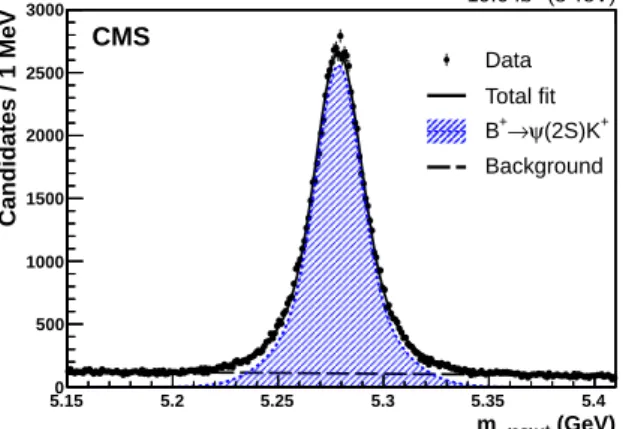
duced. All applicable selection requirements are kept the same as those for the signal channel. The ψ(2S)K+ invariant mass distribution is shown in Fig. 3. A binned maximum-likelihood fit is used to determine the number of events in this channel. Again, two Gaussian functions are used to model the B+ signal, and a first-order polynomial to model the background. The
large number of events allows a fit with all parameters free to vary and the yield is found to be 87264±363 (stat). The goodness of the fit is checked using a χ2 test, which returns χ2/dof=363/253. (GeV) + (2S)K ψ m 5.15 5.2 5.25 5.3 5.35 5.4 Candidates / 1 MeV 0 500 1000 1500 2000 2500 3000 Data Total fit + (2S)K ψ → + B Background (8 TeV) -1 19.6 fb CMS
Figure 3: The ψ(2S)K+ invariant mass distribution after implementing all event selection re-quirements. The solid curve shows the result of fitting this distribution to a signal correspond-ing to two Gaussian functions and a first-order polynomial for the background. The shaded area represents the contribution from the B+→ ψ(2S)K+channel, while the black dashed line shows the fitted background contribution.
6
Results and systematic uncertainties
The value of the branching fractionB(B+ →ψ(2S)φK+)is obtained from the ratio: NB+→
ψ(2S)φK+B(B
+ →
ψ(2S)K+)
NB+→ψ(2S)K+εrelB(φ→K+K−) , (1) where NB+→ψ(2S)φK+ and NB+→ψ(2S)K+ are the signal and normalization yields extracted from
the fit to the invariant mass distributions in the B+ → ψ(2S)φK+ and B+ → ψ(2S)K+ chan-nels, respectively. The relative reconstruction efficiency εrel = 0.52±0.01 is calculated from the ratio of the reconstruction efficiencies in the signal and normalization channels with a sta-tistical uncertainty from the number of MC events. Using the branching fractions B(φ → K+K−) = 0.489±0.005 and B(B+ → ψ(2S)K+) = (6.26±0.24) ×10−4 [13], the value of
B(B+ →ψ(2S)φK+)is determined to be(4.0±0.4 (stat)) ×10−6.
Estimates of the contributions to the systematic uncertainty inB(B+ → ψ(2S)φK+)are sum-marized in Table 2, and described below. The uncertainty from modeling the shape of the B+ invariant mass distribution is estimated to be 8.6% by allowing the widths of the two Gaus-sian functions to vary in the fit, with the background function fixed to a first order polynomial. Systematic uncertainties from sources such as muon identification, trigger efficiency, and track reconstruction efficiency for the three common tracks (two muons and a kaon) almost cancel in the measurement of the signal branching fraction. The uncertainty in the charged particle track reconstruction efficiency, obtained in an independent study by comparing two-body and four-body D0decays in data and simulated events [8], gives an uncertainty of 3.9% per track
6 6 Results and systematic uncertainties
and a total uncertainty of 7.8% for the two additional kaon tracks.A mismatch in the pT distri-bution between B+mesons in MC simulations and in data can lead to an incorrect efficiency. We therefore reweight the signal and normalization events using a weighting function derived from the normalization channel. The ratio of efficiencies from the reweighted MC events is compared to the nominal value to extract a systematic uncertainty of 5.3%.
The choice of the K+K−candidate closest to the nominal φ mass causes a bias, and, to estimate any systematic contamination of the K+K−mass peak from non-φ backgrounds, the analysis is repeated after removing the selection on the K+K− mass being closest to the mass of the φ. This makes the choice of the K+K− pair independent of the closest value to the nominal φ mass, and the branching fraction is remeasured by keeping both K+K−pair candidate events. The subsequent B+ →
ψ(2S)K+K−K+ invariant mass distribution is shown in Fig. 4. The signal in Fig. 4 is clear, but there is more background relative to the signal mass distribution shown in Fig. 1. There are 165±18 B+ signal events with two K+K− combinations for each event. The efficiency for the B+ → ψ(2S)φK+signal after removing the choice of φ candidate is(2.14±0.02) ×10−3, and the redeterminedB(B+ → ψ(2S)φK+)is(4.2±0.4 (stat)) ×10−6. The 5.0% difference between this and the nominal branching fraction is used as the systematic uncertainty from possible non-φ backgrounds.
Table 2: Relative systematic uncertainties in the measurement ofB(B+ → ψ(2S)φK+)in per-cent. The total systematic uncertainty corresponds to the sum in quadrature of the listed un-certainties.
Source Uncertainty (%)
B+mass shape for signal mode 8.6
Charged particle track reconstruction efficiency 7.8 Modeling of pTdependence of B+efficiency 5.3
φpurity 5.0
Mass distribution for the background in the signal 2.9 Uncertainty in relative efficiency of signal and normalization 2.3 Background distribution in the normalization channel 2.2
Angular distributions of K+K−systems 1.9
B+mass shape for normalization mode 1.0
B(φ→K+K−)uncertainty 1.0
Total 15
The uncertainties in modeling the B+ → ψ(2S)φK+ and the normalization channel back-grounds are estimated to be 2.9% and 2.2%, respectively, by adding polynomials of higher order in the fit to describe the background. The uncertainty from the angular distribution of the K+K−system is estimated to be 1.9%, based on the changes induced in the B+ reconstruc-tion efficiency by weighting the simulated events with different helicity angle distribureconstruc-tions. The uncertainty in the B+mass shape for the normalization channel is estimated to be 1.0% by
adding a third Gaussian function with a common mean and a varying width to the fit, with the background again modeled by a linear function. The uncertainty inB(φ→K+K−)is 1% [13]. Possible systematic uncertainties introduced by different trigger and pileup conditions and analysis selections have been investigated by dividing the data into subsets and evaluating the statistical consistency [13] of the independent samples; the resulting variations are found to be within the expected uncertainties.
The overall relative systematic uncertainty inB(B+ → ψ(2S)φK+)is 15% from adding the in-dividual contributions summarized in Table 2 in quadrature. The total uncertainty inB(B+→
7 (GeV) + K − K + (2S)K ψ m 5.22 5.24 5.26 5.28 5.3 5.32 Events / 2 MeV 0 20 40 60 80 Data Total fit + K φ (2S) ψ → + B Background (8 TeV) -1 19.6 fb CMS
Figure 4: The ψ(2S)K+K−K+invariant mass distribution with no φ mass selection. The solid curve shows the result of fitting this distribution to a signal represented by two Gaussian func-tions and a second-order polynomial for the background. The shaded area represents the signal component, while the black dashed line shows the fitted background contribution.
ψ(2S)K+)is 3.8% [13]. Thus, the final measured value ofB(B+ → ψ(2S)φK+), including all systematic uncertainties, is: (4.0±0.4 (stat)±0.6 (syst)±0.2(B)) ×10−6, where the third un-certainty is from the imprecision inB(B+→ψ(2S)K+).
7
Summary
The B+ → ψ(2S)φK+ decay has been observed for the first time by the CMS Collaboration. The result has been achieved using data from pp collisions at√s = 8 TeV, corresponding to an integrated luminosity of 19.6 fb−1. The branching fractionB(B+ → ψ(2S)φK+)is determined to be(4.0±0.4 (stat)±0.6 (syst)±0.2(B)) ×10−6, where the third uncertainty arises from the imprecision in the value of B(B+ → ψ(2S)K+). The upper limit on the fraction of B+ → ψ(2S)(non-φ)K+decays in B+→ψ(2S)K+K+K+channel is found to be 0.26 at 95% confidence. The observation of B+ → ψ(2S)φK+offers future opportunities in searches for resonances in the ψ(2S)φmass spectrum.
Acknowledgments
We congratulate our colleagues in the CERN accelerator departments for the excellent perfor-mance of the LHC and thank the technical and administrative staffs at CERN and at other CMS institutes for their contributions to the success of the CMS effort. In addition, we gratefully acknowledge the computing centers and personnel of the Worldwide LHC Computing Grid for delivering so effectively the computing infrastructure essential to our analyses. Finally, we acknowledge the enduring support for the construction and operation of the LHC and the CMS detector provided by the following funding agencies: BMWFW and FWF (Austria); FNRS and FWO (Belgium); CNPq, CAPES, FAPERJ, and FAPESP (Brazil); MES (Bulgaria); CERN; CAS, MoST, and NSFC (China); COLCIENCIAS (Colombia); MSES and CSF (Croatia); RPF (Cyprus); SENESCYT (Ecuador); MoER, ERC IUT and ERDF (Estonia); Academy of Finland, MEC, and HIP (Finland); CEA and CNRS/IN2P3 (France); BMBF, DFG, and HGF (Germany); GSRT (Greece); OTKA and NIH (Hungary); DAE and DST (India); IPM (Iran); SFI (Ireland); INFN (Italy); MSIP and NRF (Republic of Korea); LAS (Lithuania); MOE and UM (Malaysia); BUAP, CINVESTAV, CONACYT, LNS, SEP, and UASLP-FAI (Mexico); MBIE (New Zealand); PAEC (Pakistan); MSHE and NSC (Poland); FCT (Portugal); JINR (Dubna); MON, RosAtom,
8 References
RAS and RFBR (Russia); MESTD (Serbia); SEIDI and CPAN (Spain); Swiss Funding Agencies (Switzerland); MST (Taipei); ThEPCenter, IPST, STAR and NSTDA (Thailand); TUBITAK and TAEK (Turkey); NASU and SFFR (Ukraine); STFC (United Kingdom); DOE and NSF (USA). Individuals have received support from the Marie-Curie program and the European Research Council and EPLANET (European Union); the Leventis Foundation; the A. P. Sloan Founda-tion; the Alexander von Humboldt FoundaFounda-tion; the Belgian Federal Science Policy Office; the Fonds pour la Formation `a la Recherche dans l’Industrie et dans l’Agriculture (FRIA-Belgium); the Agentschap voor Innovatie door Wetenschap en Technologie (IWT-Belgium); the Ministry of Education, Youth and Sports (MEYS) of the Czech Republic; the Council of Science and In-dustrial Research, India; the HOMING PLUS program of the Foundation for Polish Science, co-financed from European Union, Regional Development Fund, the Mobility Plus program of the Ministry of Science and Higher Education, the OPUS program contract 2014/13/B/ST2/02543 and contract Sonata-bis DEC-2012/07/E/ST2/01406 of the National Science Center (Poland); the Thalis and Aristeia programs cofinanced by EU-ESF and the Greek NSRF; the National Priorities Research Program by Qatar National Research Fund; the Programa Clar´ın-COFUND del Principado de Asturias; the Rachadapisek Sompot Fund for Postdoctoral Fellowship, Chu-lalongkorn University and the ChuChu-lalongkorn Academic into Its 2nd Century Project Advance-ment Project (Thailand); and the Welch Foundation, contract C-1845.
References
[1] CDF Collaboration, “Evidence for a Narrow Near-Threshold Structure in the J/ψφ Mass Spectrum in B+ →J/ψφK+Decays”, Phys. Rev. Lett. 102 (2009) 242002,
doi:10.1103/PhysRevLett.102.242002, arXiv:0903.2229.
[2] LHCb Collaboration, “Search for the X(4140)state in B+→J/ψφK+decays”, Phys. Rev. D 85 (2012) 091103, doi:10.1103/PhysRevD.85.091103, arXiv:1202.5087. [3] D0 Collaboration, “Search for the X(4140) state in B+→J/ψφK+decays with the D0
detector”, Phys. Rev. D 89 (2014) 012004, doi:10.1103/PhysRevD.89.012004, arXiv:1309.6580.
[4] CMS Collaboration, “Observation of a peaking structure in the J/ψφ mass spectrum from B± →J/ψφK±decays”, Phys. Lett. B 734 (2014) 261,
doi:10.1016/j.physletb.2014.05.055, arXiv:1309.6920.
[5] BaBar Collaboration, “Study of B±,0 →J/ψK+K−K±,0and search for B0 →J/ψφ at BaBar”, Phys. Rev. D 91 (2015) 012003, doi:10.1103/PhysRevD.91.012003, arXiv:1407.7244.
[6] LHCb Collaboration, “Observation of J/ψφ structures consistent with exotic states from amplitude analysis of B+ →J/ψφK+decays”, (2016). arXiv:1606.07895.
[7] LHCb Collaboration, “Amplitude analysis of B+→J/ψφK+decays”, (2016). arXiv:1606.07898.
[8] CMS Collaboration, “Description and performance of track and primary-vertex reconstruction with the CMS tracker”, JINST 9 (2014) P10009,
doi:10.1088/1748-0221/9/10/P10009, arXiv:1405.6569.
[9] CMS Collaboration, “The CMS experiment at the CERN LHC”, JINST 3 (2008) S08004, doi:10.1088/1748-0221/3/08/S08004.
References 9
[10] T. Sj ¨ostrand, S. Mrenna, and P. Skands, “PYTHIA 6.4 physics and manual”, JHEP 05 (2006) 026, doi:10.1088/1126-6708/2006/05/026, arXiv:hep-ph/0603175. [11] D. J. Lange, “The EvtGen particle decay simulation package”, Nucl. Instrum. Meth. A 462
(2001) 152, doi:10.1016/S0168-9002(01)00089-4.
[12] GEANT4 Collaboration, “GEANT4: A simulation toolkit”, Nucl. Instrum. Meth. A 506 (2003) 250, doi:10.1016/S0168-9002(03)01368-8.
[13] Particle Data Group, K. A. Olive et al., “Review of Particle Physics”, Chin. Phys. C 38 (2014) 090001, doi:10.1088/1674-1137/38/9/090001.
[14] CMS Collaboration, “CMS tracking performance results from early LHC operation”, Eur. Phys. J. C 70 (2010) 1165, doi:10.1140/epjc/s10052-010-1491-3,
arXiv:1007.1988.
[15] G. Punzi, “Sensitivity of searches for new signals and its optimization”, in Proceedings of PHYSTAT 2003, Statistical problems in particle physics, astrophysics and cosmology, L. Lyons, R. P. Mount, and R. Reitmeyer, eds. Stanford, USA, 2003. arXiv:physics/0308063. doi:10.5170/CERN-2011-006.313.
[16] W. Verkerke and D. P. Kirkby, “The RooFit toolkit for data modeling”, in Proceedings of PHYSTAT 05: Statistical problems in particle physics, astrophysics and cosmology, L. Lyons and M. Karagoz, eds. Oxford, England, 2005. arXiv:physics/0306116.
[17] S. M.Flatt´e et al., “Analysis of the observed anomaly in ππ s-wave scattering near K ¯K threshold”, Phys. Lett. B 38 (1972) 232, doi:10.1016/0370-2693(72)90387-5. [18] M. J. Oreglia, “A Study of the Reactions ψ0 →γγψ”. PhD thesis, Stanford University,
1980. SLAC-R-236.
[19] T. Junk, “Confidence level computation for combining searches with small statistics”, Nucl. Instrum. Meth. A 434 (1999) 435, doi:10.1016/S0168-9002(99)00498-2, arXiv:hep-ex/9902006.
[20] A. L. Read, “Presentation of search results: the CLstechnique”, J. Phys. G 28 (2002) 2693, doi:10.1088/0954-3899/28/10/313.
[21] G. Cowan, K. Cranmer, E. Gross, and O. Vitells, “Asymptotic formulae for likelihood-based tests of new physics”, Eur. Phys. J. C 71 (2011) 1554,
doi:10.1140/epjc/s10052-011-1554-0, arXiv:1007.1727. [Erratum: doi:10.1140/epjc/s10052-013-2501-z].
11
A
The CMS Collaboration
Yerevan Physics Institute, Yerevan, Armenia
V. Khachatryan, A.M. Sirunyan, A. Tumasyan
Institut f ¨ur Hochenergiephysik der OeAW, Wien, Austria
W. Adam, E. Asilar, T. Bergauer, J. Brandstetter, E. Brondolin, M. Dragicevic, J. Er ¨o, M. Flechl, M. Friedl, R. Fr ¨uhwirth1, V.M. Ghete, C. Hartl, N. H ¨ormann, J. Hrubec, M. Jeitler1, A. K ¨onig, I. Kr¨atschmer, D. Liko, T. Matsushita, I. Mikulec, D. Rabady, N. Rad, B. Rahbaran, H. Rohringer, J. Schieck1, J. Strauss, W. Treberer-Treberspurg, W. Waltenberger, C.-E. Wulz1
National Centre for Particle and High Energy Physics, Minsk, Belarus
V. Mossolov, N. Shumeiko, J. Suarez Gonzalez
Universiteit Antwerpen, Antwerpen, Belgium
S. Alderweireldt, E.A. De Wolf, X. Janssen, J. Lauwers, M. Van De Klundert, H. Van Haevermaet, P. Van Mechelen, N. Van Remortel, A. Van Spilbeeck
Vrije Universiteit Brussel, Brussel, Belgium
S. Abu Zeid, F. Blekman, J. D’Hondt, N. Daci, I. De Bruyn, K. Deroover, N. Heracleous, S. Lowette, S. Moortgat, L. Moreels, A. Olbrechts, Q. Python, S. Tavernier, W. Van Doninck, P. Van Mulders, I. Van Parijs
Universit´e Libre de Bruxelles, Bruxelles, Belgium
H. Brun, C. Caillol, B. Clerbaux, G. De Lentdecker, H. Delannoy, G. Fasanella, L. Favart, R. Goldouzian, A. Grebenyuk, G. Karapostoli, T. Lenzi, A. L´eonard, J. Luetic, T. Maerschalk, A. Marinov, A. Randle-conde, T. Seva, C. Vander Velde, P. Vanlaer, R. Yonamine, F. Zenoni, F. Zhang2
Ghent University, Ghent, Belgium
A. Cimmino, T. Cornelis, D. Dobur, A. Fagot, G. Garcia, M. Gul, D. Poyraz, S. Salva, R. Sch ¨ofbeck, M. Tytgat, W. Van Driessche, E. Yazgan, N. Zaganidis
Universit´e Catholique de Louvain, Louvain-la-Neuve, Belgium
H. Bakhshiansohi, C. Beluffi3, O. Bondu, S. Brochet, G. Bruno, A. Caudron, S. De Visscher, C. Delaere, M. Delcourt, L. Forthomme, B. Francois, A. Giammanco, A. Jafari, P. Jez, M. Komm, V. Lemaitre, A. Magitteri, A. Mertens, M. Musich, C. Nuttens, K. Piotrzkowski, L. Quertenmont, M. Selvaggi, M. Vidal Marono, S. Wertz
Universit´e de Mons, Mons, Belgium
N. Beliy
Centro Brasileiro de Pesquisas Fisicas, Rio de Janeiro, Brazil
W.L. Ald´a J ´unior, F.L. Alves, G.A. Alves, L. Brito, C. Hensel, A. Moraes, M.E. Pol, P. Rebello Teles
Universidade do Estado do Rio de Janeiro, Rio de Janeiro, Brazil
E. Belchior Batista Das Chagas, W. Carvalho, J. Chinellato4, A. Cust ´odio, E.M. Da Costa, G.G. Da Silveira, D. De Jesus Damiao, C. De Oliveira Martins, S. Fonseca De Souza, L.M. Huertas Guativa, H. Malbouisson, D. Matos Figueiredo, C. Mora Herrera, L. Mundim, H. Nogima, W.L. Prado Da Silva, A. Santoro, A. Sznajder, E.J. Tonelli Manganote4, A. Vilela Pereira
Universidade Estadual Paulistaa, Universidade Federal do ABCb, S˜ao Paulo, Brazil
12 A The CMS Collaboration
P.G. Mercadanteb, C.S. Moona, S.F. Novaesa, Sandra S. Padulaa, D. Romero Abadb, J.C. Ruiz Vargas
Institute for Nuclear Research and Nuclear Energy, Sofia, Bulgaria
A. Aleksandrov, R. Hadjiiska, P. Iaydjiev, M. Rodozov, S. Stoykova, G. Sultanov, M. Vutova
University of Sofia, Sofia, Bulgaria
A. Dimitrov, I. Glushkov, L. Litov, B. Pavlov, P. Petkov
Beihang University, Beijing, China
W. Fang5
Institute of High Energy Physics, Beijing, China
M. Ahmad, J.G. Bian, G.M. Chen, H.S. Chen, M. Chen, Y. Chen6, T. Cheng, C.H. Jiang, D. Leggat, Z. Liu, F. Romeo, S.M. Shaheen, A. Spiezia, J. Tao, C. Wang, Z. Wang, H. Zhang, J. Zhao
State Key Laboratory of Nuclear Physics and Technology, Peking University, Beijing, China
Y. Ban, G. Chen, Q. Li, S. Liu, Y. Mao, S.J. Qian, D. Wang, Z. Xu
Universidad de Los Andes, Bogota, Colombia
C. Avila, A. Cabrera, L.F. Chaparro Sierra, C. Florez, J.P. Gomez, C.F. Gonz´alez Hern´andez, J.D. Ruiz Alvarez, J.C. Sanabria
University of Split, Faculty of Electrical Engineering, Mechanical Engineering and Naval Architecture, Split, Croatia
N. Godinovic, D. Lelas, I. Puljak, P.M. Ribeiro Cipriano
University of Split, Faculty of Science, Split, Croatia
Z. Antunovic, M. Kovac
Institute Rudjer Boskovic, Zagreb, Croatia
V. Brigljevic, D. Ferencek, K. Kadija, S. Micanovic, L. Sudic, T. Susa
University of Cyprus, Nicosia, Cyprus
A. Attikis, G. Mavromanolakis, J. Mousa, C. Nicolaou, F. Ptochos, P.A. Razis, H. Rykaczewski
Charles University, Prague, Czech Republic
M. Finger7, M. Finger Jr.7
Universidad San Francisco de Quito, Quito, Ecuador
E. Carrera Jarrin
Academy of Scientific Research and Technology of the Arab Republic of Egypt, Egyptian Network of High Energy Physics, Cairo, Egypt
E. El-khateeb8, S. Elgammal9, A. Mohamed10
National Institute of Chemical Physics and Biophysics, Tallinn, Estonia
B. Calpas, M. Kadastik, M. Murumaa, L. Perrini, M. Raidal, A. Tiko, C. Veelken
Department of Physics, University of Helsinki, Helsinki, Finland
P. Eerola, J. Pekkanen, M. Voutilainen
Helsinki Institute of Physics, Helsinki, Finland
J. H¨ark ¨onen, V. Karim¨aki, R. Kinnunen, T. Lamp´en, K. Lassila-Perini, S. Lehti, T. Lind´en, P. Luukka, T. Peltola, J. Tuominiemi, E. Tuovinen, L. Wendland
13
Lappeenranta University of Technology, Lappeenranta, Finland
J. Talvitie, T. Tuuva
IRFU, CEA, Universit´e Paris-Saclay, Gif-sur-Yvette, France
M. Besancon, F. Couderc, M. Dejardin, D. Denegri, B. Fabbro, J.L. Faure, C. Favaro, F. Ferri, S. Ganjour, S. Ghosh, A. Givernaud, P. Gras, G. Hamel de Monchenault, P. Jarry, I. Kucher, E. Locci, M. Machet, J. Malcles, J. Rander, A. Rosowsky, M. Titov, A. Zghiche
Laboratoire Leprince-Ringuet, Ecole Polytechnique, IN2P3-CNRS, Palaiseau, France
A. Abdulsalam, I. Antropov, S. Baffioni, F. Beaudette, P. Busson, L. Cadamuro, E. Chapon, C. Charlot, O. Davignon, R. Granier de Cassagnac, M. Jo, S. Lisniak, P. Min´e, M. Nguyen, C. Ochando, G. Ortona, P. Paganini, P. Pigard, S. Regnard, R. Salerno, Y. Sirois, T. Strebler, Y. Yilmaz, A. Zabi
Institut Pluridisciplinaire Hubert Curien, Universit´e de Strasbourg, Universit´e de Haute Alsace Mulhouse, CNRS/IN2P3, Strasbourg, France
J.-L. Agram11, J. Andrea, A. Aubin, D. Bloch, J.-M. Brom, M. Buttignol, E.C. Chabert, N. Chanon, C. Collard, E. Conte11, X. Coubez, J.-C. Fontaine11, D. Gel´e, U. Goerlach, A.-C. Le Bihan, J.A. Merlin12, K. Skovpen, P. Van Hove
Centre de Calcul de l’Institut National de Physique Nucleaire et de Physique des Particules, CNRS/IN2P3, Villeurbanne, France
S. Gadrat
Universit´e de Lyon, Universit´e Claude Bernard Lyon 1, CNRS-IN2P3, Institut de Physique Nucl´eaire de Lyon, Villeurbanne, France
S. Beauceron, C. Bernet, G. Boudoul, E. Bouvier, C.A. Carrillo Montoya, R. Chierici, D. Contardo, B. Courbon, P. Depasse, H. El Mamouni, J. Fan, J. Fay, S. Gascon, M. Gouzevitch, G. Grenier, B. Ille, F. Lagarde, I.B. Laktineh, M. Lethuillier, L. Mirabito, A.L. Pequegnot, S. Perries, A. Popov13, D. Sabes, V. Sordini, M. Vander Donckt, P. Verdier, S. Viret
Georgian Technical University, Tbilisi, Georgia
A. Khvedelidze7
Tbilisi State University, Tbilisi, Georgia
Z. Tsamalaidze7
RWTH Aachen University, I. Physikalisches Institut, Aachen, Germany
C. Autermann, S. Beranek, L. Feld, A. Heister, M.K. Kiesel, K. Klein, M. Lipinski, A. Ostapchuk, M. Preuten, F. Raupach, S. Schael, C. Schomakers, J.F. Schulte, J. Schulz, T. Verlage, H. Weber, V. Zhukov13
RWTH Aachen University, III. Physikalisches Institut A, Aachen, Germany
M. Brodski, E. Dietz-Laursonn, D. Duchardt, M. Endres, M. Erdmann, S. Erdweg, T. Esch, R. Fischer, A. G ¨uth, M. Hamer, T. Hebbeker, C. Heidemann, K. Hoepfner, S. Knutzen, M. Merschmeyer, A. Meyer, P. Millet, S. Mukherjee, M. Olschewski, K. Padeken, T. Pook, M. Radziej, H. Reithler, M. Rieger, F. Scheuch, L. Sonnenschein, D. Teyssier, S. Th ¨uer
RWTH Aachen University, III. Physikalisches Institut B, Aachen, Germany
V. Cherepanov, G. Fl ¨ugge, W. Haj Ahmad, F. Hoehle, B. Kargoll, T. Kress, A. K ¨unsken, J. Lingemann, A. Nehrkorn, A. Nowack, I.M. Nugent, C. Pistone, O. Pooth, A. Stahl12
Deutsches Elektronen-Synchrotron, Hamburg, Germany
M. Aldaya Martin, C. Asawatangtrakuldee, K. Beernaert, O. Behnke, U. Behrens, A.A. Bin Anuar, K. Borras14, A. Campbell, P. Connor, C. Contreras-Campana, F. Costanza, C. Diez
14 A The CMS Collaboration
Pardos, G. Dolinska, G. Eckerlin, D. Eckstein, E. Eren, E. Gallo15, J. Garay Garcia, A. Geiser, A. Gizhko, J.M. Grados Luyando, P. Gunnellini, A. Harb, J. Hauk, M. Hempel16, H. Jung, A. Kalogeropoulos, O. Karacheban16, M. Kasemann, J. Keaveney, J. Kieseler, C. Kleinwort, I. Korol, D. Kr ¨ucker, W. Lange, A. Lelek, J. Leonard, K. Lipka, A. Lobanov, W. Lohmann16, R. Mankel, I.-A. Melzer-Pellmann, A.B. Meyer, G. Mittag, J. Mnich, A. Mussgiller, E. Ntomari, D. Pitzl, R. Placakyte, A. Raspereza, B. Roland, M. ¨O. Sahin, P. Saxena, T. Schoerner-Sadenius, C. Seitz, S. Spannagel, N. Stefaniuk, K.D. Trippkewitz, G.P. Van Onsem, R. Walsh, C. Wissing
University of Hamburg, Hamburg, Germany
V. Blobel, M. Centis Vignali, A.R. Draeger, T. Dreyer, E. Garutti, K. Goebel, D. Gonzalez, J. Haller, M. Hoffmann, A. Junkes, R. Klanner, R. Kogler, N. Kovalchuk, T. Lapsien, T. Lenz, I. Marchesini, D. Marconi, M. Meyer, M. Niedziela, D. Nowatschin, J. Ott, F. Pantaleo12, T. Peiffer, A. Perieanu, J. Poehlsen, C. Sander, C. Scharf, P. Schleper, A. Schmidt, S. Schumann, J. Schwandt, H. Stadie, G. Steinbr ¨uck, F.M. Stober, M. St ¨over, H. Tholen, D. Troendle, E. Usai, L. Vanelderen, A. Vanhoefer, B. Vormwald
Institut f ¨ur Experimentelle Kernphysik, Karlsruhe, Germany
C. Barth, C. Baus, J. Berger, E. Butz, T. Chwalek, F. Colombo, W. De Boer, A. Dierlamm, S. Fink, R. Friese, M. Giffels, A. Gilbert, P. Goldenzweig, D. Haitz, F. Hartmann12, S.M. Heindl, U. Husemann, I. Katkov13, P. Lobelle Pardo, B. Maier, H. Mildner, M.U. Mozer, T. M ¨uller, Th. M ¨uller, M. Plagge, G. Quast, K. Rabbertz, S. R ¨ocker, F. Roscher, M. Schr ¨oder, I. Shvetsov, G. Sieber, H.J. Simonis, R. Ulrich, J. Wagner-Kuhr, S. Wayand, M. Weber, T. Weiler, S. Williamson, C. W ¨ohrmann, R. Wolf
Institute of Nuclear and Particle Physics (INPP), NCSR Demokritos, Aghia Paraskevi, Greece
G. Anagnostou, G. Daskalakis, T. Geralis, V.A. Giakoumopoulou, A. Kyriakis, D. Loukas, I. Topsis-Giotis
National and Kapodistrian University of Athens, Athens, Greece
A. Agapitos, S. Kesisoglou, A. Panagiotou, N. Saoulidou, E. Tziaferi
University of Io´annina, Io´annina, Greece
I. Evangelou, G. Flouris, C. Foudas, P. Kokkas, N. Loukas, N. Manthos, I. Papadopoulos, E. Paradas
MTA-ELTE Lend ¨ulet CMS Particle and Nuclear Physics Group, E ¨otv ¨os Lor´and University
N. Filipovic
Wigner Research Centre for Physics, Budapest, Hungary
G. Bencze, C. Hajdu, P. Hidas, D. Horvath17, F. Sikler, V. Veszpremi, G. Vesztergombi18, A.J. Zsigmond
Institute of Nuclear Research ATOMKI, Debrecen, Hungary
N. Beni, S. Czellar, J. Karancsi19, A. Makovec, J. Molnar, Z. Szillasi
University of Debrecen, Debrecen, Hungary
M. Bart ´ok18, P. Raics, Z.L. Trocsanyi, B. Ujvari
National Institute of Science Education and Research, Bhubaneswar, India
S. Bahinipati, S. Choudhury20, P. Mal, K. Mandal, A. Nayak21, D.K. Sahoo, N. Sahoo, S.K. Swain
Panjab University, Chandigarh, India
S. Bansal, S.B. Beri, V. Bhatnagar, R. Chawla, U.Bhawandeep, A.K. Kalsi, A. Kaur, M. Kaur, R. Kumar, A. Mehta, M. Mittal, J.B. Singh, G. Walia
15
University of Delhi, Delhi, India
Ashok Kumar, A. Bhardwaj, B.C. Choudhary, R.B. Garg, S. Keshri, S. Malhotra, M. Naimuddin, N. Nishu, K. Ranjan, R. Sharma, V. Sharma
Saha Institute of Nuclear Physics, Kolkata, India
R. Bhattacharya, S. Bhattacharya, K. Chatterjee, S. Dey, S. Dutt, S. Dutta, S. Ghosh, N. Majumdar, A. Modak, K. Mondal, S. Mukhopadhyay, S. Nandan, A. Purohit, A. Roy, D. Roy, S. Roy Chowdhury, S. Sarkar, M. Sharan, S. Thakur
Indian Institute of Technology Madras, Madras, India
P.K. Behera
Bhabha Atomic Research Centre, Mumbai, India
R. Chudasama, D. Dutta, V. Jha, V. Kumar, A.K. Mohanty12, P.K. Netrakanti, L.M. Pant, P. Shukla, A. Topkar
Tata Institute of Fundamental Research-A, Mumbai, India
T. Aziz, S. Dugad, G. Kole, B. Mahakud, S. Mitra, G.B. Mohanty, B. Parida, N. Sur, B. Sutar
Tata Institute of Fundamental Research-B, Mumbai, India
S. Banerjee, S. Bhowmik22, R.K. Dewanjee, S. Ganguly, M. Guchait, Sa. Jain, S. Kumar, M. Maity22, G. Majumder, K. Mazumdar, T. Sarkar22, N. Wickramage23
Indian Institute of Science Education and Research (IISER), Pune, India
S. Chauhan, S. Dube, V. Hegde, A. Kapoor, K. Kothekar, A. Rane, S. Sharma
Institute for Research in Fundamental Sciences (IPM), Tehran, Iran
H. Behnamian, S. Chenarani24, E. Eskandari Tadavani, S.M. Etesami24, A. Fahim25, M. Khakzad, M. Mohammadi Najafabadi, M. Naseri, S. Paktinat Mehdiabadi, F. Rezaei Hosseinabadi, B. Safarzadeh26, M. Zeinali
University College Dublin, Dublin, Ireland
M. Felcini, M. Grunewald
INFN Sezione di Baria, Universit`a di Barib, Politecnico di Baric, Bari, Italy
M. Abbresciaa,b, C. Calabriaa,b, C. Caputoa,b, A. Colaleoa, D. Creanzaa,c, L. Cristellaa,b, N. De Filippisa,c, M. De Palmaa,b, L. Fiorea, G. Iasellia,c, G. Maggia,c, M. Maggia, G. Minielloa,b, S. Mya,b, S. Nuzzoa,b, A. Pompilia,b, G. Pugliesea,c, R. Radognaa,b, A. Ranieria, G. Selvaggia,b, L. Silvestrisa,12, R. Vendittia,b, P. Verwilligena
INFN Sezione di Bolognaa, Universit`a di Bolognab, Bologna, Italy
G. Abbiendia, C. Battilana, D. Bonacorsia,b, S. Braibant-Giacomellia,b, L. Brigliadoria,b, R. Campaninia,b, P. Capiluppia,b, A. Castroa,b, F.R. Cavalloa, S.S. Chhibraa,b, G. Codispotia,b, M. Cuffiania,b, G.M. Dallavallea, F. Fabbria, A. Fanfania,b, D. Fasanellaa,b, P. Giacomellia, C. Grandia, L. Guiduccia,b, S. Marcellinia, G. Masettia, A. Montanaria, F.L. Navarriaa,b, A. Perrottaa, A.M. Rossia,b, T. Rovellia,b, G.P. Sirolia,b, N. Tosia,b,12
INFN Sezione di Cataniaa, Universit`a di Cataniab, Catania, Italy
S. Albergoa,b, M. Chiorbolia,b, S. Costaa,b, A. Di Mattiaa, F. Giordanoa,b, R. Potenzaa,b, A. Tricomia,b, C. Tuvea,b
INFN Sezione di Firenzea, Universit`a di Firenzeb, Firenze, Italy
G. Barbaglia, V. Ciullia,b, C. Civininia, R. D’Alessandroa,b, E. Focardia,b, V. Goria,b, P. Lenzia,b, M. Meschinia, S. Paolettia, G. Sguazzonia, L. Viliania,b,12
16 A The CMS Collaboration
INFN Laboratori Nazionali di Frascati, Frascati, Italy
L. Benussi, S. Bianco, F. Fabbri, D. Piccolo, F. Primavera12
INFN Sezione di Genovaa, Universit`a di Genovab, Genova, Italy
V. Calvellia,b, F. Ferroa, M. Lo Veterea,b, M.R. Mongea,b, E. Robuttia, S. Tosia,b
INFN Sezione di Milano-Bicoccaa, Universit`a di Milano-Bicoccab, Milano, Italy
L. Brianza, M.E. Dinardoa,b, P. Dinia, S. Fiorendia,b, S. Gennaia, A. Ghezzia,b, P. Govonia,b, S. Malvezzia, R.A. Manzonia,b,12, B. Marzocchia,b, D. Menascea, M. Paganonia,b, D. Pedrinia, S. Pigazzini, S. Ragazzia,b, T. Tabarelli de Fatisa,b
INFN Sezione di Napolia, Universit`a di Napoli ’Federico II’b, Napoli, Italy, Universit`a della
Basilicatac, Potenza, Italy, Universit`a G. Marconid, Roma, Italy
S. Buontempoa, N. Cavalloa,c, G. De Nardo, S. Di Guidaa,d,12, M. Espositoa,b, F. Fabozzia,c, A.O.M. Iorioa,b, G. Lanzaa, L. Listaa, S. Meolaa,d,12, P. Paoluccia,12, C. Sciaccaa,b, F. Thyssen
INFN Sezione di Padova a, Universit`a di Padova b, Padova, Italy, Universit`a di Trento c,
Trento, Italy
P. Azzia,12, N. Bacchettaa, L. Benatoa,b, D. Biselloa,b, A. Bolettia,b, R. Carlina,b, P. Checchiaa, M. Dall’Ossoa,b, P. De Castro Manzanoa, T. Dorigoa, U. Dossellia, F. Gasparinia,b, U. Gasparinia,b, A. Gozzelinoa, S. Lacapraraa, M. Margonia,b, G. Marona,27, M. Michelottoa, J. Pazzinia,b,12, N. Pozzobona,b, P. Ronchesea,b, F. Simonettoa,b, S. Venturaa, M. Zanetti, P. Zottoa,b, A. Zucchettaa,b, G. Zumerlea,b
INFN Sezione di Paviaa, Universit`a di Paviab, Pavia, Italy
A. Braghieria, A. Magnania,b, P. Montagnaa,b, S.P. Rattia,b, V. Rea, C. Riccardia,b, P. Salvinia, I. Vaia,b, P. Vituloa,b
INFN Sezione di Perugiaa, Universit`a di Perugiab, Perugia, Italy
L. Alunni Solestizia,b, G.M. Bileia, D. Ciangottinia,b, L. Fan `oa,b, P. Laricciaa,b, R. Leonardia,b, G. Mantovania,b, M. Menichellia, A. Sahaa, A. Santocchiaa,b
INFN Sezione di Pisaa, Universit`a di Pisab, Scuola Normale Superiore di Pisac, Pisa, Italy
K. Androsova,28, P. Azzurria,12, G. Bagliesia, J. Bernardinia, T. Boccalia, R. Castaldia, M.A. Cioccia,28, R. Dell’Orsoa, S. Donatoa,c, G. Fedi, A. Giassia, M.T. Grippoa,28, F. Ligabuea,c, T. Lomtadzea, L. Martinia,b, A. Messineoa,b, F. Pallaa, A. Rizzia,b, A. Savoy-Navarroa,29, P. Spagnoloa, R. Tenchinia, G. Tonellia,b, A. Venturia, P.G. Verdinia
INFN Sezione di Romaa, Universit`a di Romab, Roma, Italy
L. Baronea,b, F. Cavallaria, M. Cipriania,b, G. D’imperioa,b,12, D. Del Rea,b,12, M. Diemoza, S. Gellia,b, C. Jordaa, E. Longoa,b, F. Margarolia,b, P. Meridiania, G. Organtinia,b, R. Paramattia, F. Preiatoa,b, S. Rahatloua,b, C. Rovellia, F. Santanastasioa,b
INFN Sezione di Torino a, Universit`a di Torino b, Torino, Italy, Universit`a del Piemonte
Orientalec, Novara, Italy
N. Amapanea,b, R. Arcidiaconoa,c,12, S. Argiroa,b, M. Arneodoa,c, N. Bartosika, R. Bellana,b, C. Biinoa, N. Cartigliaa, M. Costaa,b, R. Covarellia,b, A. Deganoa,b, G. Dellacasaa, N. Demariaa, L. Fincoa,b, B. Kiania,b, C. Mariottia, S. Masellia, G. Mazzaa, E. Migliorea,b, V. Monacoa,b, E. Monteila,b, M.M. Obertinoa,b, L. Pachera,b, N. Pastronea, M. Pelliccionia, G.L. Pinna Angionia,b, F. Raveraa,b, A. Romeroa,b, M. Ruspaa,c, R. Sacchia,b, V. Solaa, A. Solanoa,b, A. Staianoa, P. Traczyka,b
INFN Sezione di Triestea, Universit`a di Triesteb, Trieste, Italy
17
Kyungpook National University, Daegu, Korea
D.H. Kim, G.N. Kim, M.S. Kim, S. Lee, S.W. Lee, Y.D. Oh, S. Sekmen, D.C. Son, Y.C. Yang
Chonbuk National University, Jeonju, Korea
A. Lee
Hanyang University, Seoul, Korea
J.A. Brochero Cifuentes, T.J. Kim
Korea University, Seoul, Korea
S. Cho, S. Choi, Y. Go, D. Gyun, S. Ha, B. Hong, Y. Jo, Y. Kim, B. Lee, K. Lee, K.S. Lee, S. Lee, J. Lim, S.K. Park, Y. Roh
Seoul National University, Seoul, Korea
J. Almond, J. Kim, S.B. Oh, S.h. Seo, U.K. Yang, H.D. Yoo, G.B. Yu
University of Seoul, Seoul, Korea
M. Choi, H. Kim, H. Kim, J.H. Kim, J.S.H. Lee, I.C. Park, G. Ryu, M.S. Ryu
Sungkyunkwan University, Suwon, Korea
Y. Choi, J. Goh, C. Hwang, J. Lee, I. Yu
Vilnius University, Vilnius, Lithuania
V. Dudenas, A. Juodagalvis, J. Vaitkus
National Centre for Particle Physics, Universiti Malaya, Kuala Lumpur, Malaysia
I. Ahmed, Z.A. Ibrahim, J.R. Komaragiri, M.A.B. Md Ali30, F. Mohamad Idris31, W.A.T. Wan Abdullah, M.N. Yusli, Z. Zolkapli
Centro de Investigacion y de Estudios Avanzados del IPN, Mexico City, Mexico
H. Castilla-Valdez, E. De La Cruz-Burelo, I. Heredia-De La Cruz32, A. Hernandez-Almada, R. Lopez-Fernandez, R. Maga ˜na Villalba, J. Mejia Guisao, A. Sanchez-Hernandez
Universidad Iberoamericana, Mexico City, Mexico
S. Carrillo Moreno, C. Oropeza Barrera, F. Vazquez Valencia
Benemerita Universidad Autonoma de Puebla, Puebla, Mexico
S. Carpinteyro, I. Pedraza, H.A. Salazar Ibarguen, C. Uribe Estrada
Universidad Aut ´onoma de San Luis Potos´ı, San Luis Potos´ı, Mexico
A. Morelos Pineda
University of Auckland, Auckland, New Zealand
D. Krofcheck
University of Canterbury, Christchurch, New Zealand
P.H. Butler
National Centre for Physics, Quaid-I-Azam University, Islamabad, Pakistan
A. Ahmad, M. Ahmad, Q. Hassan, H.R. Hoorani, W.A. Khan, M.A. Shah, M. Shoaib, M. Waqas
National Centre for Nuclear Research, Swierk, Poland
H. Bialkowska, M. Bluj, B. Boimska, T. Frueboes, M. G ´orski, M. Kazana, K. Nawrocki, K. Romanowska-Rybinska, M. Szleper, P. Zalewski
Institute of Experimental Physics, Faculty of Physics, University of Warsaw, Warsaw, Poland
K. Bunkowski, A. Byszuk33, K. Doroba, A. Kalinowski, M. Konecki, J. Krolikowski, M. Misiura, M. Olszewski, M. Walczak
18 A The CMS Collaboration
Laborat ´orio de Instrumenta¸c˜ao e F´ısica Experimental de Part´ıculas, Lisboa, Portugal
P. Bargassa, C. Beir˜ao Da Cruz E Silva, A. Di Francesco, P. Faccioli, P.G. Ferreira Parracho, M. Gallinaro, J. Hollar, N. Leonardo, L. Lloret Iglesias, M.V. Nemallapudi, J. Rodrigues Antunes, J. Seixas, O. Toldaiev, D. Vadruccio, J. Varela, P. Vischia
Joint Institute for Nuclear Research, Dubna, Russia
S. Afanasiev, P. Bunin, M. Gavrilenko, I. Golutvin, I. Gorbunov, A. Kamenev, V. Karjavin, A. Lanev, A. Malakhov, V. Matveev34,35, P. Moisenz, V. Palichik, V. Perelygin, S. Shmatov, S. Shulha, N. Skatchkov, V. Smirnov, N. Voytishin, A. Zarubin
Petersburg Nuclear Physics Institute, Gatchina (St. Petersburg), Russia
L. Chtchipounov, V. Golovtsov, Y. Ivanov, V. Kim36, E. Kuznetsova37, V. Murzin, V. Oreshkin, V. Sulimov, A. Vorobyev
Institute for Nuclear Research, Moscow, Russia
Yu. Andreev, A. Dermenev, S. Gninenko, N. Golubev, A. Karneyeu, M. Kirsanov, N. Krasnikov, A. Pashenkov, D. Tlisov, A. Toropin
Institute for Theoretical and Experimental Physics, Moscow, Russia
V. Epshteyn, V. Gavrilov, N. Lychkovskaya, V. Popov, I. Pozdnyakov, G. Safronov, A. Spiridonov, M. Toms, E. Vlasov, A. Zhokin
MIPT
A. Bylinkin35
National Research Nuclear University ’Moscow Engineering Physics Institute’ (MEPhI), Moscow, Russia
R. Chistov38, M. Danilov38, V. Rusinov
P.N. Lebedev Physical Institute, Moscow, Russia
V. Andreev, M. Azarkin35, I. Dremin35, M. Kirakosyan, A. Leonidov35, S.V. Rusakov, A. Terkulov
Skobeltsyn Institute of Nuclear Physics, Lomonosov Moscow State University, Moscow, Russia
A. Baskakov, A. Belyaev, E. Boos, M. Dubinin39, L. Dudko, A. Ershov, A. Gribushin, V. Klyukhin, O. Kodolova, I. Lokhtin, I. Miagkov, S. Obraztsov, S. Petrushanko, V. Savrin, A. Snigirev
Novosibirsk State University (NSU), Novosibirsk, Russia
V. Blinov40, Y.Skovpen40
State Research Center of Russian Federation, Institute for High Energy Physics, Protvino, Russia
I. Azhgirey, I. Bayshev, S. Bitioukov, D. Elumakhov, V. Kachanov, A. Kalinin, D. Konstantinov, V. Krychkine, V. Petrov, R. Ryutin, A. Sobol, S. Troshin, N. Tyurin, A. Uzunian, A. Volkov
University of Belgrade, Faculty of Physics and Vinca Institute of Nuclear Sciences, Belgrade, Serbia
P. Adzic41, P. Cirkovic, D. Devetak, M. Dordevic, J. Milosevic, V. Rekovic
Centro de Investigaciones Energ´eticas Medioambientales y Tecnol ´ogicas (CIEMAT), Madrid, Spain
J. Alcaraz Maestre, M. Barrio Luna, E. Calvo, M. Cerrada, M. Chamizo Llatas, N. Colino, B. De La Cruz, A. Delgado Peris, A. Escalante Del Valle, C. Fernandez Bedoya, J.P. Fern´andez Ramos,
19
J. Flix, M.C. Fouz, P. Garcia-Abia, O. Gonzalez Lopez, S. Goy Lopez, J.M. Hernandez, M.I. Josa, E. Navarro De Martino, A. P´erez-Calero Yzquierdo, J. Puerta Pelayo, A. Quintario Olmeda, I. Redondo, L. Romero, M.S. Soares
Universidad Aut ´onoma de Madrid, Madrid, Spain
J.F. de Troc ´oniz, M. Missiroli, D. Moran
Universidad de Oviedo, Oviedo, Spain
J. Cuevas, J. Fernandez Menendez, I. Gonzalez Caballero, J.R. Gonz´alez Fern´andez, E. Palencia Cortezon, S. Sanchez Cruz, I. Su´arez Andr´es, J.M. Vizan Garcia
Instituto de F´ısica de Cantabria (IFCA), CSIC-Universidad de Cantabria, Santander, Spain
I.J. Cabrillo, A. Calderon, J.R. Casti ˜neiras De Saa, E. Curras, M. Fernandez, J. Garcia-Ferrero, G. Gomez, A. Lopez Virto, J. Marco, C. Martinez Rivero, F. Matorras, J. Piedra Gomez, T. Rodrigo, A. Ruiz-Jimeno, L. Scodellaro, N. Trevisani, I. Vila, R. Vilar Cortabitarte
CERN, European Organization for Nuclear Research, Geneva, Switzerland
D. Abbaneo, E. Auffray, G. Auzinger, M. Bachtis, P. Baillon, A.H. Ball, D. Barney, P. Bloch, A. Bocci, A. Bonato, C. Botta, T. Camporesi, R. Castello, M. Cepeda, G. Cerminara, M. D’Alfonso, D. d’Enterria, A. Dabrowski, V. Daponte, A. David, M. De Gruttola, F. De Guio, A. De Roeck, E. Di Marco42, M. Dobson, B. Dorney, T. du Pree, D. Duggan, M. D ¨unser, N. Dupont, A. Elliott-Peisert, S. Fartoukh, G. Franzoni, J. Fulcher, W. Funk, D. Gigi, K. Gill, M. Girone, F. Glege, D. Gulhan, S. Gundacker, M. Guthoff, J. Hammer, P. Harris, J. Hegeman, V. Innocente, P. Janot, H. Kirschenmann, V. Kn ¨unz, A. Kornmayer12, M.J. Kortelainen, K. Kousouris, M. Krammer1, P. Lecoq, C. Lourenc¸o, M.T. Lucchini, L. Malgeri, M. Mannelli, A. Martelli, F. Meijers, S. Mersi, E. Meschi, F. Moortgat, S. Morovic, M. Mulders, H. Neugebauer, S. Orfanelli, L. Orsini, L. Pape, E. Perez, M. Peruzzi, A. Petrilli, G. Petrucciani, A. Pfeiffer, M. Pierini, A. Racz, T. Reis, G. Rolandi43, M. Rovere, M. Ruan, H. Sakulin, J.B. Sauvan, C. Sch¨afer, C. Schwick, M. Seidel, A. Sharma, P. Silva, M. Simon, P. Sphicas44, J. Steggemann, M. Stoye, Y. Takahashi, M. Tosi, D. Treille, A. Triossi, A. Tsirou, V. Veckalns45, G.I. Veres18, N. Wardle, A. Zagozdzinska33, W.D. Zeuner
Paul Scherrer Institut, Villigen, Switzerland
W. Bertl, K. Deiters, W. Erdmann, R. Horisberger, Q. Ingram, H.C. Kaestli, D. Kotlinski, U. Langenegger, T. Rohe
Institute for Particle Physics, ETH Zurich, Zurich, Switzerland
F. Bachmair, L. B¨ani, L. Bianchini, B. Casal, G. Dissertori, M. Dittmar, M. Doneg`a, P. Eller, C. Grab, C. Heidegger, D. Hits, J. Hoss, G. Kasieczka, P. Lecomte†, W. Lustermann, B. Mangano, M. Marionneau, P. Martinez Ruiz del Arbol, M. Masciovecchio, M.T. Meinhard, D. Meister, F. Micheli, P. Musella, F. Nessi-Tedaldi, F. Pandolfi, J. Pata, F. Pauss, G. Perrin, L. Perrozzi, M. Quittnat, M. Rossini, M. Sch ¨onenberger, A. Starodumov46, V.R. Tavolaro, K. Theofilatos, R. Wallny
Universit¨at Z ¨urich, Zurich, Switzerland
T.K. Aarrestad, C. Amsler47, L. Caminada, M.F. Canelli, A. De Cosa, C. Galloni, A. Hinzmann, T. Hreus, B. Kilminster, C. Lange, J. Ngadiuba, D. Pinna, G. Rauco, P. Robmann, D. Salerno, Y. Yang
National Central University, Chung-Li, Taiwan
V. Candelise, T.H. Doan, Sh. Jain, R. Khurana, M. Konyushikhin, C.M. Kuo, W. Lin, Y.J. Lu, A. Pozdnyakov, S.S. Yu
20 A The CMS Collaboration
National Taiwan University (NTU), Taipei, Taiwan
Arun Kumar, P. Chang, Y.H. Chang, Y.W. Chang, Y. Chao, K.F. Chen, P.H. Chen, C. Dietz, F. Fiori, W.-S. Hou, Y. Hsiung, Y.F. Liu, R.-S. Lu, M. Mi ˜nano Moya, E. Paganis, A. Psallidas, J.f. Tsai, Y.M. Tzeng
Chulalongkorn University, Faculty of Science, Department of Physics, Bangkok, Thailand
B. Asavapibhop, G. Singh, N. Srimanobhas, N. Suwonjandee
Cukurova University, Adana, Turkey
A. Adiguzel, M.N. Bakirci48, S. Damarseckin, Z.S. Demiroglu, C. Dozen, E. Eskut, S. Girgis, G. Gokbulut, Y. Guler, E. Gurpinar, I. Hos, E.E. Kangal49, O. Kara, U. Kiminsu, M. Oglakci, G. Onengut50, K. Ozdemir51, S. Ozturk48, A. Polatoz, D. Sunar Cerci52, S. Turkcapar, I.S. Zorbakir, C. Zorbilmez
Middle East Technical University, Physics Department, Ankara, Turkey
B. Bilin, S. Bilmis, B. Isildak53, G. Karapinar54, M. Yalvac, M. Zeyrek
Bogazici University, Istanbul, Turkey
E. G ¨ulmez, M. Kaya55, O. Kaya56, E.A. Yetkin57, T. Yetkin58
Istanbul Technical University, Istanbul, Turkey
A. Cakir, K. Cankocak, S. Sen59
Institute for Scintillation Materials of National Academy of Science of Ukraine, Kharkov, Ukraine
B. Grynyov
National Scientific Center, Kharkov Institute of Physics and Technology, Kharkov, Ukraine
L. Levchuk, P. Sorokin
University of Bristol, Bristol, United Kingdom
R. Aggleton, F. Ball, L. Beck, J.J. Brooke, D. Burns, E. Clement, D. Cussans, H. Flacher, J. Goldstein, M. Grimes, G.P. Heath, H.F. Heath, J. Jacob, L. Kreczko, C. Lucas, D.M. Newbold60, S. Paramesvaran, A. Poll, T. Sakuma, S. Seif El Nasr-storey, D. Smith, V.J. Smith
Rutherford Appleton Laboratory, Didcot, United Kingdom
K.W. Bell, A. Belyaev61, C. Brew, R.M. Brown, L. Calligaris, D. Cieri, D.J.A. Cockerill, J.A. Coughlan, K. Harder, S. Harper, E. Olaiya, D. Petyt, C.H. Shepherd-Themistocleous, A. Thea, I.R. Tomalin, T. Williams
Imperial College, London, United Kingdom
M. Baber, R. Bainbridge, O. Buchmuller, A. Bundock, D. Burton, S. Casasso, M. Citron, D. Colling, L. Corpe, P. Dauncey, G. Davies, A. De Wit, M. Della Negra, R. Di Maria, P. Dunne, A. Elwood, D. Futyan, Y. Haddad, G. Hall, G. Iles, T. James, R. Lane, C. Laner, R. Lucas60, L. Lyons, A.-M. Magnan, S. Malik, L. Mastrolorenzo, J. Nash, A. Nikitenko46, J. Pela, B. Penning, M. Pesaresi, D.M. Raymond, A. Richards, A. Rose, C. Seez, S. Summers, A. Tapper, K. Uchida, M. Vazquez Acosta62, T. Virdee12, J. Wright, S.C. Zenz
Brunel University, Uxbridge, United Kingdom
J.E. Cole, P.R. Hobson, A. Khan, P. Kyberd, D. Leslie, I.D. Reid, P. Symonds, L. Teodorescu, M. Turner
Baylor University, Waco, USA
21
The University of Alabama, Tuscaloosa, USA
O. Charaf, S.I. Cooper, C. Henderson, P. Rumerio
Boston University, Boston, USA
D. Arcaro, A. Avetisyan, T. Bose, D. Gastler, D. Rankin, C. Richardson, J. Rohlf, L. Sulak, D. Zou
Brown University, Providence, USA
G. Benelli, E. Berry, D. Cutts, A. Garabedian, J. Hakala, U. Heintz, J.M. Hogan, O. Jesus, E. Laird, G. Landsberg, Z. Mao, M. Narain, S. Piperov, S. Sagir, E. Spencer, R. Syarif
University of California, Davis, Davis, USA
R. Breedon, G. Breto, D. Burns, M. Calderon De La Barca Sanchez, S. Chauhan, M. Chertok, J. Conway, R. Conway, P.T. Cox, R. Erbacher, C. Flores, G. Funk, M. Gardner, W. Ko, R. Lander, C. Mclean, M. Mulhearn, D. Pellett, J. Pilot, F. Ricci-Tam, S. Shalhout, J. Smith, M. Squires, D. Stolp, M. Tripathi, S. Wilbur, R. Yohay
University of California, Los Angeles, USA
R. Cousins, P. Everaerts, A. Florent, J. Hauser, M. Ignatenko, D. Saltzberg, E. Takasugi, V. Valuev, M. Weber
University of California, Riverside, Riverside, USA
K. Burt, R. Clare, J. Ellison, J.W. Gary, G. Hanson, J. Heilman, P. Jandir, E. Kennedy, F. Lacroix, O.R. Long, M. Malberti, M. Olmedo Negrete, M.I. Paneva, A. Shrinivas, H. Wei, S. Wimpenny, B. R. Yates
University of California, San Diego, La Jolla, USA
J.G. Branson, G.B. Cerati, S. Cittolin, M. Derdzinski, R. Gerosa, A. Holzner, D. Klein, V. Krutelyov, J. Letts, I. Macneill, D. Olivito, S. Padhi, M. Pieri, M. Sani, V. Sharma, S. Simon, M. Tadel, A. Vartak, S. Wasserbaech63, C. Welke, J. Wood, F. W ¨urthwein, A. Yagil, G. Zevi Della Porta
University of California, Santa Barbara, Santa Barbara, USA
R. Bhandari, J. Bradmiller-Feld, C. Campagnari, A. Dishaw, V. Dutta, K. Flowers, M. Franco Sevilla, P. Geffert, C. George, F. Golf, L. Gouskos, J. Gran, R. Heller, J. Incandela, N. Mccoll, S.D. Mullin, A. Ovcharova, J. Richman, D. Stuart, I. Suarez, C. West, J. Yoo
California Institute of Technology, Pasadena, USA
D. Anderson, A. Apresyan, J. Bendavid, A. Bornheim, J. Bunn, Y. Chen, J. Duarte, J.M. Lawhorn, A. Mott, H.B. Newman, C. Pena, M. Spiropulu, J.R. Vlimant, S. Xie, R.Y. Zhu
Carnegie Mellon University, Pittsburgh, USA
M.B. Andrews, V. Azzolini, B. Carlson, T. Ferguson, M. Paulini, J. Russ, M. Sun, H. Vogel, I. Vorobiev
University of Colorado Boulder, Boulder, USA
J.P. Cumalat, W.T. Ford, F. Jensen, A. Johnson, M. Krohn, T. Mulholland, K. Stenson, S.R. Wagner
Cornell University, Ithaca, USA
J. Alexander, J. Chaves, J. Chu, S. Dittmer, K. Mcdermott, N. Mirman, G. Nicolas Kaufman, J.R. Patterson, A. Rinkevicius, A. Ryd, L. Skinnari, L. Soffi, S.M. Tan, Z. Tao, J. Thom, J. Tucker, P. Wittich, M. Zientek
Fairfield University, Fairfield, USA
22 A The CMS Collaboration
Fermi National Accelerator Laboratory, Batavia, USA
S. Abdullin, M. Albrow, G. Apollinari, S. Banerjee, L.A.T. Bauerdick, A. Beretvas, J. Berryhill, P.C. Bhat, G. Bolla, K. Burkett, J.N. Butler, H.W.K. Cheung, F. Chlebana, S. Cihangir, M. Cremonesi, V.D. Elvira, I. Fisk, J. Freeman, E. Gottschalk, L. Gray, D. Green, S. Gr ¨unendahl, O. Gutsche, D. Hare, R.M. Harris, S. Hasegawa, J. Hirschauer, Z. Hu, B. Jayatilaka, S. Jindariani, M. Johnson, U. Joshi, B. Klima, B. Kreis, S. Lammel, J. Linacre, D. Lincoln, R. Lipton, T. Liu, R. Lopes De S´a, J. Lykken, K. Maeshima, N. Magini, J.M. Marraffino, S. Maruyama, D. Mason, P. McBride, P. Merkel, S. Mrenna, S. Nahn, C. Newman-Holmes†, V. O’Dell, K. Pedro, O. Prokofyev, G. Rakness, L. Ristori, E. Sexton-Kennedy, A. Soha, W.J. Spalding, L. Spiegel, S. Stoynev, N. Strobbe, L. Taylor, S. Tkaczyk, N.V. Tran, L. Uplegger, E.W. Vaandering, C. Vernieri, M. Verzocchi, R. Vidal, M. Wang, H.A. Weber, A. Whitbeck
University of Florida, Gainesville, USA
D. Acosta, P. Avery, P. Bortignon, D. Bourilkov, A. Brinkerhoff, A. Carnes, M. Carver, D. Curry, S. Das, R.D. Field, I.K. Furic, J. Konigsberg, A. Korytov, P. Ma, K. Matchev, H. Mei, P. Milenovic64, G. Mitselmakher, D. Rank, L. Shchutska, D. Sperka, L. Thomas, J. Wang, S. Wang, J. Yelton
Florida International University, Miami, USA
S. Linn, P. Markowitz, G. Martinez, J.L. Rodriguez
Florida State University, Tallahassee, USA
A. Ackert, J.R. Adams, T. Adams, A. Askew, S. Bein, B. Diamond, S. Hagopian, V. Hagopian, K.F. Johnson, A. Khatiwada, H. Prosper, A. Santra, M. Weinberg
Florida Institute of Technology, Melbourne, USA
M.M. Baarmand, V. Bhopatkar, S. Colafranceschi65, M. Hohlmann, D. Noonan, T. Roy, F. Yumiceva
University of Illinois at Chicago (UIC), Chicago, USA
M.R. Adams, L. Apanasevich, D. Berry, R.R. Betts, I. Bucinskaite, R. Cavanaugh, O. Evdokimov, L. Gauthier, C.E. Gerber, D.J. Hofman, P. Kurt, C. O’Brien, I.D. Sandoval Gonzalez, P. Turner, N. Varelas, H. Wang, Z. Wu, M. Zakaria, J. Zhang
The University of Iowa, Iowa City, USA
B. Bilki66, W. Clarida, K. Dilsiz, S. Durgut, R.P. Gandrajula, M. Haytmyradov, V. Khristenko, J.-P. Merlo, H. Mermerkaya67, A. Mestvirishvili, A. Moeller, J. Nachtman, H. Ogul, Y. Onel, F. Ozok68, A. Penzo, C. Snyder, E. Tiras, J. Wetzel, K. Yi
Johns Hopkins University, Baltimore, USA
I. Anderson, B. Blumenfeld, A. Cocoros, N. Eminizer, D. Fehling, L. Feng, A.V. Gritsan, P. Maksimovic, M. Osherson, J. Roskes, U. Sarica, M. Swartz, M. Xiao, Y. Xin, C. You
The University of Kansas, Lawrence, USA
A. Al-bataineh, P. Baringer, A. Bean, J. Bowen, C. Bruner, J. Castle, R.P. Kenny III, A. Kropivnitskaya, D. Majumder, W. Mcbrayer, M. Murray, S. Sanders, R. Stringer, J.D. Tapia Takaki, Q. Wang
Kansas State University, Manhattan, USA
A. Ivanov, K. Kaadze, S. Khalil, M. Makouski, Y. Maravin, A. Mohammadi, L.K. Saini, N. Skhirtladze, S. Toda
Lawrence Livermore National Laboratory, Livermore, USA
23
University of Maryland, College Park, USA
C. Anelli, A. Baden, O. Baron, A. Belloni, B. Calvert, S.C. Eno, C. Ferraioli, J.A. Gomez, N.J. Hadley, S. Jabeen, R.G. Kellogg, T. Kolberg, J. Kunkle, Y. Lu, A.C. Mignerey, Y.H. Shin, A. Skuja, M.B. Tonjes, S.C. Tonwar
Massachusetts Institute of Technology, Cambridge, USA
D. Abercrombie, B. Allen, A. Apyan, R. Barbieri, A. Baty, R. Bi, K. Bierwagen, S. Brandt, W. Busza, I.A. Cali, Z. Demiragli, L. Di Matteo, G. Gomez Ceballos, M. Goncharov, D. Hsu, Y. Iiyama, G.M. Innocenti, M. Klute, D. Kovalskyi, K. Krajczar, Y.S. Lai, Y.-J. Lee, A. Levin, P.D. Luckey, A.C. Marini, C. Mcginn, C. Mironov, S. Narayanan, X. Niu, C. Paus, C. Roland, G. Roland, J. Salfeld-Nebgen, G.S.F. Stephans, K. Sumorok, K. Tatar, M. Varma, D. Velicanu, J. Veverka, J. Wang, T.W. Wang, B. Wyslouch, M. Yang, V. Zhukova
University of Minnesota, Minneapolis, USA
A.C. Benvenuti, R.M. Chatterjee, A. Evans, A. Finkel, A. Gude, P. Hansen, S. Kalafut, S.C. Kao, Y. Kubota, Z. Lesko, J. Mans, S. Nourbakhsh, N. Ruckstuhl, R. Rusack, N. Tambe, J. Turkewitz
University of Mississippi, Oxford, USA
J.G. Acosta, S. Oliveros
University of Nebraska-Lincoln, Lincoln, USA
E. Avdeeva, R. Bartek, K. Bloom, S. Bose, D.R. Claes, A. Dominguez, C. Fangmeier, R. Gonzalez Suarez, R. Kamalieddin, D. Knowlton, I. Kravchenko, A. Malta Rodrigues, F. Meier, J. Monroy, J.E. Siado, G.R. Snow, B. Stieger
State University of New York at Buffalo, Buffalo, USA
M. Alyari, J. Dolen, J. George, A. Godshalk, C. Harrington, I. Iashvili, J. Kaisen, A. Kharchilava, A. Kumar, A. Parker, S. Rappoccio, B. Roozbahani
Northeastern University, Boston, USA
G. Alverson, E. Barberis, D. Baumgartel, A. Hortiangtham, A. Massironi, D.M. Morse, D. Nash, T. Orimoto, R. Teixeira De Lima, D. Trocino, R.-J. Wang, D. Wood
Northwestern University, Evanston, USA
S. Bhattacharya, K.A. Hahn, A. Kubik, A. Kumar, J.F. Low, N. Mucia, N. Odell, B. Pollack, M.H. Schmitt, K. Sung, M. Trovato, M. Velasco
University of Notre Dame, Notre Dame, USA
N. Dev, M. Hildreth, K. Hurtado Anampa, C. Jessop, D.J. Karmgard, N. Kellams, K. Lannon, N. Marinelli, F. Meng, C. Mueller, Y. Musienko34, M. Planer, A. Reinsvold, R. Ruchti, G. Smith, S. Taroni, N. Valls, M. Wayne, M. Wolf, A. Woodard
The Ohio State University, Columbus, USA
J. Alimena, L. Antonelli, J. Brinson, B. Bylsma, L.S. Durkin, S. Flowers, B. Francis, A. Hart, C. Hill, R. Hughes, W. Ji, B. Liu, W. Luo, D. Puigh, B.L. Winer, H.W. Wulsin
Princeton University, Princeton, USA
S. Cooperstein, O. Driga, P. Elmer, J. Hardenbrook, P. Hebda, J. Luo, D. Marlow, T. Medvedeva, K. Mei, M. Mooney, J. Olsen, C. Palmer, P. Pirou´e, D. Stickland, C. Tully, A. Zuranski
University of Puerto Rico, Mayaguez, USA
S. Malik
Purdue University, West Lafayette, USA