ELECTROLYTE LEAKAGE TESTS AS INDICATORS OF MAIZE SEED VIGOR
Abstract – The objective of this work was to compare the accuracy of seedling tests based on electrolyte release to distinguish different maize seed vigor levels with the accuracy provided by biometric tests for seedling length and biomass. For this purpose, seeds with different vigor levels of the Garra Viptera hybrid had their physiological potential evaluated through tests of germination, accelerated aging, seed electrical conductivity, field emergence, seedling length, seedling dry biomass, seedling electrical conductivity, potassium leakage and membrane injury index. Completely randomized design was used, with four replications, except for the field emergence variable, when the randomized complete block design was adopted. The obtained means were compared by Fisher’s LSD test, at 5% probability, and then Pearson’s correlation coefficients were calculated between the tests based on seedling performance and the physiological quality results obtained with the seeds. In addition to their lower sensitivity to distinguish the different vigor levels, the biometric tests (length and biomass) showed values of correlation with field emergence considerably lower than those obtained with the membrane permeability tests (seedling electrical conductivity, potassium leakage and membrane injury index). Among the tests based on electrolyte extravasation, the membrane injury index was the most accurate to differentiate maize seed lots in different vigor levels, as well as to estimate the seed emergence in the field.
Keywords: Zea mays, seedling length, seedling biomass, membrane injury index,
potassium leakage
COMPARAÇÃO ENTRE TESTES BIOMÉTRICOS E DE LIXIVIAÇÃO DE ELETRÓLITOS COMO INDICATIVOS DE VIGOR DE SEMENTES DE MILHO
Resumo - O objetivo deste trabalho foi comparar a precisão dos testes de plântulas
baseados na liberação de eletrólitos para distinguir diferentes níveis de vigor de sementes de milho com aquela proporcionada por testes biométricos de comprimento e biomassa de plântulas. Para tanto, sementes de diferentes níveis de vigor do híbrido Garra Viptera tiveram seu potencial fisiológico avaliado por meio de testes de germinação, envelhecimento acelerado, condutividade elétrica das sementes, emergência em campo, comprimentos de plântulas, biomassa seca de plântulas, condutividade elétrica de plântulas, lixiviação do potássio e índice de injúria à membrana. Empregou-se o delineamento experimental inteiramente casualizado, com quatro repetições, com exceção da variável emergência a campo, em que se adotou o delineamento experimental em blocos completos casualizados. As médias obtidas foram comparadas pelo teste LSD de Fisher, a 5% de probabilidade e, em seguida, foram calculados os coeficientes de correlação de Pearson entre os testes baseados no desempenho de plântulas com os resultados de qualidade fisiológica obtidos com as sementes. Além da menor sensibilidade para distinguir os diferentes níveis de vigor, os testes biométricos (comprimento e biomassa) apresentaram valores de correlação com a emergência em campo consideravelmente inferiores aos obtidos com os testes de permeabilidade da membrana (condutividade elétrica de plântulas, lixiviação do potássio e índice de injúria à membrana). Dentre os testes baseados no extravasamento de eletrólitos, o índice de injúria às membranas foi o mais preciso para diferenciar os lotes de milho em diferentes níveis de vigor, bem como, para estimar a emergência das sementes em campo.
Palavras-chave: Zea mays, comprimento de plântula, biomassa de plântula, índice de
injúria à membrana, lixiviação do potássio.
ISSN 1980 - 6477
Journal homepage: www.abms.org.br/site/paginas
Lucas Caiubi Pereira(1)( ), Larissa Vinis Correia(1)
David Fernado Posso Suarez(2), Cristiane de
Carvalho(3) and Alessandro Lucca Braccini(1)
(1) Universidade Estadual de Maringá
E-mail: [email protected], [email protected], [email protected].
(2)Universidade Federal de Santa Catarina
E-mail: [email protected]
(3)Centro Paula Souza, ETEC Benedito Storani
E-mail: [email protected]
How to cite
PEREIRA, L. C.; CORREIA, L. V.; SUAREZ, D. F. P.; CARVALHO. C.; BRACCINI, A. L. Comparison biometric and electrolyte leakage tests as indicatives of corn seed vigor. Revista Brasileira de Milho e Sorgo, v. 19, e1127, 2020.
Brazilian Journal of Maize and Sorghum
The use of high quality maize seeds is a determining factor for maize crop establishment and, consequently, for a successful crop yield. Therefore, an important stage in this process is the prior selection, through lab tests, of seed lots with high physiological performance (Marcos Filho, 2015a). Among those tests, the most relevant are the biometric analyses of length and dry biomass of seedlings, as well as the methods based on electrolyte release to the medium (Miguel & Marcos Filho, 2002; Marcos Filho, 2015b).
Seedling length and biomass are probably the most applied seedling performance tests for seed quality control, as they are based on physical quantities that minimize subjectivities in data interpretation and, at the same time, allow repeatability in relatively simple conditions (Marcos Filho, 2015a), though with controversial results, such as those reported by Boligon et al. (2011) and Marcos Filho (2015b), as to the differentiation of seed lots with close levels of conservation.
With regard to electrical conductivity or potassium leakage, Miguel and Marcos Filho (2002), Pereira et al. (2019), Sharma et al. (2011), and Zucareli et al. (2013), among other authors, report high degrees of correlation between those tests, when applied to seeds, and the subsequent performance observed at field condition. Basically, such tests associate the plasma membrane integrity loss, which is pointed out as the first event in the seed deterioration process, with the concentration of electrolytes released to
the medium during the imbibition process (Marcos Filho, 2015b). The membrane injury index is another test based on electrolyte leakage that has showed promising results for identification of the biotic and abiotic stress level that a plant or its vegetal tissue was submitted to (Demidchik et al., 2014). However, its application as a tool to assess the seed physiological condition is still a little-studied aspect.
In this context, the present work aims to investigate the accuracy of tests based on electrolyte release by maize seedlings to distinguish vigor levels of the original seed lot in comparison with the accuracy provided by the biometric tests for length and biomass.
Material and Methods
The experiment was carried out in the Seed Laboratory located in the Main Campus of the State University of Maringá, in the municipality of Maringá, Paraná state, Brazil. From the Garra Viptera hybrid seed lot (2018/2018 crop season, 20/64 round sieve, and 94% of germination), which was designated as ‘high vigor’ lot in this study, four different physiological potential levels were obtained by submitting part of those seeds to artificial aging of 12, 24, 36 or 48h, thus forming lots termed ‘upper intermediate’, ‘intermediate’, ‘lower intermediate’ and ‘low’ vigor, respectively.
The main cause of vigor differences between seed lots is their aging stage. In the deterioration process, one of the first signs of
seed viability loss is the coagulation of membrane proteins (Marcos Filho, 2015a). Therefore, the purpose of the abovementioned procedure was to simulate the natural aging of seeds, a process that results in vigor reduction and culminates in their loss of viability. Although this aging process is currently more used as a vigor parameter, its original purpose is to estimate the storage potential of a seed lot by combining the most critical environmental factors during storage: high temperatures and relative humidity (Marcos Filho, 2015b). Similar procedure for obtaining seed lots with different vigor levels has already been adopted in other studies, as in Kranner et al. (2011).
Once the seed lots of each vigor level were obtained, they all had their physiological potential analyzed by tests based on the performance of seedlings and seeds.
Seed Analysis
Germination test: it was performed for each vigor level, with eight replications of 50 seeds. To germinate, the seeds were placed on two sheets of Germitest® paper, moistened with
distilled water in the proportion of 2.5 times the paper dry weight. Subsequently, a third sheet, which was also moistened as previously described, was positioned over the seeds so as to make paper rolls. The rolls were then taken to a germinator that was regulated to maintain a constant temperature of 25ºC. Evaluation was carried out seven days after the installation by calculating the percentage of normal seedlings
(International Seed Testing Association, 2017). Electrical conductivity: it was assessed with the use of four replications of 50 seeds for each vigor level. Initially, the seeds were weighed and placed inside glass jars with 75 mL of deionized water, then taken to B.O.D. incubator, regulated at a temperature of 20 ºC, for a period of 24 hours. At the end of this period, the reading of electrical conductivity in the imbibing solution was performed with the use of a benchtop conductivity meter. Before the reading, the imbibing solution was slightly stirred with the use of a glass rod. The electrode of the equipment was washed with demineralized water and dried with paper towel before each measurement. The value indicated by the equipment was written down and divided by the weight obtained from each replication. Thereby, the result obtained was expressed in μS cm-1 g-1 (Vieira & Krzyzanowski, 1999).
Field emergence: it was performed with four replications of 50 seeds. The seeds were distributed at 1.5 cm depth, in furrows of 1.0 m length, spaced 20 cm apart. The normal emerged seedlings were counted 15 days after sowing (Nakagawa, 1999).
Accelerated aging test: it was performed with eight subsamples of 50 seeds, following the methodology of Krzyzanowski et al. (1991), which were submitted to a temperature of 41 ± 1 ºC for 72 hours (International Seed Testing Association, 2017) in water-jacketed chamber (VWR Model 3015 / USA). After this period, the seeds were submitted to the germination test as per ISTA (International Seed Testing Association,
2017). The assessment was carried out on the 5th
day after the installation.
Seedling Testing
Seedling length: following the same procedure used for the germination test, 10 seeds were used, being distributed over a line drawn on the upper third, in the longitudinal direction. The seeds were positioned with the tip of the radicle towards the lower part of the paper and the embryo facing the top part, aiming to orientate the seedling growth as rectilinearly as possible. The rolls were prepared as in the germination test and, subsequently, were tied with rubber bands, closed within a plastic bag and placed upright inside the germinator so that the radicles would be pointing downwards. After five days in the germinator, the normal seedlings were measured with a ruler graduated in millimeters, in order to obtain three growth parameters: total seedling length (TL), aerial part length (APL) and main root axis length (RL). At the same time, the formula by Abdul-Baki & Anderson (1973) to obtain vigor indices (VI) was used, thus making it possible to obtain three other variables based on seedling performance: VITL, VIAPL andVIRL. Where VI = result of the germination on the 5th
day (%) x measured length (cm).
Seedling dry biomass: for each vigor level, four subsamples of 20 seeds were distributed in Germitest® paper rolls, moistened with distilled
water in the proportion of 2.5 times the paper dry weight. The seeds were maintained in a germinator at 25 ± 2 ºC, for seven days. After
that, the seedlings were dried in a forced air circulation oven at 65 oC until a constant weight
was achieved (Nakagawa, 1999). The average dry biomass of the seedlings was obtained through weighing process using a 0.0001 g precision analytical balance.
Electrical conductivity of seedlings, potassium leakage and membrane injury index: maize seedlings were obtained as described in the seedling length test. Five days after the installation, four subsamples, each one consisting of 10 normal seedlings randomly selected, were weighed up to 0.01 g and placed inside glass recipients with 75 mL of distilled and deionized water. After an incubation period of 24h in B.O.D. chamber at 20 °C, the electrical conductivity of the solutions (ECs) was measured and the amount of leached potassium (LK), in 5 mL portions, was determined by using a flame spectrophotometer (Miguel & Marcos Filho, 2002; Zucareli et al., 2013). As to the membrane injury index (MII), after ECs measurement, the jars containing the solutions and plant materials were sealed and placed in hot air oven (90 ± 2 °C) for 4 h. Subsequently, the samples were stored in a B.O.D incubator at 20 ± 1 °C for 30 min, so that the conductivity measurement could be replicated. The MII results were expressed in percentage, as described by Odlum and Blake (1996):
Design and Statistical Analysis
Completely randomized design was used,
with four replications. The only exception was for
the field emergence variable, when the randomized complete block design was adopted, with four replications. The results obtained were submitted to Shapiro–Wilk test for normality and Levene’s test for homogeneity of variance. When the basic assumptions were met, data were submitted to analysis of variance and, when significant, the means were compared by Fisher’s LSD test, at 5% probability. Subsequently, Pearson’s correlation coefficients were calculated between the tests
based on seedlings (TL, APL, RL, VITL, VIAPL,VIRL,
ECs,LK & MII) and the results of physiological
potential assessment based on seeds (G, AA, EM
& EC).
Results and Discussion
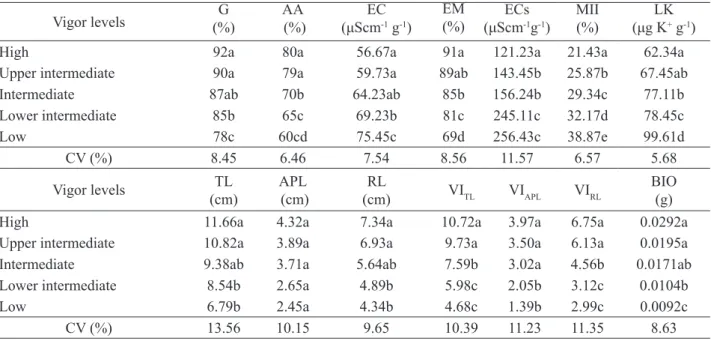
Regardless of the test applied, the seeds with initial high and low physiological quality were grouped into different vigor classes with the application of mean test (Table 1). Leakage of ions, amino acids and sugars is regarded as an indirect measure of the membrane permeability level and, consequently, of its deterioration condition (Marcos Filho, 2015b). In the present work, the MII followed the expected viability decrease with the artificial aging conducted, as the results were grouped into five means of statistically different values (Table 1).
Corroborating Pallaoro et al. (2016), the contribution of vigor analyses based on length
(TL, APL & RL) to differentiate the seed lots in distinct physiological potential levels was greater when the tests were expressed in the form of vigor index as per Abdul-Baki & Anderson (1973), thus indicating that seedlings with larger size or mass did not always originate from seed lots with higher germination speed and vice versa. Matthews et al. (2012) attribute this effect to the reduction in the speed of metabolic reactions required for germination of deteriorated seeds, which need a longer period to generate all the normal seedlings recorded in the germination reading, due to the delay in radicle emission.
Similarly to the present study (Table 1), Brunes et al. (2016) indicated the biomass and root length of wheat seedlings as the best measures to estimate field emergence; whereas Boligon et al. (2011) point out that the accuracy of those seed vigor estimation tests was reduced in lower physiological quality lots. In the present study, which was carried out with non-chemically treated seeds, the biomass and length variables (TL, APL, RL) were incapable of identifying differences between the most vigorous lots (Table 1). However, Rampim et al. (2012), Abati et al. (2014) and Mariucci et al. (2018) are some of the numerous authors that have indicated those same variables as efficient to identify the phytotoxic effect of agrochemicals applied to wheat and maize seeds.
Table 1. Means of germination (G), accelerated aging (AA), electrical conductivity of seeds (EC), field emergence (EM), electrical conductivity in seedlings (ECs), membrane injury index (MII), potassium leakage (LK), total seedling length (TL), aerial part length (APL), main root axis length (RL), vigor index based on total seedling length (VITL), vigor index based on aerial part length (VIAPL), vigor index based on main root axis length (VIRL), and seedling dry biomass (BIO) of five lots with different vigor levels of the Garra Viptera maize hybrid.
Vigor levels (%)G (%)AA (μScmEC-1 g-1)
EM
(%) (μScmECs-1g-1) MII(%) (μg KLK+ g-1)
High 92a 80a 56.67a 91a 121.23a 21.43a 62.34a
Upper intermediate 90a 79a 59.73a 89ab 143.45b 25.87b 67.45ab
Intermediate 87ab 70b 64.23ab 85b 156.24b 29.34c 77.11b
Lower intermediate 85b 65c 69.23b 81c 245.11c 32.17d 78.45c
Low 78c 60cd 75.45c 69d 256.43c 38.87e 99.61d
CV (%) 8.45 6.46 7.54 8.56 11.57 6.57 5.68
Vigor levels (cm)TL (cm)APL (cm)RL VITL VIAPL VIRL BIO (g)
High 11.66a 4.32a 7.34a 10.72a 3.97a 6.75a 0.0292a
Upper intermediate 10.82a 3.89a 6.93a 9.73a 3.50a 6.13a 0.0195a
Intermediate 9.38ab 3.71a 5.64ab 7.59b 3.02a 4.56b 0.0171ab
Lower intermediate 8.54b 2.65a 4.89b 5.98c 2.05b 3.12c 0.0104b
Low 6.79b 2.45a 4.34b 4.68c 1.39b 2.99c 0.0092c
CV (%) 13.56 10.15 9.65 10.39 11.23 11.35 8.63
Means followed by the same letter in the column do not statistically differ as per Fisher’s LSD test (p<0.05).
Table 2. Pearson’s correlation (p<0.05) between variables based on seedlings (electrical conductivity in seedlings - ECs, potassium leakage - LK, membrane injury index - MII, total seedling length - TL, aerial part length - APL, main root axis length - RL, seedling dry biomass - BIO, vigor index based on total seedling length - VITL, vigor index based on aerial part length - VIAPL, and vigor index based on main root axis length - VIRL) and variables based on seed analysis (germination - G, accelerated aging - AA, electrical conductivity of seeds – EC, and field emergence - EM) of five lots with different vigor levels of the Garra Viptera maize hybrid.
ECs LK MII TL APL RL BIO VITL VIAPL VIRL
G -0.743* -0.712* -0.845* 0.134* 0.124* 0.257* 0.258* 0.231* 0.247* 0.556* AA -0.854* -0.856* -0.939* 0.086* 0.045* 0.263* 0.274* 0.245* 0.276* 0.534* EC 0.985* 0.831* 0.976* -0.075* -0.064* -0.297* -0.211* -0.211* -0.235* -0.563* EM -0.875* -0.823* -0.911* 0.056* 0.043* 0.254* 0.213* 0.224* 0.221* 0.588*
coefficients between seedling evaluation tests (ECs, TL, APL, RL, VITL, VIAPL,VIRL, LK & MII) and the results of physiological quality based on seeds (G, AA, EC & EM). Pearson’s coefficient assumes values from -1 to 1, so that a value equivalent to 1 or -1 means that a linear model perfectly describes the relation between two variables, while the 0 value implies that there is no linear correlation between the variables (Cargnelutti-Filho et al., 2010).
Simultaneously to a lower sensitivity to distinguish vigor levels (Table 1), the biometric tests presented lower correlation values in relation to the tests based on membrane permeability (Table 2). The seedling dry biomass (BIO) and root length (RL & VIRL) were the biometric methodologies that presented the highest levels of association with the physiological quality tests in seeds. Such behavior was also observed by Boligon et al. (2011) in wheat crops.
All methodologies based on seedling membrane injury (ECs, MII & LK) presented negative correlation with the results of tests where seeds, and not seedlings, were the structures analyzed, thus indicating that the increasing values of a variable are associated with the decreasing values of other variable. That same behavior was also reported by Diniz et al. (2013), Pereira et al. (2019) and Sena et al. (2017) and it can be attributed to the nature of the tests, whose theoretical basis suggests that the activation of membrane protection and repair mechanisms, during the imbibition process, occurs more slowly in deteriorated seed lots, which results in
the uncontrolled water uptake and, consequently, the release of larger quantities of intracellular substances to the medium.
As the deterioration advances, enzymes are inactivated, alterations in DNA, RNA and protein synthesis become more intense, and the free radical content is incremented with the consumption of reserves (Kaewnaree et al., 2011). However, as it is the structure responsible for the cell-medium interaction, the membrane permeability has long been regarded as the first phenomenon of the aging process (Kaewnaree et al., 2011; Marcos Filho, 2015b). In the present work, the MII was the electrolyte test that presented correlation values closer to -1 (Table 2). This greater accuracy may be related to the nature of its methodology, which allows the collection of exudates released by plant cells of internal and external tissues, while the others primarily collect those released by the external tegument. Although demanding more time to provide a result, the MII presents an advantage in relation to the other tests based on electrolytes (electrical conductivity and potassium leakage) which is to break the membrane resistance to the exudate release, thus neutralizing the genotypic variations associated with the tegument (Demidchik et al., 2014).
Conclusion
The methodologies based on electrolyte leakage of maize seedlings, especially the membrane injury index, were more accurate than
the biometric tests to identify the vigor level of the maize seed lots used.
Acknowledgments
The present work was executed with the financial support of the Coordination for the Improvement of Higher Education Personnel - Brazil (CAPES).
References
ABATI, J.; ZUCARELI, C.; FOLONI, J. S. S.; HENNING, F. A.; BRZEZINSKI, C. R.; HENNING, A. A. Treatment with fungicides and insecticides on the physiological quality and health of wheat seeds. Journal of Seed Science, v. 36, n. 4, p. 392-398, 2014. DOI: 10.1590/2317-1545v36n41006.
ABDUL-BAKI, A. A.; ANDERSON, J. D. Vigor determination in soybean seed by multiple criteria. Crop Science, v. 13,
n. 6, p. 630-633, 1973. DOI: 10.2135/
cropsci1973.0011183X001300060013x.
BOLIGON, A. A.; LÚCIO, A. D. C.; LOPES, S. J.; CARGNELUTTI FILHO, A.; GARCIA, D. C. Wheat seedling emergence estimated from seed analysis. Scientia Agricola, v. 68, n. 3, p. 336-341, 2011. DOI: 10.1590/S0103-90162011000300010.
BRUNES, A. P.; ARAÚJO, Á. S.; DIAS, L. W.; VILLELA, F. A.; AUMONDE, T. Z. Seedling length in wheat determined by image processing using mathematical tools. Revista Ciência Agronômica, v. 47, n. 2, p. 374-379, 2016. DOI: 10.5935/1806-6690.20160044.
CARGNELUTTI FILHO, A.; STORCK, L.; GUADAGNIN, J. P. Número de repetições para a comparação de cultivares de milho. Ciência Rural, v. 40, n. 5, p. 1023-1030, 2010. DOI: 10.1590/S0103-84782010005000073.
DEMIDCHIK, V.; STRALTSOVA, D.; MEDVEDEV, S. S.; POZHVANOV, G. A.; SOKOLIK, A.; YURIN, V. Stress-induced electrolyte leakage: the role of K+ permeable
channels and involvement in programmed cell death and metabolic adjustment. Journal of Experimental Botany, v. 65, n. 5, p. 1259-1270, 2014. DOI: 10.1093/jxb/eru004.
DINIZ, F. O.; REIS, M. S.; DIAS, L. A. S.; ARAÚJO, E. F.; SEDIYAMA, T.; SEDIYAMA, C. Physiological quality of soybean seeds of cultivars submitted to harvesting delay and its association with seedling emergence in the field. Journal of Seed Science, v. 35, n. 2, p. 147-152, 2013. DOI: 10.1590/S2317-15372013000200002.
INTERNATIONAL SEED TESTING
ASSOCIATION. International rules for seed
testing. Bassersdorf, 2017.
KAEWNAREE, P.; VICHITPHAN, S.; KLANRIT, P.; SIRI, B.; VICHITPHAN, K. Effect of accelerated aging process on seed quality and biochemical changes in sweet pepper (Capsicum annuum Linn.) seeds. Biotechnology, v. 10, n. 2, p. 175-182, 2011. DOI: 10.3923/ biotech.2011.175.182.
KRANNER, I.; CHEN, H.; PRITCHARD, H.; PEARCE, S.; BIRTIĆ, S. Inter-nucleosomal DNA fragmentation and loss of RNA integrity during seed ageing. Plant Growth Regulation, v. 63, n. 1, p. 63-72, 2011. DOI: 10.1007/s10725-010-9512-7.
KRZYZANOWSKI, F. C.; FRANÇA-NETO, J. B.; HENNING, A. A. Relato dos testes de vigor disponíveis para as grandes culturas. Informativo Abrates, v. 1, n. 2, p. 15-50, 1991.
MARCOS FILHO, J. Seed vigor testing: an overview of the past, present and future perspective. Scientia Agricola, v. 72, n. 4, p. 363-374, 2015a. DOI: 10.1590/0103-9016-2015-0007.
MARCOS FILHO, J. Fisiologia de sementes de
plantas cultivadas. 2. ed. Londrina: ABRATES, 2015b. 660 p.
MARIUCCI, G. E. G.; SUZUKAWA, A. K.; BRACCINI, A. L.; SCAPIM, C. A.; LIMA, L. H. S.; ANGELOTTI, P.; PONCE, R. M.; MARTELI, D. C. V. Physiological potential of maize seeds submitted to different treatments and storage periods. Journal of Seed Science, v. 40, n. 1, p. 60-66, 2018. DOI: 10.1590/2317-1545v40n1184456. MATTHEWS, S.; NOLI, E.; DEMIR, I.; KHAJEH-HOSSEINI, M.; WAGNER, M. H. Evaluation of seed quality: from physiology to international standardization. Seed Science Research, v. 22, p. S69-S73, 2012. Supplement. DOI: 10.1017/ s0960258511000365.
MIGUEL, M. V. C.; MARCOS FILHO, J. Potassium leakage and maize seed physiological potential. Scientia Agricola, v. 59, n. 2, p. 315-319, 2002. DOI: 10.1590/S0103-90162002000200017. NAKAGAWA, J. Testes de vigor baseados no desempenho das plântulas. In: KRZYZANOWSKI, F. C.; VIEIRA, R. D.; FRANÇA-NETO, J. B (Ed.). Vigor de sementes: conceitos e testes. Londrina: ABRATES, 1999. p. 1-24.
ODLUM, K. D.; BLAKE, T. J. A comparison of analytical approaches for assessing freezing
damage in black spruce using electrolyte leakage methods. Canadian Journal of Botany, v. 74, n. 6, p. 952-958, 1996. DOI: 10.1139/b96-118. PALLAORO, D. S.; AVELINO, A. C. D.; CAMILI, E. C.; GUIMARÃES, S. C.; ALBUQUERQUE, M. C. F. Priming corn seeds with plant growth regulator. Journal of Seed Science, v. 38, n. 3, p. 227-232, 2016. DOI: 10.1590/2317-1545v38n3163847.
PEREIRA, L. C.; CORREIA, L. V.; FELBER, P. H.; PEREIRA, R. C.; MATERA, T. C.; SANTOS, R. F. D.; BRACCINI, A. L. Correlation between physiological tests and field emergence in treated corn seeds. Plant, Soil and Environment, v. 65, n. 12, p. 569-573, 2019. DOI: 10.17221/565/2019-PSE.
RAMPIM, L.; RODRIGUES-COSTA, A. C. P.; NACKE, H.; KLEIN, J.; GUIMARÃES, V. F. Qualidade fisiológica de sementes de três cultivares de trigo submetidas à inoculação e diferentes tratamentos. Revista Brasileira de
Sementes, v. 34, n. 4, p. 678-685, 2012. DOI:
10.1590/S0101-31222012000400020.
SENA, D. V. D. A.; ALVES, E. U.; MEDEIROS, D. S. D. Vigor tests to evaluate the physiological quality of corn seeds cv. ‘Sertanejo’. Ciência Rural, v. 47, n. 3, e20150705, 2017. DOI: 10.1590/0103-8478cr20150705.
SHARMA, P.; MISHRA, M.; SINGH, N. I.; CHAUHAN, J. S. Determination of integrity of seed membrane systems and mineral ions leakage in horse gram. World Journal of Agricultural Sciences, v. 7, n. 4, p. 476-479, 2011.
VIEIRA, R. D.; KRZYZANOWSKI, F. C. Teste de condutividade elétrica. In:
KRZYZANOWSKI, F. C.; VIEIRA, R. D.; FRANÇA NETO, J. B. (Ed.). Vigor de sementes: conceitos e testes. Londrina: ABRATES, 1999. cap. 4, p. 1-26.
ZUCARELI, C.; BRZEZINSKI, C. R.; ABATI,
J.; HENNING, F. A.; RAMOS JÚNIOR, E. U.; NAKAGAWA, J. Lixiviação de íons potássio, cálcio e magnésio para determinação do vigor em sementes de milho doce. Informativo Abrates, v. 23, p. 56, 2013.