Reducing Intentions to Resist Future Change 1
Neves, P., Almeida, P., & Velez, M.J. (2018) Reducing intentions to resist future change: Combined effects of commitment-based HR practices and ethical leadership. Human Resource Management, 57, 249-261.
Reducing Intentions to Resist Future Change:
Combined Effects of Commitment-Based HR Practices and Ethical Leadership
Pedro Neves, Patrícia Almeida, and Maria João Velez
Abstract
Change management, and particularly the human side of change, is a central tenet of the strategy of contemporary organizations. However, there is little evidence concerning how strategic HR practices influence how individuals anticipate and react to the implementation of a major change and how direct supervisors influence that process. With a sample of 191 employees from multiple organizations, who completed two surveys with a four-week lag, we examined the role of commitment-based HR practices on employees’ intentions to resist future change. We found that commitment-based HR practices contribute to a decrease in intentions to resist future change, measured four weeks later, via increased affective commitment to change. Moreover, we found that this relationship is conditional on ethical leadership, in that it is significant when ethical leadership is high, but not when it is low. Building on social exchange and uncertainty reduction theories, our findings contribute to the literature by examining how and under what boundary conditions HR practices are an
effective means for organizations to anticipate and manage change.
Keywords: change-individual, commitment, ethics, research methods & design-quantitative research methodology, change-organizational, attitudes, leadership
Correspondence to: Pedro Neves, Associate Professor, Nova School of Business and Economics, Campus de Campolide, 1099-032 Lisboa, Portugal, [email protected].
Introduction
In the current macroeconomic scenario, organizational change is becoming more frequent, inevitable and unanticipated (Shin, Taylor & Seo, 2012; Herscovitch & Meyer, 2002). If firms intend to remain competitive they have to effectively and efficiently manage organizational change and adapt to the changes in the market. However, failure seems to be the norm rather than the exception. Estimates suggest that about two thirds of change projects fail (Choi, 2011; Shin et al, 2012). From the myriad of factors that can contribute to
unsuccessful change processes, including pressures from the business environment and inadequate organizational infrastructure, resistance to change has been identified as a primary source of change failure (Reger, Mullane, Gustafson & DeMarie, 1994; Szabla, 2007).
Research examining resistance to change tends to emphasize the role played by the characteristics of the change process (e.g., Dent & Goldberg, 1999; Oreg, 2006; van Dam, Oreg & Schyns, 2008) and focuses on what happens during (or immediately prior to) the implementation (e.g., Coch & French, 1948; Furst & Cable, 2008; Hon, Bloom & Crant, 2014; van Dam et al., 2008). However, researchers have acknowledged that organizational life (and change events in particular) does not occur in a vacuum and is strongly influenced not only by the daily context (van Dam, et al., 2008), but also by a longer time span
(Bluehorn & Denhardt, 1988). As Bluehorn and Denhardt (1988) state, “individuals come and go but the organization lives on” (p. 301). This lack of continuity between change
processes, where managers prepare the organization as if each event is the beginning of a new cycle, rather than a part of the life cycle of the organization, might help explain such low success rates. Taking into account time and the organization’s history, values and traditions is fundamental to understand how institutions and change agents create readiness for change (Amis & Aissaoui, 2013). This strategy should help us prepare for change by anticipating it
and therefore influence not just resistance to ongoing events, but more importantly, predict intentions to resist potential change efforts, even before a formal decision to change is made.
Moreover, employees are at the center of the change process, given that in order to successfully implement changes, organizations have to encourage their employees to enact new behaviors (Armenakis & Bedeian, 1999). However, and despite increasing evidence, their role in the change process is still often underestimated (Choi, 2011). The favored perspective on organizational change research is ‘agent-centric’, in that it assumes that change agents know what they are doing and are doing it right, while change recipients are unwilling to cooperate and attempt to slow down, difficult and block the change process (Ford, Ford & D’Amelio, 2008). This portrayal of resistance to change tends to assume this array of negative reactions is independent of the interactions and relationships between change agents and recipients.
As Kotter (1995, 2007) highlighted, executives often underestimate how hard it is to establish a sense of urgency in their workforce and do not anchor major changes in the organization’s culture. Even when they try to overcome resistant behaviors, executives often make the mistake of applying a ‘one-size-fits-all’ strategy, failing for example to realize that employees do not have the necessary information to contribute to the change effort (Kotter & Schlesinger, 1979, 2008). Thus, in order to increase the effectiveness of change programs, it is imperative to challenge these assumptions and ask the question “How do individuals make sense of the organization’s practices and its history of change?”. Specifically, we need to examine how change processes influence future changes, while taking into account how employees’ sensemaking concerning the actions of the organization and its agents helps determine their assessment of a given change event and influence their intentions to resist future unforeseen changes.
In the current study, we examine if commitment-based HR practices, by
demonstrating the firm’s long-term investment in its employees (Tsui, Pearce, Porter & Tripoli, 1997), help reduce employees’ intentions to resist future changes. We propose that the underlying mechanism in this relationship is an enhancement of the employees’ belief in the benefits of the latest major change (i.e., affective commitment to change). This enhances readiness for change by decreasing the sensemaking gap between a familiar situation and future state (Amis & Aissaoui, 2013), therefore increasing the willingness to reciprocate the perceived benefits received during the preceding organizational change. Finally, we argue that the demonstration and promotion of normatively appropriate behavior (i.e., ethical leadership) by the change agents responsible for its implementation (line managers) is a key boundary condition for the effectiveness of HR practices, as it reduces uncertainty about the future intentions of the organization and reinforces the long-term orientation and moral philosophy of the organization, reflected in his/her daily practices.
We contribute to the literature by challenging several assumptions that have guided change management research. First, we take a process perspective of organizational change, (Langley, Smallman, Tsoukas & Van de Ven, 2013) and assume the centrality of time and continuity in the sensemaking of individuals, and therefore the lives of organizations, rather than examine change as a discrete event. We build on the hypothesis that events and
experiences are interconnected and that “each event arises out of, and is constituted through, its relations to other events” (Langley et al., 2013, p. 5) to test a cascade model where an organization’s strategy is expected to influence the sensemaking process concerning a major organizational change, which in turn should predict future behavioral intentions toward change efforts. Second, we build on prior research that demonstrated the importance of HR practices on long-term firm performance (Huselid, 1995) and survival (DeGeest, Follmer, Walter & O’Boyle, 2015), and extend this line of research to answer the question “Do HR
practices influence the long-term ability of the organization to adapt and change?”, an important component of long-term firm success. Building on social exchange theory (Blau, 1964), we bring attention to the importance of HR practices for change management, namely its influence on employees’ intentions concerning potential future events.
Third, we build on Ford and Ford’s (2010) argument that resistance is not irrational, but rather thoughtful and with a functional value, as it can point to inefficacies of the system and deepen the discussion about change. Change agents’ ethical conduct matters (Babalola, Stouten & Euwema, 2014) , and as such we address the call put forth by Sharif and Scandura (2014) to examine the role of ethical leadership in different organizational contexts, in our case operationalized as different HR strategies. We build on uncertainty reduction theory (Berger & Calabrese, 1975) and follow the framework put forth by Ford et al. (2008). Ford et al. (2008) suggest that in order to capture the complexities of the change process, one should examine both change agents and change recipients’ sensemaking and how they seek to
answer questions such as ‘What is the value of this change?’, ‘How will we accomplish this?’ and ‘What will happen to me?’. We argue that in order to fully understand how HR practices affect change management, we have to take into account both the HR strategy and the role played by change agents, not only during the change effort, but also prior to its
implementation.
Commitment-Based HR Practices and Change Management
HR practices set the tone and define the conditions underlying the employee-employer relationship, influencing how employees behave in the workplace (Paré & Tremblay, 2007). If the organization’s philosophy is that employees are a disposable asset, they will react accordingly and put little investment in the success and future of the organization (Tsui et al., 1997). However, if the organization’s HR practices embody a philosophy that sees employees as a valuable asset, has a long-term focus and is based on the principles of humanistic values,
organizational support and trust, employees will be more willing to contribute to the organization’s success. Arthur (1992, 1994) coined the latter perspective as an HR commitment system (or as Collins & Smith, 2006, describe it, ‘commitment-based HR practices’) which forges psychological links between organizational and employee goals (which is different from the transactional perspective of control HR systems, where the goal is to reduce direct labor costs or improve efficiency via compliance).
While the specific HR practices may vary across companies, they tend to emphasize the same three dimensions: selection practices that highlight the internal labor market, compensation practices based on group and organizational performance; and training opportunities focused on the long-term (Arthur, 1992; Tsui et al., 1997). This approach to strategic human resources has the aim “to motivate employees to contribute high levels of discretionary behaviors by aligning their interests with those of the organizations and creating a mutually reinforcing high-investment employer-employee relationship” (Collins & Smith, 2006, p. 546). This framework has also been related to high-performance work systems and high-involvement work systems, but differs in its core objective: it aims at the development of a psychological bond to the organization (Boon & Kalshoven, 2014). These practices help develop committed employees who can be trusted to use their discretion in enacting
behaviors which are in line with the organization’s goals (Arthur, 1994). Research on commitment-based HR practices has shown that this bundle of practices has an important impact on organizational functioning. It influences not only the social climate of the firm (Collins & Smith, 2006), but also employee involvement and engagement (Allen, Ericksen & Collins, 2013; Boon & Kalshoven, 2014), turnover (Allen et al., 2013; Arthur, 1994) and role behaviors (Uen, Chien & Yen, 2009), as well as firm performance (Arthur, 1994; Collins & Smith, 2006) and innovation (Ceylan, 2013).
Nonetheless, and despite the growing evidence supporting the importance of commitment-based HR practices, very little is still known about how these practices influence organizational change initiatives. A recent review of the literature on employee attitudes toward change conducted by Choi (2011) mentioned only one study that examined HR practices (Conway & Monks, 2008). Still, in this study the authors did not focus on HR practices per se, but rather employees’ satisfaction with those practices. Given the
pervasiveness of change programs in contemporary organizations and their surprisingly low success rates (Shin et al., 2012), we believe it is imperative to further our knowledge of how strategic HR practices influence such programs, namely how and under what conditions they might help manage employees’ intentions to resist future changes.
Given the importance of continuity in organizational life (Langley et al., 2013) and the emphasis commitment-based HR practices place on the long-term relationship between the organization and its employees (Arthur, 1992; Tsui, Pearce, Porter & Hite, 1995), we argue that these practices should have an impact on how individuals anticipate future events in the organization. Social exchange theory (Blau, 1964) provides a possible explanation for this relationship. Social exchange theory is one of the most influential paradigms in
organizational behavior (Cropanzano & Mitchell, 2005) and states that interactions between parties evolve through time and are contingent on the actions of the other party (Blau, 1964). Only social exchanges tend to engender feelings of personal obligation, gratitude, and trust; purely economic exchanges do not (Blau, 1964). The main principle of social exchanges lies in the norm of reciprocity (Gouldner, 1960), which involves the reciprocation of favorable treatment and as such serves as a starting mechanism for interpersonal relationships. It holds a ‘division of labor’ component that states that reciprocation will be made in terms of goods and services that are of value to the other party and are within the capability of the donor to give.
HR practices that demonstrate the organization’s support of its workforce, such as commitment-based HR practices, are expected to foster an environment of reciprocity (DeGeest et al., 2015). Such a long-term investment should enhance employees’ felt obligation to help and protect the organization, as the benefits exchanged are indicative of mutual support and investment in the relationship (Aryee, Budhwar & Chen, 2002). Interestingly, an important dimension of social exchanges is that they “involve favors that create diffuse future obligations (Blau, 1964, p. 93). Employees should feel obligated to reciprocate by exerting higher levels of discretionary behaviors and increasing the
willingness to do more for the organization (Paré & Tremblay, 2007; Mcclean & Collins, 2011; Collins and Smith, 2006), including providing active support for change efforts, rather than resisting them. We therefore propose that given its emphasis on the long-term
relationship with employees, commitment-based HR practices should reduce their intentions to resist future changes.
Hypothesis 1: Commitment-based HR practices are negatively related to intentions to resist future change.
Commitment to Change as a Sensemaking Mechanism
Building on a process perspective of organizational change (Langley et al., 2013), we argue that a deeper understanding of how individuals anticipate future events has to take into account the connection between past and future. Individuals make sense of possible courses of action based on their previous experience within their organization, as their openness to change is a result of continuous sensemaking processes, which include both cognitive and affective components (Huy, 1999). Sensemaking is particularly critical in dynamic and turbulent environments (Weick, 1993), such as change processes, where individuals attempt to interpret cues from their environment in order to deal with uncertainty and ambiguity (Maitlis, 2005) and maintain a sense of continuity (Giessner, 2011).
In line with this theoretical reasoning, previous research has shown that the history of change in an organization is an important determinant of employees’ reactions to change (Bouckennoghe, 2012). Major change initiatives are emotionally charged (Eriksson, 2004), and such emotionally arousing events are not only perceived more vividly but also reach awareness more easily (Markovic, Anderson & Todd, 2014). Subsequent emotional responses (e.g., how should I react to a new, potential change) are regulated by affect-biased attention filters (Todd, Cunningham, Anderson & Thompson, 2012), where the individual’s history plays a central role.
When determining how to react to another potential change, individuals should recall their interpretation of a recent and affectively salient event, i.e., the latest major change, and respond accordingly. We propose that commitment to (the latest major) change, as a “mind-set that binds an individual to a course of action deemed necessary for the successful
implementation of a change initiative” (Herscovitch & Meyer, 2002, p. 475), plays a key role in the relationship between HR practices and intentions to resist future change. Herscovitch and Meyer (2002) extended the three-dimensional model of commitment (Allen & Meyer, 1990; Meyer & Allen, 1991) to organizational change based on the assertion that the model should be applicable to other forms of commitment. They differentiate three forms of
commitment to change: a desire to provide support for change based on a belief in its inherent benefits (affective); a recognition of the costs associated with the failure to support the
change (continuance); and a sense of obligation to provide support for the change (normative).
Of the three dimensions, believing in the benefits of change (i.e., affective commitment to change) seems to be the main driver in the process of sensemaking and maintenance of a sense of continuity in the organization. The meta-analysis conducted by Bouckenooghe, Schwarz and Minbashian (2015) showed that, of the three dimensions,
affective commitment to change is also the strongest predictor of employees’ behavioral support for change. In their seminal work, Herscovitch and Meyer (2002) argued that many of the strategies recommended for change management, like participation and empowerment, foster mainly the affective component of commitment to change.
As previously discussed, commitment-based HR practices should signal the long-term investment of the organization in its members (Tsui et al., 1995), who would reciprocate by demonstrating their willingness to go beyond the call of duty, namely by decreasing their intentions to resist future change efforts. We also propose that individuals’ decisions concerning how to react to future change events, i.e. their sensemaking process (Weick, 1993), are part of a thoughtful process (Ford & Ford, 2010) that extends across time and multiple events (Langley et al., 2013) and helps reduce the uncertainty that is inherent to change. In order to preserve a sense of continuity in their organizational life, individuals integrate not only HR practices but also multiple events into their sensemaking process. Specifically, we argue that the employees’ assessment of the latest change process,
particularly their belief about its benefits (affective commitment to change), should serve as a linking event between the general practices of the organization and their intentions to support or resist change in the future. Thus, we expect that the impact of commitment-based HR practices on employees’ intentions to resist future change is mediated by their affective commitment to the latest major organizational change.
Hypothesis 2: Affective commitment to change mediates the negative
relationship between commitment-based HR practices and intentions to resist future change.
Ethical Leadership as a Boundary Condition
When studying organizational change processes, researchers frequently mention the impact of the increased levels of uncertainty (Matteson & Ivancevich, 1990; Nelson, Cooper & Jackson, 1995). According to uncertainty reduction theory (Berger & Calabrese, 1975),
individuals attempt to reduce uncertainty in their interactions with others before they act. This is a result of individuals’ efforts to ‘make sense’ of the surrounding environment and events in order to narrow down the range of alternatives about the other party’s probable future behavior (Berger & Calabrese, 1975). Leaders are at the center stage in the reduction of uncertainty as they provide the needed confidence and vision in times of uncertainty (Waldman, Ramírez, House & Puranam, 2001), turning insecurity into an opportunity and potential success (Bass, 1985).
As By (2005) characterized it, “few would dispute that the primary task for
management today is the leadership of organizational change” (p. 370). For leadership to be effective in managing change, it should be strongly grounded in a clear system of ethics, showing that leaders will not abuse the faith bestowed upon them (Burnes & By, 2012). Ethical leadership concerns “the demonstration of normatively appropriate conduct through personal actions and interpersonal relationships, and the promotion of such conduct to followers through two-way communication, reinforcement, and decision-making” (Brown, Treviño & Harrison, 2005, p. 4).
This is to say that ethical leaders not only talk the talk, but also walk the walk. This perspective moves away from the normative view, which establishes how leaders ought to behave, and focuses on what they actually do in practice (Neves, Rego & Cunha, 2014). Although the transformational and charismatic approaches to leadership already include an ethical component (Bass & Avolio, 2000), evidence seems to suggest that there is, at best, a partial overlap between these concepts, as none of these approaches focuses on the proactive influence of leaders on the ethical conduct of followers (Brown & Treviño, 2006). Thus, and given the centrality of ethics for organizational long-term success, ethical leadership as an independent construct deserves further attention.
Despite emerging as an independent construct rather recently, ethical leadership has already shown its impact on a number of employee outcomes, such as well-being (Avey, Wernsing, & Palanski, 2012; Kalshoven & Boon, 2012), organizational commitment (Hansen, Alge, Brown, Jackson & Dunford, 2013; Neubert, Carlson, Kacmar, Roberts & Chonko, 2009) and optimism about the future (De Hoogh, & Den Hartog, 2008). More importantly, it contributes to multiple dimensions of performance, including task (Liu, Kwan, Fu, & Mao, 2013; Piccolo, Greenbaum, Den Hartog & Folger, 2010), extra-role (Kacmar, Bachrach, Harris & Zinuvska, 2011; Liu et al., 2013) and innovative behavior (Yidong, & Xinxin, 2013), while decreasing unethical (Mayer, Aquino, Greenbaum & Kuenzi, 2012) and deviant behavior (Avey, Palanski, & Walumbwa, 2011).
Remarkably, and notwithstanding the recognition of the importance of the leader’s moral compass in contexts charged with uncertainty, namely in order to help answer the question ‘What will happen to me?’, this dimension of leadership and the challenges that come with it, has been mostly ignored in change management research. Two recent exceptions demonstrate the importance of incorporating ethical leadership in change management research. Babalola et al. (2014) showed that an increase in the frequency of change only leads to higher turnover intentions when leaders are seen as not behaving ethically. When leaders behave in the best interest of their subordinates and avoid harming them (i.e., they are ethical), employees feel more secure and wish to reciprocate the treatment received by demonstrating their loyalty to the organization these leaders are agents of. The authors of the second study indicated that ethical leadership becomes particularly important for in-role and extra-role performance during change processes, demonstrating the relevance of ethical behavior become particularly important in times of organizational turmoil (Sharif & Scandura, 2014).
Given the impact of ethical leaders as role models and agents of the organization (Brown et al., 2005), and in line with uncertainty reduction theory (Berger & Calabrese, 1975), we argue that such ethical orientation will shape employees’ sensemaking process in two distinct moments (i.e., moderate both paths of the indirect effect described in hypothesis 2): when they are interpreting their organization’s past strategic HR practices and defining how that shapes their belief in the benefits of the latest major change; when they are trying to determine their long-term investment in the firm (reducing their intentions to resist future change) based on the perceived benefits of the latest major change.
Ethical leaders reinforce the message passed by the strategic commitment-based HR practices put forth by the organization and reflected in the subordinates’ beliefs about previous organizational changes, by demonstrating that its philosophy reverberates in the daily actions and operations of its agents. Such consistency between strategy and action would reinforce the long-term nature of the employee-organization relationship, thereby reducing uncertainty concerning the true intentions behind the decision to implement a change process. It would also show that indeed the organization is trustworthy, reinforcing employees’ belief that the organization is implementing the necessary changes to remain competitive in an increasingly turbulent environment but not at the expense of their
subordinates’ interests, thereby reducing intentions to resist future change. On the other hand, the lack of ethical leadership would demonstrate to employees that there is little congruence between what is defined at the strategic level and the sanctioned day-to-day behaviors of the organization’s agents. In such cases, this discrepancy should make HR practices ineffective in reducing employees’ intentions to resist future change, via increased affective commitment to change.
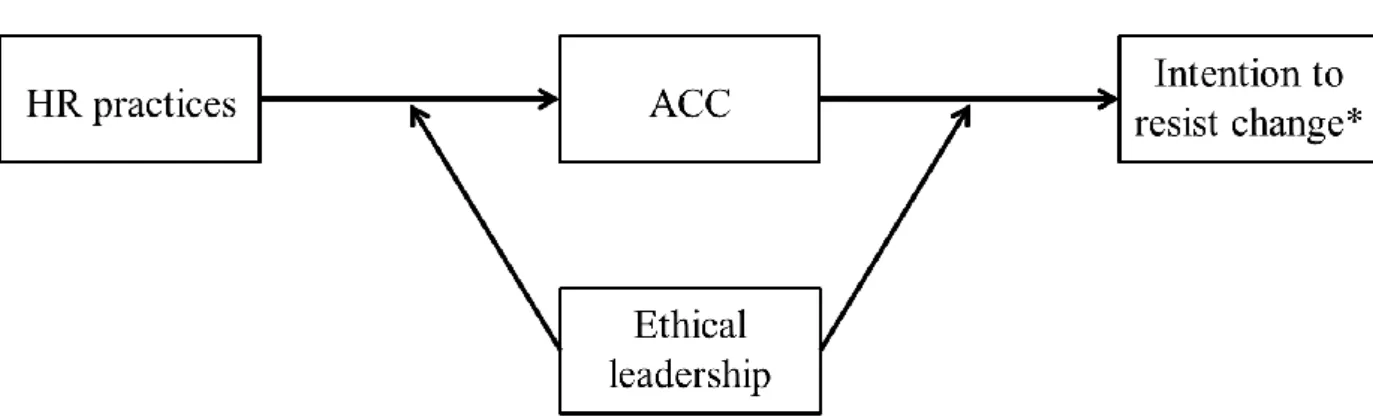
Hypothesis 3: Ethical leadership moderates the indirect relationship between commitment-based HR practices and intentions to resist future change via affective commitment to change, such that this relationship is stronger when ethical leadership is high.
--- Insert Figure 1 about here ---
Method Sample and Procedure
Our research team contacted twelve organizations operating in Portugal that had recently undergone (in the previous two years) major organizational changes. Over half of the organizations were from the private sector (55.5%) and operated in areas such as financial and insurance (33.0%) higher education (21.5%), health and pharmaceutical (20.4%), transportation (11.0%), construction (5.2%), manufacturing (4.7%) and retail (4.2%). The number of participants per organization varied between 4 and 41 (mean = 15).
To examine our theoretical model, we collected data in two separate points in time, separated by a four week lag. In the first survey (Time 1), we measured employees’ perceptions concerning the organization’s commitment-based HR practices and ethical leadership, as well as their affective commitment to change. With the aim of examining the attitudes and perceptions concerning the latest major change their organization faced, we used a retrospective method. Retrospective methods have been commonly used in the study of organizational change, as these events tend to have a strong emotional charge and individuals easily access details about how it took place and how they felt about it (e.g., Herscovitch & Meyer, 2002; Neves & Caetano, 2009). In order to elicit employees’ memories regarding that event, we asked each of them to briefly describe that specific major change in writing, including its impact on a number of dimensions (e.g., workload, job, learning new skills, personal life). The change processes described by our participants included restructuration of services and functions, change of location, acquisition of new tools and software, downsizing, among others. To assess their perceptions of high
involvement HR practices and ethical leadership, we asked them to think about how their organization functioned prior to that significant change.
Four weeks later (Time 2) we sent a second survey to participants where we asked them to assess their intentions to resist a (potential) future organizational change. To measure their intentions to resist a future change, we asked employees to imagine how they would react if their organization was about to start a change process, such as a major restructuration, departmental changes, introduction of new work processes, among other examples. In the Time 2 survey we made no reference to the change event participants described in Time 1.
We collected 226 surveys at Time 1 and of these participants, 84.5% also answered at Time 2 (N=191). Almost half of the participants had between 25 and 35 years (46.8%) and most of them were female (73.7%). Their average tenure in the organization was 6.0 years, while the average tenure with the supervisor was 4.1 years. Their educational attainment was as follows: less than high school (8.5%); high school (24.9%); bachelor degree (32.8%); post-graduation / masters (33.8%).
Measures
Commitment-based HR practices (Time 1). To measure commitment-based HR practices we used the 16-item scale developed by Collins and Smith (2006) which
encompasses three sub-dimensions: selection policies (internal labor markets and selection based on fit to the company; e.g., “We select employees based on an overall fit to the company”); incentive policies (group- and organization-based incentives; e.g., “Goals for incentive plans are based on business unit or company performance”); and training and development policies (training programs and performance appraisals based on long-term growth, team building, and development of firm-specific knowledge; “Performance
sub-dimensions, Collins and Smith (2006) found empirical support for a single global factor. In our study, the global scale also presented good reliability (α = .92).
Ethical leadership (Time 1). To measure ethical leadership we used the 10-item ethical leadership scale from Brown et al. (2005). The scale measures the supervisor’s demonstration of ethical conduct as well as the promotion of such behaviors in followers. Sample items include “My supervisor disciplines employees who violate ethical standards” and “My supervisor has the best interests of employees in mind” (α=.92).
Affective commitment to change (Time 1). To measure affective commitment to change we used the 6-item scale developed by Herscovitch and Meyer (2002). Sample items include “I believe in the value of this change” and “I think that management is making a mistake by introducing this change (reverse coded)” (α = .91).
Intentions to resist future change (Time 2). To measure employees’ intentions to resist future change, we asked participants to think about how they would react to the potential change and adapted 4 items of the behavioral dimension of Oreg’s (2006) change attitude scale by changing the wording of the items in order to focus on a potential future event. Sample items include “I would protest against the change” and “I would present my objections regarding the change to management” (α = .85).
All the previous scales were measured through Likert-type scales anchored in 1 = totally disagree and 5 = totally agree. The measures were translated to Portuguese (from the original scales published in English) following the translation – back-translation procedure outlined by Brislin (1980).
Control variables. The relationship between demographic variables and employee behavior, such as deviance (which in the context of change is a form of active resistance), has been previously documented (Berry, Ones & Sackett, 2007). Moreover, our sample comprises both private and public organizations, and these organizations may experience
organizational changes in rather diverse forms given the differences in embedded practices, jurisdiction, and bureaucracy, among others issues (Cinite, Duxbury & Higgins, 2009). Becker (2005) recommends that researchers should beware of the “’everything but the kitchen sink’ approach” (p. 285) and include in their analyses only variables correlated with the outcome variables in order not to reduce statistical power. Therefore, we first tested whether sector (public vs. private) and employees’ age, gender, educational attainment, organizational tenure and tenure with the supervisor should be included in our analysis. Only employees’ gender was significantly related to intentions to resist future change (and none with affective commitment to change), and thus was included in the second path of our analytical model. We also controlled for the effect of resistance to the latest major change (Time 1) on intentions to resist future change (Time 2) in order to show that our conditional indirect effect was significant over and beyond the effect of resistance to the originally elicited change in Time 1. By including resistance to the latest change we are controlling for past behaviors against future intentions to engage in similar behaviors, thereby showing that our process is not merely a general resistance to change effect that lingers throughout time. We used the same four items as in our measure of intentions to resist future change (α = .71).
Results
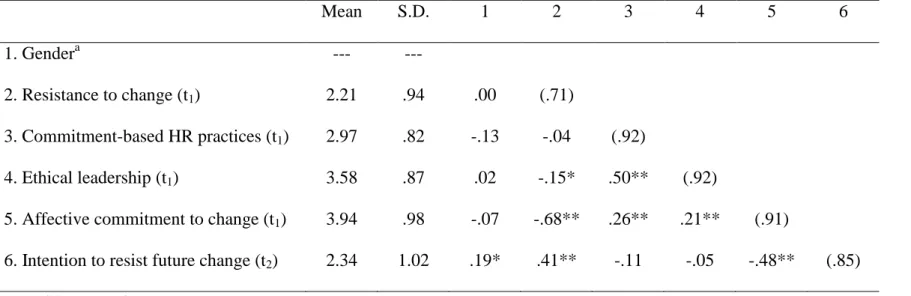
Descriptive statistics, reliabilities, and zero-order correlations are presented in Table 1. Men presented stronger intentions to resist future changes than women. Despite not including sector in our analysis for the reasons described in the methods section, it is
interesting to note that employees from the public sector perceived fewer commitment-based HR practices (r = -.40, p<.01) and ethical leadership (r = -.18, p<.05) compared to the private sector.
--- Insert Table 1 about here
---
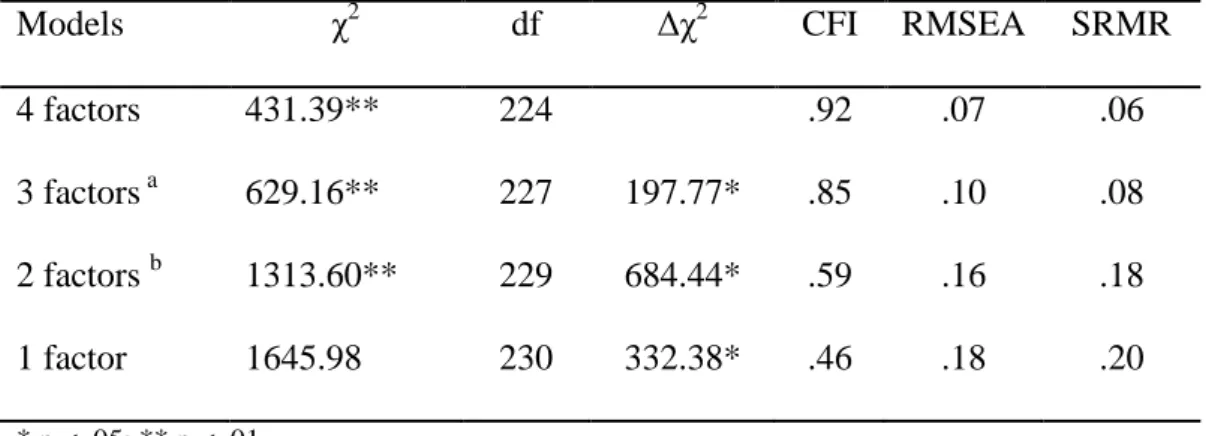
In order to test the distinctiveness of our measures, we conducted a series of confirmatory factor analysis (CFA). We compared our theoretical, four-factor model, with three alternative models. First, we compared it with a three-factor model where we aggregated the two variables that presented the strongest correlation between them: commitment-based HR practices and ethical leadership. We then compared it with a two-factor model that aggregated all variables measured at Time 1 (commitment-based HR practices, ethical leadership and affective commitment to change. Finally, we compared it with a single-factor model that included all the constructs. Since commitment-based HR practices contains three sub-dimensions (i.e., selection policies, incentive policies, and training and development practices), we used the procedure suggested by Bagozzi and Edwards (1998) and aggregated the items within each facet, using the three dimensions as indicators. Table 2 presents the results of the comparison between models. As we can see, the theoretical model (i.e., most differentiated) presented the best fit to our data.
--- Insert Table 2 about here ---
To test hypothesis 1, we conducted a linear regression, with the control variable in the first block and commitment-based HR practices in the second block. Commitment –based HR practices were not significantly related to intentions to resist future change (B = -.09, p > .05), therefore not supporting hypothesis 1. It is important to note that the direct relationship between the predictor and outcome is not a precondition to test mediation (Hayes, 2013).
To test hypotheses 2 and 3, we used the bootstrapping method developed by Preacher, Rucker and Hayes (2007), given its robustness in testing conditional indirect effects
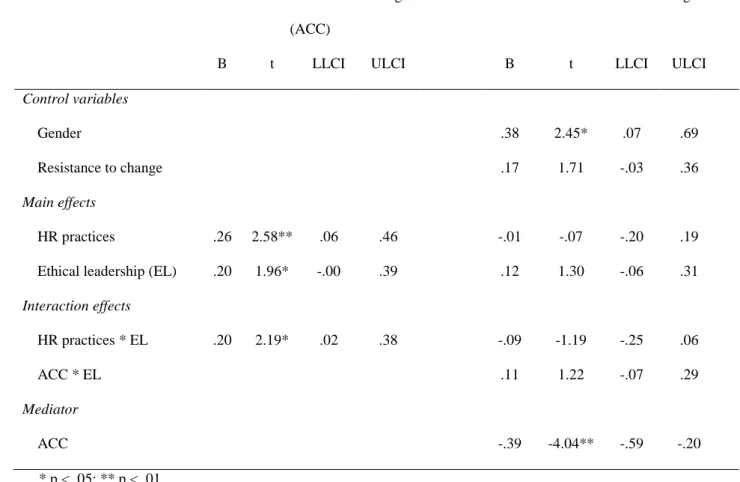
include both mediated moderation (when there is moderation of the predictor) and moderated mediation effects (when the magnitude of the effect of the predictor does not depend on the moderator, but rather the potency of the mediating effect on the outcome; Muller, Judd & Yzerbyt, 2005), as is the case of the present study. We tested our models with the PROCESS macro developed by Hayes (2013) with 1.000 bootstrap samples. Hayes (2013) identified several process model templates that can be tested with this macro, each of which depicted as a path diagram and assigned with a specific model number (our conceptual model is illustrated in Figure 1). First, we conducted a bootstrapping model (Model 4; Hayes, 2013) to test hypothesis 2, which states that commitment-based HR practices influences intentions to resist future change (Time 2) via increased affective commitment to change. We then conducted a second bootstrapping model (Model 59; Hayes, 2013) to test the moderating effect of ethical leadership in each of the three paths of the mediation model: between the predictor and mediator (X→Mi), the mediator and outcome (Mi→Y), and the direct path between the predictor and the outcome (X→Y). We centered the predictor variables and again included gender as a control variable. The results of the test of the complete conditional indirect effects model (Model 59) are presented in Table 3.
--- Insert Table 3 about here ---
In accordance with our prediction, we found that that commitment-based HR practices were significantly related to affective commitment to change (B = .31; LLCI .13, ULCI .48). That is, as commitment-based HR practices increased (prior to the change), so did
employees’ affective commitment to the following major organizational change. Moreover, affective commitment to change was significantly related to intentions to resist future change (B = -.37; LLCI -.56, ULCI -.18), measured four weeks later. Given the fact that the predictor
variable is related to the mediator, which in turn impacts the outcome variable (MacKinnon, Krull & Lockwood, 2000), coupled with a significant indirect effect via heightened affective commitment to change (B = -.11; LLCI -.20, ULCI -.05), these results support hypotheses 2. Specifically, commitment-based HR practices help reduce intentions to resist future change four weeks later, via an increase in employees’ belief in the benefits of the latest change (i.e., affective commitment to change).
As a first step in assessing the conditional indirect effects of commitment-based HR practices on our outcome variables (via affective commitment to change and dependent on the levels of ethical leadership), we first examined the interaction effects. We found a
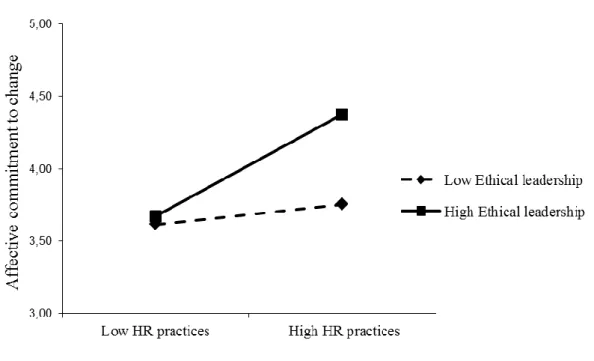
significant interaction effect between commitment-based HR practices and ethical leadership on affective commitment to change (B = .20, LLCI .02, ULCI .38). Figure 2 presents a depiction of the interaction effect. When ethical leadership is high, commitment-based HR practices are associated with higher levels of affective commitment to change (t = 3.30, p < .05). However, when ethical leadership is low, this relationship becomes non-significant (t = .69, p > .05; difference between slopes: t = 2.20, p < .05). We did not find a significant interaction effect for the second part of the model, i.e. the relationship between affective commitment to change and intentions to resist future change (B = -.11; LLCI -.07, ULCI .29), nor for the direct effect of commitment-based HR practices on intentions to resist future change (B = -.09; LLCI -.25, ULCI .06).
--- Insert Figure 2 about here ---
As a second step, we analyzed the conditional indirect effects model. When ethical leadership was high, commitment-based HR practices significantly reduced intentions to resist future change (B = -.21; LLCI -.38, ULCI -.08) via affective commitment to change.
However, when ethical leadership was low, the beneficial indirect effect of commitment-based HR practices on the reduction of intentions to resist future change (B = -.03; LLCI -.12, ULCI .06) disappeared. These results support hypothesis 3. Two additional notes are worth mentioning. First, the direct relationship between ethical leadership and commitment to change when controlling for commitment-based HR practices was non-significant (B = .20; LLCI -.00, ULCI .39). Second, commitment-based HR practices did not present a significant direct relationship with intentions to resist future change (B = -.01; LLCI -.20, ULCI .19), suggesting a full mediated moderation effect.
Our model explained 10% of the variance in affective commitment to change (of which 4.0% was due to the interaction effect) and 28% of the variance in intentions to resist future change.
Discussion
Change management research still favors the viewpoint that individuals in general have strong intentions to resist change efforts, and usually does not consider the possibility that “change agents contribute to what they call ‘resistant behaviors and communications’ through their own actions and inactions, owing to their own ignorance, incompetence, or mismanagement” (Ford et al., 2008, p. 362). Moreover, it normally examines change efforts as isolated events rather than as a part of the organization’s life cycle where time, history and traditions all influence the system’s ability to change (Amis & Aissaoui, 2013). In this study we aimed at challenging these assumptions, by examining how change agents’ decisions and actions at the strategic and operational level interact and predict how employees prepare for, and anticipate their reactions to, forthcoming major organizational changes. We adopted the perspective that intentions to resist future change, just like resistance to change, is the result of a sensemaking process in which individuals seek information and ascribe meaning to the actions of relevant agents (Thomas, Clark & Gioia, 1993).
Aligned with this perspective, our results show that commitment-based HR practices contribute to reduce employees’ intentions to resist future change (measured four weeks after we asked participants to recall a major change event) via an increase in employees’ affective commitment to the recalled change event, but only when ethical leadership is high. This means that the beneficial effects of commitment-based HR practices are conditional on the actions of immediate supervisors, namely their ethical guidance, and in its absence
commitment-based HR practices lose their ability to reduce intentions to resist future change. When the organization demonstrates in its strategic HR decisions concerning
selection, incentives and training and development (Collins & Smith, 2006) that it values employees, coupled with high levels of ethical leadership, it triggers a sensemaking process. On the one hand, these practices demonstrate the long-term investment and commitment to employees, which helps forge trust that the organization will not purposely engage in actions that might harm its workforce. On the other hand, it also demonstrates the importance of immediate supervisors for the smooth implementation of change, as they play a critical role as agents of the organization (Liden, Bauer & Erdogan, 2004) and are employees’ most proximal organizational foci (Lewin, 1943). Ethical leaders not only provide the necessary guidance in contexts charged with uncertainty (Waldman et al., 2001), but as key agents of the organization, influence employees’ sensemaking process concerning the organization’s intentions behind their HR strategy.
When there is alignment between HR practices and supervisor behavior, the employee-employer relationship is strengthened and the belief in the goodwill of the
organization and willingness to reciprocate is reinforced. As a result, employees will be more inclined to believe that the major changes proposed by the organization are beneficial and will not be achieved at the expense of the ‘disposable’ workforce, i.e., higher levels of
intentions to resist future change. On the other hand, the inconsistency revealed by an organization whose HR practices focuses on the long-term but whose agents, in this case immediate supervisors, fail to demonstrate a clear moral compass should signal to employees that the organization cannot be trusted to always have the best interests of its workforce in mind. In such case, there is an impairment of the beneficial effects of commitment-based HR practices, rendering them ineffective for change management. These results highlight the importance of: a) the previous history of change for the sensemaking process
(Bouckennoghe, 2012) and, b) of ethics for an effective management of change (Burnes & By, 2012); and suggest that commitment-based HR practices, coupled with high levels of ethical leadership, clearly set the tone for the employee-organization relationship. When the organization demonstrates through its strategic HR practices its long-term investment in the relationship with its employees (Tsui et al., 1997) and is able to reduce uncertainty through the behavior of its agents (Berger & Calabrese, 1975) they become more willing to go beyond the call of duty and embrace events charged with uncertainty.
Theoretical and Managerial Implications
Our findings carry implications for both theory and practice. Our main theoretical contribution is related to our process perspective of organizational change (Langley et al., 2013). When researchers highlight the dynamic nature of the relationship between
organizational members, the reasoning is that it “can vary over the duration of a change” (Ford et al., 2008, p. 373). Our results show how important it is to take into account the notion of time and continuity in organizational life, in that the way an organization manages a change process influences not only employees’ reactions to that specific event, but also carries implications for how individuals anticipate (and plan to react to) future events.
A second contribution is related to our extension of previous research on the long-term impact of HR practices (DeGeest et al., 2015) and application of social exchange theory
(Blau, 1964) in the empirical test of one of the main pillars of commitment-based HR practices: the importance of establishing a long-term exchange relationship between the organization and its members (Arthur, 1992; Tsui et al., 1995). Our results show that such relationship is critical for the long-term survival of the firm (DeGeest et al., 2015) and that change does not happen in a vacuum (van Dam et al., 2008). Thus, researchers and
practitioners should focus not only on what happens immediately prior to, during, and right after the change process occurs (e.g., Furst & Cable, 2008; Hon et al., 2014), but take into consideration the long-term consequences of HR practices for employees’ sensemaking concerning change efforts.
A third contribution concerns our application of uncertainty reduction theory (Berger & Calabrese, 1975) to test Ford and Ford’s (2010) argument that resistance to change (and intentions to resist future change) is not an irrational process, but instead has a purpose. We did so by examining the role of ethical leaders in the context of change management
(Babalola et al., 2014) and providing evidence for the need to couple strategic commitment-based HR practices with effective direct supervision, particularly ethical guidance. When that is not the case, HR practices become ineffective. Thus, we also contribute to the discussion on the sensemaking process employees engage in when they are faced with uncertainty and attempt to answer the question ‘What will happen to me?’: employees seem to have stronger intentions to resist future change when there are discrepancies between what the organization stands for and what its agents in fact do (Ford et al., 2008).
These findings are also useful for HR managers. Change scholars and consultants are usually called upon when the change is already starting, or at least when it is already
determined by top management. We argue that it is beneficial to look at the HR strategy as a change enactor, and for managers to consider the long-term consequences of the practices they adopt. An organization that fails to nurture talent in time of stability will have a hard
time convincing it workforce that retaining talent (versus reducing operational costs by any means necessary) is a priority in times of turbulence. Or what is even worse, when they in fact need to retain and build on talent in order to increase efficiency and reduce costs, that talent is focused on resisting change efforts as those employees do not trust the message being conveyed by organizational representatives.
This also means HR managers should pay as much attention to the behavior of those that have managerial functions, including line managers, as they do to the development of a consistent, humanistic and long-term oriented HR strategy. If they fail to do so, their strategic efforts will most likely not present the expected results. This is in line with what Brown (2007) highlights as one of the main misconceptions about ethical leadership: that employees do not look for or need ethical guidance from leaders. As he stated, “ethical leadership must be modeled, taught, expected, measured, and rewarded ” (Brown, 2007, p. 147).
Limitations and Future Research
One limitation concerns the design of the study. Although we argue that HR practices impact change management in the long run, we used a retrospective method to assess how employees’ perceptions concerning the organization’s HR practices influence how they interpreted a major change event. Such retrospective methods have been commonly used in the study of organizations (i.e., narratives), and specifically in change management research, precisely due to the inherent difficulties of studying organizations as they prepare/go through such a sensitive period (Herscovitch & Meyer, 2002; Neves & Caetano, 2009). However, one should also bear in mind that the retrieval of specific moments from the past (episodic
memory) may be subjected to biases as time passes by due to the lack of experiential cues, and thus provide inaccurate estimations of the experience being recalled (Robinson & Clore, 2002). So, to a certain extent, different sources of information (experiential, memory or belief) may provide the same individual with different answers concerning their appraisal of a
specific situation and the emotions it elicits (Robinson & Clore, 2002). Still, these potentially biased estimations drive individual behavior as Kiewitz et al (2012) report in their set of studies on the intergenerational transmission of violence. These researchers found a
consistent relationship between the perception of a supervisor’s family undermining during childhood (assessed using a retrospective method) and their subordinates’ perceptions of abusive supervision, regardless of who reported the levels of undermining, the supervisor or a sibling. Nonetheless, and given these concerns, a more thorough understanding of the
described process would require a longitudinal design involving periods of regular organizational activity punctuated by major change events.
A second concern is related to common method variance, as we relied on a single source, employees, to provide their accounts concerning HR practices, ethical leadership and change beliefs and behavioral intentions. However, these concerns were minimized by two different reasons. First, and although our measures were collected from a single source, we temporally separated the collection of predictor and criterion variables (four weeks), which is one of the procedural remedies suggested by Podsakoff and colleagues(Podsakoff,
MacKenzie, Lee & Podsakoff, 2003; Podsakoff, MacKenzie & Podsakoff, 2012). Doing so allows the previously recalled information to leave short-term memory, reducing the perceived relevance of the previously recalled information (Podsakoff et al., 2012). This is particularly important in our case, as we asked participants in Time 1 to recall a significant past event (i.e., major change), while we did not mention this event in Time 2, as we wanted participants to focus on future possibilities, rather than anchor their perceptions and attitudes in the previously recalled event. Second, our concerns were also minimized by the fact that common method variance does not create artificial interaction effects (Lai, Li & Leung, 2013; Siemsen, Roth, & Oliveira, 2010), which was one of our main findings. In fact,
common method variance deflates interaction effects, making them harder to detect (Busemeyer & Jones, 1983).
Nonetheless, this source of bias should be taken into account whenever possible (Podsakoff, et al., 2012), and as such we also applied statistical remedies, beyond the procedural remedy described in the previous paragraph. Given that we do not know the specific source of method bias, we followed the unmeasured latent method factor technique proposed by Podsakoff and colleagues (2003, 2012). This technique involves adding a first-order method factor to the CFA whose measures are the indicators of the theoretical
constructs, thus modeling its effect at the measurement level. After adding the method factor, model fit improved (χ2
(201) =330.31**; CFI =.95; RMSEA =.06; SRMR =.05), which is a sign that there is some degree of common method bias present in our study, which is expected given its single source design. However, the variance explained by the common method factor was 13%, significantly below the 25% threshold described by Williams, Cote and Buckley (1989).
Future research should also examine other mechanisms by which HR practices influence employees’ reactions to change, namely whether the group is safe for interpersonal risk taking, i.e., psychological safety (Edmonson, 1999), and if the individual is willing to be vulnerable to the actions of another party such as top management , i.e., organizational trust (Mayer & Davis, 1999). In order to better understand and isolate the impact of ethical
leadership, future research should simultaneously test the role of multiple facets of leadership for change management, such as transactional and transformational (Bass, 1985), leader-member exchange (Liden, Sparrowe & Wayne, 1997) or perceived supervisor support (Eisenberger, Stinglhamber, Vandenberghe, Sucharski & Rhoades, 2002).
In sum, our findings shed light on the role of commitment-based HR practices for the reduction of employees’ intentions to resist future change, which are likely to lead to a decrease in actual resistance behaviors, and highlight ethical leadership as a key boundary condition for the effectiveness of HR practices in change management. An effective change management strategy should start long before the top management team decides that
organizational change is in order. To prepare for change, organizations should develop a humanistic, long-term oriented HR strategy via selection, incentives and training and
development policies while making sure their line managers behave and enact their influence with a clear ethical orientation. Only when strategic guidelines and operational behaviors are aligned, will organizations be able to effectively reduce resistance to change and prepare its employees for upcoming unforeseen events, thereby reducing the chances of failure.
Author Note:
This paper is based on the Master thesis developed by Patrícia Almeida at the Nova School of Business and Economics. Pedro Neves would also like to acknowledge the support received from Nova Forum.
Pedro Neves is associate professor of Organizational Behavior and director of the PhD
Program in Management at the Nova School of Business and Economics. He received his PhD in organizational psychology from ISCTE-IUL. Current research interests include leadership and interpersonal relations, organizational change management and
entrepreneurial behavior. His research has been published in journals such as the Journal of Applied Psychology, Journal of Occupational and Organizational Psychology, Journal of Occupational Health Psychology, and The Leadership Quarterly.
Patrícia Almeida is HR Manager at Grupo E.T.E. She graduated in Human Resources
Management in 2009 at ISCTE-IUL and in 2014 she completed her Master in Management at Nova SBE. Her thesis was about the impact of high involvement HR practices on resistance to change. Prior to entering Grupo E.T.E. she was a consultant at Deloitte and a freelancer in several projects in the HR consulting area. She has also published an article about
organizational change in the practitioner oriented journal, RH Magazine.
Maria João Velez is currently a teaching assistant at Nova School of Business and
Economics, where she received her PhD. She received her M.Sc. in Psychology from
University of Évora (Portugal). Prior to her academic career, she held supervisor positions in a Portuguese public organization. She previously worked as research assistant in projects related to Psychology. She published in journals such as Journal of Occupational Health Psychology or European Review of Applied Psychology. Her main research interests include leadership, workplace emotions, stress and followership.
References
Allen, M.R., Ericksen, J., & Collins, C.J. (2013). Human resource management, employee exchange relationships, and performance in small businesses. Human Resource Management, 52, 153-174.
Allen, N. J., & Meyer, J. P. (1990). The measurement and antecedents of affective,
continuance and normative commitment to the organization. Journal of Occupational Psychology, 63, 1–18.
Amis, J.M., & Aissaoui, R.(2013). Readiness for change: An institutional perspective. Journal of Change Management, 13, 69-95.
Arthur, J.B. (1992). The links between business strategy and industrial relations systems in American steel minimills. Industrial and Labor Relations Review, 45, 488–506. Arthur, J. B. (1994). Effects of human resource systems on manufacturing performance and
turnover. Academy of Management Journal, 37, 670–687.
Aryee, S., Budhwar, P.S., & Chen, Z.X. (2002). Trust as a mediator of the relationship between organizational justice and work outcomes: test of a social exchange model. Journal of Organizational Behavior, 23, 267-285.
Armenakis, A.A., & Bedeian, A.G. (1999). Organizational change: A review of theory and research in the 1990s. Journal of Management, 25, 293-315.
Avey, J.B., Palanski, M.E., & Walumbwa, F.O. (2011). When leadership goes unnoticed: The moderating role of follower self-esteem on the relationship between ethical leadership and follower behavior. Journal of Business Ethics, 98, 573-582.
Avey, J.B., Wernsing, T.S., & Palanski, M.E. (2012). Exploring the process of ethical leadership: The mediating role of employee voice and psychological ownership. Journal of Business Ethics, 107, 21-34.
Babalola, M.T., Stouten, J., & Euwema, M. (2014). Frequent change and turnover intentions: The moderating role of ethical leadership. Journal of Business Ethics. Advance online publication. DOI 10.1007/s10551-014-2433-z
Bagozzi, R. P., & Edwards, J. R. (1998). A general approach for representing constructs in organizational research. Organizational Research Methods, 1, 45-87.
Bass, B.M. (1985). Leadership and performance beyond expectations. New York: Free Press. Bass, B., & Avolio, B. (2000). Multifactor leadership questionnaire (2nd ed.). Redwood City,
CA: Mind Garden.
Becker, T. (2005). Potential problems in the statistical control of variables in organizational research: A qualitative analysis with recommendations. Organizational Research Methods, 8, 274-289.
Berger, C. R., & Calabrese, R. J. (1975). Some explorations in initial interaction and beyond: Toward a developmental theory of interpersonal communication. Human
Communication Research, 1, 99-112.
Berry, C.M., Ones, D.S., Sackett, P.R. (2007). Interpersonal deviance, organizational
deviance, and their common correlates: A review and meta-analysis. Journal of Applied Psychology, 92, 410-424.
Blau, P. (1964). Exchange and power in social life. New York: Wiley.
Bluedorn, A.C., & Denhardt, R.B. (1988). Time and organizations. Journal of Management, 14, 299-320.
Boon, C., & Kalshoven, K. (2014). How high-commitment HRM relates to engagement and commitment: The moderating role of task proficiency. Human Resource Management, 53, 403-420.
Bouckenooghe, D. (2012). The role of organizational politics, contextual resources, and formal communication on change recipients’ commitment to change: A multilevel study. European Journal of Work and Organizational Psychology, 21, 575-602.
Bouckenooghe, D., Schwarz, G.M., & Minbashian, A. (2015). Herscovitch and Meyer’s three component model of commitment to change: Meta-analytic findings. European Journal of Work and Organizational Psychology, 24, 578-595.
Brislin, R.W. (1980). Translation and content analysis of oral and written materials. In H.C. Triandis & W.W. Lambert (Eds.), Handbook of cross-cultural psychology (Vol. 2, pp. 349–444). Boston, MA: Allyn & Bacon.
Brown, M.E. (2007). Misconceptions of ethical leadership: How to avoid potential pitfalls. Organizational Dynamics, 36, 140-155.
Brown, M.E., & Treviño, L.K. (2006). Ethical leadership: A review and future directions. The Leadership Quarterly, 17, 595-616.
Brown, M.E., Treviño, L.K., & Harrison, D.A. (2005). Ethical leadership: A social learning perspective for construct development and testing. Organizational Behavior and Human Decision Processes, 97, 117–134.
Burnes, B., & By, R.T. (2012). Leadership and change: The case for greater ethical clarity. Journal of Business Ethics, 108, 239-252.
Busemeyer, J. R., & Jones, L. E. (1983). Analysis of multiplicative combination rules when the causal variables are measured with error. Psychological Bulletin, 93, 549–562. By, R. (2005). Organisational change management: a critical review. Journal of Change
Ceylan, C. (2013). Commitment-based HR practices, different types of innovation activities and firm innovation performance. The International Journal of Human Resource Management, 24, 208-226.
Choi, M. (2011). Employees’ attitudes toward organizational change: a literature review. Human Resource Management, 50, 479-500.
Cinite, I., Duxbury, L.E., & Higgins, C. (2009). Measurement of perceived organizational readiness for change in the public sector. British Journal of Management, 20, 265-277. Coch, L., & French, J.R.P. (1948). Overcoming resistance to change. Human Relations, 1,
512-532.
Collins, C.J., & Smith, K.G. (2006). Knowledge exchange and combination: The role of human resource practices in the performance of high-technology teams. Academy of Management Journal, 49, 544-560.
Conway, E., & Monks, K. (2008). HR practices and commitment to change: Na employee-level analysis. Human Resource Management Journal, 18, 72-89.
Cropanzano, R., & Mitchell, M.S. (2005). Social exchange theory: An interdisciplinary review. Journal of Management, 31, 874-900.
De Hoogh, A. H. B. & Den Hartog, D. N. (2008). Ethical and despotic leadership, relationships with leader's social responsibility, top management team effectiveness and subordinates' optimism: A multi-method study. The Leadership Quarterly, 19, 297-311. DeGeest, D.S., Follmer, E.H., Walter, S.L., O’Boyle, E.H. (2015). The benefits of benefits: A
dynamic approach to motivation-enhancing human resource practices and entrepreneurial survival. Journal of Management. Advance online publication. doi: 10.1177/0149206315569313
Dent, E., & Goldberg, S. (1999). Challenging resistance to change. Journal of Applied Behavioral Science, 35, 25–41.
Edmonson, A. (1999). Psychological safety and learning behavior in work teams. Administrative Science Quarterly, 44, 350-383.
Eisenberger, R., Stinglhamber, F., Vandenberghe, C., Sucharski, I.L., & Rhoades, L. (2002). Perceived supervisor support: Contributions to perceived organizational support and employee retention. Journal of Applied Psychology, 87, 565-573.
Eriksson, C.B. (2004). The effects of change programs on employees’ emotions. Personnel Review, 33, 110-126.
Ford, J.D., & Ford, L.W. (2010). Stop blaming resistance to change and start using it. Organizational Dynamics, 39, 24-36.
Ford, J.D., Ford, L.W., & D’Amelio, A. (2008). Resistance to change: The rest of the story. Academy of Management Journal, 33, 362-377.
Furst, S.A., & Cable, D.M. (2008). Employee resistance to organizational change: Managerial influence tactics and leader-member exchange. Journal of Applied Psychology, 93, 453-462.
Giessner, S.R. (2011). Is the merger necessary? The interactive effect of perceived necessity and sense of continuity on post-merger identification. Human Relations, 64, 1079-1098. Gouldner, A.W. (1960). The norm of reciprocity: A preliminary statement. American
Sociological Review, 25, 161-178.
Hansen, S. D., Alge, B. J. Brown, M. E., Jackson, C. L. & Dunford, B. B. (2013). Ethical leadership: Assessing the value of a multifoci social exchange perspective. Journal of Business Ethics, 115, 435-449.
Hayes, A.F. (2013). Introduction to mediation, moderation, and conditional process analysis. New York, NY: The Guilford Press.
Herscovitch, L., & Meyer, J. (2002). Commitment to organizational change: Extension of a three-component model. Journal of Applied Psychology, 87, 474-487.
Hon, A.H.Y., Bloom, M., & Crant, J.M. (2014). Overcoming resistance to change and enhancing creative performance. Journal of Management, 40, 919-941.
Huselid, M.A. (1995). The impact of human resource management practices on turnover, productivity, and corporate financial performance. Academy of Management Journal, 38, 635-672.
Huy, Q. N. (1999). Emotional capability, emotional intelligence, and radical change. Academy of Management Review, 24, 325-345.
Kacmar, K.M.,Bachrach, D.G., Harris, K.J., & Zivnuska, S. (2011). Fostering good citizenship through ethical leadership: Exploring the moderating role of gender and organizational politics. Journal of Applied Psychology, 96, 633-642.
Kalshoven, K., & Boon, C.T. (2012). Ethical leadership, employee well-being and helping: The moderating role of human resource management. Journal of Personnel Psychology, 11, 60-68.
Kiewitz, C., Restubog, S.L.D., Zagenczyk, T.J., Scott, K.D., Garcia, P., & Tang, R.L. (2012). Sins of the parents: Self-control as a buffer between supervisors’ previous experience of family undermining and subordinates’ perceptions of abusive supervision. The Leadership Quarterly, 23, 869-882.
Kotter, J.P. (1995, 2007). Leading change: Why transformation efforts fail. Harvard Business Review, 73, 59-67.
Kotter, J.P., Schlesinger, L.A. (1979, 2008). Choosing strategies for change. Harvard Business Review, 57, 106-114.
Lai, X., Li, F., & Leung, K. (2013). A Monte Carlo study of the effects of common method variance on significance testing and parameter bias in hierarchical linear modeling. Organizational Research Methods, 16, 243-269.
Langley, A., Smallman, C., Tsoukas, H., & Van de Ven, A.H. (2013). Process studies of change in organization and Management: Unveiling temporality, activity, and flow. Academy of Management Journal, 56, 1-13.
Lewin, K. (1943). Defining the “field at a given time”. Psychological Review, 50, 292–310. Liden, R.C., Bauer, T.N. & Erdogan, B. (2004). The role of leader-member exchange in the
dynamic relationship between employer and employee: implications for employee socialization, leaders and organizations. In Coyle-Shapiro, J.A-M., Shore, L.M., Taylor, Susan, M. and Tetrick, L.E. (Eds.) The Employment Relationship, Examining Psychological and Contextual Perspectives. Oxford: Oxford University Press.
Liden, R. C., Sparrowe, R. T., & Wayne, S. J. (1997). Leader-member exchange theory: The past and potential for the future. Research in Personnel and Human Resources Management, 15, 47–119.
Liu, J., Kwan, H. K., Fu, P. P. & Mao, Y. (2013). Ethical leadership and job performance in China: The roles of workplace friendships and traditionality. Journal of Occupational and Organizational Psychology, 86, 564–584.
MacKinnon, D. P., Krull, J. L., & Lockwood, C. M. (2000). Equivalence of the mediation, confounding and suppression effect. Prevention Science, 1, 173-181.
MacKinnon, D. P., Lockwood, C. M., & Williams, J. (2004). Confidence limits for the indirect effect: Distribution of the product and resampling methods. Multivariate Behavioral Research, 39, 99–128.
Maitlis, S. (2005). The social processes of organizational sensemaking. Academy of Management Journal, 48, 21-49.
Markovic, J., Anderson, A.K., & Todd, R.M. (2014). Tuning to the significant: Neural and genetic processes underlying affective enhancement of visual perception and memory. Behavioral Brain Research, 259, 229-241.
Matteson, M.T., & Ivancevich, J.M. (1990). Merger and acquisition stress: Fear and uncertainty at mid-career. Prevention in Human Services, 8, 139-158.
Mayer, D.M., Aquino, K., Greenbaum, R.L., & Kuenzi, M. (2012). Who displays ethical leadership, and why does it matter? An examination of antecedents and consequences of ethical leadership. Academy of Management Journal, 55, 151-171.
Mayer, R.C., & Davis, J.H. (1999). The effects of the performance appraisal system on trust for management: A field quasi-experiment. Journal of Applied Psychology, 84, 123-136.