ContentslistsavailableatScienceDirect
Dendrochronologia
j o ur na l h o me p a g e : w w w . e l s e v i e r . c o m / l o c a t e / d e n d r o
ORIGINAL
ARTICLE
Potential
of
oak
tree-ring
chronologies
from
Southern
Portugal
for
climate
reconstructions
Sofia
Leal
a,b,c,∗,
Filipe
Campelo
d,
Ana
Luísa
Luz
c,
Maria
Fátima
Carneiro
e,
João
Andrade
Santos
eaiBET,InstitutodeBiologiaExperimentaleTecnológica,Av.República,Qta.doMarquês,2780-157Oeiras,Portugal bITQB,InstitutodeTecnologiaQuímicaeBiológica,UniversidadeNovadeLisboa,Av.daRepública,2780-157Oeiras,Portugal cCEF,CentrodeEstudosFlorestais,InstitutoSuperiordeAgronomia,UniversidadedeLisboa,TapadadaAjuda,1349-017Lisboa,Portugal dCFE,CentreforFunctionalEcology,DepartmentofLifeSciences,UniversityofCoimbra,3001-401Coimbra,Portugal
eCITAB,CentrefortheResearchandTechnologyofAgro-EnvironmentalandBiologicalSciences,UniversidadedeTrás-os-MonteseAltoDouro,UTAD,
5000-801VilaReal,Portugal
a
r
t
i
c
l
e
i
n
f
o
Articlehistory: Received11March2015
Receivedinrevisedform13May2015 Accepted13May2015
Availableonline23May2015 Keywords: Dendrochronology Oak Quercusspp. Mediterranean
a
b
s
t
r
a
c
t
Thepresentworkreportsafirstattempttoassemblelongtree-ringchronologiesfromPortugalpotentially usefulforclimatereconstructions.Threeoakspecies(Quercuspyrenaica,Quercusfaginea,andQuercus ilex)weresampledatthreesitesinsouthernPortugaltoobtaintree-ringchronologies.Thelongesttree ringseriescovers173yearsextendingbackto1840.Ourtree-ringrecordsshow,dependingonthesite, moderate-to-highcorrelationswithprecipitationindifferentseasons(fromr=0.40,p<0.01,to0.81, p<0.001)andtemporalstabilityinthegrowth/climaterelationshipfortwosites.Calibration-verification trialsconfirmthereliabilityofclimate/growthmodelsforclimaticreconstructionsbacktoperiods repre-sentedbytree-ringrecordsfromthesetwosites.RegionalprecipitationforAlentejocanbeestimatedfor thefollowingseasons:AprilthroughAugust(calibrationr2=0.24);September,frompreviousyear,toJuly
(calibrationr2=0.65).Theresultsareapromisingkick-offforPortuguesedendroclimatology,sincethey
representasignificantbreakthroughintheMediterraneanregion,especiallyforIberianPeninsula,where thereisaconsiderablelackofdendroclimaticreconstructions.Furthereffortstoextendthetree-ring recordsbackintimeusingsubfossilmaterialshouldbeundertaken.
©2015ElsevierGmbH.Allrightsreserved.
1. Introduction
Thepotentialthreatsresultingfromachangingclimatehave highlightedtheimportanceofpaleoclimatologystudiesin improv-ingthecurrentunderstandingoftheclimatesystem.TheEarth’s climateisprogressivelybecomingwarmerandthistrendis pro-jectedtofurtherenhanceinfuturedecadesunderanthropogenic forcing (IPCC, 2014a,b). The Mediterranean region is a climate changehotspot,assignificantwarminganddryingareexpected (Giorgi,2006;Benistonetal.,2007;GaoandGiorgi,2008;Nikulin etal., 2011; Diffenbaugh and Giorgi,2012).Indeed, this region isatriskof experiencingthestrongestalterationsin ecosystem structureandcomposition,sinceitisalreadyundervulnerable con-ditions(Cotillasetal.,2009;Sanchez-Salgueroetal.,2010;Li ˜nares
∗ Correspondingauthorat:iBET,Av.República,Qta.doMarquês,2780-157Oeiras, Portugal.Tel.:+351214469636;fax:+351214421161.
E-mailaddress:[email protected](S.Leal).
and Tiscar,2011; Pashoetal., 2011;Candel-Perezet al.,2012). Therefore,improvingthecurrentknowledgeonpastclimate vari-abilityinMediterraneanclimatesisatoppriority.
However,longandhighqualitydendroclimaticreconstructions forMediterraneanareasarescarce(Nicaultetal.,2008).Thisis duetotheextremedifficultiestoobtainlongtree-ringchronologies withstrongandconsistentclimaticsignalsinMediterranean-like climates,particularlywhencomparedtocentralEuropeanclimates (asreviewedbyCherubinietal.,2003).Effortstoovercomethis drawbackhave increasedconsiderablyintheveryrecent years. Multicentennial-long tree-ring chronologies have been used to studytemperatureinthePyrenees(Büntgenetal.,2010; Dorado-Li ˜nánetal.,2012a),eventyearsincentralSpain(Genova,2012), water-useefficiencyineasternSpain(Andreu-Haylesetal.,2011), drought variability in northwestern Africa (Esper et al., 2007; Touchanetal.,2011),Greece(Sarrisetal.,2011)andinthe Mediter-raneanBasin(Touchanetal.,2005;Nicaultetal.,2008),aswell astheNorthAtlanticOscillation(NAO)index(Trouetetal.,2009). AlthoughTouchanetal.(2011)used48oaktreesfromthreesites http://dx.doi.org/10.1016/j.dendro.2015.05.003
S.Lealetal./Dendrochronologia35(2015)4–13 5 (outofatotalof837treesand39sites)mostoftheaforementioned
studiesusedconiferspecies.
IntheSouthofPortugal,southwesternIberia,tree-ringsofpine species have shown a good agreement with climatic variables (e.g.Pinuspinea,Campelo etal.,2007b,Pinuspinaster,Campelo etal.,2013;Vieiraetal.,2010),buttheoldestpinesinthisarea areyoungerthan150years.Oaksarepotentiallytheoldesttrees inmainlandPortugal.Drought-resistantevergreenMediterranean oakspecies(e.g.Quercusilexand Quercussuber)arewidely dis-tributed in the south. Moving northwards, they are gradually replacedbymarcescentsub-Mediterraneanspecies(e.g.Quercus fagineaand Quercus pyrenaica), andthen bydeciduous temper-atespecies(e.g.QuercuspetraeaandQuercusrobur),alreadyinthe Atlanticbiogeographicalzone(Benito-Garzonetal.,2008).
Thelongesttree-ringseriesforPortugalareca.250year-old, from Q. robur growing in sub-humid microclimates in Central Portugal, but showing very low synchrony between samples (Santos et al., 2015).Nevertheless, low-frequency variability in someofthesetreeringseriesisinagreementwithlong-termtrends in springprecipitation. Theremainingstudies withoak species havemostlyanalyzedshorttree-ringseries(<100years).The cli-mate/growthrelationshipsareremarkablystronginyoungtrees (<30yrs)ofQ.suber(Lealetal.,2008),andQ.ilex(Campeloetal., 2007a,2010)andinoldtrees(>100yrs)ofQ.ilex(Campeloetal., 2009,Abrantesetal.,2013),evenhigherthanthosefortemperate regions.However,theseresultswereonlypossibletoachieveby usingstemcrosssectionsresultingfromauthorizedtreefellings. Thereareverystrictregulationsinthecountryconcerningtree fellingforthesetwospecies,particularlyforQ.suber,whichisa highlyprotectedspeciesbecauseofitscorkproduction.The tran-sitionalspecies,betweenMediterraneanandmesicoaks,suchas Q.pyrenaica(Corcueraetal.,2002)andQ.faginea(Corcueraetal., 2004),becauseoftheirring-porouswoodanddistinctrings,can besampledthroughtreecoring.Thisgreatlyimprovesthewhole processoftree-ringchronologydevelopment,whilestillproviding valuableclimaticsignals.Somestudiessuccessfullyusedcoresfrom Q.pyrenaicatoexploreclimaticcontroloverthisspeciesgrowthin Iberia(Corcueraetal.,2006;Roigetal.,2009;Rozasetal.,2009; Gea-IzquierdoandCa ˜nellas,2014;González-Gonzálezetal.,2014). Toourknowledge,climate/growthrelationshipsinQ.fagineawere rarelystudiedusing cores (e.g.Grandaet al.,2014), despiteits treeringsshowingaresponsetoclimaticvariables(Corcueraetal., 2004).
The present study is a first attempt to establish long tree-ringchronologiesfordendroclimaticreconstructionsinmainland Portugal. For that purpose, three oak species (Q. pyrenaica, Q. faginea, and Q. ilex) were sampled at three sites in southern Portugal.Foreachspecies:(a)thelimitationsinidentifyingand measuringtreerings;(b)thequalityoftheobtainedchronologies, basedonthestrengthoftheircommonsignal;and(c)their abil-ityfordendroclimaticreconstructions,basedonthestrengthand temporalstabilityoftheclimaticsignals,areanalyzed.
2. Materialandmethods
Tree-ring patterns in long-lived oaks, growing in Portugal, southwestern Iberia, and their suitability for dendroclimatic reconstructionsareanalyzedherein.Thesamplingtookplaceat threesitesinsouthernPortugal(Fig.1),whicharecharacterizedby Mediterraneanclimates–typesCsa(inlandsites)andCsb(coastal site),accordingtotheKöppen–Geigerclassification,updatedfor theperiod1950–2000(Kotteketal.,2006).
Atleast10treespersiteweresampledfromthreeoakspecies making a total of 39 trees used for further analysis (Table 1). Tree ring samples were obtained as whole stem discs in the
Fig.1. Locationofthestudysites(NI:NorthInterior,SC:SouthCoastal,SI:South Interior),andrespectiveombrothermicdiagramsfortheclosestmeteorological sta-tions(datafrom1950to2000).Thelocationofthemeteorologicalstationsusedfor theanalysisofclimate/growthrelationshipsisalsooutlined(x).
caseofQ.ilexasdescribedbyCampeloetal.(2009),orthrough treecoring(two corespertree) inthecase ofQ. pyrenaicaand Q. faginea. Afterstandard sample surface preparation, tree-ring widths (and also latewood widths in the case of ring porous species,Q.pyrenaicaandQ.faginea)weremeasuredtothenearest 0.001mm,using anincrement measurement table,LINTAB Lin-ear Table560/2.5mm,connected to a stereo microscope LEICA M80andthesoftwareTSAP-WinScientific.Treeringswere cross-dated within and between trees by visualinspection of single curvesplots.Theresultswerecheckedandsupportedusing cor-relation coefficients, Gleichläufigkeit values (Fritts, 1976), and Student’s t-test acrosstree ring series.Using ARSTANsoftware (Cookand Holmes,1986), cubic smoothing splines,witha 50% cut-off ata 60-year wavelength,wereadjusted tothecorrectly datedseries.Indexedserieswereobtainedbydividingthe origi-naldatathroughthesecurves.Theeffectofautocorrelationwas removedandtheresultingindexedserieswereaveragedforeach siteusingabi-weightrobustmean.Thequalityofthechronologies, concerningtheirstrengthofcommonsignaland representative-ness,wasassessedthroughstandardstatisticalindicators(Fritts, 1976;Wigleyetal.,1984;Schweingruberetal.,1988;Cookand Kairiukstis,1990):effectivechronologysignal(reff)andexpressed populationsignal(EPS),usingtheRpackagedetrendeR(Campelo etal.,2012).
Climate/growthrelationshipswereanalyzedwithPearson cor-relations between each site chronology and climatic variables (monthlyprecipitationandtemperatureaveragesfromprevious yearSeptembertocurrentDecember).Datafromtheclosest mete-orologicalstations wereused (Fig. 1):São Mamede for NI,and
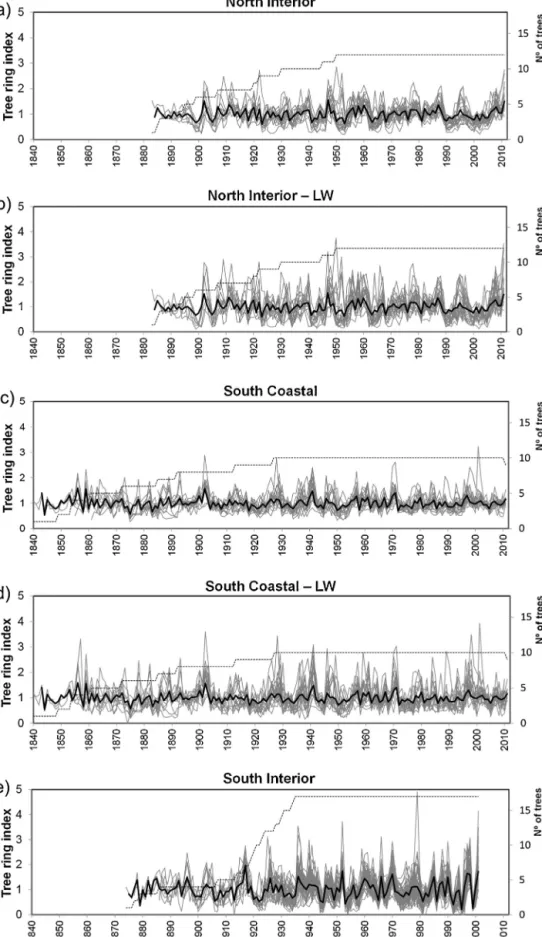
Fig.2. Individualtreeringindicesandrespectivesitechronologiesfor:(a)NI;(b)NI-LW;(c)SC;(d)SC-LWand(e)SI.Correspondingsamplesizesasafunctionoftimeare alsoshown(dottedline).
S.Lealetal./Dendrochronologia35(2015)4–13 7
Fig.3. Chronologystatistics(EPS:ExpressedPopulationSignal,inblack;andreff:
EffectiveChronologySignal,ingray)calculatedfrom50-yearrunningperiodslagged by1yearfor:(a)NI;(b)NI-LW;(c)SC;(d)SC-LWand(e)SI.Dashedlinehighlights EPSvaluesabovethe0.85level(Wigleyetal.,1984).Theresultsaretruncatedtoa samplesize>3.
Alentejo(averageoffourstations:Elvas,Beja,Évora,andGrândola) forSCandSI.
Sincetheavailableclimaticdatafromthemeteorological sta-tionscover onlytheperiodfrom1950onwards,anappropriate verificationofthetemporalstabilityoftheclimaticsignalisnot possible.ThereforealongprecipitationseriesforLisbon–HistPT (Camuffoetal.,2013),showingagoodagreementwiththe mete-orologicalstationsfortotalannualprecipitation(r=0.75,p<0.001, forSãoMamede; andr=0.92,p<0.001,forAlentejo),wasused. The temporal stability of theclimate/growth relationshipswas testedusing 50-yearmoving windows,at1-year lags, to calcu-latecorrelationcoefficientsbetweenclimaticandtree-ringrecords. Additionally,theperiodcoveredbytree-ringandclimaticrecords wassplitintwoforcalibration-verificationtests.Eachsub-period wasconsidered as an independent dataset and used to setup calibration models (regression equations between climate and
growthrecords),whichwereverified/validatedontheremaining one(CookandKairiukstis,1990).Thefollowingstatistical indica-tors werecalculated todeterminethemodel’sskilltoestimate climatevariabilityonindependentperiods:r2forthecalibration period;correlationcoefficientsbetweenobservedandestimated climaticdata,usingcalibrationequationsontheverificationperiod; reductionoferror–RE(Blasingetal.,1981).
3. Results
Fortheringporousspecies(Q.pyrenaicaandQ.faginea),two cores pertreeweresufficient tocrossdate within-tree,as ring-widthmeasurementsshowedveryhighagreementwithintrees (r=0.70–0.73, p<0.001) and few missing rings. Despite having almostunmistakable tree-ringboundaries, crossdatingbetween treeswasextremelydifficultandtimeconsuming.Infact,cores fromdifferenttreesdepicthighlyvariable,oftennoncoincident, ringpatterns.Nearlyonethirdoftheoriginalsampleswererejected duetopoorcrossdatingwiththeremainingset.Astreering bound-ariesareverydifficulttorecognizeinQ.ilex,theywereidentifiedby themarginalparenchymabandsandbydifferencesinvessellumen areaalongthegrowthring(fordetailsseeCampeloetal.,2009; Gea-Izquierdoetal.,2009).Stemcross-sectionsmustbeusedfora propertreeringdating,owingtodiffuseporosity,highlyvariable ringwidthalongthetreeperimeter,andmissing,interruptedand locallyabsenttreerings.Inordertoidentifycorrectlymissingrings, morethanthreeradialdirectionsineachdiskwereconsidered.A totalof41missingringswereidentifiedandallthesampleswere keptforfurtheranalysis.
Thecrossdatedtree-ringseriesextended173yearsbackintime (from1840to2012),withaveragesite segmentlengthsvarying between89and141years(Table2).Thedetrendedindividual tree-ringseries(basedonringwidthand,inthecaseofQ.pyrenaicaand Q.faginea,latewoodwidthmeasurements–LW)foreachsite,as wellasthecorrespondingchronology(Fig.2),revealedaneffective chronologysignalincreasingsouthwardsandinland(reff=0.42at SCandNI,reff=0.60atSI)(Table2).EPSvaluesarestableduringthe lastsectionofthechronologies,decreasingonlyduringtheearly lessreplicatedperiod(<8trees),butfortheperiod1920–2000all chronologiesshowedEPSvalues>0.85(Fig.3).Thiscommon vari-anceobservedforallchronologiesevidencesagoodagreementin growthbetweentreesateachstudylocation.
Thestrongestclimate/growthcorrelations(Fig.4)werefound between: NIand precipitationaccumulatedin winter(previous year December and current year January) before the start of thegrowingseason(r=0.40,p<0.01);SC-LWandspring-summer (AprilthroughJuly)precipitation(r=0.50,p<0.001);SIand pre-cipitation accumulated during autumn and winter, before the growthseasononset, throughout springand summer(previous yearSeptemberthroughJulyofcurrentyear)(r=0.81,p<0.001).
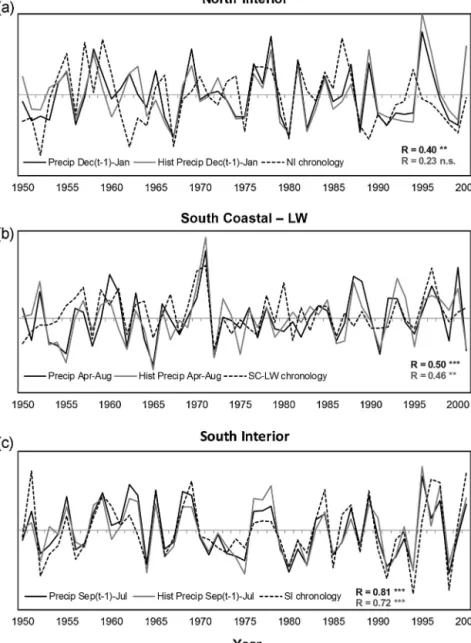
Thecorrelationsbetweeneachchronologyandthenormalized temporalseriesoftherespectivekeyclimaticvariable,calculated fromalongprecipitationdatasetforLisbon–HistPT(Camuffoetal., 2013),werelowerthanthoseobtainedusingthemeteorological stationsclosertothesamplingsites(Fig.5)–NI:r=0.23(n.s.)vs r=0.40(p<0.01);SC-LW:r=0.46(p<0.01)vsr=0.50(p<0.001); SI:r=0.72(p<0.001)vsr=0.81(p<0.001).
Temporalstabilityontheclimate/growthrelationshipswas ana-lyzedusingtheHistPTseries(Fig.6).Thenorthernmostsite,NI, exhibitsaveryunstablerelationship,withcorrelationcoefficients rarelyabovethe95%significancelevel.SC-LWshowsarelatively constant relationship along theperiod covered bythe chronol-ogy(1840–2011),even at thelowestsample depth(numberof trees=1),alwaysabovethe95%significancelevel.Theexception wasfor 1900–1920, withlower but still statisticallysignificant
Fig.4.Correlationcoefficientsbetweentree-ringchronologiesandmonthlyclimaticvariables(precipitationsumsandtemperatureaveragesfrompreviousSeptember, S(t−1),toDecember)fortheperiod1950–2000:(a)NI;(b)NI-LW;(c)SC;(d)SC-LW,and(e)SI.Whitebackgroundbarsindicatethepredominantclimaticsignalineach chronology(**p<0.01,***p<0.001).Dashedlinesrepresentthe99%confidencelimit.
S.Lealetal./Dendrochronologia35(2015)4–13 9
Fig.5.Sitechronologiesandrespectivenormalizedclimaticvariables(precipitationsums)fortheperiod1950–2000,usingdatafromtheclosestmeteorologicalstations(NI: SãoMamede;SCandSI:Alentejo,averageofGrândola,Beja,Évora,Elvas;cf.Fig.1)andfromlong-termprecipitationseriesforHistPT(Camuffoetal.,2013):(a)December (t−1)andJanuaryforNI;(b)ApriltoAugustforSC-lw;and(c)September(t−1)toJulyforSI.Correlationcoefficients(n.s.=non-significant;**p<0.01;***p<0.001)between treeringrecordsandclimaticdataareshowninblack(withcloseststations)andingray(withHistPT).
correlationcoefficients.Thisperiodcorrespondstoa discontinu-ityinthechronology’sreliability(Fig.3d).Until1892,atasample depthof8trees,EPSis>0.85excluding1900–1920whenitfalls under0.85.AttheSIsitethecorrelationsgraduallydrop,withthe decreaseinsampledepth,from0.73(p<0.001)toinsignificant val-ues(Fig.6c).
Theperiodscoveredbytree-ringrecordsshowingthemost sta-ble climate/growthrelationships, SC-LW and SI,were splitinto sub-periodsforcalibration-verificationtrialsagainstHistPTdata: 1899–1949,and1950–2000(Fig.7).
4. Discussion
4.1. Fromsiteandspeciesselectiontotree-ringcrossdating
An active survey for long lived oak tree species has been maintained. However, old trees that fulfill the principles of dendrochronology requirements (Fritts, 1976), namely grow-inghealthy and undisturbed,insufficient number foradequate
replication,atsiteswhereclimateispotentiallygrowthlimiting, aredifficulttolocateinPortugalandsamplingpermissionisnot easy toobtain.Mostof thepresentforestin mainlandPortugal is relativelyrecent. Oakforests, which inMedieval times occu-piedmostoftheterritory(Azevedo,1997),havebeengradually replacedbyexoticspecies(suchasP.pinasterandEucalyptus glo-bulus)withhighereconomicvalue.Evergreenspecies,Q.suberand Q. ilex,arenowadays stillresponsible forone thirdof thetotal mainlandforestedarea,whiletheremainingoakspeciessubsist inisolatedandneglectedstands,representingonly2%ofthetotal forestarea(ICNF,2013).Therefore,propersiteselectionand exper-imentaldesignaredifficulttoachieveasnotedbyGea-Izquierdo etal.(2011).Nevertheless,climaticsensitivetree-ringrecordswere obtained,thelongesttreeringseriesextendingbackto1840,from Mediterraneanand sub-Mediterranean oak speciesatthree dif-ferentsites,followinga gradientfrommesic toxericconditions (Figs.1and4).
The strength of the common signal between indexed tree-ring series, measured by the effective chronology signal, reff,
Table1
Sitesandtreesdescription.
Sitecode Species Soil Altitude Slope Exposure Ntrees
NI Q.pyrenaica Prominentreliefwithquartziteoutcrops;schists 670m 5% S 12
SC Q.faginea Paleiozoicschistandgreywacke;shallowandpoor 150m – – 10
SI Q.ilex Schists;lithosols,shallowandpoor 135–145m 5% – 17
Fig.6. Temporalstabilityontheclimate/growthrelationshipsgivenby50-years runningcorrelationcoefficientslaggedby1-yearbetweenthesitechronologiesand therespectiveclimaticvariables(precipitationsums)usingclimaticrecordsfrom HistPT:(a)December(t−1)andJanuaryforNI;(b)ApriltoAugustforSC-LW;and(c) September(t−1)toJulyforSI.Correlationcoefficientsforthetotalperiodcovered bythetreeringrecordsareshown(n.s.=non-significant;**p<0.01;***p<0.001). Dashedlinesrepresentthe95%confidencelimitanddottedlinesthesamplesizeas afunctionoftime.
increases from mesic (reff=0.42) to xeric (reff=0.60) sites. The
higher strength of association between different trees at SI is
likely due to a higher number of trees but also to the more
limitingsiteconditions.Q.ilextreesweregrowingunderharsher
conditionsthan theothertwospecies, consideringwater
avail-ability, evidenced by a large number of missing rings. For the
sitesNIandNCmorefactorsandinteractionsmusthavebeenat
play.
4.2. Tree-ringchronologiesandclimate/growthrelationships
The longest tree-ring series extends back to 1840 and the
chronologies are representative after 1920 for the three sites
(EPS>0.85). Allsites show a significant dominant climatic
fac-torcontrollinggrowth(Fig.4).The useof latewoodwidthdata
improvedthesignalstrengthin thecase ofSC(SC-LW) butnot forNItrees.Precipitationistheclimaticparametershowingthe strongest influence on tree-ringgrowth, despite some discrep-anciesbetweensitesand species.Drought hasbeenextensively pointed outasthemain growthlimiting factor fortrees inthe Mediterranean(reviewedbyPashoetal.,2011).Atthemoremesic sites,NI(r=0.40,p<0.01 withDecember (t−1)toJanuary pre-cipitation)andSC-LW(r=0.50,p<0.001withAprilthroughJuly precipitation), theclimaticsignalstrength isweaker. Sincetree growthin theMediterranean iscontrolled bymultipleclimatic factors,treeringsusually showweak-to-moderateclimatic sig-nals,generallymuchweakerthanintemperateclimates,andoften notconcentratedinasingleseasonand/orvaryingfromyearto year(Olanoetal.,2012).Theclimaticcontrolismorepronounced andextendingthroughoutalongerperiodoftheyear(September (t−1)toJuly)atthemostaridsite,SI.Theclimate/growth relation-shipatthissiteisunusuallyhigh(r=0.81,p<0.001),giventhat, evenfortemperate climatewheretrees tendtoshowthe high-estclimatic signals, treering records rarelyexplain more than 60%of thevariability inthe respectiveclimaticfactor (Hughes, 2002).
4.3. Dendroclimaticreconstructions
Manyrecentdendroclimaticstudiesreportadivergingtrendin theclimate/growthrelationshipstarting afterthelate20th cen-tury(e.g.Briffaetal.,1998;Barberetal.,2000;Wilmkingetal., 2004;WilsonandElling, 2004;Büntgenetal.,2006;Carrerand Urbinati,2006;D’Arrigoetal.,2008;Lealet al.,2008).The rea-sons for this change, or lack of climatic response, are not yet fullyunderstood.Anyhow,thishasraisedgreatconcernregarding theaccuracyof dendroclimaticreconstructions,as theymaybe over-orunderestimatingpastvariabilityinclimaticfactors. Con-trarytotheaforementionedstudies,climate/growthrelationship isstable throughoutthestudy periodfor SC-LWand SI (Fig.6) similarlytoP.nigrachronologiesfromsouthern Spain( Dorado-Li ˜nán et al., 2012b) and to a recent study from Alaska (Wiles et al., 2014). Calibration and verification statistics are robust (Fig.7),assuringthatgrowth/climatemodelsremainskillfulwhen appliedtoindependenttree-ringdatasets.Therefore,ahigh poten-tialfordendroclimaticreconstructions is shown forSC-LW and SI chronologies. Althoughthe present tree ring records do not
Table2
Characterizationofthetreeringseriesandbasicstatisticsfortree-ringchronologies (RW=ringwidth;LW=latewoodwidth).
Sitecode NI SC SI
Firstyear 1883 1840 1875
Lastyear 2012 2012 2002
Averagesegmentlength 99 141 89
Statisticalindicatorsofcommonsignalstrength(1950–2000) EPS–expressedpopulationsignal
RW 0.90 0.88 0.96
LW 0.89 0.87 –
reff–effectivechronologysignal
RW 0.42 0.42 0.60
S.Lealetal./Dendrochronologia35(2015)4–13 11
Fig.7. Calibration-verificationtrialsforclimate/growthmodelsshowingobserved(solidgraylines)vsestimated(dashedblacklines)normalizedHistPTprecipitationsums from:(a)ApriltoAugustusingSC-LWtreeringrecords;(b)andSeptember(t−1)toJulyusingSItreeringrecords.Timeperiods:1=1899–1949,2=1950-2000;Cal=coefficient ofdeterminationforthecalibrationmodel;Ver=correlationcoefficientbetweenobservedandestimatedvalues,whenverifyingthecalibrationmodelinindependentperiods; RE=reductionoferror.
extendbeyondthe existing instrumental records,the
crossdat-ingpotentialandsensitivitytoclimatemakeolderoaktreesand
subfossilmaterialpromising.Oakspeciesareveryimportant
play-ersofthePortugueseforestheritagewithalongpresenceinthe
countryand a higheconomicalvalue inthe past,e.g. fornaval
construction.Sub-aquaticsourcesofarcheologicalwoodmaterial
arecommonand couldcontribute totheextension oftreering
records.
5. Conclusions
Thepresentstudydemonstratesthatlong-livedtreessuitable
fordendroclimaticreconstructionscanindeedbefoundinPortugal
and, in the case of Q. pyrenaica and Q. faginea, sampling can
resorttocores;thelongesttree-ringseriespresentedinthisstudy
extends173yearsintimebackto1840.Q.ilextreesgrowingat
theSouthinterior(SI)showaverystrongclimaticsignal;a
ring-widthchronologyexplainsmorethan65%ofthetotalvariabilityin
precipitation.Thisisevenhigherthanfortree-ringsfrom
central-Europeanclimates,whichgenerallytendtoshowstrongersignals
thanthoseofMediterraneanareas.TreeringsfromQ.ilexandfrom
Q.fagineatrees,growingattheSouthcoastalbelt(SC-LW),show
stableandhighclimate/growthrelationshipsfrom1920onwards.
Calibrationmodelsbuiltfortheperiodcoveredbytheinstrumental
dataare,therefore,reliableforthereconstructionofprecipitation
backtoperiodsrepresentedonlybytree-ringrecords.
However,someshortcomingsarestillnoteworthy:
-ThestrongestclimaticsignalswerefoundforQ.ilex,whichhas
tobesampledusingwholestemdisks,adestructivemethod,and
takingadvantageofauthorizedfeeling’swhichlimitsthe
experi-mentaldesign.
-TheSC-LWchronologyclimaticsignalstrength,thoughin
accor-dancewithotherstudiesfortheMediterraneanandtemporally
stable, isweak fordendroclimatic reconstructions. It explains
only24%oftheobservedspring-summerprecipitation.
-Thetreeringrecords,althoughextendingbeyondthe
instrumen-talrecordsfortheregion,donotprovideadditionalinformation
aboutthepast.ThehistoricprecipitationseriesforPortugalfrom
Camuffoetal.(2013)arelongerthanthesechronologiesand,as expected,showabetteragreementwiththeregional precipita-tion.
Furtherresearchusingolderoaktreesandsubfossilmaterial isneededtoextendthetree-ringrecordsintime.Nevertheless, thepresentstudyprovidesanimportantbreakthroughinIberian dendrochronologywithpromisingresultsforforthcomingresearch onclimatereconstructioninPortugal.
Acknowledgements
Thisstudywascarriedoutwithintheframeworkoftheprojects PTDC/AAC-CLI/103046/2008, PTDC/AAC-CLI/119078/2010, and PTDC/HIS-ARQ/117099/2010 supported by national funds from FCT – Portuguese Foundation for Science and Technology and PEst – OE/AGR/UI4033/2014.Filipe Campelo was supportedby a postdoctoralresearchgrant(SFRH/BPD/47822/2008) fromFCT withfundsfromPOPH(PortugueseOperationalHumanPotential Program) and QREN Portugal (Portuguese National Strategic ReferenceFramework).Thefirstauthoracknowledgesa postdoc-toral grant (SFRH/BPD/44493/2008) and a grant under the FCT InvestigatorProgramme(IF/00826/2012)bothsupportedbyFCT. WewishtothankUmutSen,AntónioNogueira,andEvaMedina, for assistance in fieldwork; Alexandra Lauw for advice during laboratorywork; Rui Rebelo and the Centrefor Environmental
Biology(FCUL)forpermissiontosamplewithintheirfieldstation “HerdadedaRibeiraAbaixo”;LuísGriloandParqueNaturaldeSão Mamedeforsamplingpermission.
References
Abrantes,J.,Campelo,F.,García-González,I.,Nabais,C.,2013.Environmental con-trolofvesseltraitsinQuercusilexunderMediterraneanclimate:relatingxylem anatomytofunction.Trees-Struct.Funct.27,655–662,http://dx.doi.org/10. 1007/s00468-012-0820-6
Andreu-Hayles,L.,Planells,O.,Gutiérrez,E.,Muntan,E.,Helle,G.,Anchukaitis,K.J., Schleser,G.H.,2011.Longtree-ringchronologiesreveal20thcenturyincreases inwater-useefficiencybutnoenhancementoftreegrowthatfiveIberianpine forests.Glob.ChangeBiol.17,2095–2112, http://dx.doi.org/10.1111/j.1365-2486.2010.02373.x
Azevedo,O.V.,1997.AFlorestaeoDomíniodoMar.Memórias,vol.XXVII.Academia deMarinha,Lisboa.
Barber,K.E.,Maddy,D.,Rose,N.,Stevenson,A.C.,Stoneman,R.,Thompson,R.,2000. Replicatedproxy-climatesignalsoverthelast2000yrfromtwodistantUKpeat bogs:newevidenceforregionalpalaeoclimateteleconnections.Quat.Sci.Rev. 19,481–487,http://dx.doi.org/10.1016/S0277-3791(99)00102-X
Beniston,M.,Stephenson,D.B.,Christensen,O.B.,Ferro,C.A.T.,Frei,C.,Goyette,S., Halsnaes,K.,Holt,T.,Jylha,K.,Koffi,B.,Palutikof,J.,Scholl,R.,Semmler,T.,Woth, K.,2007.FutureextremeeventsinEuropeanclimate:anexplorationofregional climatemodelprojections.Clim.Change81,71–95,http://dx.doi.org/10.1007/ s10584-006-9226-z
Benito-Garzon,M.,Sanchez-de-Dios,R.,Sainz-Ollero,H.,2008.Effectsofclimate changeonthedistributionofIberiantreespecies.Appl.Veg.Sci.11,169–178, http://dx.doi.org/10.3170/2008-7-18348
Blasing,T.J.,Duvick,D.N.,West,D.C.,1981.Dendroclimaticcalibrationand verifica-tionusingregionallyaveragedandsinglestationprecipitationdata.Tree-Ring Bull.41,37–43.
Briffa,K.R.,Schweingruber,F.H.,Jones,P.D.,Osborn,T.J.,Harris,I.C.,Shiyatov,S.G., Vaganov,E.A.,Grudd,H.,1998.Treestellofpastclimates:butaretheyspeaking lessclearlytoday?Philos.Trans.R.Soc.Lond.Ser.B:Biol.Sci.353,65–73,http:// dx.doi.org/10.1098/rstb.1998.0191
Büntgen,U.,Frank,D.C.,Schmidhalter,M.,Neuwirth,B.,Seifert,M.,Esper,J.,2006. Growth/climateresponseshiftinalongsubalpinesprucechronology. Trees-Struct.Funct.20,99–110,http://dx.doi.org/10.1007/s00468-005-0017-3 Büntgen,U.,Frank,D.,Trouet,V.,Esper,J.,2010.Diverseclimatesensitivityof
Mediterraneantree-ringwidthanddensity.Trees-Struct.Funct.24,261–273, http://dx.doi.org/10.1007/s00468-009-0396-y
Campelo,F.,Gutiérrez,E.,Ribas,M.,Nabais,C.,Freitas,H.,2007a.Relationships betweenclimateanddoubleringsinQuercusilexfromnortheastSpain.Can. J.For.Res.37,1915–1923,http://dx.doi.org/10.1139/X07-050
Campelo,F.,Nabais,C.,Freitas,H.,Gutiérrez,E.,2007b.Climaticsignificanceof tree-ringwidthandintra-annualdensityfluctuationsinPinuspineafromadry MediterraneanareainPortugal.Ann.For.Sci.64,229–238,http://dx.doi.org/10. 1051/forest:2006107
Campelo,F.,Nabais,C.,García-González,I.,Cherubini,P.,Gutiérrez,E.,Freitas,H., 2009.DendrochronologyofQuercusilexL.anditspotentialuseforclimate recon-structionintheMediterraneanregion.Can.J.For.Res.39,2486–2493,http://dx. doi.org/10.1139/X09-163
Campelo,F.,Nabais,C.,Gutiérrez,E.,Freitas,H.,García-González,I.,2010.Vessel featuresofQuercusilexL.growingunderMediterraneanclimatehaveabetter climaticsignalthantree-ringwidth.Trees-Struct.Funct.24,463–470,http://dx. doi.org/10.1007/s00468-010-0414-0
Campelo,F.,García-González,I.,Nabais,C.,2012.detrendeR–agraphicaluser inter-facetoprocessandvisualizetree-ringdatausingR.Dendrochronologia30, 57–60,http://dx.doi.org/10.1016/j.dendro.2011.01.010
Campelo,F.,Vieira,J.,Nabais,C.,2013.Tree-ringgrowthandintra-annualdensity fluctuationsofPinuspinasterresponsestoclimate:doessizematter?Trees27, 763–772,http://dx.doi.org/10.1007/s00468-012-0831-3
Camuffo,D.,Bertolin,C.,Diodato,N.,Cocheo,C.,Barriendos,M.,Dominguez-Castro, F.,Garnier,E.,Alcoforado,M.J.,Nunes,M.F.,2013.WesternMediterranean pre-cipitationoverthelast300yearsfrominstrumentalobservations.Clim.Change 117,85–101,http://dx.doi.org/10.1007/s10584-012-0539-9
Candel-Perez, D., Linares, J.C., Vinegla, B., Lucas-Borja, M.E., 2012. Assessing climate–growthrelationshipsundercontrastingstandsofco-occurringIberian pinesalonganaltitudinalgradient.For.Ecol.Manag.274,48–57,http://dx.doi. org/10.1016/j.foreco.2012.02.010
Carrer,M.,Urbinati,C.,2006.Long-termchangeinthesensitivityoftree-ringgrowth toclimateforcinginLarixdecidua.NewPhytol.170,861–871,http://dx.doi.org/ 10.1111/j.1469-8137.2006.01703.x
Cherubini,P.,Gärtner,B.L.,Tognetti,R.,Bräker,O.U.,Schoch,W.,Innes,J.L.,2003. Identification,measurementandinterpretationoftreeringsinwoodyspecies fromMediterraneanclimates.Biol.Rev.78,119–148,http://dx.doi.org/10.1017/ S1464793102006000
Cook,E.,Holmes,R.,1986.UsersManualforProgramARSTAN.Laboratoryof Tree-RingResearch,UniversityofArizona,Tucson,USA.
Cook,E.R.,Kairiukstis, L.A.,1990.Methods ofDendrochronology: Applications intheEnvironmentalSciences.KluwerAcademicPublishers,Dordrecht,pp. 394.
Corcuera,L.,Camarero,J.J.,Gil-Pelegrín,E.,2002. FunctionalgroupsinQuercus speciesderivedfromtheanalysisofpressure–volumecurves.Trees-Struct. Funct.16,465–472,http://dx.doi.org/10.1007/s00468-002-0187-1
Corcuera,L.,Camarero,J.J.,Gil-Pelegrín,E.,2004.Effectsofaseveredroughton growthandwoodanatomicalpropertiesofQuercusfaginea.IawaJ.25,185–204, http://dx.doi.org/10.1163/22941932-90000360
Corcuera,L.,Camarero,J.J.,Siso,S.,Gil-Pelegrín,E.,2006.Radial-growthand wood-anatomicalchangesinoveragedQuercuspyrenaicacoppicestands:functional responsesinanewMediterraneanlandscape.Trees-Struct.Funct.20,91–98, http://dx.doi.org/10.1007/s00468-005-0016-4
Cotillas,M.,Sabate,S.,Gracia,C.,Espelta,J.M.,2009.Growthresponseofmixed Mediterraneanoakcoppicestorainfallreduction:couldselectivethinninghave anyinfluenceonit?For.Ecol.Manag.258,1677–1683,http://dx.doi.org/10. 1016/j.foreco.2009.07.033
D’Arrigo,R.,Wilson,R.,Liepert,B.,Cherubini,P.,2008.Onthe‘DivergenceProblem’ inNorthernForests:areviewofthetree-ringevidenceandpossiblecauses.Glob. Planet.Change60,289–305,http://dx.doi.org/10.1016/j.gloplacha.2007.03.004 Diffenbaugh,N.S.,Giorgi,F.,2012.ClimatechangehotspotsintheCMIP5global cli-matemodelensemble.Clim.Change114,813–822,http://dx.doi.org/10.1007/ s10584-012-0570-x
Dorado-Li ˜nán, I., Büntgen, U., Gonzalez-Rouco, F., Zorita, E., Montavez, J.P., Gomez-Navarro,J.J.,Brunet, M.,Heinrich,I.,Helle,G.,Gutierrez,E., 2012a. Estimating 750 years of temperature variationsand uncertainties in the Pyreneesbytree-ringreconstructionsandclimatesimulations.Clim.Past8, 919–933.
Dorado-Li ˜nán,I.,Gutiérrez,E.,Andreu-Hayles,L.,Heinrich,I.,Helle,G.,2012b. Poten-tialtoexplainclimatefromtreeringsinthesouthoftheIberianPeninsula.Clim. Res.55,119–134,http://dx.doi.org/10.3354/Cr01126
Esper,J.,Frank,D.,Büntgen,U.,Verstege,A.,Luterbacher,J.,2007.Long-termdrought severityvariationsinMorocco.Geophys.Res.Lett.34,L17702,http://dx.doi.org/ 10.1029/2007gl030844
Fritts,H.C.,1976.TreeRingsandClimate.AcademicPress,London.
Gao,X.,Giorgi,F.,2008.IncreasedaridityintheMediterraneanregionunder green-housegasforcingestimatedfromhighresolutionsimulationswitharegional climatemodel.Glob.Planet.Change62,195–209,http://dx.doi.org/10.1016/j. gloplacha.2008.02.002
Gea-Izquierdo,G.,Ca ˜nellas,I.,2014.Localclimateforcesinstabilityinlong-term productivityofaMediterraneanoakalongclimaticgradients.Ecosystems17, 228–241,http://dx.doi.org/10.1007/s10021-013-9719-3
Gea-Izquierdo,G.,Martín-Benito,D.,Cherubini,P.,Ca ˜nellas,I.,2009.Climate–growth variabilityinQuercusilexL.westIberianopenwoodlandsofdifferentstand density.Ann.For.Sci.66,802,http://dx.doi.org/10.1051/forest/2009080 Gea-Izquierdo,G.,Cherubini,P.,Ca ˜nellas,I.,2011.Tree-ringsreflecttheimpactof
climatechangeonQuercusilexL.alongatemperaturegradientinSpainover thelast100years.For.Ecol.Manag.262,1807–1816,http://dx.doi.org/10.1016/ j.foreco.2011.07.025
Genova,M.,2012.Extremepointeryearsintree-ringrecordsofCentralSpainas evidenceofclimaticeventsandtheeruptionoftheHuaynaputinaVolcano(Peru, 1600AD).Clim.Past8,751–764,http://dx.doi.org/10.5194/cp-8-751-2012 Giorgi,F.,2006.Climatechangehot-spots.Geophys.Res.Lett.33,L08707,http://dx.
doi.org/10.1029/2006GL025734
González-González,B.D.,Rozas,V.,García-González,I.,2014.Earlywoodvesselsof thesub-MediterraneanoakQuercuspyrenaicahavegreaterplasticityand sen-sitivitythanthoseofthetemperateQ.petraeaattheAtlantic-Mediterranean boundary.Trees-Struct.Funct.28,237–252, http://dx.doi.org/10.1007/s00468-013-0945-2
Granda,E.,Rossatto,D.,Camarero,J.J.,Voltas,J.,Valladares,F.,2014.Growthand car-bonisotopesofMediterraneantreesrevealcontrastingresponsestoincreased carbondioxideanddrought.Oecologia174,307–317,http://dx.doi.org/10.1007/ s00442-013-2742-4
Hughes,M.K.,2002.Dendrochronologyinclimatology–thestateoftheart. Den-drochronologia20,95–116,http://dx.doi.org/10.1078/1125-7865-00011 ICNF,2013.IFN6–ÁreasdosusosdosoloedasespéciesflorestaisdePortugal
con-tinental.Resultadospreliminares[pdf].InstitutodeConservac¸ãodaNaturezae dasFlorestas,Lisboa,pp.35.
IPCC,2014a.In:Field,C.B.,Barros,V.R.,Dokken, D.J.,Mach,K.J.,Mastrandrea, M.D.,Bilir,T.E.,Chatterjee,M.,Ebi,K.L.,Estrada,Y.O.,Genova,R.C.,Girma,B., Kissel,E.S.,Levy,A.N.,MacCracken,S.,Mastrandrea,P.R.,White,L.L.(Eds.), ClimateChange2014:Impacts,Adaptation,andVulnerability.PartA:Global andSectoralAspects.ContributionofWorkingGroupIItotheFifth Assess-mentReportoftheIntergovernmentalPanelonClimateChange.Cambridge University Press,Cambridge, UnitedKingdomandNew York,NY,USA, p. 1132.
IPCC,2014b.In:Barros,V.R.,Field,C.B.,Dokken,M.D.,Mastrandrea,Mach,K.J., Bilir,T.E.,Chatterjee,M.,Ebi,K.L.,Estrada,Y.O.,Genova,R.C.,Girma,B.,Kissel, E.S.,Levy,A.N.,MacCracken,S.,Mastrandrea,P.R.,White,L.L.(Eds.),Climate Change2014:Impacts,Adaptation,andVulnerability.PartB:RegionalAspects. ContributionofWorkingGroupIItotheFifthAssessmentReportofthe Inter-governmentalPanelonClimateChange.CambridgeUniversityPress,Cambridge, UnitedKingdomandNewYork,NY,USA,p.688.
Kottek,M.,Grieser, J.,Beck,C.,Rudolf,B.,Rubel, F.,2006.Worldmap ofthe Koppen–Geigerclimateclassificationupdated.MeteorologischeZeitschrift15, 259–263,http://dx.doi.org/10.1127/0941-2948/2006/0130
Leal,S.,Nunes,E.,Pereira,H.,2008.Corkoak(QuercussuberL.)woodgrowthand vesselcharacteristicsvariationsinrelationtoclimateandcorkharvesting.Eur. J.For.Res.127,33–41,http://dx.doi.org/10.1007/s10342-007-0180-8
S.Lealetal./Dendrochronologia35(2015)4–13 13 Li ˜nares,J.C.,Tiscar,P.A.,2011.BufferedclimatechangeeffectsinaMediterranean
pinespecies:rangelimitimplicationsfromatree-ringstudy.Oecologia167, 847–859,http://dx.doi.org/10.1007/s00442-011-2012-2
Nicault,A.,Alleaume,S.,Brewer,S.,Carrer,M.,Nola,P.,Guiot,J.,2008.Mediterranean droughtfluctuationduringthelast500yearsbasedontree-ringdata.Clim.Dyn. 31,227–245,http://dx.doi.org/10.1007/s00382-007-0349-3
Nikulin,G.,Kjellstrom,E.,Hansson,U.,Strandberg,G.,Ullerstig,A.,2011. Evalua-tionandfutureprojectionsoftemperature,precipitationandwindextremes overEuropeinanensembleofregionalclimatesimulations.TellusSer.a–Dyn. Meteorol.Oceanogr. 63,41–55, http://dx.doi.org/10.1111/j.1600-0870.2010. 00466.x
Olano,J.M.,Eugenio,M.,García-Cervigón,A.I.,Folch,M.,Rozas,V.,2012.Quantitative tracheidanatomyrevealsacomplexenvironmentalcontrolofwoodstructure incontinentalMediterraneanclimate.Int.J.PlantSci.173,137–149,http://dx. doi.org/10.1086/663165
Pasho,E.,Camarero,J.J.,deLuis,M.,Vicente-Serrano,S.M.,2011.Impactsofdrought atdifferenttimescalesonforestgrowthacrossawideclimaticgradientin north-easternSpain.Agric.For.Meteorol.151,1800–1811,http://dx.doi.org/10.1016/ j.agrformet.2011.07.018
Roig,F.A.,Barriopedro,D.,Herrera,R.G.,Dominguez,D.P.,Monge,S.,2009.North Atlantic Oscillation signatures in Western Iberian tree-rings. Geografiska AnnalerSer.A–Phys.Geogr.91A,141–157, http://dx.doi.org/10.1111/j.1468-0459.2009.00360.x
Rozas,V.,Lamas,S.,García-González,I.,2009.Differentialtree-growthresponsesto localandlarge-scaleclimaticvariationintwoPinusandtwoQuercusspeciesin northwestSpain.Ecoscience16,299–310,http://dx.doi.org/10.2980/16-3-3212 Sanchez-Salguero,R.,Navarro-Cerrillo,R.M.,Camarero,J.J.,Fernandez-Concio,A., 2010.Drought-inducedgrowthdeclineofAleppoandmaritimepineforestsin south-easternSpain.For.Syst.19,458–469.
Santos,J.A.,Carneiro,M.F.,Alcoforado,M.J.,Leal,S.,Luz,A.L.,Camuffo,D.,Zorita,E., 2015.Calibrationandmulti-sourceconsistencyanalysisofreconstructed pre-cipitationseriesinPortugalsincetheearly17thcentury.Holocene25,663–676, http://dx.doi.org/10.1177/0959683614566250
Sarris,D.,Christodoulakis,D.,Korner,C.,2011.Impactofrecentclimaticchangeon growthoflowelevationeasternMediterraneanforesttrees.Clim.Change106, 203–223,http://dx.doi.org/10.1007/s10584-010-9901-y
Schweingruber,F.H.,Bartholin,T.,Schar,E.,Briffa,K.R.,1988. Radiodensitometric-dendroclimatologicalconiferchronologiesfromLapland(Scandinavia)andthe Alps(Switzerland).Boreas17,559–566.
Touchan,R.,Xoplaki,E.,Funkhouser,G.,Luterbacher,J.,Hughes,M.K.,Erkan,N., Akkemik,U.,Stephan,J.,2005.Reconstructionsofspring/summerprecipitation fortheEasternMediterraneanfromtree-ringwidthsanditsconnectionto large-scaleatmosphericcirculation.Clim.Dyn.25,75–98,http://dx.doi.org/10.1007/ s00382-005-0016-5
Touchan,R.,Anchukaitis,K.J.,Meko,D.M.,Sabir,M.,Attalah,S.,Aloui,A.,2011. SpatiotemporaldroughtvariabilityinnorthwesternAfricaoverthelastnine centuries.Clim.Dyn.37,237–252, http://dx.doi.org/10.1007/s00382-010-0804-4
Trouet,V.,Esper,J.,Graham,N.E.,Baker,A.,Scourse,J.D.,Frank,D.C.,2009. Persis-tentpositiveNorthAtlanticOscillationmodedominatedthemedievalclimate anomaly.Science324,78–80,http://dx.doi.org/10.1126/science.1166349 Vieira,J.,Campelo,F.,Nabais,C.,2010.Intra-annualdensityfluctuationsofPinus
pinasterarearecordofclimaticchangesinthewesternMediterraneanregion. Can.J.For.Res.40,1567–1575,http://dx.doi.org/10.1139/X10-096
Wigley,T.M.L.,Briffa,K.R.,Jones,P.D.,1984.Ontheaveragevalueofcorrelated time-series, with applications in dendroclimatology and hydrometeorol-ogy. J. Clim. Appl. Meteorol. 23,201–213, http://dx.doi.org/10.1175/1520-0450(1984)023<0201:Otavoc>2.0.Co;2
Wiles,G.C.,D’Arrigo,R.D.,Barclay,D.,Wilson,R.S.,Jarvis,S.K.,Vargo,L.,Frank,D., 2014.Surfaceairtemperaturevariabilityreconstructedwithtreeringsforthe GulfofAlaskaoverthepast1200years.Holocene24,198–208,http://dx.doi. org/10.1177/0959683613516815
Wilmking,M.,Juday,G.P.,Barber,V.A.,Zald,H.S.J.,2004.Recentclimate warm-ingforcescontrastinggrowthresponsesofwhitespruceattreelineinAlaska throughtemperaturethresholds.Glob.ChangeBiol.10,1724–1736,http://dx. doi.org/10.1111/j.1365-2486.2004.00826.x
Wilson,R.,Elling,W.,2004.Temporalinstabilityintree-growth/climateresponse intheLowerBavarianForestregion:implicationsfordendroclimatic recon-struction.Trees-Struct. Funct. 18,19–28, http://dx.doi.org/10.1007/s00468-003-0273-z.