ARCHITECTURES IN LIVING SYSTEMS
byAntonio Heitor REIS and Antonio Ferreira MIGUEL Original scientific paper
UDC: 612.087.1:532.517.2 BIBLID: 0354-9836, 10 (2006), 1, 57-64
We ap ply Constructal the ory to the study of the flow struc ture of the hu man re spi ra tory tree. We show that the flow ar chi tec ture that would per form ox y gen a tion of the blood and re moval of car bon di ox ide best, i. e. with low est re -sis tance, would be com posed of a chan nel sys tem with 23 bi fur ca tion with a dif fu sive zone (alveolus) at the end. As this tree matches the hu man re spi ra -tory tree we con clude that na ture has op ti mized it in time. Two constructal re la tion ships also emerge: (1) the length l, de fined by the ra tio of the square of the air way di am e ter to its length, is con stant for all in di vid u als of the same spe cies, and (2) the length l is re lated to the vol ume of the space al lo -cated to the re spi ra tory pro cess, to the length of the re spi ra tory tree and to the area of the al ve oli, and de ter mines univocally the branch ing level of the re spi ra tory tree.
Keywords: flow architectures, living systems, constructal theory
Introduction
The Constructal law, first for mu lated by Adrian Bejan [1], states that if a sys tem has free dom to morph it de vel ops in time the flow ar chi tec ture that pro vides eas ier ac cess to the cur rents that flow trough it. In all classes of flow sys tems (an i mate, in an i mate, en gi neered) the gen er a tion of flow ar chi tec ture emerges as a uni ver sal phe nom e non. Ac -cord ing to Constructal the ory the op ti mal struc ture is con structed by op ti miz ing vol ume shape at ev ery length scale, in a hi er ar chi cal se quence that be gins with the small est build -ing block and pro ceeds to wards larger build -ing blocks (which are called “con structs”). A ba sic out come of Constructal the ory is that sys tem shape and in ter nal flow ar chi tec ture do not de velop by chance, but re sult from the per ma nent strug gle for better per for mance and there fore must evolve in time [2].
Bejan used Constructal the ory to suc cess fully ex plain some allometric laws of liv ing struc tures namely the rhythm of res pi ra tion in an i mals in re la tion with body size [1], the re la tion be tween met a bolic rate and to tal body vol ume [1, 3], and the heart beat fre quency in re la tion to met a bolic rate [1, 4]. Reis et al. [5] fo cused on the struc ture of the pul mo nary air flow tree, which starts at the tra chea and bi fur cates 23 times be fore reach -ing the al ve o lar sacs. Un til now, the rea son for the ex is tence of just 23 bi fur ca tions in the re spi ra tory tree has re mained un ex plained in the lit er a ture. Has this spe cial flow ar chi tec
-ture been de vel oped by chance or does it rep re sent the op ti mum struc -ture for the lung’s pur pose, which is the ox y gen a tion of the blood?
Purpose and trade-off between competing trends
Even though ev ery liv ing fluid tree works with a spe cific pur pose, all share some gen eral fea tures. For ex am ple, ev ery liv ing fluid tree works ei ther for the de liv ery of sub -stances to a vol ume or a sur face where a pro cess oc curs, e. g. a chem i cal re ac tion, or for the re moval of other sub stances in clud ing the prod ucts of chem i cal re ac tions. At the small est scale dif fu sion dom i nates while chan nel ing of the flow and de vel op ment of flow ar chi tec tures oc cur at higher scales. Fig ure 1 il lus trates how a first chan nel of width D0 and con duc tiv ity K0,col lects the fluid that per me ates the rect an gu lar area and de liv ers it to a wider chan nel (D1, K1). Chan nels or ga nize hierarchically in a flow ar chi tec ture in which chan nels of lower con duc tiv ity are trib u tar ies of a chan nel of higher con duc tiv ity.
As il lus trated in fig. 1, in crease in the num ber of the el e men tary ar eas through which fluid dif fuses im plies in creas ing num ber of chan nels, and there fore in creas ing re sis -tance to fluid flow. On the other hand, if the num ber of chan nels is re duced, the re sis -tance to fluid flow is also re duced ac cord ingly but in this case, the el e men tal rect an gle has to have a larger area, there fore in creas ing the re sis tance to fluid dif fu sion. The op ti mal flow ar chi -tec ture is the one that re sults from the trade-off be tween these two com pet ing trends.
Figure 1. Area-to-point flow. The fluid seeps through the pores of the elemental volume of conductivity K and surface area (H0 ´ L0) before reaching the first channel of width D0 and conductivity K0 that delivers it to the next higher conductivity (K1) channel of width D1. The flow rate at the end of the K1 channel is & ¢m1. The width of this construct is H1 = 2 ´ L0 + D1 while its length is given by n1 ´ H0 where n1 is the number of the elemental volumes. Complex flow architecture may be constructed by repeating this process at higher scales
In line with Bejan’s Constructal law, we be lieve that ev ery liv ing sys tem has de -vel oped in time the flow ar chi tec ture that pro vides eas ier ac cess to the cur rents that flow trough it. As a lead ing ex am ple of a liv ing flow struc ture, we fo cus on the hu man re spi ra tory tree. By us ing Constructal the ory, Reis et al. [5] ad dressed the study of the re spi ra -tory tree as a flow sys tem with duct flow resistances (tra chea and bron chial sys tem) and dif fu sive resistances. In their study, to eval u ate and com pare the flow resistances, was con sid ered that ox y gen and car bon di ox ide flow within the re spi ra tory tree (bron chial tree plus al ve o lar sacs) as driven by the chem i cal po ten tial. This is a rather con ve nient po ten tial be cause pres sure dif fer ences that drive the iso ther mal air flow in the bron chial sys -tem may be ex pressed in terms of chem i cal po ten tial dif fer ences trough the gen er al ized Gibbs-Duhem equa tion, Dm=r-1DP+De, where e stands for ki netic en ergy per unit mass (see [5] for de tails). The bron chial tree was as sumed to be com posed of cy lin dri cal chan nels with HagenPoiseuille flow. Even though the bron chial chan nels are not per -fectly round, Bejan has shown that nearly round chan nels per form al most as well as the ex actly round chan nels [2].
For lam i nar flow, Constructal the ory in di cates that the min i mum flow re sis tance at a bi fur ca tion is achieved if the ra tio be tween con sec u tive duct di am e ters is:
D D n n -= 1 1 3 2 / (1)
while the ratio of the respective lengths, is;
L L n n -= 1 1 3 2 / (2)
These re la tions the o ret i cally pre dicted by Constructal the ory, were dis cov ered em pir i cally long ago and cor re spond to the so-called Murray’s laws.
Af ter hav ing con sid ered ev ery de tail of the flow be tween the en trance of the tra chea and the al ve o lar sur face where ox y gen meets the blood and car bon di ox ide is re -moved from the blood, in clud ing the resistances due to bi fur ca tions, Reis et al. [5] showed that the global re sis tance [Jskg-2 ] to ox y gen trans por ta tion within the re spi ra tory tree is of the form:
R vL D N R T ox N = -+ + -256 1 013 2 0 0 4 0 2 3 p [( ) ] ( ) . ( ) / fox fox r g ox pL D0 ox oxf r (3)
In eq. (3), N matches the num ber of bi fur ca tions of the bron chial tree, n is the ki -ne matic vis cos ity of the air, L0 and D0 rep re sent tra chea length and di am e ter, re spec
-tively, T is tem per a ture, fox and (fox)0 rep re sent the rel a tive con cen tra tion of ox y gen in the al ve oli and in the out side air, re spec tively, Dox is the diffusivity of the ox y gen in the air, Rg is the air con stant, and r stands for the den sity of the air.
The first term in the right hand side of eq. (3) rep re sents the global chan nel flow re -sis tance (bronchiolar tree) while the sec ond term matches to the global dif fu sive re -sis tance to ox y gen trans port in the al ve oli. Equa tion (3) with the cor re spond ing vari ables holds also for the re sis tance to car bon di ox ide flow in the re spi ra tory tree. These resistances can be eval u ated by as sum ing a body tem per a ture of 36 ºC and tak ing all per ti nent val ues at this tem per a ture. The av er age value of ox y gen rel a tive con cen tra tion within the re spi ra tory tree,
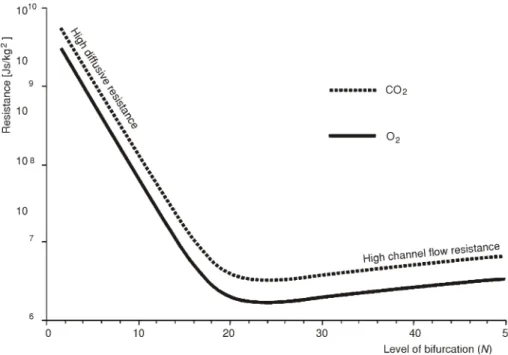
fox, may be eval u ated from the al ve o lar air equa tion in the form: [(fox)0 – fox)]Q – S = 0, where (fox)0 ~1/2(fair+ fox) and fair are the ox y gen rel a tive con cen tra tion at the en trance of the tra chea, and in the ex ter nal air, re spec tively, Q is the tidal air flow, and S is the rate of ox -y gen con sump tion. With (fox)air = 0.2095, Q ~ 6 ×10⁻³ m3/min., and S ~ 0.3×10⁻³ m3/min. we ob tain fox ~ 0.1095. The value of the av er age rel a tive con cen tra tion of car bon di ox ide in the re spi ra tory tree, fcd = 0.04. In this case we used S = 0.24×10⁻³ m3/min. since the re spi ra tory co ef fi cient is close to 0.8 and (fcd)air ~ 0.315×10⁻³. An a tomic trea tises in di cate that L0 is typ i -cally 15 cm, while the tra chea di am e ter, D0, is ap prox i mately 1.5 cm. The global resistances to ox y gen and car bon di ox ide trans por ta tion in the re spi ra tory tree are plot ted against num -ber of bi fur ca tions in fig. 2.
Figure 2. Total resistances to oxygen and carbon dioxide transport between the entrance of the trachea and the alveolar surface plotted as function of the level of bifurcation (N). The minimum resistance both to oxygen access and carbon dioxide removal matches N = 23
The min i mum of each re sis tance oc curs close to N = 23. This same re sult can be ob tained by find ing the num ber of bi fur ca tions Nopt an a lyt i cally that matches to the min i -mum of the global re sis tance – see eq. (3). This min i -mum is given by:
N D R T L vD opt g ox ox ox ox = × é -2164 235 10 1 4 0 4 0 2 0 . ln . ( ) (f ) f ë ê ù û ú ì í ï î ï ü ý ï þ ï (4)
With the same val ues used for the re spec tive curves in fig. 2 we found Nopt = =j23.4, and Nopt = 23.2 for the ox y gen and the car bon di ox ide trans port, re spec tively. As the num ber of bi fur ca tions must be an in te ger we con clude that it must be 23.
A first re sult is that the hu man re spi ra tory tree that bi fur cates 23 times be tween the tra chea and the al ve oli is op ti mized both for ox y gen ac cess and for car bon di ox ide re -moval. The trade-off be tween re sis tance to flow in the bron chial tree and the re sis tance ox y gen and car bon di ox ide dif fu sion in the al ve oli is achieved by the hu man re spi ra tory tree, which has been op ti mized by na ture in time. A sec ond out come is that the ac tual flow ar chi tec ture of the re spi ra tory tree can be an tic i pated the o ret i cally based on Constructal the ory.
Constructal relationships of the respiratory tree
We see from eq. (4) that the num ber of bi fur ca tions that matches min i mal global re sis tance to ox y gen ac cess an car bon di ox ide re moval is func tion of sev eral en vi ron -men tal vari ables such as nor mal body tem per a ture, ox y gen and car bon di ox ide diffusivities and con cen tra tions in the air, air ki ne matic vis cos ity and only one mor pho -log i cal pa ram e ter, which is the length l = D02 L0. As ev ery in di vid ual lives with the same the av er age en vi ron men tal pa ram e ters, we con clude that if the re spi ra tory tree with 23 bi -fur ca tions is a char ac ter is tic of hu man kind there fore the num ber l is also a char ac ter is tic of hu man kind. In other words, the ra tio of the square of tra chea di am e ter to its length is the same for ev ery hu man be ing. This the o ret i cal re sult is an tic i pated by Constructal the -ory and now awaits con fir ma tion by the anat o mists.
An other constructal re la tion ship in volv ing the length l, the area al lo cated for the re spi ra tory pro cess (the to tal area of the al ve oli) A, the vol ume of the lungs V, and the length of the re spi ra tory tree (be tween the en trance of the tra chea and the sur face of the alveolus) L, was also de rived by Reis et al. [5] and is the fol low ing:
l f f f = = -ì í ï î ï ü ý ï D L AL V vD T 0 2 0 0 863. ) [( ) )] ox ox g ox ox ox (R þï 1 2/ (5)
From eq. (5) we con clude that the non-di men sional num ber AL/V, de ter mines the char ac ter is tic length l = D02 L0 which in turn de ter mines the num ber of bi fur ca tions of the re spi ra tory tree by eq. (4). This constructal re la tion ship may be sum ma rized as fol
lows: “The al ve o lar area re quired for gas ex change A, the vol ume al lo cated to the re spi ra -tory sys tem V, and the length of the re spi ra -tory tree L, which are con straints posed to the re spi ra tory pro cess de ter mine univocally the struc ture of the lungs, namely the bi fur ca -tion level of the bron chial tree.” Here we may ob serve the realm of Constructal the ory, which is minimization of global resistances to fluid ac cess un der geo met ric con straints im posed to the pro cess.
Conclusions
The flow ar chi tec ture of the hu man re spi ra tory tree can be an tic i pated based on the Constructal law. If, as en gi neers we had to de sign the flow ar chi tec ture that would pro vide min i mal re sis tance to ox y gen ac cess from the ex ter nal air to a sur face where a chem i cal re ac tion takes place and to car bon di ox ide re moval from this same sur face, we would find out a flow tree with 23 bi fur ca tions with al ve oli at the end. The hu man re spi -ra tory tree is such a tree, there fore in di cat ing that na ture has op ti mized in time the hu man re spi ra tory flow ar chi tec ture.
Ad di tional constructal re la tion ships of the re spi ra tory tree were an tic i pated the -o ret i cally: (1) the length l (de fined as the ra ti-o -of the square -of the first air way di am e ter to its length) is con stant for ev ery in di vid ual of the same spe cies and re lated to the char ac -ter is tics of the space al lo cated for the re spi ra tory pro cess; (2) the length l is univocally de ter mined by a non-di men sional num ber, AL/V, which in volves the char ac ter is tics of the space al lo cated to the re spi ra tory sys tem, namely the to tal al ve o lar area, A, the to tal vol ume V, and the to tal length of the air ways, L.
Fi nally, we re mark that the Constructal the ory that was suc cess fully em ployed in en gi neer ing (see [1]), prom ises to serve as fun da men tal tool to the study of liv ing flow struc tures.
Nomenclature
A – total alveolar area, [m2]
D – diffusion coefficient, [m2s-1)
D0 – diameter of the trachea; channel diameter in fig. 1, [m]
L – length from the entrance of the trachea to alveolus, [m]
L0 – length of the trachea; channel length in fig. 1, [m]
N – total number of bifurcations, [–] P – pressure, [N/m2]
Q – tidal airflow, [m3]
R – total resistance, [J kg-2s-1]
Rg – specific gas constant, [Jkg -1
K-1]
S – rate of oxygen consumption, [kgs-1]
T – temperature, [K]
Greec letters
e – mechanical energy per unit mass, [Jkg-1]
l – characteristic length (eq. 5), [m]
m – chemical potential, [Jkg-1]
n – kinematic viscosity, [m2s]
r – density, [kgm-3]
f – relative gas concentration, [–]
Subscripts
air – relative to air
cd – relative to carbon dioxide
n – order of bifurcation (0 for trachea) opt – relative to the optimal value ox – relative to oxygen
References
[1] Bejan, A.,Shape and Struc ture, from En gi neer ing to Na ture, Cam bridge Uni ver sity Press, Cam bridge, UK, 2000
[2] Bejan, A., Lorente, S., Ch. 4, in: Bejan’s Constructal The ory of Shape and Struc ture (Eds. R. N. Rosa, A. H. Reis, A. F. Miguel), Evora Geo phys ics Cen ter, Évora, Por tu gal, 2003 [3] Bejan, A., Ad vanced En gi neer ing Ther mo dy nam ics, 2nd ed., John Wiley and Sons, New
York, USA, 1997
[4] Bejan, A., The Tree of Con vec tive Heat Streams: Its Ther mal In su la tion Func tion and the Pre dicted 3/4-Power Re la tion be tween Body Heat Loss and Body Size, Int. J. Heat Mass
Trans fer, 44 (2001), 4, pp. 699-704
[5] Reis, A. H., Miguel, A. F., Aydin, M., Constructal The ory of Flow Ar chi tec tures of the Lungs, Med i cal Phys ics, 31 (2004), 5, pp. 1135-1140
[6] Brad, H., et al., Bron chial Anat omy, Vir tual Hos pi tal, http://www.vh.org/, Uni ver sity of Iwoa, USA, 2003
[7] Rob erts, F., Up date in An aes the sia, Re spi ra tory Phys i ol ogy, 12 (2003), ar ti cle 11, http://www.nda.ox.ac.uk/wfsa/html/u12/u1211_01.htm#anat, pp. 1-3
Author's address:
A. H. Reis, A. F. Miguel
Physics Department and Évora Geophysics Center University of Évora 59, R. Romão Ramalho
7000-671 Évora, Portugal
Corresponding author (A. H. Reis): E-mail: [email protected]
Paper submited: December 2, 2004 Paper revised: January 23, 2005 Paper accepted: February 13, 2006