Universidade de Lisboa
Faculdade de Medicina Dentária
Reparability of two different CAD/CAM polymer materials using a
light-cured composite and Universal adhesives.
Bianca Andrada Rosca
Dissertação
Mestrado Integrado em Medicina Dentária
2016
Universidade de Lisboa
Faculdade de Medicina Dentária
Reparability of two different CAD/CAM polymer materials using a
light-cured composite and Universal adhesives.
Bianca Andrada Rosca
Dissertação orientada pelos
Professor Doutor Jaime Pereira Fontes de Alemida Portugal Dra. Ana Isabel da Silva Pequeno Lamy
Mestrado em Medicina Dentária
2016
To my parents,
Table of contents
Acknowledgements ... i Abstract ... ii Resumo ... iv Introduction... 1 Objective ... 4Materials and Methods ... 5
Results ... 10
Discussion ... 13
Conclusion ... 17
References ... 18
Appendices ... I List of Figures and Tables ... II Data from experimental group: POM + OptiBondTM XTR ... III Data from experimental group: POM + Futurabond® M+ ... IV Data from experimental group: POM + ScotchBondTM U ... V Data from experimental group: POM + OptiBond® Solo PlusTM ... VI
Data from experimental group: PMMA + OptiBondTM XTR ... VII Data from experimental group: PMMA + Futurabond® M+ ... VIII Data from experimental group: PMMA + ScotchbondTM U ... IX Data from experimental group: PMMA + OptiBond® Solo PlusTM ... X
Instructions for use (Grandio® SO) ... XI Instructions for use (OptiBondTM XTR) ... XII Instructions for use (Futurabond® M+) ... XIII Instructions for use (ScotchbondTM U) ... XIV
i
Acknowledgements
B
ecausethis thesis wouldn’t exist without support, I would like to express my gratitude:To Professor Jaime Portugal, for being always available and supportive. It was an honour to learn with a brilliant mind and to have such an outstanding guidance. To Dr. Ana Pequeno, for her availability and kindness. To Professor Sofia Arantes de Oliveira and Dr. Filipa Chasqueira, for all the support during the laboratory work; To Sofia, the best partner and the best friend I could have had through this journey. I can’t imagine me achieving my goals without you by my side. To all my Friends and Family, who fulfill me and make life easier and funnier. And last but not least...
To my Parents, Liliana and Eugen, for being my model, my inspiration and my
motivation for everything I do, and for their effort in providing me the best
education.
ii
Abstract
Objective: The aim of the present study was to evaluate the reparability of two different CAD/CAM polymer materials, polymethyl methacrylate (PMMA) and polyoxymethylene (POM) by assessing the shear bond strength (SBS) of a light-cured composite, using four different adhesive systems.
Materials and Methods: Eighty blocks of PMMA and eighty blocks of POM, with 7 mm of diameter and 4 mm height, were milled by the manufacturer. The top surface of all specimens was abraded with 50 µm Al2O3 and after, ultrasonically cleaned in an ethanol ultrasonic bath for 5
minutes. The 80 specimens of each material were randomly allocated to four experimental groups (n=20) according to the different adhesive system used: OptiBond™ XTR (KerrTM, Italia)
Futurabond® M+ (VOCO GmbH, Germany), ScotchbondTM Universal (3M ESPE, Germany) or OptiBond™ Solo Plus (KerrTM, Italia). The bonding area was customized using a perforated
adhesive tape with round-shaped orifices (3 mm diameter) and each adhesive was applied according to the manufacturer´s recommendations. The repairing composite resin Grandio®SO (VOCO GmbH, Germany), was applied according the manufacturer’s instructions, and polymerized during 10 seconds (1000 mW/cm2). Specimens were stored in distilled water at 37 °C for 48 hours before the SBS was tested and failure modes were assessed.
Results: The mean SBS yielded with PMMA specimens was significantly higher than with POM. There were no statistical differences between adhesive systems. No cohesive failure was obtained, with the POM specimens having mostly adhesive failures, in contrast with the PMMA with mostly mixed failures and no significant difference was identified between adhesives.
Conclusion: It is possible to achieve an adequate adhesion bond to POM and PMMA. SBS values were higher in PMMA specimens than to POM but no differences were found between adhesive systems.
iv
Resumo
Introdução: Polimetilmetacrilato (PMMA) e polioximetileno (POM) são polímeros com propriedades físicas e mecânicas otimizadas além de apresentarem elevada biocompatibilidade. A sua polimerização em condições laboratoriais padronizadas e posterior fresagem através do sistema CAD/CAM permite o fabrico de restaurações protéticas provisórias, pilares estéticos de implantes e ganchos estéticos de próteses removíveis. O facto de poderem ser utilizados para a confeção de restaurações fixas provisórias de longa duração, leva a que muitas vezes seja necessário a adição de outro material. Tal procedimento poderá ser importante, tanto para reparação em caso de fratura ou desgaste da restauração, ou quando se pretende alterar a sua forma como forma de cumprir os objetivos da reabilitação. Para a reparação ou alteração deste tipo de restaurações provisórias, a resina composta é normalmente o material elegido pelos clínicos, especialmente devido à sua fácil utilização e propriedades estéticas. Existe escassa informação sobre qual o melhor procedimento para obter valores de adesão adequados entre o material a reparar e o material reparador. A obtenção de elevados valores de adesão está normalmente dependente de uma componente mecânica e componente química. entre os dois materiais é normalmente criada por dois mecanismos, um mecânico e outro químico. Se existe algum consenso quanto ao método de condicionamento mecânico da superfície a reparar, aplicação de jato de óxido de alumínio, não existem estudos conclusivos sobre o tipo de sistemas adesivos a utilizar. Recentemente, foi disponibilizado um novo grupo de sistemas adesivos, os adesivos universais, cujos fabricantes reclamam eficácia no estabelecimento de adesão a diversos substratos. No entanto, tal eficácia em promover adesão aos polímeros utilizados com o sistema CAD/CAM não se escontra estudado.
Objetivos: O objetivo do presente estudo foi avaliar a reparabilidade de dois materiais poliméricos utilizados para fresagem através do sistema CAD/CAM, o polimetilmetacrilato (PMMA) e o polioximetileno (POM), utilizando um compósito fotopolimerizável e diferentes sistemas adesivos, de acordo com as seguintes hipóteses nulas: 1) o tipo de material polimérico utilizado como substrato não influencia a resistência adesiva do material reparado; 2) não existe diferença entre a resistência adesiva promovida pelos diferentes sistemas adesivas utilizados.
v
Materiais e Métodos: Um total de 160 blocos, 80 blocos de PMMA e 80 blocos de POM, foram fresados pelo fabricante, com dimensões padronizadas de 7 mm de diâmetro e 4 mm de altura. O topo de cada um dos espécimes foi condicionado mecanicamente com jato de Al2O3 (granulometria - 50 µm; pressão - 2,5 bar; distância - 10 mm; tempo - 15 segundos). Após
o condicionamento mecânico, todos os espécimes foram lavados num banho ultrassónico de etanol durante 5 minutos. A superfície dos espécimes foi então lavada com jato de água e ar, durante 15 segundos e, por fim, seca com jato de ar durante 10 segundos. Os 80 espécimes de cada material foram então aleatoriamente atribuídos a um dos quatro grupos experimentais (n=20), segundo o sistema adesivo utilizado: OptiBond™ XTR (KerrTM, Itália) Futurabond® M+ (VOCO GmbH,
Alemanha), ScotchbondTM Universal (3M ESPE, Alemanha) ou OptiBond™ Solo Plus (KerrTM, Itália). Os espécimes foram fixados a placas de Watanabe com gesso, e a área de adesão (3 mm de diâmetro) foi estabelecida utilizando uma fita adesiva perfurada. O sistema adesivo foi em seguida aplicado e fotopolimerizado de acordo com as instruções do respetivo fabricante. Por fim, o compósito Grandio®SO (VOCO GmbH, Germany), foi aplicado num incremento único de 2 mm e polimerizado, consoante as instruções do fabricante, durante 10 segundos, utilizando um fotopolimerizador (Ortholux LED Curing Light - 3M Unitek, Alemanha) com uma intensidade de 1000 mW/cm2. A própria placa de Watanabe foi utilizada como molde para a aplicação do compósito e a ponta do fotopolimerizador foi sempre aplicada de forma perpendicular à superfície de união de maneira a garantir o máximo possível de energia. Após o procedimento adesivo, todos os espécimes foram armazenados em água destilada, a 37 º C durante 48 horas. Findo este período de tempo de armazenamento, foram realizados os testes mecânicos. A resistência adesiva a tensões de corte foi medida com uma máquina de testes universal (Instrom modelo 4502, Instrom Ltd., Bucks, HP 12 3SY, England), utilizando uma célula de carga de 1 kN e uma velocidade de 0,5 mm/min. Após o ensaio de resistência mecânica, a superfície de fratura foi observada com um estereomicroscópio (EMZ-8TR, Meiji Techno Co) utilizando uma ampliação de 20x com o objetivo de avaliar o tipo de falha de união. O tipo de falha foi classificado em três tipos possíveis. Falha adesiva, quando a falha ocorreu na interface adesiva. Falha coesiva, caso a falha tenha ocorrido dentro do compósito ou do substrato. Falha mista, caso se tenha verificado uma combinação das duas situações anteriormente descritas. Os dados foram submetidos a análise estatística de acordo a natureza da variável independente em questão. Após a verificação da normalidade da distribuição da amostra e da homogeneidade da variância, realizada recorrendo
vi
aos testes de Shapiro-Wilk (p > 0,05) e Levene (p > 0,05), respetivamente, os dados de resistência adesiva a tensões de corte foram submetidos a uma análise de variância (ANOVA de duas vias) utilizando o tipo de substrato e o tipo de adesivo utilizado como fatores independentes. Devido à natureza dos dados, foram utilizados testes não paramétricos, segundos métodos de Kruskal-Wallis e Mann-Whitney, para a análise do tipo de falha. Para todos os testes, foi fixada uma significância estatística de 5% (alfa = 0,05).
Resultados: Os valores médios de resistência adesiva a tensões de corte variaram entre 22,6 MPa e 40,0 MPa. Os valores médios mais baixos foram obtidos quando o substrato a reparar foi o POM e o adesivo utilizado foi o OptiBond® Solo PlusTM. Os valores de resistência adesiva mais elevados foram obtidos no grupo de espécimes fabricados com o PMMA e reparados utilizando o adesivo OptiBondTM XTR. A análise estatística dos dados obtidos permitiu verificar que o tipo de material polimérico utilizado como substrato influenciou de uma forma estatisticamente significativa (p < 0,001) os valores de adesão. A resistência adesiva obtida nos espécimes fabricados com o PMMA apresentou valores mais elevados que os obtidos nos espécimes fabricados com o POM. No entanto, não se observaram diferenças estatisticamente significativas (p = 0,062) entre valores de resistência adesiva obtidos com os diferentes sistemas adesivos utilizados. A interação entre os dois fatores (substrato e adesivo) também não se revelou com significado estatístico (p = 0,212). Quanto ao tipo de falha de união observado, a maioria das falhas obtidas com o PMMA foram do tipo misto (86,3%). Ao contrário, com o POM o tipo de falha de união mais observado foi o adesivo (87,5%). A análise estatística inferencial, permitiu detetar diferenças estatisticamente significativas (p < 0,001) entre o tipo de falha observado em cada um dos dois materiais poliméricos de CAD/CAM. No entanto, tal como tinha sucedido para a resistência adesiva, também não se verificaram diferenças estatisticamente significativas (p=0,925) em relação ao tipo de falha observado com os diferentes sistemas adesivos utilizados.
Conclusões: O presente ensaio laboratorial permitiu verificar que é possível obter uma adesão eficaz a qualquer um dos materiais poliméricos de CAD/CAM testados. No entanto, os valores de adesão foram mais elevados para o PMMA do que para o POM, independentemente do sistema adesivo utilizado. Por outro lado, nas condições experimentais do presente estudo, os sistemas adesivos universais testados não se mostraram mais eficazes que o sistema adesivo convencional utilizado como controlo.
vii
Palavras-chave: PMMA; POM; Resina acetálica; Polímeros de CAD/CAM; Reparabilidade; Adesão.
1
Introduction
Fixed temporary or provisional dental restorations are used for a limited period of time, after which, they are replaced by the definitive ones (The Academy of Prosthodontics, 2005). They are meant to enhance aesthetic, and/or function, protect pulpar and periodontal health, promote guided tissue healing, prevent migration of the adjacent teeth and provide an adequate occlusal scheme (Verri et al., 2008; Peñate et al., 2015; Proussaefs et al.,2015). They are also diagnostic tools, as they permit the evaluation of hygiene procedures and maxillo-mandibular relationships, playing an important role for understanding the treatment outcomes and limitations. (Amet et al., 1995; Lodding, 1997; Gratton et al., 2004; Reshad et al., 2010; Kurbad, 2014)
Several types of self or light curing acrylic resins, such as polymethyl methacrylate (PMMA) resin, polyethyl methacrylate resin, polyvinyl methacrylate resin, bis-acryl composite resin, and visible light-cured urethane dimethacrylates, are the most common materials used for the fabrication of interim restorations (Michalakis et al, 2006; Patras et al, 2012; Prasad et al., 2014).
Despite provisional restorations mainly serving for a short period of time, some situations such as comprehensive occlusal reconstructions or oral implantation treatments require a long-term temporary restoration (Beuer et al., 2011; Güth et al., 2012; Bähr et al, 2013). Therefore, the material used to fabricate these type of restorations should present improved mechanical properties, adequate colour stability and provide marginal integrity to face extended functional loading. (Ergün et al., 2005; Rayyan et al, 2015;)
For this purpose, the use of resin materials for computer aided design/computer aided manufacturing (CAD/CAM) have increased lately (Vanoorbeek et al., 2010; Edelhoff et al., 2012). Nowadays, temporary and even permanent dental restorations can be milled of polymeric materials, such as polymethyl methacrylate (PMMA)-based or polyoxymethylene (POM), CAD/CAM blocks. (Wimmer et al., 2016).
Several studies have shown that the milling technique provide high precision restorations, with a more precise marginal quality than conventionally processed resin, improved colour stability and better physical and mechanical properties compared to the conventionally fabricated ones. (Alt et al., 2011; Khng, 2013; Rayyan et al, 2015; Peñate et al. 2015)
2
Restorations milled of PMMA-based CAD/CAM blocks present better mechanical properties, a wider range of translucency and a higher stability against discolouration compared to the conventionally polymerized ones. (Wiegand et al., 2015)
Polyoxymethylene (POM), also called “Acetal Resin”, is an alternative to PMMA-based resin. It is a thermoplastic polymer with a monomer-free crystalline structure consisting of a chain of alternating methyl groups linked by an oxygen molecule, and it is produced by the polymerization of formaldehyde (Fitton et al., 1994; Turner et al., 1999; Tannous et al., 2012; Maha et al., 2015).
This material has been brought into medicine in total hip replacement surgeries and temporomandibular joint reconstructions, with its use in dentistry increasing lately due to its mechanical and physical properties such as high wear, fracture and creep resistance and high fatigue endurance and its superior esthetic features (Thomas et al., 2011; Cervera der Rio, 2013; Tannous et al., 2012; Maha et al., 2015). Being monomer-free allows it to be used as an innovative and a safe treatment alternative for patients who are allergic to conventional resins, presenting high biocompatibility (Lekha et al, 2016). In addition, is a hydrophobic material, which means that does not absorb water or saliva and has little or no porosity, which reduces the accumulation of biological material like plaque, avoiding odour and stains (Maha et al., 2015).
At the moment is used as a material for pre-formed clasps for partial dentures, as direct retainers attached to a cobalt-chromium removable partial denture framework, removable partial prostheses, partial denture frameworks, provisional bridges and restorations, post-surgery space maintainers, occlusal splints, and even implant abutments. (Thomas et al, 2011; Tannous et al., 2012; Cervera der Rio, 2013; Maha et al, 2015; Lekha et al, 2016)
As they can be used for a long period of time, repairing or relining temporary restorations is common in clinical practice, since fractures may occur intraorally between appointments. (Chen
et al., 2008; Patras et al., 2012; Wiegand et al., 2015). Furthermore, those materials should undergo
reshaping, addition, removing and repolishing procedures to allow new treatment approaches (Güth et al., 2012; Patras et al., 2012; Bähr et al., 2013).
Light-cured resin materials have been suggested to repair and reshape provisional restorations, because of their adequate working time, easy procedure and aesthetic advantages
3
(Patras et al., 2012). However, the strength of this bonding remains questionable and scarce information on the reparability of CAD/CAM polymer-based materials and the preferred repair method is available so far (Wiegand et al., 2015).
Previous studies showed that mechanical pre-treatment such as surface roughening through air abrasion with aluminium oxide before the bonding procedure increases the bond strength repair of all the materials. (Wiegand et al., 2015) Actually, the limiting factor is the low chemical bond strength to the polymeric material since the standardized polymerization under high pressure and high temperature results in a higher degree of conversion and less residual monomer in the material. (Bähr et al., 2013). It is necessary to assess if the use of Universal adhesive might be a solution to overcome the difficulty in achieving adequate chemical bonding, since it is known their ability to bond various materials is well known (Alex, 2015).
4
Objectives
Therefore, the aim of the present study was to evaluate the reparability of two different CAD/CAM polymer materials (PMMA and POM) by assessing the shear bond strength (SBS) of a light-cured composite, using four different adhesive systems, according to the following null hypothesis:
1) there are no differences between the bond strength to the CAD/CAM polymer materials; 2) the SBS is not influenced by the adhesive system used.
5
Materials and Methods
Based on a pilot study, the sample size (n=20) was estimated with a power analysis in order to provide statistical significance (α=0.05) at 80% power.
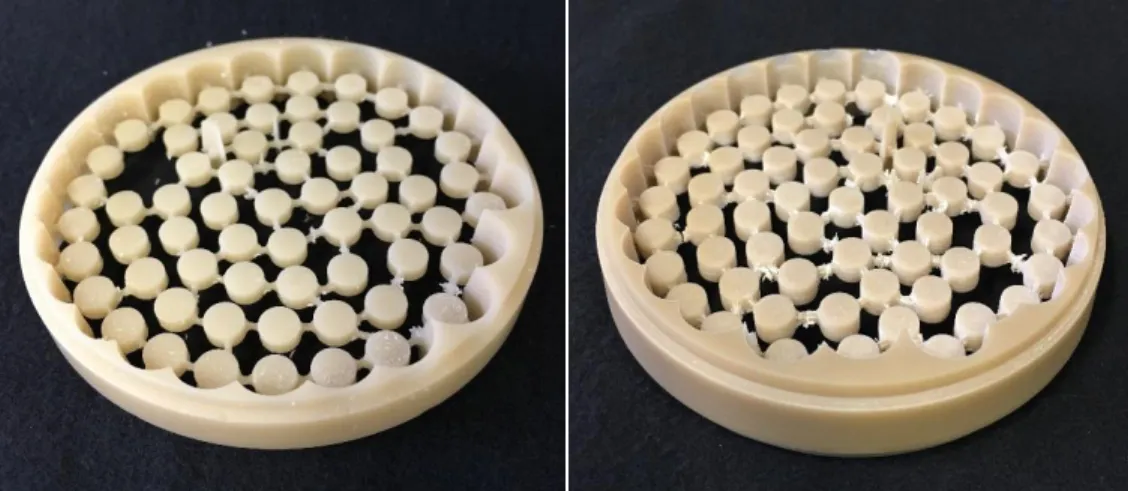
One hundred and sixty blocks of CAD-CAM polymeric materials, with standardized dimensions of 7 mm diameter and 4 mm height, were milled by the manufacturer. Eighty blocks were made of PMMA (PMMA – GT Medical S.L, Spain) and 80 were made of POM (POM-fit – GT Medical S.L, Spain) (Figure 1) (Table 1).
Figure 1: CAD/CAM milled blocks made of PMMA (left) and POM (right).
*According to the information provided by the manufacturer. Table 1: Characteristics of the polymeric CAD/CAM materials used.
Material Manufacturer Composition*
PMMA GT Medical, Madrid, Spain
Powder
(Polymethylmethacrylate); Liquid (Methyl
Methacrylate MMA and Ethyleneglycol
Dimethacrylate EDMA); Pigments (yellow – FeOCH, Black – Fe3O4, White – TiO3, Red – Fe2O3).
POM-FIT GT Medical, Madrid, Spain
Acetal resin
6
The top surface of all specimens was mechanically conditioned with 50 µm Al2O3
(Microetcher II; Danville Engineering) airborne particle abrasion, performed perpendicularly to the block surface with 2.5 bar pressure for 15 seconds at 10 mm distance (Figure 2). After the sandblasting, the specimens were ultrasonically cleaned in an ethanol ultrasonic bath (Elmasonic One; Elma) for 5 minutes and then cleaned with water-spray and air-dried carefully with oil-free compressed air.
Figure 2: Sandblasting of the polymer blocks.
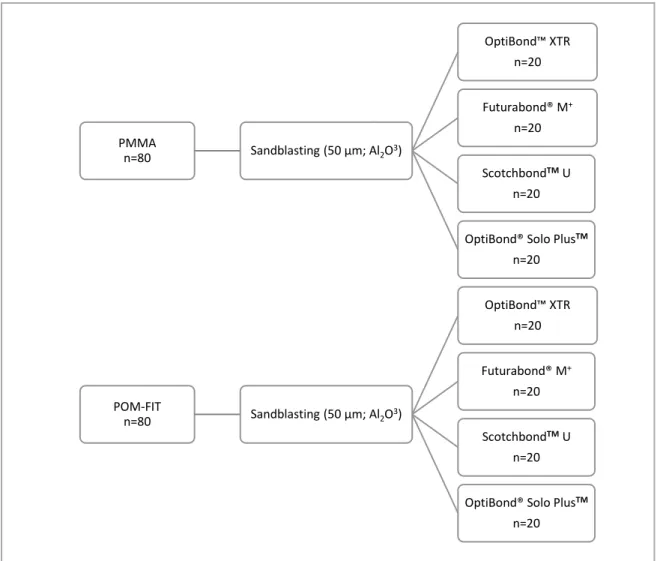
The 80 specimens of each material were randomly allocated to four experimental groups, 20 specimens each, according to the different adhesive system used (Figure 3): OptiBond™ XTR (KerrTM, Scafati, SA 1-84018, Italia) Futurabond® M+ (VOCO GmbH, Cuxhaven, 27472,
Germany), ScotchbondTM Universal (3M ESPE, Neuss, 41453, Germany) or OptiBond™ Solo
Plus (KerrTM, Scafati, SA 1-84018, Italia) (Table 2).
The specimens were fixed on Watanabe plates using plaster and to customize and define the bonding area, a perforated adhesive tape (Adhesive vinyl, SRA3; Xerox) with round-shaped orifices (3 mm in diameter) was positioned on the surface of the blocks (Figure 4). Each adhesive was applied according to the manufacturer´s recommendations (Table 2).
7
Figure 3. Experimental design protocol.
Figure 4. Customization of the adhesive area and adhesive procedure. PMMA n=80 Sandblasting (50 µm; Al2O3) OptiBond™ XTR n=20 Futurabond® M+ n=20 ScotchbondTMU n=20
OptiBond® Solo PlusTM
n=20 POM-FIT n=80 Sandblasting (50 µm; Al2O3) OptiBond™ XTR n=20 Futurabond® M+ n=20 ScotchbondTMU n=20
OptiBond® Solo PlusTM
8
Adhesive Batch Nr Manufacturer Composition* Bonding Procedure**
OptiBond® XTR™ Adhesive: 5812210 Primmer: 5790784 KerrTM, Orange, CA, USA Primer – GPDM phosphate monomer, acetone, ethyl alcohol, HEMA
Adhesive – ethyl alcohol, alkyl dimethacrylate resins, barium
aluminoborosilicate glass, fumed silica, sodium hexafluorosilicate
Apply primmer using scrubbing motion (20 sec). Air thin with medium air pressure (5 sec). Apply the adhesive with brushing motion (15 sec). Air thin with medium air pressure and then strong air (5 sec). Light-cure during 10 sec. Futurabond® M+ 1612531 VOCO GmbH, Cuxhafen, Germany Bis-GMA, 2-hydroxyethyl methacrylate, HDDMA, Acidic Adhesive Monomer, Urethanedimethacrylate, pyrogenic silicic acids, catalyst.
Apply the adhesive with brushing motion (20 sec). Air thin with medium air pressure and then strong air (5 sec). Light-cure during 10 sec. ScotchbondTM Universal 616836 3M ESPE, St. Paul, MN, USA MDP Phosphate Monomer, Dimethacrylate resins, HEMA, Vitrebond™ Copolymer, Filler, Ethanol, Initiators, Water, Silane.
Apply the adhesive with brushing motion (20 sec). Air thin with medium air pressure and then strong air (5 sec). Light-cure during 10 sec. OptiBond® Solo Plus™ 5357097 Kerr Corporation, Orange, CA, USA Bis-GMA, GDM, HEMA, GPDM, Ethanol,
Aluminiun borosilicate glass, Fumed silica,
Sodium hexafluorosilicate, Photoinitiator
Apply the adhesive with brushing motion (20 sec). Air thin with medium air pressure and then strong air (5 sec). Light-cure during 20 sec.
Table 2: Characteristics of the adhesive systems and the bonding procedure. *According to the information provided by the manufacturer. **According manufacturer’s instructions.
The repairing composite resin Grandio®SO (VOCO GmbH, Cuxhaven, 27472, Germany), was applied according the manufacturer’s specific instructions, in a 2 mm layer, using the Watanabe plate as a mold, and polymerized during 10 seconds.
The adhesive and composite were light cured using Ortholux LED Curing Light (3M Unitek, 82171 Puchheim, Germany, Lot nr: 939830000776). The tip of the light curing unit was kept perpendicular to and in contact with the surface in order to receive a maximum curing energy. The intensity of the curing light, 1000 mW/cm2, was monitored with a Cure Rite Visible Curing Light Meter (Dentsply, York, PA, USA).
9
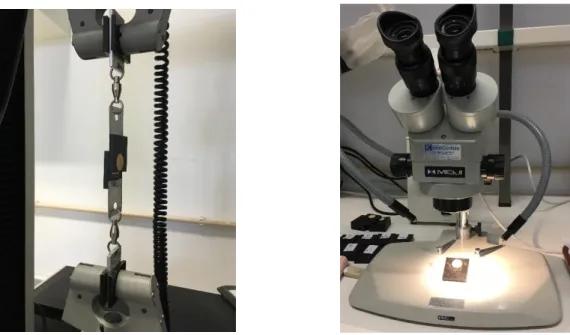
Specimens were stored in distilled water at 37 °C for 48 hours before testing. SBS was measured with a single-plane lap device in a universal testing machine Instron model 4502 (Instrom Ltd., Bucks, HP 12 3SY, England) with a 1 kN load cell at a cross-head speed of 0.5 mm/min (Figure 5).
The mode of failure was analyzed with a stereomicroscope (EMZ-8TR, Meiji Techno Co) at 20x magnification (Figure 6). The failure mode was classified as adhesive type, if the failure occurred at the adhesive interface, cohesive when the failure occurred within the composite or CAD/CAM resin, or as mixed if a combination of failures occurred.
Figure 5: Measuring the SBS: Instrom Testing machine. Figure 6. Stereomicroscope EMZ-8TR.
Data were statistically analyzed with software (IBM SPSS Statistics 20; SPSS Inc). After assessing normality and homoscedasticity with Shapiro–Wilk and Levene’s tests (p>0.05), SBS data were submitted to 2-way ANOVA model (α=0.05). Non-parametric Kruskal-Wallis and Mann-Whitney tests were used to analyze the failure mode data (α=0.05).
10
Results
The descriptive statistic of the sample is presented in Table 3, with the SBS values (mean and standard deviation) and Failure Mode (number and percentage) according to each experimental group.
The mean SBS ranged between 22.6 MPa for the POM specimens repaired with OptiBond Solo Plus and 40.0 MPa for the PMMA with OptiBond XTR.
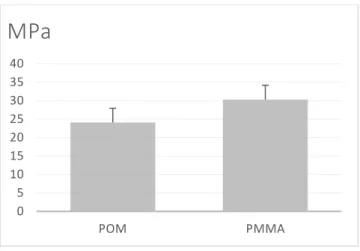
The mean SBS yielded with PMMA specimens was significantly (p<0.001) higher than with POM (Figure 7). Two-way ANOVA showed no statistical (p=0.062) differences between adhesive systems (Figure 8) and an interaction (p=0.212) between the two factors was not detected (Table 4).
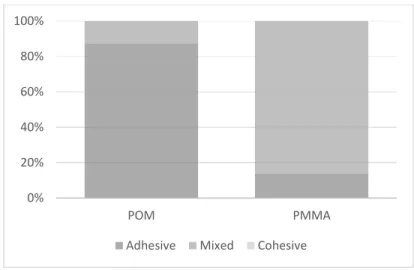
When the failure mode was analyzed, no cohesive failure was obtained, regardless of the experimental group considered. A statistically significant difference was detected between the failure mode observed with the two CAD/CAM resins (p<0.001), with the POM specimens having mostly adhesive failures (87.5%), in contrast with the PMMA with mostly mixed failures (86.3%) (Figure 9). No statistically significant (p=0.925) difference was identified between adhesives (Figure 10).
Polymeric
material Adhesive
SBS values (MPa) Failure Mode N (%)
Mean SD Adhesive Mixed Cohesive
POM
OptiBond™ XTR 24,3 3,56 18 (90%) 2 (10%) 0 (0%)
Futurabond® M+ 26,2 4,23 18 (90%) 2 (10%) 0 (0%)
ScotchbondTM Universal 23,3 3,93 18 (90%) 2 (10%) 0 (0%)
OptiBond™ Solo Plus 22,6 2,82 16 (80%) 4 (20%) 0 (0%)
PMMA
OptiBond™ XTR 40,0 3,47 1 (5%) 19 (95%) 0 (0%)
Futurabond® M+ 30,3 4,66 2 (10%) 18 (90%) 0 (0%)
ScotchbondTM Universal 30,7 3,83 2 (10%) 18 (90%) 0 (0%)
OptiBond™ Solo Plus 29,4 3,58 6 (30%) 14 (70%) 0 (0%)
Table 3: Descriptive statistic of the SBS values and Failure Mode distribution according to the 8 experimental groups.
11
Figure 7. Mean SBS values and standard. deviation of the CAD-CAM polymeric material. Statistically significant difference was found between materials (p<0.,001).
Figure 8. Mean SBS values and standard. deviation according to the adhesive protocol system used. No statistically significant difference was found (p>=0.,0625).
Source df Sum of squares Mean Square F Sig.*
Material 1 1535.059 1535.059 106.670 0.000
Adhesive 3 107.597 35.866 2.492 0.062
Material/ Adhesive 3 65.584 21.861 1.519 0.212
Error 152 2187.400 14.391
Total 160 122350.021
Table 4. Two-Way ANOVA. *p<0.05 indicates statistically significant differences.
0 5 10 15 20 25 30 35 40 POM PMMA
MPa
0 5 10 15 20 25 30 35 40 OptiBond XTR FuturaBond M+Scotchbond U Optibond Solo Plus
12
Figure 9. Failure Mode distribution according to the CAD-CAM polymeric material. A statistically significant difference was shown between the groups (p<0.001).
Figure 10. Failure Mode distribution according to the adhesive system used. No statistically significant difference was identified between the adhesives (p=0.925).
0% 20% 40% 60% 80% 100% POM PMMA Adhesive Mixed Cohesive
0% 10% 20% 30% 40% 50% 60% 70% 80% 90% 100%
OptiBond XTR FuturaBond M+ Scotchbond U Optibond Solo Plus Adhesive Mixed Cohesive
13
Discussion
The SBS test has been widely used (Heintze, 2013), although some authors suggest there are problems related to the validity of the obtained measurements, sustaining that the stresses are mostly concentrated in the substrate and not in the adhesive interface, thus causing its premature failure prior to the interface itself, resulting in a higher percentage of cohesive failures (Della Bona
et al., 1995; Meerbeek et al., 2010). However, even with the high SBS values obtained in the
present study, when the failure mode was analyzed, no cohesive failure was obtained, regardless the experimental group considered, which might confirm the validity of the measurements. Moreover, this method has been used in most of the recent studies testing the adhesion to CAD/CAM materials, enabling the comparison of the present results (Wiegard et al., 2015; Keul
et al., 2014; Bähr et al., 2013)
With the advent of adhesive dentistry, it has become possible to bond artificial materials to other artificial materials which enables dentists to repair rather than replace restorations in case of chippings, fractures or marginal caries (Chen et al., 2008; Heintze et al., 2013). Another approach made possible by adhesion is the reshaping of the restorations by adding another material, in case of aesthetic improvements required by the patient (Güth et al., 2012; Patras et al., 2012; Chen et al., 2008).
For the CAD/CAM materials considered in this study, no information on the preferred repair method or material is available so far, especially regarding the acetal resin. (Patras et al., 2012; Stawarczyk et al., 2013; Wiegand et al., 2015) The chemical composition of the base and the added material, surface characteristics of the interface, and time elapsed since the initial setiing of the restoration should be considered before choosing the repair procedure (Patras et al., 2012)
Self-cured acrylic resins made from PMMA, bis-acryl provisional resins and resin composites, are the most common materials used for repair, because they have the ability to easily reconstruct shape defects, allowing for simple and quick manipulation (Chen et al., 2008). Among those, the use of self-cured acrylic resins is most popular, although direct clinical repair procedures with PMMA can be technically challenging due to the unpleasant odour, significant shrinkage, short working times and a pronounced exothermic setting reaction (Patras et al., 2012). Moreover, residual methacrylate monomer used as repair or relining materials demonstrates cytotoxicity and
14
potential allergenicity (Chen et al., 2008; Patras et al., 2012). More recently, light-cured resin composites have been suggested for the intraoral repair of provisional restorations with the following advantages: availability in numerous shades and viscosities, ease of application and manipulation, adequate working time, minimal odour, low polymerization shrinkage, and increased marginal accuracy (Chen et al., 2008; Patras et al., 2012; Blum et al., 2014).
Since several studies showed that previous mechanical conditioning of the substrate is important to achieve high bond strength (Patras et al., 2012; Stawarczyk et al., 2012; Stawarczyk
et al., 2013; Keul et al., 2014; Wiegand et al., 2015), the specimens were all sandblasted with
aluminium particles (50µm) before the bonding procedure in the present investigation.
Nevertheless, the ability of achieving an adequate chemical bonding to the substrate remains questionable, since the polymerization under standardized conditions, high pressure and high temperature, of the CAD/CAM materials, results in a higher degree of conversion and less residual monomer in the material (Bähr et al., 2013). Thus, the amount of residual monomer or free radicals is very low or even insufficient to allow co-polymerization and these materials present a low surface energy (and wettability) and resistance to surface modification by different chemical treatments (Li Zhoua et al., 2014). Moreover, monomers of the adhesive system (Bis-GMA, HEMA; GDMA) and of the composite (Bis-GMA, UDMA, TEGDMA, bis-EMA) might not co-polymerize with PMMA-based materials (Stawarczyk et al., 2012; Wiegand et al., 2015).
Several possible mechanisms were proposed to explain the role played by the adhesive during the composite resin filling repair. Firstly, the micromechanical interlocking formed by infiltration of the monomer into micro retentions created by the mechanical conditioning should be considered, since the adhesive monomers enable the achievement of better wetting of the surface, due to the solvent and a surfactant that are often added to the bonding agent and the wetting properties of the adhesive monomers themselves, since they have low viscosity (Marshall et al., 2010; Seung-Ryong et al., 2016). The POM specimens presented mostly adhesive failures, in contrast with the PMMA with mostly mixed failures, indicating that the bond strength achieved is higher to the PMMA. Thus the first null hypothesis that there were no differences between the two substrates was rejected. Since the micromechanical interlocking plays an important role in the repair bond strength, the differences obtained might be explained by differences in the surface
15
properties of the two substrates: it is known than the POM presents a higher resistance to surface modification (Maha et al., 2015).
In addition to the mechanical interlocking, it was suggested the possibility of a chemical bond formation to the surface fillers and to the matrix (Bähr et al., 2013). Although, as mentioned before, a co-polymerization with the traditional adhesive monomers is not sufficient because the CAD/CAM resins are industrially polymerized and present a higher degree of conversion and low amount of unsaturated C-C bonds, it is known that the new Universal adhesive systems contain silane or phosphoric acid monomers with high affinity to inorganic filler particles, that may form covalent bond to the unreacted methacrylate groups on the matrix or to the inorganic compound of the CAD/CAM materials (Cardoso et al., 2011; Stawarczyk et al., 2015; Alex, 2015; Seung-Ryong et al., 2016).
However, in the present study, for the different adhesives, although there are differences in their composition (OptiBond® Solo Plus™ does not contain phosphoric monomers) no statistically significant difference was reached, indicating that the bonding agent doesn’t influence the failure mode, which means that the second null hypothesis cannot be rejected. Further studies are necessary, with no mechanical conditioning (highly polished specimens), to assess if the chemical bonding alone is sufficient to achieve adequate SBS values.
Also, all surfaces were air-abraded to create a standardized surface with some micromechanical retentions. Different conditioning procedures, like abrasion with alumina-coated silica particles followed by silanization, should also be investigated, since there are several pre-treatment procedures available and described by the literature as efficient to condition CAD/CAM polymeric material (Schmidlin et al., 2010; Hallmann et al., 2012; Li Zhoua et al., 2014; Wiegand
et al., 2015; Seung-Ryong et al., 2016).
From a methodological point of view, a shortcoming of this study is the lack of artificial ageing by thermocycling or long-term water storage. In previous studies, adhesion between PMMA-based polymer restorations and conventional resin cements, as well as shear bond strength of repaired dimethacrylate-based direct composites, has shown to be impaired by ageing (Ozcan
et al., 2010; Bähr et al., 2013; Wiegand et al., 2015). Several mechanisms were proposed to explain
16
repaired substrate and the residual monomer content and consequently the number of carbon-carbon double bonds, but it is also discussed that thermocycling might increase the repair bond strength by intensifying the process of post-polymerization between polymeric CAD/CAM materials and adhesive resins (Bähr et al., 2013).
To the knowledge of the author this is the first evaluation of the bonding performance to POM in regard to dental applications. Hence, the present results cannot be compared to other available studies. In addition, differences in the methodology and especially the substrate evaluation, adequate comparisons and conclusions are significantly impeded. However, as this was the first study, the main goal was to assess the overall viability of establishing bonding to POM.
Likewise, very few in vitro studies address the repairation of restorations milled of PMMA-based CAD/CAM blocks and consequently, many of the comparisons and conclusions drawn about this matter are based on essays studying the bonding strength to these kind of polymers regarding different conditioning and adhesive procedures for veneering or cementing purposes.
Techniques and materials used in this study should be tested in more demanding laboratory conditions to closer simulate clinical environment.
Although it is difficult to set a clinically relevant SBS value for bond strength after repair, most in vitro studies presented repair bond strength values of dimethacrylate-based direct composites of at least 20 MPa, depending on the kind of composite material and the repair method used (Wiegand et al., 2015). In the present study, the mean SBS values obtained were higher than those suggested above, demonstrating that the repairing method tested is efficient, with the PMMA blocks achieving statistically significant higher values than the acetal resin, regardless of the adhesive system used.
17
Conclusions
It is possible to achieve an adequate adhesion bond to POM and PMMA. However, SBS values were higher in PMMA specimens than to POM. No differences were found between adhesive systems.
18
References
Alex G. Universal adhesives: the next evolution in adhesive dentistry? Compend Contin Educ Dent. 2015 Jan;36(1):15-26.
Alt V, Hannig M, Wöstmann B, Balkenhol M. Fracture strength of temporary fixed partial dentures: CAD/CAM versus directly fabricated restorations. Dent Mater. 2011 Apr;27(4):339-47. Amet EM, Phinney TL. Fixed provisional restorations for extended prosthodontic treatment. J Oral Implantol. 1995;21(3):201-6.
Bähr N, Keul C, Edelhoff D, Eichberger M, Roos M, Gernet W, Stawarczyk B. Effect of different adhesives combined with two resin composite cements on shear bond strength to polymeric CAD/CAM materials. Dental Materials Journal 2013; 32(3): 492–501.
Beuer F, Schweiger J, Edelhoff D, Sorensen JA. Reconstruction of esthetics with a digital approach. Int J Periodontics Restorative Dent. 2011 Apr;31(2):185-93.
Blum IR, Lynch CD, Wilson NHF. Factors influencing repair of dental restorations with resin composite. Clinical, Cosmetic and Investigational Dentistry 2014:6 81–87
Cardoso MV, de Almeida Neves A, Mine A, Coutinho E, Van Landuyt K, De Munck J, Van Meerbeek B. Current aspects on bonding effectiveness and stability in adhesive dentistry. Aust Dent J. 2011 Jun;56 Suppl 1:31-44.
Chen HL, Lai YL, Chou IC, Hu CJ, Lee SY. Shear Bond Strength of Provisional Restoration Materials Repaired with Light-cured Resins. Operative Dentistry, 2008, 33-5, 508-515
Della Bona A, Noort RV. Shear vs. tensile bond strength of resin composite bonded to ceramic. J Dent Res. 1995 Sep;74(9):1591-6.
Edelhoff D, Beuer F, Schweiger J, Brix O, Stimmelmayr M, Guth JF. CAD/CAM-generated high-density polymer restorations for the pretreatment of complex cases: a case report. Quintessence Int. 2012 Jun;43(6):457-67.
19
Ergün G, Mutlu-Sagesen L, Ozkan Y, Demirel E. In vitro color stability of provisional crown and bridge restoration materials. Dent Mater J. 2005 Sep;24(3):342-50. (Ergün et al., 2005)
Fitton JS, Davies EH, Howlett JA, Pearson GJ. The physical properties of a polyacetal denture resin. Clin Mater. 1994;17(3):125-9.
Gratton DG, Aquilino SA. Interim restorations. Dent Clin North Am. 2004 Apr;48(2):vii, 487-97. Güth J.F, Almeida e Silva J.S, Beuer F, Edelhoff D. Enhancing the predictability of complex rehabilitation with a removable CAD/CAM-fabricated long-term provisional prosthesis: A clinical report. J Prosthet Dent 2012;107:1-6.
Hallmann L, Mehl A, Sereno N, Hämmerle CHF. The improvement of adhesive properties of PEEK through different pre-treatments. Applied Surface Science 258 (2012) 7213– 7218
Heintze SD. Clinical relevance of tests on bond strength, microleakage and marginal adaptation. Dental Materials 29 (2013) 59–84.
Isabel Cervera del Río. Estudio del pmma y la resina acetálica para puentes implantosoportados confeccionados por cad/cam como alternativa a los materiales radicionales: ensayo clínico e “in vitro”. Máster Oficial en Ciencias Odontológicas 2013, Universidad Complutese de Madrid, Facultad de Odontología, Departamento de Estomatología I. (Cervera der Rio, 2013)
Keul C, Liebermann A, Schmidlin PR, Roos M, Sener B, Stawarczyk B. Influence of PEEK surface modification on surface properties and bond strength to veneering resin composites. J Adhes Dent. 2014 Aug;16(4):383-92.
Kurbad A. Provisional polymer-based CAD/CAM implant superstructures. Int J Comput Dent. 2014;17(3):239-51.
Kwang Yong Kelvin Khng. An in vitro evaluation of the marginal integrity of CAD/CAM interim crowns compared to conventional interim resin crowns. MS (Master of Science) thesis, University of Iowa, 2013.
20
Lekha K, Savitha N.P, Roseline M, Nadiger R.K. Acetal resin as an esthetic clasp material. Journal of Interdisciplinary Dentistry. Jan-Apr 2012. Vol-2. Issue-1
Li Zhoua, Yuetong Qianb, Ye Zhuc, Hong Liua, Kang Gana, Jing Guo. The effect of different surface treatments on the bond strength of PEEK composite materials. Dental materials 30 (2014) e209–e215 (Li Zhoua et al, 2014)
Lodding DW. Long-term esthetic provisional restorations in dentistry. Curr Opin Cosmet Dent. 1997;4:16-21.
Maha AM, Lamis AH, Mohamed AE. Comparative study of surface roughness between polyamide, thermoplastic polymethyl methacrylate and acetal resins flexible denture base materials before and after polishing. Life Sci J 2015;12(10):90-95.
Marshall SJ, Bayne SC, Baier R, Tomsia A, Marshall GW. A review of adhesion science. Dental Materials 26 (2010) e11–e16.
Meerbeek BV, Peumans M, Poitevin A, Mine A, Ende AV, Neves A, Munck JD. Relationship between bond-strength tests and clinical outcomes. Dental Materials 26 (2010) e100–e121. Michalakis K, Pissiotis A, Hirayama H, Kang K, Kafantaris N. Comparison of temperature increase in the pulp chamber during the polymerization of materials used for the direct fabrication of provisional restorations. J Prosthet Dent. 2006 Dec;96(6):418-23.
Ozcan M, Cura C, Brendeke J. Effect of aging conditions on the repair bond strength of a microhybrid and a nanohybrid resin composite. J Adhes Dent (2010) 12:451–459
Patras M, Naka O, Doukoudakis S, Pissiotis A. Management of Provisional Restorations’ Deficiencies: A Literature Review. J Esthet Restor Dent 24:26–39, 2012. (Patras et al, 2012) Peñate L, Basilio J, Roig M, Mercadé M. Comparative study of interim materials for direct fixed dental prostheses and their fabrication with CAD/CAM technique. J Prosthet Dent 2015;114:248-253.
21
Prasad DK, Alva H, Shetty M. Evaluation of color stability of provisional restorative materials exposed to different mouth rinses at varying time intervals: an in vitro study. J Indian Prosthodont Soc. 2014 Mar;14(1):85-92.
Proussaefs P. Immediate provisionalization with a CAD/CAM interim abutment and crown: a guided soft tissue healing technique. J Prosthet Dent 2015;113:91-95.
Rayyan MM, Aboushelib M, Sayed NM, Ibrahim A, Jimbo R. Comparison of interim restorations fabricated by CAD/CAM with those fabricated manually. J Prosthet Dent 2015;114:414-419. Reshad M, Cascione D, Kim T. Anterior provisional restorations used to determine form, function, and esthetics for complex restorative situations, using all-ceramic restorative systems. J Esthet Restor Dent 2010;22:7-17.
Seung-Ryong H., Sung-Hun K., Jai-Bong L., Jung-Suk H., In-Sung Y. Improving shear bond strength of temporary crown and fixed dental prosthesis resins by surface treatments. J Mater Sci (2016) 51:1463–1475.
Schmidlin PR, Stawarczyk B, Wieland M, Attin T, Hämmerle C.H.F, Fischer J. Effect of different surface pre-treatments and luting materials on shear bond strength to PEEK. Dental Materials 26 (2010) 553–559. doi:10.1016/j.dental.2010.02.003
Stawarczyk B, Basler T, Ender A, Roos M, Özcan M, Hämmerle C. Effect of surface conditioning with airborne-particle abrasion on the tensile strength of polymeric CAD/CAM crowns luted with self-adhesive and conventional resin cements. J Prosthet Dent 2012;107:94-101
Stawarczyk B, Trottmann A, Hämmerle CHF, Özcan M. Adhesion of veneering resins to polymethylmethacrylate-based CAD/CAM polymers after various surface conditioning methods, Acta Odontologica Scandinavica, (2013) 71:5, 1142-1148.
Stawarczyk B, Krawczuk A, Ilie N. Tensile Bond strength of resin composite repair in vitro using differente surface preparation conditionings to an aged CAD/CAM resin nanoceramic. Clin Oral Invest (2015) 19:299–308.
22
Tannous F, Steiner M, Shahin R, Kern M. Retentive forces and fatigue resistance of thermoplastic resin clasps. Dental Materials, March 2012, Vol.28(3), pp.273-278.
Thomas SA, Nandini VV. Acetal Resin - A Quantum Leap in Aesthetic Restorative Dentistry. Int. Journal of Clinical Dental Science. Nov. 2011; 2(4)
The academy of prosthodontics. The glossary of prosthodontic terms. The journal of prosthetic dentistry. Jul 2005, vol 94, Nr 1.
Turner JW, Radford DR, Sherriff M. Flexural properties and surface finishing of acetal resin denture clasps. J Prosthodont. 1999 Sep;8(3):188-95.
Vanoorbeek S, Vandamme K, Lijnen I, Naert I. Computer-aided designed/computer-assisted manufactured composite resin versus ceramic single-tooth restorations: a 3-year clinical study. Int J Prosthodont. 2010 May-Jun;23(3):223-30.
Verri FR, Pellizzer EP, Mazaro JV, de Almeida EO, Antenucci RM. Esthetic interim acrylic resin prosthesis reinforced with metal casting. J Prosthodont. 2009 Aug;18(6):541-4. (Verri at al., 2008) Wiegand A, Stucki L, Hoffmann R, Attin T, Stawarczyk B. Repairability of CAD/CAM high-density PMMA- and composite-based polymers. Clin Oral Invest (2015) 19:2007–2013
Wimmer T, Huffmann AM, Eichberger M, Schmidlin PR, Stawarczyk B. Two-body wear rate of PEEK, CAD/CAM resin composite and PMMA: Effect of specimen geometries, antagonist materials and test set-up configuration. Dent Mater. 2016 Jun;32(6):e127-36.
I
Appendices
II
List of Figures and Tables
Figure 1: CAD/CAM milled blocks made of PMMA (left) and POM (right). ………..Page 4 Figure 2: Sandblasting of the polymer blocks. ………...………..………….Page 5 Figure 3. Experimental design protocol. ...Page 6 Figure 4. Customization of the adhesive area and adhesive procedure. ………Page 6 Figure 5: Measuring the SBS: Instrom Testing machine. ………Page 8 Figure 6. Stereomicroscope EMZ-8TR. ………..……Page 8 Figure 7. Mean SBS values and standard. deviation of to the CAD-CAM polymeric material. Statistically significant difference was found between materials (p<0.,001). ……….Page 10 Figure 8. Mean SBS values and standard. deviation according to the adhesive protocol system used. No statistically significant difference was found (p>=0.,0625). ……….…….………..Page 10 Figure 9. Failure Mode distribution according to the CAD-CAM polymeric material. A statistically significant difference was shown between the groups (p<0.001). ………...………Page 11 Figure 10. Failure Mode distribution according to the adhesive system used. No statistically significant difference between the adhesives was identified (p=0.925). ……….…..…….Page 12
Table 1: Characteristics of the polymeric CAD/CAM materials used. ………..….….…….Page 4 Table 2: Characteristics of the adhesive systems and the bonding procedure. …………..…….….…..Page 7 Table 3: Descriptive statistic of the SBS values and Failure Mode distribution according to the 8
experimental groups. ……….………..Page 9 Table 4. Two-Way ANOVA. ……….…Page 10
III
Data from experimental group: POM + OptiBond
TMXTR
*Failure Mode: 1 – Adhesive; 2 - Cohesive, with composite; 3 - Cohesive, with acetal resin; 4 - Mixed, with composite; 5 - Mixed, with resin. 6 - Mixed, with composite and resin.
** Simplified Failure Mode: 1 – Adhesive; 2 – Mixed; 3 – Cohesive.
N Force (N) MPa Failure
Mode* Simplified Failure mode** 1 153.1 23.07 1 1 2 153.8 21.76 1 1 3 156.3 22.11 1 1 4 202.1 28.59 1 1 5 199.5 28.22 1 1 6 175.3 24.8 1 1 7 180.2 25.49 1 1 8 155.3 21.97 5 2 9 127.4 18.02 1 1 10 184.3 26.07 1 1 11 198.7 26.98 1 1 12 120.5 17.05 1 1 13 182.2 25.78 1 1 14 160.1 22.65 5 2 15 160.9 22.76 1 1 16 155.4 21.98 1 1 17 158 22.35 1 1 18 219.4 31.04 1 1 19 204.7 28.96 1 1 20 179.9 25.45 1 1
IV
Data from experimental group: POM + Futurabond® M
+*Failure Mode: 1 – Adhesive; 2 - Cohesive, with composite; 3 - Cohesive, with acetal resin; 4 - Mixed, with composite; 5 - Mixed, with resin. 6 - Mixed, with composite and resin.
** Simplified Failure Mode: 1 – Adhesive; 2 – Mixed; 3 – Cohesive.
N Force (N) MPa Failure
Mode Simplified Failure mode 1 176 24.9 1 1 2 232.9 32.95 1 1 3 185 26.17 1 1 4 174.7 24.71 1 1 5 242.4 34.29 1 1 6 189.6 26.82 1 1 7 165.8 23.46 1 1 8 223.8 31.68 1 1 9 219.2 31.01 5 2 10 183.6 25.97 1 1 11 164.7 23.3 1 1 12 125.1 17.7 1 1 13 151.8 21.36 5 2 14 172.7 24.43 1 1 15 158.9 22.48 1 1 16 199.6 28.24 1 1 17 177.4 25.1 1 1 18 215.6 30.5 1 1 19 156 22.07 1 1 20 193.6 27.39 1 1
V
Data from experimental group: POM + ScotchBond
TMU
N Force (N) MPa Failure
Mode Simplified Failure mode 1 188.8 26.71 1 1 2 169.8 23.91 1 1 3 195.5 27.66 1 1 4 208.7 29.52 1 1 5 153.9 21.77 1 1 6 169 23.91 1 1 7 107.9 15.26 1 1 8 161.8 22.89 1 1 9 189.9 26.87 1 1 10 111.6 15.79 1 1 11 179.6 25.41 1 1 12 157.1 22.23 1 1 13 162.6 23 5 2 14 134.5 19.03 1 1 15 140.6 19.89 1 1 16 175.3 24.8 1 1 17 201.2 28.46 1 1 18 178.9 25.31 4 2 19 135.9 19.23 1 1 20 174.9 24.74 1 1
*Failure Mode: 1 – Adhesive; 2 - Cohesive, with composite; 3 - Cohesive, with acetal resin; 4 - Mixed, with composite; 5 - Mixed, with resin. 6 - Mixed, with composite and resin.
VI
Data from experimental group: POM + OptiBond® Solo Plus
TMN Force (N) MPa Failure
Mode Simplified Failure mode 1 157.6 22.3 1 1 2 146.8 20.77 1 1 3 162.1 22.93 1 1 4 177.1 25.05 1 1 5 137.9 19.51 1 1 6 129.4 18.31 1 1 7 135.4 19.16 1 1 8 181.6 25.69 5 2 9 180.5 25.54 1 1 10 150.3 21.26 1 1 11 142.4 20.15 1 1 12 192.1 27.18 4 2 13 181.3 25.69 1 1 14 140.4 18.86 1 1 15 147.1 20.81 1 1 16 192.8 27.28 4 2 17 162.7 23.02 1 1 18 151.1 21.38 1 1 19 168.2 23.8 1 1 20 171.3 24.23 4 2
*Failure Mode: 1 – Adhesive; 2 - Cohesive, with composite; 3 - Cohesive, with acetal resin; 4 - Mixed, with composite; 5 - Mixed, with resin. 6 - Mixed, with composite and resin.
VII
Data from experimental group: PMMA + OptiBond
TMXTR
N Force (N) MPa Failure
Mode Simplified Failure mode 1 221.4 31.32 4 2 2 188.9 26.72 4 2 3 183.1 25.9 4 2 4 220.9 31.25 4 2 5 191.4 27.08 6 2 6 217.3 30.74 4 2 7 207.2 29.31 6 2 8 218.6 30.93 4 2 9 223.1 31.56 6 2 10 245.3 34.7 4 2 11 215.8 30.53 4 2 12 221.4 31.32 1 1 13 188.1 26.61 4 2 14 277.9 39.31 4 2 15 254.2 35.96 4 2 16 215.7 30.52 6 2 17 209.8 29.68 4 2 18 233.3 33.01 4 2 19 248.1 35.1 4 2 20 190.7 26.98 4 2
*Failure Mode: 1 – Adhesive; 2 - Cohesive, with composite; 3 - Cohesive, with acetal resin; 4 - Mixed, with composite; 5 - Mixed, with resin. 6 - Mixed, with composite and resin.
VIII
Data from experimental group: PMMA + Futurabond® M
+N Force (N) MPa Failure Mode Simplified
Failure mode 1 169 23.91 4 2 2 244.3 34.56 4 2 3 270.6 38.28 4 2 4 141.3 19.99 1 1 5 230.4 32.59 4 2 6 190.5 26.95 4 2 7 249.1 32.24 4 2 8 206.6 29.23 4 2 9 185.2 26.2 4 2 10 179.6 25.41 4 2 11 239.3 33.85 4 2 12 237.6 33.61 4 2 13 243.2 34.41 1 1 14 241.1 34.11 4 2 15 187.4 26.51 4 2 16 214.5 30.35 6 2 17 187.8 26.57 4 2 18 255.9 36.2 6 2 19 203.6 28.8 4 2 20 221.1 31.28 4 2
*Failure Mode: 1 – Adhesive; 2 - Cohesive, with composite; 3 - Cohesive, with acetal resin; 4 - Mixed, with composite; 5 - Mixed, with resin. 6 - Mixed, with composite and resin.
IX
Data from experimental group: PMMA + Scotchbond
TMU
N Force (N) MPa Failure Mode Simplifie
d Failure mode 1 189.4 26.79 4 2 2 205.5 29.07 4 2 3 222.9 31.35 4 2 4 199.4 28.21 4 2 5 189.2 27.77 1 1 6 185.6 26.26 4 2 7 220.7 31.22 4 2 8 277.1 39.2 4 2 9 192.5 27.23 1 1 10 222.1 31.42 4 2 11 270.1 38.21 4 2 12 214.4 30.33 4 2 13 200.1 28.31 4 2 14 202.8 28.69 4 2 15 192.8 27.28 4 2 16 235.4 33.38 4 2 17 235.1 33.26 4 2 18 186.3 26.36 4 2 19 245.1 34.67 4 2 20 243.5 34.45 4 2
Failure Mode: 1 – Adhesive; 2 - Cohesive, with composite; 3 - Cohesive, with acetal resin; 4 - Mixed, with composite; 5 - Mixed, with resin. 6 - Mixed, with composite and resin.
X
Data from experimental group: PMMA + OptiBond® Solo Plus
TMN Force (N) MPa Failure
Mode Simplified Failure mode 1 198.6 28.1 4 2 2 236 33.39 4 2 3 208.1 29.44 4 2 4 170.4 24.11 1 1 5 219.9 31.11 4 2 6 217.5 30.77 1 1 7 234.4 33.16 1 1 8 203.3 28.76 4 2 9 162.3 22.96 1 1 10 163.5 23.13 4 2 11 245.3 34.7 4 2 12 236.2 33.42 4 2 13 214 30.27 4 2 14 187.4 26.51 4 2 15 232.5 32.89 4 2 16 228.4 32.31 4 2 17 212.3 30.03 4 2 18 211.1 29.86 4 2 19 195.5 27.66 1 1 20 176.1 24.91 1 1
Failure Mode: 1 – Adhesive; 2 - Cohesive, with composite; 3 - Cohesive, with acetal resin; 4 - Mixed, with composite; 5 - Mixed, with resin. 6 - Mixed, with composite and resin.
XI
Instructions for use (Grandio® SO)
XII
XIII
XIV
XV