TEACHER-CHILD INTERACTIONS, DISABILITY PROFILE, AND SOCIAL EXPERIENCES OF CHILDREN IN INCLUSIVE PRESCHOOL CLASSROOMS
Milene Alexandra Gregório Ferreira
Tese submetida como requisito parcial para obtenção do grau de
Doutoramento em Psicologia
Área de Especialidade……… Psicologia Educacional
TEACHER-CHILD INTERACTIONS, DISABILITY PROFILE, AND SOCIAL EXPERIENCES OF CHILDREN IN INCLUSIVE PRESCHOOL CLASSROOMS
Milene Alexandra Gregório Ferreira
Tese orientada por Prof.ª Doutora Cecília Aguiar (ISCTE – Instituto Universitário de Lisboa) Coorientada por Prof.ª Doutora Júlia Serpa Pimentel
(ISPA – Instituto Universitário)
Tese submetida como requisito parcial para obtenção do grau de
Doutoramento em Psicologia
Área de Especialidade……… Psicologia Educacional
2016
Tese apresentada para cumprimento dos requisitos necessários à obtenção do grau de Doutor em Psicologia na área de especialização de Psicologia Educacional realizada sob orientação de Prof.ª Doutora Cecília Aguiar e coorientação de Prof.ª Doutora Júlia Serpa Pimentel, apresentada no ISPA – Instituto Universitário no ano de 2016.
Aos Avôs Umbelino e Joaquim. Ao Miguel e à minha família.
Agradecimentos
À Prof.ª Doutora Cecília Aguiar e à Prof.ª Doutora Júlia Serpa Pimentel, pela oportunidade, por toda a orientação, acompanhamento e empenho, sem os quais não poderia ter concretizado este trabalho.
A toda a equipa do projeto pelo árduo trabalho que realizou e pela ajuda prestada em todos os momentos.
A todos os educadores de infância e crianças que participaram no estudo. Ao meu colega Rui por me ter ajudado a gerir o tempo.
Aos meus amigos.
À minha família, em especial ao Miguel, à Patrícia e aos meus pais por toda a compreensão e suporte que me prestaram nesta caminhada.
Palavras-chave:
Crianças com incapacidades; relações sociais; interações educadora-criança; competências sociais
Key words:
Children with disabilities; social relationships; teacher-child interactions; social competence
Categorias de Classificação da tese
(PsycINFO Classification Categories and Codes) 3500 Educational Psycology
3560 Classroom Dynamics & Student Adjustment & Attitudes 3570 Special & Remedial Education
2800 Developmental Psychology
RESUMO
Em Portugal, quase todas as crianças com incapacidades encontram-se a frequentar contextos de educação pré-escolar regular, tornando-se fundamental promover a sua inclusão de uma forma que potencie o seu desenvolvimento global, bem como o desenvolvimento de sentimentos de pertença, relações sociais positivas e amizades. De facto, recentemente, o desenvolvimento socio-emocional e comportamental das crianças com incapacidade foi considerado um objetivo crucial de uma inclusão de elevada qualidade na infância (DEC/ NAEYC, 2009).
Composta por três estudos, a presente dissertação tem por objetivo alargar o conhecimento existente acerca das experiências sociais das crianças com incapacidades que frequentam contextos de educação pré-escolar e da forma como as suas características individuais e a exposição ao contexto, considerando quer a qualidade das interações educador-criança quer e o tempo de exposição a essas interações, influenciam o estabelecimento de relações sociais e o seu desenvolvimento social. Neste estudo, participaram um total de 86 crianças com incapacidades (63 rapazes) com idades que variavam entre os 45 e 88 meses (M = 67.53, DP = 10.54), frequentando 86 jardins-de-infância inclusivos da área metropolitana de Lisboa, bem como os seus respetivos educadores de infância. O primeiro estudo permitiu descrever as experiências sociais das crianças com incapacidades ao nível das relações diádicas e ao nível do grupo, identificando características individuais e perfis de funcionalidade que dificultam a inclusão social. No segundo estudo, procurou-se compreender em que medida as características das crianças associadas a maior risco de exclusão social e as características dos contextos que parecem ser protetoras, como a qualidade das interações educador-criança (e.g., Burchinal et al., 2010), influenciam as suas experiências sociais e como esta relação é moderada pelo tempo de exposição. Por fim, no terceiro estudo, analisou-se o papel moderador da qualidade das interações educador-criança e do tempo de exposição na relação entre o grau de incapacidade das crianças e as suas competências sociais e comportamentais.
Os resultados encontrados evidenciam que as crianças com perfis de incapacidade mais graves e que revelam dificuldades socio-comportamentais apresentam um maior risco de exclusão social, verificando-se que os seus educadores de infância poderão não identificar processos de rejeição destas crianças, colocando em causa a sua inclusão social. Crianças com dificuldades comportamentais e baixa competência verbal parecem revelar mais dificuldades em termos de inclusão social quando têm níveis superiores de exposição, ou seja, quando faltam menos dias. A qualidade das interações educador-criança não parece ter um impacto direto nas experiências sociais das crianças; contudo, parece moderar a associação entre o grau de incapacidade das crianças e os seus problemas de comportamento, tendo a baixa qualidade um impacto negativo nos comportamentos das crianças com incapacidades mais ligeiras.
Com base nestes resultados, importa no futuro apoiar os educadores no desenvolvimento de competências de identificação de processos de rejeição e exclusão de crianças com incapacidade pelos seus pares, bem como na implementação de estratégias ativas que promovam o envolvimento das crianças com incapacidade em interações de elevada qualidade, potenciando o desenvolvimento das suas competências e relações sociais. Por outro lado, a simples permanência das crianças com comportamentos desafiantes e menos competências de linguagem em contextos inclusivos parece não ser suficiente para assegurar a sua inclusão social, sendo importante implementar intervenções específicas que promovam, efetivamente, as suas competências socio-comportamentais.
ABSTRACT
In Portugal, almost all children with disabilities attend regular preschool classrooms. Therefore, it is crucial to promote their inclusion ensuring their global development, as well as the development of a sense of belonging, positive social relationships, and friendships. Indeed, recently, the socio-emotional and the behavioral development of children with disabilities was considered a critical goal of high-quality early childhood inclusion (DEC/ NAEYC, 2009).
Constituted by three studies, the present dissertation aims to extend the existing knowledge on the social experiences of children with disabilities who attend inclusive early childhood education and care (ECEC) settings and on how their individual characteristics and exposure to context, specifically the quality of teacher-child interactions and the amount of their exposure, influence the development of social relationships and social development. In this study, participated a total of 86 children with disabilities (63 boys), aged between 45 and 88 months (M = 67.53, SD = 10.54) from 86 inclusive preschool classrooms from the metropolitan area of Lisbon, as well as their respective teachers. The first study aimed to describe the social experiences of children with disabilities in terms of dyadic relationships and group level experiences, identifying individual characteristics and functional profiles that hinder their social inclusion. In the second study, we sought to understand to what extent children's characteristics associated with a higher risk of social exclusion and context characteristics that seem to be protective, as the quality of teacher-child interactions (e.g., Burchinal et al., 2010), influence their social experiences and how this association is moderated by their exposure. Finally, in the third study, we analyzed the moderating role of teacher-child interactions quality and dosage in the associations between children’s degree of disability and their social and behavioral competences.
Findings showed children with more severe disabilities, and children who revealed socio behavioral difficulties present a higher risk of social exclusion, while suggesting their teachers may not be aware of processes of social rejection, jeopardizing their social inclusion. Children with behavior difficulties and low verbal competence seem to have more social inclusion difficulties, when they have higher levels of dosage, that is, when they miss more school days. Teacher-child interactions quality does not seem to have a direct impact on children's social experiences; however, it does seem to moderate the association between the children’s degree of disability and their problem behaviors, with lower quality having a negative impact on the behavior of children with mild disabilities.
Based on these findings, it is important to support early childhood education teachers’ in identifying processes of social rejection and exclusion of children with disabilities by their peers, as well as in implementing active strategies that promote the involvement of children with disabilities in high-quality interactions, enhancing the development of their competences and social relationships. On the other hand, the simple exposure of children with challenging behaviors and less verbal competences to inclusive settings does not seem to be sufficient to ensure their social inclusion, and the implementation of specific interventions to effectively promote their social-behavioral skills seems necessary.
TABLE OF CONTENTS
CHAPTER I: General Introduction... 1
Social Experiences of Children with Disabilities in Inclusive Classrooms ... 4
Teacher-Child Interactions ... 6
The present work ... 8
References ... 13
CHAPTER II: Social Experiences of Children with Disabilities in Inclusive Portuguese Preschool Settings ... 19 Abstract ... 20 Introduction ... 21 Friendship ... 22 Social Acceptance... 23 Sociometric Status ... 23 Social Networks... 24 Method ... 25 Participants ... 25
Measures and Procedures ... 27
Results ... 30
Descriptive statistics ... 30
Sociometric status based on sociometric peer nominations and teacher report ... 31
Correlations among variables ... 31
Characteristics of accepted and rejected children ... 34
Social experiences as a function of type of disability... 35
Limitations ... 42
Conclusions ... 43
Implications ... 43
References ... 45
CHAPTER III: Friendships and social acceptance of children with disabilities: The role of teacher-child interactions, individual skills, and ECEC dosage ... 51
Abstract... 52
Introduction... 53
Method... 57
Participants ... 57
Measures and Procedures ... 58
Results ... 61
Descriptive statistics ... 61
Associations between teacher-child interactions and children’s friendship and social acceptance: The moderator role of dosage ... 64
Associations between children’s social skills / behavior problems / verbal competence and friendship and social acceptance: The moderator role of dosage ... 66
Discussion ... 71
Limitations ... 73
Conclusions and implications ... 74
References ... 76
CHAPTER IV: Social Skills and Behavior Problems of Preschoolers with Disabilities: Examining Moderating Effects of Teacher-Child Interactions and Dosage ... 83
Introduction... 85
Participants ... 89 Measures ... 90 Procedure ... 91 Results ... 92 Descriptive statistics ... 92 Correlation Coefficients ... 93
Multiple regression analyses predicting social skills... 95
Multiple regression analyses predicting problem behaviors ... 97
Discussion ... 101
Limitations ... 103
Conclusion and implications ... 104
CHAPTER V: General Discussion ... 111
Disability profiles and children’s social experiences ... 113
ECEC Dosage and children’s social experiences ... 114
Limitations ... 116
Implications for practice ... 118
Directions for future research ... 119
Conclusion... 120
INDEX OF TABLES
CHAPTER II: Social Experiences of Children with Disabilities in Inclusive Portuguese Preschool Settings
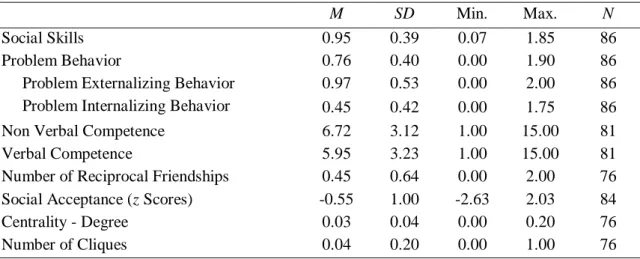
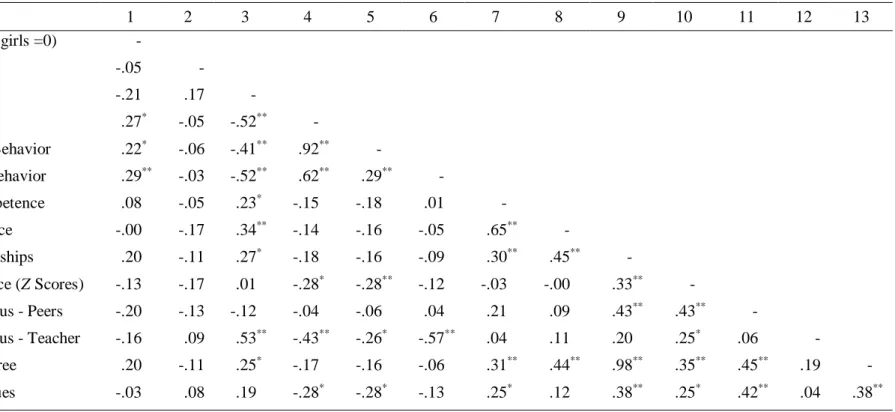
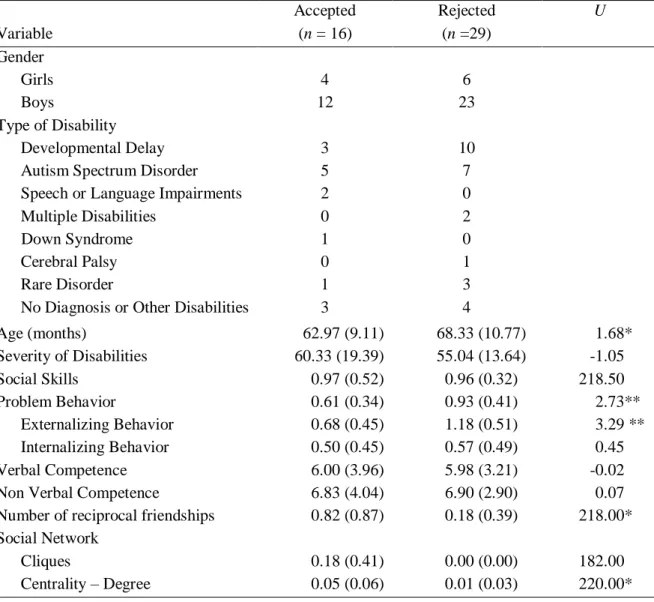
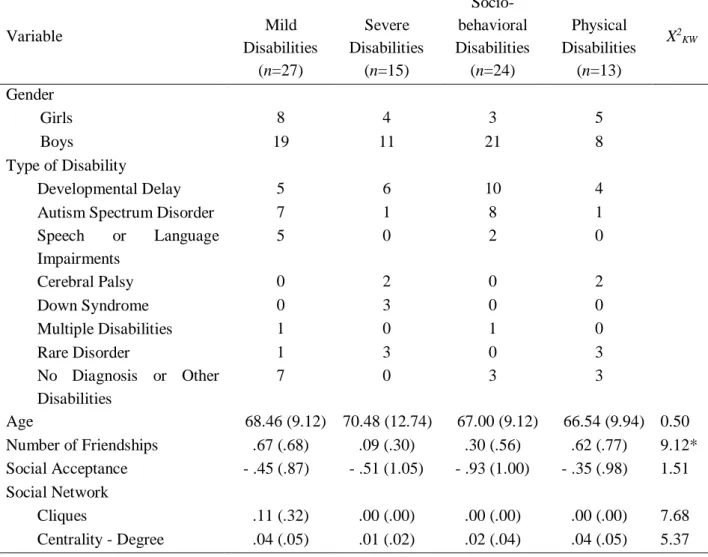
Table 1. Descriptive statistics ……….………… 30 Table 2. Children with disabilities sociometric status rated by peers and teachers ………… 31 Table 3. Spearman correlation coefficients among variables ………...……….. 33 Table 4. Information of type of disabilities, severity of disabilities, social skills, problem behavior, verbal and nonverbal competence, reciprocal friendship, and social network for socially accepted and rejected groups ……….……… 34 Table 5. Information of type of disabilities, friendship and social network for disabilities profile ………..……… 37 Table 6. Multiple Regression Analysis for Variables Predicting Number of Reciprocal Friendships ………..……… 39
CHAPTER III: Friendships and social acceptance of children with disabilities: The role of teacher-child interactions, individual skills, and ECEC dosage
Table 1. Descriptive statistics ………..…... 61 Table 2. Pearson correlation coefficients among variables ……….……… 63 Table 3. Summary of multiple regression analyses for testing the moderating effect of dosage on the relationship between teacher-child interactions and social acceptance of children with disabilities ………...… 65 Table 4. Summary of multiple regression analyses testing the moderating effect of dosage on the relationship between teacher-child interactions and friendships of children with disabilities ………. 66 Table 5. Summary of multiple regression analyses testing the moderating effect of dosage on the relationship between children’s verbal, social, and behavioral competences and children’s acceptance ………..……… 67
Table 6. Summary of multiple regression analyses testing the moderating effect of dosage on the relationship between children’s verbal, social, and behavior competences and children’s friendships ………...……… 70
CHAPTER IV: Social Skills and Behavior Problems of Preschoolers with Disabilities: Examining Moderating Effects of Teacher-Child Interactions and Dosage
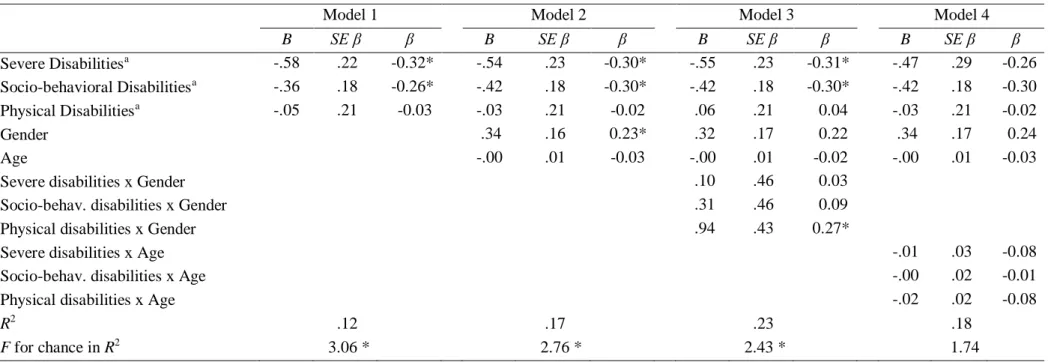
Table 1. Descriptive Statistics of the Major Study Variables ………. 92 Table 2. Pearson Correlations Coefficients Among Study Variables ………. 94 Table 3. Multiple Regression Analyses Predicting Social Skills in the Spring, Testing the Moderating Effects of Teacher-Child Interactions ………. 96 Table 4. Multiple Regression Analyses Predicting Spring Social Skills, Testing the Moderating Effects of Dosage ……… 97 Table 5. Multiple Regression Analyses Predicting Spring Problem Behaviors, Testing the Moderating Effects of Teacher-Child Interactions ………. 98 Table 6. Multiple Regression Analyses Predicting Spring Problem Behaviors, Testing the Moderating Effects of Dosage ……….. 101
INDEX OF FIGURES
CHAPTER I: General Introduction
Figure 1. Hypothesized relationships among variables in study 1: The associations between children’s disability profile and their social experiences ……….. 9 Figure 2a. Hypothesized relationships among variables in study 2: The associations between teacher-child interactions and children’s friendships and social acceptance ……….. 10 Figure 2b. Hypothesized relationship among variables in study 2: The associations between children’s competence and their friendships and social acceptance ………...…… 11 Figure 3. Hypothesized relations among variables in study 3: The associations between children’s degree of disability and their social skills and problem behaviors …………...…. 12
CHAPTER II: Social Experiences of Children with Disabilities in Inclusive Portuguese Preschool Settings
Figure 1. (Dis)Abilities Profile based on Hierarchical Cluster Analysis (Ward’s Method) ………..……….... 36
CHAPTER III: Friendships and social acceptance of children with disabilities: The role of teacher-child interactions, individual skills, and ECEC dosage
Figure 1. Moderating effects of proportion of days absent in the relationship between externalizing behavior and social acceptance ………. 68 Figure 2. Moderating effects of proportion of days absent in the relationship between verbal competence and social acceptance ……….. 69 Figure 3. Moderating effects of number of months with lead teacher in the relationship between externalizing behavior and friendship ……….. 71
CHAPTER IV: Social Skills and Behavior Problems of Preschoolers with Disabilities: Examining Moderating Effects of Teacher-Child Interactions and Dosage
Figure 1. Moderating effects of teacher-child interaction in the relationship between degree of disability and problem behaviors ……….………. 99 Figure 2. Moderating effects of emotional support in the relationship between degree of disability and problem behaviors ……….. 100
CHAPTER V: General Discussion
Figure 1. Summary of statistically significant findings of the first study. Non-significant findings are presented in grey ……….………... 113 Figure 2. Summary of statistically significant findings of the second study. Non-significant findings are presented in grey ………..……….... 115 Figure 3. Summary of statistically significant findings of the third study. Non-significant findings are presented in grey ………..…………..…..… 116
CHAPTER I General Introduction
Today an ever-increasing number of infants and young children with and without disabilities play, develop, and learn together in a variety of places – homes, early childhood programs, neighborhoods, and other community-based settings. The notion that young children with disabilities and their families are full members of the community reflects societal values about promoting opportunities for development and learning, and a sense of belonging for every child. (DEC/ NAEYC, 2009, pp. 1)
In Portugal, about 99% of children with disabilities attend classrooms in regular schools (Direção-Geral de Estatísticas da Educação e Ciência, 2016). According to DEC/ NAEYC (2009), early childhood inclusion has to ensure that every child, with and without disabilities, participates in a wide variety of contexts and activities, achieving his/her potential. Furthermore, developing a sense of belonging, positive social relationships, and friendship are critical goals for high-quality early childhood inclusion.
Positive social outcomes (e.g., having a friend) have been identified for young children with disabilities attending inclusive preschools (Buysse, Goldman, & Skinner, 2002). However, globally, research reports high levels of social rejection (Odom et al., 2006) and few friends for children with disabilities (Guralnick, Gottman & Hammond, 1996), especially for children with decreased peer-related social competence (Meyer & Ostrosky, 2016). Portuguese preschool children with disabilities also seem to experience difficulties in social interactions with peers, spending more time alone, isolated, than children without disabilities (Gamelas, 2003). Further, previous research findings suggest older Portuguese children and with less severe disabilities are at higher risk of social rejection (Aguiar, Moiteiro, & Pimentel, 2010).
In inclusive preschool classrooms, children with and without disabilities play together, developing social relationships, and it seems that they experience higher levels of global quality than children enrolled in non-inclusive classrooms (Grisham-Brown, Cox, Gravil, & Missall, 2010). Interactions between teachers and children in inclusive classrooms also seem to be of higher quality and more developmentally appropriate (Hestenes, Cassidy, Shim, & Hedge, 2008). Further, children with disabilities seem to have good-quality individual experiences in inclusive settings, based on positive teacher-child relationships (Jeon et al., 2010). Harmonious, stimulating, and warm
classrooms that provide emotional support, create an environment where children feel safe and seek the teacher as a source of support, promoting children’s connections (Downer, Sabol, & Hamre, 2010). Classrooms with high-quality teacher-child interactions have been associated with positive socio-emotional developmental outcomes for children without disabilities, including children from disadvantaged backgrounds (Howes, 2011; Mashburn et al., 2008). However, few studies have looked into these associations among children with disabilities.
The present work is part of a broader project entitled “Enhancing peer relationships: Preschool teachers' ideas and practices”, funded by Fundação para a Ciência e a Tecnologia (PTDC/CPE-CED/117476/2010), that aims to (a) understand the ideas of Portuguese preschool teachers about what is important to promote children’s relationships; (b) document the strategies that teachers use towards this goal, investigating the relationship between teachers’ ideas and practices and the social participation of children with and without disabilities; and (c) investigate whether children's ability profiles influence the associations between teachers’ practices and children’s social participation experiences. The specific contribution of this particular work is the focus on the social experiences of children with disabilities and on the role of teacher practices, specifically, teacher-child interactions, on the social outcomes of this specific group of children.
In general, this work aims to investigate the social experiences of children with disabilities at the dyadic and group level, as well as to identify individual characteristics and classroom features that enhance or hinder their social inclusion. In inclusive classrooms, teacher practices may influence children’s social competence and relationships. Therefore, the quality of teacher-child interactions and its associations with children’s social experiences are examined in this study. More specifically, this work aims to (1) identify disability profiles with increased risk of social rejection and exclusion; (2) investigate teachers’ awareness of social exclusion and rejection processes experienced by children with disabilities; (3) investigate the associations between early childhood education and care (ECEC) dosage and children’s friendships, social acceptance, and socio-behavioral competence; (4) investigate the associations between teacher-child interactions and children’s friendships, social acceptance, social skills, and problem behaviors. To this effect, a set of three studies are presented and
discussed in this dissertation, trying to increased available information on children’s social experiences and identifying potential areas of intervention.
This work examines children’s social development outcomes building on the bioecological theory of human development (Bronfenbrenner & Morris, 2006). According to this theoretical framework, human development can be better understood on the basis of a process-person-context-time model; more specifically, development results from processes that involve dynamic interactions between a developing individual and the persons, objects, and symbols within a context, during a period of time. Processes are one of principal components of this model and are also known as proximal process. Their impact on human development varies as a result of the characteristics of the developing person, his/her contexts (immediate or remote environment), and time (for example, frequency, duration). These processes occur within a microsystem. Microsystems are the immediate environment with specific physical, social, and symbolic characteristics, where the developing person experiences interpersonal relations, social roles, and activities that enhance or hinder his/her involvement in interactions with increased complexity over time (Bronfenbrenner, 1994). Children’s preschool settings are important microsystems, where development occurs. This work studies the associations among the individual characteristics of children with disabilities (i.e., personal characteristics), their interactions with peers, classroom-level teacher-child interactions (proximal processes), and children’s social outcomes, within a specific microsystem, the preschool setting, while considering the impact of time on these processes.
Social Experiences of Children with Disabilities in Inclusive Classrooms
Inclusive preschools, a natural environment with children without disabilities, who may be more available for interactions, seem to enhance the opportunities for children with disabilities to develop friendships, a specific type of relationships which are dyadic, reciprocal, and voluntary (Buysse et al., 2002; Goldman, 2007; Rubin, Bukowski, & Parker, 2006). Despite findings suggesting positive effects of inclusion for children with disabilities (Buysse et al., 2002), most of them seem to be at risk of social exclusion (Odom et al., 2006). As described above, personal characteristics influence proximal processes (Bronfenbrenner & Morris, 2006) and, consequently, their desired outcomes. Depending on the type of disability, children present specific characteristics that can influence their play activities and interactions with other children, which are
indicators of young children’s social relationships, such as friendship (e.g., Dietrich, 2005; Hollingsworth & Buysse, 2009).
Research suggests some individual characteristics of children with disabilities are related to having fewer friends, including type of diagnosis (Buysse, 1993), developmental status (Guralnick et al., 1996), developmental age (Buysse, 1993), and socio-behavioral competence (Meyer & Ostroky, 2016). Children with language disabilities are more likely to have at least one friend when compared to children with developmental delay or cognitive disabilities (Buysse, 1993; Guralnick et al., 1996). Further, children with more social skills and less problem behaviors (Meyer & Ostrosky, 2016) are more likely to have friends. It is not clear if gender is related to friendship. Preschool children tend to form same gender friendship dyads (Vaughn, Colvin, Azria, Caya, & Krzysik, 2001) and it seems that it is more likely that a girl chooses a peer with disabilities to play with (Diamond, Hong, & Tu, 2008), which may suggest that boys with disabilities have an increased risk of social exclusion. Therefore, this issue needs further investigation.
Children’s characteristics also seem to influence their inclusion at a higher level of social complexity, the group level. Research on the social acceptance of children with disabilities suggests the severity of disability (Aguiar et al., 2010) and type of disability (Odom et al., 2006) are related to levels of social acceptance and rejection. Disabilities that influence children’s socio-behavioral competence, such as intellectual disabilities and autism-pervasive developmental disorders, appeared more related to social rejection (Meyer & Ostrosky, 2016; Odom et al., 2006). Age also appears to be associated with social acceptance but, in this case, chronological age appears negatively associated with the acceptance of children with disabilities (Aguiar et al., 2010).
Also at the group level, sociometric status may be an indicator of children’s social impact and preference. Peer sociometric nominations can be used to determine five independent social statuses: popular, rejected, neglected, average, and controversial (Coie, Dodge, & Coppotelli, 1982). Knowing each child’s social status helps to identify processes of social rejection and neglect. Little available research, based on peer report, suggests children with disabilities have more disadvantageous sociometric statuses than their typically developed peers (Ochoa & Olivarez, 1995).
Social networks are useful both to analyze children’s social connections within the group, providing information about the structure of the group (Scott, 2009), and to study the influence of the group structure on individuals (Wasserman & Faust, 2009). Group or solitary play are examples “of enduring patterns of proximal process” (Bronfenbrenner & Morris, 2006, pp. 797). For example, being involved in subgroups enhances the opportunities to develop more relationships (Schaefer, Light, Fabes, Hanish, & Martin, 2010). Very limited knowledge exists about the social networks of young children with disabilities. Available research suggests children with sociocognitive disabilities have lower involvement in peer social networks than children with physical disabilities (Aguiar, Pimentel, Moiteiro, Boavida, & Figueiredo, 2011) and older children with high-functioning Autism Spectrum Disorders assume more peripheral positions in the peer group structure (Chamberlain, Kasari, & Rotheram-Fuller, 2007), with more children isolated, and having smaller networks (Kasari, Locke, Gulsrud, & Rotheram-Fuller, 2011), than their typically developed peers.
Friendship in inclusive classrooms has been the focus of many international studies, especially in United States of America (e.g., Buysse, 1993; Buysse et al., 2002; Dietrich, 2005; Guralnick et al., 1996), as it is considered an indicator of children’s social inclusion. However, having friends (or not) does not mean being popular (or unpopular) (Peceguina, Santos, & Daniel, 2008). Peer acceptance and sociometric status or social network features have been less studied in this particular group of children.
This dissertation aims to improve our knowledge across different levels of social complexity and offers a European perspective on the social experiences of children with disabilities in inclusive preschool settings. Moreover, social experiences of children with disabilities are often described based on teacher or parent reports, rather than on sociometric peer assessments, which has been considered a gap in the literature (Meyer & Ostrosky, 2014). This work considers children’s perspective, including children with disabilities, of their relationships.
Teacher-Child Interactions
Classroom quality can be conceptualized in different ways, but it is commonly accepted that it includes both structural characteristics, such as group size, adult-child ratio, teachers’ education, and process characteristics, such as child, teacher-group, and child-child interactions, as well as participation in activities (Vandell &
Wolfe, 2000). Process quality has been consistently reported as having a positive impact on the academic and social development of young children without disabilities (e.g., Burchinal et al., 2008; Mashburn et al., 2008) and on children’s social experiences (Mikami, Griggs, Reuland, & Gregory, 2012), with effects lasting over time (Vandell et al., 2010). This work focuses on process quality by addressing proximal processes (i.e., teacher-child interactions) that happen inside preschool classrooms and seem to promote children’s development. Considering the important role of teacher-child interactions in organizing children’s experiences (Pianta, Hamre, & Allen, 2012) and as a basic mechanism through which children’s social development happens (Mashburn et al., 2008), a new quality framework has been recently proposed, the Teaching Through Interactions framework (Pianta, La Paro, & Hamre, 2008). This framework examines different aspects of teacher-child interaction and organizes them in three domains: emotional support, classroom organization, and instructional support (Pianta et al., 2008). Each of these domains is differently related to children’s social development.
Emotional support is more frequently related to children’s socio-emotional development (Downer et al., 2010). Specifically, it predicts higher ratings of children’s social skills and fewer problem behaviors (Mashburn et al., 2008), and moderates the effects of challenging behaviors on teacher-child dyadic relationships (Buyse, Verschueren, Doumen, Damme, & Maes, 2008). It also seems to moderate the effect of poverty and the effect of caregivers’ depressive symptoms on children’s prosocial behaviors (Johnson, Seidenfeld, Izard, & Kobak, 2013). However, low-to-moderate emotional support levels seem to predict problem behaviors but not social skills (Burchinal, Vandergriff, Pianta, & Mashburn, 2010). Sensitive and warm teachers may facilitate the engagement of children in multiple prosocial interactions, while negative emotional climates possibly promote relational hostility and conflictual teacher-child interactions, as well as less positive child-child interactions (Howes, 2011). The effect of these proximal processes on children’s social development is relatively consistent, although modest (Curby et al., 2009; Mashburn et al., 2008). Interestingly, a direct negative effect of higher levels of emotional support was found for social preference, an indicator of social acceptance (Mikami et al., 2012).
The other two domains of teacher-child interactions present inconsistent findings. For example, classroom organization seems to be related to self-regulation development (Downer et al., 2010). However, Cadima, Verschueren, Leal, and Guedes
(2015) did not find gain effects of the organizational domain on self-regulation. High levels of instructional support predict children’s social skills (Burchinal et al., 2008), and improve children’s self-regulation skills across the school year (Cadima et al., 2015). However, lower levels of cognitive self-control were found for children in classrooms with higher levels of instructional support (Rimm-Kaufman, Curby, Grimm, Nathanson, & Brock, 2009).
The studies reported above focused on the interactions between teachers and children without disabilities. In this work, we examine the impact of such proximal processes on the social skills and problem behaviors of children with disabilities. Each domain will be analyzed to help understand the role of different domains of classroom interactions on children’s development. The associations between teacher-child interactions and children’s social acceptance and friendship will also be examined. These associations are underexplored, both for children with and without disabilities.
Within the bioecological theory, time is also an important variable (Bronfenbrenner & Morris, 2006). The exposure (amount of time) to teacher-child interactions in preschool settings may vary in duration (days, months), frequency, interruption, timing, and intensity (Bronfenbrenner & Evans, 2000). To effectively promote children’s development it is likely that (high-quality) proximal processes have to occur frequently, at the right moment, be predictable and intensive enough, and last for a sufficient amount of time (Bronfenbrenner & Evans, 2000). Findings from previous research about the associations between early childhood education dosage (i.e., degree of exposure) and children’s social development have been inconsistent; however, it seems that children at risk, who are engaged for more time in higher-quality interactions with teachers, have increased social development outcomes (Zaslow et al., 2010). The exposure to high-quality interactions for long periods of time may function as a protective factor for children at high risk, such as children with disabilities. In the present work, we will analyze the effects of this variable on the social experiences and socio-behavioral development of children with disabilities.
The present work
In our first study, we explore how the individual characteristics of children with disabilities influence their proximal processes, resulting in having more or less positive social experiences. Children’s type of disability has been related to their ability to
establish friendships (e.g., Buysse, 1993, Guralnick et al., 1996) and their social acceptance (e.g., Odom et al., 2006). In this study, children with disabilities are grouped into functional profiles, considering a set of domains. Functional disability profiles seem to describe more comprehensively children’s functioning than only the diagnostic category (Castro, Ferreira, Dababnah, & Pinto, 2003), allowing for the identification of functional characteristics that, together, may contribute to an increased risk of social exclusion and rejection. Gender (Aguiar et al., 2010) and age (Diamond et al., 2008) have also been related to social inclusion. Their potential role as moderators on the associations between children’s disability profile and their friendships, social acceptance, and centrality in the social network will be explored (see Figure 1).
Figure 1. Hypothesized relationships among variables in study 1: The associations between
children’s disability profile and their social experiences.
In general, this first study describes different social experiences of children with disabilities – number of friends, social acceptance, sociometric status, and characteristics of the social network – reported by children and their peers. The study also identifies disability profiles with increased risk of social rejection and exclusion. Based on previous studies, we believe children with socio-behavioral disabilities will present fewer friends, higher levels of social rejection, and more peripheral positions in the social network, than children with physical disabilities. In this first study, we also compare the social status of children with disabilities based on children and teacher reports. This analysis intends to explore teachers’ awareness of processes of social exclusion and rejection in children with disabilities.
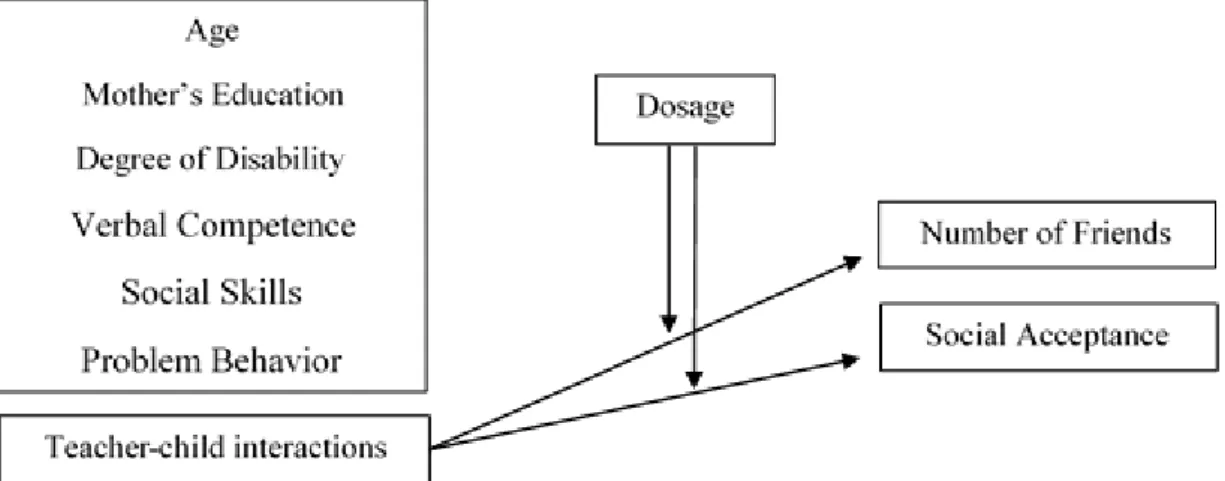
The second study focuses on teacher-child interactions (proximal processes), the exposure to these processes (i.e., dosage), and social outcomes of children with disabilities in preschool classrooms. It also focuses on children’s individual characteristics, namely verbal competence (e.g., Odom et al., 2006; Son et al., 2014) and socio-behavioral competence (e.g., Meyer & Ostrosky, 2016), as these competences have been previously identified as characteristics that influence the social outcomes of children with disabilities. More specifically, the second study examines (1) the associations between teacher-child interactions and children’s friendship and social acceptance, while testing moderator effects of dosage (see Figure 2a), and (2) the relationship between children’s verbal competence, social skills, and externalizing behaviors with children’s friendship and social acceptance, also testing moderator effects of dosage (see Figure 2b).
Figure 2a. Hypothesized relationships among variables in study 2: The associations between
teacher-child interactions and children’s friendships and social acceptance.
Based on the little available research and on Bronfenbrenner and Morris’s (2006) theoretical framework, it is expected that children who have spent more time with the lead teacher and have more days of attendance in classrooms with higher quality teacher-child interactions have more friends and are more socially accepted. In addition, we expect a positive effect of spending more time with the lead teacher and having higher attendance for children with less social skills and verbal competence and more problem behaviors.
Figure 2b. Hypothesized relationship among variables in study 2: The associations between
children’s competence and their friendships and social acceptance.
One of the most consistent findings on children’s social inclusion is the role of social skills and problem behaviors on their social experiences (e.g., Meyer & Ostrosky, 2016; Odom et al., 2006). High-quality teacher-child interactions have been positively related to the socio-behavioral competence of children without disabilities (e.g., Mashburn et al., 2008); however, we are unaware of such effects on children with disabilities. Therefore, our third study examines the associations between children’s degree of disability and their social skills and behavior problems, controlling for previous levels of social and behavioral outcomes, while testing the moderator effects of teacher-child interactions and dosage (see Figure 3).
Figure 3. Hypothesized relations among variables in study 3: The associations between
children’s degree of disability and their social skills and problem behaviors.
A positive moderating effect of both high-quality teacher-child interactions and ECEC dosage is expected for children with more severe disabilities, resulting in improvements in their social skills and problem behaviors over the school year.
References
Aguiar, C., Moiteiro, A. R., & Pimentel, J. S. (2010). Classroom quality and social acceptance of preschoolers with disabilities. Infants &Young Children, 23(1), 34-41. doi: 10.1097/IYC.0b013e3181c9766e
Aguiar, C., Pimentel, J., Moiteiro, A. R., Boavida, T., & Figueiredo, A. (2011, February). Qualidade em contextos pré-escolares inclusivos e experiências sociais de crianças com incapacidades. Paper included on thematic symposium “Qualidade em contexto pré-escolar”, and presented at the I Congresso Internacional de Psicologia do Desenvolvimento, Lisbon, Portugal.
Bronfenbrenner, U. (1994). Ecological models of human development. In T. Husen & T. N. Postlethwaite (Eds.), International Encyclopedia of Education (Vol. 3, 2nd Ed., pp. 1643-1647). Oxford: Elsevier.
Bronfenbrenner, U., & Evans, G. (2000). Developmental science in the 21th century:
Emerging questions, theoretical models, research design, and empirical findings. Social Development, 9(1), 115-125. doi: 10.1111/1467-9507.00114
Bronfenbrenner U., & Morris P. A. (2006). The bioecological model of human development. In W. Damon (Series Ed.) & R. M. Lerner (Vol. Ed.), Handbook of child psychology: Theoretical model of human development (pp. 793-828). New York, NY: John Wiley.
Burchinal, M., Howes, C., Pianta, R., Bryant, D., Early, D., Clifford, R., & Barbarin, O. (2008). Predicting child outcomes at the end of kindergarten from the quality of pre-kindergarten teacher–child interactions and instruction. Applied Developmental Science, 12(3), 140–153. Doi:10.1080/10888690802199418
Burchinal, M., Vandergrift, N., Pianta, R., & Mashburn, A. (2010). Threshold analysis of association between child care quality and child outcomes for low-income children in pre-kindergarten programs. Early Childhood Research Quarterly, 25(2), 166–176. doi: 10.1016/j.ecresq.2009.10.004
Buyse, E., Verschueren, K., Doumen, S., Damme, J. V., & Maes, F. (2008). Classroom problem behavior and teacher-child relationships in kindergarten: The moderating role of classroom climate. Journal of School Psychology, 46, 367–391. doi:10.1016/j.jsp.2007.06.009
Buysse, V. (1993). Friendship of preschoolers with disabilities in community-based child care settings. Journal of Early Intervention, 17 (4), 380-395. doi:10.1177/105381519301700404
Buysse, V., Goldman, B. D., & Skinner, M. L. (2002). Setting effects on friendship formation among young children with and without disabilities. Exceptional Children, 68(4), 503–517. doi:10.1177/001440290206800406
Cadima, J., Verschueren, K., Leal, T., & Guedes, C. (2015). Classroom interactions, dyadic teacher–child relationships, and self–regulation in socially disadvantaged young children. Journal of Abnormal Child Psychology, 44(1), 7-17. doi:10.1007/s10802-015-0060-5
Castro, S., Ferreira, T., Dababnah, S., & Pinto, A. I. (2013). Linking autism measures with the ICF-CY: Functionality beyond the borders of diagnosis and interrater agreement issues. Developmental Neurorehabilitation, 16(5), 321-331. doi:10.3109/17518423.2012.733438
Chamberlain, B., Kasari, C., & Rotheram-Fuller, E. (2007). Involvement or isolation? The social networks of children with autism in regular classrooms. Journal of Autism and Developmental Disorders, 37(2), 230–242. doi:10.1007/s10803-006-0164-4
Coie, J. D., Dodge, K. A., & Coppotelli, H. (1982). Dimensions and types of social status: A cross-age perspective. Developmental Psycology, 18(4), 557-570. doi:10.1037/0012-1649.18.4.557
Curby, T. W., LoCasale-Crouch, J., Konold, T. R., Pianta, R. C., Howes, C., Burchinal, … Barbarin, O. (2009). The relations of observed pre-K classroom quality profiles to children’s achievement and social competence. Early Education & Development, 20(2), 346-372. doi:10.1080/10409280802581284
DEC/NAEYC. (2009). Early childhood inclusion: A joint position statement of the Division for Early Childhood (DEC) and the National Association for the Education of Young Children (NAEYC). Chapel Hill: The University of North Carolina, FPG Child Development Institute. Retrieved from: http://www.naeyc.org/files/naeyc/file/positions/DEC_NAEYC_EC_updatedKS.pd f
Diamond, K., Hong, S.-Y., & Tu, H. (2008). Context influences preschool children’s decisions to include a peer with a physical disability in play. Exceptionality, 16(3), 141–155. doi:10.1080/09362830802198328
Dietrich, S. L. (2005). A look at friendships between preschool-aged children with and without disabilities in two inclusive classrooms. Journal of Early Childhood Research, 3(2), 193–215. doi:10.1177/1476718X05053933
Direção-Geral de Estatísticas da Educação e Ciência. (2016). Questionário das Necessidades Especiais de Educação: Ano letivo 2015/2016 [Questionnaire on Special Education Needs: School Year 2015/2016]. Retrieved from. http://www.dgeec.mec.pt/np4/224/%7B$clientServletPath%7D/?newsId=334&fil eName=DGEEC_DSEE_DEEBS_2016_NEE2.pdf
Downer, J., Sabol, T. J., & Hamre, B. (2010). Teacher-child interactions in the classroom: Toward a theory of within- and cross domain links to children’s development outcomes. Early Education and Development, 21(5), 699-723. doi:10.1080/10409289.2010.497453
Gamelas, A. M. (2003). Contributos para o estudo da qualidade de contextos pré-escolares inclusivos. Psicologia, XVII(1), 195-226
Goldman, B. D. (2007). What early educators and parents can do to support friendships in early childhood. The Magazine of the National Head Start Association - Children and Families, Spring/ Summer. Retrieved from: http://www.nectac.org/~pdfs/Meetings/InclusionMtg2007/Goldman_HeadStartcol orfinalII.pdf
Grisham-Brown, J., Cox, M., Gravil, M., & Missal, K. (2010). Differences in child care quality for children with and without disabilities. Early Education and Development 21(1), 21-37. Doi: 10.1080/10409280902783491
Guralnick, M. J., Gottman, J. M, & Hammond, M. A. (1996). Effects of social setting on the friendship formation of young children differing in developmental status. Journal of Applied Developmental Psychology, 17, 625-651. doi:10.1016/S0193-3973(96)90019-2
Hestenes, L. L., Cassidy, D. J., Shim, J., & Hegde, A. V. (2008). Quality in inclusive preschool classrooms. Early Education and Development, 19(4), 519-540. doi:10.1080/10409280802230973
Hollingsworth, H. L., & Buysse, V. (2009). Establishing friendships in early childhood inclusive settings: What roles do parents and teachers play? Journal of Early Intervention, 31(4), 287–307. doi:10.1177/1053815109352659
Howes, C. (2011). A model for studying socialization in early childhood education and care settings. In M. Kernan & E. Singer (Eds.), Peer relationships in early childhood education and care (pp. 15-26). Oxford: Routledge.
Jeon, H., Langill, C. C., Peterson, C. A. Luze, G. J., Carta, J. J., & Atwater, J. B. (2010). Children’s individual experiences in early care and education: Relations with overall classroom quality and children’s school readiness. Early Education and Development, 21(6), 912-939. doi:10.1080/10409280903292500
Johnson, S.R., Seidenfeld, A. M., Izard, C. M., & Kobak, R. (2013). Can classroom emotional support enhance prosocial development among children with depressed caregivers? Early Childhood Research Quarterly, 28(2), 282-290. doi:10.1016/j.ecresq.2012.07.003
Kasari, C. Locke, J., Gulsrud, A., & Rotheram-Fuller, E. (2011). Social network and friendships at school: Comparing children with and without ASD. Journal of Autism and Developmental Disorders, 41, 533-544. doi:10.1007/s10803-010-1076-x
Mashburn, A. J., Pianta, R. C., Hamre, B. K., Downer, J. T., Barbarin, O. A., Bryant, D., ... Howes, C. (2008). Measures of classroom quality in prekindergarten and children’s development of academic, language, and social skills. Child Development, 79(3), 732-749. doi:10.1111/j.1467-8624.2008.01154.x
Meyer, L. E. & Ostrosky, M. M. (2016). Impact of an affective intervention on friendship of kindergarteners with disabilities. Topics in Early Childhood Special Education, 35(4), 200-210. doi: 10.1177/0271121415571419
Meyer, L. E., & Ostrosky, M. M. (2014). Measuring the friendships of young children with disabilities: A review of the literature. Topics in Early Childhood Special Education, 34(3), 186-196. doi:10.1177/0271121413513038
Mikami, A. Y., Griggs, M. S., Reuland, M. M., & Gregory, A. (2012). Teacher practices as predictors of children’s classroom social preference. Journal of School Psychology, 50(1), 95–111. doi:10.1016/j.jsp.2011.08.002
Ochoa, S. H., & Olivarez, A. Jr. (1995). A meta-analysis of peer rating sociometric studies of pupils with learning disabilities. The Journal of Special Education, 29(1), 1-19. doi:10.1177/002246699502900101
Odom, S.L., Zercher, C., Li, S., Marquart, J.M., Sandall, S., & Brown, W.H. (2006). Social acceptance and rejection of preschool children with disabilities: A mixed-method analysis. Journal of Educational Psychology, 98(4), 807-823. doi:10.1037/0022-0663.98.4.807
Peceguina, I., Santos, A. J., & Daniel, J. R. (2008). A concordância entre medidas sociométricas e a estabilidade dos estatutos sociais em crianças de idade pré-escolar [Agreement among sociometric measures and the stability of social status in preschool-aged children]. Análise Psicológica, 26(3), 479-490
Pianta, R. C., Hamre, B. K., & Allen, J. P. (2012). Teacher-student relationships and engagement: Conceptualizing, measuring, and improving the capacity of classroom interactions. In S. L. Christenson, A. L. Reschly & C. Wylie (Eds.), Handbook of research on student engagement (pp. 365-386). New York, NY: Springer Science. doi:10.1007/978-1-4614-2018-7_17
Pianta, R.C., La Paro, K.M., & Hamre, B. K. (2008). Classroom Assessment Scoring System Manual: Pre- K. Baltimore: Brookes.
Rimm-Kaufman, S. E., Curby, T. W., Grimm, K. J., Nathanson, L., & Brock, L. L. (2009). The contribution of children’s self-regulation and classroom quality to children’ s adaptive behaviors in the kindergarten classroom. Developmental Psychology, 45(4), 958–972. doi:10.1037/a0015861
Rubin, K. H., Bukowski, W. M., & Parker, J. G. (2006). Peer interactions, relationships, and groups. In W. Damon (Series Ed.) & N. Eisenberg (Vol. Ed.), Handbook of child psychology: Vol. 3, Social, emotional and personality development (6th ed., pp. 571-645). New York, NY: Wiley.
Schaefer, D. R., Light, J. M., Fabes, R. A., Hanish, L. D., & Martin, C. L. (2010). Fundamental principles of network formation among preschool children. Social Networks, 32(1), 61–71. doi:10.1016/j.socnet.2009.04.003
Scott, J. (2009). Social network analysis: A handbook (2nd Ed.). London: Sage Publications.
Son, E., Peterson, N.A., Pottick, K. J., Zippay, A., Parish, S.L., & Lohrmann, S. (2014). Victimization among young children with disabilities: Early risk and protective factors. Exceptional Children, 80(3), 370-386. doi: 10.1177/0014402914522422 Vandell, D. L., Belsky, J., Burchinal, M., Steinberg, L., & Vandergrift, N. (2010). Do
effects of early child care extend to age 15 years? Results from the NICHD study of early child care and youth development. Child Development, 81(3), 737–56. doi:10.1111/j.14678624.2010.01431.x
Vandell, D. L., & Wolfe, B. (2000). Child care quality: Does it matter and does it need to be improved? (Full Report). Institute for Research on Poverty University of
Wisconsin–Madison. Retrieved from:
http://aspe.hhs.gov/hsp/ccquality00/ccqual.htm
Vaughn, B. E., Colvin, T. N., Azria, M. R., Caya, L., & Krzysik, L. (2001). Dyadic analyses of friendship in a sample of preschool-age children attending Head Start: Correspondence between measures and implications for social competence. Child Development, 72(3), 862-878. doi: 10.1111/1467-8624.00320
Wasserman, S. & Faust, K. (2009). Social network analysis: Methods and applications. Cambridge: Cambridge University Press.
Zaslow, M., Anderson, R., Redd, Z., Wessel, J., Tarullo, L. and Burchinal, M. (2010). Quality dosage, thresholds, and features in early childhood settings: A review of the literature, OPRE 2011-5. Washington, DC: Office of Planning, Research and Evaluation, Administration for Children and Families, U.S. Department of Health and Human Services.
CHAPTER II
Social Experiences of Children with Disabilities in Inclusive Portuguese Preschool Settings 1
________________________
1 Ferreira, M., Aguiar, C., Correia, N., Fialho, M., & Pimentel, J. S. (in press). Social
experiences of children with disabilities in Portuguese inclusive preschool settings. Journal of Early Intervention.
Abstract
Based on peer sociometric reports, we examined how number of friendships, social acceptance, and characteristics of social networks vary as a function of disability profile. We also investigated teachers’ awareness of the sociometric status of young children with disabilities. Participants were 86 children with disabilities (63 boys) enrolled in inclusive preschool classrooms from the Metropolitan Area of Lisbon, Portugal (Mage = 67.33 months, SD = 10.54). Findings suggest children with severe or
socio-behavioral disabilities may be at increased risk for social rejection and isolation, having fewer friends and lower social network centrality than children with mild disabilities. Low agreement between teachers’ classifications of the social status of children with disabilities and classifications based on peer nominations, raises concerns about their awareness of processes of social rejection and neglect. Findings highlight the need for interventions to support positive social experiences at the dyadic and group levels in Portuguese inclusive preschool classrooms.
Introduction
Early childhood inclusion aims to promote children’s positive social relationships, sense of belonging, and membership, ensuring that every child has opportunities to participate in a variety of activities and contexts, independently of their abilities (DEC/NAEYC, 2009). In inclusive preschool settings, children with and without disabilities have the opportunity to spend time together and interact with each other (Dietrich, 2005). However, children with disabilities seem to spend more time alone than their typically developed peers (Gamelas, 2003) and are more likely to be socially rejected (Odom et al., 2006).
Children’s social experiences with peers can be analyzed at different levels of social complexity, including interactions, relationships, and groups (Rubin, Bukowski, & Parker, 2006). Interactions are the most basic level and represent complementary and interdependent social exchanges between two individuals. Relationships refer to a set of interactions that take place within a dyad of individuals who are known to each other, can influence new interactions between the members of the dyad, and are characterized by emotions, expectations, and shared meanings, developed over time. Friendships constitute one particular type of relationship. Finally, the third, and more complex level, is the group, a network of relationships between individuals that influence each other. Typically, groups have specific norms, which characterize them, and properties such as hierarchical organization and cohesiveness (Rubin et al., 2006).
Previous evidence suggests children with disabilities struggle at all levels of peer social experiences. For example, according to Guralnick (1990), children with disabilities present difficulties in engaging in group play and perform specific social behaviors, do not use important social processes such as negotiation, have fewer friendships, and are less often chosen to play or to be a resource or a model for peers.
In this study, we will investigate the social experiences of Portuguese preschoolers with disabilities, in inclusive preschool classrooms, at two levels: relationships (i.e., friendships) and groups. In Portugal, the legal framework for special education is inclusion-oriented, ensuring that 99% of all children with disabilities are served in regular schools (87% in public schools), with only 13% of these not participating full time in their regular classroom (Direção-Geral de Estatísticas da Educação e Ciência, 2016). Recently, based on a representative sample, the
Inspeção-Geral de Educação e Ciência (2015) reported that about 20% of public Portuguese preschool classrooms include at least one child with disabilities. Moreover, the Portuguese preschool coverage rate is rather high, with 96.1%, 90.6%, and 76.9% of children aged 5, 4, and 3 years-old, respectively, enrolled in preschool settings (Direção-Geral de Estatísticas da Educação e Ciência, 2015).
Friendship
Friendships are dyadic, reciprocal, and voluntary relationships (e.g., Goldman, 2007; Rubin et al., 2006). Friends choose to stay with one another, play, express enjoyment and positive affect (e.g., Dietrich, 2005; Hollingsworth & Buysse, 2009). Children with disabilities who establish friendships are more likely to be socially interactive (Guralnick, Gottman, & Hammond, 1996), have less frequent solitary play and more playmates than children without friendships (Guralnick, Neville, Hammond, & Connor, 2007). Furthermore, Meyer and Ostrosky (2016) found evidence that having a close friendship may partially mediate the association between social competence and peer acceptance. Children with disabilities with friends also present better results in behavioral characteristics such as activity level, reactivity, goal-directedness, and responsiveness to adults (Buysse, 1993). In an inclusive setting, friends without disabilities can be an important resource for children with disabilities to develop social competence (Guralnick, 1990), because they tend to support and scaffold dyadic interactions (Guralnick, Connor, & Johnson, 2011).
Friendships of preschool children with and without disabilities seem to be similar (Dietrich, 2005; Hollingsworth & Buysse, 2009; Meyer & Ostrosky, 2014). However, in general, children with disabilities have less reciprocal relationships than peers without disabilities (Buysse, Goldman, & Skinner, 2002). The number of friends seems to be associated with type of diagnosis (Buysse, 1993) and developmental status (Guralnick et al., 1996). For example, research has shown children with language disabilities have more friends than children with developmental delay or cognitive disabilities (Buysse, 1993; Guralnick et al., 1996), and children with reciprocal friends seem to have higher developmental age than children without reciprocal friends (Buysse, 1993).
Studies with preschool-age children without disabilities found that young children form, essentially, same-gender friendship dyads (Vaughn, Colvin, Azria, Caya, & Krzysik, 2001). The same pattern has been found for children with ASD (Kasari et
al., 2011). However, despite the preponderance of boys with disabilities, in most cases their friends are girls (Guralnick et al., 2007). Conversely, Diamond, Hong, and Tu (2008) found it is more likely for a girl to choose a child with disabilities to play with. Therefore, boys may be at a disadvantage when compared to girls and consequently have an increased risk of social rejection. Further examination of the role of gender on the social experiences of children with disabilities is thus warranted.
Social Acceptance
Within a group, individual children can have different social experiences, which can be described in terms of social acceptance and rejection. Social acceptance and rejection quantify how much peers like or dislike a child (Rubin et al., 2006).
Social acceptance and rejection of young children with disabilities have been the subject of few studies (e.g., Odom et al., 2006). Despite the fact that young children in inclusive classrooms show high acceptance towards peers with disabilities (Diamond, 2001), about a quarter of young children with disabilities are rejected (Odom et al., 2006) and typically developing children’s identification of a peer as having a disability seems to be negatively associated to their associative/cooperative play (Yu, Ostrosky, & Fowler, 2015).
Children’s individual characteristics, such as type of disability, degree of disability, and age seem to be related to their social acceptance. For example, previous research suggests children with speech and language impairments or orthopedic impairments are more socially accepted by peers than children with intellectual disabilities and autism-pervasive developmental disorder (Odom et al., 2006). Furthermore, younger children and children with more severe disabilities seem to be more socially accepted (Aguiar, Moiteiro, & Pimentel, 2010). Research also suggests social acceptance is associated with social behavior such as interest in peers, social awareness, communication, and social skills. In contrast, social rejection appears associated with social withdrawal (related to internalizing behavior problems) and conflict-aggression (i.e., externalizing behavior problems) (Odom et al., 2006).
Sociometric Status
At the group level, children can also be classified into five social statuses - popular, rejected, neglected, average, and controversial (Coie, Dodge, & Coppotelli, 1982; Newcomb, Bukowski, & Pattee, 1993). Social status seems to be an important
predictor of children’s subsequent adaptation (Peceguina, Santos, & Daniel, 2008). However, previous research, based on evidence from peer reports, suggests children with disabilities have more disadvantaged sociometric statuses within their peer groups, when compared to their typically developing peers (Ochoa & Olivarez, 1995). Interestingly, to the best of our knowledge, there is no data on teachers’ awareness of the sociometric status of young children with disabilities in the peer group, which is likely necessary to identify and support children experiencing social rejection or neglect.
Social Networks
Still at the group level, social networks analysis provides information on the structure of the group and its influence on individuals (Wasserman & Faust, 2009). For example, one may identify cohesive subgroups such as cliques, constituted by at least three individuals with mutual ties (i.e., all “choosing” each other) (Scott, 2009; Wasserman & Faust, 2009) or determine the children’s centrality in the peer group based on network activity. Individuals with higher degree centrality have more connections, while individuals with lower degree centrality have fewer links to other individuals in the social network, taking peripheral positions in the group (Scott, 2009).
Very limited research has examined the characteristics of the social networks of preschool children with disabilities. The few available studies focus of specific types of disability, suggesting, for example, that older children with high-functioning Autism Spectrum Disorder (ASD) present low levels of social network centrality, take more peripheral positions in the social structure of the group (Chamberlain, Kasari, & Rotheram-Fuller, 2007), and have a smaller network (Kasari, Locke, Gulsrud, & Rotheram-Fuller, 2011) than their peers. Aguiar, Pimentel, Moiteiro, Boavida, and Figueiredo (2011) found evidence that children with physical disabilities are more involved in peer social networks than children with sociocognitive disabilities.
In conclusion, we now know enough to understand that children with disabilities struggle with the demands of being part of a friendship dyad and a group of children. Early childhood inclusion aims towards ensuring children’s positive social relationships, sense of belonging, and membership (DEC/NAEYC, 2009), addressing multiple levels of peer-related social experiences (i.e., individual, dyadic, and group). Consequently, it is important to further understand which individual characteristics place young children with disabilities at an increased risk of social rejection or