M
ERGERS AND
A
CQUISITIONS
:
The Case of Merck & Co and Schering-Plough Corporation
___________________________________________________
Nádia Teixeira
Advisor: Peter Tsvetkov
Dissertation submitted in partial fulfillment of requirements for the degree of MSc in Business Administration, at the Universidade Católica Portuguesa, September 2012
Abstract
The global pharmaceutical industry is characterized for being highly competitive and for having though market regulations. Therefore, companies whose seek to generate value and continue with a strategic position in the market, look for different and smart ways to achieve the objective. In this industry, Mergers and Acquisitions are very supported by practitioners and managers, since it enhance the productivity of the company and the shareholder value. Merck & Co., Inc and Schering-Plough Corporation are an example of the merger of two companies that brought and incorporated different capabilities in an efficient way, therefore taking advantage of new opportunities in the different segments of the pharmaceutical industry.
The goal of this dissertation is to do the historical financial analyze and estimate the enterprise value of both companies as if they were optimally managed; and assess the value of the merged entity and the synergies created. Last it is proposed an acquisition mode and optimal price for the deal to be accepted. Through the Literature Review it is presented explained the different valuation methods and M&A concepts and applications.
This work showed that Merck & Co., Inc and Schering-Plough Corporation were undervalued during 2008, and the merger will create value of both companies. The estimated synergies, approximately $ 84 billion, represent 26 percent of the merged entity enterprise value. The company’s share price, by the end of 2008 was 30.4 and 17.03, Merck and Schering-Plough, respectively. As a result of all the valuation factors, the premium offered to Schering-Plough was 30 percent over the company’s average market capitalization, financed 51% with equity and the remaining with debt and cash.
Table of Contents
Abstract ... II Table of Contents ... III List of Appendixes ... VII List of Tables ... V List of Figures ... V List of Abbreviations ... IX Acknowledgments ... X
1. Introduction ... 1
2. Industry and Company Analysis... 2
2.1. Overview of the Pharmaceutical Industry ... 2
2.2. Merck & Co ... 5
2.2.1. Prescription Pharmaceutical Segment ... 7
2.2.2. Vaccines and Infectious Diseases Segments ... 7
2.2.3. Costs, Expenses and Others ... 7
2.2.4. Capital Structure ... 8
2.3. Schering-Plough Corporation ... 9
2.3.1. Prescription Pharmaceuticals Segment ... 10
2.3.2. Animal Health Segment ... 10
2.3.3. Consumer Health Segment ... 11
2.1.1. Costs, Expenses and Others ... 11
2.1.2. Capital Structure ... 11
3. Literature Review ... 12
3.1. Valuation ... 12
3.1.1. Cash Flows ... 12
3.1.1.1. Types of Cash Flows ... 12
3.1.1.2. Terminal Value ... 13
3.1.1.3. Growth rate (GR) ... 13
3.1.2. Approaches to Valuation ... 14
3.1.2.1. Adjusted Present Value and Discounted Cash Flow Methodologies ... 14
3.1.2.1.1. Compressed Adjusted Present Value ... 15
3.1.2.2. The method of Comparables/Multiples ... 15
3.1.3. Discount Rates ... 16
3.1.3.1. Cost of Equity – CAPM... 17
3.1.3.2. Risk Free rate ... 17
3.1.3.2.1. Real and Nominal Risk Free ... 18
3.1.3.3. Beta ... 19
3.1.3.4. Risk Premium ... 20
3.1.4. Mergers and Acquisitions ... 21
3.1.4.2. Sources of Synergy ... 22
3.1.4.2.1. Valuing Synergies ... 23
3.1.4.3. M&A does pay? ... 23
3.1.4.4. Premium Metrics ... 25
3.1.4.5. The Era of Cross- Border on M&A ... 26
3.1.4.6. Skepticism of Investors ... 27
3.1.4.7. Misleading Arguments ... 27
4. Performance in the Stock Market ... 29
5. Valuation of Entities Independently ... 30
5.1. Performance Forecast ... 30
5.1.1. Merck ... 31
5.1.1.2. Costs ... 35 5.1.1.3. Capital Expenditures... 37 5.1.1.4. Depreciation ... 38 5.1.1.5. Working Capital ... 38 5.1.1.6. Financial leverage ... 40 5.2. Schering-Plough ... 43 5.2.1.1. Revenues ... 43 5.2.1.2. Costs ... 45
5.2.1.3. Capital Expenditures (Capex) ... 48
5.2.1.5. Working Capital ... 49
5.2.1.6. Financial Leverage ... 50
5.3. Relative Valuation ... 52
5.3.1. Merck ... 53
5.3.2. Schering-Plough ... 54
6. Valuation of the Merged Entity ... 55
6.1. Valuation of the merged entity without Synergies ... 55
6.1.1. Revenues and Costs ... 55
6.2. Valuation of the merged entity with synergies ... 56
6.2.1. Synergies ... 57
6.2.2. Operating Synergies ... 57
6.2.4. Merger Restructuring Costs ... 60
6.2.5. Account Synergies ... 62
6.2.5.1. Value of Synergies ... 62
6.2.5.2. Distribution of Synergy ... 64
7. The Acquisition ... 65
7.1. Approaching Shareholders ... 65
7.1.1. Premium offered to Schering-Plough shareholders ... 66
7.2. Payment Method ... 66
8. Conclusion ... 69
9. Appendixes ... 70
List of Figures
FIGURE 1:TOP 15 COUNTRIES ACCORDING TO HEALTHCARE SPENDING IN 2008 AS A % OF GDP ... 2
FIGURE 2:PHARMACEUTICAL MARKET SEGMENTATION ... 3
FIGURE 3:BREAKDOWN OF THE WORLD –PHARMACEUTICAL MARKET –2007SALES ... 3
FIGURE 4:NEW CHEMICAL OR BIOLOGICAL ENTITIES (1988–2007) ... 4
FIGURE 5:TOP 10GLOBAL CORPORATION... 5
FIGURE 6:MERCK PERFORMANCE ..……….………6
FIGURE 7:SEGMENTS REVENUE PERFORMANCE ... 6
FIGURE 8:SCHERING-PLOUGH PERFORMANCE...……….10
FIGURE 9:SEGMENTS REVENUE FORECAST ... 10
List of Tables
TABLE 1:RANKING OF INDUSTRY SECTORS BY AGGREGATE R&D FROM THE WORLD TOP 1,400 COMPANIES IN THE
2007EUSCORECARD –2006 ... 4
TABLE 2:COSTS,EXPENSES AND OTHERS ... 8
TABLE 3:IMSHEALTH PHARMACEUTICAL MARKET GROWTH PROGNOSIS ... 32
TABLE 4:RESPIRATORY JOINT-VENTURE ... 36
TABLE 5:PERCENTAGE OF DEPRECIATION OVER NET ASSETS FROM 2004 TO 2008 ... 38
TABLE 6:WORKING CAPITAL ... 39
TABLE 7:PERCENTAGE OF DEPRECIATION OVER NET ASSETS FROM 2004 TO 2008 ... 49
TABLE 8:WORKING CAPITAL ... 49
TABLE 9:PEER GROUP DATA ... 52
TABLE 10:MERCK RELATIVE VALUATION RESULTS ... 53
TABLE 11:SCHERING-PLOUGH RELATIVE VALUATION RESULTS ... 54
TABLE 12:SYNERGIES VALUE OF THE MERGED ENTITY ... 63
TABLE 13:MERGED ENTITY RESTRUCTURING COSTS ... 63
TABLE 14:MERGED ENTITY DEBT CAPACITY ... 67
List of Appendixes
Appendix 1: Global Pharmaceutical Market by Region (Total Unaudited and Audited Companies) ……70
Appendix 2: Total Market Composition, June 2007 ………... 70
Appendix 3: Distribution Margins and VAT rates ………...………. 70
Appendix 4: R&D ………...………... 71
Appendix 5: Merck Corporation ………...………. 73
Appendix 5.1: Merck Research Pipeline in February 2009 ………...………… 73
Appendix 5.2: Product Sales Performance ………..……….. 73
Appendix 5.3: Capital Structure ………..…….. 74
Appendix 6: Schering-Plough Corporation ………..……. 74
Appendix 6.1: Organon BioSciences N.V. …...……….………..….. 74
Appendix 6.2: Capital Structure ………..…. 74
Appendix 7: Market Indices (Market Evolution) ……….………... 74
Appendix 8: Company Evolution – Company’s Market Share ………...……….. 76
Appendix 9: Merck Income Statement ………...………... 77
Appendix 10: Costs disaggregated (Historical information) ……..………..………. 78
Appendix 11: Supplemental data …….………...………... 78
Appendix 12: Treasury Yield Curve Rates ………...……….… 79
Appendix 13: Levered and Unlevered Betas ………...………. 79
Appendix 14: Country Risk Premium ………...……… 79
Appendix 15: Long-term debt of Merck at December 31..………. 80
Appendix 16: Cost of debt, Interest Coverage ratio and Default spread ………..………... 80
Appendix 17: Merck Market Value from 2005 to 2008 ………...……….… 80
Appendix 18: Merck Balance Sheet ………...………….... 81
Appendix 19: Base- Case Value ..………..………… 82
Appendix 20: Schering – Plough segments weight ………..……… 83
Appendix 21: Sales of foreign countries with ≥ 5% consolidated net sales ……….. 83
Appendix 22: Schering-Plough Income Statement ………..…..… 84
Appendix 24: Supplement data ...………...… 85
Appendix 25: Estimated Parameters (Re, Rd, β and Rp) ………... 86
Appendix 26: Schering-Plough Market Value from 2005 to 2008 ………...…. 86
Appendix 27: Schering-Plough Balance Sheet ………...… 87
Appendix 28: Base-Case Value of Schering-Plough …..………...… 88
Appendix 29: Income Statement of the merged entity without synergies ……….…… 89
Appendix 30: Balance Sheet of the merged entity without synergies ………... 90
Appendix 31: Base-Case of the merged entity without synergies ...……….. 91
Appendix 32: Merged company sales by areas ...………..……... 92
Appendix 33: Long-term debt increase ...………..……. 92
Appendix 34: Synergies Value and Restructuring Cost of the merged entity ………...… 92
Appendix 35: Upside Potential of Schering-Plough ...……….………..…… 92
Appendix 36: Merck debt financing to purchase Schering-Plough ...………...……….….... 93
Appendix 37: The three sources of finance ………..………. 93
Appendix 38: Income Statement of the merged entity with synergies ………..……….. 93
Appendix 39: Balance Sheet of the merged entity with synergies ...………..……...…….... 94
List of Abbreviations/Acronyms
APV Adjusted Present Value
BE Book Equity
CAPEX Capital Expenditure
CAPM Capital Asset Pricing Model CCC Cash Conversion Cycle
CF Cash Flow
CFs Cash Flows
CFD Cost of financial distress
DCF Discounted Cash Flow
EBITDA Earnings before Interest Taxes Depreciation and Amortizations FCFE Free Cash Flow to the Equity
FCFF Free Cash Flow to the Firm
FDA Food and Drug Administration Organization
FV Firm Value
GDP Gross Domestic Product
GR Growth Rate
HLT Highly leverage transactions M&A Mergers and Acquisitions
ME Market Equity
NDA New Drug Applications
PBV Price-book Value
PE Price-earnings ratio
PS Price-Sales ratio
PwC PriceWaterHouseCoopers
ROIC Return on invested Capital OBS Organon BioSciences N.V.
TC Tax Rate
TIPs Inflation-indexed Treasury Securities
VAT Value added tax
VU Value of Unlevered Firm
VTS Value of Tax Shields
WACC Weighted average cost of capital
Acknowledgments
I would like to express my deep gratitude to my dissertation advisor, Professor Peter Tsvetkov, for the support through this long process, for being always available and giving continuous feedback. I would also like to thank my family, specially my mother and father for giving support during all my life, backing my choices, and most important during this period of work, providing me with words of encouragement whenever it was needed.
Finally, I want to thank my “mentor”, my uncle Alexandre Tavares, whose I am very grateful for teaching me about the pharmaceutical industry and for the guidance provided during all the process of writing the dissertation; and specially now for the advices and help making the best decisions in my professional life.
1. Introduction
The emphasis of this master thesis is on Mergers and Acquisitions (M&A). The objective of the thesis is to evaluate the merger of two companies and give reasonable reasons for their consolidation. The thesis focuses on the real case of merger of two biopharmaceutical companies, Merck & Co., Inc and Schering-Plough Corporation in 2008. Since the merger occurred in 2008 it will be analyzed as the present time began in the end of 2008, time when both companies expressed a desire to merge, therefore all financial and market information will be from the same year.
The pharmaceutical industry is characterized for having innumerous opportunities that can be captured when two pharmaceutical companies merge, since the different companies can combine different capabilities that leverage their competitive advantage. Hereby, in this thesis one will demonstrate the opportunities that Merck & Co., Inc and Schering-Plough Corporation will gain with the merger.
The thesis will initiate with the industry and company analysis of Merck & Co., Inc and Schering-Plough Corporation. This framework in the pharmaceutical industry will provide information of how the industry works and their segments. The company analysis section will present Merck & Co., Inc and Schering-Plough Corporation, sales performance and main costs that affect their operations.
The thesis will have a literature review chapter to present the various valuations models and the proper model to value these companies. The literature review will also focus on M&A, crucial notions that are important to understand and proceed with the consolidation of two companies.
Proceeding there will be a chapter dedicated to the performance in the stock market of Merck and Schering-Plough in order to compare both companies share price.
The performance forecast will be separated in different chapters, where there will be the standalone valuation forecast for Merck and Schering-Plough, in this chapter it is applied expectations for both companies. Hereafter, the merger of the companies; the valuation will be done with the same valuation method. In the merger it will be stretched the opportunities that the merged entity will have and applied in the valuation.
2.
Industry and Company Analysis
2.1. Overview of the Pharmaceutical Industry
The pharmaceutical market is worth 781 US$ billion1 corresponding to a GDP expenditure2 global average of 6 percent (Figure 1) and it is represented by two general product segments (Figure 2). The pharmaceutical industry is considered high technology sector with the greatest value added per person employed. It also represents the highest global business R&D investments to net sales and the highest total world manufacturing value added3. The average growth rate of the industry in the past 5 years (2003 to 2008) is 6.6 percent, having in 2002 to 2003 the highest growth rate of 9.1 percent4.
Figure 1: Top 15 countries according to healthcare spending in 2008 as a % of GDP
As mentioned previously the market is divided in two general segments, originally protected and never protected segment. The originally protected segment is formed by pharmaceutical and biotechnological companies. The last segment, never protected, is formed by generic companies and pharmaceutical companies that produce health care products.
Pharmaceutical and Biotechnological companies develop, produce and market medicines; due to the long years (10 to 12 years) it takes to develop and market a new medicines these are legally protected with a patent. The difference between the two types of companies is that biopharmaceutical companies focus their work on finding medicines working with human molecules, instead of chemical molecules. This area of the pharmaceutical industry is considered the new challenge of the business since patients interact in the studies and it will be possible to create personalized medicines. The United States market has approximately 75 percent of the global revenues and R&D expenditure.
1“Total Unaudited and audited Global Pharmaceutical market in 2008”, IMS Health Market Prognosis, March 2010 2
Sheppard, A. (2010) “Generic Medicines: Essential contributors to the long-term health of society”, Sector Sustainability Challenges in Europe, IMS Health
3
EPFIA (2008) “The Pharmaceutical Industry in Figures”
4
Figure 2: Pharmaceutical Market Segmentation
Generic companies, as the name already says sell generics. Generics is the term used to define the drug segment that is similar to a branded medicines in terms of effectiveness and quality features, dosage to be taken, route of administration and strength, this segment can only be commercialized when the intellectual property protection of originally branded drugs achieves to its end. This segment is the fastest growing segment and it has been gaining strength among the markets, as governments increase their efforts to reduce health expenditure. In volume terms, generics raised 46 percent in the key markets during five years (2002-2007), but in value terms it grew 2 percent, from 12 to 14 percent (during the period of 2002 to 2006), in the global pharmaceutical market (Appendix 2).
By 2007, the greatest market in the world is represented by North American market (USA& Canada) with 45.9 percent market share and it is worth $311.8 billion in sales, followed by Europe and Japan (Figure 3). Although the greatest market, the European market outpaced the US market in terms of growth rate, 7.1 percent and 4.4 percent, respectively, but the fastest growing market is the Asian market with 15 percent growth rate. According to the statistics of IMS Health, it is expected that, between 2008 and 2013, US market might enter in a small recession [(1) to 2 percent], and the remaining markets will continue to grow (Appendix 1).
The pharmaceutical industry is a highly regulated industry and an industry where other players besides the manufacture play a big role.
Figure 3: Breakdown of the world – Pharmaceutical Market – 2007 Sales Source: IMS Health, February 2008 (data relate to the 2007 audited market at ex-factory prices)
Distribution margins, in one of the examples where it is possible to see how many players influence the final price of medicines (Appendix 3). Normally, distribution margins are fixed by governments (mainly in European countries), and approximately 35 percent of retail price reverts to governments and distributors (pharmacists and wholesales). VAT rates are not standardized within countries, according to EU Member States requirement, it must be at least 15 percent, but it varies from country to country.
Pharmaceutical Development Cost are very high due to great length and riskiness that involves the process of research and development of medicines, 10 to 12 years (Appendix 4), approximately, and the improvement of societies and patients that are requiring more complex and suitable medicines (Table 1). In 2007, it was estimated an average cost of spending for a new medicine, biological or chemical, of $1.318 million. The high cost of R&D demonstrates the high necessity for investments in pharmaceutical companies, which tend to be sponsored by their own financial capacities.
Table 1: Ranking of Industry Sectors by aggregate R&D from the world top 1,400 companies in the 2007 EU Scorecard – 2006
Source: EPFIA; The Pharmaceutical Industry in Figures (2008)
The European pharmaceutical companies have been for a long time the main region where new medicines were invented, reaching during five years (1960 – 1965) a pick of 65% share of the market. But since 2003, United States pharmaceutical companies surpassed EU firms, being the
leading market in inventing new molecules (Figure 4).
Figure 4: New Chemical or Biological Entities (1988 – 2007) S ector
(according to the ICB)
R&D investment (€ million) S hare in R&D investment (%) R&D/S ales ratio (%)
Pharmaceutical & Biotechnology 70.523,5 19.3 15.9 Technology hardware & Equipment 64.351,5 17.6 8.6 Automobiles & parts 60.807,1 16.6 4.2 Electronic & electrical Equipment 27.138,9 7.4 4.4 Software and computer services 26.522,8 4.7 3.1
Chemicals 17.186,0 4.7 3.1
Aerospace & Defence 15.991,3 4.4 4.8
Leisure goods 14.208,6 3.9 6.5
Industrial engineering 9.319,3 2.5 2.7
General industrials 8.867,6 2.4 2.1
Fixed line telecommunications 7.283,1 2.0 1.6 Health care equipment & services 6.446,1 1.8 6.8 Oil & gas producers 4.923,7 .13 0.3
Food producers 3.918,5 1.1 2.2
Household goods 3.911,9 1.1 1.6
Others (22 sectors) 24.243,9 6.6 0.9
2.2. Merck & Co
Merck operates in the pharmaceutical industry, focused on research and development of pharmaceutical products. The Merck family entered in the
pharmaceutical business in 1668 through a pharmacy and the persistency in discovering and developing medicines has maintained the company operations
until the present day5.
According to IMS Health data in 2008, Merck Corporation ranked in eight in the top 15 Global
Pharmaceutical Corporations (Figure 5).
Figure 5: Top 10 Global Corporation
The company separates its business into two product basis operations, Pharmaceutical segment and the Vaccines and Infectious Diseases segment, reporting results in this matter. Pharmaceutical products are human health pharmaceutical products used in therapeutics and for prevention of human disorders. Vaccines and Infectious Diseases products include products related to both, vaccines for human health, such as preventive pediatric, adolescent and adult vaccines that have to be administrated by medical professionals; and infectious diseases medicines.
Operating results of the Company have been increasing during the years enhancing Merck’s’ presence in the market (Figure 6 and 7). Although the positive performance in 2008, the company faced a decline of 1% on its revenue compared to 2007 due to sales decline of two of its products, Fosamax6 and Zocor7, which lost exclusivity (patents) in 2008 and 2006, respectively. The decline in the current year was not greater due to increase of sales of three products, Januvia, Janumet and Insentress8. Merck performed better in markets outside the United States, having an enlargement of 10 percent in sales, while in the domestic market sales decreased 9 percent, compared to 2007.
5 Information taken in the Portuguese Merck official website, on November 29th,
http://www.msd.pt/content/corporate/about/pt_historia.html
6
Fosamax is used for the treatment and prevention of osteoporosis. Fosamax and Fosamax Plus D lost their patent in the United States in February 2008 and April 2008, respectively.
7
Zocor, used to modify cholesterol, lost exclusivity to the United States Market in 2006.
8
Januvia and Janumet are medicines used for the treatment of diabetes type 2. Isentress is an antiretroviral therapy for the treatment of HIV infection
Figure 6: Merck Performance Figure 7: Segments Revenue Performance
The main focus of the company is on innovation and customer value, facing the challenges of the market, in this way the company has the ability to continue to grow and prepare itself for future trends. Merck develops its business with internal and external R&D programs; the objective is to optimize its portfolio by focusing only on the company core competencies, outsourcing its non-core competencies and investing in opportunities such as Merck BioVentures9, growing emerging markets, like China, and business development.
In the same year, Merck announced a global restructuring program which aimes to the enhance competitiveness, cost reduction and efficiency enlargement. The guidelines of the project go through extensive use of outside technology, in order the company to focus only on its core competencies, as previously mentioned, centralize marketing and sales operations, reinforce and streamline operations. “The company expected to eliminate 6,800 employees and 400 vacancies, 40 percent being in the United States, by the end of 2011. The program would yield a pretax cost of $1.8 to $2.0 billion by 2011, in return from 2008 to 2013 the company expected to have pretax savings of $3.8 to $4.2 billion dollars”10
.
In the beginning of 2008, the company had nine products in Phase III clinical development and it was anticipating to submit three New Drug Applications (“NDA”) with the U.S. Food and drug Administration (“FDA”) in 2009 (Appendix 5.1).
9
New division of the company that focused on an unique technology platform for follow-on and novel biologics
10
2.2.1. Prescription Pharmaceutical Segment
Prescription Pharmaceutical products are sold through prescriptions and the company sells them to drug wholesalers and retailers, hospitals, government agencies and managed health care providers (pharmacy benefit managers, health maintenance providers and other institutions).
Sales of this segment had a decline of 1% in 2008 and 2007 due to the end of exclusivity of the products previously mention. Part of the decline felt in the pharmaceutical segment was offset by an increase of sales of Januvia, Janumet, Singulair11 and Cozaar/Vaseretic. Singulair was one of the medicines with a higher growth rate of 19% in the segment, in 2007; this rose was due to increase of volume sales in Europe and Japan. Januvia was also an important medicine in the company portfolio since it started with sales in 2006 of $42.9 million, $667.5 million in 2007 to $1.4 billion in 2008. (Appendix 5.2)
2.2.2. Vaccines and Infectious Diseases Segments
Vaccines and infectious diseases products cannot be sold directly to the public by retailers due to the fact that they have to be administrated by professionals; therefore this segment has different distribution networks then the Pharmaceutical products. Vaccines distribution network are physicians, wholesalers, physician distributors and government entities. Infectious Diseases products are distributed to wholesalers and retailers, hospitals and governments agencies.
In 2007, sales of this segment grew 48 percent 12 driven by strong performance of four products, Gardasil, Varivax, Rotateq and Zostax. Contrary to 2007, a small decline from $4.3 billion to $4.2 billion was experienced in 2008 and the main factor was the Gardasil and Varivax reduction of sales.
2.2.3. Costs, Expenses and Others
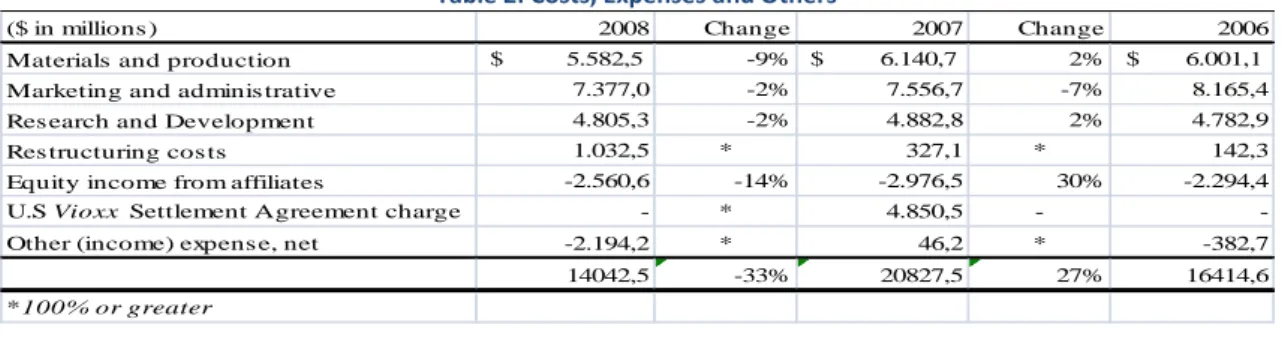
Merck reduced its cost by 33% in 2008 in comparison with 2007. This reduction was influenced by the 2008 restructuring program implemented in the company and it had different effects in different areas of the company. The higher decrease was seen in Materials and Production costs and Equity Income from affiliates, with (9) and -14 percent, respectively (Table 2).
11
Medicine for astham and seasonal and perennial allergic rhinitis treatment.
12
Table 2: Costs, Expenses and Others
Materials and Production costs were reduced to align with the reduction of costs of the restructuring program. Respectively to the restructuring program $132.2 million were costs related to material and production, where $88.7 million were associated with the closure of facilities and $34.5 million of asset write-offs and others. The Company gross margin was 76.6 percent compared to 74.6 percent in 2008 and 2007, respectively. Changes in the product mix in 2008, decline of Fosamax sales, influenced the gross margin.
Marketing and administrative expenses and research and development (R&D) had each a decline in costs of 2 percent in 2008. The cost reduced in marketing and administrative were the reduction of future legal defense costs and reduction of the cost base, like sales force. R&D reduction costs reflect closure of facilities, associated with the restructuring program.
The reduction in Equity Income from Affiliates reflects a decrease in partnerships, more specifically some partnership with Schering-Plough Corporation and reduction in returns of other partnerships.
2.2.4. Capital Structure
From 2004 to 2008, Merck presents a slightly stable capital structure. During the 5 historical years (2004 to 2008) the debt to capital varied from 59 to 62 percent. The company does not provide information about their choices and reasons for the different sources of finance, therefore one cannot provide further comments about the capital structure (Appendix 5.3).
($ in millions ) 2008 Change 2007 Change 2006
Materials and production $ 5.582,5 -9% $ 6.140,7 2% $ 6.001,1
Marketing and adminis trative 7.377,0 -2% 7.556,7 -7% 8.165,4
Res earch and Development 4.805,3 -2% 4.882,8 2% 4.782,9
Res tructuring cos ts 1.032,5 * 327,1 * 142,3
Equity income from affiliates -2.560,6 -14% -2.976,5 30% -2.294,4
U.S Vioxx Settlement Agreement charge - * 4.850,5 -
-Other (income) expens e, net -2.194,2 * 46,2 * -382,7
14042,5 -33% 20827,5 27% 16414,6
2.3. Schering-Plough Corporation
Schering AG was created in 1851 by Ernst Christian F. Schering in Germany and Plough was a Memphis company formed in 1908 by Abe Plough. In 1971, the companies merged originating Schering-Plough Corporation, becoming a United States based company.
The company is an “innovation-driven science-centered global health care company”, which focus its operations in three customer segments, such as prescription, consumer health care and animal health. Although Schering-Plough is presence in all the stages of product development, discovering, developing and manufacturing pharmaceutical products, it also tried to have external programs to enhance innovation through partnering, in-licensing and acquisition. Its main R&D activities were focused in the prescription segment, but it also had crucial applications for the other two segments.
By 2003, with the new management the company strategy was to focus on creating undiscovered therapies and treatments for medical needs and that have commercial value, therefore investing significant funds in scientific research, a six-to-eight year strategic plan denominated by Action Agenda. The goal of this plan was to build strategic and long-term value for shareholders and patients that depend upon the company’s medicines. This corresponds to growing sales, control costs and investments in R&D as mention previously.
According to IMS Health data in 2005, the company accounted for 1.4 percent market share of the United States market, being the seventeenth biggest pharmaceutical company in the world.
In 2008, Schering-Plough net sales were $18.billion, having an increase of 46 percent compared to 2007. According to annual report of the company this increase was generated by greater sales of pharmaceutical products such as Nasonex, Remicade and Temodar, as well as greater sales by the Animal Health segment and the Organon BioSciences N.V.13 (OBS) products. Some products, such as Vytorin and Zetia, had a decreased of 11 percent of global net sales. Net sales outside the domestic market accounted for 70 percent of consolidated net sales. (Appendix 6.1)
13
Figure 8: Schering-Plough Performance Figure 9: Segments Revenue Forecast
2.3.1. Prescription Pharmaceuticals Segment
Prescription Pharmaceutical products are medicines created for therapeutic treatments that need to be prescribed by a profession to be used. Sales of this segment increased from $10.773 to $14.253 million, corresponding to an enhanced of 40 percent in 2008 compared to 2007. In 2007, the segment had also an increase of 19 percent in sales.
Organon, the human health business of OBS, bought in late 2007, has been one of the main contributors to the sales increase, totalizing in 2008 and 2007 an amount of $3.5 billion and $409 million, respectively. Remicade14 grew 28 and 33 percent in 2008 and 2007, contributed by a favorable impact from foreign exchange, higher market growth and penetration in certain markets.
Greater drop in sales was seen by Rebetol15 with (6) and (11) percent in 2008 and 2007, respectively, due to sales reduction in Japan and the increase of generics competition.
2.3.2. Animal Health Segment
Animal health products are medicines used for animal therapeutic treatments. In terms of percentage it was the segment with higher growth rate from 2007 to 2008, 138 percent, this great increase was driven by the acquisition of OBS, contribution of $1.9 billion in sales, since this company has a high focus on the animal health segment treatments. Global sales grew in a solid way in all geographic areas the company was present but it also enlarged the competition, the later was driven mainly by generics.
14
Drug administrated for the treatment of immune-mediated inflammatory disorders like rheumatoid.
15
2.3.3. Consumer Health Segment
Having only three product lines in this segment, this also had an increase of 1 percent ($10 million) in 2008, compared to the previous year. MiraLAX, launched in 2007, was the main contributor to sales increase in the segment, being offset by a decrease of 12 percent OTC Claritin16 sales. Contrary to 2008, in 2007 the segment had an increase of 13 percent compared to the previous year which the main contribution was given by OTC Claritin, with an increase of 18 percent in sales.
The consumer health care segment is a very competitive segment that requires constant introductions of new and innovative products in the market and strong advertisings to costumers.
2.1.1. Costs, Expenses and Others
Schering-Plough gross margin was 65.3 percent in 2007 and 60.5 percent in 2008. The reduction in gross margin in 2008 and 2007 compared to 2006 was due to the impact of $1.4 from purchase accounting adjustments included in costs of sales derived by the amortization of fair values of inventories billion and $326 million from intangible assets acquired with OBS transaction.
R&D and selling, general and administrative expenses (SG&A) suffered an increase of 20.6 percent and 24.8 percent in 2008 and 2007 mainly due to OBS acquisition. Expenses in SG&A rose due to OBS acquisition, ongoing investments in emerging markets, greater promotion spending and unfavorable impact of foreign exchange. R&D expenses were not only influenced by OBS acquisition but also by the increase of clinical trials and related activities and investments in R&D that enhance and expand the company pipeline.
2.1.2. Capital Structure
From 2004 to 2008, Schering-Plough does not present a stable capital structure. From 2004 to 2006 the debt to capital ratio was 52 percent, approximately, but in 2007 and 2008 the ratio increased to 64 and 63, respectively. The company states in its 2008 10-K report that it must maintain a debt to capital ratio of 65 percent in 2009 and 60 percent thereafter (Appendix 6.2).
Having into account the different characteristics of the industry, Merck & Co., Inc and Schering-Plough Corporation, one will chose the most appropriate method to value the two companies.
16
3.
Literature Review
Through the Literature Review it is going to be explained different valuation methods and the mergers and acquisitions (M&A) concept and methodology.
Regardless of the companies that are going to be valued it is crucial to bear in mind that the value of a project is the sum of future cash flows expected discounted by a proper discount rate.
To valuate these companies we have to evaluate the different methodologies and find the most suitable for the companies that are being valued. The method of Discounted Cash Flows, the Adjusted Present Value and the method of Comparables are going to be the three main methodologies discussed through this Literature Review.
3.1. Valuation
“There are those who are disingenuous enough to argue that value is in the eye of the beholder, and that any price can be justified if there are other investors willing to pay that price. Perceptions need to be backed up by reality, which implies that is the paid for any asset should reflect the cash flows it is expected to generate.”17
(Damodaran, 2002)
This sentence stretches the importance of valuing companies according to cash flows they generate. 3.1.1. Cash Flows
Damodaran (2002) presents the value of an asset as its capacity to generate cash flows. To value cash flows (CFs) it is crucial that CFs is valued prior to taxes, debt payments and reinvestment needs. When valuing equity, Cash flows to equity must be without debt payments.
3.1.1.1. Types of Cash Flows
As it seen so far, there are different cash flows depending on the valuation that is being chosen to estimate the company value, different CFs have to be computed.
Dividends are the only CFs that is received when an investor buys a stake of a company publically. The model to evaluate equity is named as dividend discount model, which the value of the stock is the present value of the dividend payment.
17
Damodaran, A. (2002), Investment Valuation, Tool and Techniques for Determining the Value of Any Asset, University Edition, Second Edition, John Wiley & Sons, Inc., New York
Free Cash Flow to the Firm (FCFF) is the group of all cash flows that are generated by the firm operations. All claim holders cash flows must be included and those are stockholders, bondholders and preferred stockholders.
Free Cash Flow to Equity (FCFE) is defined as the remaining cash flow after paying debt obligations, capital expenditure, tax issues and working capital.
3.1.1.2. Terminal Value
According to Damodaran (2002) firms “do not last forever” and it is necessary to establish a moment in the future to estimate its liquidation value. In assessing the terminal value it is imposed a closure in the Discounted Cash Flow Valuation (methodology that will be explained in the next section). Assuming a constant nominal rate in perpetuity, Kaplan et al. (1996) reinforces that depreciation and amortization must be seen as means of comparison with CAPEX, and CAPEX should be as high as those two costs.
3.1.1.3. Growth rate (GR)
According to Damodaran (2002), when estimating growth rate (GR) it is important to have into account, the historical performance of the company, since the past information can be valuable information to the estimation of growth. The growth rate can be calculated simply by doing the product of reinvestment rate (2.1) and the return on capital (2.2).
(2.1) (2.2)
Reinvestment rate accounts for how much a firm is going to generate future growth. Although not the most accurate estimation it is used the most recent financial statements of the company to forecast18. Damodaran (2005) states that the higher reinvestment rate will increase the growth rate. The return on invested capital (ROIC) is based upon the firm’s operating incomes on existing investments divided by the total capital (Damodaran, 2005). By the formula, it is clear that the growth and reinvestment rate are linked, estimating one will influence the estimation of the other, so in order to grow at greater rate it is necessary to reinvest intensively (Damodaran, 2002). Growth is also directly related with ROIC, the quality of the investment will be reflected in the growth of the company.
18
3.1.2. Approaches to Valuation
3.1.2.1. Adjusted Present Value and Discounted Cash Flow Methodologies
Considered for a long time one of the best methods to value assets (for instance a factory, business, product line or market position) was the Discounted Cash Flow (DCF) methodology (Luehrman, 1997) The DCF methodology values any asset as the expected future cash flows (CFs) of a project. But to find the present value of the CF, it is necessary to discount them at a proper discount rate. The discount rate will be related with the riskiness of the estimated cash flows, with higher rates for riskier assets and lower rates for safer projects.19
The DCF approach with the Weighted Average Cost of Capital (WACC) (2.3), it’s used to obtain the firm value by discounting the FCFF with the WACC rate, which is the cost of the different components of financing used by the firm, weighted by their market value proportion. (Damodaran, 2002)
(2.3)
The value of the firm can also be derived by valuing the different pieces of the firm separately. This approach is called Adjusted Present Value (APV), where the firm value is the sum of two pieces. The first piece is the value of the firm as unlevered firm (2.4), all-equity financed; and the second piece is the value added by a firm’s choice of capital structure, in order words the financing side (2.5), which comes in the form of interest tax shield (Kaplan, S et al., 1996). The valuation must contain the tax shields valuation since the company pays taxes and interests, so it is crucial to taken into consideration.
∑
(2.4)
Interest tax shields will reduce taxable income by the amount of the interest and consequently the tax bill by the amount of interest times the tax rate. As with the all-equity financed part the tax shields must be discounted at an “appropriate rate” to reflect its risk (Luehrman, 1997). The common discount rate is the cost of debt since tax shields are as uncertain as principal and interest payments. The author also states that in the terminal horizon, indebtedness will grow as the company grows so the growth rate will be the same as the one applied in the equity side.
∑ (2.5) 19
Damodaran, Aswath, Investment Valuation, Tools and Techniques for Determining the Value of Any Asset; University Edition, Second Edition, 2002
The cost of financial distress (CFD) (2.6) is a way to adjust the company’s value to the likelihood of the company to enter in hazard, being unable to deliver its terminal value or simply the forecasted cash flows. According to Damodaran (2002) the present value of the distress is multiplied by the probability of distress. In the pharmaceutical industry, it is assumed 27% of losses in case of distress, according to Korteweg (2007) research paper for the health industry.
(2.6)
According to Copeland et al. (2000) and Damodaran (2002), the value of the company (2.7) is the sum of the different components described previously.
(2.7)
Although a good method when it was discovered, currently the WACC approach is considered obsolete by many researches. To substitute the WACC it is presented the APV, whereas many researches support the usage of the later due to its versatility, reliability and its lower propensities to serious errors (Luehrman, 1997).
Luehrman reinforces the idea by saying that “APV always works when WACC does, and sometimes when it doesn’t, because it requires fewer restrictive assumptions. APV’s power lies in added managerially relevant information it can provide. APV can help managers analyze not only how much an asset is worth but also where the value comes from.”
3.1.2.1.1. Compressed Adjusted Present Value
Kaplan et al. introduced in their study a version of the APV methodology to be applied where it is used the FCFs of an all equity financed firm and the interest tax shields at the same unlevered, all-equity financed firm. This methodology will discount all the capital cash flows to an equity discount rate.
3.1.2.2. The method of Comparables/Multiples
The method of comparables is a methodology based on relative valuations. The value of an asset is based on how similar assets are priced in the marketplace.
According to Steven Kaplan et al. (1996), the value of a company through multiples is obtained by multiplying the ratio or multiple from the comparable companies by the performance measure of the company being valued. Aswath Damodaran (2002) claims the value of the asset through multiples is derived from the pricing of comparable assets, standardized using common variable such as earnings, cash flows, book value, or revenues.
The most widely used multiple analysis are Earnings, Book Value and Revenue Multiples. To determine the Market Value of Equity the multiples analyzed are the Price-earnings ratio (PE), Price-book value (PBV) and Price-Sales ratio and to estimate the Value of the business analysts use FV20/EBITDA, Tobin’s Q and the Value-sales ratio (FV/Sales). (Damodaran 2002)
Kaplan et al. assert after the analysis of 51 highly leverage transactions (HLT) that although some of the “comparable” or multiple methods performed well on an average basis, the DCF methods were more reliable because they return estimation. Kaplan et al. findings also asserts that most reliable estimates were those obtained by using the DCF and the comparable methods together, being more efficient to perform an analysis with both methods for the sample being studied.21
When using Multiples and a methodology based on Cash flows in the same sample it is important to employ Multiples based on EBITDA- Kaplan et al. – in order to obtain a comparability factor.
Kaplan concludes that to employ the multiple method, comparable companies need to have similar trends. These companies need to grow at the same rate and have the same risk profile. It’s also expected that these companies vary their value in a direct proportion with changes in performance measures, for instance EBITDA.
3.1.3.
Discount Rates
After explaining the three different methodologies that can be applied when valuing a company, cannot be forgotten the different rates that are used by the different methodologies already presented. In this section, it will be stretched these rates and highlight their major differences.
The Adjusted Present Value Methodology employs a discount rate directly to the company cash flows as if the company was entirely equity financed, for this reason the rate employed is an “opportunity cost of capital” (Luehrman, 1997), the unlevered cost of equity, and a Cost of Debt to discount the tax shields.
According to Luehrman (1997) the Discount Cash Flow Model with WACC can be applied to companies where exists constant ratio of debt to total capital. Expected Cash Flows that are already known and those CFs are discounted using a weighted average cost of capital, that has into account debt and equity.
20
Firm Value
21
It’s important to retain that in the HLT analysis the DCF approached with the WACC couldn’t been applied due to one of its assumptions that states that companies must have constant debt ratios, which was not the case.
3.1.3.1. Cost of Equity – CAPM
Aswath Damodaran presents the cost of equity (Re) as the required rate on equity investments in a firm
by the investors. According with the Capital Asset Pricing Model (CAPM) which the Re formula(2.8)
lays on the principle that investors are individuals with diversified portfolios, diversification is a way of reducing the risk, in this sense investors are only exposed to Market Risk. Investors hold a small portfolio of assets, between 10 to 20, reducing their exposure to risk, due to reduction of marginal benefits gained with the increase of portfolio diversification.
The CAPM assumes that investments are “infinitely divisible”, being the investors able to purchase an asset by any of its fraction; they are well informed, they have access to all information of the market (no asymmetry) and finally that there is no transaction costs, every asset in the market can be traded.
CAPM incorporates three elements, a Risk-free rate (Rf), a Risk Premium (Rp = Rm – Rf) and an unlevered beta (βu) or systematic risk (Luehrman, 1997) that measure the company’s exposure to the market risk.
(2.8)
As Jason MacQueen22 stated in his study and as we can see by the equation in the CAPM the “return and the systematic risk go together” and it’s not possible to work with one without the other.
3.1.3.2. Risk Free rate
“Academics and practitioners have long used government security rates as risk free rates, though there have been differences on whether to use short term or long-term rates” Aswath Damoradaran (2008) states in his paper.
As Damodaran shows in his findings, the majority of risk and return models takes as a starting point an asset as risk free, and use it to calculate the risk and return of other assets. The importance in this section is to clarify how to choose the appropriate risk free for the valuation of Merck and Schering-Plough.
The expected return of any risky investments is based on the risk free rate of the riskless asset and later added the expected equity premium, which is also based on the risk free rate (in section 2.1.3.4 it’s going to be more detailed this relationship). To have a risk free asset means that returns that are expected to be generated by the asset are equal to actual returns. The risk would be the variance between actual returns and the expected return, and in this case the risk would be null.
22
For Aswath Damodaran it’s crucial to estimate properly the risk free rate due to great dependency of the cost of equity, as seen in the section 3.1, and cost of debt have on it. In case of the cost of debt, to compose it, it is added the default spread (risk premium), being the latter dependent on the credit risk of the company.
The risk free rate has also influence upon the company’s growth, the greater the risk free rate the smaller will growth be, since the value of growth assets will decrease. In this sense, mature companies would have a greater rate than growth companies.
But to use the risk free rate it’s imposed some requirements:
The riskless securities may have no default risk. Being so, only government securities may be chosen, since governments are the only entities that are able to “fulfill promises”.
Securities with risk free rates may not have reinvestment risk. If a security has reinvestment risk it means that in maturity the value of the Treasury bill rate is uncertain.
To have a proper use of risk free rate, valuation should be done with zero-coupon default-free bonds maturing in the same period has the asset of the company. The risk free rate may also vary among countries, since different each country has its own inflation rate, having countries with high inflation rates a higher risk free rate for the same maturity, therefore, securities should be measured in the same currency.
3.1.3.2.1. Real and Nominal Risk Free
What determines whenever it is used the real or the nominal risk free rate is the inflation of a specific country (Damodaran, 2008). In a market where inflation is unstable and high, company valuation should be done with real rates. In this sense, the discount rates should also be real rates.
Government bonds are not based on real rates, instead returns are risk free rate in nominal terms, accounting for inflation. To obtain the value of the real rate it is simply subtracted to the nominal rate the expected inflation.
Another option for obtaining a real risk free rate is through the inflation-indexed treasuries. The inflation-indexed treasury (TIPs) presents a guaranteed real return but not a guaranteed nominal return.
3.1.3.3. Beta
According to Rosenberg B. and Rudd, A. (1998) al. beta (β) is the key variable in the CAPM and it has been used as a measure of risk by the investment community. The authors also state that the value of β can be derived by observing relationship between the market trend and the stock price of the company.
The value of β (of a stock) has a direct relationship with the proportion of excess stock return when compared to the excess return on the market, in other words, the higher the excess stock return compared with the excess market return, the higher will be the β estimation of the stock. In this line of thought, β would be an estimation of “historical alignment of stock price with the market” and it can be used to estimate future trends of risk.
Since β is based on historical data is crucial to bear that some levels of risk may have occurred in abnormal situations (chance events) causing the stock price to move with market. In case these events occurred frequently, the stock value will have a β estimation with misleading values, having an unreliable predictor. These estimations problems are named as “estimation error” and have to be considered.
Aswath Damodaran (2002) suggests a second method to estimate betas through the fundamentals of the business. The author claims that β is a pure reflection of decisions on which business the company should be in, the level of operating leverage to be applied in the business and the proper financial leverage for the company.
A third way to have the value of beta is estimating the risk parameters from accounting earnings rather from than traded prices. Since variations in earnings in the company reflect the variations in earnings of the market, from the same period, the value of β can be estimated easily to be used in the Capital Asset Pricing Model.
Rosenberg B. and Rudd, A. (1998) concluded in their paper that despite the errors that can appear from the beta estimation, this variable is so far the best risk estimator.
Although, these authors support the use of β, Fama E. and French, K. (FF) (1996) caught the attention of practitioners introducing two arguments against CAPM model, more specifically against the usage of β. The authors argue in their paper that one premises of CAPM (β is the only parameter that explains the expected return and β risk delivers a positive expected premium) does not hold. The authors argue in their findings that expected return is not only explained by β but also by other variables, such as firm’s size (market capitalization), book equity (BE) data and the ratio of BE with market equity (ME).
Fama and French (1996) support the usage of intertemporal CAPM (ICAPM) or the arbitrage pricing theory (APT) is strengthen, since expected market return, common time-series variation in returns and market premium are accounted.
Kaplan, P and Peterson, J (1998) state in their paper that, although FF presented arguments against CAPM, there are no “theoretical justified alternative model” that can be easily applied. Giving reasons to many practitioners to deepen their studies on CAPM.
The authors also present other two different ways to use the β for companies that operate in a single industry or in several. The first concept is the beta of the pure-play portfolio. βeta of pure-play portfolios are applied for firms that are specialized in a single industry. To rise to a proper value of β, the authors suggest that calculation should be done to a group of pure-plays that operate in the same industry, division or project that is being done, in this way statistic noise is reduced.
Conglomerates are not included in this group since they operate in different businesses. For this group the authors illustrate that through the usage of full-information industry beta estimation it can be reached the value of β. This model is done through the weighted average of company individual businesses betas coefficients, having into account the firm-specific betas and the percentage of sale (of each firm) of each industry the companies operate, in order to get the observable betas of the conglomerates.
3.1.3.4. Risk Premium
The equity risk premium (2.9) reflects how much risk analysts attributed to the market and price attached to that risk; the risk premium influences the expected return and the value of any risky investment (Damodaran, 2011). Being the equity risk premium the price for taking risk, the premium only considers the risk that is added to the diversified portfolio (unsystematic/market risk), risk that can be measured and compensated.
The equity risk premium determinants are economic risk, information, liquidity, risk aversion and catastrophic risk, whereas the first three factors play a major role. Information asymmetry is related to the quantity and quality of information available to investors. Yee (2006) states that information asymmetry and incomplete information are two relevant points, in CAPM, and they should not be misunderstood. If all information is public, equity risk may be influenced by the poor-earnings quality which creates incomplete “information environment in the market”. Poor-earnings quality by itself may affect the cost of capital.
One of the most used methodology to estimate risk premium is through historical premium approach (Damodaran, 2011). This has into account the estimation of actual returns earned on stocks for a long
period of time and actual returns of a riskless asset, normally a treasury security, the value of actual return of the two assets are compared and computed (differential) on annual basis. To assess to the historical risk premiums one can use the available indexes of rating companies (S&P, Moody’s and Fitch) of the market (Damodaran, 2002).
Since some markets are volatile and short (Emerging markets and European Equity markets) the accurate way to measure historical premiums is to find the country risk, having an unreliable parameter. For this reason it’s crucial to estimate the country risk premium and add it to the premium of a mature equity market (Damodaran, 2002).
(2.9)
Important to bear that only the country risk that is not diversifiable by the marginal investor should be accounted (Damodaran, 2011), reflecting an extra risk in a specific market.
3.1.4. Mergers and Acquisitions
“A merger or acquisition happens when two or more companies join, often to share costs, increase efficiency or gain market power”, (Ullah et al., 2010), and more precisely to create synergies.
Accordingly, Damodaran (2005) states that the added value that a firm will get after merging or acquiring a new firm is the defined as synergy. This added value wouldn’t be reached if both companies continue operating solely.
3.1.4.1. Types of Mergers
There are four types of mergers. The type of mergers is associated to the market that the merged companies are operating. For instance:
Horizontal mergers happen when companies operate in the same market and are direct competitors. These companies tend to sell products that can be substitutes.
Vertical mergers occur between companies that can operate or actually operate in the same value chain, having the potential to have a buyer-seller relationship.
Conglomerate Mergers may occur between companies that might share some parts of the value chain, like marketing and distribution channels and in some cases the production.
Last, Congeneric mergers happen when two companies operate in the same industry but have different clients and suppliers. The companies engage in this type of mergers have no relation with each other.
3.1.4.2. Sources of Synergy
Aswath Damodaran presents two main groups of synergies, where different sources can explain the appearance of synergy within the merged companies.
Operating Synergies, as the name already says, is one of the sources of synergy and it affects the operations of the company. It will cause an increase in growth and/or an increase in operating income from existing assets. Operating Synergies can be seen as:
Economies of Scale – the combined firm increases cost-efficiency and profitability.
Increase of Pricing Power - the combined firm reduce competition and increase their market share by forming a single company, this combination will deliver higher operating income and higher margins.
Different combination of functional strength – when the combined companies can transfer functional strengths between the two businesses. It can be observed in a vast variety of mergers.
Higher growth increases the capability of the combined firm to generate more sales of products.
The first two Operational Synergies will be achieved only when the two combined companies are from the same business, named as Horizontal Mergers.
Financial Synergies are more specific comparing with the previous synergy. This source of synergy can deliver higher cash flows and/or a lower discount rate. The different types of this synergy are:
Cash Slack or Excess Cash – when one company has excess of cash but poor or limited investment opportunities combine with another that it is in the opposite situation, a company with limited cash and “high-return projects”. When combining both companies higher value will be created.
Debt Capacity – the combined firm will have a higher debt level than if they were operating solely. Earnings and cash flows also become more certain and stable, allowing the new company to borrow higher amounts than they could before as separate entities, having in turn tax benefits.
Tax Benefits – can be enhanced if companies are acquired or merged to take “advantage of tax laws to write up the target company’s asset or from the use of net operating losses to shelter income”.
Diversification- “most controversial source of financial synergy” due the fact that are easier and cheapest ways to do it. But in case of a private or closely held firm, the acquire firm can achieve potential benefits.
Although Damodaran presents different sources of synergies, he concludes that companies enter in mergers to create synergies but only a small part of them can deliver “substantial synergy”. These findings suggest that synergies can be achieved but are very arduous to be put into practice.
3.1.4.2.1. Valuing Synergies
Before describing briefly the way mergers should be valued, it is important to distinguish two concepts that may be mistaken. Damodaran (2005), states that the value of control is the added value that a company can achieve by running the company in its maximum efficiency. This value is believed to be achieved by the acquired company without the merger, the buyer firm believes that changing management objectives and strategies and applying better investments, the company will increase its value. In the end, companies compare the value achieved in a changed scenario (if it was managed at its maximum efficiency and with the merger) with the status quo.
In the same findings, Damodaran presents how the valuation should be done. The method applied in the findings is:
Value the firms involved in the merger independent.
Estimation of company value with a different management, a management that would yield the maximum value of company (value of control).
Estimate the value of the combine company, without the added value of synergy.
Estimate the value of the combine company with synergy. The difference with the previous valuation is the value of synergy.
3.1.4.3. M&A does pay?
According to some practitioners and studies M&A on average does pay, but there is some skepticism on the market.
For Mark Sirower and Sumit Shani (2006) companies don’t do an average acquisition. They reinforce the idea saying that it is important that executives and boards of the company that make the decisions and monitor investments, have the proper tools to help them distinguish between the good and the bad deals.
Sirower and Shani in their findings also support that initial reactions of the market are a good signal of the acquirer’s operating performance in the future. The first year after the deal is established is crucial to deliver promises, it is a signal of the credibility of those promises.
On average, acquirers underperform their industry peers – the average return to acquires acquisitions deal around the announcement days were -4.1%, where only 36% of the deals were seen as positive and 64% were perceived as bad deals.
Initial reactions are persistent and indicative of future returns” – one year later deals that started with a negative and positive reactions maintained their performance (-9.2% to -9% and 5.7% to 4.9%, respectively).
Delivering results after a good start pays off big – deals that start in a good path and deliver results outperform the ones that started badly.
Price matters - the average premium paid to companies were around 36%. An average premium of 38.4% was paid by initially negative group and 30.7% paid by the positive group. The same results were intact one year later
Cash deals outperform stock deals – cash deals on average outperform stock deals by 4%, results from one year later shows a wider gap between the two, 8.3%.
Sellers are the biggest beneficiaries of M&A transactions – sellers win on average with the deals, 20% of the pre-adjusted return was earned.
M&A transactions create value at the macroeconomic level – In general there is a value creation of 1% at the announcement, the combination of both seller and buyer market capitalization adds value for the merger.
Robert Bruner (2004) also supports that M&A does pay. According to his findings shareholders of selling firms earn abnormal returns from M&A, and the combination of the returns of the seller and buyers earn significant positive returns. Buyers, on the other side, earn the rate of return on the investments. The author also supports the argument that M&A deals are not homogeneous; each transaction is local, so depending on different circumstances different outcomes will be achieved. The author concluded in his study (sample of 12.023 deals) that the average adjusted return to buyers was positive in 1.1%, this value is low due to the unprofitability of some big deals. The losses occurred in 87 deals out of the total sample. This cases also happened during 1998 and 2001, a hot M&A market.
Although it was clear for Sirower that mergers do create add value for the companies and for the economy, his paper also presents some skepticism of investors. Many reasons put investors on hold in relation to mergers.
When deciding to enter in this type of deal it’s required a full payment upfront and it’s crucial to achieve synergies when acquires promised otherwise it will influence negatively the expected net present value of the investment.
Share price of both companies (seller and buyer) reflect the significant performance improvements, named as the base case, even without paying an acquisition premium, on which gains will be built. Synergies will only occur if the acquirer can surpass the base case.
Many practitioners and researchers think that mergers come for free but it doesn’t. According to Sirower there is always a financial cost associated with achieving synergies (revenue or cost synergies), the synergy matching principle.
The authors also states that majority of managers that integrate in a bad mergers they tend to invest more money in the hope of saving the deal, showing investors that it was unnecessary to invest in the business. The major concern is that these businesses usually involve large amounts of money and dissolving them it’s extremely expensive, so managers believe they can solve it by investing more.
Stock deals also deliver two significant signals to investor. It shows that it’s the best time to issue new shares since they are overvalued. So the buyer should question the sellers’ motive to sell the company. Paying with stock shows that sellers are not confident with the deal, otherwise they would pay with cash, paying with debt, requiring confidence and discipline to pay it.
3.1.4.4. Premium Metrics
Premium value is the the added value that is going to be augmented to the base case of the company acquisition value.
Sirower and Sahni present methodologies to be used as tool to compare with the reality. These tools are not replacements to the previous methodologies presented.
Shareholder Value at Risk (SVAR) methodology is a “straightforward starting point for assessing the materiality of a deal whether it is paid for with cash or with stock”. In other words, it is a good tool to access which proportion of the value of the company will be at risk if synergies are not achieved after the merger. This methodology (2.10) demonstrates that the higher the value of the seller company comparing to the buyer, and the higher the premium percentage paid to sellers, higher will be the SVAR.
(2.10)
The Equity Market Value (2.11) is a tool used to check the integration of the companies after the merger. This value should be a multiple (P/E) of its after-tax earnings (E).