Marta Nogueira
Feliciano Veiga
Self-Concept in Portuguese Students: Implications for Learning and Career Education
Liliana Faria, Maria do Céu Taveira, Marta Nogueira, Feliciano Veiga Isla Leiria
0155
The Asian Conference on Psychology & the Behavioral Sciences Official Conference Proceedings 2012
INTRODUCTION
The study of self-concept has a long life and is considered one of the oldest areas of research in social sciences and humanities (Marsh and Hattie, 1996). However, only with the works of William James (1890) we are witnessing a psychological approach to this concept. For this author, self- concept includes all attributes that the individual can refer to as part of himself from his body, skills, possessions, home and family.
The interest in studying the self-concept comes from the fact that the same constitute the core of personality and existence, and be instrumental in the decision of the thoughts, feelings and behaviors. In general, Self-concept refers to a student’s perceptions of competence or adequacy in academic and nonacademic (e.g., social, behavioral, and athletic) domains and is best represented by a profile of self-perceptions across domains. Relates the perception that the individual has of himself, and in specific terms, the attitudes, feelings and self-awareness about their abilities, skills, physical appearance and social acceptability (Byrne, 1984; Faria, 2002; Faria and Fontaine, 1990; Marsh and Hattie, 1996).
The self concept is understood as a construct of what the individual perceives and values of itself and that conforms to the framework of various socio-cultural experiences throughout the entire life cycle (Thompson, 1998). Self-concept as a construct comprising cognitive, affective, and behavioral dimensions (Garcia and Sanchez, 2009). The same turn has relevance for understanding the individual's interaction with its environment, since it fulfills tasks relating to self-regulation of behavior, motivation, self-efficacy, and so on (Pienda, Pérez, Pumariega, and García, 1997).
The importance of studying self-concept in adolescence is related to its predictive capability for the conduct of individuals in different realms of existence (e.g., academic, physical, social) (Faria, 2005; Lassance, 2005). Thus, adolescents who underestimate their capabilities have negative expectations about their future achievements, and as such, tend to avoid the action, to think that others expect less of them and realize their efforts and their investments as less regular and effective. In this sense, overestimate the stringency of the tasks of accomplishment and feeling more negative pressure and demands of different contexts, as well as pressure from significant others (parents, teachers, coaches, and particularly of pairs). The evaluation of itself leads to an underutilization of the potential individual and, often, lowers expectations on the part of others toward the individual, leading to the award of goals less challenging (Faria, 2005). We can thus understand that developing a good intra-individual level of self-concept will be beneficial for interpersonal relationship, since as a mediator of information processing in this cultural and social context, self-concept refers to a perception of self to influence the behavior of specific situations (Markus and Kunda, 1986; Simões, 1997). Moreover, self-concept has been associated to academic performance, attitudes towards school, adjustment in school transition and to motivation (Marsh and O'Mara, 2008; Marsh and Yeung, 1998; Möller, Retelsdorf, Köller, and Marsh, 2011; Skaalvik, Valåns, and Sletta, 1994).
The relationship between gender and self concept, according to Bernardo and Matos (2003), in most cases is consistent both with regard to differences or similarities between the sexes. Gender differences consistent with gender stereotypes seem to occur in specific facets whose main pattern reveals that females consistently report more favorable perceptions of their appearance and their competence.
METHOD Participants
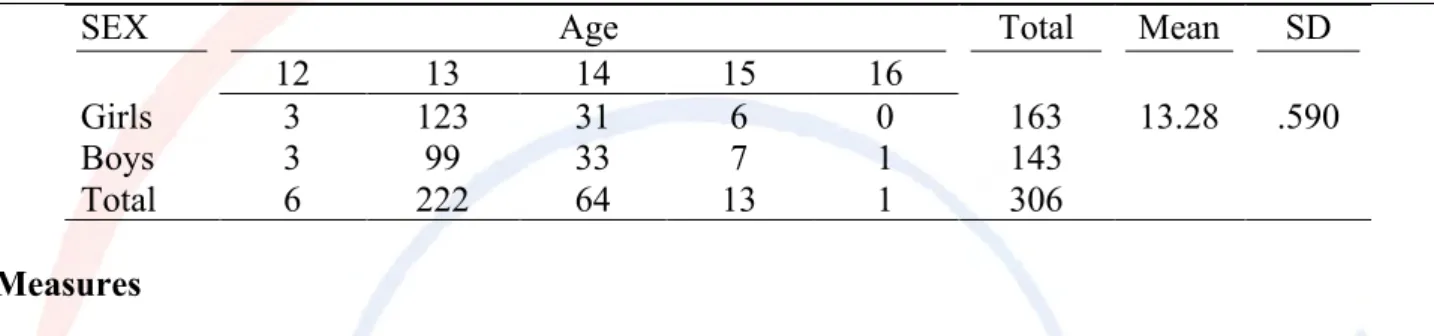
Participated in the study 306 students, 163 boys (53.3%) and 143 girls (46.7%), aged between 12 and 16 years old (M=13.28, SD=0.590), from three public schools (Primary Schools in the 2nd and 3rd cycles) of north of Portugal, two belonging to the municipality of Braga, and the other to the municipality of Viana do Castelo. The subjects attended the 8th grade. Table 1 presents sample distribution by sex and age.
Table 1. Sample distribution by sex and age
SEX Age Total Mean SD
12 13 14 15 16
Girls 3 123 31 6 0 163 13.28 .590
Boys 3 99 33 7 1 143
Total 6 222 64 13 1 306
Measures
The Piers-Harris Children's Self-Concept Scale (PHCSCS-2 - Piers and Herzberg, 2002; adapted. Veiga, 2006) is a brief mean of self assessment which was created in order to help evaluate the meaning of ‘I’ in children and adolescents. The data on the scale are marked in a positive or negative wording so as to show the dimension of this self‐evaluation. The version used in this study was adapted and validated for the Portuguese population by Veiga (2006). The scale comprises of 60 questions. A number of sentences which state how various people feel about themselves are given to the children and they are then asked to mark with a yes or no whether these sentences relate or not to how they feel about themselves.
The Piers ‐Harris scale measures the attitudes of evaluation and the child’s behavior. The main purpose of the scale is usually to give a global index of self‐concept, but it can also be used as a means of promoting formulation of hypothesis and wider fields of clinical research. More specifically, this scale checks whether the self‐concept of the child is negative or positive. In addition, it provides the ability to measure the following factors: behavior, intellectual and school status, physical appearance and attributes, anxiety, popularity, and satisfaction and happiness.
Procedures
Attempted to control the variable motivation, with the collaboration of the subjects as being enrolled in a national study of students in primary and secondary education, which aimed to understand and act in ways that prepare young people for various life roles. Furthermore, it was indicated that the race was voluntary and informed if students complete confidentiality of the individual results. The administration of the Piers-Harris Children's Self-Concept Scale was collectively and made by specialists, graduates in psychology, research collaborators, who have agreed to uniform administration procedures. Each child of the sample answered with a yes or no to the 60 questions of the Piers-Harris scale.
The analysis of the effects of age and sex self concept was held from calculations of average, standard deviation and variance analysis (t test and ANOVA) for the six indices of Piers-Harris Children's Self-Concept Scale. Results were considered statistically significant when the value of the significance test was less than .05 (p <.05).
RESULTS
Table 1 shows the average results obtained in PHCSCS-2. The results are presented either to the total sample, in function of age.
Table 1. Means and standard deviations (SD), dimensions of PHCSCS-2 in the total sample and in function of age.
Dimensions Self concept Total F
N Mean SD
Behavior 300 22.31 1.73 3.524*
Intellectual and school status 292 18.60 1.76 .346
Physical appearance and attributes 301 11.52 2.03 .491
Anxiety 301 12.71 1.90 3.027*
Popularity 301 16.99 1.70 1.129
Satisfaction and happiness 302 10.25 .78 .967
*p≤ .05
The distribution of the results the sample demonstrate that the values obtained in PHCSCS-2 oscillate between the values obtained in the dimension Behavior (M = 22.31, SD = 1.73) and the size achieved in the satisfaction and happiness (M = 10.25, SD = 78). There was also the existence of a statistically significant level of Behavior (F = 3.524, p <.05) and Anxiety (F = 3.027, p <.05) in function of age.
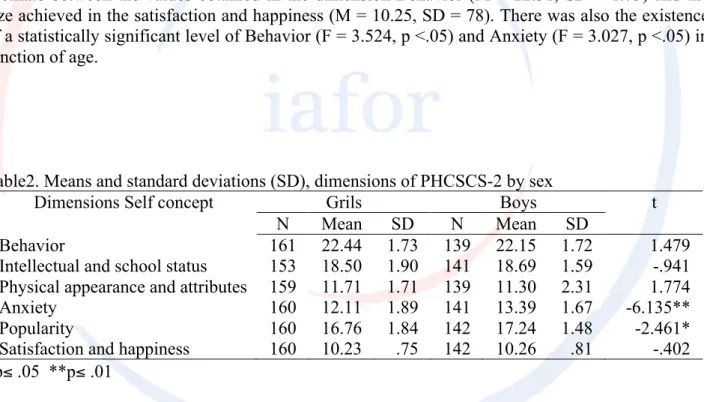
Table2. Means and standard deviations (SD), dimensions of PHCSCS-2 by sex
Dimensions Self concept Grils Boys t
N Mean SD N Mean SD
Behavior 161 22.44 1.73 139 22.15 1.72 1.479
Intellectual and school status 153 18.50 1.90 141 18.69 1.59 -.941 Physical appearance and attributes 159 11.71 1.71 139 11.30 2.31 1.774
Anxiety 160 12.11 1.89 141 13.39 1.67 -6.135**
Popularity 160 16.76 1.84 142 17.24 1.48 -2.461*
Satisfaction and happiness 160 10.23 .75 142 10.26 .81 -.402 *p≤ .05 **p≤ .01
The analysis of Table 2 and 3 indicates also that the results are above the midpoint on all subscales the total sample and in samples of boys and girls. Furthermore, as shown in Table 2, there is also the existence of a statistically significant level of Anxiety (t = -6.135, p <.01) and Popularity (t = -2.461, p <.05), in favor of boys.
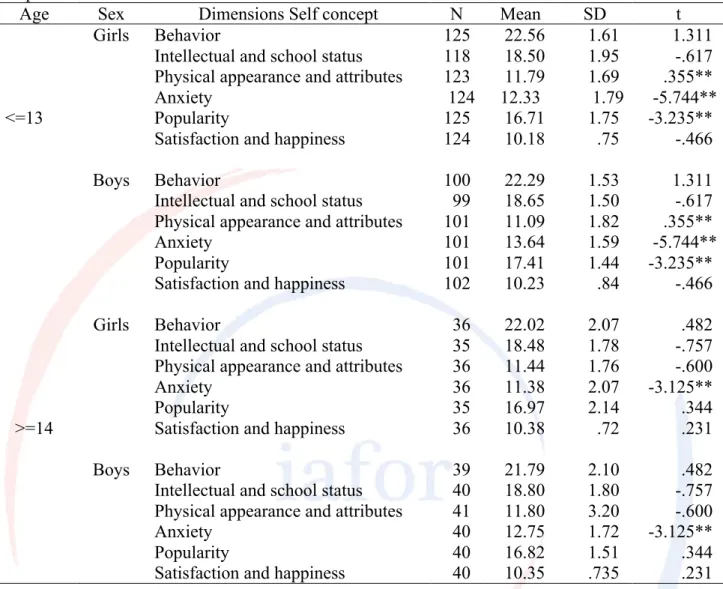
Table 3 allows us to analyze the effect of interaction between sex and age ratios in the PHCSCS-2, combining these data with results of the descriptive statistics of the indices of PHCSCS-2 by age and sex, listed in Table 2.
Table 3. Means and standard deviations (SD), dimensions of PHCSCS-2 by sex, and in the total sample
Age Sex Dimensions Self concept N Mean SD t
<=13
Girls Behavior 125 22.56 1.61 1.311
Intellectual and school status 118 18.50 1.95 -.617 Physical appearance and attributes 123 11.79 1.69 .355**
Anxiety 124 12.33 1.79 -5.744**
Popularity 125 16.71 1.75 -3.235**
Satisfaction and happiness 124 10.18 .75 -.466
Boys Behavior 100 22.29 1.53 1.311
Intellectual and school status 99 18.65 1.50 -.617 Physical appearance and attributes 101 11.09 1.82 .355**
Anxiety 101 13.64 1.59 -5.744**
Popularity 101 17.41 1.44 -3.235**
Satisfaction and happiness 102 10.23 .84 -.466
>=14
Girls Behavior 36 22.02 2.07 .482
Intellectual and school status 35 18.48 1.78 -.757 Physical appearance and attributes 36 11.44 1.76 -.600
Anxiety 36 11.38 2.07 -3.125**
Popularity 35 16.97 2.14 .344
Satisfaction and happiness 36 10.38 .72 .231
Boys Behavior 39 21.79 2.10 .482
Intellectual and school status 40 18.80 1.80 -.757 Physical appearance and attributes 41 11.80 3.20 -.600
Anxiety 40 12.75 1.72 -3.125**
Popularity 40 16.82 1.51 .344
Satisfaction and happiness 40 10.35 .735 .231
The analysis of Table 3 indicates that girls aged less than or equal to 13 years old present values of physical appearance higher than boys the same age. In turn, the boys presented higher levels of anxiety and popularity. In other dimensions, there are no statistically significant differences. Aged greater than or equal to 14 years old boys also have higher levels of anxiety. In other dimensions, there are no statistically significant differences.
DISCUSSION AND CONCLUSION
This study aimed to analyze the main results of students from the 8th grade in PHCSCS-2 and the same test differences by gender and age of the participants.
Overall analyzing, these results demonstrate a positive adolescent’s self-concept, no negative factors were found above the midpoint of the range. The study results confirm the existence of statistically significant differences between boys and girls with regard to self-concept, but with the boys to present significantly higher values those girls only with regard to the dimensions of Anxiety and Popularity.
The results of the popularity dimension will meet the published reports that indicate a greater acceptance in the peer group and popularity for boys (Craft, Pfeiffer, and Pivarnik, 2003). When you see the differences in popularity among boys and girls according to age, we find that there is an only statistically significant difference in younger individuals, in favor of boys.
Interestingly, at the age of the older, these differences exist in order to better results for girls, however, not statistically significantly. These results run counter to other findings in the literature showing that self-concept changes with the years, although there is need for longitudinal studies to confirm this change (Saldanha, Oliveira, and Azevedo, 2011).
For the anxiety dimension, contrary to what are expected, the boys showed higher levels in all age groups. These results may indicate a potential change in social stereotypes (Saldanha et al., 2011), with the boys to feel less secure.
There were also significant differences according to age, with younger to submit values higher Anxiety and Behavior. This trend with age may relate to the increase of experiences that allow gain greater security (Piaget, 1977). These results also seem consistent with those found by Marsh (1989) emphasizing that the early years of adolescence are characterized by more negativity than the later years.
The younger girls also seem to present higher values, statistically significant in the dimension physical appearance than younger boys. These results are contrary to the results of studies conducted in the Portuguese context showing that adolescent girls have lower physical self-concept than boys in the areas of physical appearance and athletic competence (Faria and Fontaine, 1995; Fontaine, 1991).
When we analyze this dimension at the age of 14 years found that there are differences in favor of better outcomes for boys, but these values are not statistically significant. What may be related to the fact that girls age 14 having higher probability of value more the dimension of physical appearance, and feel more dissatisfied with it, which shows the divergence or discrepancy between appearance and perceived value this is attributed (Harter, 1993), emphasizing that the female body undergoes more changes, which are both more salient and explicit, such as the onset of menarche or first menstruation, which marks the entry into puberty: and these more visible changes in female body lead to greater changes and fluctuations in physical self-concept.
We conclude, by calling attention, to the need for the school to provide conditions for development to adolescents, so that they develop confidence in themselves, their individual capacities, intellectual and social skills.
Some methodological limitations of this study should be taken into account in the discussion of the results. The fact that the sample was reduced and heterogeneous in terms of grade, or middle school age and provenance, as well as the fact that it was applied to a single instrument, and was not used external criterion for assessing the external validity, are some of the weaknesses that exist in generalizing the results.
REFERENCES
Bernardo, R.P.S., and Matos, M. G. 2003. Desporto aventura e auto-estima nos adolescentes, em meio escolar. Revista Portuguesa de Ciências do Desporto, 3, 33-46.
Boucher, H.C. 2011. The dialectical self-concept II: Cross-role and within-role consistency, well-being, self-certainty, and authenticity. Journal of Cross-Cultural Psychology, 42, 1251-1271. Byrne, B. 1984. The general/academic self-concept nomological network: A review of construct
validation research. Review of Educational Research, 54, 427-456
Craft, L.L., Pfeiffer, K.A., and Pivarnik, J.M. 2003. Predictors of physical competence in adolescent girls. Journal of Youth and Adolescence, 32 (6), 431-438.
English, T., and Chen, S. 2011. Self-concept consistency and culture: The differential impact of two forms of consistency. Personality and Social Psychology Bulletin, 37, 838-849.
Faria, L., and Fontaine, A.M. 1990. Avaliação do conceito de si próprio de adolescentes: adaptação do SDQ I de Marsh à população portuguesa. Cadernos de Consulta Psicológica, 6, 97-105. Faria, L., and Fontaine, A.M. 1995. Reflexões sobre a adaptação de um instrumento de
auto-conceito a crianças e pré-adolescentes: Self-Perception Profile for Children (SPPC) de Harter. In L.S. Almeida, and I.S. Ribeiro (Eds.), Avaliação Psicológica: Formas e Contextos (Vol. III, pp. 323-330).Braga: APPORT.
Faria, L. 2002. A importância do auto-conceito em contexto escolar. In C.M. Lopes Pires, P.J. Costa, S. Brites, and S. Ferreira (Orgs.), Psicologia, Sociedade & Bem-estar (pp. 87-98). Leiria: Editorial Diferença.
Faria, L. 2005. Desenvolvimento do autoconceito físico nas crianças e nos adolescentes. Análise
Psicológica, 23, 361-371.
Fontaine, A.M. 1991a. O conceito de si próprio no ensino secundário: Processo de desenvolvimento diferencial. Cadernos de Consulta Psicológica, 7, 33-54.
Fontaine, A.M. 1991b. Desenvolvimento do conceito de si próprio e realização escolar na adolescência. Psychologica, 2, 1-19.
Garcia, J.A. and Sanchez, D.T. 2009. Collective Self-Esteem (pgs. 194-196). In Lopez, S. J. (Ed).
Encyclopedia of Positive Psychology. London: Blackwell Publishing.
Harter, S. 1993. Causes and consequences of low self-esteem in children and adolescents. In R. F. Baumeister (Ed.), Self-esteem: The puzzle of low self-regard (pp. 87- 116). New York: Plenum Press.
Harter, S. 1999. The construction of the self: A developmental perspective. New York: The Guilford Press.
James, W. 1890. Principles of psychology. Chicago: Encyclopedia Britannica.
Lassance, M.C.P. 2005. Adultos com dificuldades de ajustamento ao trabalho: Ampliando o enquadre da orientação vocacional de abordagem evolutiva. Revista Brasileira de Orientação
Vocacional, 6(1), 41-51.
Markus, H., and Kunda, Z. 1986. Stability and malleability of the self-concept. Journal of
Personality and Social Psychology, 51, 858-866.
Marsh, H.W., and Hattie, J. 1996. Theoretical perspectives on the structure of self-concept. In B. A. Bracken (Ed.), Handbook of self-concept: Developmental, social and clinical considerations (pp. 38-90). New York: John Wiley & Sons. Marsh, H. W., Hey, J., Johnson, S., & Perry, Marsh, H.W., and O'Mara, A.J. 2008. Reciprocal effects between academic concept,
self-esteem, achievement and attainment over seven adolescent-adult years: Unidimensional and multidimensional perspectives of self-concept. Personality and Social Psychology Bulletin, 34, 542-552
Marsh, H.W., and Yeung, A.S. 1998. Longitudinal structural equation models of academic self-concept and achievement: Gender differences in the development of math and english constructs. American Educational Research Journal, 35, 705-738.
Marsh, H. W. 1989a. Age and sex effects in multiple dimensions of self-concept: preadolescence to early adulthood. Journal of Educational Psychology, 81, 417-430.
Möller, J., Retelsdorf, J., Köller, O. and Marsh, H.W. 2011. The reciprocal I/E model: An integration of models of relations between academic achievement and self-concept. American
Educational Research Journal, 48, 1315 - 1346.
Piaget, J. 1977. O julgamento moral na criança. São Paulo: Editora Mestre Jou.
Pienda, J.A., Pérez, J.C., Pumariega, S.G., and García, M.S. 1997. Autoconcepto, Autoestima Y Aprendizaje Escolar. Psicothema,9(2), 271-289.
Piers, E.V. and Herzberg, D.S. 2002. Piers-Harris 2, Piers-Harris Children’s Self- Concept Scale,
Second Edition. Los Angeles, CA: Western Psychological Services.
Saldanha, A.A., Oliveira, I. C., and Azevedo, R.L. 2011. O autoconceito de adolescentes escolares.
Paidéia, 21(48), 9-19.
Simões, M.F.J. 1997. Auto-conceito e desenvolvimento pessoal em contexto escolar. Revista
Portuguesa de Pedagogia, 1,2,3, 195-210.
Skaalvik, E.M., Valåns, H., and Sletta, O. 1994. Task involvement and ego involvement: relations with academic achievement, academic self-concept and self-esteem. Scandinavian Journal of
Educational Research, 38, 231-243.
Thompson, R.A. 1998. Early sociopersonality development. In W. Damon (Ed.) and N. Eisenberg (Vol. Ed.), Handbook of child psychology: Vol. 3. Social, emotional, and personality
development (5th ed., pp. 25-104). New York: Wiley.
Veiga, F.H. 1989. Escala de autoconceito: Adaptação portuguesa do “Piers-Harris children’s self-concept scale”. Psicologia, 7, 275-284.
Veiga, F.H. 1992. Disrupção escolar dos jovens em função da idade e do autoconceito. Revista de
Educação, 2, 23-33.
Veiga, F.H. 1995. Transgressão e autoconceito dos jovens na escola. Lisboa: Fim de Século Edições.
Veiga, F.H. 1996. Autoconceito e rendimento dos jovens em matemática e ciências: Análise por grupos com diferente valorização do sucesso. Revista de Educação, 5, 41-53.
Veiga, F.H. 2006. Uma nova versão da escala de autoconceito: Piers-Harris Children´s Self-concept Scale (PHCSCS-2). Poster apresentado na XI Conferência Internacional Avaliação