PATHS TO POSITIVITY:
EXPLORING THE DYNAMICS OF POSITIVE ORGANIZING1
MIGUEL PINA E CUNHA Universidade Nova de Lisboa
Faculdade de Economia Rua Marquês de Fronteira, 20
1099-038 Lisboa - Portugal E-mail: [email protected]
Tel: 351-21-3822706 Fax: 351-21-3873973
RITA CAMPOS E CUNHA Universidade Nova de Lisboa
Faculdade de Economia R. Marquês Fronteira, 20 1099-038 Lisboa - Portugal E-mail: [email protected] Tel: 351-212 822 725 Fax: 351-213 873 973 ARMÉNIO REGO Universidade de Aveiro
Departamento de Economia, Gestão e Engenharia Industrial Campus de Santiago 3810-193 Aveiro- Portugal E-mail: [email protected] Tel: +351-234 370 024 Fax: +351-234 370 215 1
We thank our MBA students for the support in the data collection process, and to João Vieira da Cunha to his comments and suggestions. Miguel Cunha gratefully acknowledges support from Instituto Nova Forum.
PATHS TO POSITIVITY:
EXPLORING THE DYNAMICS OF POSITIVE ORGANIZING
ABSTRACT
This paper advances a theory about the way patterns of positive and negative organizing unfold. It is grounded in data collected from 58 individuals. We followed an inductive logic and used critical incidents to collect information on positive and negative processes and outcomes. From this we extracted six dimensions, which are present in different combinations in the 116 incidents narrated by the participants: recognition/ indifference, communication/silence, interaction/separation, confidence/distrust, loyalty/betrayal, and organizational transparency/organizational secrecy. We then analyzed how these dimensions fit together and discovered that they could be organized around four major patterns combining the clarity/opacity of organizational rules and the considerate/ detached behavior of leaders. We assert that positive leaders are essential in the creation of positive organizations, regardless of the features of the external context.
The notion of “positive organizations” made a triumphant arrival on the scene of organization studies in very recent years (Cameron et al., 2003; Luthans, 2002). Positive oriented researchers focused on topics as unusual in the organizational literature as happiness (Wright, 2004), hope (Ludema, Wilmot & Srivastva, 1997), humility (Vera & Rodriguez-Lopes, 2004), resilience (Sutcliffe & Vogus, 2003), positive deviance (Spreitzer & Sonenshein, 2004), compassion (Kanov et al., 2004) and virtuosity (Gavin & Mason, 2004), to mention just a few. Accepting the challenge of positive psychologists such as Seligman and Csikszentmihalyi (2000), positive organizational scholars suggested that the bias towards the negative (stress, work overload, work-life unbalance, unethical behavior) should be counterbalanced with more attention to the virtuous side of organizing.
With the present work, we contribute to the field of positive organization studies by studying how the dynamics of positivity (and by contrast, negativity) unfold in organizational contexts. An inductive approach is applied to data collected from a sample of 58 people. We start with a brief and general introduction to positive organization studies and discuss the need for a dynamic view of organizational positivity. With this, we suggest that at least as important as knowing if an organization is more or less rich in, say, virtuosity, is the knowledge of how it reached such a state of positivity. The benefits of a dynamic approach are evident: knowledge of how a positive organization grows may facilitate the creation and maintenance of this type of organization.
Organizations are often approached from a negative perspective, both in the theoretical and applied domains. Theories have been developed to explain how to manage stress and burnout, how to prevent bullying, how to deal with organizational cynicism, and how to motivate unmotivated people. Work-life imbalance, organizational misbehavior, the consequences of massive layoffs and the breach of psychological contracts have also attained relevant places in the research agendas. On the contrary, the positive virtues of individuals and organizations have been taken as “soft” topics with minor relevance in the hypercompetitive world of organizations. Even in the more applied domains, such as consulting, the “negative model” tends to prevail: companies are “diagnosed” according to a logic of “disease” and consultants mimic physicians with their prescriptions to “cure” the organization.
Recently, however, important changes have been witnessed in the corporate as well as in the academic landscapes. The eruption of corporate scandals in some of the world’s leading companies, the September 11th tragedy and the “positive turn” in the psychological field, have contributed to create a momentum for a positive approach to work and organizations. Positive theories have flourished and positive forms of intervention have received increased attention, both from academic and popular authors. Interestingly, attention to both good and evil have characterized organizational research. Some authors have devoted attention to “executive psychopaths” and “snakes in suits” (Morse, 2004; Spinney, 2004), whereas others have focused on the analysis of “healing leaders” and “office angels” (Frost, 2003; Kuper, 2004). We are interested in the development, rather than the outcomes, of both positive and negative organizational contexts. We suspect, considering previous research, that the outcomes generated by positive individual and organizational processes may be favorable (Judge et al., 2001;
Fulmer et al., 2003) but make no claims about them. It is plausible that positive and negative processes mirror each other, but that possibly demands empirical analysis. Despite the relevance of this contrast, we embrace the positive movement and aim to contribute to a better understanding of how positivity grows in organizations. Hence our preferential focus on positive theories and interventions.
Positive theories. Positive theories have been developed at several levels of analysis. The virtues of positive individuals have been extolled. Individual traits have been shown to produce favorable results. The traits that constitute a positive self-concept have been found, in a meta-analytic study conducted by Judge et al. (2001), to significantly and positively impact job satisfaction and job performance. Humility has been presented as a trait of those leaders that create great companies (Collins, 2001). At the group level, psychologically safe teams where interactions are more honest and genuine, have been demonstrated to be more conducive to learning (Edmondson, 2001). They constitute the “holding environments” that facilitate rich interpersonal relationships. These, in turn, facilitate collective learning and interpersonal trust (Kahn, 2005). The role of authentic leaders has also been scrutinized and the positive impacts of authentic leaders on their teams have been studied (Luthans & Avolio, 2003). At the organizational level, scholars have investigated, for example, “truly healthy organizations” (Kriger & Hanson, 1999) and “authentizotic organizations” (Kets de Vries, 2001). In other words, organizations roughly corresponding to the profile of the best companies to work for, have been indicated as an ideal to pursue, and as more effective economically (Fulmer et al., 2003) than a comparable sample of firms.
Positive interventions. Diagnostic and intervention approaches usually aim to locate sources of misfit and to reestablish a state of fit in the organizational system. The logic of organizational diagnosis (e.g., Weisbord, 1976) aims to identify the sources of problems or misfit and to solve them. Taking organizational systems as configurations, researchers and practitioners try to identify those subsystems that, for some reason, are not aligned with the configuration. In other words, they apply a disease model to their interventions. The positive appreciative inquiry logic, however, springs from a different perspective. Instead of looking at the problems with the organization, it stresses the best of the organizational system (Powley et al., 2004). It suggests the need to develop an imaginative and progressive view of organizations, based on their positive qualities (Cooperrider & Srivastva, 1987). This positive approach is expected to reinforce what the organization is already good at, and to trigger a virtuous spiral. Given appreciative inquirers’ assumption that we create the world we later discover, this positive look at organizations will presumably end up producing positive organizations. After this generic introduction, and given the inductive logic followed in this research, we describe the research first and “discover” the theory second.
METHOD
To analyze the dynamics of positive organizing, data were collected from 58 Portuguese individuals. 29 MBA students each interviewed two employed persons about a negative and a positive experience in the workplace. The overall purpose of the study was explained to students, as well as the need to follow the interview’s protocol. Each student would base his or her field work on the interview data. Permission to use the students’ data was granted, with guarantees of confidentiality and anonymity of both students and interviewees. Semi-structured interviews were thus conducted with a
diversity of people in different professions. The conversations were taped and transcribed in order to facilitate interpretation. 38 participants were male. The group’s average age was 33, ranging from 24 to 61. To circumscribe the sample, participants were well educated professionals with university degrees. They worked in a variety of industries (e.g., computers, banking, telecommunications, consulting, oil, central administration) and hold several jobs (e.g., controller, consultant, social worker, events manager, scientific director, director of human resources, software developer).
The semi-structured interviews followed a predetermined but loose structure. The interviewing philosophy was, following Alvesson’s (2002) terminology, more “romantic” than “neopositivist”. In other words, we were looking for lived experience and deep meaning rather than for context-free truth. After a brief biographical sketch, participants were invited to think about a situation, which they would definitely characterize as positive, and then to describe with the greatest possible detail the antecedents of this situation. They were then asked to think about a situation they would undoubtedly classify as negative and then follow the same logic.
With this critical incidents approach we strove to understand the antecedents and the process leading to situations that people would qualify as positive or negative. We believe that the selection of critical incidents elicits relevant events to those who lived them. As such, our findings are based on episodes with a major impact on people’s view of the paths to positivity/negativity. The retrieval of significant events led, especially during the conversations on negative events, to signs of emotionality. In some cases, people expressed the anger they were feeling towards the agent that triggered the negative dynamic – as we will discuss below, their supervisor was a good candidate. A
few people even said that they were only then realizing how unfair the situation was, even when it took place a long time ago.
The principle of theoretical saturation (Glaser & Strauss, 1967) was respected, meaning that after 116 incidents the same stories were repeated over and over and that new information was not being reported to challenge the stability of the interpretation. The method to develop theory about the dynamics of positive organizing drew on available descriptions of how to build theory from qualitative data. Major sources included Flanagan (1954), Glaser and Strauss (1967), Mintzberg (1979), Roos (2002) and Alvesson and Deetz (2000). The procedure consisted of three major phases: (1) eliciting critical incidents on the dynamics of organizing; (2) comparing between theory and data until the adequate conceptual categories stabilized; (3) deriving patterns associating the categories discovered in the previous phase. To increase the reliability of our emergent theory, several measures were taken. The interpretation was sent back to a sample of MBA students participating in the data collection process, for criticism and refinement. Some participants were also able and willing to read the original version of the paper. The research was also presented in workshops and executive education sessions, as well. A preliminary paper was distributed to those expressing an interest in the ongoing project. The interpretation was considered acceptable in these various checks. Next, we discuss the phases of the data analysis:
Phase 1: the extraction of conceptual categories from the critical incidents.
Phase 2: grounded theorizing for combining the themes extracted in phase 1, into patterns able to uncover the more salient dynamics.
RESULTS AND DISCUSSION
We start this section with a presentation of the themes that emerged as the more salient and stable across the interviews.
Phase 1: Critical themes
Six themes emerged as able to capture the essence of the episodes revealed by our subjects. Interestingly, they can be understood as “pairs”, in the sense that the same people tended to mention them in tandem. Despite the variation in the stories we heard, some of the following elements were present in every episode. As such, we interpret this finding as meaning that they play a significant role in how the paths to positivity and negativity unfold. These conceptual pairs are, in no special order,
recognition/indifference, communication/silence, interaction/isolation, confidence/distrust, loyalty/betrayal and organizational transparency/organizational
secrecy.
Recognition/Indifference. This dimension refers to the feeling of being recognized as making a contribution to the organization vs. the lack of interest of the supervisor towards what people view as a contribution. Recognition, emotional and intellectual, has been indicated as associated with organizational justice and fair process (Kim & Mauborgne, 1998). When people feel that the organization does not provide the adequate recognition, they express some form of psychological suffering. The following quotation is illustrative: “I have worked hard, really hard, sometimes I didn’t even have the time to have lunch or to take care of the family. (...) I feel I’ve been used. My heart is bleeding” (social worker, female, 57 years-old). Recognition, on the contrary,
stimulates positive feelings: “I feel from the hierarchy that I’m treated as a human being, that what I do is appreciated. It all starts in the top managers themselves. They transmit in a very informal, yet very explicit way, the recognition for the effort people put in their work” (sales director, female, 30).
Communication/Silence. This dimension refers to how the supervisor communicates with people. Some supervisors use honest communication and provide valuable information and feedback, whereas others keep the group in a state of ignorance regarding relevant issues (e.g., the employee’s performance assessment). Communication is sometimes used constructively. As reported by a 27-year old consultant in a large multinational consulting firm, when feedback is based on rigorous facts, not on impressions, and when negative feedback is provided with constructive intentions (e.g., accompanied by coaching and support), people feel that the company really cares about them. The reason why clear and honest communication is valued, has to do with the fact that it signals care and transparency and limits competition and disputes inside the organization. In these situations, as a logistics manager in a computer firm told us, people “don’t have to adopt defensive tactics.” When silence prevails, people feel confused and lost. “I have many reasons to complain, since the physical separation. I’m in Oporto and my supervisor in Lisbon. Dialogue is far from fluid. I’m ignored up there” (male controller, 30, construction company).
Interaction/Isolation. This theme refers to the quality of the interpersonal relations and describes the extent to which a leader is accessible and interacts frequently with team members. Some leaders are viewed as accessible, others as detached and isolated. Interaction with the supervisor translates organizational rules into daily practices. Good
interactions buffer people from bad policies. Bad interactions amplify bad rules and neutralize the advantages of good ones. Consider, for example, the case of a salesman of a pharmaceutical company: “My supervisor does not act like a leader. Recently, he sent an email to every salesperson saying that we are paid to sell and that if we do not sell, we will suffer the consequences. There are many ways to say this very same thing. He could have sent the same message with a positive tone. That way, the message would have a positive effect, it would have energized us, it would signal that he was on our side. The way he put things, we could only think that he was going to fire us the next month.” If sometimes managers produce negative results actively, on other occasions they do the same passively. This may occur when people approach managers looking for help and do not receive it – something which tends to damage the relationship between supervisor and subordinate (Cunha, 2002). The same sales representative described a conversation with his supervisor as “speaking to a wall.” The most positive situations in terms of learning and feeling respected, occur when results are not satisfactory but the treatment is perceived as fair and respectful. On the contrary, anger was triggered by unfair treatment and offences from above, a finding which fits the results of Fitness (2000). As a software developer reported, some companies slide into contexts that become so harsh that, “only a fool would make a sacrifice for this company.”
Confidence/Distrust. This dimension describes the emotional atmosphere experienced during the process leading to the episode. Feelings of confidence or “even flow” contrasted with an ambience of distrust, fear and oppression. “Repression works”, says a 30-year old controller in a construction company. Invited to explain the meaning of “repression” he mentions a constellation of factors such as the lack of clear goals,
deficit of communication with his supervisor, lack of clear criteria for evaluation, and the supervisor’s style, characterized as “old school type.” As a result, he reports situations such as the difficulty in uncovering errors (“If we were not afraid of repression, errors could be seen as a stimulus, we would report them easily and confidently”) and the discretionary use of power, namely in terms of performance assessment, where the “momentary sensitivity of the supervisor” plays a significant role. Similar remarks about what an interviewee described as “Bulldozer-style leadership” were recorded. The style often results, as a principal in a professional services company pointed out, in aggressive organizational climates: “We are always waiting to be attacked.” The scientific director of a pharmaceutical firm said that her supervisor is so threatening that every Sunday afternoon she starts to feel the anxiety. As a consequence of this leadership behavior, as one software developer put it, “I always try to protect myself from being beaten.”
Other examples of leadership by fear suggest that some leader behaviors actually direct teams onto a negative path: “He is not polite, is technically incompetent and lacks emotional intelligence. He is very insecure and is always defending himself. Sometimes he deceives people. For example, he appropriates other people’s merits. In that sense, he is dishonest” (lawyer, 27). Other subjects report their dissatisfaction with the lack of coaching and support from their supervisors: “they are only concerned with profits and the bottom line. Nothing else matters. They don’t care about the quality of work, if things are well done or not. Technical support is none” (project manager, 29, construction industry). These effects are in stark contrast with the consequences of confidence: “I have been treated fairly when I did something wrong. These situations
have a special impact because they the most valuable from a learning perspective” (male, multinational computer company).
Loyalty/Betrayal. As a result of some of the previous issues, two contrary types of attachment with the organization emerged: loyalty and betrayal. An interesting aspect of this dimension resides in the fact that the sense of loyalty or betrayal is often expressed towards the organization but is stimulated by the leader’s role. Thus, feelings toward the leader may spill over to the organization. A consultant started to work as an independent professional because he felt betrayed when his former supervisor left the firm to launch a new business with some of his former subordinates. This consultant was left behind. He later pointed out that, “it was not being left behind. It was the lack of honesty. He [the supervisor] left and then people started to leave, one after the other.” He claims that the supervisor developed a sense of “family” within his team, and that the “family” was destroyed by the same person who created it. Another example: when a logistics technician in a multinational computer firm asked his supervisor’s permission to study management in a university program at the end of the day, he faced strong resistance. He was surprised because the opportunity had been discussed before and approval was promised. This new attitude was perceived as a broken promise, a disruption of expectations, as evidence that the supervisor should not be trusted.
Organizational cynicism, resulting from the perception that managers should not be trusted (Dean, Brandes & Dharwadkar, 1998) also erupted, as a result of the perception that the rules of the organization had been changed while people were “playing the game”. A consultant for a multinational professional services firm feels that the organizational climate in the company is negative because a new career system has been
implemented. The system retards career movements and is perceived, again, as a broken promise (people worked hard because they expected rapid rewards). Additionally, people knew what to expect. Now they do not: “The satisfaction level is as low as possible. In contrast, the firm’s communication machine, or better, propaganda machine ... works. It works so well that the company has been considered as one of the nation’s best companies to work for”. In contrast, organizations may build good intentions and feelings of loyalty: “In my first year in the company I was invited on the annual trip – to Brazil, that year. (...) At the time, I did not deserve that prize, but the fact is that the company conquered me at that very moment. This feeling has lasted until today.” (product manager, pharmaceutical company, 30).
Organizational transparency/Organizational secrecy. This refers to the clarity of the organization’s rules and polices. In some cases they were viewed as clear, whereas in others they were taken as opaque: “Everything is a mystery. We are simply not informed”, says a 61 year-old lady, working in social service. And she adds: “Everything could change with open communication. Presently, people are afraid to talk.” Secrets and mysteries are also mentioned with regards to performance management. As an engineer in a utilities firm observed, the assessment process is “merely theatrical” and the result is dependent on the supervisor’s criteria. As the process at the company level is viewed as “merely bureaucratic”, supervisors have a great deal of discretion. They do not have to justify their decisions and, as the same engineer remarked, sometimes they “pull some rabbits out of the magic hat”, meaning that they have access to information that no one else has and that this information can be used at will: “When they tell me that I have not reached the goals and when actually I
was not informed about any goals, the question is ... What exactly did I fail to attain?” (male, 26, telecom firm).
A man in a hygiene products company who feels unfairly treated, says that the information he gets access to is “broadcast” via the so called “Radio Corridor”. As a result, he informed his supervisor six years ago that he felt his salary should be increased. As a response he was told that “the company’s door is really big...” From then on he has not address the issue again. He adds that the above situation showed him that the company considers that “my value is zero.” When questioned about how he deals with this, the answer was, “I just don’t care.” The literature suggests that positive organizing thrives on clarity (Cohen & Prusak, 2001), not on mystery as seems to be the case with the situations mentioned by the interviewees.
Another consequence of the lack of clarity is the increase in organizational politicking. A product manager in a pharmaceutical company describes how political games thrive in the absence of transparency: “There is a lot of politics. Relationships are quite informal but not transparent. The atmosphere is really bad. But on the surface we have ... la vie en rose. Everybody invites everybody for a coffee.” In other cases, the organization creates clear rules and enforces their application. When these rules are perceived as aimed at benefitting the employees, their effect may be especially positive: “We have long and demanding work days. To reward our effort, the company gives us some extra days off. These days, once defined, cannot be changed. That is very important because in this business there is a lot of pressure to respect deadlines and therefore there is some tendency to align private life with the company’s interest” (consultant, male, 28).
Phase 2: Patterns
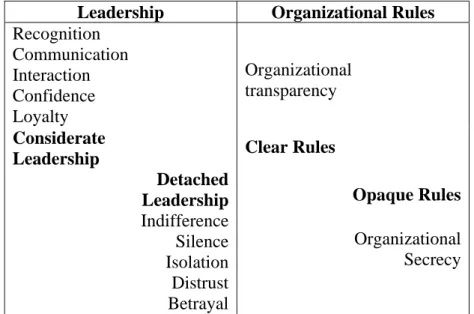
Having discerned the major themes in our data, we next analyze the relational patterns among them. Four distinct relational patterns emerged, two leading to positivity and the other two to negativity. It is important to observe that the previous conceptual themes organize in a stable way: the themes mentioned by an interviewee tended to be strongly associated in terms of their signal. For example, recognition tended to be coupled with confidence or loyalty, but not with fear or feelings of betrayal. In the same vein, indifference was associated with fear or betrayal but not with confidence or loyalty. Organizational transparency or opacity were not subjected to the same kind of co-variation found in the other conceptual themes. This allows us to consider that, broadly speaking, there is one organizational conceptual category (organizational transparency or opacity) and five interpersonal categories (Table 1).
--- Table 1 about here
---
The two main factors can be taken as independent, but the concepts composing the interpersonal categories are interdependent. Given the inductive nature of the study, this “factorialization” separated the concepts in such a way as to keep the discussion as close as possible to the meanings we obtained from the participants – or, to be more precise, to the meaning we gave to the meanings obtained from the participants. We continue the discussions with the presentation of the four patterns that were identified. These were the following:
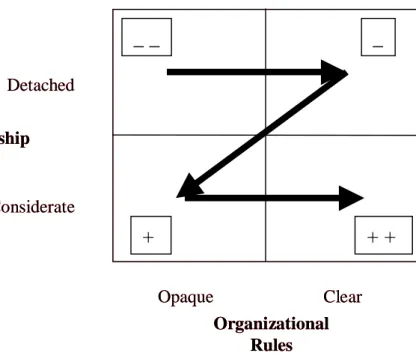
Path 1: clear rules + considerate leader → positive organizing Path 2: clear rules + detached leader → negative organizing Path 3: opaque rules + considerate leader → positive organizing Path 4: opaque rules + detached leader → negative organizing
Path 1: clear rules + considerate leader → positive organizing. The situation identified as the most favorable by the participants was the one involving considerate leaders acting with clear and fair organizational rules. This pattern was characterized by the presence of most of the positive categories identified above: individual recognition, honest communication, easy interaction, confidence, a sense of loyalty and clear rules. This dynamic holds similarities with the contexts described by Lawler (2003) as “virtuous spirals”: considerate leaders apply a set of clear rules leading to a cycle where people feel energized, involved and sometimes in a state of flow. This was described by our interviewees as the situation that best utilized their skills and talents. This virtuous combination corresponds to what may be best described as positive organizing. People felt engaged by a common goal, the leader was viewed as a facilitator, politicking was not an issue and personal defenses were dormant. In other words, considerate leaders and clear rules create energetic and intensely positive environments.
Path 2: clear rules + detached leader → negative organizing. A second path, leading to negativity, was characterized by the combination of clear rules and a detached leader. Despite the existence of clear and fair organizational rules, people did not show such feelings as confidence, loyalty and so forth. Relationships with the leader were distant and defensive. The result of this dynamic was perceived by people as frustrating and
negative. Employees did not express a highly intense negative emotion but a mild negativity. This state can be interpreted according to the theories of organizational justice: rule clarity guaranteed a reasonable degree of fairness in terms of the distribution of outcomes, but the detached behavior of the leader produced feelings of injustice due to the lack of procedural and interactional fairness.
Path 3: opaque rules + considerate leader → positive organizing. The third path we identified was characterized by a combination of opaque organizational rules and a considerate leader. It mirrors the previous path: despite the lack of an adequate context, the leader does what he or she can to produce a positive organizational dynamic. Given the difficulties of such a task, people tended to express admiration towards the leader and the situation was labeled by interviewees as positive. When this description was provided, people did not express a great enthusiasm towards the organization; hence, the energetic levels were low, but within the group feelings of recognition, honest communication, easy interaction, confidence and loyalty were expressed. People viewed the leader as a buffer, as someone who defended the group against external adversity (Gabriel, 1999) and who provided adequate and fair explanations (Cropanzano & Greenberg, 1987). This created a positive attitude towards the leader and a sense of belonging to a team that prevailed over the opacity of the rules and the context provided by the organization, which is congruent with data suggesting that interactional justice can reduce the negative impact of procedural injustice (Skarlicki & Folger, 1997). This pattern and the previous one are revealing in the role of leaders in the construction of positive organizations. Considerate leaders buffer the group from a negative context, whereas detached leaders neutralize the positive context around them. Leaders, in this sense, may play a particularly important role in their subordinates’ construction of the
positive organization. Given the “ambiguity” and “symbolism” associated with leadership (Pfeffer, 1977), people’s perceptions of positive or negative organizing may be a consequence of their interpretation of leader behavior. Hence, the associations between “good” leaders/positive organizations and “bad” leaders/negative organizations.
Path 4: opaque rules + detached leader → negative organizing. This is the situation which elicited negative emotionality during the interviews. People’s stories and ex post reactions evoked the notion of destructive emotions produced by toxic leaders (Frost, 2003). When subjects felt that the situation was tainted with generalized injustice, their feelings were the most negative and, in some cases, revived during the interviews. There was, they said, no reason to express any kind of gratitude towards the organizations or the leader. Opacity and secrecy were practiced by the immediate leader and dominated the organization. People expressed anger and, as mentioned above, sometimes the dormant feelings were revived when the episode was narrated. The consequences of negativity have been explored before: “Much employee disengagement and lack of performance results from feeling cheated, of feeling they have not been actively involved and consulted in decisions, such as those relating to benefits, that they believe are crucial to them” (Gratton, 2004, p.23). Lack of participation and the feeling of being cheated were the source of negative attitudes and emotions and constituted an inevitable path to negativity.
These four patterns resonate Bruch and Ghoshal’s (2003) description of the several forms of organizational energy. Clear rules and considerate leaders tend to focus people’s attention on goals. This may facilitate the creation of a productive or
passionate organization. Clear rules and detached leaders may create a feeling of resignation, characterized by low intensity negative energy, at least in collectivist and high-power distance cultures, in which “obeying a paternalistic leader may be more crucial than following specific procedures” (McFarlin & Sweeney, 2001, p. 86). Opaque rules and considerate leaders may create a comfort zone: people feel protected but are not enthusiastic about the organization. Opaque rules and detached leaders create aggressive organizational climates, marked by high intensity negative energy. If our interpretation is correct, organizational energy results from the way in which individuals interpret the organizational context, and particularly a highly salient element in that context: their immediate leader. Positive leaders are the agents of positive organizing , responsible for transporting the organization from negative to positive energy zones. As depicted in Figure 1, the path from more negative to more positive zones can be represented as taking the shape of a Z. Their impact, however, may be leveraged or inhibited by the context surrounding the team, namely organizational policies and their impacts on feelings of justice or injustice.
--- Figure 1 about here
---
CONCLUSION
Some organizations establish relationships with their members that are so negative that negativity can spread within the company even to non-work-related events. For example, one chemical engineer in the sample attributed the dissolution of his marriage to the company: “We worked so hard! Some days I almost didn’t go home. Result: my
marriage failed and my life lost its meaning.” Other companies, on the contrary, add meaning to the life of their members. According to our findings, a major influence on the development of a positive or negative process is leader behavior. This is in line with research showing that the immediate supervisor is the major stimulus for positive or negative action (e.g., Bateman & Organ, 1983; Moorman, 1991; Cardona, 2000). Leader behavior is able to buffer the team from opaque rules or to neutralize the positive effects of clear rules. When leaders express a reduced willingness to listen to their team members, they create a process which is difficult to reverse. When questioned about how they deal with situations that they perceive as negative, people often offer some variation on the following quotation: “Have I discussed the situation with my boss? He is not the kind of person open enough to this sort of discussion”, an engineer said. The supervisor is the “translator” of organizational policies and rules. The way these are appropriated by the leader and transmitted to the team help to make the difference between positive and negative organizing. One person in our sample mentioned that, even aware that his supervisor was applying the rules received from headquarters in another country, he was “puzzled” by the acritical acceptance of those orders that, in his point of view, were not adequate to the country’s culture.
Regarding practice, the paper offers two major conclusions: (1) leader behavior is crucial in the creation of positive organizational contexts – with “good” leaders being able to neutralize an inappropriate organizational context; (2) productive organizations, in the sense of the high-intensity positively energized organizations described by Bruch and Ghoshal (2003), are only possible when the considerate leaders that create positive contexts are supported by clear organizational policies and rules which facilitate the creation of perceptions of organizational justice. Some organizational processes have
traditionally been conducted in secretive ways. For example, Conger and Fulmer (2003) observed that leadership succession practices in a significant number of companies were based on the CEO’s discretionary power rather than on a set of clear, transparent rules. The secret way may have some advantages (e.g., last minute change of plans without frustrating expectations), but does not seem adequate in a corporate world where performance and individual initiative are increasingly expected to replace loyalty and obedience.
The paper makes several contributions to the organizational literature. It helps to understand how positive organizations are formed. In other words, we address the process of positive organizing instead of treating positive organizations as formed and stable entities. We also add to the literature on how leaders affect the feelings of their followers, a research stream that Brief and Weiss (2002) qualified as embryonic. We provide evidence that is consistent with the idea that the main internal problems in firms arise from a feeling of not being fairly treated and respected by the organization (Vera & Rodriguez-Lopez, 2004). We noticed that the leader’s behavior proves to be crucial for the evaluation of the firm as a whole: leaders “materialize” the firm. In this sense, considering the extra-ordinary nature of leaders as represented by followers (Gabriel, 1997), they have a significant emotional impact on their followers even when they do not expect it: as put by Alvesson and Sveningsson (2003) their mundane behavior is subjected to a process of “extra-ordinarization”. Hence, their substantive emotional impact.
We make no inferences regarding employee performance in any of the extracted paths. Some research suggests that positive dynamics facilitate better performance (e.g.,
Cameron, 2003), but we do not take any sides on that issue. As such, it should not be inferred from our study that positivity paths are superior in terms of performance results. However, it does not diminish the relevance of the conclusions, in our perspective, given the importance of human relations in the workplace. With this research, we also contribute to the emerging topic of organizational energy. We found an interesting parallel between the four patterns uncovered in our research and Bruch and Ghoshal’s (2003) typology.
We do not have the type of data needed to explore whether the leadership factor is differentially affected by the interpersonal themes that were identified, e.g., considerate leadership is mainly determined by the three first themes – recognition, communication and interaction, while detached leadership is mainly provoked by fear and betrayal.
However, we believe this would improve the understanding of the dynamics leading to positive/negative organizing and should be further investigated, namely
through a survey study.
Some characteristics of the study should be taken as potential limitations. The results we have obtained should be read with caution regarding generalization. Data were collected in a national culture characterized by strong affiliation needs, high femininity and high power distance, which may have influenced sensitivity to leader behavior (Hofstede, 1980; McClelland, 1961; Jesuino, 2002). As such, the prominent impact of leader behavior should be interpreted with care before attempts of generalization. Despite this cautionary note, the importance of “transparent” interaction with others has been considered in distinct cultural settings (Avolio et al., 2004, p.802). Other limitations of the study are a consequence of the sample, which is biased towards people
with qualified professions. The validity of these interpretations to different samples should not be taken for granted, and future work is necessary to test that possibility. A third limitation, associated with the method, refers to the fact that people presented ex post narratives of events. We may not assume that these are “objective” descriptions of the events. People tend to retrospectively justify their action in order to preserve order and self-esteem. Events may have been biased – perhaps inadvertently – with that purpose. On the other hand, our interpretations do not preclude the possibility that other people, confronted with the same information, may have produced distinct categories and interpretations.
In this project, we were looking for meaning (Alvesson & Deetz, 2000), and we found our meaning in the meaning provided by others. As can be inferred from the reliability checks, we apparently generated acceptable explanations for the theme under scrutiny. But, again, this does not rule out the possibility of alternative plausible explanations nor the possibility that the “acceptability” of our explanations resulted from a process of social construction weaved together among ourselves, the participants, and the audiences with whom we shared the theory. To wrap this point up, we do not assume the relationship between data and the outside world to be unproblematic (Alvesson & Skoldberg, 2000). With this in mind, we hope to have contributed to the emerging literature on positive organization studies with the analysis of the interaction between leaders and their organizational contexts in the construction of positive (or, for that matter, negative) states of organizing.
REFERENCES
Alvesson, M.. Postmodernism and social research. Buckingham: Open University Press, 2002.
Alvesson, M. & Deetz, S.. Doing critical management research. Thousand Oaks, CA: Sage, 2000.
Alvesson, M. & Skoldberg, K. Reflexive methodology: New vistas for qualitative research. Thousand Oaks, CA: Sage, 2000.
Alvesson, M. & Sveningsson, S. Managers doing leadership: The extra-ordinarization of the mundane. Human Relations, 2003, 56, 1435-1459.
Avolio, B.J., Gardner, W.L., Walumbwa, F.O., Luthans, F. & May, D.R. Unlocking the mask: A look at the process by which authentic leaders impact follower attitudes and behaviors. Leadership Quarterly, 2004, 15, 801-823.
Bateman, T.S. & Organ, D.W. Job satisfaction and the good soldier: The relationship between affect and employee "citizenship". Academy of Management Journal, 1983, 26, 587-595.
Bruch, H. & Ghoshal, S. Unleashing organizational energy. MIT Sloan Management Review, Fall 2003, 45-51.
Cameron, K.S. Organizational virtuousness and performance. In K.S. Cameron, J.E. Dutton & R.E. Quinn (Eds.), Positive organizational scholarship (pp.48-65). San Francisco: Berrett Koehler, 2003.
Cameron, K.S., Dutton, J.E. & Quinn, R.E. (Eds.) Positive organizational scholarship. San Francisco: Berrett Koehler, 2003.
Cardona, P. Transcendental leadership. Leadership and Organization Development Journal, 2000, 21(4), 201-207.
Cohen, D. & Prusak, L. In good company: How social capital makes companies work. Boston, MA: Harvard Business School Press, 2001.
Collins, J.C. Good to great. New York: Harper, 2001.
Conger, J.A. & Fulmer, R.M. Developing your leadership pipeline. Harvard Business Review, 2003, December, 76-84.
Cooperrider, D.L. & Srivastva, S. Appreciative inquiry in organizational life. Research in Organizational Change and Development (vol.1; pp.129-169). Greenwich, CT: JAI Press, 1987.
Cropanzano, R. & Greenberg, J. Progress in organizational justice: Tunneling through the maze. In C.L. Cooper & I.T. Robertson (Eds.), International Review of Industrial and Organizational Psychology (vol.12; pp. 317-372). Chichester: John Wiley & Sons, 1997.
Csikszentmihalyi, M. Flow: The psychology of optimal experience. New York: HarperCollins, 1990.
Cunha, M.P. “The best place to be”: Managing control and employee loyalty in a knowledge intensive firm. Journal of Applied Behavioral Science, 2002, 38, 401-415.
Dean, J.W., Brandes, P. & Dharwadkar, R. Organizational cynicism. Academy of Management Review, 1998, 23, 341-352.
Edmondson, A.C. Psychological safety and learning behavior in work teams. Administrative Science Quarterly, 1999, 44, 350-383.
Fitness, J. Anger in the workplace: An emotion script approach to anger episodes between workers and their superiors, co-workers and subordinates. Journal of Organizational Behavior, 2000, 21, 147-162.
Flanagan, J.C. The critical incident technique. Psychological Bulletin, 1954, 51, 327-358.
Frost, P.J. Toxic emotions at work. Boston, MA: Harvard Business School Press, 2003. Fulmer, I.S., Gerhart, B. & Scott, K.S. Are the 100 best better? An empirical
investigation of the relationship between being “A great place to work” and firm performance. Personnel Psychology, 2003, 56, 965-993.
Gabriel, Y. Meeting God: When organizational members come face to face with the supreme leader. Human Relations, 1997, 50, 315-342.
Gabriel, Y. Organizations in depth. London. Sage, 1999.
Gavin, J.H. & Mason, R.O. The virtuous organization: The value of happiness in the workplace. Organizational Dynamics, 2004, 33(4), 379-392.
Glaser, B. & Strauss, A. The discovery of grounded theory. Strategies for qualitative research. London: Wiedenfeld & Nicholson, 1967.
Gratton, L. The democratic enterprise. London: Financial Times/Prentice Hall, 2004. Hofstede, G. Culture’s consequences. Beverly Hills, CA: Sage, 1980.
Jesuino, J.C. Latin Europe cluster: From south to north. Journal of World Business, 2002, 37, 81-89.
Judge, T.A., Bono, J.E., Thorensen, C.J. & Patton, G.K. The job satisfaction-job performance relationship: A qualitative and quantitative review. Psychological Bulletin, 2001, 127, 376-407.
Kahn, W.A. Holding fast. The struggle to create resilient caregiving organizations. Hove: Brunner-Routledge, 2005.
Kanov, J.M., Maitlis, S., Worline, M.C., Dutton, J.E., Frost, P.J. & Lilius, J.M. Compassion in organizational life. American Behavioral Scientist, 2004, 47, 808-827.
Kets de Vries, M.F.R. Creating authentizotic organizations: Well-functioning individuals in vibrant companies. Human Relations, 2001, 54, 101-111.
Kim, W.C. & Mauborgne, R. Procedural justice, strategic decision making and the knowledge economy. Strategic Management Journal, 1998, 19, 323-338.
Kriger, M.P. & Hanson, B.J. A value-based paradigm for creating truly healthy organizations. Journal of Organizational Change Management, 1999, 12, 302-317.
Kuper, S. Office angels. FT Weekend, 2004, December 31, 1-2.
Lawler, E.E. Treat people right! How organizations and individuals can propel each other into a virtuous spiral of success. San Francisco: Jossey Bass, 2003.
Ludema, J.D., Wilmot, T.B. & Srivastva, S. Organizational hope: Reaffirming the constructive task of social and organizational inquiry. Human Relations, 1997, 50, 1015-1052.
Luthans, F. Positive organizational behavior: Developing and managing psychological strengths. Academy of Management Executive, 2002, 16(1), 57-72.
Luthans, F. & Avolio, B. Authentic leadership development. In K.S. Cameron, J.E. Dutton & R.E. Quinn (Eds.), Positive organizational scholarship (pp.241-258). San Francisco: Berrett Koehler, 2003.
McClelland, D.C. The achieving society. Princeton, NJ: Van Nostrand, 1961.
McFarlin, D.B. & Sweeney, P.D. Cross-cultural applications of organizational justice. In R. Cropanzano (Ed.), Justice in the workplace: From theory to practice (pp.67-95). Mahwah, NJ: Lawrence Earlbaum, 2001.
Mintzberg, H. An emerging strategy of ‘direct’ research. Administrative Science Quarterly, 1979, 24, 580-589.
Moorman, R.H. Relationship between organizational justice and organizational citizenship behaviors: Do fairness perceptions influence employee citizenship? Journal of Applied Psychology, 1991, 76, 845-855.
Morse, G. Executive psychopaths. Harvard Business Review, 2004, October, 20-22. Pfeffer, J. The ambiguity of leadership. Academy of Management Review, 1977, 2,
104-112.
Powley, E.H., Fry, R.E., Barrett, F.J. & Bright, D.S. Dialogic democracy meets command and control: Transformation through the Appreciative Inquiry summit. Academy of Management Executive, 2004, 18(3), 67-80.
Roos, I. Methods of investigating critical incidents: A comparative review. Journal of Services Research, 2002, 4, 193-204.
Seligman, M.E.P. & Csikszentmihalyi, M. Positive psychology: An introduction. American Psychologist, 2000, 55, 5-14.
Skarlicki, D.P. & Folger, R. Retaliation in the workplace: The roles of distributive, procedural, and interactional justice. Journal of Applied Psychology, 1997, 82, 434-43.
Spinney, L. Snakes in suits. New Scientist, 2004, August 21, 40-43.
Spreitzer, G.M. & Sonenshein, S. Toward the construct definition of positive deviance. American Behavioral Scientist, 2004, 47, 828-847.
Sutcliffe, K.M. & Vogus, T.J. Organizing for resilience. In K.S. Cameron, J.E. Dutton & R.E. Quinn (Eds.), Positive organizational scholarship (pp.94-110). San Francisco: Berrett Koehler, 2003.
Vera, D. & Rodriguez-Lopez, A. Strategic virtues: Humility as a source of competitive advantage. Organizational Dynamics, 2004, 33(4), 393-408.
Weisbord, M.R. Diagnosing your organization: Six places to look for trouble with or without theory. Group & Organization Studies, 1976, 1, 430-447.
Wright, T.A. The role of happiness in organizational research: Past, present and future directions. Research on Occupational Stress and Well Being, 2004, 4, 221-264.
Leadership Organizational Rules Recognition Communication Interaction Confidence Loyalty Organizational transparency Considerate Leadership Detached Leadership Clear Rules Opaque Rules Indifference Silence Isolation Distrust Betrayal Organizational Secrecy
Leadership Detached Considerate Opaque Clear Organizational Rules