T
he attention of students during physical education class based on academic performance La atención de los estudiantes durante la clase de educación física basada en el rendimientoacadémico
*Jorge Manuel Folgado dos Santos, *João Manuel Patricio Duarte Petrica, *João Júlio Matos Serrano, *Marco Alexandre da Silva Batista, *Samuel Alexandre de Almeida Honório, **Luis Alberto Coelho Rebelo Maia
*Polytechnic Institute of Castelo Branco (Portugal), **Beira Interior University (Portugal)
Abstract. Attention is an important variable that can dictate the success and failure of an activity or task. This variable is characterized by the ability to direct cognitive resources to a given situation. The purpose of this research was to find patterns in the students’ attention profiles, according to their academic achievement, during the physical education class and in different sports. We used the ATEST-EF questionnaire (Petrica, 2010) in which students had to answer the question «What were you thinking the moment you heard the signal?» The study involved 156 students from the 3th cycle of basic education, aged between 12 and 16 years old ( = 14,7 ± 1,3) evaluated in
four different sports taught in the discipline of physical education (athletics, gymnastics, basketball and football), and in four moments of the class. Considering our variables, we used Chi-Square and Kruskal-Wallis statistical tests. The results show that task attendance holds the highest percentage values throughout the class in relation to the remaining categories, regardless of their academic performance and sport, but we observed that students with satisfactory and good academic performance have more stable values of attention regarding the students with less academic performance. We found statistical significance at the end of the class between students with good academic performance and affective attention, and among students with lower academic performance and attention to other things. Subsequently, we used the same classification to compare the profiles of attention among the four mentioned sports. We observed some patterns between team and individual sports, but did not find statistically differences, however the results suggest a positive relationship between attention and academic performance.
Key words: Academic performance, Attention, Parts of class, Physical Education.
Resúmen: La atención es una variable importante que puede dictar el éxito y el fracaso de una actividad o tarea. Esta variable se caracteriza por la capacidad de dirigir recursos cognitivos a una situación dada. El propósito de esta investigación fue encontrar patrones en los perfiles de atención de los estudiantes, de acuerdo con sus logros académicos, durante la clase de educación física y en diferentes deportes. Utilizamos el cuestionario ATEST-EF (Petrica, 2010) en el que los estudiantes tenían que responder la pregunta «¿Qué estaba pensando en el momento en que escuchó la señal?» En el estudio participaron 156 estudiantes del tercer ciclo de educación básica, con edades comprendidas entre 12 y 16 años (= 14,7 ± 1,3) evaluados en cuatro deportes diferentes que se imparten en la disciplina de educación física (atletismo, gimnasia, baloncesto y fútbol), y en cuatro momentos de la clase. Considerando nuestras variables, utilizamos las pruebas estadísticas Chi-Square y Kruskal-Wallis. Los resultados muestran que la asistencia a las tareas tiene los valores porcentuales más altos en toda la clase en relación con las categorías restantes, independientemente de su rendimiento académico y deporte, pero observamos que los estudiantes con un rendimiento académico satisfactorio y bueno tienen valores de atención más estables con respecto a los estudiantes con Menos rendimiento académico. Encontramos significación estadística al final de la clase entre estudiantes con buen rendimiento académico y atención afectiva, y entre estudiantes con bajo rendimiento académico y atención a otras cosas. Posteriormente, utilizamos la misma clasificación para comparar los perfiles de atención entre los cuatro deportes mencionados. Observamos algunos patrones entre el equipo y los deportes individuales, pero no encontramos diferencias estadísticas, sin embargo, los resultados sugieren una relación positiva entre la atención y el rendimiento académico.
Palabras clave: rendimiento académico, atención, partes de la clase, educación física.
Introduction
Today the practice of regular physical activity is already recognized as an enhancer of a healthier lifestyle where the practice contributes to the development of physical (Cal-ahorro-Cañada, Torres-Luque, Lopez-Fernandez & Carnero, 2016), psychological (Cotman, Berchtold & Christie, 2007) and social components (Wigfield, Cambria, & Eccles, 2012). According to Chaddocka et al. (2010) sport’s practice, especially in young adolescents, have a positive relations-hip with the development of several psychological capabili-ties such as the growth of nerve cells (Bellies, Figueiredo, Aurelio & Grindstone 2018), better vascularization and neu-ral activity (Bullitt et al., 2009), volume of brain tissue (Kami-jo, et al., 2011), among others.
2020, Retos, 38, 222-228
© Copyright: Federación Española de Asociaciones de Docentes de Educación Física (FEADEF) ISSN: Edición impresa: 1579-1726. Edición Web: 1988-2041 (www.retos.org)
Attention is an important cognitive ability, which can dictate the success or failure during the activities of our daily life. Fehmi and Shor (1990) indicate that this compo-nent is characterized by the ability to develop our brain re-sources for a given situation. So physical activity can and should be practiced from an early age, since children are more receptive to outside stimulus, as a result of practice, the body will have a better development as well as improve their attention, concentration, information storage and pro-cessing, among others, which will enhance their academic performance (Budde, Voelcker-Rehage, Pietrabyk-Kendzio-rra, Ribeiro & Tidow, 2008; Trudeau & Shepard, 2008; Bullitt et al, 2009; Pesce, Crova, Cereatti, Casella & Bellucci, 2009; Chaddocka et al., 2010; Wolf, Batista & Delgado, 2015).
The academic performance has been the subject of seve-ral investigations. For example, a systematic review conduc-ted by Peralta, et al. (2014) identifies several studies in phy-sical education and where positive associations were found
Fecha recepción: 11-10-19. Fecha de aceptación: 08-01-20 Jorge Manuel Folgado dos Santos
in both boys and girls (Martins, Marques Diniz & Costa, 2010; Ardoy, et al, 2014). Furthermore, a more recent syste-matic review about the influence of physical activity on aca-demic achievement (Marques, Gomez, Martins, Catunda & Sarmento, 2017). It shows that, in general, the researchers found a positive correlation between the academic achieve-ment and physical activity (Batista, Lercas, Ferreira, Taborda & Faustino, 2016; Marques, Gomez, Martins, Catunda & Sarmento, 2017; Barrigas, Figueiredo, Aurelio & Grindstone 2018). A review of Santana et al. (2017) is more specific, the authors found articles that seek to associate more particular components of the training or physical activity to academic performance, such as cardiorespiratory function, flexibility and body composition (Esteban-Cornejo et al., 2014;. Torri-jos-Nino et al., 2014; Garcia-Hermoso 2016). They also found a positive association between physical activity and the pre-viously described indicators, consistent with the literature cited in this paragraph.
From a developmental perspective, children between 3 and 5 years should carry out activities that stimulate their sensory and motor systems. Subsequently there is an evo-lution from 5 to 10 years where coordination and motor con-trol allow a better development for learning new and more complex motor skills. Children need to be stimulated with appropriate/adapted exercises, where the practice has many positive effects. In relation to motor skills, these are being acquired and supporting the learning of more complex skills in exercises/situations whose attentional levels make a diffe-rence to the acquisition, success and decrease assimilation time (Ladewig, 2017).
Attention has an important role in the teaching/learning process, as shown on investigations such as Petrica and Tavares (1999), Petrica (2003), Santos (2009), Santos et al, (2020) that measured and plotted attentional profiles during physical education classes. We also found studies with an emphasis on attentional focus, such as Tsetseli, Zetou, Ver-nadakis and Mountaki (2018) who studied the attentional focus of young people while practicing tennis. They found that students who received feedback from external nature had better results than students who received internal dbacks. In addition to the internal and external type of fee-dback (attentional focus directed to inner feelings and thoug-hts versus attentional focus on external stimuli to the body itself, such as the movement of teammates), there are two types concerning the number of stimuli that can be assimila-te simultaneously. In the case of an individual being able to process one or two stimuli at the same time, it is considered that he has a narrow attention, when you can perceive and process more than two stimuli, it is considered that has a wide attention (Nideffer & Sagal, 2010; Santos, Petrica & Maia, 2019; Weinberg & Gould, 2019).
According to this, it’s our intention to investigate whe-ther whe-there is a positive association between academic perfor-mance of students and their attention. For this purpose we traced an attentional profile based on the academic perfor-mance of students during a physical education class, and then check for patterns according to the different sports covered in those classes.
Methodology
The variables and procedures used are consistent with the qualitative and cross typology because we only held data collection once.
Our sample consisted of 156 students of the Institute Vaz Serra in Cernache do Bonjardim, aged between 12 and 16 ( = 14.7 ± 1.3) where 84 were female (53.8%) and the remaining 72 were males (46.2%). They all attend the 3rd cycle (7th, 8th or
9th grade), and were evaluated in the practice of one of four
sports (Athletics, Gymnastics, Basketball and Football) whi-ch gave us a total of 624 observational units that gave 2496 statistical data.
Procedures
Before beginning the research, both the school and the student’s parents gave the authorization so that their stu-dents could be part of our study.
To be able to achieve our goal we used the ATEST-EF (Petrica, 2010), with procedures already applied by other au-thors to analyze the attention and the teaching/learning pro-cess (Petrica, 2003; Santos, 2009; Santos, Petrica & Maia, 2019), which allowed us to evaluate students at several times in the class, in a quick way and without changing the proper functioning of the class.
To determine the attentional profiles of students and their academic performance, we used the same three categories that Santos (2009), where the income is obtained from the mean of all school subjects in the 3rd period. The
classifica-tion is «weak»(mean values less than 3), satisfactory (mean values between 3 and 3.95) and good (mean values higher than 4).
The ATEST-EF is a questionnaire that allows us to know in a simple and quick way, what students are thinking. They were distributed by students and procedures explained to them before the beginning of the class. In short, when they heard the beep (previously known), they would have to re-gister one of several options to the question «What were you thinking when you heard the signal?» For the data co-llection, Atest-EF was applied in four classes of Athletics, Gymnas- tics, Football and Basketball, at certain moments of the class (initial part, main part and final part). At certain moments, it was issued by a non-participant in the class, a sound signal previously known to the students (Fox whist-le), and immediately after hearing the signal, students would have to move to a predetermined location where they would
Table 1
Variables, scale and items of the Atest-EF test
Attentional variables Level Sub-variable Item Attention to the task 5 To be performed
In realization Fulfilled
What am I going to do? What am I doing? What I did. Attention to the behaviour 4 Behaviour of the: Teacher; Colleagues.
What the teacher was doing. What my colleagues were doing. Attention to the
information
3 Listening Relate to. Understanding
What the professor was saying. What my colleague said. Affective attention 2 colleagues
teachers friends Family In my colleague In my teacher In my friends In my family Attention outside the task 1 In class
Outside the class
What my colleague did to me. What am I going to do to my colleague. What am I going to do on break. In a computer game. Attention in other things 0 Others Another thing. What?
have to mark with an (x) the option that faithfully catalogued what they were thinking the moment they heard the signal and immediately returned to their normal activity.
Statistical procedures
All analyzes were performed using SPSS, version 25.0 (IBM, Chicago, Illinois, USA). Descriptive statistics (mean ± standard deviation), Chi-Squared (÷2) and Kruskal-Wallis tests were made, assuming a 5% error probability (p d»0.05). To understand which groups showed statistical differences we used the residual adjustments, that according to Sharpe (2015) the value is significant when the value is equal to or greater than 1.96.
Results
Now we present the descriptive values of the number of students, considering their academic performance. The num-ber of students with academic performance «satisfactory» (N = 372; 59.6%, 1488 responses) is far greater than the other categories, corresponding to more than half of the sample. With «good» academic achievement we had 160 students (25.6%; 640 responses) and finally 92 with «weak» academic performance (14.7%; 368 replies).
Subsequently, we cross the attentional variables with the categories of academic achievement. In students with weak academic achievement that corresponds to the lowest percentage of our sample we observed on table 1 that throug-hout the class students are paying attention to the task (AT), followed by attention to the behaviour (AB) with a higher percentage value than attention to information (AI) only in the fundamental part of the class (2nd and 3rd Signal). In terms of affective attention (AA) the percentage increases in the 1st signal to the 2nd signal and then decreases to the 3rd signal and returns to increase in the end of the class. The remaining two variables related to external things of the class (Attention outside the task and attention in other things), have lower percentage values throughout the lesson. In the end of the class there were more students «distracted» then in the rest of the class.
Like in the previous situation, we present below the res-pective absolute values and percentages (Table 2) of all attentional categories of students with satisfactory acade-mic achievement in the different signals. We note that the category that stands out the most is the attention to the task (AT), which has always been increasing until the end of the fundamental part (3rd Signal). In the case of attention to in-formation (AI) and the attention to the behaviour (AB), the-se had approximate percentages, with little fluctuation, but denote that attention to information (AI) only decreases from the 1st to 3rd signal. The remaining variables show small percentages and in all of them there is an increase on the 4th signal.
The results of students with good academic achieve-ment (Table 3) reveal a high level of attention to the task (AT) that is distinguishable from the other attentional categories, such as the remaining sample. This attention (AT) obtained values almost «stable» throughout the physical education class, contrasting slightly when compared to the previous ones. The attention to the behaviour (AB) shows an increa-sed percentage to the 2nd signal but has a decrease until the end of class. The attention to information (AI) and affective attention (AA) have a similar variation, both begin to de-crease in the initial part to the fundamental part and slightly increase until the end of the class. Attention outside the task (AOT) and attention on other things (AoT) had very low percentages throughout the lesson and values have little variance
To find statistical differences we used the Chi-Squared and Kruskal-Wallis tests. Except for the 4th signal, the re-maining variables did not meet the conditions for the realiza-tion of the Chi-Squared, therefore they are presented alter-natively the Kruskal-Wallis test.
Therefore, we started by analyzing the relationship bet-ween the categories and the attention on the whole sample, according to their academic performance in different signals. The results show statistically significant differences in some of the lesson times which are presented below (Table 4).
From the results of statistical tests and the residual ad-justments we found statistically significant differences in the 4th signal between students with good academic perfor-mance and affective attention (AA; residual adjustments = 2.5) and among participants with weak academic achieve-ment and attention to other things (AoT; residual adjust-ments = 2.8).
On the 3rd signal there’s no significant differences (p>
.05), and on signals 1 and 2 the results of Chi-Squared did not fulfil all the assumptions, that is, the expected proportion of cells exceeds 20% (1st signal: 27.8%; 2nd signal; 22.2%). However, as the value of the Kruskal-Wallis test has approxi-mated significant to the Chi-Squared value, we decided to accept these two results as good indicators of the existence
Table 2
Frequency and percentage values of students' attentional profile with weak academic achievement in different signals.
1st Signal 2nd Signal 3rd Signal 4th Signal
N % N % N % N % AB 16 17.4 25 27.2 23 25 15 16.3 AI 19 20.7 11 12 10 10.9 17 18.5 AT 41 44.6 41 44.6 47 51.1 36 39.1 AA 10 10.9 14 15.2 7 7.6 10 10.9 AOT 2 2.2 0 0 4 4.3 4 4.3 AoT 4 4.3 1 1.1 1 1.1 10 10.9 Table 3
Frequency and percentage of students' attentional profile with satisfactory academic performance according to signals.
1st Signal 2nd Signal 3rd Signal 4th Signal
N % N % N % N % AB 63 16.9 74 19.9 68 18.3 69 18.5 AI 120 32.3 70 18.8 57 15.3 74 19.9 AT 153 41.1 203 54.6 217 58.3 162 43.5 AA 22 5.9 12 3.2 20 5.4 23 6.2 AOT 12 3.2 9 2.4 7 1.9 27 7.3 AoT 2 0.5 4 1.1 3 0.8 17 4.6 Table 4
Frequency and percentage values of students' attentional profile with good academic achievement in the different signals.
1st Signal 2nd Signal 3rd Signal 4th Signal
N % N % N % N % AB 22 13.8 39 24.4 35 21.9 29 18.1 AI 33 20.6 18 11.3 21 13.1 19 11.9 AT 80 50 84 52.5 80 50 79 49.4 AA 19 11.9 9 5.6 17 10.6 24 15 AOT 4 2.5 6 3.8 5 3.1 7 4.4 AoT 2 1.3 4 2.5 2 1.3 2 1.3 Table 5
Test Chi-Squared values ??and Kruskal-Wallis
1st Signal 2nd Signal 3rd Signal 4th Signal
Chi-Squared (?2) Kruskal-Wallis Chi-Squared (?2) Kruskal-Wallis Chi-Squared (?2) Kruskal-Wallis Chi-Squared (?2) Kruskal-Wallis .006 * .004 * .001 * .006 * .317 .136 .001 * .023 *
of statistically significant differences between attention and academic performance in students. With the residual adjust-ments the differences are on the 1st signal, among students with weak academic performance and attention to other things (AoT; residual adjustments = 2.6) and on the 2nd signal bet-ween students with good academic achievement and affecti-ve attention (AA; residual adjustments = 3.9).
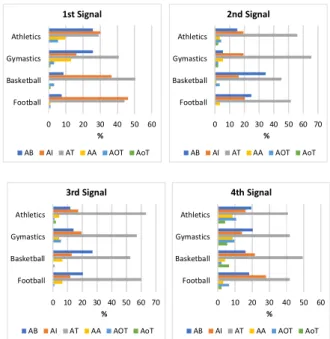
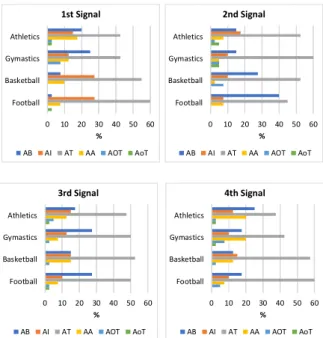
Then we will conduct the same process to verify the existence of attentional patterns in the several sports taught in physical education class, depending on their income (Char-ts 1, 2 and 3).
Students with weak academic achievement shows that they are essentially attentive to the class and its associated components, whereby the percentage values of attention to the task (AT), attention to information (AI) and attention to behaviour (AB) are higher in relation to other categories. The amount of attention to the task (AT) is the highest in all sports evaluated. At the beginning of the class, students with weak academic performance in the practice of team sports have more attention to information (AI) than pupils practi-cing the individual sports, however attention to behaviour (AB) and affective attention (AA) have values higher in in-dividual sports than in collective.
Expose in chart 1 are the attentional profiles of students with weak academic performance in different moments and different sports. At the beginning of the class the students with weak performance, evaluated during the practice of athle-tics are particularly attentive to the task and behaviour. In the main part of the class there has been an increased atten-tion to the task (AT) as opposed to attenatten-tion to the behavio-ur (AB). The percentage levels of affective attention (AA) rise at the end of the class, the attention to the task (AT) decreases and there is an increase on attention to behaviour (AB).
On gymnastics, students with weak performance have more attention to the task (AT) throughout the lesson, with reduced percentages on attentional categories that relate
negatively to the teaching/learning process (Attention off task and attention to other things).
The affective attention (AA) has high values at the first signals in relation to the 3rd and 4th signals. The percentage values of attention to information (AI) are relatively stable throughout the lesson and attention to behaviour (AB) in-creases from the beginning to the end of gymnastics class. In basketball students show to be aware of the task, which have low values of inattention (attention off the task and attention to other things). The initial and final part of the class have values of attention to the behaviour (AB) lower than in the fundamental part of the class. On football, atten-tion to the task (AT) is the attenatten-tional focus with the highest percentage over the class.
Students evaluated on athletics with satisfactory acade-mic achievement begin with more attention to information (AI), attention to task (AT) and attention to behaviour (AB), respectively. From the fundamental part (2nd signal) stu-dents begin to focus more on the task than in the other variables, at the end of the class the values of attention to behaviour (AB) and attention to information (AI) begin to increase. We observed that the attentional profile of stu-dents evaluated on gymnastics have many similarities to the profile of athletics students in the 2nd signal. «Gymnasts» have higher percentages of attention to the task (AT) than students of athletics, and the opposite happens at the end of the key part (3rd signal).
In collective sports (basketball and football) students with satisfactory performance show a very similar attentio-nal profile throughout the lesson, where attention to the task (AT), attention to information (AI) and attention to behavio-ur (AB) stand out. Note an exception in the beginning of the class where students of football are more attentive to infor-mation (AI) than to the task.
As in previous charts, we can see some similar traits among the team sports profiles (basketball and football) and the individual ones (athletics and gymnastics). We denote
Graphic 1 - Attentional profile of students with weak academic performance in different sports. Attention to the behaviour (AB), attention to information (AI), attention to task (AT), emotional attention (AA), attention off the task (AOT) and attention to other things (AoT).
0 10 20 30 40 50 60 Athletics Gymastics Basketball Football % 1st Signal AB AI AT AA AOT AoT 0 10 20 30 40 50 60 Athletics Gymastics Basketball Football % 2nd Signal AB AI AT AA AOT AoT 0 10 20 30 40 50 60 Athletics Gymastics Basketball Football % 3rd Signal AB AI AT AA AOT AoT 0 10 20 30 40 50 60 Athletics Gymastics Basketball Football % 4th Signal AB AI AT AA AOT AoT 0 10 20 30 40 50 60 Athletics Gymastics Basketball Football % 1st Signal AB AI AT AA AOT AoT 0 10 20 30 40 50 60 70 Athletics Gymastics Basketball Football % 2nd Signal AB AI AT AA AOT AoT 0 10 20 30 40 50 60 70 Athletics Gymastics Basketball Football % 3rd Signal AB AI AT AA AOT AoT 0 10 20 30 40 50 60 Athletics Gymastics Basketball Football % 4th Signal AB AI AT AA AOT AoT
Graphic 2 - Attentional profile of students with satisfactory performance in different sports. Attention to the behaviour (AB), attention to information (AI), attention to task (AT), affective attention (AA), attention off the task (AOT) and attention to other things (AoT).
that students with good academic achievement, evaluated during the practice of athletics and gymnastics, are mainly attentive to the task (AT) and to behaviour (AB), at the be-ginning and end of the class. The basketball and football students however have higher percentage values in atten-tion to the task (AT) and attenatten-tion to informaatten-tion (AI) than in individual sports.
During the main part of the class students of team sports have more attention to the task (AT) and attention to beha-viour (AB) instead of attention to information (AI). Students of gymnastics and athletics are more focused on the task and behaviour during almost all signals except signal 2. On the end of the class we can see higher levels of affective attention (AA) than in the rest of the class.
Its observable that there are some traces in attentional profiles depending on their academic performance, so we have verified the existence of statistically significant diffe-rences on different sports, where we found only diffediffe-rences in football (1st signal) and gymnastics (2nd signal), as shown in table 5.
With these results we search for where the differences are, from the residual adjustments on their signals. In the 1st signal in football are the differences in students with weak academic performance and attention to other things (AoT; residual adjustments = 2.6) in satisfactory academic perfor-mance and attention to information (AI; residual adjust-ments = 2.0) and attention to other things (AoT; residual adjustments = 2.1) on good academic achievement and affec-tive attention (AA; residual adjustments = 2.3).
In the case of the 2nd signal on gymnastics, differences
occur in weak academic performance and attention to beha-viour (AB; residual adjustments = 3.1) as well as attention to the task (residual adjustments = 2.2) and affective attention (AA; residual adjustments = 2.1). We have also found diffe-rences in students with satisfactory academic achievement and attention to behaviour (AB; residual adjustments = 2.9).
Discussion of Results
Our results show that students during physical educa-tion classes, are especially attentive to the task, these values will meet studies like Petrica (2003), Santos (2009) and San-tos et al. (2019) which also found that attention to the task is the one that stands out more in comparisson to the remai-ning attentional categories.
We denote although the percentage values of attention to the task (AT) are higher on students with satisfactory/ good academic achievement, than on students with lower academic performance. This is consistent with the results of Wolf, Batista and Delgado (2015) and Batista, Lercas, Ferrei-ra, Taborda and Faustino (2016) to conclude that there is a positive trend between academic performance and the num-ber of hours of sports practice. However students with weak academic performance report being more inattentive to class issues and the teacher, in relation to students with higher performance, whose percentages for the attention outside the task and in other things are low.
The pace of learning is variable from individual to indivi-dual, so that the students’ attention to the contents taught is indispensable, with time and experience they can unders-tand and acquire new skills, and attention will be one of the factors that will dictate if the development is faster and bet-ter (Ladewig, 2017). It is also necessary that the teacher can create and adapt their ways of teaching to their target au-dience, not only to captivate their attention and promote their development, but also to effectively give more motor engagement time as possible, to contribute to a good physi-cal, psychological and social development, as is also evi-denced in studies of Chaddocka, et al. (2010), Erwin, Fedewa and Ahn (2012), Ardoy et al. (2014).
In terms of differences between groups, unlike Santos (2009), we detected statistically significant differences on the final part of the class (4th signal), among students with good academic performance and affective attention (AA), and among students with lower academic achievement and attention to other things (AoT). For the 1st and 2nd signals the assumptions were not fully met (number of expected cells is higher then 20%), but was not far beyond what would be the desirable value, we will accept these results as indica-tors to investigate further in the future. The differences are in the initial and fundamental part of the class, between stu-dents with weak academic performance and the attention to other things (AoT) and affective attention (AA).
On attentional profiles of the different sports we found some interesting similarities, with some attentional patterns between the two individual sports and the two team sports. This leads us to think about the strategy that is used by the teacher, taking into account the waiting times that can dis-perse students attention more of the class issues because they are not in practice, which reduces the motor time
com-0 10 20 30 40 50 60 Athletics Gymastics Basketball Football % 1st Signal AB AI AT AA AOT AoT 0 10 20 30 40 50 60 Athletics Gymastics Basketball Football % 2nd Signal AB AI AT AA AOT AoT 0 10 20 30 40 50 60 Athletics Gymastics Basketball Football % 3rd Signal AB AI AT AA AOT AoT 0 10 20 30 40 50 60 Athletics Gymastics Basketball Football % 4th Signal AB AI AT AA AOT AoT
Graphic 3 - Attentional profile of students with good performance in different sports. Attention to the behaviour (AB), attention to information (AI), attention to task (AT), affective attention (AA), attention off the task (AOT) and attention to other things (AoT).
Table 6
Values ??of the Chi-Squared and Kruskal-Wallis at different times on the four sports practiced. 1st Signal 2nd Signal 3rd Signal 4 Signal
Chi-Squared (?2) Kruskal-Wallis Chi-Squared (?2) Kruskal-Wallis Chi-Squared (?2) Kruskal-Wallis Chi-Squared (?2) Kruskal-Wallis Athletics .198 .084 .238 .346 .295 .247 .245 .210 Gymnastics .887 .903 .017* .028* .278 .220 638 .635 Basketball .140 .077 .105 .198 .083 .143 .327 .275 Football .015* .019* .107 .089 .775 .723 .062 .097 (* p <.05)
mitment and this may be an explanation for our differences in students with weak academic performance with attention to other things (AoT; residual adjustments = 2.8).
The results suggest that the affective attention (AA) has significant results on students with good academic per-formance (residual adjustments = 3.9) and the students du-ring this exercise with weak academic performance (residual adjustments = 2.1), however the affective attention (AA) is an attentional category that can create some doubts, as pre-viously mentioned the practice of physical activity promo-ted in physical education classes also develops the socio-affective component, however if this is not directed to the class content then the students are distracted.
We tried to find differences between attentional catego-ries according to academic achievement on four different sports, the statistical tests show differences in the gymnas-tics (2nd signal) and football (1st signal), however we can only take these results as good indicators of the existence of statistically significant differences because the expected number of cells are exceeded (61.1%).
Conclusions and Recommendations
The attention of students during physical education class is focused mainly on the task and less focused on things outside the class regardless of their academic performance, but attention values of students with satisfactory/good aca-demic achievement have an attentional profile more directed to improve the teaching/learning process.
The differences found are good indicators that students with a satisfactory and good academic achievement reveal attentional levels of attention to the task (AT) more stable, than students with weak academic performance. In this way we remember the importance of improving the forms of inter-vention of teachers in physical education classes to develop strategies to give more time to students in order to increase motor commitment. One way to monetize the time it is the quality and quantity of information provided to students, «using» students to help on organization of the lecture ma-terial, between these and others, it is possible to adapt cer-tain aspects to recer-tain students’ attention (Grube, Ryan, Lo-well, & Stringer, 2018).
In attentional profiles, when comparing the sports we can observe an attentional pattern that may result from the context and teaching strategies. As is the case with attention to information (AI) on the 1st signal, whose percentages are higher on team sports than on individual ones, as it will be when the teacher explains the lesson objectives and the ne-cessary information, this factor seems to outstand on team sports, perhaps because these sports have many group exer-cises that depending on the amount of information requires more time to explain, and therefore is required more attention from the students.
Similarly there has been generally a high percentage of attention to the behavior (AB), especially in the key part of the class, perhaps because students have already begun to practice and also focus their attention on the behavior of their colleagues.
Thought is a complex variable to analyze and therefore «questioned students» to know exactly what catches their
attention. Unfortunately we did not find many recent studies that have been used the same procedures so we can make more comparisons or establish more relationships, however, we recommend a sample increase and methodological repli-cation of the study so that we can take more concrete infe-rences face the theme.
Author Information
*Jorge Manuel Folgado dos Santos, *João Manuel Patricio Duarte Petrica, *João Júlio Matos Serrano, *Marco Alexandre da Silva Batista, *Samuel Alexandre de Almeida Honório, **Luis Alberto Coelho Rebelo Maia
*SHERU (Sport, Health and Exercise Research Unit), Polytechnic Institute of Castelo Branco ** Beira Interior University, Portugal - Center in Sports Sciences, Health Sciences and Human Development (CIDESD)
References
Ardoy, D., Rodriguez-Fernandez, J., Jiménez-Pavon, D., Cas-tillo, R., Ruiz, JR. & Ortega, F. (2014). The Physical Educa-tion Improves trial adolescents’ cognitive performance and academic achievement: the EDUFIT study. Scandi-navian Journal of Medicine & Science in Sport, 12, 52-61
Bellies, C., Figueiredo, N., Aurelio H. & Grindstone, A. (2018). Physical Education, Physical Fitness and Academic Per-formance. Newsletter Portuguese Society of Physical Education, 41, 67-82.
Baptist, A.S., Lercas, A.J., Ferreira, D., Taborda, B. & Fausti-no, A.J. (2016). Academic Performance Evaluation in Vo-lume function oriented and Body Coordination Quotient Children 1st cycle. E-handball: Journal of Sport Scien-ce, 12(3), 185-194.
Budde, H., Voelcker-Rehage, C., Pietrabyk-Kendziorra, S., Ribeiro, P. & Tidow, G. (2008). Acute coordinative exerci-se Improves attentional performance in adolescents. Neu-roscience Letters, 441(2), 219-223
Bullitt, E., Rahman, F.N., Smith, J.K., Kim, E., Zeng, D., Katz, L.M. & Marks, B.L. (2009). The effect of exercise on the brain vasculature of healthy subjects aged visualized by the MR Angiography. American Journal of Neurora-diology, 30, 1857-1863.
Calahorro-Canada, F., Torres-Luque, G., Lopez-Fernandez, I. & Carnero, E.A. (2016). Physical Education is an effecti-ve way to Increase physical activity in children with lo-wer cardiorespiratory fitness? Scandinavian Journal of Medicine & Science in Sport, 27(11), 1417-1422 Chaddocka, L., Erickson, K., Prakash, R.S., Kim, J.S., Voss,
M., VanPatter, M. & Kramer, A. (2010). The neuroimaging investigation of the association between aerobic fitness, hippocampal volume and memory performance in prea-dolescent children. Elsevier, 12, 172-183.
Cotman, C.W., Berchtold, N.C. & Christie, L.A. (2007). Exerci-se builds brain health: key roles cascades of growth fac-tor and inflammation. Elsevier, 30(9), 464-472.
Erwin, H., Fedewa, A. & Ahn, S. (2012). Student Academic Performance Outcomess Classroom of Physical Activity Intervention: A Pilot Study. International Journal of
Elec-tronic Elementary Education, 4(3), 473-487.
Cornejo-Esteban, I., Gonzalez-Tejero, M.C., Gomez-Martinez, D., Del Campo, J., Gonzalez-cock, A., Moledo-Padilla, C. & Veiga, L.W. (2014). Independent and Combined In-fluence of the Components of Physical Fitness on Aca-demic Performance in Youth. The Journal of Pediatrics, 165(2), 306-312.
Fehmi, L.G. & Shor, S.B. (1990). Open Focus: The Attentional Foundation of Health and Well-being. In BJ Diehl, & T. Miller, Moderne Suggestionsverfahren (pp. 425-437). USA: Springer.
Hermoso-Garcia, A. (2016). Aerobic capacity as a mediator of the influence of birth weight and school performance. Journal of Developmental Origins of Health and Disea-se, 7(4), 337-341
Grube, D., Ryan, S. Lowell, S. & Stringer, A. (2018). Effective Classroom Management in Physical Education: Strate-gies for Beginning Teachers. Journal of Physical Edu-cation, Recreation & Dance, 89(8), 47-52.
Kamijo, K., Pontifex, M.B., O’Leary, K.C., Scudder, M.R., Wu, C.T., Castelli, M.D. & Hillman, C.H. (2011). The effects of physical activity an afterschool program on working me-mory in preadolescent children. Developmental Scien-ce, 14(5), 1046-1058.
Ladewig, I. (2017). The importance of attention in learning motor skills. Paulista journal Physics Education (su-ppl.3), 62-71.
Wolf, A., Batista, M. & Delgado, S.C. (2015). Physical activi-ty as a boosting factor of psychological variables and academic performance of primary school students. Latin American Journal of Psychology Ejercicio y el del Sport, 10(1), 85-93.
Marques, A., Gomez, F., Martinez, J., Catunda, R. & Sarmen-to, H. (2017). Association between physical education, school-based physical activity, and academic performan-ce: a systematic review. Straight(31), 316-320.
Martins, J., Marques, A., Diniz, J. & Costa, F.C. (2010). Stu-dents lifestyle characterization of basic education with different levels of school performance. Newsletter Por-tuguese Society of Physical Education, (35), 87-98. Nideffer, R.M.,« & Sagal, M.S. (2010). Concentration and
attention control training. In J. Williams, Sport Applied Psychology: Personal Growth to Peak Performance (6th ed, pp 382-403..). New York: McGraw-Hill Higher Educa-tion.
Peralta, M., Maurice, I., Lopes, M., Costa, S., Sarmento, H. & Marques, A. (2014). The relationship between physical education and academic performance of adolescents: a systematic review. Journal of Child and Adolescent Psy-chology, 5 (2), 129-137.
Pesce, C., Crova, C., Cereatti, L., Casella, R. & Bellucci, M. (2009). Physical activity and mental performance in prea-dolescents: Effects of acute exercise on free-recall me-mory. Mental Health and Physical Activity, 2(1), 16-2. Petrica, J. (2003). The formation of Physical Education
tea-chers: Analysis of visible and invisible dimension of edu-cation due to different models of preparation for practi-ce. Vila Real: University of Tras-os-Montes and Alto Douro.
Petrica, J.M. & Tavares, G.N. (1999). Study of attention in
Physical Education. Magazine Section of Physical Edu-cation, (1), 61-71.
Santana, D.C., Azevedo, L.B., Cattuzzo, M.T., Hill, J.O., An-drade, L.P. & Prado, W.L. (2017). Physical fitness and academic performance in youth: A systematic review. Scandinavian Journal of Medicine & Science in Spor-ts, (27), 579-603.
Santos, J. (2009). The attention and school performance in physical education. Master’s thesis, not published: Uni-versity of Minho.
Santos, J.M., Petrica, J.M. & Maia, L.A. (2019). Study of the attention and its importance in teaching / learning spor-ts. Retos. Nuevas tendencias en Educación Física, De-porte y Recreación (36), 457 - 460.
Santos, J., Maia, L., Petrica, J., Serrano, J., Batista, M., & Honorio, S. (2019). Attention in physical education clas-ses: Differences between individual different modalities. Human Journal of Sport and Exercise, 14 (1proc), S37 -S46.
Santos, J., Maia, L., Petrica, J., Serrano, J., Batista, M., Lercas, A., & Honório, S. (2020). Attention in physical education classes: Differences between colletive sports. Retos. Nuevas tendencias en Educación Física, Deporte y Re-creación – (37), 129 - 133
Sharpe, D. (2015). Your Chi-Square Test is statistically Signi-ficant: Now What? Practical Assessment, Evaluation & Research, 20(8), 1-10.
Torrijos-Nino, C., Martinez-Vizcaíno, V., Brown-Guijarro, M.J., Garcia-Prieto, J.C., Arias Palencia, N.M. & Sanchez-Lo-pez, M. (2014). Physical Fitness, Obesity, and Academic Achievement in Schoolchildren. The Journal of Pedia-trics, 8, 104-109.
Trudeau, F. & Shepard, R. (2008). Physical education, school physical activity, school sports and academic performan-ce. International Journal of Behavioral Nutrition and Physical Activity, 10 (5), 1-12.
Tsetseli, M. Zetou, E., Vernadakis, N. & Mountaki, F. (2018). The attentional focus impact on tennis skills’ technique in 10 and under years old players: Implications for real game situations. Human Journal of Sport and Exercise, 13 (2), 328-339.
Weinberg, R.S. & Gould, D. (2019). Concentration. RS Wein-berg & D. Gould, Foundations of Sport and Exercise Psy-chology (7th ed., Pp. 381-414). Champain: Human Kine-tics.
Wigfield, A., Cambria, J. & Eccles, J.S. (2012). Motivation, personality, and social development Within embedded contexts: An overview of self-determination theory. RM Ryan, The Oxford Handbook of human motivation (pp. 463-475). Oxford: Oxford Library of Psychology.