AR
TICLE
1 Escola Nacional de Saúde Pública, Fiocruz. R. Leopoldo Bulhões 1480, Manguinhos. 21041-210 Rio de Janeiro RJ Brasil. [email protected]
Relations between Representation and Involvement at the Rio de
Janeiro Municipal Health Council (CMS): user sector, 2013-2014
Abstract This article analyzes the influence of “Representative Configuration” of the Rio de Ja-neiro Municipal Health Council (CMS) on user counselor performance. Representative Configu-ration is defined as being a combination of two institutional rule axes: Axis 1 consists of eligibility and involvement rules, and Axis 2, of represen-tation rules. The theoretical discussion was cen-tered on the relationship between Representation and Involvement in its contemporary democratic context, and specifically relates to the Municipal Health Council (CMS). The study method fo-cused on Participative Observation, Interviews, and Document Analysis. The results show that the district counsel representatives act based on the mandate of those they represent, since they cre-ate close ties with these institutions, whereas mu-nicipal counselors are more likely to lean towards autonomy in their representation, resulting in weaker ties with these bodies. The representatives’ mandate-based posture is combined with a more in-depth involvement in meetings and greater ex-pression of their represented citizens’ interests. Key words Health councils, Social participation, Representation
Raphael Batista de Rezende 1
R
ez
e
nd
e RB
, M
Introduction
The current Brazilian democratic structure is comprised of Management Councils whose role is to expand the involvement of the community in public policy decision processes and to act as a constant presence in renewing contemporary democratic actions1-3. Studies of these councils regularly monitor the advances and limitations of the involvement and actions of local political figures4. However, recent actions have also ex-amined the possibility of reconfiguring the rep-resentation of the community in such instances and the effectiveness of its involvement3,5-7.
The major strong suits of the Health Coun-cils in this scenario are the strength of their in-stitutionalization and their decision powers at all stages of the policy cycle8,9, the latter assured by this sector’s organic legislation. Accordingly, the councils encourage social involvement in the SUS (Single Health System) which includes sectors di-rectly linked to this System: users, workers, man-agers, and service providers10.
A significant proportion of the Health Coun-cil assessments address the advances and (espe-cially) the limits of the effectiveness of the social control in SUS, and relates them to the inability of these bodies to transform the capitalist social structure11 or to modify the traditional politi-cal culture of the national institutions, thereby prevailing over their authoritarian and elitist trends12,13. These criticisms tend to undermine legal objectives and undercut the Councils’ other Health management roles10, such as voicing the demands of the community and deciding on the sector’s policies14.
Conversely, few studies have been made of representation within the Councils, which fur-ther diminishes exploration of relations between the counselors and the citizens they represent. The aim of this article is to contribute to bridg-ing this gap by analyzing the relations between Representation and Involvement in the Munici-pal Health Council (CMS) environment, in the context of institutional regulations.
The premise applied was that rules of repre-sentation favoring contact between the counsel-ors and the citizens they represent lead to greater representative involvement in the daily life of the Municipal Health Council (CMS) (i.e., in health policies), which also becomes more effective since it is based on the needs of the represented citi-zens. Furthermore, to the degree that the rules of eligibility enable democratic access to the Coun-cils and the rules of involvement enable equitable
conditions for counselor action, the greater the likelihood that the needs of the represented pop-ulation will influence these bodies’ activities.
This premise was tested at the Rio de Janeiro Municipal Health Council (CMS-RJ) and focused on the user sector. For this, an analytical model was prepared based on the concept of “Repre-sentative Configuration”. This consists of two institutional rule axes: Axis 1 involves the rules of eligibility, which define entities and counselors, and the rules of involvement, which create the limitations for these individuals’ actions; Axis 2 covers the rules of representation for the bodies that monitor counselor relations, and define the nature of the representation to be provided.
Thus, the aim of the article is to analyze the influence of the “Representative Configuration” of the Rio de Janeiro Municipal Health Council (CMS-RJ) in respect of the actions of its user counselors between 2013 and 2014.
Methodological Aspects
Here, a quality approach study was carried out analyzing the rules of eligibility and involvement of the CMS-RJ, via an assessment of this body’s normative documents and interviews with the counselors, and the rules of representation of the user organizations, based on such interviews. The performance of CMS-RJ counselors in 2013 and 2014 was also analyzed via Participatory Ob-servation and studies of the minutes of meetings and of the interviews.
All the interviews were based on script of 12 open questions and all were recorded. The entire material was transcribed and, immediately there-after, the more material passages were systemized to enable their analysis. This analysis was based on data on the eligibility of the counselors, their relationships with one another and the citizens they represented, and the performance of the players in the CMS-RJ. Participatory Observa-tion occurred during Council meetings from May to December 2014 utilizing a specific script to study the representation and involvement of these counselors.
e C
ole
tiv
a,
21(5):1409-1420,
2016
the period under study, which reduced the re-search to the 18 titular counselors who attended, at least, one meeting.
The study was approved by the Ethics in Re-search Committee of ENSP/FIOCRUZ. As re-quired under Bioethics principles, the study was submitted to the plenary Council session of the CMS-RJ, in the presence of the researcher at the meetings, and the counselors were invited to take part in the research after clearly presenting their objectives. Accordingly, all 18 subjects decided to take part and signed the Free and Clarified Term of Consent.
In order to place the results of the study in context, we present the theoretical references on which the analytical model of the data collected is based.
Democracy, representation, and involvement
The historic debate on Democracy has always involved thought currents and political move-ments in theoretical and ideological conflicts arising from the hegemony of the most virtuous ‘democratic ideal’ for organizing the political and social areas. Here, the ‘Involvement’ and ‘Repre-sentation’ concepts appear as essential elements of contemporary democratic agreements since, respectively, they indicate the contingent of cit-izens involved in the election of government and its political instances9,15 and the mechanism whereby involvement in mass democracies be-comes operational via the actions of the repre-sentatives in the decision-making arenas15,16. Al-ternatively, the ‘Representative Democracy’ and ‘Participative Democracy’ models are locked in a dogmatic battle regarding the organizational format of the political systems, where the former has been undisputed leader over recent decades1. A leading player here is Robert Dahl’s15 pol-yarchy model, that demonstrates government ca-pacity to continuously respond to citizen demand as an expression of the democratic ideal. It is Dahl’s view that the institutional developments of national governments which lead to an increase in the number and variety of citizens whose in-terests are represented in the government, cul-minating in the formation of Polyarchies. This transition requires both the assurance of political equality distributed over the inclusivity axes, re-flecting the increased numbers of political com-petition participants, and of liberalization, which brings together the rules and institutional condi-tions to ensure the feasibility of this competition.
Dahl indicates three main channels for a Polyarchy: (i) the simultaneous development of two axes; (ii) the advance of liberalization over inclusivity, thereby enabling the legitimization of democratic institutions prior to expanding citi-zen involvement; (iii) the advance of inclusivity over liberalization, which requires the formation of such institutions in areas of great conflict, due to the diversity of the players15. Although the au-thor believes that the second trail, blazed by the more traditional polyarchies, is more successful in its mission to establish democracy, the last trail, closer to the reality of Brazilian history, has shown itself to be insufficiently stable for demo-cratic consolidation.
In a context above and beyond the level of national governments, Dahl points out the im-portance of institutional rules to define the di-rections of involvement and representation in democratic instances15, thereby enabling the ap-plication of his ideas in Health Council analyses. In defining eligibility as the third axis of the polyarchy model, Wanderley Guilherme dos San-tos highlights the importance of its role in demo-cratic stability given that the changes in the rules of eligibility demonstrate the number of partic-ipants, both in democratic and non-democratic circumstances17.
Recent work has criticized the representative model and challenged the difficulties in attain-ing effective citizen involvement in politics and in formalizing the representation of social de-mands. Democratic revitalization options based on complementing the representative structure with innovative mechanisms expanding the in-volvement and representation of citizens in pub-lic decisions, have been submitted1,5,18,19. In the Brazilian scenario, the Municipal Health Coun-cils (CMS) report on important events experi-enced since they established a presence in all mu-nicipalities of the country as organizations with a decision role in health policies8.
The increased communication between Rep-resentation and Involvement in the democratic field have been examined in the context of politi-cal representation as a concrete activity according to Hanna Pitkin16, where the actions of the rep-resentatives in political situations and their rela-tionship with the citizens they represent are the determinants that consolidate the representation of people and groups.
R
ez
e
nd
e RB
, M
But, in the case of the extreme autonomy trend views, the path to addressing the general inter-ests is to grant independence so that the repre-sentatives can act in accordance with their own judgments regarding the well being of the people, and where the government consists of rational decisions taken by the politicians, with minimal regard for the wishes of the general public16.
For Pitkin, not only are they not representa-tion since they ignore representing-represented relations, but these polar prospects represent a theoretical dispute and insoluble practice, known as the autonomy mandate controversy. Thus, rep-resentation involves elements of both trends, marking the boundaries of a dilemma for the representatives: to fight for the interests of the represented citizens via a mandate posture or to strive in the general interest according to their views, by assuming the autonomy posture? With-in these limitations, effectiveness and legitimacy represent reasonably independent action by rep-resentatives who ally their political views to the interests of their represented citizens, defined as autonomy-mandate posture16.
Since the above discussion shows that Rep-resentation and Involvement are indissolubly related in the context of democratic institutions, this line of reasoning will be projected into the context of the Municipal Health Council (CMS).
Representation and Involvement in the Municipal Health Councils (CMS)
The Municipal Health Council (CMS) ex-periment has been recorded in a series of studies describing their functions in a number of differ-ent local situations. Some point to obstacles in involvement, relating to asymmetrical counselor funds20, the prevalence of the managers’ technical pronouncements21 and the pervading nature of au-thoritarian culture in the councils22,23. Others focus on decision attributions, and associate them with a number of different topics such as the dynamics of counselor action24, specifics of associationism in Brazil25, and functional assessment models26. Representation aspects have warranted very few consistent analyses, chief among which are sugges-tions of publicizing the selection of representatives and the application of more inclusive mechanisms of a variety of community organizations27.
Furthermore, some studies stress the chal-lenges of carrying out social controls, explaining them as: restrictions on the representations of the users in the neo-liberal environment28, man-agers’ control over the agenda29, elitism and
bu-reaucratic councils30, and minimal disclosure of actions taken, and distancing between represen-tatives and their bases31.
In their review of these studies, Moreira and Escorel8 show that Municipal Health Councils (CMS) contribute to democratizing municipal health policy by expanding and diversifying the players involved in SUS decisions, but this does not guarantee that they are sufficiently part of this decision process to ensure its full democra-tization. In their study of the Brazil-wide Mu-nicipal Health Councils (CMS), after applying an analytical model based on the Polyarchy theory15, the authors conclude that the institutional rules successfully increase involvement, but are insuffi-cient to ensure the institutional consolidation of the councils. This situation has encouraged the Municipal Health Councils (CMS) to take a veto player position in sector decisions. This caused managers to withhold needed working funds8.
Following this view in the light of the auton-omy-mandate controversy16, Moreira10 analyzed the representation of Brazil’s Municipal Health Council (CMS) sectors, describing their users as being part of a “scattered multiplicity” – entities with a variety of interests and differing among themselves – which encourages the counselors to take mandate type positions whose decisions are based on vetoing other players’ proposals. Equal-ly, the representatives of the other sectors tend to take mandate positions, even if their interests are more consistent and the counselors’ actions in-clude alliances with other sectors.
In order to refine the results of these national studies8,10, an analytical model of the Represen-tation-Involvement in specific Municipal Health Councils (CMS) based on the “Representative Configuration” concept was drawn up, and ap-plied to the reality of CMS-RJ users.
Representation and involvement in the Municipal Health Council – RJ (CMS-RJ)
e C
ole
tiv
a,
21(5):1409-1420,
2016
Law No. 5104/2009 establishes that the Rio de Janeiro Municipal Health Council (CMS-RJ) functions on a quadrennial basis, with 40 estab-lishments distributed on a user parity represen-tation basis. This law also determines that the 20 user seats be divided among the ten District Health Councils (CODS) – located in the city’s Health Planning Areas (APs)32 – and 10 municipal entities. The composition of the current CMS-RJ sector includes the entities listed in Chart 1.
Although the institutional missions of these entities differ among themselves, thereby re-producing a “scattered multiplicity” situation10, among the Brazilian Municipal Health Council (CMS) users, what actually defines the represen-tative sector arrangement of the CMS-RJ is the split into two specific groups of the CODS and the municipal bodies.
While the municipal entity counselors are se-lected and regulate their actions based on a “dual representation mechanism” (representing their entities and the user sector10), the district coun-selors carry out these activities based on a triple
representation mechanism, since they represent their own entities, the CODS, and the user sector. This third representation level (District Council) introduces specific duties that interfere with the CMS-RJ Representative Configuration and, thus, in the representative and involvement of the us-ers and in the actions of the Council itself.
In order to display the central results of the study, the Representative Configuration estab-lished as being the category representing the two rule axes: Axis 1 involves the rules of eligibility, which define the entities and counselors involved, and the rules of involvement, which demarcate the possibilities of action of these players; Axis 2 covers the entities’ rules of representation, which channel inter-counselor relations, and classify the type of representation carried out.
Axis 1 of representative configuration: rules of eligibility and Involvement
CMS-RJ rules of involvement, established by Law No. 5104/2009 and the Internal Regulations,
Chart 1. User representation entities with the Rio de Janeiro Municipal Health Council (CMS-RJ) (2012-2015).
1 District Health Councils (CODS) AP 1.0 (City Center, Port Zone, São Cristóvão, Rio Comprido, Santa Tereza, Ilha de Paquetá and neighboring areas)
2 District Health Councils (CODS) AP 2.1 (Copacabana, Botafogo, Lagoa, Rocinha and neighboring areas) 3 District Health Councils (CODS) AP 2.2 (Tijuca, Vila Isabel and neighboring areas)
4 District Health Councils (CODS) AP 3.1 (Penha, Ramos, Complexo do Alemão, Maré, Vigário Geral, Ilha do Governador and neighboring areas)
5 District Health Councils (CODS) AP 3.2 (Méier, Inhaúma, Jacarezinho and neighboring areas) 6 District Health Councils (CODS) AP 3.3 (Anchieta, Irajá, Madureira, Pavuna and neighboring areas) 7 District Health Councils (CODS) AP 4.0 (Barra da Tijuca, Jacarepaguá, Cidade de Deus and neighboring areas) 8 District Health Councils (CODS) AP 5.1 (Bangu, Realengo and neighboring areas)
9 District Health Councils (CODS) AP 5.2 (Campo Grande, Guaratiba and neighboring areas) 10 District Health Councils (CODS) AP 5.3 (Santa Cruz and neighboring areas)
11 Associação Carioca de Distrofia Muscular (ACADIM)
12 Associação de Movimentos dos Renais Vivos e Transplantados do Estado do Rio de Janeiro (AMORVIT- RJ)
13 Associação de Parentes e Amigos de Pessoas com Alzheimer, Doenças Similares e Idosos dependentes (APAZ)*
14 Grupo Unidos de Apoio aos Portadores de Hepatite C*
15 Associação de Amigos, Familiares e Doentes Mentais do Brasil (AFDM) 16 Associação Carioca de Diabéticos (ACD)
17 Grupo Otimismo de Apoio ao Portador de hepatite C
18 Federação das Associações de Favelas do Estado do Estado do Rio (FAFERJ) 19 Federação das Associações de Moradores do Município do Rio de Janeiro (FAM-Rio) 20 Instituto Afro Brasil Cidadão (IABC)
* Entities excluded from the study due to the absence of any representatives in Rio de Janeiro Municipal Health Council (CMS-RJ) meetings.
R
ez
e
nd
e RB
, M
create equitable conditions of action for the counselors at plenary meetings and for the elec-tion to posielec-tions of greater decision power in the entity (Chairman, Substitute Chairman, and Ex-ecutive Committee), without permitting selective privileges and preserving representational parity. However, the rules of eligibility of the CMS-RJ permit differing circumstances for user repre-sentatives, but require an in-depth examination. They establish life-time seats on the ten CODS and competition for the other ten vacancies in the Health Conference elections, for which a va-riety of entities with municipal jurisdiction of action can become candidates. Accordingly, that this last possibility involves “electoral” type rules, as opposed to the “non-electoral” rules to which the CODS are subject.
Selection of the counselors under these enti-ties’ internal eligibility rules is evidence of a sec-ond filter which further underscores the inequi-ties between the users. At this level, the municipal bodies select the counselors under “non-elector-al” rules, i.e., by recommendation of the Pres-ident’s office or the board of directors. This evidences procedures restricted to senior levels which greatly reduce members’ ability to apply for the position of counselor and, normally, this
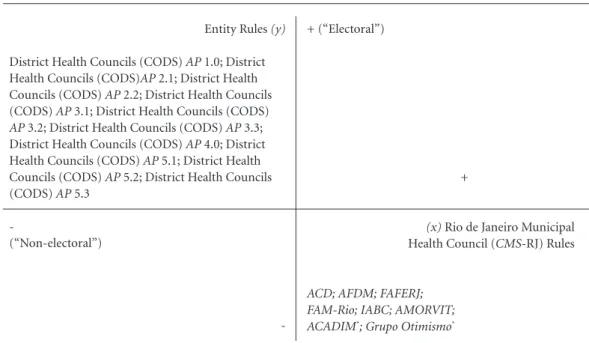
process occurs with absolutely minimal compe-tition. The CODS also have their own “electoral” rules for selecting their municipal representa-tives. In other words, there is a system of open elections for which these bodies may become candidates for office. Graphic 1 shows the oppo-sition in the arrangement of the rules of eligibili-ty for the two groups.
Graphic 1 shows that the selection of the selection of the CODS representatives is based on a combination of CMS-RJ “non-electoral” rules/ internal “electoral” rules. Inversely, the choice of municipal body counselors is based on a sequence of CMS-RJ “electoral” rules/ internal “non-electoral” rules.Since the rules of eligibili-ty not only limit the selection of players involved in the CMS-RJ, but also represent the first level of relationships between the representatives and their represented parties, it is possible to link these rules to counselor representation practices as defined by Hanna Pitkin16.
Axis 2 of the Representative configuration: r rules of representation
Here, we analyzed the rules of representation of the 18 entities that manage the interaction
Graphic 1. Axes of the Rules of Eligibility as applied to Rio de Janeiro Municipal Health Council (CMS-RJ) users.
* Entities indicated by SMS-RJ to be part of the Rio de Janeiro Municipal Health Council (CMS-RJ), despite the recommendations of the rules of eligibility.
Source: Preparation by the Authors based on the normative documents of the Rio de Janeiro Municipal Health Council (CMS-RJ) and on interviews with counselors in office during 2013/2014.
Entity Rules (y)
District Health Councils (CODS) AP 1.0; District Health Councils (CODS)AP 2.1; District Health Councils (CODS) AP 2.2; District Health Councils (CODS) AP 3.1; District Health Councils (CODS) AP 3.2; District Health Councils (CODS) AP 3.3; District Health Councils (CODS) AP 4.0; District Health Councils (CODS) AP 5.1; District Health Councils (CODS) AP 5.2; District Health Councils (CODS) AP 5.3
-
(“Non-electoral”)
-
+ (“Electoral”)
+
(x) Rio de Janeiro Municipal Health Council (CMS-RJ) Rules
ACD; AFDM; FAFERJ; FAM-Rio; IABC; AMORVIT;
e C
ole
tiv
a,
21(5):1409-1420,
2016
with their representatives on the CMS-RJ, deal-ing with representation positions, duly classified as: mandate, autonomy, and autonomy-mandate. This analysis was based on interviews with the counselors, since the municipal entities and the CODS regulations do not explain these rules.
In assigning a value to the influence of the rules of representation in the context of the bal-ance of the mandate and autonomy elements, mandate type positions were deemed to be those chiefly influenced by the interests of the entities and represented groups, while the internal rules were viewed as an important means for strength-ening bonds between the counselors and the en-tities. Autonomy type positions embody the ma-jority representation as guided by the judgment of the respective counselor on how to carry out health policies, in a context where the entities’ rules have a reduced ability to define practices representing the interests of the represented citi-zens. However, autonomy-mandate positions are those where the rules of representation enable counselors to combine the two trends in a bal-anced manner, to thus represent the interests of the entity in line with the general interests of the SUS users, duly symbolized by the “Health as a Right” motto highlighted by Moreira10.
Although the municipal entities hold meet-ings with their represented citizens to deal with health requirements, it is only in the cases of ACD, FAFERJ, FAM-Rio, and IABC that these meeting actually contribute to indicating the in-terests of the respective groups in order to give the representatives a base from which to work. Furthermore, only the FAFERJ and IABC coun-selors advised us that the meetings include spe-cific debates on CMS-RJ matters and the trans-mission of the entity’s involvement.
Thus, it can be seen that few of these entities have rules favoring effective representation prac-tices by the Council. The most emphatic exam-ples are those shown by AFDM, which, currently, does not hold meetings for structural difficulty reasons, and AMORVIT-RJ, and Grupo Otimis-mo, whose representatives state that the actions of the CMS-RJ make no contribution to these entities’ objectives.
These rules of representation features were reflected in a scenario where almost all the mu-nicipal entity counselors (with the exception of the FAM-Rio representative) stated that their ac-tions were substantially guided by their views on the interests of the entities and the needs of SUS, which underscores the influence of the autonomy of representation trend.
In turn, all the CODS have their objective rules for organizing monthly plenary meetings that, given the very nature of the subject matter, involve specific discussion on the health issues of the respective APs, including topics relating directly to the CMS-RJ agenda. Moreover, six of the group members interviewed, mentioned the utilization of practical representation tools, such as reports on involvement in the CMS-RJ, ments showing CODS requirements, and state-ments of position.
The CODS rules of representation also in-clude monthly inter-district meetings between the municipal presidents and representatives of the ten bodies, covering CMS-RJ matters and health-related topics involving the APs. As stated by nine of the individuals interviewed, the pur-pose of these meetings was to discuss the inter-ests of CODS users and reach a common decision regarding the topics under debate.
These rules ensure a robust working relation-ship between the CODS and their representa-tives, to the extent that all group counselors, with the exception of the AP 2.1, representative, stated that their actions were substantially based on the user interests agreed in these councils, a clear il-lustration of the representation mandate trend.
In order to specifically demonstrate these findings, Chart 2 shows the results of the analysis of the rules and representation relations of the 18 entities assessed and listing the rules of eligibility, thus characterizing the Representative Configu-ration of the CMS-RJ.
In the municipal entities, the Elector-al”/“Non-electoral” section of the rules of eligi-bility (Axis 1) does not encourage contact be-tween entities and counselors. This is because the “electoral” rules of the CMS-RJ contain some flaws – both institutions were indicated by the SMS-RJ and the other two (excluded from this study) did not even trouble themselves to be present at the Council – and the entities’ internal rules order the selection of counselors via pro-cedures that neither involve the actions of their members nor the SUS users. By combining this direction with the rules of representation (Axis 2), the counselors of this group tend to a certain autonomy in their CMS-RJ activities, as pointed out in the distribution of representation posi-tions: 4 autonomy types, 3 autonomy-mandates, and 1 mandate.
R
ez
e
nd
e RB
, M
This is combined with a standard set of rules of representation encouraging strong relations be-tween counselors and instances, in addition to bringing together a group of representatives at the inter-district meetings, pursuant to the man-date type model representation, shown by the composition of positions of the group actors: 7 mandate types, 2 autonomy-mandates, and 1 au-tonomy.
Relations between Rio de Janeiro Municipal Health Council (CMS-RJ) representation and involvement
The representation scenario was based on the joint involvement of the counselors in the CMS-RJ, the analysis whereof included monitoring the 24 ordinary assemblies and the extraordinary assemblies of 2013 and 2014. To this end, the Council’s discussion agenda was examined, with
Axis 1:Rio de Janeiro Municipal Health Council (CMS-RJ)rules of eligibility
“Electoral” type*
“Electoral” type*
“Electoral” type
“Electoral” type
“Electoral” type
“Electoral” type
“Electoral” type
“Electoral” type
“Non-electoral” type
“Non-electoral” type
“Non-electoral” type
“Non-electoral” type
“Non-electoral” type
“Non-electoral” type
“Non-electoral” type
“Non-electoral” type
“Non-electoral” type
“Non-electoral” type
Chart 2. Representative Configuration for Rio de Janeiro Municipal Health Council (CMS-RJ) users*.
Entity
ACADIM
Otimismo
AMORVIT-RJ
AFDM
ACD
FAFERJ
FAM-Rio
IABC
District Health Councils(CODS)AP 1.0
District Health Councils(CODS)AP 2.1
District Health Councils(CODS)AP 2.2
District Health Councils(CODS)AP 3.1
District Health Councils(CODS)AP 3.2
District Health Councils(CODS)AP 3.3
District Health Councils(CODS)AP 4.0
District Health Councils(CODS)AP 5.1
District Health Councils(CODS)AP 5.2
District Health Councils(CODS)AP 5.3
* Entities indicated by the SMS-RJ despite the requirements of the rules of eligibility of the Rio de Janeiro Municipal Health Council (CMS-RJ) Source: Prepared by the Authors based on documents of the Rio de Janeiro Municipal Health Council (CMS-RJ) and on interviews with the counselors active in 2013/2014.
Axis 1: Entity rules of eligibility
“Non-electoral” type (president)
“Non-electoral” type (president)
“Non-electoral” type (president)
“Non-electoral” type (board)
“Non-electoral” type (board)
“Non-electoral” type (board)
“Non-electoral” type (board)
“Non-electoral” type (board)
“Electoral” type
“Electoral” type
“Electoral” type
“Electoral” type
“Electoral” type
“Electoral” type
“Electoral” type
“Electoral” type
“Electoral” type
“Electoral” type
Axis 2: Rules of representation
Autonomy
Autonomy
Autonomy
Autonomy
Autonomy-mandate
Autonomy-mandate
Mandate
Autonomy-mandate
Mandate
Autonomy
Mandate
Mandate
Mandate
Mandate
Autonomy-mandate
Autonomy-mandate
Mandate
e C
ole
tiv
a,
21(5):1409-1420,
2016
due importance placed on the three points that led to intense debates and provided opportuni-ties for the counselors to take part in the Health Decision process (i) presentations on patholo-gies, situations, and health-related actions; (ii) explanations by the SMS-RJ; (iii) presentations of SMS-RJ management tools. Value was given to information provided by counselors that, despite not leading to consistent decisions, represented an important user situation activity.
Thus, 38 presentations were covered, 31 of them given by SMS-RJ members (among them some counselors). Of these, 11 were manage-ment tool addresses (SMS-RJ plans, budget directives, rendering of accounts, and admin-istrative reports) with only five voting sessions which approved the materials; six explanations by the SMS-RJ, and 14 presentations on patholo-gies, situations, and health-related actions. This shows management sector leadership in covering these topics, while, in the study period, only three presentations were given by user counselors.
Our analysis of the involvement of these play-ers considered strength of action as being the chief parameter. The criteria applied defined the level of action (+) such as merely attending meetings and taking part in CMS-RJ voting. The (++) level indicates that, in addition to voting, there is also the process of providing the council with im-portant information and sporadic presence at the central points of the topic, without considering SMS-RJ management tools. Then, there is inten-sive action (+++), which is characterized by more frequent interventions in the chief topics with ir-regular action involving management tools. Last-ly, intensity (++++) indicates involvement with consistent and constant interventions in the deci-sions of the CMS-RJ, including such tools.
Another standard utilized in the study was the counselors’ action profile. This enables us to classify the players in accordance with the most characteristic involvement practice for the fol-lowing categories: (i) claiming: action limited to voting; (ii) informative: searching for informa-tion on health-related acinforma-tions; (iii) vocalizing: vocalization of the entities’ interests; (iv) de-mands: demands for improvements in the SUS services; (v) evaluative: evaluations (and criti-cisms) of the manner in which SMS-RJ policies are carried out. Chart 3 shows the results of the assessment of the counselor involvement in the CMS-RJ with the findings on representation.
Chart 3 shows the disparity between the user groups: while all the municipal entity counselors (with the exception of the ACD representative)
were classified by a degree of action (+) or (++), six district counselors took intensive action in the meetings, at (+++) or (++++) and none was classified at (+). In other words, half of the first Group players took part in the meetings purely by exercising their voting right, whereas, at some time, all the District Health Council (CODS) rep-resentatives took part in the central decisions of the CMS-RJ.
Since the Demanding, Vocalizing, and Eval-uative profiles applied to six of the more active district players, it would seem that claims for improvements in the SUS, projection of demand by the entities, and evaluations of the SMS-RJ management policies reveal the actual action of Council users.
Considering that Chart 3 shows the Repre-sentation-Involvement relations of the 18 coun-selors assessed, advances in familiarity with these relations within the environment of the CMS-RJ require an analysis of the user groups. With this in mind, Chart 4 summarizes the research find-ings, and indicates the influence of Representa-tive Configuration in this sector’s performance.
Chart 4 shows that, in the municipal entities, the category of “Electoral”/“Non-electoral” of the rules of eligibility and the rules of representation resulted in an autonomy type representation model, which released an erratic involvement in the CMS-RJ, classified as intensity (+/++). In the CODS, the “Non-electoral”/Electoral” topic of the rules of eligibility combined with the ob-jective rules of representation for the CMS-RJ show a representation model mandate, which reflected faster action at the council, and scored (+++/++++).
The protagonist role of the district counsel-ors is borne out by the occupation of high deci-sion power positions at the CMS-RJ, which offers increased opportunities for involvement in the topics and progress of the meetings. In an inter-val in the study, the two teams from the Executive Commission of the CMS-RJ included six District Health Council (CODS) representatives but only two municipal entity counselors. Furthermore, the President’s two substitutes elected during this period represented the AP councils 5.1 and 5.3.
R
ez
e
nd
e RB
, M
themselves to priority voting topics, to elections to the office of President, and to membership of the board.
At the level of inter-sector relations, where-as, municipal counselors took a neutral position both in respect of taking action and of conflict manifestation, the district counselors (with the exception of the AP 2.1 and 4.0 representatives) were more inclined to form alliances with the management sector in order to work in the in-terests of the users of the respective areas and to strive for upgrades in SUS services. Conflicts were noted between the District Health Council (CODS) representatives and the workers’ sector, the latter persistently opposing the Social Or-ganizations management model, in place at the SMS-RJ.
Accordingly, our findings show that the counselors of the more active users tended not to assume a veto player position in respect of management since their mission was to act in the interests of the represented citizens and for in-ter-district agreements. This bears out the Morei-ra and Escorel analytical model8, since, the less users systematically veto the SMS-RJ proposal, the more management does not react by
restrict-ing funds. This is why the CMS-RJ functions better than most.
Final Considerations
The results shown would suggest that the out-standing involvement of the district counselors in the CMS-RJ shows a substantial representa-tion of user interest as established in the domain of the CODS, resulting in its conspicuous posi-tion at municipal level. This underscores the im-portance of the political and strategic position of the CODS in municipal health decision policies, as much as for handling major SUS services man-agement as for bringing to bear their proposals at the CMS-RJ.
It is also apposite to point out that the anal-ysis of the Representative Configuration – joint-ly with the rules of eligibility, involvement, and representation – and its influence on the em-pirical actions of the counselors led to advances in the understanding of the Representation-In-volvement relation at Municipal Health Council (CMS) level, through a specific study in Rio de Janeiro. On this matter, the article contributes
Entity
ACADIM Grupo Otimismo AMORVIT-RJ AFDM ACD FAFERJ FAM-Rio IABC
District Health Councils (CODS)AP 1.0 District Health Councils (CODS) AP 2.1 District Health Councils (CODS) AP 2.2 District Health Councils (CODS) AP 3.1 District Health Councils (CODS) AP 3.2 District Health Councils (CODS) AP 3.3 District Health Councils (CODS) AP 4.0 District Health Councils (CODS) AP 5.1 District Health Councils (CODS) AP 5.2 District Health Councils (CODS) AP 5.3
Chart 3. Representation-Involvement relations of Rio de Janeiro Municipal Health Council (CMS-RJ) users.
Group
Representatives of Municipal Entities
Representatives of District Councils
Source: Prepared by the Authors based on documents of the Rio de Janeiro Municipal Health Council (CMS-RJ) and on interviews with the counselors active in 2013/2014.
Representation position
Autonomy Autonomy Autonomy Autonomy Autonomy-mandate Autonomy-mandate Mandate
Autonomy-mandate Mandate
Autonomy Mandate Mandate Mandate Mandate
Autonomy-mandate Autonomy-mandate Mandate
Mandate
Degree of action
++ + ++
+ ++++
++ + + ++ +++
++ +++
++ +++ ++++
+++ ++ ++++
Synopsis of action
e C
ole
tiv
a,
21(5):1409-1420,
2016
District Councils
“Non-electoral” type: Lifetime seat for all 10 District Health Councils(CODS)
“Electoral” type: Election of the municipal representative from among the District Health Council(CODS) users
Monthly meetings covering topics directly relating to SUS and to theRio de Janeiro Municipal Health Council (CMS-RJ) agendas;
Closer ties between the District Health Council(CODS) representative and inter-district meetings: Mandate Trend
(+++ /++++)
Preferential occupation of senior positions on the Rio de Janeiro Municipal Health Council (CMS-RJ)
Strong alliances in the inter-district meetings;
Discussions with managers to confirm compliance with user demands
Protagonism in involvement in user sector plan, dominating the representation of the interests of AP users; importance in the overall functioning of the CMS-RJ
Chart 4. Representative Configuration Influenceon user action.
Axis 1: Rules of eligibility of the Rio de Janeiro Municipal Health Council (CMS-RJ)
Axis 1: Rules of eligibility for theentities
Axis 2: Rules of representation
Degree of action
Alliances and Conflicts
Action: Representation-Involvement
Source: Prepared by the Authors based on documents of the Rio de Janeiro Municipal Health Council (CMS-RJ) and on interviews with the counselors active in 2013/2014.
Municipal entities
“Electoral” type: Election of 10 entitiesat the World Health Conferences
“Non-electoral” type: Recommendation of the counselor by the entities’ boards/ president
Ineffective rules for running meetings involving debates about the Rio de Janeiro Municipal Health Council (CMS-RJ)and representations practices at this entity; Counselor-entity distancing:
Autonomy Trend
(+/++)
Alliances with users limited to central voting and elections of the Rio de Janeiro Municipal Health Council (CMS-RJ); Minimal alliances and conflicts with other sectors
Secondary involvement in the user plan sector, with limitations in entity representations; discreet role in the dynamics of the functions of the CMS-RJ
to improved familiarity with social involvement in SUS, particularly because it presents objective findings regarding interactions between counsel-ors and entities.
Based on the above and, given the frequent criticisms directed towards the political actions of the councils, it could be suggested that the counselors, experts, and managers discuss rela-tions between counselors, entities, and the
pop-ulation at large, in order to strengthen the rep-resentation of SUS users and to encourage effec-tive and transformaeffec-tive social involvement. The perspective covered in the study is a good reason for discussing the impact of institutional rules on these outcomes. They suggest the need for robust regulations resulting in democratic counselor se-lection processes, allied to involvement practices representing user interests.
Collaborations
R
ez
e
nd
e RB
, M
Fuks M. Participação e influência política no Conselho Municipal de Saúde de Curitiba. Rev Sociol Polit 2005; 25:47-61.
Wendhausen A, Caponi S. O diálogo e a participação em um conselho de saúde em Santa Catarina, Brasil.
Cad Saude Publica 2002; 18(6):1621-1628.
Guizardi FL, Pinheiro R. Dilemas culturais, sociais e políticos da participação dos movimentos sociais nos Conselhos de Saúde. Cien Saude Colet 2006; 11(3):797-805.
Oliveira LC, Pinheiro R. A participação nos conselhos de saúde e sua interface com a cultura política. Cien
Saude Colet 2010; 15(5):2455-2464.
Côrtes SV, Michelotti FC, Goldoni AC, Santos LA. Con-selhos Municipais de Saúde da Região Metropolitana de Porto Alegre: funcionamento, atores e dinâmica das relações sociais. In: Côrtes SV, organizadora. Participa-ção e Saúde no Brasil. Rio de Janeiro: Fiocruz; 2009. p. 145-176.
Avritzer L. Associativismo e Participação na saúde: uma análise da questão na região nordeste do Brasil. In: Fleury S, Lobato LVC, organizadoras. Participação,
democracia e saúde. Rio de Janeiro: CEBES; 2009. p.
151-174
Vieira M, Calvo MCM. Avaliação das condições de atuação de Conselhos Municipais de Saúde no Esta-do de Santa Catarina, Brasil. Cad Saude Publica 2011; 27(12):2315-2326.
Coelho VSP. Conselhos de saúde enquanto instituições políticas: o que está faltando? In: Coelho VSP, Nobre M, organizadores. Participação e Deliberação: teoria
de-mocrática e experiências no Brasil contemporâneo. São
Paulo: Editora 34; 2004. p. 255-269.
Gershman S. Conselhos Municipais de Saúde: atuação e representação das comunidades populares. Cad
Sau-de Publica 2004; 20(6):1670-1681.
Landerdhal MC, Unfer B, Braun K, Skupien JA. Reso-luções do Conselho de Saúde: instrumento de controle social ou documento burocrático? Cien Saude Colet
2010; 15(5):2431-2436.
Morita I, Guimarães JFC, Di Muzio BP. A participa-ção de Conselhos Municipais de Saúde: soluparticipa-ção que se transformou em problema? Saude Soc 2006; 15(1):49-57.
Cotta RMM, Cazal MM, Martins PC. Conselho Muni-cipal de Saúde: (re)pensando a lacuna entre o formato institucional e o espaço de participação social. Cien
Saude Colet 2010; 15(5):2437-2445.
Instituto Pereira Passos (IPP). Anuário Estatístico da ci-dade do Rio de Janeiro. Rio de Janeiro: IPP; 2000.
Article submitted 16/11/2015 Approved 27/01/2016
Final version submitted 29/01/2016 20.
21.
22.
23.
24.
25.
26.
27.
28.
29.
30.
31.
32. References
Santos BS, Avritzer L. Introdução: para ampliar o câ-none democrático. In: Santos BS, organizador. Demo-cratizar a democracia. Os caminhos da democracia par-ticipativa. Rio de Janeiro: Civilização Brasileira; 2002. p. 39-82.
Fung A. Receitas para esferas públicas: oito desenhos institucionais e suas consequências. In: Coelho VSP, Nobre M, organizadores. Participação e Deliberação: teoria democrática e experiências no Brasil contemporâ-neo. São Paulo: Editora 34; 2004. p. 173-209. Lüchmann LHH. A representação no interior das ex-periências de participação. Lua Nova 2007; 70:139-170. Almeida C, Tatagiba L. Os conselhos gestores sob o crivo da política: balanços e perspectivas. Serv Soc Soc
2012; 109:68-92.
Gurza Lavalle A, Houtzager PP, Castello G. Democra-cia, pluralização da representação e sociedade civil. Lua Nova 2006; 67:49-103.
Avritzer L. Sociedade civil, Instituições Participativas e Representação: da autorização à legitimidade da ação.
Dados 2007; 50(3):443-464.
Lüchmann LHH. Associações, participação e represen-tação: combinações e tensões. Lua Nova 2011; 84:141-174.
Moreira MR, Escorel S. Conselhos Municipais de Saúde do Brasil: um debate sobre a democratização da políti-ca de saúde nos vinte anos do SUS. Cien Saude Colet
2009; 14(3):795-806.
Escorel S, Moreira MR. Participação Social. In: Giova-nella L, Escorel S, Lobato LVC, Noronha JC, Carvalho AI, organizadores. Políticas e Sistema de Saúde no Brasil. 2ª Ed. Rio de Janeiro: Fiocruz; 2012. p. 853-883. Moreira MR. Democratização da Política de Saúde: avanços, limites e possibilidades dos Conselhos Munici-pais de Saúde [tese]. Rio de Janeiro (RJ): Escola Nacio-nal de Saúde Pública Sérgio Arouca; 2009.
Bravo MIS, Correia MVC. Desafios do controle social na atualidade. Serv Soc Soc 2012; 109:126-150. Labra ME. Conselhos de Saúde: dilemas, avanços e de-safios. In: Lima NT, Gershman S, Edler FC, Suárez JM, organizadores. Saúde e Democracia: histórias e perspec-tivas do SUS. Rio de Janeiro: Fiocruz; 2005. p. 353-383. Labra ME, Figueiredo JSA. Associativismo, participa-ção e cultura cívica. O potencial dos conselhos de saú-de. Cien Saude Colet 2002; 7(3):537-547.
Côrtes SV. Sistema Único de Saúde: espaços decisórios e a arena política de saúde. Cad Saude Publica 2009; 25(7):1626-1633.
Dahl RA. Poliarquia: Participação e Oposição. São Pau-lo: Edusp; 2012.
Pitkin HF. The Concept of Representation. California: University of California Press; 1967.
Santos WG. Poliarquia em 3D. Rio de Janeiro: Dados. 1998: 41(2):207-281.
Urbinati N. O que torna a representação democrática?
Lua Nova 2006; 67:191-228.
Lima Júnior OB. Instituições Políticas Democráticas –
o segredo da legitimidade. Rio de Janeiro: Jorge Zahar
Editora; 1997. 1.
2.
3. 4.
5.
6.
7.
8.
9.
10.
11. 12.
13.
14.