AR
TICLE
1 Programa de Pós-Graduação em Enfermagem, Universidade Estadual de Maringá. Av. Colombo, Zona 07. 87020-900 Maringá PR Brasil. dé[email protected] 2 Programa de Pós- Graduação em Enfermagem, Universidade Federal de Mato Grosso. Cuiabá MT Brasil.
Factors associated with recurrent falls in a cohort of older adults
Abstract Objective: To analyze the factors asso-ciated with recurrent falls in community-dwelling
older adults from Cuiabá. Methods: This is an
epidemiological, prospective, concurrent cohort study with a two-year follow-up. In-home surveys were conducted in 2012 and 2013. The data were treated by the software Epi Info and SPSS. Bivar-iate analysis investigated associations between risk factors and recurrent falls by calculating the relative risk (RR) of the cumulative incidences with a confidence interval of 95% (95%CI). Mul-tiple analysis with Poisson regression included all variables with p < 0.20 in the crude analyses. The significance level of 5% (p < 0.05) was adopted as significant association for remaining in the final
model. Results: Most older adults (77.6%) had
re-current falls. The variables significantly associated with recurrent falls were older adult’s income of up to two minimum salaries (RR = 1.62; 95%CI 1.04-1.77), absence of arthritis or arthrosis (RR = 1.32; 95%CI 1.10-1.48), having regular to very bad self-perceived health (RR = 1.44; 95%CI 1.12-2.04), and having visual impairment (RR
= 1.23; 95%CI 1.01 -1.69). Conclusions: Falls
in older adults are associated with low education levels, regular to very bad self-perceived health,
visual impairment, and recurrent falls.
Key words Accidents by falls, Older adults, Risk factors
Débora Regina de Oliveira Moura Abreu 1
Rosemeiry Capriata de Souza Azevedo2
Ageo Mario Candido da Silva2
Annelita Almeida Oliveira Reiners 2
A
b
re
u DR
Introduction
Falls are a serious public health problem with di-rect implications on the quality of life and well-being of older adults1,2. The risk of falls increases significantly with age, making this geriatric syn-drome one of the great public health problems because of its high incidence, morbidity, and mortality, and the social and economic costs of the consequent injuries3-5. Roughly 30% of com-munity-dwelling adults fall yearly, 50% of these have recurrent falls, and this proportion increas-es between 32% and 42% in individuals aged more than 70 years1.
Fall is defined as a nonintentional dropping to a lower level without possibility of correction in due time and determined by multifactorial circumstances that compromise stability6. These circumstances stem from intrinsic and extrin-sic factors. Intrinextrin-sic factors include age-related physiological changes; poor balance and gait; vi-sual and auditory impairment; and presence of diseases. The extrinsic factors include environ-mental risks, such as poor lighting and slippery floor; risk behaviors, such as climbing chairs or ladders; and behaviors related to activities of dai-ly living2,6.However, most falls result from the in-teraction of all these factors.
Falls have significant consequences because of the vulnerability of older adults in addition to the factors cited above, such as: less mobility and functionality, higher disease susceptibility, bruis-ing, contusions, fractures, institutionalization, fear of falling again, and repercussion on the lives of family members. Moreover, there is evidence of a strong association between mortality in old-er adults who expold-erienced falls and fall-related injuries, since these are long lasting, even after treatment3,7-10.
In 2011 in Brazil there were 373,105 fall-re-lated hospitalizations in the Unified Healthcare System (SUS). Women aged 60 years or more fall more than men in the same age group, with fall rates of 43.6 per 10 thousand women and 35.7 per 10 thousand men. Accidental falls prevail at 49.8% of the total, followed by falls from stand-ing at 34.4%. In 2010 24,760 people aged more than 60 years died of falls in Brazil11.
Considering that a higher occurrence of falls is common in older adults and that they compro-mise health, reduce quality of life, and increase public spending with inpatient and outpatient care, recurrent falls worsen the health condition of older adults even more. Since most falls occur outside institutions and hospitals, the objective
of this study was to analyze the factors associated with recurrent falls in community-dwelling older adults.
Methods
This is an epidemiological, concurrent, closed cohort study based on a sample of the project “Life and health conditions of older adults from the municipality of Cuiaba-MT”12.
In the initial project, the sample size was de-termined considering a confidence coefficient of 95% (z = 1.96); sampling error of 5%; and proportion of value of 0.5 (p = 0.5). The urban population contained 43,096 older adults. The number of census tracts that would be included by district by cluster sampling was given by the formula
,
where ci is the number of census tracts, Ni
is the number of older adults, Ci is the number of tracts, and ni is the number of older adults in the sample of each district. Eleven of the 355 census tracts of Cuiaba were selected, and based on probability criteria with a sample size correc-tion of 50%, the sample should include 573 older adults.
The present study selected all older adults who had had a fall in the three months prior to data collection, totaling 109 participants. These individuals were interviewed again exactly one year after the first in-home survey conducted by the main researcher from January to March 2013. Between the two surveys six older adults died, so the final sample consisted of 103 participants.
The exposure variables included sociodemo-graphic information (gender, age group, marital status, income, and education level) and health status (self-reported diseases, use of medications, self-perceived health, changes in gait and balance, visual and auditory impairments, and level of physical activity). The Katz et al. Index13 assessed the functional skills of the older adults, and Law-ton & Brody Scale14 assessed the instrumental ac-tivities of daily living. Recurrent falls between the two surveys was the outcome variable.
The questionnaires were coded and digitized twice. Digitalization errors were compared and corrected by the software Data Compare. The data were treated by the programs Epi Info ver-sion 7.0 and SPSS verver-sion 20.0. Descriptive, bi-variate, and multiple analyses were conducted.
ci = * Ni ni
aúd
e C
ole
tiv
a,
21(11):3439-3446,
2016
Descriptive analysis determined the absolute and relative frequencies of the variables. Bivari-ate analysis investigBivari-ated associations between the risk factors and recurrent falls by calculating the relative risk of the cumulative incidences (confi-dence interval of 95%).
Multiple analysis with Poisson regression in-cluded all variables with associations with p-val-ue < 0.20 in the crude analyses. The variables gender and marital status were maintained for better model adjustment. The significance level of 5% (p<0.05) was adopted as a significant asso-ciation for remaining in the final model.
This project was approved by the local Re-search Ethics Committee and complied with the guidelines of Resolution 466/2012 of the Nation-al HeNation-alth Council (CNS).
Results
The study sample had a prevalence of recurrent falls of 77.6%. Table 1 shows the sociodemo-graphic variables of the older adults who expe-rienced recurrent falls. Most were females (65%) aged more than 70 years (63.8%). Almost half (47.5%) had partners, 53.7% had up to three years of formal education, and 93.7% had a fam-ily income of up to two minimum salaries.
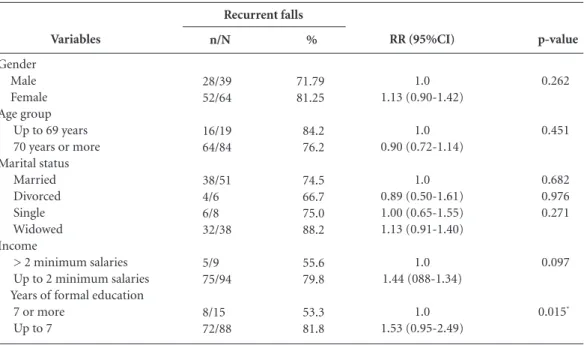
In the bivariate analysis between recurrent falls and sociodemographic variables, recurrent falls was associated with up to seven years of formal education (RR = 1.53; 95%CI 0.95-2.49) (Table 2).
Recurrent falls was also associated with regu-lar to very bad self-perceived health (RR = 1.80; 95%CI 0.86-3.78) (Table 3).
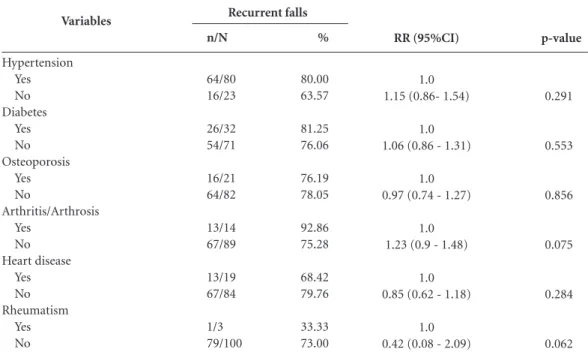
Tables 4 and 5 show the distribution of older adults who experienced recurrent falls according to the presence of some diseases and the results of the multiple Poisson model, respectively. The following variables remained associated with re-current falls: income of up to two minimum sala-ries (RR = 1.62; 95%CI 1.04-1.77), absence of ar-thritis or arthrosis (RR = 1.32; 95%CI 1.10-1.48), having regular to very bad self-perceived health (RR = 1.44; 95%CI 1.12-2.04), and having visual impairment (RR = 1.23; 95%CI 1.01-1.69).
Discussion
This is one of the few Brazilian studies that fo-cused on recurrent falls in community-dwelling older adults, demonstrating the great importance
of this phenomenon in this population. Most of the study older adults (77.6%) experienced re-current falls. The odds of rere-current falls15,16 were higher in females aged more than 70 years and with low education level. Studies have evidenced that being female is a risk factor for recurrent falls, since women lose more bone mass and have less lean mass and muscle strength than men17-21. More than three-fourths of the studies in a literature review22 indicated that older women are at greater risk of falls23 than older men because of their better functional status. Older women perform numerous house chores more frequent-ly and intensefrequent-ly than men, either because they believe house chores are culturally a female role or because they consider that performing such activities spares them from being categorized as older women.
The literature agrees that the prevalence of falls increases with age as senescence promotes progressive and functional changes that may
Variable
Recurrent falls Yes No Gender
Male Female Age group
60 − 69 years 70 – 79 years 80 years or more Marital status
Married/Has partner Widowed
Single
Separated/Divorced Years of formal education
More than 7.1 3.1 to 7 1 to 3 Illiterate Income
More than 2 MS 1 to 2 MS Less than 1 MS No income
Frequency (n)
80 23
28 52
29 35 16
38 32 6 4
8 29 14 29
5 59 10 6
Percentage (%)
77.6 22.4
35.0 65.0
36.3 43.8 20.0
047.5 40.0 07.5 05.0
10.0 36.2 17.5 36.2
6.3 73.7 12.5 07.5
Table 1. Distribution of older adults by
sociodemographic data. Cuiaba-MT, 2013.
A
b
re
u DR
compromise the performance of motor activities and hinder one’s adaptation to the environment, which may explain recurrent falls24-26. Falls are the main cause of injuries and need of medical
p -value
0.014*
0.541
0.196
0.142
0.406
0.168
Variables
Self-perceived health Excellent-Good Regular-Very bad Changes in gait
No Yes
Changes in balance No
Yes
Visual impairment No
Yes
Auditory impairment No
Yes
Physically active Yes
No
Table 3. Bivariate analysis between recurrent falls and health conditions. Cuiabá-MT, 2013.
Recurrent falls
n/N %
4/9 44.44 74/92 80.43
36/48 75.00 44/55 80.00
33/46 71.74 47/57 82.46
16/24 66.67 64/79 81.01
48/64 75.00 32/39 82.05
11/17 64.71 69/86 80.23
RR (IC 95%)
1.0 1.80 (0.86-3.78)
1.0 1.06 (0.86 - 1.31)
1.0 1.15 (0.92-1.45)
1.0 1.21 (0.89 - 1.64)
1.0 1.09 (0.89 - 1.34)
1.0 0.80 (0.55 - 1.16)
RR: relative risk; 95%CI: 95% confidence interval.
p-value
0.262
0.451
0.682 0.976 0.271
0.097
0.015*
Variables
Gender Male Female Age group
Up to 69 years 70 years or more Marital status
Married Divorced Single Widowed Income
> 2 minimum salaries Up to 2 minimum salaries Years of formal education 7 or more
Up to 7
Table 2. Bivariate analysis of the association between recurrent falls and sociodemographic variables.
Cuiaba-MT, 2013.
Recurrent falls
n/N %
28/39 71.79 52/64 81.25
16/19 84.2 64/84 76.2
38/51 74.5 4/6 66.7 6/8 75.0 32/38 88.2
5/9 55.6 75/94 79.8
8/15 53.3 72/88 81.8
RR (95%CI)
1.0 1.13 (0.90-1.42)
1.0 0.90 (0.72-1.14)
1.0 0.89 (0.50-1.61) 1.00 (0.65-1.55) 1.13 (0.91-1.40)
1.0 1.44 (088-1.34)
1.0 1.53 (0.95-2.49)
RR: relative risk; 95%CI: 95% confidence interval.
experienc-aúd
e C
ole
tiv
a,
21(11):3439-3446,
2016
a higher risk of falls, which may stem from the poor environment in which they live, including poor housing conditions and infrastructure2-30. The interaction of these factors may be respon-sible for the higher recurrence of falls in older adults.
Older adults with low education level expe-rienced more recurrent falls in bivariate analysis,
p-value
0.291
0.553
0.856
0.075
0.284
0.062
Variables
Hypertension Yes No Diabetes
Yes No Osteoporosis
Yes No
Arthritis/Arthrosis Yes
No Heart disease
Yes No Rheumatism
Yes No
Table 4. Bivariate analysis between recurrent falls and self-reported diseases. Cuiaba-MT, 2013.
Recurrent falls
n/N %
64/80 80.00 16/23 63.57
26/32 81.25 54/71 76.06
16/21 76.19 64/82 78.05
13/14 92.86 67/89 75.28
13/19 68.42 67/84 79.76
1/3 33.33 79/100 73.00
RR (95%CI)
1.0 1.15 (0.86- 1.54)
1.0 1.06 (0.86 - 1.31)
1.0 0.97 (0.74 - 1.27)
1.0 1.23 (0.9 - 1.48)
1.0 0.85 (0.62 - 1.18)
1.0 0.42 (0.08 - 2.09)
RR: relative risk; 95%CI: 95% confidence interval.
RR (95%CI) Adjusted
1.0 1.62 (1.04-1.77)
1.0 1.32 (1.10-1.48)
1.0 1.44 (1.12-2.04)
1.0 1.23 (1.01 -1.69)
Variables
Income
> 2 minimum salaries Up to 2 minimum salaries Arthritis/Arthrosis
Yes No
Self-perceived health Excellent – Good Regular – Very bad Visual impairment
No Yes
Table 5. Multiple Poisson model of variables associated with recurrent falls in older adults from the municipality
of Cuiaba-MT, 2013.
RR (95%CI) crude
1.00 1.44 (0.88-1.34)
1.0 1.23 (1.02 - 1.48)
1.0 1.80 (0.86-3.78)
1.0 1.21 (0.89 - 1.64)
Adjusted for gender and marital status.
ing new falls with more severe consequences can prevent distinguishing different age groups by the prevalence of recurrent falls28,29.
A
b
re
u DR
even though this association was not significant in the final predictive model. This effect may have been attenuated by the possible confounder low income. Low education level combined with low income can contribute to social vulnerability and result in a higher recurrence of falls31. On the other hand, people with higher education level and income are concerned with their own health, so they practice physical activities that help to maintain their physical and organic integrity, which lead to better postural control32.
Studies on the risk factors for falls in old-er adults found that arthritis and arthrosis are frequently associated with falls, contrary to the present finding33-35. Some studies have found that an increase in chronic diseases occurs simul-taneously with loss of functional capacity, and higher immobility and physical dependence1,36. Meanwhile, arthrosis, arthritis, and other mus-culoskeletal disorders result in joint stiffness and pain, leading to unsteady gait, poor balance, and higher probability of falling37.
A study that investigated the association be-tween the risk factors for falls and arthritis found that people with arthritis are at greater risk of falls, regardless of age, since they also have less muscle strength, postural instability, pain, and fatigue38, contrary to the present finding. How-ever, when older adults fall, they tend to reduce their daily activities either because they fear fall-ing again or because their family members and caregivers become protective, which can reduce the risk of new falls39.
There is no consensus in the literature garding recurrent falls. A study on falls and re-current falls in a group of community-dwelling older adults from Itu (SP) did not find these as-sociations. Falls probably induce older adults or their caregivers to be more attentive and careful to prevent new falls40.
Another study finding was the association between bad self-perceived health and recurrent falls in bivariate analysis. A study of communi-ty-dwelling older adults found recurrent falls to be associated with bad self-perceived health, de-pression symptoms, and social isolation41. Oth-er studies indicated that illitOth-erate oldOth-er adults or those with low education level, similar to the study sample, tend to have worse self-rated health than older adults with higher education levels1,7. In this sense, falls lead to the loss of au-tonomy and independence in activities of daily
living, feelings of frailty and insecurity, fewer so-cial activities, and low self-esteem2.
Self-reported visual impairment was associ-ated with recurrent falls in the final model, even though this association did not occur in bivariate analysis. An age effect may probably justify this difference, since very old adults are more likely to have visual impairment. A study in the mu-nicipality of Amparo (SP) found a correlation between number of falls and higher visual im-pairment as individuals with poor vision were older than those with normal vision40. Another study followed community-dwelling adults aged 65 years or more and found that the effect of visual impairment on the daily performance of older adults was an important predictor of falls and recurrent falls41.
Despite the significant aspects related to re-current falls in older adults and the associated factors found by the present study, one cannot exclude a possible memory bias as the occurrence of falls was self-reported. Older adults who expe-rienced falls with more severe consequences may have remembered the details more often than older adults with no or mild fall-related conse-quences. However, the direction and magnitude of these associations may reveal important risk factors that may help to prevent falls in commu-nity-dwelling older adults.
This study was one of the first to assess recur-rent falls in community-dwelling older adults by following a cohort of older adults. The study results reinforce the importance of preventing recurrent falls and all its negative health outcomes. Under-standing the causes of recurrent falls may allow primary healthcare to create educational interven-tions and activities that minimize their occurrence. Health professionals must remain attentive to these factors in order to create effective interventions that reduce these events in the community.
Conclusion
aúd
e C
ole
tiv
a,
21(11):3439-3446,
2016
Collaborations
DROM Abreu, RCS Azevedo, AMC Silva, AAO Reiners and HCA Abreu participated equally in all stages of preparation of the article.
References
Tinetti ME, Kumar C. The patient who falls. JAMA
2010; 303(3):258-266.
Ribeiro AP, Souza ER, Atie S, Souza AC, Schilithz AO. A influência das quedas na qualidade de vida de idosos.
Cien Saude Colet 2008; 13(4):1265-1273.
Cruz DT, Ribeiro LC, Vieira MT, Teixeira MTB, Bastos RR, Leite ICG. Prevalência de quedas e fatores associa-dos em iassocia-dosos. Rev Saude Publica 2012; 46(1):138-146. Pinho TAM, Silva AO, Tura LFR, Moreira MASP, Gur-gel SN, Smith AAF, Bezerra VP. Avaliação do risco de quedas em idosos atendidos em Unidade Básica de Saúde. Rev Esc Enferm USP 2012; 46(2):320-327. Abreu HCA, Reiners AAO, Azevedo RCS, Silva AMC, Abreu DROM. Incontinência urinária na predição de quedas em idosos hospitalizados. Rev esc enferm USP
2014; 48(5):851-856.
World Health Organization (WHO). Injuries and
vio-lence: the facts. Geneva: WHO; 2010.
Maia BC, Viana PC, Arantes PMM, Alencar MA. Con-sequências das quedas em idosos vivendo na comuni-dade. Rev Bras Geriatr Gerontol 2011; 14(2):381-393. Siqueira FV, Facchini LA, Silveira DS, Piccini RX, To-masi E, Thume E, Silva SM, Dilélio A. Prevalence of falls in elderly in Brazil: a countrywide analysis. Cad
Saude Publica 2011; 27(9):1819-26.
Tinetti ME, Inouye SK, Gill TM, Doucette JT. Shared risk factors for falls, incontinence, and functional dependence: unifying the approach to geriatric syn-dromes. JAMA 1995; 273(17):1348-1353.
Abreu DROM, Azevedo RCS, Silva AMC, Reiners AAO, Abreu H. Características e condições de saúde de uma coorte de idosos que sofreram quedas. Rev enferm
UFPE online 2015; 9(Supl. 3):7582-7589.
Brasil. Ministério da Saúde (MS). Morbidade por aci-dentes e violências no Brasil: tendência das hospitaliza-ções no período de 2002 a 2011. [acessado 2014 set 09]. Disponível em: http://portalsaude.saude.gov.br/portal-saude/arquivos/saudebrasil2011 _parte1_cap9.pdf Cardoso JDC, Azevedo RCS, Reiners AAO, Louzada CV, Espinosa MM. Poor self-rated health and associat-ed factors among elderly urban residents. Rev Gaucha
Enferm 2014; 35(4):35-41.
Katz S, Downs TD, Cash HR, Grotz RC. Progress in development of the index of all. Gerontologist 1970; 10(1):20-30.
Lawton MP, Brody EM. Assessment of older people; self-maintaining and instrumental activities of dai-ly-living. Gerontologist 1969; 9(3):179-186.
Motta LB, Aguiar AC, Coutinho ESF, Huf G. Prevalên-cia e fatores assoPrevalên-ciados a quedas em idosos em um município do Rio de Janeiro. Rev Bras Geriatr Gerontol
2010; 13(1):83-91.
Peeters GMEE, Heymans MW, de Vries OJ, Bouter LM, Lips P, van Tulder MW. Multifactorial evaluation and treatment of persons with a high risk of recur-rent falling was not cost-effective. Osteoporos Int 2011; 22(7):2187-2196.
Deandrea S, Lucenteforte E, Bravi F, Foschi R, La Vec-chia C, Negri E. Risk factors for falls in communi-ty-dwelling older people: a systematic review and me-ta-analysis. Epidemiology 2010; 21(5):658-668. 1.
2.
3.
4.
5.
6. 7.
8.
9.
10.
11.
12.
13.
14.
15.
16.
A
b
re
u DR
Dantas EL, Brito GEG, Lobato IAF. Prevalência de que-das em idosos adscritos à estratégia de saúde da família do município de João Pessoa, Paraíba. Rev APS 2012; 15(1):67-75.
Milat AJ, Watson WL, Monger C, Barr M, Giffin M, Reid M. Prevalence, circumstances and consequences of falls among community- dwelling older people: re-sults of the 2009 NSW Falls Prevention Baseline Sur-vey. New South Wales public health bulletin 2011; 22(3-4):43-48.
Stenhagen M, Ekström H, Nordell E, Elmståhl S. Falls in the general elderly population: a 3-and 6-year pro-spective study of risk factors using data from the longi-tudinal population study ‘Good ageing in Skane’. BMC Geriatr 2013; 13:81.
Grundstrom AC, Guse CE, Layde PM. Risk factors for falls and fall-related injuries in adults 85 years of age and older. Arch Gerontol Geriatr 2012; 54(3):421-428. Gomes ECC, de Oliveira Marques AP, Leal MCC, de Barros BP. Fatores associados ao risco de quedas em idosos institucionalizados: uma revisão integrativa.
Cien Saude Colet 2014; 19(8):3543-3551.
Hamra A, Ribeiro MB, Miguel OF. Correlação entre fratura por queda em idosos e uso prévio de medica-mentos. Acta Ortop Bras 2007; 15(Supl. 3):143-145. Rolita L, Spegman A, Tang X, Cronstein BN. Greater number of narcotic analgesic prescriptions for osteo-arthritis is associated with falls and fractures in elderly adults. J Am Geriatr Soc 2013; 61(3):335-340.
Kelsey JL, Berry SD, Procter-Gray E, Quach L, Nguyen US, Li W, Kiel DP, Lipsitz LA, Hannan MT. Indoor and outdoor falls in older adults are different: The main-tenance of balance, independent living, intellect, and Zest in the Elderly of Boston Study. J Am Geriatr Soc
2010; 58(11):2135-2141.
World Health Organization (WHO). Injuries and
vio-lence: the facts. Geneva: WHO; 2010.
Cunha AA, Lourenço RA. Quedas em idosos: prevalên-cia e fatores assoprevalên-ciados. Revista Hospital Universitário
Pedro Ernesto 2014; 13(2):21-29.
Antes DL, Schneider IJC, Benedetti TRB, d’Orsi E. Fear of recurrent falls and associated factors among older adults from Florianópolis, Santa Catarina State, Brazil.
Cad Saude Publica 2013; 29(4):758-768.
Pinheiro MP, Ciconelli RM, Martini LA, Ferraz MB. Risk factors for recurrent falls among Brazilian women and men: the Brazilian Osteoporosis Study (BRAZOS).
Cad Saude Publica 2010; 26(1):89-96.
Freitas MGD, Bonolo PDF, Moraes END, Machado CJ. Elderly patients attended in emergency health services in Brazil: a study for victims of falls and traffic acci-dents. Cien Saude Colet 2015; 20(3):701-712. 18.
19.
20.
21.
22.
23.
24.
25.
26. 27.
28.
29.
30.
Rocha L, Budó MLD, Beuter M, Silva RM, Tavares JP. Vulnerabilidade de idosos às quedas seguidas de fratu-ra. Esc. Anna Nery 2010; 14(4):690-696.
Maciel ACC, Guerra RO. Prevalência e fatores associa-dos ao déficit de equilíbrio em iassocia-dosos. Rev Bras Ciênc Mov. 2005; 13(1):37-44.
Siqueira FV, Fachini LA, Silveira DS, Piccini RX, Tomasi E, Thumé E, Dilélio A. Prevalence of falls in elderly in Brazil: a countrywide analysis. Cad Saude Publica 2011; 27(9):1819-1826.
Mickle KJ, Munro BJ, Lord SR, Menz HB, Steele JR. Foot pain, plantar pressures, and falls in older people: a prospective study. J Am Geriatr Soc 2010; 58(10):1936-1940.
Dellaroza MSG, Mattos Pimenta CA, Lebrão ML, Oliveira Duarte YA, Braga PE. Associação entre dor crônica e autorrelato de quedas: estudo populacional - SABE. Cad Saude Publica 2014; 30(3):522-532. Cavalcante ALP, Aguiar JB, Gurgell LA. Fatores asso-ciados a quedas em idosos residentes em um bairro de Fortaleza, Ceará. Rev Bras Geriatr Gerontol 2012; 15(1):137-146.
Rubenstein LZ, Josephson KR. The epidemiology of falls and syncope. Clin Geriatr Med 2002; 18(2):141-158.
Stanmore EK, Oldham J, Skelton DA, O’Neill T, Pilling M, Campbell AJ, Todd C. Risk factors for falls in adults with rheumatoid arthritis: a prospective study. Arthritis
Care Res 2013; 65(8):1251-1258.
Brito TA, Fernandes MH, Coqueiro DS, Jesus CS. Que-das e capacidade funcional em idosos longevos resi-dentes em comunidade. Texto & Contexto Enferm 2013; 22(1):43-51.
Luiz LC, Rebelatto JR, Coimbra AMV, Ricci NA. As-sociação entre déficit visual e aspectos clínico-funcio-nais em idosos da comunidade. Rev Bras Fisioter 2009; 13(5):444-450.
Perracini MR, Ramos LR. Fatores associados a quedas em uma coorte de idosos residentes na comunidade.
Rev Saude Publica 2002; 36(6):709-716.
Article submitted 05/08/2015 Approved 30/10/2015
Final version submitted 02/ 11/2015 31.
32.
33.
34.
35.
36.
37.
38.
39.
40.