www.reumatologia.com.br
REVISTA BRASILEIRA DE
REUMATOLOGIA
R E V B R A S R E U M A T O L . 2 0 1 3 ;5 3 ( 5 ): 3 7 5 – 3 7 6
0482-5004/$ - see front matter. © 2013 Elsevier Editora Ltda. All rights reserved.
Editorial
Group for Research and Assesment of Psoriasis and
Psoriatic Arthritis-GRAPPA (2003-2013)
The common concept of rheumatologists and dermatologists to deal with the combined evaluation of patients with psoria-sis (PsO) and psoriatic arthritis (PsA) have led to the founda-tions of Group for Research and Assessment of Psoriasis and Psoriatic Arthritis (GRAPPA), now in its 10th anniversary. This
editorial looks over the past ten years until the last meeting in Toronto last July.
A history of success
The association of PsO with articular manifestations, simi-larly to what was also known with inl ammatory bowel dis-ease and uveitis, have been known for long time, although the mechanism behind these clinical observations were and still are only partially understood. It was only in 1973 that John Moll and Verna Wright have tried to create fundamentals that would identify in a patient with psoriasis that he was also suffering from PsA (Table 1).1
Using these diagnostic criteria, Moll and Wright described i ve subgroups of PsA: distal interphalangeal (DIP), asym-metrical oligoarthritis, polyarthritis, spondylitis, and arthritis mutilans.
In the 90’s several other classii cations were proposed by different authors and were reviewed by Gladman and Espi-noza.2 In the past decade an international group assembled
what is now known as the Classii cation of Psoriatic Arthritis criteria (CASPAT).The original diagnostic criteria of Moll and Wright are now being replaced by the CASPAR criteria.3
CAS-PAR takes into account the presence of articular manifesta-tions, the presence of skin disease or familial history, typical nail changes, the presence of swelling of the digit and juxtar-ticular bone in formation. It was shown that CASPAR has a sensibility of 98.7% and a specii city of 91.4%.
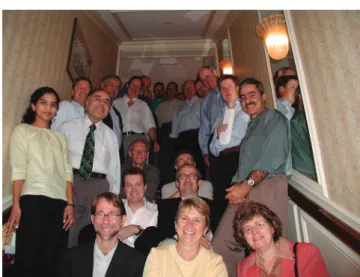
GRAPPA is a non-proi t educational and scientii c organi-zation, created to facilitate sharing of information that relates to PsO and PsA. It was initiated 10 years ago with their i rst meeting in New York City (Fig. 1). Its objectives include: 1) Pro-mote the development of national and international collab-orative registries of PsA and PsO patients to standardize the
data being obtained and learn more about the natural history of the disease as well as its genetic underpinnings; 2) Work closely with representatives of patient service leagues to pro-mote public education and awareness of PsA and PsO; 3) Work closely with representatives of biopharmaceutical companies to promote and conduct research on effective therapies for PsA and PsO; 4) Work closely with representatives of regulatory agencies to establish appropriate guidelines for regulatory approval of new therapies; 5) Work with other professional
Table 1 – Moll and Wright criteria for identii cation of psoriatic arthritis.
Inl ammatory arthritis (peripheral arthritis and/or sacoiliitis and spondylitis)
The presence of psoriasis
The usual absence of serological tests for rheumatoid factor
376
R E V B R A S R E U M A T O L . 2 0 1 3 ;5 3 ( 5 ): 3 7 5 – 3 7 6bodies, such as the American College of Rheumatology, Amer-ican Academy of Dermatology, and OMERACT to promote knowledge of research about PsA and PsO within the context of those disciplines; and 6) Develop treatment guidelines for governmental and other interested parties.
Important publications that are now standard references were published during the past i ve years and are listed in Table 2:
Brazil have been an active participant in the mission of GRAPPA in Latin America with national meetings throughout in Brazil and Latin America; several Brazilian rheumatologists and dermatologists are now working together for the benei t of patients with both diseases.The i rst joined meeting was held in Porto Alegre (RS, Brazil) together with the Brazilian Congress; the second meeting was held in Fortaleza (CE, Bra-zil) in 2012 and the third will be in Salvador (BA, BraBra-zil), on the second semester of this year.4 Last July, together with the
35th anniversary of the creation of the Psoriatic Arthritis Clinic
at the University of Toronto, GRAPPA was commemorating its 10th anniversary since its inception in New York. The
Brazil-ian rheumatologists Claudia Schainberg, Roberto Ranza, Sueli Carneiro, Penelope Pelarminos, Rachel Gryzpan and myself attended the event (Fig. 2).
As of today Brazil has 29 members afi liated with GRAPPA 15 of them are rheumatologists.New projects are being de-signed with participation of Brazilian rheumatologists in the upcoming years. The projects are listed below.
• New projects are being developed in rei nement and vali-dation of arthritis outcome measures in PsA
• Development of instruments to assess QOL, function, and participation
• Standardization of histologic and immunohistochemical assessments in PsA and PsO
• Updated criteria for classii cation of PsA (CASPAR) • Imaging in PsA.
Morton Scheinberg
Hospital Israelita Albert Einstein, São Paulo, SP, Brazil Hospital Abreu Sodré (AACD), São Paulo, SP, Brazil E-mail: [email protected]
R E F E R E N C E S
1. Moll JM, Wright V. Psoriatic Arthritis Seminars in Arthritis and Rheumatism. 1973,3:55-78.
Table 2 – ARD Supplement - PsA and PsO: state of the art review and research advances.
ARD Treatment Recommendations for Psoriatic Arthritis, 2008 GRAPPA Newsletter, Primavera de 2012
JRheum Supplement - 2007 Updates; Screening & Assessment Tools, Quality etc
JRheum Supplement - 2008 Annual Meeting Imaging; Comp Measures; Biomarkers
JRheum Supplement - 2009 Annual Meeting of GRAPPA, Estocolomo, Suécia
JRheum Supplement - 2010 Annual Meeting of GRAPPA, Miami Beach, FL
JRheum Supplement - Systematic Review of Treatments for PsA Patient Global Assessment in PsA: A Multicenter GRAPPA and
OMERACT Study
Fig 2 – Tenth GRAPPA meeting, Toronto, 2013. From left to right: Luis Espinoza, Claudia Schainberg, John Moll and Morton Scheinberg.
2. Gladman DD, Espinoza LR. International symposium on psoriatic arthritis. J Rheumatol. 1992;19(2):290-1. 3. Taylor W, Gladman D, Helliwell P, Marchesoni A, Mease P,
Mielants H; CASPAR Study Group. Classii cation criteria for psoriatic arthritis: development of new criteria from a large international study. CASPAR Study Group Arthritis Rheum. 2006;54(8):2665-73.