Received on 10/31/2010. Approved on 03/4/2011. Authors declare no confl ict of interests. Ethics Committee: FR279051. Universidade Federal de Santa Catarina – UFSC, Brazil.
1. PhD in Sciences by the Universidade de São Paulo – USP; Assistant physician at the Rheumatology Department of the UFSC 2. Master in Sciences by the UFSC; Assistant physician at the Rheumatology Department of the UFSC
3. PhD in Sciences by the USP; Chief-assistant at the Rheumatology Department of the UFSC
4. Master in Sciences by the Hospital do Servidor Público Estadual de São Paulo; Assistant physician at the Unit of Cardiology of the UFSC
Correspondence to: Sonia Cristina de Magalhães Souza Fialho. Rua Virgílio Várzea, 1.510, Bloco H, 101. Florianópolis, SC, Brazil. Zip Code 88032-001. E-mail: fi [email protected]
Musculoskeletal system assessment
in an emergency room
Sonia Cristina de Magalhães Souza Fialho1, Gláucio Ricardo Werner de Castro2, Adriana Fontes Zimmermann2,
Giovana Gomes Ribeiro1, Fabrício Souza Neves1, Ivânio Alves Pereira3, Guilherme Loureiro Fialho4
ABSTRACT
Objective: Musculoskeletal conditions have an enormous and growing impact worldwide. In spite of that, some cli-nicians are not confi dent in their own musculoskeletal examination skills. This study aimed to evaluate the prevalence of musculoskeletal symptoms in an emergency room, and the frequency of musculoskeletal physical examination description on those cases. Methods: This was a cross-sectional study. We performed a systematic analysis of medical fi les at the emergency room of the University Hospital of the Federal University of Santa Catarina, Brazil, from April 24th to 30th, 2009. Results: We analyzed 392 fi les, where 41.5% of patients were male and mean age was 38.7 ± 17.2 years-old. Sixty nine out of 392 patients (17.6%) presented with a musculoskeletal complaint. The most common mus-culoskeletal complaint was low back pain (33/69). Only 49.2% of patients with a musmus-culoskeletal chief complaint had a specifi c physical examination registered on the fi les. Patients with musculoskeletal complaints had lower registrations of abdominal examination (46% versus 62%, P = 0.01) and vital signs (46% versus 66%, P = 0.002), but a higher fre-quency of musculoskeletal examination registration (49% versus 0.6%, P = 0.00). Conclusions: Our study confi rms other observations worldwide. Musculoskeletal complaints are frequent in a emergency room setting and in spite of that it is suggested that musculoskeletal symptoms are poorly evaluated, which is probably related to an insuffi cient musculoskeletal education. It is essential that medical schools place more emphasis on these conditions so that young physicians will be more prepared to deal with these common diseases.
Keywords: musculoskeletal system, physical examination, education, medical, graduate, diagnosis, rheumatic diseases.
[Rev Bras Reumatol 2011;51(3):240-8] ©Elsevier Editora Ltda
INTRODUCTION
Musculoskeletal conditions have an enormous and growing impact worldwide. They are the most common cause of chronic
pain and physical inabilities.1 Musculoskeletal impairments
ranked number one in chronic impairments in the United States, and chronic musculoskeletal pain is reported in surveys by
1 in 4 people in both less and more developed countries.1 In
addition, musculoskeletal conditions were the most expensive disease category in a Swedish cost of illness study, representing 22.6% of the total cost of illness.1 Also, with population growth and increased longevity, the burden is increasing.
Surveys of the workload of general practitioners (GPs) have shown that between 15 and 20% of all consultations are for disorders of the musculoskeletal system.2 In spite of that, patients with musculoskeletal conditions are frequently unde-rappreciated by the health system. We believe that occurs for
several reasons including that they are rarely fatal, are conside-red irreversible, and also probably because of the inappropriate musculoskeletal education provided by medical schools.
The education of medical students in rheumatic diseases is often insuffi cient and warrants careful reconsideration.2-5 Consequently, it is not surprising to fi nd that some practicing clinicians are not confi dent in their own musculoskeletal examination skills; many wish that they had had more musculoskeletal training and some do not regard this as a part of their routine medical practice.6
supposedly frequent in these settings and many newly doctors begin their practice in those locations.
This study evaluated the prevalence of musculoskeletal symp-toms in an emergency room, and the frequency of musculoskeletal physical examination description on those cases. We also performed a secondary analysis comparing patients with musculoskeletal complaints and patients with skin complaints (considered to be of low clinical gravity) in order to identify if possible fi les registra-tions differences found in our primary analysis were related to the characteristics of a consultation in an emergency room.
MATERIAL AND METHODS
This was a cross-sectional study. We performed a systematic analysis of medical fi les of patients consulted at the emergency room of the University Hospital of Santa Catarina (a tertiary center with an open door policy) from April 24th to 30th, 2009. Medical consultations at this unit are performed by residents in Internal Medicine and medical students (5th and 6th academic years) under the supervision of another doctor (general practi-tioner) with at least two years of residency in Internal Medicine. The protocol evaluated registrations of the following: name, day and time of consultation, age, gender, chief complaint, physical examination (vital signs, cardiovascular, respiratory, abdominal, and musculoskeletal), laboratory exams, radiogra-phic exams and diagnostic hypothesis.
Patients were divided in two groups: with and without musculoskeletal complaints. Groups were compared for several points concerning fi les registrations.
After, a secondary analysis was performed comparing patients with musculoskeletal complaints and patients with skin complaints (considered to be of low clinical gravity). The objective of this analysis was to identify if possible fi les registrations differences found in our primary analysis were related to the characteristics of a consultation in an emergency room, which are directed to urgent illness.
Variables normally distributed were compared using student’s T test. Categorical data among groups were compared by Fisher exact test. A statistical signifi cance was set at P < 0.05. All statistical analyses were performed using NCSS software.
This study received institutional review and was approved by the Ethics Committee on Human Being Research of the Federal University of Santa Catarina, Brazil (FR- 279051).
RESULTS
We analyzed 392 fi les, where 41.5% of patients were male and mean age was 38.7±17.2 years-old.
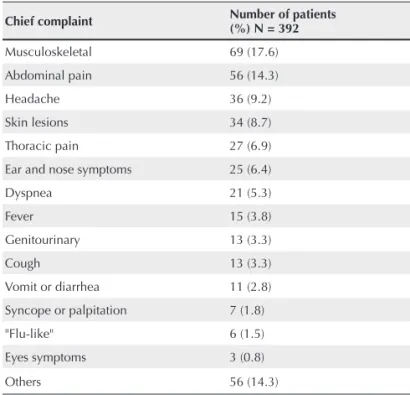
Table 1 shows the prevalence of chief complaints reported by the patients at the moment of consultation. Sixty nine out of 392 patients (17.6%) presented with a musculoskeletal complaint.
Table 1
Prevalence of chief complaints reported at consultation
Chief complaint Number of patients
(%) N = 392
Musculoskeletal 69 (17.6)
Abdominal pain 56 (14.3)
Headache 36 (9.2)
Skin lesions 34 (8.7)
Thoracic pain 27 (6.9)
Ear and nose symptoms 25 (6.4)
Dyspnea 21 (5.3)
Fever 15 (3.8)
Genitourinary 13 (3.3)
Cough 13 (3.3)
Vomit or diarrhea 11 (2.8)
Syncope or palpitation 7 (1.8)
"Flu-like" 6 (1.5)
Eyes symptoms 3 (0.8)
Others 56 (14.3)
Musculoskeletal complaints are demonstrated at Table 2. The most common musculoskeletal complaint was low back pain (33/69), followed by dorsalgia (9/69).
Table 2
Musculoskeletal complaints reported at consultation Musculoskeletal complaint Number of patients N = 69
Low back pain 33
Dorsalgia 9
Shoulder pain 6
Foot pain 4
Leg pain 3
Hip pain 2
Cervicalgia 2
Myalgia 2
Knee pain 2
Hands paresthesia/pain 2
Polyarthralgia 1
Buttocks pain 1
Elbow pain 1
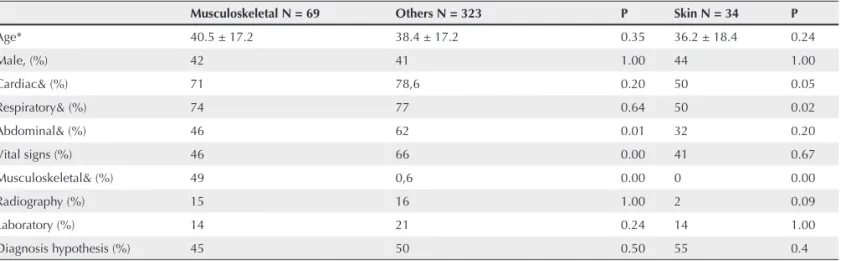
Table 3 shows the data comparing patients with and without musculoskeletal complaints. Only 49.2% of pa-tients with a musculoskeletal chief complaint had a specifi c musculoskeletal physical examination registered on the fi les. When considering only patients with low back pain (the most common musculoskeletal complaint) only 27% had their physical examination registered. By contrast, 50 out of the 56 patients who presented with abdominal pain had their abdominal examination registered. Patients with musculoskeletal complaints had lower registrations of ab-dominal examination (46% versus 62%, P = 0.01) and vital signs (46% versus 66%, P = 0,00), but a higher frequency of musculoskeletal examination registration (49% versus 0.6%, P = 0.00). In Table 3, we also demonstrate data comparing patients with musculoskeletal and skin complaints. All patients with skin complaints had a cutaneous examination described on fi les. Patients with musculoskeletal symptoms had a higher frequency of cardiac and respiratory examination registration (71% versus 50%, P = 0.049; 74% versus 50%, P = 0.02, respectively).
DISCUSSION
Our study demonstrated a high prevalence of musculoskeletal complaints in an emergency room at a University Hospital in Brazil. Similarly, two other studies reported a high pre-valence of those symptoms in a primary health care setting. Colombo et al. found 13.5% of musculoskeletal complaints
in a working day in a primary care unit.7 Another study found
that musculoskeletal pain was the most prevalent symptom in 1,306 investigated patients (10.64%).8 In the United States
and Canada, musculoskeletal symptoms are responsible for
approximately 15% to 30% of primary care units visits;4 in
the United States, 20% of emergency rooms consultations are
for musculoskeletal complaints.9
Interestingly, only 49.2% of patients with musculoske-letal symptoms had a registration of the musculoskemusculoske-letal examination. This fi nding could refl ect lack of knowledge in physical examination performance or lack of registration. In an emergency room setting, professionals could be less worried about registering on fi les, especially considering a not lethal complaint. That could actually be the reason why patients with musculoskeletal complaints had lower registrations of the vital signs, although that had not occurred with cardiac and respiratory examinations registrations (systems primary involved in lethal conditions).
On the other hand, all patients with skin symptoms (com-plaint most of the times not associated with gravity) had a skin examination described. In agreement with that, we observed a lower frequency of cardiac and respiratory examination registration on these patients. Even considering the fact that skin examination demands (most of the times) lesser effort to be performed, this fi nding reinforces the possibility of musculoskeletal physical examination neglect. In addition, 50 out of 56 patients who presented with abdominal pain had an abdominal physical examination described, which also reinforces our hypothesis.
There is plenty of evidence of musculoskeletal examina-tion negligence in clinical practice. This occurs in a variety of clinical settings,10,11 and may have a number of explanations. Lillicrap et al.12 also evaluated the extent of musculoskele-tal assessment (history and examination) amongst medical
Table 3
Registered fi le data in patients with and without musculoskeletal and skin complaints
Musculoskeletal N = 69 Others N = 323 P Skin N = 34 P
Age* 40.5 ± 17.2 38.4 ± 17.2 0.35 36.2 ± 18.4 0.24
Male, (%) 42 41 1.00 44 1.00
Cardiac& (%) 71 78,6 0.20 50 0.05
Respiratory& (%) 74 77 0.64 50 0.02
Abdominal& (%) 46 62 0.01 32 0.20
Vital signs (%) 46 66 0.00 41 0.67
Musculoskeletal& (%) 49 0,6 0.00 0 0.00
Radiography (%) 15 16 1.00 2 0.09
Laboratory (%) 14 21 0.24 14 1.00
Diagnosis hypothesis (%) 45 50 0.50 55 0.4
in-patients. Active musculoskeletal problems were seen fre-quently amongst medical in-patients (63% of all the patients had locomotors symptoms) but signs were recorded in 20% of patients. They concluded that there is signifi cant discrepancy between the number of patients with clinical symptoms and signs and the frequency with which they are detected and treated.
Teaching of musculoskeletal examination at medical scho-ols has frequently been regarded as poor, and this has been pointed out as the most important reason for musculoskeletal medicine negligence by the health system. Musculoskeletal system examination is especially important in making a diag-nosis since in several conditions diagdiag-nosis can be made without further testing, and also because of the lack of “gold standard” diagnostic tests in some other diseases.
Reports from Canada suggest that only 12% of their clinical
schools have mandatory teaching in musculoskeletal disease.3
In the United Kingdom, the majority of medical schools inclu-des rheumatology clinical skills teaching in the curriculum for all of their students, but in some schools up to half the students may receive no clinical rheumatology teaching at all.5 A study on the curriculum analysis of medical schools from Canada published in 2001 revealed that, on average, medical schools in Canada devoted 2.26% (range, 0.61% to 4.81%) of their curriculum time to musculoskeletal education.
Freedman and Bernstein13 evaluated the quality of
muscu-loskeletal knowledge among a cohort of recent medical school graduates. In that study, they administered a basic competency examination in musculoskeletal medicine to eighty-fi ve resi-dents on their fi rst day of residency at their institution. The examination was validated by surveying orthopedic program directors. According to their criterion, 82% of our test group of recent medical school graduates failed to demonstrate basic competency in musculoskeletal medicine. Latter, the valida-tion process was repeated with program directors of internal medicine residency departments. According to them, a large majority of the examinees once again failed to demonstrate
basic competency in musculoskeletal medicine.14
A study from Harvard medical school assessed medical students’ knowledge and clinical confi dence in musculoske-letal medicine. A cross-sectional survey of students in all four years of Harvard Medical School was conducted during the 2005-2006 academic year. Participants were asked to fi ll out a 30-question survey and a nationally validated basic
competency exam in musculoskeletal medicine. Medical students rated musculoskeletal education to be of major im-portance (3.8/5) but rated the amount of curriculum time spent on musculoskeletal medicine as poor (2.1/5). These fi ndings, which are consistent with those from other schools, suggest that medical students do not feel adequately prepared in mus-culoskeletal medicine and lack both clinical confi dence and cognitive mastery in the fi eld.15
Our study confirms others observations worldwide. Musculoskeletal complaints are frequent in an emergency room setting and in spite of that it is suggested that musculoskeletal symptoms are poorly evaluated, which is probably related to an insuffi cient musculoskeletal education. Our results must be taken in the context of several limitations. First, although the lack of musculoskeletal physical examination registration suggests that it was not performed, we cannot be sure about that. Second, if the physical examination was really neglected, that could have occurred for other reasons not related to musculoskeletal medicine knowledge, especially considering that this study was performed in an emergency setting, where professionals could devote lesser time with fi les fulfi lling (particularly when evaluating complaints not considered that urgent). However, the high frequency of physical examination registration in patients with cutaneous and abdominal complaints suggests the health unit was not an important factor to be considered and a lack of musculoskeletal medicine knowledge is more likely to be the reason. Finally, this is a single-institution study and our results may not represent those of other medical institutions, although it is likely pertinent to other medical schools.
In conclusion, the view that examination of the musculoske-letal system is of lesser importance than that of other systems is at odds with the frequency of musculoskeletal complaints in clinical practice, their place as the most common cause of disability in the community, their contribution to the burden of disease in the population and the contribution made to the
diagnosis of these conditions by clinical examination.6 It is
REFERENCES REFERÊNCIAS
1. Woolf AD, Akesson K. Understanding the burden of musculoskeletal conditions. The burden is huge and not relected in national health priorities. BMJ 2001; 322:1079-80.
2. Rasker JJ. Rheumatology in general practice. Br J Rheumatol 1995; 34:494-7.
3. Pinney SJ, Regan WD. Educating medical students about musculoskeletal problems. Are community needs relected in the curricula of Canadian medical schools? J Bone Joint Surg Am 2001; 83:1317-20.
4. Williams JR. The teaching of trauma and orthopaedic surgery to the undergraduate in the United Kingdom. J Bone Joint Surg Br 2000; 82:627-8.
5. Kay LJ, Deighton CM, Walker DJ, Hay EM. Undergraduate rheumatology teaching in the UK: a survey of current practice and changes since 1990. Arthritis Research Campaign Undergraduate Working Party of the ARC Education Sub-committee. Rheumatology (Oxford) 2000; 39:800-3.
6. Walker DJ, Kay LJ. Musculoskeletal examination for medical students: the need to agree what we teach. Rheumatology 2002; 41:1221-3.
7. Colombo D, Santa Helena ET, Agostinho ACMG, Didjurgeit JSMA. Padrão de prescrição de medicamentos nas unidades de programa de saúde da família de Blumenau. Rev Bras Cienc Farm 2004; 40(4):549-58.
8. Cordeiro Q, El Khouri M, Corbett CE. Dor musculoesquelética na atenção primária à saúde em uma cidade do Vale do Mucuri, nordeste de Minas Gerais. Acta Fisiatr 2008; 15(4):241-4.
9. De Lorenzo RA, Mayer D, Geehr EC. Analyzing clinical case distributions to improve an emergency medicine clerkship. Ann Emerg Med 1990; 19:746-51.
10. Ahern MJ, Soden M, Schultz D, Clark M. The musculoskeletal examination: a neglected clinical skill. Aust N Z J Med 1991; 21:303-6.
11. Doherty M, Abawi J, Pattrick M. Audit of medical inpatient examination: a cry from the joint. J R Coll Physicians Lond 1990; 24:115-8.
12. Lillicrap MS, Byrne E, Speed CA. Musculoskeletal assessment of general medical in-patients-joints still crying out for attention. Rheumatology 2003; 42:951-4.
13. Freedman KB, Bernstein J. The adequacy of medical school education in musculoskeletal medicine. J Bone Joint Surg Am 1998; 80:1421-7.
14. Freedman KB, Bernstein J. Educational deficiencies in musculoskeletal medicine. J Bone Joint Surg Am 2002; 84:604-8. 15. Day CS, Yeh AC, Franko O, Ramirez M, Krupat E. Musculoskeletal