THE IMPORTANCE OF AUDITORY HEALTH TRAINING:
AN INTEGRATIVE REVIEW
A importância da capacitação em saúde auditiva:
uma revisão integrativa
Gisele Marques Ribeiro(1), Maria Fernanda Santos Figueiredo(2), Luiza Augusta Rosa Rossi-Barbosa(3)
(1) State University of Montes Claros – Unimontes, Montes
Claros, Minas Gerais, Brazil.
(2) State University of Montes Claros – Unimontes, Montes
Claros, Minas Gerais, Brazil.
(3) State University of Montes Claros – Unimontes, Montes
Claros, Minas Gerais, Brazil.
Conlict of interest: non-existent
Communication is key to ensure the social
-ization of the person, and promotes the acquisition of new experiences, as well as the production of active activities with the society and his/her family. The reduction of this communicative process may contribute to the patient’s social withdrawal, thus resulting in frustration, isolation and depression2,3.
Therefore, we observe that preventing auditory problems is critical.
In 2004 the Ministry of Health, by means of Directive GM/MS no. 2073, established the Brazilian National Policy on Auditory Health, which enabled a breakthrough in the activities related to auditory health as regards the Sistema Único de Saúde
(Uniied Health System, SUS) This health care program to assist patients with auditory disability comprises not only diagnosis, treatment and
INTRODUCTION
A person’s health is directly associated not only to his/her biopsychosocial welfare, but also to the absence of diseases. An important aspect to be taken into account when maintaining the popula
-tion’s health is the person’s capacity to communicate and interact with the environment he/she lives, in order to further the quality of life1.
ABSTRACT
This study aimed to verify the scientiic production on auditory health training in the last ive years. This is an exploratory research onthe following databases: MEDLINE, SciELO, LILACS. We performed an integrative review of the published literature from 2007 to 2011, using the keywords: Hearing, Hearing Impairment, Hypoacusis and Hearing loss. People with Hearing Loss, Hearing Impaired People, combined with: Training, Training Services, Family Health Program, Human Resources Training in Health. It was found 31 articles, ive were selected, which contemplated the topic researched. Of these, three were directed to the Community Health Workers who work at the Family Health Teams, the aim of these articles were verify the effectiveness of training in relation to the children’s auditory health, and two were directed to company workers, whose goal wasto raise awareness among the professionals about prevention of the hearing impairment in professional activities. One of the studieswith Community Health Agents used video conference and classroom training simultaneously and the other only classroom training. It was observed that video conference is one of ways that can provide knowledge dissemination; however it must be used in a complementary manner. In studies with workers were found that the training must be permanent and focus the use, handling and maintenance of hearing protectors. The publications conirm the effectiveness of training; however, there are few studies in this area which reinforces the importance of new researches focusing auditory health education.
METHODS
This is an integrative scientiic literature review study on the training of health care professionals and companies’ workers regarding auditory health. In order to achieve the goal, a search was carried out on the following main electronic bases of periodicals: Medline, Lilacs and Scientiic Electronic
Library Online (SciELO), using the descriptors
below: Hearing, Auditory Disability, Hypoacusis, Hearing Loss, Loss of Hearing, Loss of Auditory Capacity, People with Auditory Disability, Persons with Auditory Disability, Persons with Auditory Failure, Persons with Deafness, combined with the descriptors below: Training, On-the-Job Training, Family Health Program, Training of Health Care Human Resources.
The inclusion criteria comprised articles published in the past ive years, corresponding to the years 2007 – 2011, in English or in Portuguese, and which were available for reading. The exclusion criteria took into account the articles that, after being identiied by means of their titles and abstracts, did not fall under the core objective of the study. The articles comprising reviews, clinical trials, case reports, editorials, letters and comments were also excluded. The analysis of the material selected was carried out by means of critical and qualitative reading, which allowed the identiication of conver
-gences, enabling the following classiication into two thematic axes: auditory health training practices and the outcomes reached with the auditory health
trainings.
During the search, 31 articles were found using all descriptors selected. Nine studies were discarded in accordance with the exclusion criteria, one of which being a comment, six clinical trials, one case report and one systematic review. After reading the 22 remaining articles, 17 publications were excluded for being in disagreement with the topic of the study: auditory health training. One out of the ive articles selected was found exclusively in the Lilacs
database, one in the Medline, two exclusively in the
SciELO and one reference was found both in the
Lilacs and in the SciELO databases (Figure 1). As
regards the languages of the articles selected, one was written in English and four were in Portuguese. None of the articles speciied which professionals carried out the auditory health trainings.
rehabilitation actions, but also health care promotion and protection4.
Even with the presence of a substantiated concept of health care promotion and protection, the activities of the professionals are still limited to curative measures; therefore, ongoing educational polices, as well as changes in the professional training processes are required5.
The Ministry of Health proposed the Política Nacional de Educação Permanente em Saúde
(Brazilian National Policy on Permanent Health Care Education) with a view to developing profes
-sional skills in order to improve the activities within
the Estratégia Saúde da Família (Brazil’s National
Family Health Strategy, FHS), bearing in mind that, for eficient results in promotion and rehabili
-tation, the presence of well-prepared professionals according to an integral healthcare perspective is required, with actions that may envisage a multipro
-fessional and multidisciplinary practice6.
The health care practices require proper decision-making processes and occur from the moment the persons must obtain, process and understand health care information. That process is part of the health care literacy, which inluences the ways of thinking, thus generating values, helping to change attitudes and beliefs, enabling the acqui
-sition of competences and promoting changes of behavior and lifestyles7.
Any signiicant learning opportunity must be led by discoveries and appreciation of the learning process – the contents must be worked out in a problem-solving manner, in a context where the relevant relationships are analyzed and interpreted, and knowledge is established and reestablished on a dialogical basis, through a back-and-forth movement between prior knowledge and current experience8.
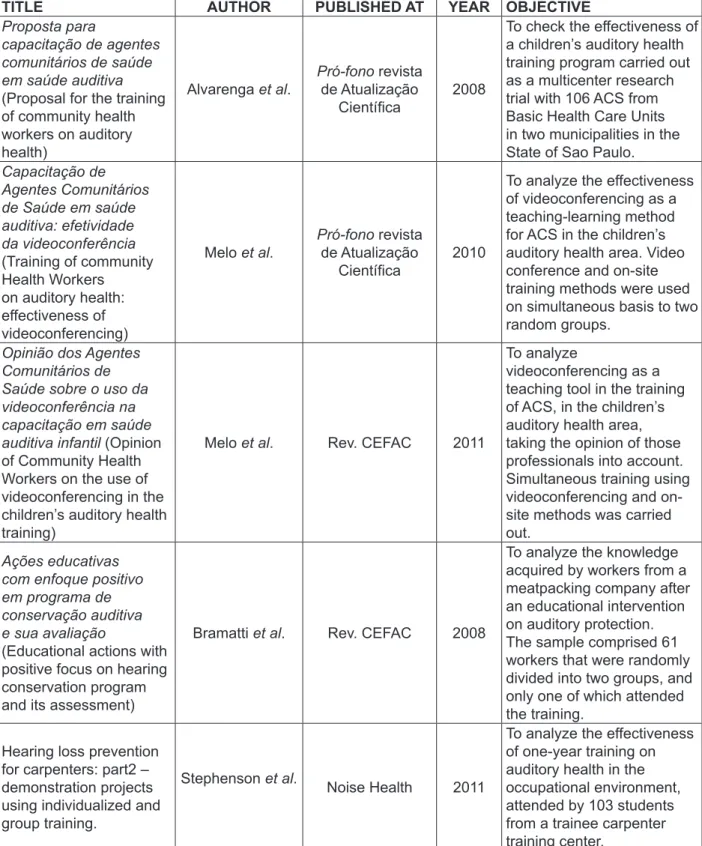
TITLE AUTHOR PUBLISHED AT YEAR OBJECTIVE
Proposta para
capacitação de agentes comunitários de saúde em saúde auditiva
(Proposal for the training of community health workers on auditory health)
Alvarenga et al.
Pró-fono revista
de Atualização
Cientíica 2008
To check the effectiveness of a children’s auditory health training program carried out as a multicenter research trial with 106 ACS from Basic Health Care Units in two municipalities in the
State of Sao Paulo.
Capacitação de Agentes Comunitários de Saúde em saúde auditiva: efetividade da videoconferência
(Training of community Health Workers on auditory health: effectiveness of videoconferencing)
Melo et al.
Pró-fono revista
de Atualização
Cientíica 2010
To analyze the effectiveness of videoconferencing as a teaching-learning method for ACS in the children’s auditory health area. Video conference and on-site training methods were used on simultaneous basis to two random groups.
Opinião dos Agentes Comunitários de Saúde sobre o uso da videoconferência na capacitação em saúde
auditiva infantil (Opinion
of Community Health Workers on the use of videoconferencing in the children’s auditory health
training)
Melo et al. Rev. CEFAC 2011
To analyze
videoconferencing as a teaching tool in the training of ACS, in the children’s auditory health area, taking the opinion of those professionals into account.
Simultaneous training using
videoconferencing and on-site methods was carried
out.
Ações educativas com enfoque positivo em programa de conservação auditiva e sua avaliação
(Educational actions with positive focus on hearing conservation program and its assessment)
Bramatti et al. Rev. CEFAC 2008
To analyze the knowledge acquired by workers from a meatpacking company after an educational intervention on auditory protection. The sample comprised 61 workers that were randomly divided into two groups, and only one of which attended the training.
Hearing loss prevention for carpenters: part2 – demonstration projects using individualized and group training.
Stephenson et al. Noise Health
2011
To analyze the effectiveness
of one-year training on
auditory health in the occupational environment, attended by 103 students from a trainee carpenter training center.
Key: ACS = Agentes Comunitários de Saúde (Community Healthcare Workers)
the following year14. In another study, a protocol was
prepared and applied after the training, bearing in mind the attendees’ opinion on the activity6. The
protocols used in the studies selected aim at quanti
-fying the outcomes, thus showing the importance of auditory health prevention-oriented activities.
Protocols are instruments that draw the users’ attention to health care, showing features oriented to preventive, promotional and educational actions. Their use is critical to the organization of the services, and they are directly related to the attention model and the construction of the work process intended for implementation15. Therefore, they are important
guiding instruments, as they help qualify the needs and proper guidance.
As regards the objectives, two studies addressed the need to raise the professionals’ awareness on the importance of preventing hearing capacity changes during the performance of the professional activities. The trainings were preceded by hearing
tests13,14. In the other three studies, the aim was to
check the effectiveness of the trainings on children’s auditory health, intended to ACS6,11.
The Brazilian National Policy on Permanent Health Care Education envisages a transformation in the healthcare sector work with a view to a critical, relexive, committed and technically competent action16.
The health care trainings – both within the public healthcare and the corporate environments – need to take into account the development of competencies, using student-centered, critical, innovative and relexive teaching-learning methodologies, whose core objective is the transformation of patients and active subjects17.
The Ministry of Health is concerned about training professionals from several health care sectors. A broad family health care coverage represents an impact on the Auditory Health Care Network and, upon the training of professionals, the latter will participate directly in auditory health promotion action with the community in all life cycles. The general agreement is that the training of health care professionals in auditory health brings considerable beneits for the population, changing the behavior of professionals and public administrators, not only on the knowledge about the topic, but also on the access of the hearing impaired to health care services18.
As for the logistic structure, three studies did not report the location and the structure of the rooms used to hold the trainings6,12,13, another one reported
the location the room in only one of the centers integrated to the study (the amphitheater of a city hospital), but there are no reports on its physical structure19. In one of the articles, the trainings
LITERATURE REVIEW
Auditory health training practice
The term ‘training’ is used similarly to the terms development and formation. It is used to mean a process to prepare and train persons with a view to improving the quality of their performance of their duties9.
The trainings within both the SUS’ and the companies’ environments strengthen the impor
-tance of preventing and promoting auditory health. The concept of health care prevention is present when the person is held responsible for his/her own health status, without regard to the environment he/ she lives in, and it occurs with a view to seeking answers for the health-disease process. The health care promotion must break out of the vertical integration of knowledge between users and profes
-sionals, as it values the interpersonal exchanges. In this new model of health care education, the person becomes the bearer of knowledge oriented to the health-disease-care process10.
The trainings mentioned in the articles selected in three studies6,11,12 were intended for the ACS
(Agentes Comunitários de Saúde, Community
Health Care Workers) and none of them had partici
-pated in any previous training, as far as hearing is concerned. In two studies6,12 the training was
carried out with 50 ACS from health care units. A third article11 dealt with a multicenter research trial,
with the training of 31 ACS from three Family Health Strategy (EFS) units in the city of Bauru, Sao Paulo, and 75 ACS from four units in Sorocaba, also in Sao Paulo. Two studies were related to companies’ workers, with focus on the topic occupational auditory health13,14. In one of them, the training was
carried out with 61 workers from a meatpacking company, approaching the beliefs and attitudes concerning hearing conservation12. In another one,
a one-year training program was carried out with 103 trainee carpenters, approaching the attitudes and beliefs related the prevention of hearing losses. The attendees were randomly split in two groups, and half of them received guidance on a collective basis, and the other half received guidance in an individual manner14.
Some studies collected data by applying a protocol before and after the training of all attendees of the sample, aiming at checking its effectiveness12-14. In
one of the studies, the protocol was applied to half of the attendees before and after the training. Only one protocol was applied to the other half, and they did not participate in the training13. In the study involving
of training programs on the correct use of ear protectors becomes fundamental22. In one of the
studies with workers, the following were used as training instruments: multimedia projectors, slides with images and written content, songs and daily situations experienced by the workers13. In another
one, a 30-minute interactive discussion led by an instructor took place, using audiovisual material. Then, a 45-minute hands-on training was carried
out14. The use of motivating teaching methodologies
for the trainings’ attendees was crucial, as they ensured a consolidation of the topic and the perfor
-mance of a more eficient preventive work.
The objective of the health care education is to prevent diseases and promote health, by means of duly guided knowledge, where the scientiic knowledge produced must reach the people’s daily lives. It must establish favorable circumstances to relections on a person’s health oriented to health care practices, changes in potentially harmful behaviors, the acquisition of habits favorable to the common good and the individual health23.
The teaching-learning process must produce a relection on the student, where he/she is capable of provoking changes in his/her social reality, thus allowing the integration of the person as subject, transforming the world and establishing relation
-ships with other persons and the environment8.
Consequently, the learning process stimulates the discussion, enables the acknowledgment of knowledge and the appreciation of the community’s realities and needs, turning the learning environment into a democratic one, and appreciating the student’s prior knowledge, thus strengthening the teaching-learning process11.
The outcomes reached with the auditory health trainings
The study with ACS proved the eficiency of the use of aids to ensure a more interactive work, with the participation of the subjects and their experiences during the trainings11. In two studies with activities
carried out through videoconferencing, we may conclude that such resources are still very seldom used for the process of training professionals in the SUS environment. Videoconferencing is a means that may provide the dissemination of knowledge in all regions of the Brazilian territory and improve the performance of the ACS and other professionals. Despite being an effective Health Care Education tool, it must be used on a supplemental basis6,12.
In the work carried out with employees from a meatpacking company, we observed that the use, handling and conservation of ear protectors need to be more focused, as it will relect upon the reduction of health hazards. It mentions the importance were held at college premises, with adequate
room containing video conference facilities and another room for on-site training12. In another
study where videoconferencing was also used during the trainings, the structure of the rooms was adequate for such activities; however, the venue is not mentioned, and there are no details about their physical structure6.
As regards the venues where the activities were held, we observed that they were well structured. A survey undertaken with users, in order to under
-stand the perspective about Health Care Education, presented some reports from these persons, thus showing that the local reality must be taken into account, as well as its needs – for example, the lexibility of the hours. The logistics within a health care education activity must be not only related to the conditions required by the professionals, but must also consider the attendees’ daily routine20.
About the teaching methodology, two studies carried out with ACS6,12 used videoconferencing
the on-site training, so the two groups of attendees were divided on a random basis. A tutor was present in the video conference room, in order to manage the questions and provide monitoring/feedback on the audio and video used, as well on the content proposed. In both studies, the training manual prepared by the World Health Organization (WHO) – Primary Ear and Hearing Care Training Resource – basic, intermediate and advanced levels was used, after being adapted and validated to Portuguese. In another study carried out with ACS, audiovisual aids were used as methodology to follow up the trainings. As it is a multicenter research trial, in only one of the centers an adaptation of the material proposed by the WHO – Primary Ear and Hearing Care Training Resource – basic, intermediate and advanced levels was used, with a view to checking the contribution and inluence of this material in the
training11.
A study on Traditional Education Models and Dialogical Models applied to health care education showed that, in the dialogical education model, the teacher and the student play an active role in the learning process. It is a methodology that proposes the building of knowledge, stimulates the exchange of experiences and provides people with a critical-relexive view of the reality. However, its application has been a challenge, as the professionals are still unaware of that methodology. The authors emphasize the need for professional training programs by means of Permanent Education, for the performance of educational activities21.
the knowledge of these professionals, who may properly send their patients to the referral systems. Therefore, the training of the basic health care teams will strengthen the Auditory Health Care Network18.
Every eficient training process must be based mainly upon practical experiences, thus ensuring and allowing a critical relection of the real-life situa
-tions, as the learning process is not only based on the theoretical reproduction of knowledge, but also on strategies where the active participation and integration between theory and practice take place17.
The education work to promote health care is an important tool to reduce the comorbidities and early identiication of speech articulation disorders, and contributes to expand the dissemination of data and information in relation to the rights and duties of the user at SUS, thus co-operation with the assistance, once it prioritizes the health care promotion to the detriment of the treatment1.
CONCLUSION
Five articles published in the past ive years (2007 a 2011) on the training of health care professionals and companies’ workers about auditory health were selected, according to the descriptors and synonyms for Hearing, Hearing Loss, People with Auditory Disability combined with the descriptors Training, On-the-Job Training, Family Health Program, Training of Health Care Human Resources.
The auditory health trainings are necessary both within the FHS and in the work environments, since the auditory health is important for the people’s communicative and social process. However, the activities oriented to the promotion and prevention of changes in that area are still very limited.
The trainings and guidance to professionals within the public health level and in companies are necessary, since the teaching-learning process requires activities that emphasize the importance of detecting and preventing hearing changes.
For the teaching-learning process, motivating, relexive and critical methodologies are required, so the students become active subjects. It is important to establish such favorable circumstances to ensure the consolidation of the topic and a more effective preventive work.
After the assessment and analysis of the articles included in this study, we concluded that few works emphasized the importance of auditory health trainings, and it is necessary to include new studies that might show the effectiveness of the educational activity for the hearing impairment prevention.
of ongoing training to ensure gains not only for
the worker, but also for the company and for the society13. In the study carried out with carpenters,
we observed that the trainings are capable of leveling the workers’ knowledge both in group and in individual trainings, on the attitudes, beliefs and behavioral intentions regarding the correct use of ear protectors14.
As regards the beneits achieved, the contri
-bution of one of the studies was to show, before and after the training, the behavior and the attitudes of the workers in relation to hearing loss, thus favoring a training oriented to the areas where there is higher deicit. The male workers and recently-hired employees proved to have the least knowledge on the issue13.
In one of the studies with video conference, the conclusion was that it is an effective training method
-ology and it was accepted well by the ACS6. And in
another study, also using videoconferencing, there was signiicant improvement in the performance of the two groups, those who attended the training on-site and the other by means of video conference; however, the latter was less signiicant, thus showing the importance of the on-site training12. One of the
studies with ACS proved the effectiveness of training program when using an interactive approach and speciic didactic material11.
The training of the health care professional on auditory health is presented as an effective methodology, as it helps the early identiication of hearing pathologies. That occurs from the moment professionals begin to obtain the knowledge on the topic and try to send their patients to SUS’ referral
systems18.
A survey with companies’ workers showed that the training is eficient for its positive inluence on the use of ear protectors in a noisy working environment. During the training, the trainees showed their intention and awareness towards the use of the protection11. Therefore, we observe
that the auditory health trainings are an effective instrument to prevent hearing losses.
The publications selected conirmed the impor
-tance and the need for auditory health trainings6,11-14.
One of the studies emphasized that the topic rehabilitation must be included, and the importance of using the Hearing Aid so the ACS may offer support to the families both in the hearing diagnosis and in the adaptation processes11.
The training of the ACS, as well as the Family Health Teams, contributes effectively for the identi
REFERENCES
1. Goulart BNG, Henckel C, Martin M. Fonoaudiologia e promoção da saúde: relato de experiência baseado em visitas domiciliares. Rev
CEFAC. 2010;12(5):842-9.
2. Fialho IM, Bortoli D, Mendonça GG, Pagnosim DF, Scholze AS. Percepção de idosos sobre o uso de AASI concedido pelo Sistema Único de Saúde.
Rev. CEFAC. 2009;11(2):338-44.
3. Teixeira AR, Almeida LG, Jotz GP, De Barba MC. Qualidade de vida de adultos e idosos pós adaptação de próteses auditivas. Rev Soc Bras Fonoaudiol. 2008;13(4):357-61.
4. Rossi-Barbosa LAR, Vieira SMFV, Manzoni CRT, Caldeira AP, Honorato-Marques R, Ribeiro JA, et al. Processo de construção de indicadores em saúde auditiva. Rev CEFAC. 2010;13(1):102-11.
5. Molini-Avejonas DR, Mendes VLF, Amato CALH. Fonoaudiologia e Núcleos de Apoio à Saúde da Família: conceitos e referências. Rev Soc Bras Fonoaudiol. 2010;15(3):465-74.
6. Melo TM, Alvarenga KF, Blasca WQ, Taga MFL. Opinião dos agentes comunitários de saúde sobre o uso da videoconferência na capacitação em saúde auditiva infantil. Rev CEFAC. 2011;13(4):692-7. 7.Loureiro LMJ, Mendes AMOC, Barroso TMMDA, Santos JCP, Oliveira RA, Ferreira RO. Literacia em
saúde mental de adolescentes e jovens: conceitos e desaios. Rev. Enf. Ref. 2012;serIII(6):157-66. 8. Coriolano MWL, Lima MM, Queiroga BAM, Ruiz-Moreno L, Lima LS. Educação permanente com agentes comunitários de saúde: Uma proposta de cuidado com crianças asmáticas. Trab Educ Saúde. 2012;10(1):37-59.
9. Carvalho AV, Nascimento L P. Administração de Recursos Humanos. V.1 .São Paulo: Pioneira;
2002.
10.Brites LS, Souza APR, Lessa AH. Fonoaudiólogo e agente comunitário de saúde: uma experiência educativa. Rev Soc Bras Fonoaudiol. 2008; 13(3):
258-66.
11. Alvarenga KF, Bevilacqua MC, Martinez MANS, Melo TM, Blasca WQ, Taga MFL. Proposta para capacitação de agentes comunitários de saúde em saúde auditiva. Pró-Fono R Atual. Cient. 2008;20(3):171-6.
12. Melo TM, Alvarenga KF, Blasca WQ, Taga MFL. Capacitação de agentes comunitários de saúde em saúde auditiva: efetividade da videoconferência. Pró-Fono R Atual. Cient. 2010;22(2):139-44.
13. Bramatti L, Morata TC; Marques JM. Ações educativas com enfoque positivo em programa de conservação auditiva e sua avaliação. Rev. CEFAC.
2008;10(3):398-408.
RESUMO
A presente pesquisa teve como objetivo veriicar a produção cientíica, sobre capacitação em saúde auditiva nos últimos cinco anos. Trata-se de uma pesquisa exploratória nas bases de dados: MEDLINE, SciELO, LILACS. Foi realizada uma revisão integrativa da literatura publicada no período de 2007 a 2011, utilizando os descritores: Audição, Deiciência Auditiva, Hipoacusia, Perda Auditiva, Perda da Audição, Perda da Capacidade Auditiva, Pessoas com Deiciência Auditiva, Portadores de Deiciência Auditiva, Portadores de Insuiciência Auditiva, Portadores de Surdez, combinadas com: Capacitação, Capacitação em Serviço, Programa Saúde da Família, Capacitação de Recursos Humanos em Saúde.Foram encontrados 31 artigos e selecionados cinco, que contemplavam a temá
-tica pesquisada. Destes, três eram direcionados aos Agentes Comunitários de Saúde que atuavam em Equipes de Saúde da Família, para veriicar a efetividade das capacitações em relação à saúde auditiva infantil, e dois trabalhadores de empresas, para sensibilizar os proissionais sobre a preven
-ção das alterações auditivas nas atividades proissionais. Dois estudos com os Agentes Comunitários de Saúde utilizaram a videoconferência e a capacitação presencial simultaneamente e outro somente presencial. Observou-se que a videoconferência é um meio que pode proporcionar a disseminação do conhecimento, no entanto deve ser utilizada de uma forma complementar. Nos estudos com traba
-lhadores veriicou-se que as capacitações devem ser permanentes e enfocar mais o uso, manuseio e conservação dos protetores auditivos. As publicações conirmam a efetividade das capacitações, porém, há poucos trabalhos nesta área, o que vem reforçar a importância de novas pesquisas com enfoque na educação em saúde auditiva.
revisão sistemática. Rev Soc Bras Fonoaudiol.
2009;14(2):280-6.
19. Cézar MRV. Atuação do fonoaudiólogo na prevenção da perda auditiva induzida por ruído. CEFAC. 2000. Available from: http://xa.yimg.com/ kq/groups/15597459/1081818890/name/6c632bfa6 a1536f760aad180eb36afae.pdf.
20. Figueiredo MFS, Rodrigues Neto JF, Leite MTS. Health education in the context of family health from the user’s perspective. Interface – Comunic., Saude, Educ. 2012;9(41):315-29.
21. Figueiredo MFS, Rodrigues Neto JF, Leite MTS. Modelos aplicados às atividades de educação em saúde. Rev. bras. enferm. 2010;63( 1 ):117-21. 22. Valenzuela MAS, Villagra CEA. Estrategia Frente a la Problemática delRuido Ocupacional. Ciencia & Trabajo. 2006;8(20):58-64.
23. Alves VS. Um modelo de educação em saúde para o Programa Saúde da Família: pela integralidade da atenção e reorientação do modelo assistencial. Interface – Comunic Saúde Educ.
2005;9(16):39-52.
14. Stephenson MR, ShawPB, Stephenson CM, Graydon OS. Hearing loss prevention for carpenters: Part 2 – Demonstration projects using individualized and group training. Noise Health [serial on the Intenet]. 2011 [cited2012 may 6]; 13(51): 122-31. Available from: http://www.noiseandhealth.org/text. asp?2011/13/51/122/77213.
15. Werneck MAF, Faria HP, Campos KFC. Protocolo de cuidado à saúde e organização do serviço. Belo Horizonte: COOPMED; 2009.
16. Lima JVC, Turini B, Carvalho BG, Nunes EFPA, Lepre RL, Mainardes P, et al. A educação permanente em saúde como estratégia pedagógica de transformação das práticas: possibilidades e limites. TrabEduc Saúde. 2010;8(2):207-27.
17. Gomes KO, Cotta RMM, Cherchiglia ML, Mitre SM, Batista RS. A práxis do agente comunitário de saúde no contexto do programa saúde da família: relexões estratégicas. Saude Soc. 2009;18(4):744-55.
18. Melo TM, Alvarenga KF. Capacitação de proissionais da saúde na área de saúde auditiva:
Received on: May 28, 2013 Accepted on: November 30, 2013 Mailing address:
Gisele Marques Ribeiro
Rua Bocaiuva, 94, Centro – Taiobeiras
Minas Gerais – MG – Brasil CEP: 39550-000