DOI: 10.1590/1518-8345.1495.2860 www.eerp.usp.br/rlae
Assessment of the nursing care product (APROCENF): a reliability and
construct validity study
1Danielle Fabiana Cucolo
2Márcia Galan Perroca
3Objectives: to verify the reliability and construct validity estimates of the “Assessment of nursing
care product” scale (APROCENF) and its applicability. Methods: this validation study included
a sample of 40 (inter-rater reliability) and 172 (construct validity) assessments performed by
nurses at the end of the work shift at nine inpatient services of a teaching hospital in the Brazilian
Southeast. The data were collected between February and September/2014 with interruptions.
Cronbach’s alpha and Spearman’s correlation coefficients were calculated, as well as the
intraclass correlation and the weighted kappa index (inter-rater reliability). Exploratory factor
analysis was used with principal component extraction and varimax rotation (construct validity).
Results: the internal consistency revealed an alpha coefficient of 0.85, item-item correlation
ranging between 0.13 and 0.61 and item-total correlation between 0.43 and 0.69. Inter-rater
equivalence was obtained and all items evidenced significant factor loadings. Conclusion: this
research evidenced the reliability and construct validity of the scale to assess the nursing care
product. Its application in nursing practice permits identifying improvements needed in the
production process, contributing to management and care decisions.
Descriptors: Validity of Tests; Nursing Assessment; Outcome and Process Assessment (Health
Care); Validation Studies; Health Management; Hospital Administration.
1 Paper extracted from Doctoral Dissertation “Carga de trabalho e sua influência sobre os resultados do processo de cuidar”, presented to Faculdade de Medicina de São José do Rio Preto, São José do Rio Preto, SP, Brazil.
2 PhD, Professor, Departamento de Enfermagem, Universidade Federal de São Carlos, São Carlos, SP, Brazil. 3 PhD, Adjunct Professor, Faculdade de Medicina de São José do Rio Preto, São José do Rio Preto, SP, Brazil.
How to cite this article
Cucolo DF, Perroca MG. Assessment of the nursing care product (APROCENF): a reliability and construct validity study.
Rev. Latino-Am. Enfermagem. 2017;25:e2860. [Access ___ __ ____]; Available in: ____________________. DOI:
Introduction
Nursing work takes place in production
subsystems, adapting and interacting constantly with other subsystems(1).This dynamics produces emergent
behaviors, besides unexpected situations related to health practice, which demand self-organization and (re)
prioritization of the activities, which are characteristics of a complex adaptive system (CAS)(2). This demands lexibility from nursing to respond to the needs
required(3).
Its organization is not linear, but inluenced by
factors related to individual needs, health technologies and care production(1).The product that results – care
– is intangible, and delivered and consumed at the
moment the care is provided(4).
The authors consider the construct investigated in this study, the nursing care product, to be the interaction between structural factors (human capital and support
services) and work organization methods (care planning, patient/family care and multidisciplinary interaction) that intervene in the care process. The more favorably aligned these factors and methods are, the better the
product will be assessed.
As a result of the productive transformation, the professionals need instruments to measure the means needed for nursing’s main activity from the perspective
of nursing care(2), contributing to management and care
decisions. Despite the development and increasing use
of speciic instruments to measure results of interest in
the nursing area, in the literature, no approaches and/or
scales were evidenced that permit assessing the product generated at the end of the shift, considering the interaction between the work structure and organization methods. Thus, the “Assessment of the nursing care
product” scale (APROCENF in Portuguese) was developed to evidence the critical factors of care management and classify the impact in the activities delivered at the end of a work shift (product) and which involves attending
to the needs of the patients/relatives and professionals. Measuring scales support professional activities and are available to measure a range of phenomena. Nevertheless, many of these do not properly describe
their psychometric properties(5).The reliability and
validity measures determine the accuracy and quality of the instruments, helping the nurses in their evidence-based practice(6).
The reliability is related to the precision of a
scale, that is, if its measures relect the true values of
the attributes accurately(7).One of the aspects of the
reliability, the internal consistency, assesses whether
the subparts of a scale measure the same characteristic
or attribute. Another, the inter-rater reliability, veriies
the agreement among two or more independent raters on the score obtained(8).
The validity indicates the extent to which the
scale measures what it intends to measure. One of its modalities, the construct validity, tests hypotheses, demonstrating trust or not with regard to what was proposed in the theoretical perspective(8).Thus, an
imprecise, that is, an unreliable measure cannot measure the attribute in a valid manner. On the other hand, the reliability does not guarantee the validity(8).
Is the APROCENF valid and reliable? How do
the nurses perceive its applicability in the care and management context? To answer these questions, this research was developed to verify reliability estimates and the construct validity of the “Assessment of the nursing
care product” scale (APROCENF) and its applicability.
Methods
The APROCENF scale rests on the concept of care production(1), management(9) and quality in health(10),
combining factors that can contribute to the provision of nursing care. It consists of eight items: Nursing care planning; Resources needed for care provision; Estimation of nursing staff requirements; Educative
actions and staff development; Care monitoring and transfer; Interaction and multidisciplinary activity; Patient and/or family care and Meeting the care needs. Each item is scored between one and four in
which, the higher the score, the better the product of nursing care.
To apply the scale, the nurse needs to assess all items at the end of the work shift at one of the four
levels, considering the option that best approaches the reality experienced. The individual item scores are
added up and lead to a classiication according to the
following intervals: 9-12points (poor), 13-21(regular),
22-30 (good) and 31-36 (excellent). The content validity
of the scale and its items was conirmed in advance(11).
To verify the inter-rater reliability estimate and the construct validity, 40 and 172 nursing assessments at
the end of the work shift were considered, respectively. The sample size for the validity assessment complied with the criterion estimated for the factorial analysis, i.e. 20 times the number of instrument items(12).
The research was developed at three medical and surgical clinical inpatient services and six specialized services, being one Pediatric, one Maternal-Infant and four Intensive Care Units –ICU (General, Coronary,
Pediatric and Neonatal) at a large teaching hospital in the Brazilian Southeast. The data collection for this phase of the study took place between February and September/2014.
Two pairs of nurses from two ICUs independently
assessed 20 shifts each (inter-rater agreement)(8). To
assess the construct validity, 13 nurses applied the scale at the end of their work shifts. Each assessment was registered daily on a print scale the nurses
received.
To investigate the nurses’ perception on the use of the scale in professional practice, a questionnaire was applied with demographic and professional data
and the participants also answered nine propositions
on a ive-point Likert scale (from I completely disagree
to I completely agree), related to the pertinence, clarity, objectivity, complexity, grade, applicability and
relevance of the instrument.
Descriptive statistics were used to characterize the sample and examine the frequency distributions for each item. The scale was considered as an ordinal
measuring level and signiicance was set at p≤0.05for
all analyses made.
To assess the internal consistency, the following
were analyzed: Cronbach’s alpha coeficient
>0.70(8),Spearman’s correlation coeficient
(item-item and (item-item-total) with0.30 cut-off(13)and intraclass correlation coeficient (ICC) ≥0.70(8).The inter-rater agreement level on the different classiications (bad, regular, good and excellent) was veriied, considering the weighted Kappa coeficient(Kw), as follows:<0.20
(poor), 0.21-0.40 (fair), 0.41-0.60 (moderate), 0.61-0.80 (good) and 0.81-1.00 (very good)(14).
The exploratory factorial analysis (EFA) using principal component extraction and the Varimax rotation method was applied for the construct validation. Initially, the Kaiser-Meyer-Olkin (KMO) index was calculated for
each item and the overall scale and Bartlett’s sphericity test was applied to verify the null hypothesis that there is no correlation among the items;
To deine the number of factors extracted, the
following were examined: eigenvalues superior to 1.0;
Scree plot and whether the components represented at least 60% of the explained variance. Factor loadings
≥0.40 were considered and were only repeated if they loaded signiicantly in one factor (at least 0.20
of difference among the loadings). The communalities
were assessed for each item and considered signiicant
when>0.50(12). Kruskal-Wallis’ test was applied, followed
by Dunn’s post-test for multiple comparisons between the work shifts and the mean instrument score. For these analyses, the software Statistical Package for Social Sciences (SPSS, Chicago, Illinois, USA) 19.0 was
used.
Approval for the research was obtained from the Research Ethics Committees of the institutions involved–process No. 0379/11 (Hospital1), process
No.0050/12 (inclusion Hospital 2 and 3) and process
No.002/12 (Hospital 3) and consent was obtained from
the participating institutions and nurses.
Results
The assessments
The EFA was conducted using 172 assessments at medical and surgical clinical inpatient units (94;54%), Pediatric (26;14%) and Maternal-Infant units (13;8%),General ICU (13;8%), Coronary ICU
(13;8%)and Pediatric ICU (13;8%), distributed among the following shifts: morning (39;23%), afternoon (76;44%) and evening (57;33%).Two assessments were excluded because they were incomplete. On
average, each nurse performed 13 assessments. Most of the nurses were female (n=11), with an average age of 33 years (sd=5.2; range 28-43 years) and mean length of professional experience 5.5 years (sd=3.4; range
3-16 years).
The nursing care product was classiied as poor
(3; 1.8%), regular (38; 22.1%), good (111; 64.5%) and excellent (20; 11.6%), with a median of 24 points
(Q1-Q3=21-26), equivalent to a good score. The item with the worst assessment (adding up poorand regular scores) was Interaction and multidisciplinary activity (103; 59.9%) and the best score (adding up good and
excellent scores) went to Meetingthe care needs(145; 84.4%).
The answers to the questionnaire on the pertinence, clarity, objectivity, complexity, grade, applicability and
relevance of the instrument revealed lesser agreement on the propositions related to the common language among the professionals (Md4.0;Q1-Q3=4.0-5.0),clarity in the statements (Md 4.0; Q1-Q3=4.0-5.0) and
implementation in daily practice (Md 4.0;
Q1-Q3=4.0-4.0), but did not signal justiications and/or suggestions
for improvements (Table 1).
Table 1 – Opinion of the nurses on the Assessment of
the Nursing Care Product(APROCENF) scale (n=13).
Campinas, SP, Brazil, 2015
Proposition Md (Q1-Q3)*
Discusses the most important items 5.0(4.0-5.0)
Discusses relevant factors of each item 5.0(4.0-5.0)
Permits a shared language among the professionals 4.0(4.0-5.0)
Presents clear statements 4.0(4.0-5.0)
Is very extensive 2.0(2.0-4.0)
Is complex 2.0(2.0-4.0)
The intensity of its grades increases 5.0(4.0-5.0)
Can be introduced in daily nursing practice 4.0(4.0-4.0)
Can produce useful data for management decision making
5.0(4.0-5.0)
In the scores obtained per work shift, the afternoon
period presented the highest median score (Md 25.0;
Q1-Q3=22.5-28.0), followed by the morning shift (Md
23.0; Q3=19.0-24.0) and night shift (Md 22.0;
Q1-Q3=20.0-26.0), with p<0.0001. The difference between the scores was conirmed using Dunn’s post-test,
which intends to explain the inter-group differences.
Signiicance was found between the afternoon shift and the other, and no signiicance between the morning and
night shifts.
Reliability Test
The instrument presented a high Cronbach’s alpha
coeficient, equaling 0.85. The item-item correlation
ranged between0.13 and 0.61.Correlations inferior to
0.30 involved the items: resources needed for care
provision and interaction and multidisciplinary activity.
The item-total correlation ranged between 0.43
(interaction and multidisciplinary activity) and 0.69
(patient and/or family care) (Table2).
Table 2 – Spearman item-item and item-total correlation coeficient of the Assessment of Nursing Care Product
(APROCENF) scale (n=172). Campinas, SP, Brazil,2015
Items* Item1 Item2 Item3 Item4 Item5 Item6 Item7 Item8 Item-Total
Item1 0.67†
Item2 0.39† 0.46†
Item3 0.45† 0.34† 0.51†
Item4 0.47† 0.13§ 0.42† 0.60†
Item5 0.52† 0.30† 0.38† 0.47† 0.68†
Item6 0.34† 0.20‡ 0.25‡ 0.31† 0.36† 0.43†
Item7 0.52† 0.41† 0.45† 0.45† 0.58† 0.33† 0.69†
Item8 0.45† 0.42† 0.42† 0.61† 0.59† 0.22‡ 0.49† 0.68†
*Item 1–Nursing care planning; Item 2–Resources needed for care provision; Item 3–Estimation of nursing staff requirements; Item 4–Educative actions and staff development; Item 5–Care monitoring and transfer; Item 6–Interaction and multidisciplinary activity; Item 7–Patient and/or family care and Item 8–Meeting the care needs.
†p<0.0001;‡p<0.05;§p<0.1
Inter-rater reliability
Forty assessments were considered, undertaken
by two pairs of nurses working at the Neonatal and
Coronary ICU, to conirm the agreement. The
inter-rater equivalence, represented by the ICC, ranged
between 0.71 (95% CI: 0.36-0.88) and 0.93(95%
CI: 0.83-0.97) and the Kw between 0.23 (95% CI:
-0.06-0.52) and 0.83 (95% CI: 0.61-1.00). Eight
disagreements were observed in one pair of nurses,
but none of them was superior to one degree (one
classiication immediately superior or inferior) in
relation to the total score.
Construct validity
The KMO measure of sample adequacy was equal
to 0.85, ranging between 0.76 and 0.92, and Bartlett’s
sphericity test was signiicant at p<0.01.Then, the
adjustment of the data to the factorial analysis was
veriied. The correlation matrix indicated different items with coeficients≥0.30.
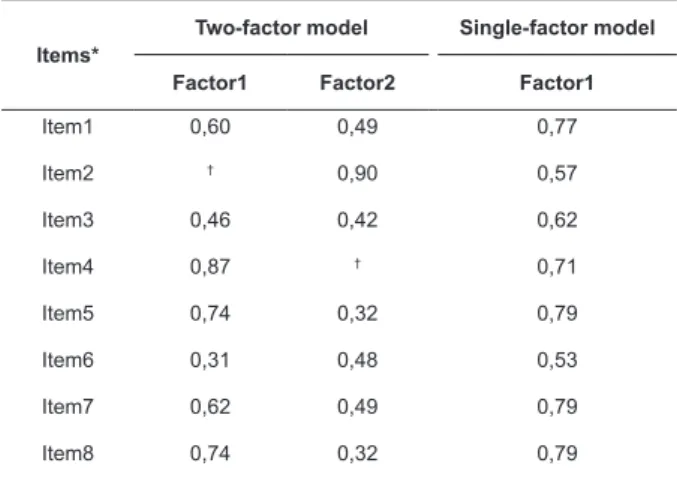
An EFA model with eight factors was adjusted and
only the irst factor presented an eigenvalue>1,conirmed
in the Scree plot. Nevertheless, two factors
explained60.2%of the accumulated variance. Factor
1 (eigenvalue 3.98) explained 49.7% of the total
variance and factor 2 (eigenvalue 0.84) 10.5%. The
two-factor model was then adjusted and the factor
loadings were analyzed, demonstrating no precise
association of all items with the factors (at least 0.20
of difference among the loadings). Therefore, only the
irst factor was considered for interpretation (Table 3).
Table 3 – Varimax rotated factorial matrix considering
single and two-factor models (n=172). Campinas, SP,
Brazil, 2015.
Items*
Two-factor model Single-factor model
Factor1 Factor2 Factor1
Item1 0,60 0,49 0,77
Item2 † 0,90 0,57
Item3 0,46 0,42 0,62
Item4 0,87 † 0,71
Item5 0,74 0,32 0,79
Item6 0,31 0,48 0,53
Item7 0,62 0,49 0,79
Item8 0,74 0,32 0,79
*Item 1–Nursing care planning; Item 2–Resources needed for care provision; Item 3–Estimation of nursing staff requirements; Item 4– Educative actions and staff development; Item 5–Care monitoring and transfer; Item 6–Interaction and multidisciplinary activity; Item 7–Patient and/or family care and Item 8–Meeting the care needs.
Discussion
To produce good outcomes in health care, the
organization and delivery of the care needs to be
improved, in order to comply with the safety, equity,
punctuality, eficiency and eficacy dimensions with
a focus on the needs of the subjects involved(15). The
nurses are responsible for the management dimensions
of care and should carefully assess this process,
proposing improvements for practice(16).
The availability of valid and reliable instruments
enhances the accuracy of the information collected,
as well as the eficacy of the decision process(17-18).
Therefore, assessing the psychometric properties,
including the reliability and construct validity of the
APROCENF scale, has become essential.
In the reliability analysis, the correlation coeficient
determines the intensity of the relation between the
instrument items (item-item) and between each item
and the total score (item-total), using 0.30 as the
cut-off for validation(13).Although this criterion was not fully
complied with, correlations≥0.30were found with other
items, justifying its maintenance in the instrument.
The assessment of the Cronbach’s alpha coeficient
when deleting the item for item 2, related to the
Resources needed for care provision, and for item 6
(Interaction and multidisciplinary activity), evidenced no
signiicant interference in the internal consistency of the
instrument. In addition, these are important variables
for care production from the perspective of CAS(2) and
the patient safety concept(19).Thus, the instrument
continued with eight items. As regards the ICC, in view
of the score, equivalence was obtained.
The nursing care product at the end of the work
shift is the abstract concept under analysis and the
construct validity investigated the adequacy of the
instrument to measure it. The factor loadings represent
the item’s correlation with the factors, with signiicance
when ranging between 0.50 and 0.70 and indicating a
well-deined structure when>0.70(12).
The indings revealed signiicant factor loadings in
all scale items. The dimensions of patient and
family-centered care (Meeting the care needs and Patient
and/or family care) seem to strongly inluence the
assessment of the nursing care product. This health care
strategy acknowledges the importance of the relations
and promotes the partnership between professionals
and patients, encouraging autonomy and the patients’
engagement in the decisions and in care planning. In
addition, the strategy advocates better communication
skills, through the development of relexive listening and
an environment that permits the teams’ engagement(20).
Some items related to the structure (Estimation
of nursing staff requirements and Resources needed
for care provision) and relationships (Interaction and
multidisciplinary activity) presented a lower weight in
the factor analysis and communalities of 0.38, 0.33 and
0.28, respectively. These items were not determinant,
but are signiicant in the composition of the scale. It can
be inferred that the factorial structure does not explain
much of the variation in these items.
Considering that, the more adjusted the structural
factors and the work organization methods, the better
the nursing product will be. In the nurses’ assessments
at the end of the work shift, 64.5% evidenced a good
care product. When comparing the scores per work shift,
the afternoon period seems to indicate the best nursing
care product. Nevertheless, new studies are needed to
explain the shift work and the care provision.
The items with favorable weights, adding up good
and excellent, were Meeting the care needs (84.4%)
and Estimation of nursing staff requirements (76.7%).
As for Meeting the care needs, the accomplishment of
planned interventions and nurses’ speciic activities with
minimization of patient risks were considered. The health
quality programs have been widespread in the past
decade, mainly in hospitals. Studies have demonstrated
a signiicant association between the quality of care
and/or unattended needs and the occurrence of adverse
events(10)and the nurses working at these institutions
prioritize patient care management, mitigating these
risks(21),also evidenced in this study. In the same
sense, the adequate composition of the nursing team
to respond to the patients’ demands has been widely
discussed and studied, due to its close relation with the
quality and safety of care(22).Nevertheless, it is important
to highlight that this is a picture of the practical scenario
under investigation and that new studies in other
contexts can diverge.
On the other hand, the items with negative
weights, adding up regular and poor, are related to
Interaction and multidisciplinary activity (59.9%) and
Care monitoring and transfer (28.5%). These questions
seem to advance timidly in view of the complexity of the
and team integration(23).Therefore, teaching and
interdisciplinary practice have been investigated, and
are currently encouraged to improve the fragmented
health systems, constituting a feasible and eficient
service provision model(24).Another challenge evidenced
in this study that is in accordance with other indings(25)
is related to the transfer of information among clinical
teams through formal registers, reducing adverse
incidents and improving the continuity of health care.
It can be highlighted that the scale permits not
only measuring the nursing care product at the end of
each work shift, but also mapping the critical aspects
that compromise the productive system. Thus, it equips
nurses, health managers, educators and researchers
by targeting proposals for improvement towards the
weaknesses evidenced.
According to the nurses’ perception on the use
of the scale in professional practice, the instrument is
pertinent, relevant and supports management decision
taking. They agree on the clarity and applicability as
well, but argue some dificulty in using it daily, in view
of the activities related to the work process, supporting
earlier assessments(11).
As all production systems aim for continuous
improvement, this research was intended to contribute
to the discussions on the productive transformation in
nursing, targeting the management of patient-centered
care. Although evidence of reliability and construct validity
were found when the scale was used at different health
care units, additional studies are needed to examine the
feasibility of its application in other contexts. Another
limitation in this research was the non-random selection
of the participating nurses and work shifts. The Kappa
coeficients found (Kw equal to 0.23-95%CI: -0.06-0.52)
in one pair of raters were considered poor/fair.
Conclusion
In this research, the reliability and construct
validity of a tool to assess the nursing care product were
evidenced. Its application in clinical practice allows the
nurse managers to measure the eficiency and eficacy
of the production process, contributing to management
and care decisions.
Acknowledgements
To the Research Group “Health and Nursing
Service Management” (GESTSAÚDE) at Faculdade de
Medicina de São José do Rio Preto, São José do Rio
Preto, SP, Brazil.
References
1. Meyer RM, O’Brien-Pallas LL. Nursing services
delivery theory: an open system approach. J Adv Nurs.
[Internet]. 2010 [Access May 29, 2016];
66(12):2828-38. Available from: http://onlinelibrary.wiley.com/
doi/10.1111/j.1365-2648.2010.05449.x/epdf
2. Kannampallil TG, Schauer GF, Cohen T, Patel VL.
Considering complexity in healthcare systems. J Biomed
Inform. [Internet]. 2011 [Access May 29, 2016];
44(6):943–47. Available from: http://www.sciencedirect.
com/science/article/pii/S1532046411001067
3. Chaffee MW, McNeill MM. A model of nursing as a
complex adaptive system. Nurs Outlook. [Internet].
2007 [Access Oct 4, 2016]; 55(5):232-41. Available
from:
http://www.nursingoutlook.org/article/S0029-6554(07)00100-5/pdf
4. Rossi FR, Silva MAD. Fundamentos para processos
gerenciais na prática do cuidado = Fundaments for
managing process in care practices = Fundamento para
el proceso generencial en las prácticas del cuidado. Rev
Esc Enferm USP. [Internet]. 2005 [Acesso 4 out 2016];
39(4):460-8. Disponível em: http://www.ee.usp.br/
reeusp/upload/pdf/68.pdf Português, Inglês, Espanhol.
5. Streiner DL, Kottner J. Recommendations for reporting
the results of studies of instrument and scale development
and testing. J Adv Nurs. [Internet]. 2014 [Access May
29, 2016]; 70(9):1970-79. Available from: http://
onlinelibrary.wiley.com/doi/10.1111/jan.12402/epdf
6. Perroca MG. The new version of a patient classiication
instrument: assessment of psychometric properties.
J Adv Nurs. [Internet]. 2013 [Access Jan 11, 2015];
69(8):1862-68. Available from: http://onlinelibrary.
wiley.com/doi/10.1111/jan.12038/pdf
7. Pasquali L. Psicometria = Psychometrics. Rev Esc
Enferm USP. [Internet]. 2009 [Acesso 4 out 2016];
43(Spe):992-9. Disponível em: http://www.scielo.br/
pdf/reeusp/v43nspe/en_a02v43ns.pdf
8. Polit DF, Beck CT. Fundamentos de pesquisa em
enfermagem: avaliação de evidências para a prática da
enfermagem. 7. ed. Porto Alegre: Artmed; 2011. 669 p.
Disponível em: https://books.google.com.br/books?hl=
ptBR&lr=&id=2AKpDAAAQBAJ
9. Costa VT, Meirelles BHS, Erdmann AL. Best practices
Latino-Am. Enfermagem. [Internet]. 2013 [Access Oct
4, 2016]; 21(5). Available from: http://www.scielo.br/
pdf/rlae/v21n5/0104-1169-rlae-21-05-1165.pdf
10. Ball JE, Murrells T, Rafferty AM, Morrow E, Grifiths P.
Care left undone’ during nursing shifts: associations with
workload and perceived quality of care. BMJ Qual Safety.
[Internet]. 2014 [Access May 29, 2016]; 23:116-25.
Available from: http://qualitysafety.bmj.com/content/
early/2013/07/08/bmjqs-2012-001767.full.pdf+html
11. Cucolo DF, Perroca MG. Instrument to assess
the nursing care product: development and content
validation. Rev. Latino-Am. Enfermagem. [Internet].
2015 [Access Oct 4, 2016]; 23(4):642-50. Available
from:
http://www.scielo.br/pdf/rlae/v23n4/0104-1169-rlae-23-04-00642.pdf
12. Hair JF, Anderson RE, Tathan RL, Black WC. Análise
multivariada de dados [Internet]. 6. ed. Porto Alegre
(RS): Bookman; 2009. Disponível em: https://books.
google.com.br/books?id=oFQs_zJI2GwC&printsec=fron
tcover&hl=ptBR#v=onepage&q&f=false
13. Hopkins WG. A scale of magnitudes for effect
statistics. A new view of statistics [Internet]. 2002.
[Access Sept 26, 2016]. Available from: http://sportsci.
org/resource/stats/contents.html
14. Altman D. Practical Statistics for Medical
Research [Internet]. Chapman & Hall, London: UK;
1991. Available from: https://books.google.com.br/
books?id=v-walRnRxWQC&printsec=frontcover&hl=pt-BR#v=onepage&q&f=false
15. Institute of Medicine (IOM) Committee on Quality of
Health Care in America. Crossing the quality chasm: a
new health system for the 21st century. [Internet] 2001
[Access Oct 4, 2016]. Available from: https://www.nap.
edu/read/10027/chapter/1
16. Hausmann M, Peduzzi M. Articulação entre as
dimensões gerencial e assistencial do processo
de trabalho do enfermeiro = Articulating between
management and care dimensions in the nursing work
process = Enlace entre las dimensiones gerencial y
asistencial del proceso de trabajo del enfermero. Texto
Contexto Enferm. [Internet]. 2009 [Acesso 4 out 2016];
18(2): 258-65. Disponível em: http://www.scielo.br/
pdf/tce/v18n2/08.pdf Português, Inglês, Espanhol.
17. Palese A, Tameni A, Ambrosi E, Albanese S,
Barausse M, Benazzi B, et al. Clinical assessment
instruments validated for nursing practice in the Italian
context: a systematic review of the literature. Ann Ist
Super Sanità. [Internet]. 2014 [Access May 29, 2016];
50(1): 67-76. Available from: http://www.iss.it/publ/
anna/2014/1/50167.pdf
18. Perroca MG. Development and content validity of
the new version of a patient classiication instrument.
Rev. Latino-Am. Enfermagem. [Internet]. 2011 [Access
Oct 4, 2016]; 19(1):58-66. Available from: http://www.
scielo.br/pdf/rlae/v19n1/09.pdf.
19. Alenius LS, Tishelman C, Runesdotter S, Lindqvist
R. Stafing and resource adequacy strongly related to
RNs’ assessment of patient safety: a national study of
RNs working in acute-care hospitals in Sweden. BMJ
Qual Safety. [Internet]. 2014 [Access May 29, 2016];
23:242-49. Available from: http://qualitysafety.bmj.
com/content/23/3/242.full.pdf+html
20. Abdelhadi N, Drach-Zahavy A. Promoting patient
care: work engagement as a mediator between ward
service climate and patient-centred care. J Adv Nurs.
[Internet]. 2012 [Access May 29, 2016];
68(6):1276-87. Available from: http://onlinelibrary.wiley.com/
doi/10.1111/j.1365-2648.2011.05834.x/epdf
21. Tvedt C, Sjetne IS, Helgeland J, Bukholm G. A
crosssectional study to identify organisational processes
associated with nurse-reported quality and patient safety.
BMJ Open. [Internet]. 2012 [Access May 29, 2016];
2(6). Available from: http://www.ncbi.nlm.nih.gov/
pmc/articles/PMC3533052/pdf/bmjopen-2012-001967.
22. Aiken LH, Sermeus W, Heede KV, Sloane DM,
Busse R, McKee M, et al. Patient safety, satisfaction,
and quality of hospital care: cross sectional surveys of
nurses and patients in 12 countries in Europe and the
United States. BMJ. [Internet]. 2012 [Access May 29,
2016]; 344:e1717. Available from: http://www.bmj.
com/content/bmj/344/bmj.e1717.full.pdf
23. Hartgerink JM, Cramm JM, Bakker TJEM, Van
EIJ, Sden AM, Mackenbach JP, et al. The importance
of multidisciplinary teamwork and team climate for
relational coordination among teams delivering care
to older patients. J Adv Nurs. [Internet].2014 [Access
May 29, 2016]; 70(4):791-99. Available from: http://
www.ncbi.nlm.nih.gov/pmc/articles/PMC4282281/pdf/
jan0070-0791.pdf
24. Brandt B, Lutiyya MN, King JA, Chioreso C. A
scoping review of interprofessional collaborative
practice and education using the lens of the Triple Aim. J
Received: Feb. 4th 2016
Accepted: Dec. 12th 2016
Copyright © 2017 Revista Latino-Americana de Enfermagem This is an Open Access article distributed under the terms of the Creative Commons (CC BY).
This license lets others distribute, remix, tweak, and build upon your work, even commercially, as long as they credit you for the original creation. This is the most accommodating of licenses offered. Recommended for maximum dissemination and use of licensed materials.
Corresponding Author: Danielle Fabiana Cucolo
Rua Engenheiro Augusto de Figueiredo, 437, Apto. 133C Jardim Bom Sucesso
CEP: 13045-248, Campinas, SP, Brasil
E-mail: [email protected] / [email protected] 28(5):393-99. Available from: http://www.ncbi.nlm.nih.
gov/pmc/articles/PMC4162503/pdf/JIC-28-393.pdf
25. Hall W, Keane P, Wang S, Debell F, Allana A, Karia
P. Intensive care discharges: improving the quality
of clinical handover through changes to discharge
documentation. BMJ Qual Improv Report. [Internet].
2015 [Access May 29, 2016]; 4 (1). Available from:
http://qir.bmj.com/content/4/1/u209711.w4036.full.