Urine leak in minimally invasive partial nephrectomy:
analysis of risk factors and role of intraoperative ureteral
catheterization
_______________________________________________
Homayoun Zargar
1, Ali Khalifeh
1, Riccardo Autorino
1, Oktay Akca
1, Luis Felipe Brandao
1, Humberto
Laydner
1, Jayram Krishnan
1, Dinesh Samarasekera
1, George-Pascal Haber
1, Robert J. Stein
1, Jihad H
Kaouk
11Center for Laparoscopic & Robotic Surgery, Glickman Urological and Kidney Institute, Cleveland Clinic, Cleveland, OH, USA
ABSTRACT
ARTICLE
INFO
______________________________________________________________ ______________________
Purpose: To investigate risk factors for urine leak in patients undergoing minimally in-vasive partial nephrectomy (MIPN) and to determine the role of intraoperative ureteral catheterization in preventing this postoperative complication.
Materials and Methods: MIPN procedures done from September 1999 to July 2012 at our Center were reviewed from our IRB-approved database. Patient and tumor charac-teristics, operative techniques and outcomes were analyzed. Patients with evidence of urine leak were identified. Outcomes were compared between patients with preoperative ureteral catheterization (C-group) and those without (NC-group). Univariable and multi-variable analyses were performed to identify factors predicting postoperative urine leak.
Results: A total of 1,019 cases were included (452 robotic partial nephrectomy cases and 567 laparoscopic partial nephrectomy cases). Five hundred twenty eight patients (51.8%) were in the C-group, whereas 491 of them (48.2%) in the NC-group. Urine leak occurred in 31(3%) cases, 4.6% in the C-group and 1.4% in the NC-group (p<0.001). Tumors in NC-group had significantly higher RENAL score, shorter operative and warm ischemic times. On multivariable analysis, tumor proximity to collecting system (OR=9.2; p<0.01), surgeon’s early operative experience (OR=7.8; p<0.01) and preoperative moderate to se-vere CKD (OR=3.1; p<0.01) significantly increased the odds of the occurrence of a pos-toperative urine leak.
Conclusion: Clinically significant urine leak after MIPN in a high volume institution setting is uncommon. This event is more likely to occur in cases of renal masses that are close to the collecting system, in patients with preoperative CKD and when operating surgeon is still in the learning curve for the procedure. Our findings suggest that routine intraoperative ureteral catheterization during MIPN does not reduce the probability of postoperative urine leak. In addition, it adds to the overall operative time.
Key words:
complications [Subheading]; Nephrectomy; Risk Factors; Urinary Incontinence; Ureter; Urinary Catheters
Int Braz J Urol. 2014; 40: 763-71
_____________________
Submitted for publication: January 27, 2014
_____________________
Accepted after revision: April 06, 2014
INTRODUCTION
Partial nephrectomy (PN) has widely re-placed radical nephrectomy in the management
recognized. Among them, postoperative urine leak is regarded as a clinically significant entity, which negatively impacts patient’s recovery (2-5). Inade-quate repair of a violated collecting system during renorrhaphy is the cause of postoperative urine leak. The management of urine leak is tailored de-pending on the case. The treatment options include observation, percutaneous drainage, ureteral drai-nage and surgical interventions (6-8).
Intraoperative ureteral catheterization during PN has been traditionally used as a measure to recog-nize and prevent the occurrence of urine leaks (9). The concept behind this practice was that intra-operative retrograde dilute methylene-blue instillation could confirm collecting system entry and water tightness of the repair. With accumulation of experience with the technique, routine ureteral cannulation was re-served for central, more complex renal tumors (10). Ureteral catheterization however adds to the total operative time and costs. With advancements in mi-nimally invasive techniques for PN, the routine use of ureteral catheterization has been further questioned (11). Overall, the utility of routine ureteral catheteri-zation during PN has not been well studied.
The aim of this study was to investigate risk factors for urine leak in patients undergoing minimally invasive partial nephrectomy (MIPN) and to determine the role of intraoperative urete-ral catheterization in preventing this postoperati-ve complication.
MATERIALS AND METHODS
Study population
Our IRB-approved prospectively maintai-ned institutional database was queried to identify MIPN cases (laparoscopic and robotic) performed at our Center from September 1999 to July 2012.
Patients’ demographic characteristics, including age, BMI, and ASA as well as tumor characteristics, including R.E.N.A.L nephrometry score (12) were assessed. Main intraoperative pa-rameters, including technique modality (laparos-copic or robotic), use of ureteral catheterization, operative time (calculated from skin incision to skin closure, including ureteral catheterization time), warm ischemia time (WIT), and estimated blood loss (EBL) were recorded.
Cases with intraoperative ureteral injury were excluded. Patients with ureteral abnormali-ty such as ureteropelvic junction obstruction or duplicated collecting were also excluded.
Surgical experience was taken into ac-count in the analysis. Completion of the learning curve was considered to be 25 cases for RPN and 50 cases for LPN according to previous publica-tions (13, 14).
Clinically significant urine leak was de-fined as persistent drain output >48 hours after PN with biochemical analysis consistent with urine or radiographic evidence of urine leak (15). Radiological imaging was only performed where patient’s clinical status or symptoms were sug-gestive of urine leak (Figure-1).
Surgical technique
The decision for ureteral catheterization was at the discretion of surgeon on case by case basis. Ureteral catheterization was performed immediately after induction of general anesthesia with the pa-tient in lithotomy position, using rigid cystoscopy. An open ended 6 French ureteral catheter was passed over the guide wire and catheter was secured to the Foley catheter. A syringe filled with dilute methylene blue was attached to the catheter for later instillation. The patient was then repositioned in the modified la-teral decubitus position and PN commenced. Ureteric catheter was removed at the end of the procedure.
Our surgical techniques for both laparoscopic (LPN) and robot assisted PN (RPN) have been pre-viously described (16, 17).
Essential steps of the laparoscopic technique include renal defatting, maintaining fat over the tu-mor, laparoscopic ultrasound to score the resection line, hilar clamping, tumor excision with cold scis-sors, suture repair of the collecting system and sutu-red renorrhaphy over a hemostatic bolster.
For both laparoscopic and robotic cases, a Jackson-Pratt drain was left in the perinephric space.
Analysis
Estimated glomerular filtration rate (eGFR) was calculated using modification of diet in re-nal disease (MDRD) formula. Moderate to seve-re chronic kidney disease (CKD) was defined as eGFR<60mL/min/1.73m2.
For continuous data with normal distri-bution variables are presented as mean±standard deviation (SD). The mean values were compared using student’s t-test. For variables with non-nor-mal distribution, data is presented as median (IQR) and the groups were compared using Mann-Whi-tney U test. Categorical variables were compared using chi-squared test.
A comparative analysis was performed between the group where a ureteral catheter was used (C group) and the one where this was not used (NC group).
Univariable and multivariable logistic re-gression analyses were performed to calculate odd ratios for factors affecting urinary leak. The-se included surgical technique (laparoscopic or robotic), learning curve (beyond or within), age (continuous), BMI (continuous), renal function (moderate to severe CKD vs. mild CKD to normal renal function), tumor size (continuous), growth
pattern (>or<50% endophytic), proximity to col-lecting system (>or<7mm), WIT (continuous), EBL (continuous) and use of intraoperative ureteral ca-theterization (yes or no).
Statistical significance was set at p<0.05. Variables were entered into multivariable model if p<0.2 for univariable analysis. All analyses were performed using SPSS v21 software (IBM SPSS Statistics, Armonk, NY: IBM Corp).
RESULTS
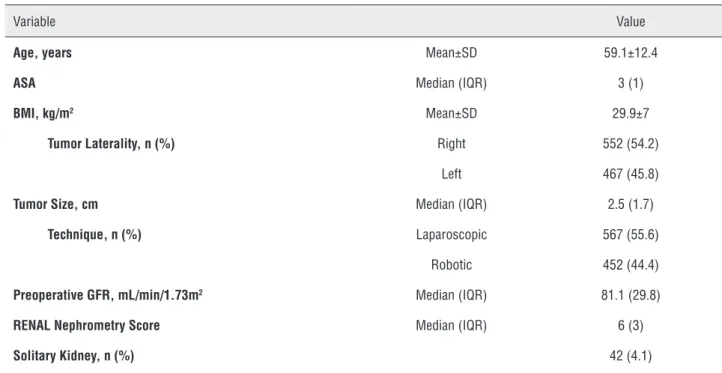
A total of 1019 MIPN cases were consi-dered in this analysis, including 567 LPN cases (55.6%) and 452 RPN cases (44.4%) (Table-1).
Table-2 summarizes the main surgical ou-tcomes for the entire series. In 528 cases (51.8%) intra-operative ureteral catheterization was used. A total of 31 (3.0%) urine leaks were detected pos-toperatively and managed using stenting, CT-gui-ded drainage or observation.
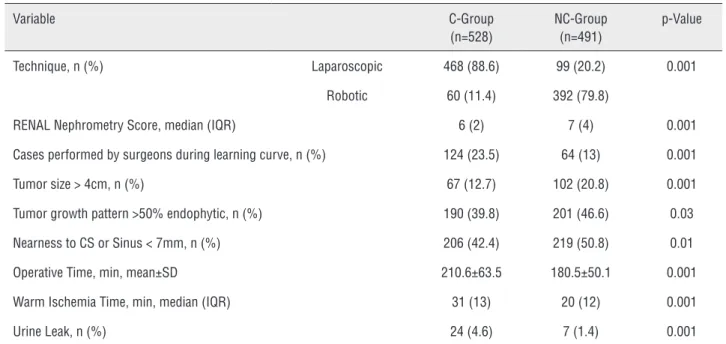
There were no differences in the patients’ age, gender, BMI, ASA, renal function, tumor late-rality and solitary kidney status between C-group and NC-group (Table-3). Tumors in the C-group presented a lower overall R.E.N.A.L nephrometry score, longer distance from the collecting system, smaller size and more exophytic location compa-red to NC-group. The majority of cases in C-group
Table 1 - Population Demographics (n=1019).
Variable Value
Age, years Mean±SD 59.1±12.4
ASA Median (IQR) 3 (1)
BMI, kg/m2 Mean±SD 29.9±7
Tumor Laterality, n (%) Right 552 (54.2)
Left 467 (45.8)
Tumor Size, cm Median (IQR) 2.5 (1.7)
Technique, n (%) Laparoscopic 567 (55.6)
Robotic 452 (44.4)
Preoperative GFR, mL/min/1.73m2 Median (IQR) 81.1 (29.8)
RENAL Nephrometry Score Median (IQR) 6 (3)
Solitary Kidney, n (%) 42 (4.1)
ASA: American Society of Anesthesiologists; GFR: Glomerular Filtration Rate; BMI: Body Mass Index; SD: Standard Deviation; IQR: Inter-Quartile Range.
Table 2 - Surgical Outcomes (n=1019).
Variable Value
Intra operative Ureteral Catheterization, n (%) 528 (51.8)
Operative Time, min Mean±SD 196.9±59.7
Unclamped Renal Hilum, n (%) 71 (7)
Warm Ischemia Time, min Median (IQR) 26(15)
Zero Ischemia, n (%) 68 (6.7)
Estimated Blood Loss, mL Median (IQR) 150 (200)
Urine Leak, n (%) 31 (3)
Urine Leak Management, n (%) Ureteral Stenting 19 (61.3)
CT-guided Drainage 3* (9.7)
Observation 11 (35.5)
Length of Stay, days Median (IQR) 3 (2)
Follow up, months Median (IQR) 18 (34)
*Two of those had also ureteral stents and counted also in that group
Table 3 - Comparison between Populations under Study (n=1019).
Variable C-Group
(n=528)
NC-Group (n=491)
p-Value
Technique, n (%) Laparoscopic 468 (88.6) 99 (20.2) 0.001
Robotic 60 (11.4) 392 (79.8)
RENAL Nephrometry Score, median (IQR) 6 (2) 7 (4) 0.001
Cases performed by surgeons during learning curve, n (%) 124 (23.5) 64 (13) 0.001
Tumor size > 4cm, n (%) 67 (12.7) 102 (20.8) 0.001
Tumor growth pattern >50% endophytic, n (%) 190 (39.8) 201 (46.6) 0.03
Nearness to CS or Sinus < 7mm, n (%) 206 (42.4) 219 (50.8) 0.01
Operative Time, min, mean±SD 210.6±63.5 180.5±50.1 0.001
Warm Ischemia Time, min, median (IQR) 31 (13) 20 (12) 0.001
Urine Leak, n (%) 24 (4.6) 7 (1.4) 0.001
C-Group: Ureteral Catheterization used; NC-Group: Ureteral Catheterization not used; CS: Collecting System; BMI: Body Mass Index; ASA: American Society of Anesthesiologists
were done laparoscopically, whereas only 20% were done laparoscopically in NC-group (88.6% vs. 20.2%, p=0.001). The operative time was longer for patients in C-group (211 vs. 180 min, p<0.01). Once we control for ureteric catheteri-zation, there is no difference in operating time between LPN and RPN (186±51.2 vs.178±49.5 min, p=0.17). There were 24 (4.6%) cases of uri-ne leak in C-group as compared to 7 (1.4%) ca-ses in NC-group (p=0.001). For LPN caca-ses there was no difference in practice of ureteric cathe-ter insertion with increasing experience. The rate of utility of ureteric catheter was 80.2% for surgeons within and 83% for surgeons beyond learning curve (p=0.49). For RPN group, this proportions were 49.4% and 4.7 % respectively (p=0.001) (Figure-2).
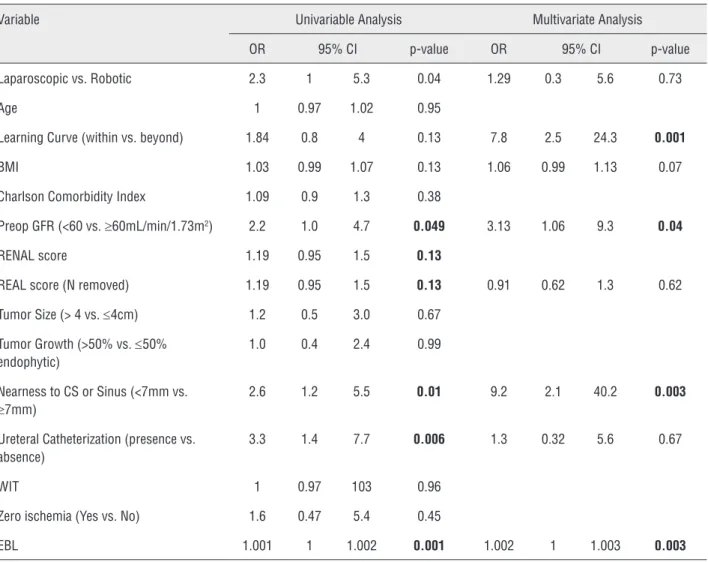
On univariable analysis, use of lapa-roscopy, presence of moderate to severe CKD, tumor nearness to collecting system or renal sinus, EBL and use of ureteral catheter had sig-nificantly higher odds of urine leak (Table-4).
On multivariable analysis, (Table-4), near-ness of the tumor to collecting system (OR=9.2; p=0.003), early surgeon’s experience (OR=7.8;
p=0.001), moderate to severe CKD (OR=3.1; p=0.04) and EBL (OR 1.002; p=0.003) were associated with higher urine leak occurrence. Intraoperative ure-teral catheterization had no significant effect on urine leak occurrence (OR=1.3; p=0.67).
DISCUSSION
Urine leak is related to an incomplete re-pair of the collecting system at the time of renor-rhaphy and it potentially represents a clinically significant complication of PN procedure (2-5). The reported incidence rate of urine leak post PN varies among institutions. Despite being low at high volume centers (3), as confirmed in the pre-sent analysis, it may result in considerable morbi-dity and financial cost.
Figure 2 - Bar graphs demonstrating the rate of employment of intraoperative ureteric catheter according to surgeon’s experience for both LPN and RPN.
require invasive procedures, such as percutaneous drainage or surgical re-intervention. Investigatio-nal less invasive avenues are being explored, such as retrograde injection of sealant through the ure-teral stent (6).
Routine intraoperative ureteral cathete-rization during PN has been used as an intra--operative measure to minimize the risk of urine leak. This practice has been carried from early open PN to LPN and even early RPN experience (9, 18, 19). Ureteral catheterization is time con-suming, incurs additional cost and is not without risk of complications.
The decision for pre-operative ureteral ca-theterization in our series was based on surgeon’s preference on case-by-case basis. This was also
influenced by the minimally invasive modality and surgeon’s own experience with that modality. For LPN cases, the use of ureteral catheter was not influenced by surgeon’s experience or tumor complexity. For RPN cases ureteral catheter was inserted in 49.4% of cases performed within the surgeons’ learning curve and only in 4.7% of ca-ses beyond that. This was the case despite an in-crease in overall tumor complexity.
use of intraoperative ureteral catheter. Kidneys operated during the surgeons’ learning curve, had 7.8 fold higher probability of developing urine leak (p=0.001).
Proximity of the tumor to the collecting system also increased the odds of urine leak (OR=9.2; p=0.003). This is not surprising as a com-plete excision of these tumors, without entering the collecting system is not possible. This in turn, increases the likelihood of subsequent urine leak. This has been previously reported in large multi--institutional series (3, 21). Bruner et al. identi-fied tumor’s R.E.N.A.L nephrometry score was associated with risk of urine leak after PN (10). The authors reported that for each unit increase
in R.E.N.A.L nephrometry the odds of urine leak increased by 35% (OR 1.35; 95% CI 1.08-1.69; P=0.009).
Presence of moderate to severe CKD was also found to be associated with increased like-lihood of urine leak (OR=3.1; p=0.04). CKD has long been associated with poor wound healing (22) and this is a possible explanation for our finding.
On multivariable regression, the use of in-traoperative ureteral catheterization was not a sig-nificant factor toward developing (or preventing) collecting system leak (p=0.19). EBL increased the odds of urinary leak, and this is likely a surrogate for complexity of surgery.
Table 4 - Univariable and Multivariable Analysis of factors predicting postoperative urine leak.
Variable Univariable Analysis Multivariate Analysis
OR 95% CI p-value OR 95% CI p-value
Laparoscopic vs. Robotic 2.3 1 5.3 0.04 1.29 0.3 5.6 0.73
Age 1 0.97 1.02 0.95
Learning Curve (within vs. beyond) 1.84 0.8 4 0.13 7.8 2.5 24.3 0.001
BMI 1.03 0.99 1.07 0.13 1.06 0.99 1.13 0.07
Charlson Comorbidity Index 1.09 0.9 1.3 0.38
Preop GFR (<60 vs. ≥60mL/min/1.73m2) 2.2 1.0 4.7 0.049 3.13 1.06 9.3 0.04
RENAL score 1.19 0.95 1.5 0.13
REAL score (N removed) 1.19 0.95 1.5 0.13 0.91 0.62 1.3 0.62
Tumor Size (> 4 vs. ≤4cm) 1.2 0.5 3.0 0.67
Tumor Growth (>50% vs. ≤50% endophytic)
1.0 0.4 2.4 0.99
Nearness to CS or Sinus (<7mm vs.
≥7mm)
2.6 1.2 5.5 0.01 9.2 2.1 40.2 0.003
Ureteral Catheterization (presence vs. absence)
3.3 1.4 7.7 0.006 1.3 0.32 5.6 0.67
WIT 1 0.97 103 0.96
Zero ischemia (Yes vs. No) 1.6 0.47 5.4 0.45
EBL 1.001 1 1.002 0.001 1.002 1 1.003 0.003
The rate of urine leak in contemporary PN series is around 1-5% (3, 23, 24). Kundu et al. re-ported that larger tumor sizes, higher estimated blood loss and longer ischemia time were asso-ciated with fistula formation. Apart from EBL, we did not identify any associated of urine leak with these factors in our cohort.
The operative time was longer for patients in C-group (211 vs. 180 min, p<0.01). Given smal-ler and less complex tumors in C-group, the urete-ric catheterization is the likely reason for increase in operating time observed in this group.
On univariable analysis, RPN had signifi-cantly lower rate of urine leak compared to LPN group, but on multivariable analysis the groups were comparable despite more complex tumors in the RPN group. Given the small number of events (31 leaks) and differences in complexity of the tumors between the RPN and LPN groups, it is difficult to reach a definite conclusion on this. However, it can be speculated that the better vi-sion offered by robotic console and the articula-tion ability of robotic instruments facilitate better identification and repair of the breached collec-ting systems (25, 26). This could be another expla-nation with regards to decrease utility of intraope-rative ureteral catheter in the robotic cohort.
Bove et al. concluded that in selected group of patients (n=103) with small (mean size <3cm) renal mass undergoing LPN, routine use of ureteral catheter is not indicated (11). We have confirmed this finding in a large (n=1019) series of LPN and RPN cases, with 425 of patients having tumors in close proximity to collecting system and 169 patients having tumor sizes >4cm.
Lack of randomization, heterogeneous na-ture of the series and retrospective aspect of data are the main limitation of our series. Moreover, the small number of events further limits the analysis. In addition, the large volume nature of our center’s experience with PN might limit the applicability of our findings to other settings. Des-pite these, we believe that our results provide the answer to the question of routine ureteral catheter use in PN. Lastly, it was outside the scope of the present study to perform a formal cost-analysis, so it remains to be demonstrated whether addi-tional cost and time for ureteral catheterization
outweighs the cost involved in the management of urine leaks eventually occurring postoperatively.
CONCLUSIONS
Clinically significant urine leak after MIPN in a high volume institution setting is uncommon. This event is more likely to occur in cases of renal masses that are close to the collecting system, in patients with preoperative CKD and when opera-ting surgeon is still in the learning curve for the procedure. Our findings suggest that routine in-traoperative ureteral catheterization during MIPN does not reduce the probability of postoperative urine leak. In addition, it adds to the overall ope-rative time.
CONFLICT OF INTEREST
None declared.
REFERENCES
1. Uzzo RG, Novick AC. Nephron sparing surgery for renal tumors: indications, techniques and outcomes. J Urol. 2001; 166: 6-18.
2. Kim FJ, Rha KH, Hernandez F, Jarrett TW, Pinto PA, Kavoussi LR. Laparoscopic radical versus partial nephrectomy: assessment of complications. J Urol. 2003; 170: 408-11. 3. Tanagho YS, Kaouk JH, Allaf ME, Rogers CG, Stifelman MD,
Kaczmarek BF, et al. Perioperative complications of robot-assisted partial nephrectomy: analysis of 886 patients at 5 United States centers. Urology. 2013; 81: 573-9.
4. Permpongkosol S, Link RE, Su LM, Romero FR, Bagga HS, Pavlovich CP, et al. Complications of 2,775 urological laparoscopic procedures: 1993 to 2005. J. Urol.2007; 177: 580-5.
5. Wheat JC, Roberts WW, Hollenbeck BK, Wolf JS Jr, Weizer AZ. Complications of laparoscopic partial nephrectomy. Urol Oncol. 2013; 31: 57-62.
6. French DB, Marcovich R. Fibrin sealant for retrograde ureteroscopic closure of urine leak after partial nephrectomy. Urology. 2006; 67: 1085.e1-3.
7. Meeks JJ, Smith ND, Lesani OA, Nadler RB. Percutaneous endoscopic management of persistent urine leak after partial nephrectomy. J Endourol. 2008; 22: 485-8.
9. Haber GP, Gill IS. Laparoscopic partial nephrectomy: contemporary technique and outcomes. Eur Urol. 2006; 49: 660-5.
10. Bruner B, Breau RH, Lohse CM, Leibovich BC, Blute ML. Renal nephrometry score is associated with urine leak after partial nephrectomy. BJU Int. 2011;108: 67-72.
11. Bove P, Bhayani SB, Rha KH, Allaf ME, Jarrett TW, Kavoussi LR. Necessity of ureteral catheter during laparoscopic partial nephrectomy. J Urol. 2004; 172: 458-60.
12. Kutikov A, Uzzo RG. The R.E.N.A.L. nephrometry score: a comprehensive standardized system for quantitating renal tumor size, location and depth. J Urol. 2009; 182: 844-53. 13. Pierorazio PM, Patel HD, Feng T, Yohannan J, Hyams ES, Allaf
ME. Robotic-assisted versus traditional laparoscopic partial nephrectomy: comparison of outcomes and evaluation of learning curve. Urology. 2011; 78: 813-9.
14. Link RE, Bhayani SB, Allaf ME, Varkarakis I, Inagaki T, Rogers C, et al. Exploring the learning curve, pathological outcomes and perioperative morbidity of laparoscopic partial nephrectomy performed for renal mass. J Urol. 2005; 173: 1690-4.
15. Tomaszewski JJ, Cung B, Smaldone MC, Mehrazin R, Kutikov A, Viterbo R, et al. Renal Pelvic Anatomy Is Associated with Incidence, Grade, and Need for Intervention for Urine Leak Following Partial Nephrectomy. Eur Urol. 2013. pii: S0302-2838(13)01082-8.
16. Simmons MN, Gill IS. Decreased complications of contemporary laparoscopic partial nephrectomy: use of a standardized reporting system. J Urol. 2007 ; 177: 2067-73; discussion 2073.
17. Kaouk JH, Khalifeh A, Hillyer S, Haber GP, Stein RJ, Autorino R. Robot-assisted laparoscopic partial nephrectomy: step-by-step contemporary technique and surgical outcomes at a single high-volume institution. Eur Urol. 2012; 62: 553-61. 18. Kaouk JH, Hillyer SP, Autorino R, Haber GP, Gao T,
Altunrende F, et al. 252 robotic partial nephrectomies: evolving renorrhaphy technique and surgical outcomes at a single institution. Urology. 2011; 78: 1338-44.
19. Gill IS, Desai MM, Kaouk JH, Meraney AM, Murphy DP, Sung GT, et al. Laparoscopic partial nephrectomy for renal tumor: duplicating open surgical techniques. J Urol. 2002; 167: 469-7; discussion 475-6.
20. Khalifeh A, Autorino R, Hillyer SP, Laydner H, Eyraud R, Panumatrassamee K, et al. Comparative outcomes and assessment of trifecta in 500 robotic and laparoscopic partial nephrectomy cases: a single surgeon experience.J Urol. 2013; 189: 1236-42.
21. Ficarra V, Bhayani S, Porter J, Buffi N, Lee R, Cestari A, et al. Predictors of warm ischemia time and perioperative complications in a multicenter, international series of robot-assisted partial nephrectomy. Eur Urol. 2012; 61: 395-402. 22. Cheung AH, Wong LM. Surgical infections in patients with
chronic renal failure. Infect Dis Clin North Am. 2001; 15: 775-96.
23. Kundu SD, Thompson RH, Kallingal GJ, Cambareri G, Russo P. Urinary fistulae after partial nephrectomy. BJU Int. 2010; 106: 1042-4.
24. Vittori G. Open versus robotic-assisted partial nephrectomy: a multicenter comparison study of perioperative results and complications. World J Urol. 2014; 32: 287-93.
25. Faria EF, Caputo PA, Wood CG, Karam JA, Nogueras-González GM, Matin SF. Robotic partial nephrectomy shortens warm ischemia time, reducing suturing time kinetics even for an experienced laparoscopic surgeon: a comparative analysis. World J Urol. 2014; 32: 265-71.
26. Mayer WA, Godoy G, Choi JM, Goh AC, Bian SX, Link RE. Higher RENAL Nephrometry Score is predictive of longer warm ischemia time and collecting system entry during laparoscopic and robotic-assisted partial nephrectomy. Urology. 2012; 79: 1052-6.
_______________________ Correspondence address: