Copyright © 2008 by Sociedade Brasileira de Pediatria
O
RIGINALA
RTICLEToilet training: situation at 2 years of age in a birth cohort
Denise M. Mota,1 Aluisio J. D. Barros2Abstract
Objectives:Acquisition of bladder and bowel control is influenced by physiological, psychological and sociocultural factors. The objective of this study was to evaluate the prevalence of children out of diapers by 24 months of age and the factors associated with this finding.
Methods:A total of 3,281 children born in Pelotas, RS, Brazil in 2004 were enrolled on a longitudinal study. At 24 months their mothers were visited at home and replied to a questionnaire containing questions about sociodemographic data and the characteristics of their children’s urinary and intestinal evacuation habits, with special attention to toilet training. Multivariate analyses were carried out using Poisson regression.
Results:From the total, 24.3% were out of diapers during the day, with the female sex predominating (27.8 vs. 21.1%, p < 0.001) and 8.6% were out of diapers at night, also with the female sex predominating (10.6 vs. 6.8%, p < 0.001). The abilities needed to start toilet training were present in 85.5% of the children. Guidance was received from a pediatrician in 10% of cases, and more frequently among richer mothers than among poorer mothers (22.9 vs. 4.8%). Mothers who spent more years in education (13.2%) and were from higher social classes (14%) took their children out of diapers later; a greater number of children living at home (relative risk = 1.32) and being able to communicate the need to go to the toilet (relative risk = 11.74) both increased the probability of being out of diapers; previous unsuccessful attempts delayed removal of diapers (relative risk = 0.59).
Conclusions:Although the abilities needed for acquisition of bladder and bowel control were already present at 24 months, indicating that toilet training could be started, the majority of children had not yet started this training. Better-informed mothers delayed training the most.
J Pediatr (Rio J). 2008;84(5):455-462:Toilet training, children, bladder control, bowel control, voiding dysfunction.
Introduction
Acquisition of bowel and bladder control is one of the mile-stones of child development and one of the major challenges that a child will have to face, since, in addition to requiring physical control of bowel and bladder sphincters, it is also nec-essary to adapt to the social and cultural values of the envi-ronment in which the child is living. Each different culture has its own characteristic expectations of, and methods for, toilet training.1-4Physiological and psychological factors can also affect this control.5
The majority of children are ready to start toilet training between the ages of 18 and 24 months, since the abilities needed for this control are already present at this age.6-8
Despite this, over recent years toilet training has been being delayed in the majority of countries, with a gradual increase in the age at which control is attained.9
Healthy bladder and bowel movement habits are impor-tant for the healthy function of the systems involved (urinary and intestinal).9,10Late acquisition of bladder and bowel con-trol may be related to the increased prevalence of dysfunc-tional elimination observed over recent years.9 Other pathologies that may be related to incorrect toilet training are recurrent urinary infections, enuresis, constipation, toileting refusal and encopresis.11-13Despite the importance of toilet training, both for the children and for the parents who live with them, there is a lack of interest in the subject among pediatricians.9,14
1. Médica nefrologista pediátrica. Doutora. Programa de Pós-Graduação em Epidemiologia, Universidade Federal de Pelotas (UFPel), Pelotas, RS, Brazil. 2. PhD. Professor associado, Programa de Pós-Graduação em Epidemiologia, UFPel, Pelotas, RS, Brazil.
No conflicts of interest declared concerning the publication of this article.
Suggested citation:Mota DM, Barros AJ. Toilet training: situation at 2 years of age in a birth cohort. J Pediatr (Rio J). 2008;84(5):455-462.
Manuscript received May 27 2008, accepted for publication Aug 06 2008.
doi:10.2223/JPED.1832
The objective of this study was to measure the preva-lence of children achieving bowel and bladder control by 24 months and to evaluate the factors associated with this prevalence.
Methods
This study is the result of follow-up of a birth cohort started in 2004 in the city of Pelotas, RS, Brazil. The mothers of chil-dren born and resident in the city were interviewed during admission to hospital, and their babies were measured (length and weight) and examined for estimation of gestational age.
The initial cohort was made up of 4,231 children who were selected for the perinatal study (0.8% of losses and refus-als). A total of 88 children died during their first 2 years of life, leaving 4,143 children eligible for the visit at 24 months. Of these, there were 239 losses and 40 refusals, leaving 93.3% of the original cohort.
An attempt was made to contact each child at 3, 12 and 24 months, and their mothers were interviewed and an anthropometric assessment of the child carried out. Details of the methods used for the 2004 Pelotas birth cohort have been published elsewhere.15
The data from the 24-month visit and some data from the perinatal visit will be used for this study. Seven children with meningomyelocele were excluded from this analysis, as was one child with cerebral palsy, one child for whom there was no information about when diapers were withdrawn, one child who had never used diapers and 33 pairs of twins, leaving a sample of 3,821 children.
At the 24-month visit, the mothers replied to a question-naire about the condition of their children's health, morbidi-ties, feeding, sleeping patterns and vaccination and also provided information about their own health. A great deal of information was also recorded about toilet training, including age in months at start of toilet training; whether or not the child was wearing diapers during the day and during the night; age in months when taken out of diapers; duration of training; previous attempts at withdrawing diapers; where the child evacuated; and whether or not they had received any guid-ance about how to go about taking their child out of diapers.
For this analysis, data were also used on abilities that are important for starting toilet training: motor development (walking with confidence at 18 months, sitting up), language (the ability to say more than 10 words), coordination (remov-ing clothes with or without help) and cognition (understand-ing and follow(understand-ing instructions, signal(understand-ing a need to go to the toilet). This cohort's child development was evaluated using the screening version of the Battelle development test and selected items from the Denver development screening test,16,17and from the results of this overall assessment, we selected the abilities of interest when investigating the start of toilet training. The interviewers were specially trained in
advance and were accompanied by a pediatrician during vis-its and while administering tests.
Quality control was included, in order to identify and avert fraud during interviews, and this consisted of repeating 10% of the interviews during home visits, using a reduced ques-tionnaire. One attempt was made at telephone contact with each mother who had a telephone at home. All interviewers were accompanied by a research supervisor once a fortnight with the objective of assessing their application of the devel-opment test and the questionnaire.
The study outcomes were not wearing diapers during the day and during the night, based on the answers to the follow-ing questions:
- At what age did you start to take [child’s name] out of dia-pers during the day?
- At what age did [child’s name] stop wetting his/her clothes during the day?
- Does your child wear diapers during the day?
- Does [child’s name] wear diapers all the time or part of the time?
- Does your child wear diapers during the night?
The remaining variables also included in the analyses were: characteristics of the children: sex, gestational age in weeks (preterm up to 36 weeks, full term from 37 to 41 weeks and overdue at 42 weeks or more), birth weight (< 2,500 g [low birth weight] and ≥ 2,500 g); maternal characteristics: educational level and age (in full years), parity and employ-ment (outside of the home); characteristics of home: num-ber of children in the residence and economic child level measured in Pelotas-specific reference quintiles from the National Economic Indicator (IEN –Indicador Econômico Nacional).
employed, starting with all of the variables on level 1. Vari-ables without statistical significance (p ≥ 0.05) were then removed from the model and the model tested once more until all variables on the same level reached p < 0.05. Prior to con-structing the model, variables had been tested for linearity, and, where this was the case, the variable with the higher level of significance was chosen for the model. Level 2 variables were then added and the same strategy repeated, higher level variables were retained even if they lost statistical signifi-cance as lower level variables were added. The same proce-dure was repeated with the remaining levels until the final model was arrived at. The adjusted analysis presents the final result of the modeling process, but with the effects adjusted for all of the variables in the model, making it possible to evalu-ate the effects of the more distal variables when adjusted for the most proximal ones. These changes reflect processes through which study variables mediate each other.
The protocol for this study was approved by the Research Ethics Committee at the Medical Faculty of the Universidade Federal de Pelotas (UFPel), RS, Brazil. Written consent was obtained from each mother before participation and after they had been informed about the objectives and had been guar-anteed that the information would be kept confidential. Field-work took place between December 2004 and December 2006.
Results
Table 1 lists the sociodemographic and economic charac-teristics of the mothers and their children for the whole sample and the prevalence of children not wearing diapers during the day and during the night. The greatest number of mothers were in the first IEN reference quintile, demonstrating a larger number of children in the poorest strata of the population.
In the bivariate analysis (Table 1), girls and children with birth weight > 2,500 g had a higher prevalence of daytime and nocturnal control, when compared with boys and low birth weight children. Children whose mothers had greater num-bers of children or who lived in homes with greater numnum-bers of children were more likely to be out of diapers by 2 years, both during the daytime and at night. Higher percentages of children were out of diapers, both in the day and at night, in the poorer social strata and born to mothers who had received less education.
The sample was stratified by sex for the analysis of vari-ables related with child development and bowel and bladder control (Table 2). In order to evaluate whether the set of abili-ties needed for toilet training was present, we recorded the number of abilities attained by each child, broken down by sex. At 24 months, 85.5% of the children exhibited four or more of the abilities necessary to be correctly toilet trained. Being able to communicate the need to go to the toilet was the least common ability among the children (43.6%). Ana-lyzing this ability in isolation, it was found that 91.4% of the
children who were already out of diapers during the day indi-cated their need to go to the toilet, while only 57.6% of those who wore diapers some of the time were able to do so. Among the children still wearing diapers, the prevalence of this abil-ity was 17.9% (p < 0.001; data not shown).
Table 3 contains data on some of the characteristics of toi-let training. It was found that 41% of the mothers described some type of previous, unsuccessful, attempt at taking their child out of diapers, and that 58% of these attempts were started before 18 months of age. In the majority of cases, these attempts lasted less than 2 weeks (55.9%), but 15.7% of attempts lasted 9 weeks (data not shown).
Among the motives that the mothers gave for starting to take their children out of diapers, the most often cited was age (54.2%), followed by requests from the children them-selves (20.5%). Despite the mothers not having mentioned this as a motive themselves, it was observed that 60% of them started toilet training between October and January, which are the warmest months of the year in southern Brazil.
Overall, 10.2% of the mothers described having received medical instructions about toilet training, with a tendency for the number of mothers receiving medical advice to increase in line with economic level. In the first quintile, 4.8% of the mothers said they had received instructions, while in the rich-est quintile, the proportion was four times greater (22.9%; data not shown). In the majority of cases (85.3%) toilet train-ing was carried out by mothers, with 64.7% of them saytrain-ing they had simply followed their own intuition, without any instructions from anyone else. One quarter of the mothers had received some instruction from their own mothers about how to carry out this task.
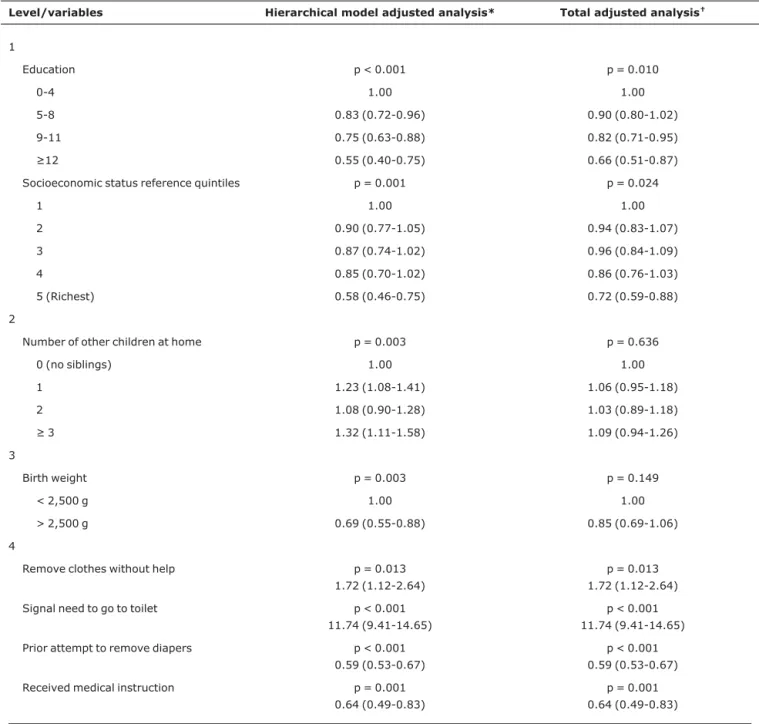
The multivariate analysis (Table 4) demonstrated that both the educational level and socioeconomic status of the mothers were inversely related with removing diapers during the day. The proportion of the children of mothers who had attended education for 0 to 4 years and were out of diapers during the day was 45% greater (relative risk - RR = 0.55) than for the children of mothers who had attended school for 12 years or more. The proportion of the children of mothers who attended education for 5 to 8 years and were out of dia-pers during the daytime was 17% lower (RR = 0.83). Socio-economic status exhibited a similar tendency, in that it was twice as likely for a child in the first economic quintile (the poorest) to be out of diapers than a child from the richest quintile.
Table 1- Perinatal and socioeconomic characteristics at 24 months of age of 3,821 single born children from the 2004 Pelotas birth cohort
Proportion of children
Variable (n)* n (%)
No diaper during the day
(%)
No diaper during the night
(%)
All children 3,821 (100.0) 929 (24.3) 329 (8.6)
Sex (n = 3,821) p < 0.001 p < 0.001
Male 1,985 (51.8) 21.1 6.8
Female 1,836 (48.2) 27.8 10.6
Gestational age (weeks) (n = 3,817)
p = 0.688 p = 0.495
Preterm (up to 36 weeks) 545 (14.3) 25.1 9.9
Full term (37-41) 3,023 (79.2) 24.1 8.4
Overdue (≥ 42) 249 (6.5) 26.1 8.8
Birth weight (n = 3,820) p = 0.006 p = 0.043
< 2,500 g 322 (8.3) 18.0 5.6
> 2,500 g 3,498 (91.7) 24.9 8.9
Maternal age (years) (n = 3,819)
p = 0.136† p = 0.252†
Adolescent (up to 19) 717 (18.8) 26.2 8.8
20-29 1,902 (49.8) 24.5 9.2
30-39 1,079 (28.3) 22.9 7.6
≥ 40 121 (3.2) 24.0 7.4
Mother’s education (full years) (n = 3,783)
p < 0.001† p < 0.001†
0-4 581 (15.4) 33.1 10.7
5-8 1,554 (41.0) 26.5 10.2
9-11 1,269 (33.5) 21.6 6.7
≥ 12 379 (10.0) 13.2 6.1
Parity (n = 3,820) p = 0.001† p = 0.003†
1 1,514 (39.6) 20.7 7.0
2 1,007 (26.4) 25.4 9.2
3 616 (16.1) 25.8 9.1
≥ 4 683 (17.9) 29.3 10.8
Number of other children at home (n = 3,821)
p < 0.001† p < 0.001†
0 (no siblings) 1,719 (45.0) 20.5 6.8
1 1,161 (30.4) 26.5 9.4
2 552 (14.5) 25.0 9.1
≥ 3 389 (10.1) 33.4 13.6
Socioeconomic status reference quintiles (IEN) (n = 3,821)
p < 0.001† p < 0.001†
1 (poorest) 895 (23.4) 31.0 12.6
2 783 (20.5) 26.6 8.4
3 853 (22.3) 24.5 9.3
4 605 (15.8) 23.0 7.1
5 (richest) 685 (17.9) 14.0 4.1
Mother employed away from home (n = 3,735)
p = 0.016 p = 0.462
Yes 1,477 (39.5) 22.1 8.1
No 2,258 (60.5) 25.5 8.8
IEN = Indicador Econômico Nacional (National Economic Indicator).
With relation to abilities, children capable of indicating their need to go to the toilet and of removing clothes with or without help exhibited a higher probability of being out of dia-pers at 24 months (RR = 11.74 and RR = 1.72, respectively). Children who had undergone a prior, unsuccessful, attempt to remove diapers were less likely to be out of diapers at 24 months (RR = 0.59). The children of mothers who had received medical advice were also less likely to be out of diapers.
Discussion
In developed countries, for more than 2 decades a ten-dency has been being observed towards delaying the start of toilet training.3,6,9,19,20A study carried out in Brazil in 2003 found an earlier age for withdrawing diapers than the data pre-sented here,21but those results may have been skewed by memory bias since the children were already between 3 and 9 years of age when the questionnaires were administered.
Several different factors are involved in this process, from the emergence and growing use of disposable diapers (even in the poorest strata) to the lifestyle of many mothers (employment away from the home, split-shift working days, domestic chores delegated to third parties, the number of chil-dren at home, lack of time for toilet training).20,22Economic factors are also related to this control: richer mothers with more education train their children later.
Despite the observation that, at 2 years of age, the major-ity of children have reached an adequate stage of develop-ment to start toilet training (the necessary abilities were
already present in the majority of children), only a small pro-portion of them had started this training, even though their parents' expectations were related to earlier ages.23The same phenomenon is being observed in other places, with mean age of acquisition of bladder and bowel control being around 36 months of age.4,24,25
On the other hand, early training (before 18 months) is still common in some cultures.26It was observed that 41% of mothers who attempted toilet training before their children had reached 18 months of age were unsuccessful and that, at 24 months, a greater proportion of their children were still wearing diapers. It was concluded that it is undesirable to start toilet training early and that premature training can actually delay acquisition of bladder and bowel control.27,28The pres-ence of the necessary abilities for autonomous use of the toi-let must be an aspect that is of relevance to guiding parents and health professionals in their choice of time to start toilet training. Children must be taught about the routine for using the toilet and their parents should be advised by the child's doctor about the time and methods best suited to successful toilet training.
One limitation of this study is that we have no way of assessing a child's awareness of the imminence of their evacu-ations. We should treat with caution the relative risk of 11.74 for the ability to communicate need to go to the toilet. Despite this study being longitudinal, the annual assessments are cross-sectional and we cannot exclude the possibility of Table 2- Prevalence rates of abilities related to toilet training and outcomes at 24 months of age, broken down by sex, for the 3,821 single-born
children from the 2004 Pelotas birth cohort
Proportion of children with this ability
Variable All Males Females p*
Indicates need to go to toilet (n = 3,821) 43.6 38.5 49.2 < 0.001
Walks with confidence (at 18 months) (n = 3,818) 96.7 96.6 96.8 0.647
Can remove one item of clothing with or without help (n = 3,820) 94.4 91.8 97.1 < 0.001
Number of instructions followed when asked (n = 3,820) 0.181
0-1 6.5 7.2 5.8
2 3.4 3.5 3.3
3-4 90.1 89.3 91.0
Can say more than ten words (n = 3,820) 90.0 87.5 92.8 < 0.001
Total number of abilities per child†(n = 3,817) < 0.001
0-1 0.8 1.1 0.6
2 1.7 2.4 1.0
3 12.0 14.8 9.0
4-5 85.5 81.7 89.4
* Chi-square test.
reverse causality, since, when we assess the capacity of a child to indicate their need to go to the toilet, we cannot conclude whether the child indicates this by being out of diapers (they are being trained) or, wearing nappies, truly demonstrates this need (wishing to be trained).
Some recent studies suggest training at much earlier ages (during the first months of life), but, evaluating the results with relation to children with previous unsuccessful attempts, and to the age of removing diapers, we do not believe that this is an appropriate strategy.26Assessing the child with rela-tion to maturarela-tion of the urinary and intestinal tracts, we know that it is not possible to accelerate the development and myeli-nation of nerve fibers, which are necessary to acquire this con-trol, and that the child needs cognitive development to be able to understand the mechanisms involved in acquisition of uri-nary habits, and also how to adapt to the local culture and socialize.29
Another important factor that should be mentioned is related to voiding dysfunction. It is known that voiding dys-function has been increasing gradually and that this is related
to inappropriate micturition and evacuation patterns.1,30The majority of children who use a toilet do not use a reducing seat or a foot rest, which are important accessories to achieve a healthy posture while evacuating. It is known that these simple devices facilitate perineal relaxation and, conse-quently, bladder and bowel evacuation. Incorrect positions while eliminating contribute to the emergence of micturition dysfunctions, which are more easily observed after toilet training.12,13
In addition to the need for a child to learn, parents also need to know how to provide training, thereby creating a har-monious and tranquil environment for adequate development; mothers should receive instruction on the abili-ties that should be present before starting toilet training, and should be discouraged from initiating training prematurely. Instruction should be provided by a trained professional who is aware of the best techniques, avoiding frustration and fam-ily conflicts.9Pediatricians are the best-qualified people to per-form this task, at around the time when the child reaches 12 Table 3- Characteristics related to the toilet training of 3,821 single-born children from the 2004 Pelotas birth cohort
Variables Prevalence (%)
Prior unsuccessful attempts 41.0
Received medical advice on toilet training 10.2
Motive for withdrawing diapers*
Age of child 54.2
Child’s wishes 20.5
Cost of diapers 7.2
Was going to start daycare 1.2
More practical 10.1
Accessories used when starting training*
Toilet 33.8
Potty 58.4
Place where child evacuates at 24 months*
Toilet 42.5
Potty 39.4
Potty and toilet 9.6
Floor 8.4
Children using the toilet
Also use seat reducer 24.8
Also use a footrest 5.3
Use both seat reducer and footrest 5.6
Type of diapers used by children
Disposable 80.4
Cloth 17.0
Both 2.6
months of age, they should ask the parents about their expec-tations of, and knowledge about, toilet training and explain to them the importance of assessing the degree of child devel-opment, paying attention to the abilities needed for bladder and bowel control. During the child’s second year of life, after evaluating the child’s abilities, they should propose that the parents start toilet training (if the child is ready) and teach them the most appropriate strategies.
In synthesis, the majority of children exhibit the neces-sary abilities for toilet training by 24 months of age, despite
less than half of them exhibiting consciousness of and the need to use the toilet or potty. From this point on, the child is ready to be trained and should be instructed by their parents, who should in turn be guided by trained professionals.
References
1. Bakker E, Wyndaele JJ.Changes in the toilet training of children during the last 60 years: the cause of an increase in lower urinary tract dysfunction?BJU Int. 2000;86:248-52.
Table 4- Adjusted analyses, hierarchical and total, with respective relative risks and confidence intervals for being out of diapers during the day, for the 3,821 single-born children in the 2004 Pelotas birth cohort
Level/variables Hierarchical model adjusted analysis* Total adjusted analysis†
1
Education p < 0.001 p = 0.010
0-4 1.00 1.00
5-8 0.83 (0.72-0.96) 0.90 (0.80-1.02)
9-11 0.75 (0.63-0.88) 0.82 (0.71-0.95)
≥12 0.55 (0.40-0.75) 0.66 (0.51-0.87)
Socioeconomic status reference quintiles p = 0.001 p = 0.024
1 1.00 1.00
2 0.90 (0.77-1.05) 0.94 (0.83-1.07)
3 0.87 (0.74-1.02) 0.96 (0.84-1.09)
4 0.85 (0.70-1.02) 0.86 (0.76-1.03)
5 (Richest) 0.58 (0.46-0.75) 0.72 (0.59-0.88)
2
Number of other children at home p = 0.003 p = 0.636
0 (no siblings) 1.00 1.00
1 1.23 (1.08-1.41) 1.06 (0.95-1.18)
2 1.08 (0.90-1.28) 1.03 (0.89-1.18)
≥ 3 1.32 (1.11-1.58) 1.09 (0.94-1.26)
3
Birth weight p = 0.003 p = 0.149
< 2,500 g 1.00 1.00
> 2,500 g 0.69 (0.55-0.88) 0.85 (0.69-1.06)
4
Remove clothes without help p = 0.013 1.72 (1.12-2.64)
p = 0.013 1.72 (1.12-2.64)
Signal need to go to toilet p < 0.001 11.74 (9.41-14.65)
p < 0.001 11.74 (9.41-14.65)
Prior attempt to remove diapers p < 0.001 0.59 (0.53-0.67)
p < 0.001 0.59 (0.53-0.67)
Received medical instruction p = 0.001 0.64 (0.49-0.83)
p = 0.001 0.64 (0.49-0.83)
* Analysis by hierarchical model, with forward selection of variables, starting with level 1. As each level is added, the subsequent level is adjusted for the previous, and so on successively. Variables with p < 0.05 are retained.
2. deVries MW, deVries MR.Cultural relativity of toilet training readiness: a perspective from East Africa. Pediatrics. 1977;60: 170-7.
3. Michel RS.Toilet training.Pediatr Rev. 1999;20:240-5.
4. Schum TR, McAuliffe TL, Simms MD, Walter JA, Lewis M, Pupp R.Factors associated with toilet training in the 1990s.
Ambul Pediatr. 2001;1:79-86.
5. Howe AC, Walker CE.Behavioral management of toilet training, enuresis, and encopresis.Pediatr Clin North Am. 1992;39: 413-32.
6. Brazelton TB.A child-oriented approach to toilet training.
Pediatrics. 1962;29:121-8.
7. Brazelton TB, Christophersen ER, Frauman AC, Gorski PA, Poole JM, Stadtler AC, et al.Instruction, timeliness, and medical influences affecting toilet training.Pediatrics. 1999;103: 1353-8.
8. Stadtler AC, Gorski PA, Brazelton TB.Toilet training methods, clinical interventions, and recommendations.American Academy of Pediatrics. Pediatrics. 1999;103:1359-68.
9. Mota DM, Barros AJ. Toilet training: methods, parental expectations and associated dysfunctions.J Pediatr (Rio J). 2008; 84:9-17.
10. Christophersen ER.Toileting problems in children.Pediatr Ann. 1991;20:240-4.
11. Polaha J, Warzak WJ, Dittmer-Mcmahon K.Toilet training in primary care: current practice and recommendations from behavioral pediatrics.J Dev Behav Pediatr. 2002;23:424-9.
12. De Paepe H, Renson C, Hoebeke P, Raes A, Van Laecke E, Vande Walle J.The role of pelvic-floor therapy in the treatment of lower urinary tract dysfunctions in children.Scand J Urol Nephrol. 2002;36:260-7.
13. De Paepe H, Hoebeke P, Renson C, Van Laecke E, Raes A, Van Hoecke E, et al.Pelvic-floor therapy in girls with recurrent urinary tract infections and dysfunctional voiding.Br J Urol. 1998;81 Suppl 3:109-13.
14. Olson LM, Inkelas M, Halfon N, Schuster MA, O'Connor KG, Mistry R.Overview of the content of health supervision for young children: reports from parents and pediatricians. Pediatrics. 2004;113 (6 Suppl):1907-16.
15. Barros AJ, da Silva dos Santos I, Victora CG, Albernaz EP, Domingues MR, Timm IK, et al.[The 2004 Pelotas birth cohort: methods and description].Rev Saude Publica. 2006;40:402-13. 16. Frankenburg K, Dodds J, Archer P, Bresnick B. Denver II: technical manual and training manual. Denver: Denver Developmental Materials; 1990.
17. Newborg J, Stock J, Wnek L, Guidabaldi J, Svinicki J. Battelle Developmental Inventory. Itasca: Riverside Publishing; 1988.
18. Barros AJ, Hirakata VN.Alternatives for logistic regression in cross-sectional studies: an empirical comparison of models that directly estimate the prevalence ratio.BMC Med Res Methodol. 2003;3:21.
19. Martin JA, King DR, Maccoby EE, Jacklin CN.Secular trends and individual differences in toilet-training progress.J Pediatr Psychol. 1984;9:457-67.
20. Jansson UB, Hanson M, Sillén U, Hellström AL.Voiding pattern and acquisition of bladder control from birth to age 6 years-a longitudinal study. J Urol. 2005;174:289-93.
21. Mota DM, Victora CG, Hallal PC.Investigação de disfunção miccional em uma amostra populacional de crianças de 3 a 9 anos.J Pediatr (Rio J). 2005;81:225-32.
22. Hallgren B.Enuresis. I. A study with reference to the morbidity risk and symptomatology. Acta Psychiatr Neurol Scand. 1956; 31:379-403.
23. Mota DM, Barros AJ.Treinamento esfincteriano precoce: prevalência, características materna, da criança e fatores associados numa coorte de nascimentos.Rev Bras Saude Mater Infant. 2008;8:103-11.
24. Schum TR, Kolb TM, McAuliffe TL, Simms MD, Underhill RL, Lewis M.Sequential acquisition of toilet-training skills: a descriptive study of gender and age differences in normal children. Pediatrics. 2002;109:E48.
25. Stehbens JA, Silber DL.Parental expectations in toilet training.
Pediatrics. 1971;48:451-4.
26. Rugolotto S, Sun M, Ball T, Boucke L, de Vries M.A surging new interest on toilet training started during the first months of age in Western countries.Tech Coloproctol. 2007;11:162-3.
27. Luxem M, Christophersen E.Behavioral toilet training in early childhood: research, practice, and implications.J Dev Behav Pediatr. 1994;15:370-8.
28.Taubman B. Toilet training and toileting refusal for stool only: a prospective study. Pediatrics. 1997;99:54-8.
29. Hellström AL, Hanson E, Hansson S, Hjälmås K, Jodal U.
Micturition habits and incontinence in 7-year-old Swedish school entrants. Eur J Pediatr. 1990;149:434-7.
30. Hellstrom AL.Influence of potty training habits on dysfunctional bladder in children.Lancet. 2000;356:1787.
Correspondence: Denise Marques Mota Rua General Osório, 956
CEP 96020-000 - Pelotas, RS - Brazil Tel.: +55 (53) 3222.4356