J Bras Pneumol. 2012;38(5):672-673
To the Editor:
Adult invasive mechanical ventilation requires the use of an endotracheal tube with an inflatable cuff at its distal end. It is important to ensure adequate pressure within the device because its objective is to seal the interface between the tracheal mucosa and the cuff in order to prevent microaspiration of oropharyngeal secretions and pressure-induced ischemic injury due to obliteration of the tracheal mucosal arteries.(1) Therefore, the III Consenso Brasileiro de Ventilação Mecânica (III CBVM, Third Brazilian Consensus on Mechanical Ventilation) recommends intracuff pressures between 15 and 25 mmHg (20-34 cmH2O), with a grade of recommendation of D.
(2)
However, other authors recommend the use of the minimal occlusive volume (MOV) technique in order to reach a minimum pressure to seal the interface between the cuff and the tracheal mucosa, because it is known that lower cuff pressures on the tracheal mucosa translate to a lower risk of tracheal mucosal injury and, in the event of injury, to less severe injury.(3)
In order to compare the intracuff pressures that can be obtained by the MOV technique with the pressures recommended by the III CBVM, we conducted a prospective descriptive study at the Adult ICU of the State University at Campinas Hospital de Clínicas between August and December of 2011. The study was approved by the Research Ethics Committee of the State University at Campinas School of Medical Sciences (Protocol no. 542/2011). We measured intracuff pressures using the MOV technique in 29 adult patients on mechanical ventilation. We included patients over 18 years of age who had been on mechanical ventilation with a high-volume, low-pressure cuffed endotracheal tube for less than 48 h. We excluded patients with a history of intubation.
For the use of the MOV method, the study patients were placed in the supine position, with the neck in a neutral position, and their
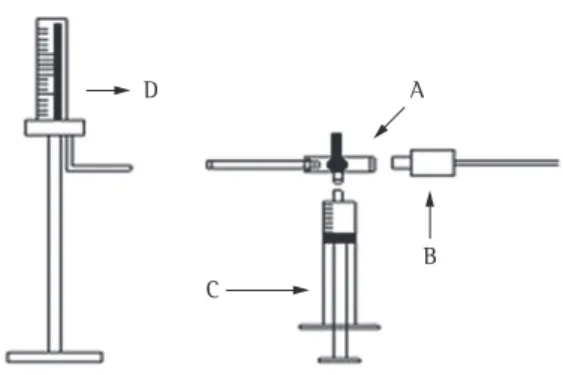
oropharyngeal cavity was cleaned and aspirated. Subsequently, the cuff was deflated and inflated with a 20-mL syringe, which was attached to one of the ports of a three-way stopcock. Of the two remaining stopcock ports, one was connected to an endotracheal tube cuff and the other was attached to a mercury-filled glass column, calibrated in mmHg (Figure 1). The cuff was inflated until auscultation with a stethoscope placed on the suprasternal notch of the patient showed the absence of adventitious sounds, at which point mercury manometer readings were taken.(3) Data were analyzed with the one-sample Student’s t-test, and values of p < 0.05 were considered significant.
The patients studied were in the 26-83 year age bracket (mean age, 56 ± 14 years). The reasons for intubation were as follows: postoperative period of neurovascular surgery, in 31% of the cases; pulmonary focus, in 34%; postoperative period of general surgery, in 10%; trauma, in 7%; and other reasons, in 18%. All tracheal tubes had an internal diameter of 7.5-9.0 mm and had a low-pressure cuff.
The mean intracuff pressure obtained by the MOV method was 15 ± 4 mmHg, the minimum value being 7 mmHg and the maximum value being 22 mmHg (2nd quartile, 14 mmHg, and 3rd quartile, 17 mmHg; Figure 2). Data analysis revealed a statistically significant difference (p < 0.001) between the mean intracuff pressures recommended by the III CBVM and the pressures obtained by the MOV method.
We found that the intracuff pressures obtained by the MOV method did not remain the same in all patients. All of the 29 study patients received intracuff pressures that were lower than the maximum pressure recommended by the III CBVM (25 mmHg), and, in 20 patients (69%), the lowest recommended intracuff pressure (15 mmHg) could have been used. For those patients, we could have reduced the pressure on the tracheal
Tailored intracuff pressures
Valores individualizados de pressão intracuff
Armando Carlos Franco de Godoy, Mariana Del Grossi Moura, Monique Louise Adame, Gustavo Pereira Fraga
Tailored intracuff pressures
J Bras Pneumol. 2012;38(5):672-673
673
mucosal injury and, in the event of injury, the severity of the injury.
Armando Carlos Franco de Godoy Physical Therapist, Adult ICU,
State University at Campinas
Hospital de Clínicas
, Campinas, BrazilMariana Del Grossi Moura Physical Therapist, Adult ICU,
State University at Campinas
Hospital de Clínicas
, Campinas, BrazilMonique Louise Adame Physical Therapist, Adult ICU,
State University at Campinas
Hospital de Clínicas
, Campinas, BrazilGustavo Pereira Fraga Coordinator of the Division
of Trauma Surgery, Department of Surgery, State University at Campinas
School of Medical Sciences, Campinas, Brazil
References
1. Seegobin RD, van Hasselt GL. Endotracheal cuff pressure and tracheal mucosal blood flow: endoscopic study of effects of four large volume cuffs. Br Med J (Clin Res Ed). 1984;288(6422):965-8. PMid:1442489. http:// dx.doi.org/10.1136/bmj.288.6422.965
2. Sociedade Brasileira de Pneumologia e Tisiologia. III Consenso Brasileiro de Ventilação Mecânica. J Bras Pneumol. 2007;33(Suppl 2):S1-S150.
3. Guyton DC, Barlow MR, Besselievre TR. Influence of airway pressure on minimum occlusive endotracheal tube cuff pressure. Crit Care Med. 1997;25(1):91-4. PMid:8989182.
mucosa in contact with the cuff by 10.6 g/cm2 if they had been receiving the highest pressure recommended by the III CBVM (25 mmHg). Only one patient (3%) required the maximum pressure of 22 mmHg, which is still lower than that recommended by the III CBVM.
We conclude that the MOV method can be used in order to obtain tailored intracuff pressures within the pressure range recommended by the III CBVM, thereby minimizing the risk of tracheal
Submitted: 22 February 2012. Accepted, after review: 1 March 2012.
Figure 1 - Diagram of the apparatus used in the present
study. In A, three-way stopcock. In B, endotracheal tube cuff. In C, 20-mL graduated plastic syringe. In D, mercury-filled glass column calibrated in mmHg.
Figure 2 - Intracuff pressures obtained by the minimal