in the Educational Sector
Rachel Faria BrinoI Mayra Aparecida de Oliveira SouzaI IUniversidade Federal de São Carlos (UFSCAR), São Carlos/SP – Brazil
ABSTRACT – Conceptions of Intrafamily Violence in the Educational Sec-tor. The objective of this study was to investigate the conceptions of intra-family violence among professionals and students of the education sector. We used an adaptation of the questionnaire Beliefs about Domestic Violence. The study included 58 participants. The quantitative analysis yielded means and the total percentages of appropriate and inappropriate responses of each group regarding all items of the instrument. Statistically significant differences in these items were also observed. Data showed statistically sig-nificant differences in 6 items and in the total score of each group. Students had more adequate conceptions than the professionals. Lastly, we highlight the need to implement continuous courses for professional updating. Keywords: Intrafamily Violence. Education. Training.
RESUMO – Concepções sobre Violência Intrafamiliar na Área Educacio-nal. O objetivo deste estudo foi investigar as concepções sobre violência in-trafamiliar entre profissionais e estudantes da área educacional. Utilizou-se a adaptação do questionário Crenças sobre Violência Doméstica. O estudo incluiu 58 participantes. Na análise quantitativa obtiveram-se as médias e porcentagens das respostas adequadas e inadequadas de cada grupo em todos os itens do instrumento, assim como foram verificadas as diferenças estatisticamente significativas nesses itens. Os dados apontaram diferen-ças estatisticamente significativas em 6 itens e na pontuação total de cada grupo. Os estudantes apresentaram concepções mais adequadas do que os profissionais. Considera-se, por fim, a necessidade de cursos contínuos para atualização profissional.
Introduction
Domestic or intrafamily violence has been widely discussed in the news due to the epidemic proportions it has achieved in recent years. Intrafamily violence and abuse against children and adolescents have been gaining ground in discussions on health, education and pub-lic popub-licy worldwide.
Nationally, the Law No. 8069/1990, known as the Statute of the Child and Adolescent (Brazil, 1990), focuses on the rights and obliga-tions of all people regarding the care and protection of children and adolescents.
Although the law tries to ensure a dignified, free and healthy life to citizens, intrafamily violence is a reality for many families. Adolescents and children unfortunately are victims or spectators of aggression and constant abuse in an environment that should ensure them security, their homes. Living in a home with marital violence does not mean the child is a direct victim of this violence; however, it is a risk factor in their healthy development (Koller, 2000; D’affonseca; Williams, 2011).
Being aware of this situation, health care and education profes-sionals, in particular, need to be alert to any signs of abuse. Violence must be fought against, whether producing more markedly physical, psychological, sexual or property consequences, since any of these modes can evolve into fatal violence (Stelko-Pereira; Williams, 2010).
However, studies indicate that professionals in general, be it from the education or the health care sector, are not prepared to deal with cases of intrafamily violence, either against children and adolescents or against women (Brino; Williams, 2003; Vagostello et al. 2003; Faleiros; Matias; Bazon, 2009). Moreover, these studies show beliefs and miscon-ceptions about the subject, making it difficult to identify cases. Nunes, Sarti and Ohara (2008) conducted a study with members of a Family Health Unit, aiming to understand health care professionals’ concep-tions of intrafamily violence against children and adolescents. Data were collected through the observations of the participants, interviews and document consultations. The results showed that health care pro-fessionals associate violence with economic, social and political condi-tions as well as cultural aspects; for some, violent acts are part of the in-tergenerational cycle and family dynamics, and physical punishment is considered violence by some, and advocated as an educational measure by others. They also found that health care professionals have a hard time understanding violence in the context in which it has meaning and to recognize it as the consequence of complex relationship dynamics (Nunes; Sarti; Ohara, 2008).
munici-pal preschool (EMEIS) educators of a medium-sized city in the state of São Paulo, related to the Statute of the Child and Adolescent (ECA), re-garding domestic violence against children, the symptoms presented by a sexually abused child and the procedures and actions adopted in case of sexual abuse. The results indicated that most teachers had in-sufficient information on the subject and reported taking inadequate measures when faced with cases of children who had suffered sexual abuse. Of the participants, 65% presented inappropriate beliefs or dis-courses on the theme. Inadequate beliefs were grouped according to their nature and classified using the following categories: use of inap-propriate procedures (i.e., that violate the law) regarding a possible case of child sexual abuse; misconception that child sexual abuse is only as-sociated with low income or stereotypical view of the socioeconomic status of the victim; misconceptions about behavioral symptoms that sexually abused children demonstrate; stereotypical views of gender that can even lead to blaming the victim; inadequate knowledge of the role and legitimacy of the ECA; misconception that sexual abuse only occurs in certain age groups and a common sense view about sex of-fenders. Generally speaking, the study revealed the lack of information about sexual abuse among education professionals, in addition to inad-equate intervention measures for victims, difficulty in identifying the abused child and, finally, inadequate beliefs about the subject (Brino; Williams, 2003).
The main considerations of these studies refer to the lack of infor-mation about violence, the little knowledge about proper professional attitude when faced with cases of violence or abuse, in addition to be-liefs and misconceptions that professionals carry regarding such issues. As a result, it is extremely important to demystify violence and break beliefs such as the one of home always being a safe place that guards the family, and that outsiders should not violate this sacred space or meddle in family problems. In most cases, the perpetrators are part of this sacred home, and for victims being home is similar to torture, to experiencing pain and fear. For this reason, it seems so necessary to in-vestigate the knowledge of professionals who can deal with this issue in their daily work. These mismatches show the need to contextualize the phenomenon of violence to understand the meaning assigned to it by the various actors involved, in order to formulate appropriate assis-tance (Nunes; Sarti; Ohara, 2008).
Teachers’ attitude when faced with cases of violence and abuse is of great importance. It is extremely necessary that they are aware of the behaviors that victimized children and adolescents exhibit in the school environment, keeping a close eye on changes in such students (Williams; Padovani; Araújo et al., 2010).
Considering the value of prevention and early identification of victimized children and adolescents, and also the barrier that beliefs and misconceptions represent in effective and well-directed actions of education professionals, one might consider if the misconception may already be present in the bases of higher education – i.e., if students of the education sector already have misconceptions about intrafamily vi-olence and ill-treatment, or if these are created by the lack of continuous training throughout their careers. National literature lacks studies that specifically show beliefs about intrafamily violence among students of careers in the education sector, a fact that increases the relevance of understanding more about the subject.
Therefore, this study, with its exploratory vein, aimed to inves-tigate the conceptions about intrafamily violence among education professionals and university students of the education area, in order to compare the performance of these two groups in a questionnaire on the beliefs of intrafamily violence.
Method, Collection and Analysis
Participants: The study included two groups, one of students (23 participants) of the education undergraduate program of a public uni-versity in the inland of the state of São Paulo, and the other of gradu-ated professionals (35 participants) of the education sector with at least three years of professional experience in the labor market, totaling 58 participants.
Data collection instruments: Adapted questionnaire on the Beliefs aboutDomestic Violence (Williams, 2010), consisting of an instrument with 45 statements about Intrafamily Violence that participants had to declare true (T) or false (F), with the possibility of justifying their an-swers.
Procedure: The project was submitted and approved by the Eth-ics Committee on Human Research of the University. After approval, participants were contacted to explain the objectives of the study and collect individual consent for their participation in the research, by signing the Informed Consent Form. Then, the questionnaires were de-livered by hand to the participants and they were free to answer them anywhere they pleased, with a scheduled date for its return. After the questionnaires were returned, they were marked, indicating the appro-priate and inapproappro-priate responses, and given back to the participants for their perusal, with basic information materials about intrafamily violence.
(students and professionals in the education sector) on all items of the instrument. Statistically significant differences in these items were in-vestigated using the Mann-Whitney test (Mann; Whitney, 1947), a non-parametric method analysis, in order to compare the means between independent groups. This test makes no assumptions about the nature of data distribution. The significance level was 5%; this way, we reject-ed the hypothesis of equality among groups when the p-value was less than 0.05.
The answers given by the participants to justify their T or F choic-es for each assertion were analyzed according to content analysis, so we sought to obtain reliable data about the views of the participants in this regard. The content analysis of the information was developed from emerging categories identified in the answers given (Bardin, 2009).
Results
Quantitative Analysis
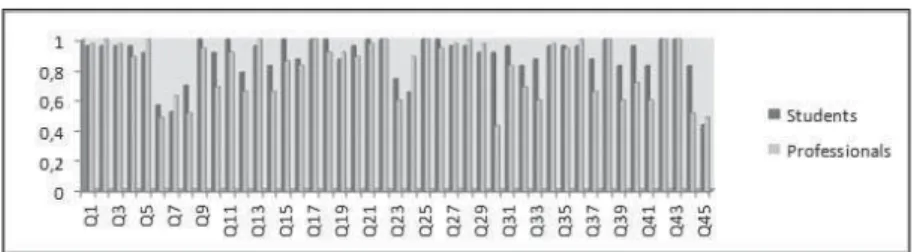
Figure 1 shows the means of adequate responses of the students’ group and of the professionals’ group for each of the instrument’s asser-tions (Q1 to Q45).
Figure 1 – Means for Each Analyzed Group in the Different Assertions of the Questionnaire
Source: Prepared by the authors.
Figure 1 shows some performance similarities among assertions, thus revealing that the means of adequate responses to some items were equal or very close to each other. This fact is most visible in items Q1, Q3, Q17, Q22, Q25, Q27, Q34, Q38, Q42 and Q43. However, it is noteworthy that the group of students presented means of adequate responses more frequently along the graph.
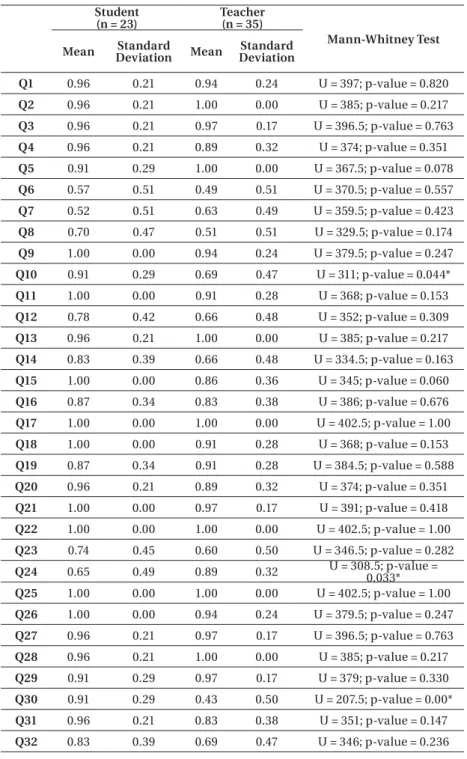
Table 1 – Means and Standard Deviation for Each Group in Each Assertion of the Questionnaire
Student
(n = 23) Teacher(n = 35)
Mann-Whitney Test
Mean DeviationStandard Mean DeviationStandard
Q33 0.87 0.34 0.60 0.50 U = 294; p-value = 0.029* Q34 0.96 0.21 0.97 0.17 U = 396.5; p-value = 0.763 Q35 0.96 0.21 0.94 0.24 U = 397; p-value = 0.820 Q36 0.96 0.21 1.00 0.00 U = 385; p-value = 0.217 Q37 0.87 0.34 0.66 0.48 U = 317; p-value = 0.073 Q38 1.00 0.00 1.00 0.00 U = 402.5; p-value = 1.00 Q39 0.83 0.39 0.60 0.50 U = 311.5; p-value = 0.071 Q40 0.96 0.21 0.71 0.46 U = 305; p-value = 0.022* Q41 0.83 0.39 0.60 0.50 U = 311.5; p-value = 0.071 Q42 1.00 0.00 1.00 0.00 U = 402.5; p-value = 1.00 Q43 1.00 0.00 1.00 0.00 U = 402.5; p-value = 1.00 Q44 0.83 0.39 0.51 0.51 U = 277; p-value = 0.017* Q45 0.43 0.51 0.49 0.51 U = 382; p-value = 0.706 QT 40.09 1.81 37.06 2.86 U = 146.5; p-value = 0.00*
* p-value < 0.05 Source: Prepared by the authors.
Regarding the values presented by the students, we found that the assertions with the lowest means were: Q6 – The consumption of alcohol is the leading cause of a man beating up his wife and children – (mean 0.57), Q7 – Generally, children who arrive at hospitals and emergency rooms with serious fractures and bruises were victims of domestic acci-dents – (mean 0.52) and Q45 – When a couple has a violent relationship, the only solution is separation – (mean 0.43). Q45 was the only one with a mean lower than 0.50, indicating that more inadequate responses were given by the participants of this group to this item. In addition, means equal to 1 in assertions Q9 – Husband and wife’s fighting has no solution –, Q11 – Nobody gets beaten up for no reason –, Q15 – The woman teases. No wonder the man is violent –, Q17 – Most women like to get beaten up –, Q18 – A woman who gets beaten up is suspicious, because it takes two to tango –, Q21 – Most women who seek the police station for being beaten up by their husbands are not honest –, Q22 – Violence against women can reach all layers of the population –, Q25 – The propagation of child erotica (such as text, photography/filming of naked children or children having sex) is harmful, because it harms the children who are exposed and en-courages the acceptance of sex between children and adults as normal –, Q26 – It is not easy for a woman to leave an abusive relationship –, Q38 – The woman deserves to be beaten because she annoys the man –, Q42 – Women need to be beaten up to be kept in line –, and Q43 – The woman can also be a physical and/or sexual aggressor of children – were present-ed by the students, thus indicating that all participants in this group responded adequately to the statements in these items.
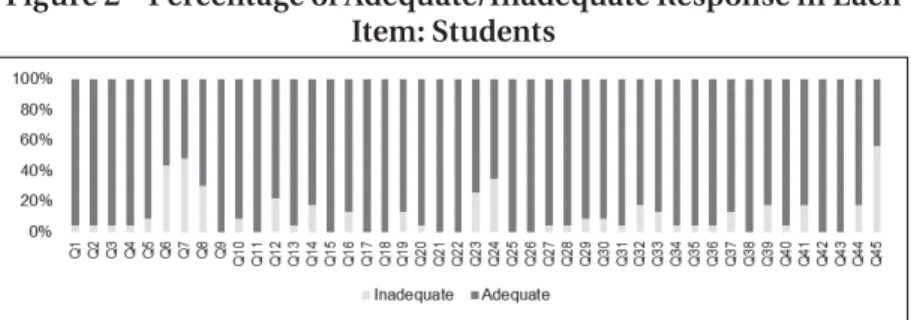
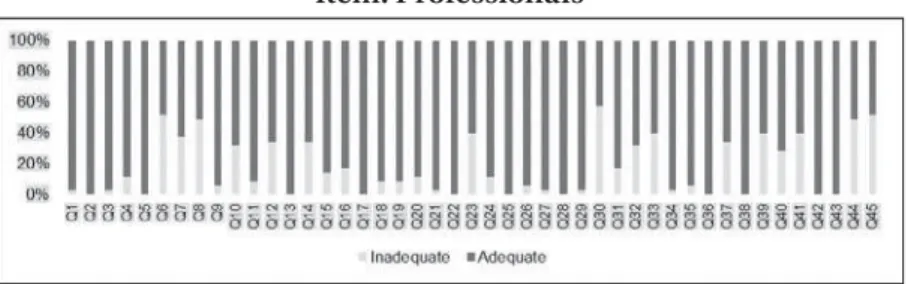
Figures 2 and 3 show the percentages of adequate and inadequate responses on each item for students and professionals, respectively.
Figure 2 – Percentage of Adequate/Inadequate Response in Each Item: Students
Figure 3 – Percentage of Adequate/Inadequate Response in Each Item: Professionals
Source: Prepared by the authors.
In general, we observed that the main differences between the means of the groups were in the statements: Q8 – Children who see their mothers being assaulted by their fathers often feel guilty for the violence –, Q10 – The child who grows up in a violent home does not necessarily be-come violent as an adult –, Q12 – The man who beats up a woman is crazy, unbalanced: he’s mentally ill –, Q14 – A fight between a man and his wife is not like a neighbor fight: there is no point in intervening –, Q15 – The wom-an teases. No wonder the mwom-an is violent –, Q23 – A child rarely lies about being abused. A small percentage of cases are fictional and in these cases, it is usually older children who are seeking some advantage –, Q30 – The woman who acts up and gets the men angry encourages domestic violence –, Q31 – She filed a complaint against her violent husband at the police station. It is horrible that she’s airing their dirty laundry in public –, Q32 – People the child knows, such as parents, uncles, aunts, grandparents and neighbors, pose the greatest risk of ill-treatment –, Q33 – In Brazil, parents and professionals who deal with children are not sufficiently informed about ill-treatment and, therefore, are often unfit to deal with the problem –, Q37 – When a husband and wife fight, no one should stand between –, Q39 – Usually, pedophile contact begins in virtual form via the Internet, but may soon evolve into physical contact, even raising the possibility of child murder –, Q40 – She is like a real punching bag to her husband’s fists, she does not leave him because she does not want to –, Q41 – Whenever minors come to the precinct to depose, they lie, since they are not imput-able (not likely to face criminal penalty) –, and Q44 – The woman who gets beaten up by her husband can leave him, she just needs to want it –, with higher values for the students group, and Q7 – Generally, children who arrive at hospitals and emergency rooms with serious fractures and bruises were victims of domestic accidents – and Q24 – The man also gets beaten up by his wife as much as he beats her up – with higher values for the professionals’ group.
be-come violent as an adult – (p-value = 0.044), Q24 – The man also gets beat-en up by his wife as much as he beats her up – (p-value = 0.033), Q30 – The woman who acts up and gets the men angry encourages domestic violence – (p-value = 0.000), Q33 – In Brazil, parents and professionals who deal with children are not sufficiently informed about ill-treatment and, there-fore, are often unfit to deal with the problem – (p-value = 0.029), Q40 – She is like a real punching bag to her husband’s fists, she does not leave him because she does not want to – (p-value = 0.022), Q44 – The woman who gets beaten up by her husband can leave him, she just needs to want it – (p-value = 0.017) and in the a total score (QT) of each group (p-value = 0.000). Among these items, the students’ mean was lower than the pro-fessionals’ only for item Q24. Figure 4, below, shows the means of each group in the items with significant differences.
Figure 4 – Percentage of Adequate Reponses in the Items with Significant Differences
Source: Prepared by the authors.
Qualitative Analysis
Using the content analysis of this information, developed from emerging categories identified in the responses obtained (Bardin, 2009), the qualitative data were listed and analyzed. Ten categories were identified in the justifications, specifically related to a type of thematic origin (letters A, B and C). The themes and categories belonging to each of them are listed as follows:
unaccept-able; B) Reasons for not breaking with the violence and not reporting it to the competent authorities: VII) Dependency on the aggressor (fi-nancial, emotional, etc.), VIII) Fear (of losing the children and/or home, of being alone, of losing those they love or even their own lives) and/or embarrassment (of being separated, of other people knowing about the assault and/or the very condition of being assaulted), IX) Hope that the violence will not occur again; C) Ways of breaking with the violence: X) Improvement in the dialogue among those involved and/or therapeutic interventions.
It is important to highlight that the category any kind of violence is unacceptable is part of the thematic axis Cause/reason for the occurrence of violence in family relationships due to its aspect of negative towards the existence of a violent act, since this is not acceptable – i.e., to say that there is no reason to be violent, the cause/reason is null, according to the justification of some participants.
Table 2, below, shows the frequency of times that participants jus-tified their answers with the categories previously idenjus-tified. More than one participant had the same justification for different items, and more than one justification also appeared for the same item.
Table 2 – Frequency of Justifications in Each Category
A) Cause/reason for the occurrence of violence
B) Reasons for not breaking with the violence and not
reporting it
C) Ways of breaking
with the violence
Categories I II III IV V VI VII VIII IX X
Frequency 8 38 4 5 18 30 9 42 17 67
Legend: I) Lack of spirituality/religion in the family cycle or of the offender, II) Vulnerable psychological condition (substance abuse, psychological disorders), jealousy and possession, III) Vulnerable household (dysfunctional family), IV) Low
socioeconomic status, V) Lack of respect among family members, VI) Any kind of violence is unacceptable, VII) Dependency on the aggressor (financial, emotional, etc.), VIII) Fear (of losing the children and/or home, of being alone, of losing those
they love or even their own lives) and/or embarrassment (of being separated, of other people knowing about the assault and/or the very condition of being assaulted), IX) Hope that the violence will not occur again and X) Improvement in
the dialogue among those involved and/or therapeutic interventions. Source: Prepared by the author.
competent authorities, with 42 citations; and finally, the category II) Vul-nerable psychological condition, jealousy and possession of the thematic axis Cause/reason for the occurrence of violence in family relationships, with 38 citations.
Discussion
The objective of this research was to develop an exploratory study aimed to assess and compare the views of students and graduated pro-fessionals of the education area regarding Intrafamily Violence. The first consideration about the research results is that the studied sample was restricted to students of the same institution located in the inland of the state of São Paulo as well as professionals of the same region, con-stituting a specific population with no pretense of data generalization for other areas of the country. However, the results found, considering the exploratory and pioneer nature of the study, shed light on the issue of how the education sector faces intrafamily violence, enabling im-portant reflections and improvement of the methodology used in this study, culminating in suggestions for future studies to explore new gaps of knowledge.
The results found and the analysis performed confirmed that both groups showed a satisfactory performance, since participants generally had means of adequate responses above 60%. However, the profession-als’ group showed lower means of adequate answers on most items com-pared with the students’ group. This fact is remarkable when the three lowest means of right answers achieved by each group are compared, since one of the students’ was below 0.50, while the professionals’ group had all three means below 0.50, demonstrating once again the better performance of university participants. A possible hypothesis for these results could be the fact that the students are in academic training, i.e., these participants probably have more chances to learn about the sub-ject from lectures, academic events, seminars, papers and discussion tables, factors that would enable a more comprehensive knowledge rep-ertoire and probably a better performance in the questionnaire. On the other hand, a possible explanation for the poor performance of the pro-fessionals would be the professional outdating, which may occur due to lack of graduate courses and continuing education at work, as well as demands involved with being a teacher, which lead to overload and, consequently, a decrease of interest in such issues.
al-lows the interpretation that participants who answered this statement as true attribute external causality to the domestic violence phenom-enon, focusing on drug abuse as the main reason. This was also found in the justifications written in the questionnaire, since when trying to explain the cause/reason for the occurrence of violence in family rela-tionships – in more than one item –, participants provided answers that encompassed substance abuse as a way to justify such behavior, with this thematic category – Vulnerable psychological condition(substance abuse, psychological disorders), jealousy and possession – being one of the most frequently mentioned by participants.
However, according to the literature, several factors relate to vio-lence, and these involve social, biological, cognitive and situational is-sues (D’affonseca; Williams, 2003; Williams, 2004). The fact that partici-pants attribute episodes of intrafamily violence to the use of licit and illicit drugs only indicates the need to reject that such a cruel and unac-ceptable behavior can come from a human being without the interfer-ence of any substance. Previous studies (Giusto, 2011; Nunes, 2012) that used the Questionnaire of Beliefs about Domestic Violence (Williams, 2010) and its modified version (Ferrari, 2013) reported results similar to the ones found in this study, since the poor performance of groups investigated in this statement (Q6 assertion) was also highlighted by the authors.
Generally, alcohol and drugs can be identified as enhancers of violence, that is, facilitators of the use of physical force, allowing attack-ers to abdicate responsibility for their behavior, with such drugs being used as a way to vent their violent desires (Sinclair; Bonomi; Williams, 2010). Thus, by using the momentary change provided by alcohol or other drugs to justify their violent act, aggressors mask the reason for their behavior and contribute to the strengthening and propagation of this belief.
The Q45 statement (When a couple has a violent relationship, the only solution is separation), for which the two investigated groups had a poor performance, encompasses issues related to possible solutions for violence not reoccurring in the household. Participants who responded inadequately to this statement showed that, according to their views, the only way to solve the problem is to separate the couple, which indi-cates a probable lack of knowledge about alternative solutions to chang-ing violent relationships. It is important to note that separation is the way for some relationships, but many women do not want or are able to leave their partners.
concep-tion; most participants in both studies believed that the best solution for marital violence to cease, would be for the woman to leave the vio-lent relationship. These concepts found in the abovementioned studies and in this study show the delicateness of the victimized woman’s status and the weight that social beliefs cause in her decisions. It is a dichot-omy: on the one hand, she must leave the house to protect herself from the violence; on the other hand, she may be accused of abandoning her home and destroying her family. However, if this woman remains in an abusive relationship, she can be accused of needing the abuse or even taking pleasure in it (Sinclair; Bonomi; Williams, 2010).
Regarding the items to which all participants responded ad-equately, some points should be emphasized. In general, students showed consistency in their hits, since most of the items with complete-ly right answers were about the causes for the occurrence of violence and the possible relationship of the victim with these episodes. Profes-sionals also showed a good performance in assertions on this theme. However, item Q30 (The woman who acts up and gets the men angry en-courages domestic violence), for example, encompassing the same theme – causes for the occurrence of violence –, had the highest percentage of error for most teachers, with a statistically significant difference when compared with the performance of university students. In a deeper analysis into the contents of the Q30 assertion, one can interpret that participants who responded inadequately to this item understood that some actions of the woman may cause a man to be angry, and therefore, in this potentially dangerous condition, could trigger the marital vio-lence. Thus, we can conclude that these participants showed the belief that women have certain behaviors that motivate a man’s aggression; therefore, their action would incite violence.
It is noteworthy that the participants of this study offered written justifications about the reasons why a woman does not leave a violent relationship or report the partner to the competent authorities, with the most cited involving the victim’s feeling of fear (whether of losing their children and/or their home, of being alone, of losing the people they love or even their own lives) and/or embarrassment (of being separated, of other people knowing about the assault and/or the very condition of being assaulted). Such justifications highlight even further this paradox in the professionals’ group, because at the same time that participants demonstrate understanding of the difficulties faced by the victim, they blame her for the situation they experience. Ferrari (2013) points out that the erroneous belief of blaming the victim for staying in a violent relationship ignores other aspects involved in a relationship and fac-tors that weigh heavily in the decision making of the victim, such as the need for adequate protection, economic dependence, children, feelings for the husband, among others. In his work, Nunes (2012) points out that the victim’s permanence in a violent relationship does not mean that she likes the beating or the ill-treatment she suffers.
Marital violence is a criterion of great importance for the under-standing of intrafamily violence, because its consequences go beyond the couple’s relationship, representing risks to the development of chil-dren and adolescents present in the violent household. Antoni (2012) points out that any kind of violence between the child’s parents can lead to a home that is unsafe, scary, reckless and unpredictable.
There are cases, however, when marital violence does not occur within the household, but this place still represents a risk to children and adolescents, who are targets of abuse by their own parents, close relatives, stepfathers, stepmothers, neighbors or friends who reside in or often visit this environment. Study participants appear to have adequate conceptions about it, as demonstrated by the excellent per-formance in the Q36 assertion (Generally, the ill-treatment of children is repetitive, and occurs mostly at home, making the attacker’s access to the victim easier), which highlights the risk that the household poses for children who are victims of abuse, and the Q43 assertion (The woman can also be a physical and/or sexual aggressor of children), which empha-sizes the independence of gender in the practice of violence, for both men and women can be physical and/or sexual aggressors of children.
private schools in a city in the state of São Paulo through the collection of information from their educators. Moreover, the authors confronted their findings with prevalence rates estimated by the city Guardian-ship Council for that population. At the end of the study, the authors concluded that the official prevalence (0.3%) was much lower than the one found in the education sector (5.7%), showing an underreporting of cases of ill-treatment by the teachers. Studies have shown that profes-sionals might be trained to identify cases of abuse, but show deficits for subsequent referrals. In some cases, for example, professionals try to solve the problem by talking with the victims themselves and/or their parents, or fail to notify suspected cases to the responsible bodies and sometimes do not interfere in the case at all, omitting it; these measures jeopardize the well-being and the safety of abused children and ado-lescents (Brino; Williams, 2003; Vagostello et al., 2003; Faleiros; Matias; Bazon, 2009).
The Q33 assertion (In Brazil, parents and professionals who deal with children are not sufficiently informed about ill-treatment and, there-fore, are often unfit to deal with the problem) addressed this issue with the participants, and once again there was a statistically significant difference between the groups. While students had more adequate re-sponses, admitting some failures in this issue, most professionals an-swered that there is no misinformation between parents and teachers regarding ill-treatment and that they are able to face it. One can not disregard that professionals value their work, and that the vast majority performs it with dedication and commitment, but this finding reveals a possible overestimation of their expertise and the knowledge of parents regarding ill-treatment and the skills necessary to face this problem.
Generally, the authors concluded that professionals can identify several situations and characteristics related to domestic abuse, but are not able to properly solve these cases. The main action of education-al institutions when faced with this problem, according to that study, was the guidance of parents or guardians, rather than the referral to child and adolescent protection services. Omission (preferred not to get involved) and the referral of the victim to the psychologist were also highlighted in the results as other actions taken by the professionals. Those actions were close to the views presented by the participants of this study: in an attempt to introduce effective measures to prevent the recurrence of intrafamily violence in their written justifications, mea-sures such as improvement in the dialogue of those involved and/or therapeutic intervention were cited several times throughout the ques-tionnaire.
The Statute of the Child and Adolescent (ECA) reaffirms the role of the school, as well as of society, to protect and ensure basic rights to children and adolescents, so they can develop in a natural and healthy way. Article 5 (Brazil, 1990) discusses this obligation, stressing that no child or adolescent may be subjected to any form of negligence, dis-crimination, exploitation, violence, cruelty and oppression, with any attack – be it either act or omission – against their fundamental rights being punishable by law. Article 245 (Brazil, 1990) specifies that if teach-ers – among other professionals who deal directly with children and adolescents – fail to notify the competent authorities of cases they are aware of, involving suspected or confirmed ill-treatment against this public, they shall be punished by law in the form of a fine.
Recently, the ECA has changed, further highlighting the impor-tance of the federal government, the states, the Federal District and the municipalities acting in a coordinated manner to develop public poli-cies and to implement actions to curb the use of corporal punishment and to spread nonviolent forms of educating children and adolescents. One of its main purposes is the promotion of local inter-sectoral spaces for coordinating actions and developing focused action plans towards families in situations of violence, with the participation and integrated work of health care, education and welfare professionals, as well as bod-ies of promotion, protection and defense of child and adolescent rights. Valuing and encouraging public policies that foster the participation of educational institutions in the fight against abuse confirm the school’s importance as one of the foundations for the prevention of violence. Furthermore, the school is an institution that promotes awareness, be-ing fundamental for a real transformation to occur. Accordbe-ing to De Antoni (2012), it is the best preventive tool, for it is the only way to really create interpersonal and parental relationships guided by collabora-tion, guidance and love.
repertoire shown by participants in the professionals’ group, some erro-neous beliefs can potentially interfere with their behavior towards vic-tims of intrafamily violence, and cause short- and long-term damage to the lives of the children and adolescents involved. Nunes (2012) pointed out awareness as a powerful tool for transformation; citing Paulo Freire, the author commented that awareness generates a demythologization, allowing people to recognize myths and beliefs that disguise reality and thus interpreting and analyzing it more clearly.
One way of promoting awareness is through continued training courses, also mentioned in the recent changes made to the ECA. Arti-cle 70, in particular, discusses the duty of all people to prevent the oc-currence of threats or violations of child and adolescent rights (Brazil, 1990).
Training should frequently inform and update professionals about intrafamily violence, allowing them to enrich their repertoire and to be able to identify and report the cases of abuse present in the schools. We emphasize, however, the importance of professionals tak-ing active roles of social agents that can cause changes and, thus, be able to transform their environment and impact all those around them. This way, training can also be a space for discussions and reflections, whether on the effectiveness of current public policies, on the concep-tions that interfere in the prevention of violence, for the exchange of information between professionals from different fields, or others. It is important to highlight that some municipalities develop works of in-tegration between professionals of education and of other areas in or-der to make the most effective intervention in cases of intrafamily vio-lence. However, most of these interactions occur mechanically, without any other exchange involved. What stands out at this time, besides the need for training courses to become more frequent, is the importance of more intra- and extra-professional contact for the promotion of new ideas and exchange of experiences that allow modification and forma-tion of new beliefs and concepforma-tions.
Given the role that beliefs play in society, influencing the actions of individuals, guiding their behaviors and dictating the social rules that they must follow, the study of beliefs is a way to get to know the roots of social problems as intrafamily violence. Since erroneous be-liefs can lead to inappropriate interventions, which affect not only the assistance and protection of the victim, but also the perpetuation and normalization of violence in society, research and interventions in this area are necessary and essential.
mainly, that the professionals had more misconceptions about intra-family violence, a factor that can lead to inadequate interventions.
It is important to highlight that the investigative area of beliefs about intrafamily violence lacks validated instruments; thus, the data found and the statistical analysis performed in this study can con-tribute to the validation of the Questionnaire on Beliefs about Domestic Violence (Williams, 2010), which is an instrument of easy applicability and potentially measures beliefs effectively. This instrument was used in this study because no other instruments for the same purpose were available in the literature, in addition to the fact that the questionnaire has been employed in previous studies (mentioned above), with the same objective and has already been an object of improvement, consid-ering the findings of previous studies (Ferrari; Priolo; Brino, submitted). For further research, we suggest the use of a more diverse sample, with more participants, the participation of other regions of the coun-try and professionals from other areas. We also suggest other forms of research, such as semi-structured interviews and inventories that can better characterize the study population, whereas complete data about participants may help better understand the data obtained, which was not the object of the collection and analysis in this study. Additionally, we suggest the presence of judges who can collaborate on the analysis of the justifications offered by the participants in the instrument, in order to verify if the emerging categories found by the researchers with this instrument are similar to those identified by the judges, thus making the qualitative data more reliable; and lastly, we suggest the validation of the adapted Questionnaire on Beliefs about Domestic Violence (Wil-liams, 2010), which proved to be an effective research tool for both this research and for previous studies (Giusto, 2011; Nunes, 2012; Ferrari, 2013).
Final Considerations
The years after entering the labor market, however, seem to inter-fere with the conceptions of violence and, consequently, the knowledge about the latest and the proper techniques for assisting victims. This hypothesis correlates with the results obtained by the professionals’ group, which showed greater heterogeneity among their justifications and more misconceptions when compared with the students group. Such findings call for the need to invest in the continued training of professionals, promoting not only the most common theoretical and practical knowledge, but collaborating to the reformulation of beliefs crystallized by time or strengthened by the social environment, which may interfere decisively in the professional performance. Furthermore, we suggest that this training be a space to promote practical reflections and bring together professionals, community and public power to joint-ly create a network of effective protection.
Lastly, the results also enable future critical reflections on the role of professionals in the education sector in the fight against intrafamily violence and the challenges in preventive professional performance.
Received on February 5, 2015 Approved on July 14, 2015
Translation Proofreader: Ananyr Porto Fajardo
References
AZEVEDO, Maria Amélia; GUERRA, Viviane. Crianças Vitimizadas: a síndrome do pequeno poder.São Paulo: Iglu, 1989.
BARDIN, Laurence. Análise de Conteúdo.Lisboa: Edições 70, 2009.
BRASIL. Lei n° 8.069, de 13 de julho de 1990. Estatuto da Criança e do
Adolescen-te. Diário Oficial da União, Brasília, DF, 1990.
BRINO, Rachel de Faria; WILLIAMS, Lúcia Cavalcanti de Albuquerque. Concep-ções da professora acerca do abuso sexual infantil. Cadernos de Pesquisa, São Paulo, n. 119, p. 113-128, 2003.
D’AFFONSECA, Sabrina Mazzo; WILLIAMS, Lúcia Cavalcanti de Albuquerque. Clubinho: intervenção psicoterapêutica com crianças vítimas de violência físi-ca intrafamiliar. Temas em Desenvolvimento, São Paulo, v. 12, p. 33-43, 2003. D’AFFONSECA, Sabrina Mazzo; WILLIAMS, Lúcia Cavalcanti de Albuquerque. Habilidades Maternas de Mulheres Vítimas de Violência Doméstica: uma revi-são da literatura. Psicologia: Ciência e Profissão, Brasília, v. 31, n. 2, p. 236-251, 2011.
DE ANTONI, Clarissa. Abuso Emocional Parental contra Crianças e Adolescen-tes. In: HABIGZANG, Luísa Fernanda; KOLLER, Silvia Helena. Violência contra
Crianças e Adolescentes: teoria, pesquisa e prática. Porto Alegre: Artmed, 2012.
P. 33-40.
FERRARI, Isa Maria Souza Fernandes. Crenças sobre Violência Intrafamiliar: um estudo com profissionais e estudantes da área da saúde. 2013. 68 f. Relatório de Iniciação Científica não publicado – Curso de Psicologia, Universidade Fede-ral de São Carlos, São Carlos, 2013.
FERRARI, Isa Maria Souza Fernandes; PRIOLO, Sidnei; BRINO, Rachel de Faria. Questionário sobre Violência Intrafamiliar: crenças em profissionais e estu-dantes da saúde. Psicologia: Teoria e Prática, São Paulo (Submetido).
GIUSTO, Roselaine Oliveira. Agentes Comunitários de Saúde e sua Concepção
sobre Família e Violência Intrafamiliar. 2011. 138 f. Dissertação (Mestrado) –
Programa de Pós-graduação em Educação Especial, Universidade Federal de São Carlos, São Carlos, 2011.
KOLLER, Silvia Helena. Violência Doméstica: uma visão ecológica. Brasília: UNICEF, 2000.
MANN, Henry Berthold; WHITNEY, Donald Ransom. On a Test of whether one of two random variables is stochastically larger than the other. Annals of
Ma-thematical Statistics, v. 18, n. 1, p. 50-60, 1947.
NUNES, Cristina Brandt; SARTI, Cynthia Andersen; OHARA, Conceição Vieira da Silva. Concepções de Profissionais de Saúde sobre a Violência Intrafamiliar contra a Criança e o Adolescente. Revista Latino-Americana de Enfermagem, Ribeirão Preto, v. 16, n. 1, online, 2008.
NUNES, Patrícia Migliato. A Violência Contra a Mulher e o Atendimento
Pres-tado às Vítimas: a perspectiva do policial civil. 2012. 176 f. Dissertação
(Mestra-do) – Programa de Pós-Graduação em Educação Especial, Universidade Federal de São Carlos, São Carlos, 2012.
SINCLAIR, Débora; BONOMI, Miriam; WILLIAMS, Lúcia Cavalcanti de Albu-qerque. Introdução à Violência contra a Mulher. In: WILLIAMS, Lúcia Caval-canti de Albuquerque; MAIA, Joviane Marcondelli Dias; RIOS, Karyne Souza Augusto (Org.). Aspectos Psicológicos da Violência: pesquisa e intervenção cognitivo-comportamental. Santo André: ESETec, 2010. P. 69-83.
STELKO-PEREIRA, Ana Carina; WILLIAMS, Lúcia Cavalcanti de Albuquerque. Sobre o Conceito de Violência: distinções necessárias. In: WILLIAMS, Lúcia Ca-valcanti de Albuqerque; MAIA, Joviane Marcondelli Dias; RIOS, Karyne Souza Augusto. Aspectos Psicológicos da Violência: pesquisa e intervenção cognitivo--comportamental. Santo André: ESETec, 2010. P. 41-66.
VAGOSTELLO, Lucilena et al. Violência Doméstica e Escola: um estudo em es-colas públicas de São Paulo. Paidéia, Ribeirão Preto, v. 13, n. 26, p. 191-196, 2003. WILLIAMS, Lúcia Cavalcanti de Albuquerque. A Violência e suas Diferentes Representações. In: SOLFA, Glaziela Cristina (Org.). Gerando Cidadania: refle-xões, propostas e construções práticas sobre direitos da criança e do adolescen-te. São Carlos: RiMa, 2004. P. 141-153.
WILLIAMS, Lúcia Cavalcanti de Albuquerque; PADOVANI, Ricardo Costa; ARAÚJO, Eliane Aparecida Campanha et al. Fortalecendo a Rede de Proteção
da Criança e do Adolescente. São Carlos: Pedro e João Editores, 2010.
WILLIAMS, Lúcia Cavalcanti de Albuquerque. Questionário sobre Crenças a Respeito de Violência Doméstica. In: WILLIAMS; Lúcia Cavalcanti de Albuquer-que; DIAS, Joviane Marcondelli; RIOS, Karyne Souza Augusto (Org.). Aspectos
Psicológicos da Violência: pesquisa e intervenção cognitivo-comportamental.
Rachel Faria Brino is an associate professor of the Department of Psycholo-gy of Universidade Federal de São Carlos. She is a researcher at the LAPREV – Laboratory for the Analysis of Violence and coauthor of the book “A Escola como agente de prevenção do abuso sexual infantil” (School as a preventive agent of child sexual abuse).
E-mail: [email protected]
Mayra Aparecida de Oliveira Souza is a 5th year Psychology undergraduate
student at Universidade Federal de São Carlos. She had a scholarship from PIBIC-CNPq during the performance of this research.