177
Article
Adaptation and Validation of the Salience Inventory to Brazilian Adults
1Maria Célia Lassance2
Jorge Castellá Sarriera
Universidade Federal do Rio Grande do Sul, Porto Alegre-RS, Brasil
Abstract: Role salience refers to the importance of a role in relation to other roles performed by a person in his/her social context. The purpose of this study was to adapt and validate the Brazilian version of the Salience Inventory, called Inventário de Saliência (IS). The SI is composed of 170 items, which evaluate salience through three dimensions: Participation, Commitment and Value expectation in relation to fi ve roles: Study, Work, Community services, Home and Family, and Free Time. The sample was composed of 388 women and 111 men, 21 to 65 years of age with higher education. The results offer evidence supporting the IS construct validity and provide a normative base for an adult sample with higher educational level. Future studies should compare the results of this sample with diverse samples. The results are compared with the original study in terms of means and salience rates. Finally, study limitations and suggestions for further studies are discussed.
Keywords: Salience Inventory, psychological assessment, measurements, career counseling, role salience
Adaptação e Validação do Inventário de Saliência (Salience Inventory)
para Adultos Brasileiros
Resumo: Saliência é a importância que uma pessoa atribui a um papel em relação a outros papéis que desempenha no seu contexto social. O presente estudo teve por objetivo adaptar e validar a versão original do Salience Inventory denominada Inventário de Saliência (IS) na adaptação brasileira. O instrumento contém 170 itens que avaliam a saliência a partir de três dimensões: Participação, Comprometimento e Expectativa de Valor, para cinco papéis, relativos às atividades de Estudo, Trabalho, Serviço Comunitário, Casa e Família, e Tempo Livre. Participaram do estudo 388 mulheres e 111 homens, entre 21 e 65 anos, com nível superior de escolaridade. O IS apresentou validade de construto e fornece base normativa para a população adulta com nível de educação superior, com a qual se poderá realizar comparações. Os resultados são comparados com os do estudo de validação original em termos de médias e ordem de saliência. Finalmente, discutem-se as limitações deste estudo e possibilidades para pesquisas futuras.
Palavras-chave: Inventário de Saliência, avaliação psicológica, medidas, aconselhamento de carreira, saliência de papel
Adaptación y Validez del Inventario de Predominancia de los Roles (Salience Inventory)
para Adultos Brasileños
Resumen: Predominancia de papel es la importancia que una persona atribuye a un papel con relación a otros papeles que ejerce en su contexto social. Este artículo trata de la adaptación y validez para la version brasileña del Salience Inventory, denominado de Inventario de Saliência (IS) en Brasil. Posee 170 itens que evalúan la predominancia en sus tres dimensiones: Participación, Compromiso y Expectativa de valor, para cinco papeles, relativos a las actividades de Estudio, Trabajo, Servicio comunitario, Casa y familia y Tiempo Libre. Participaron 388 mujeres y 111 hombres, de 21 a 65 años, con estudios de nível superior. El IS presentó validez de constructo y oferece base normativa para la población adulta con educación superior, con lo cual se podrán realizar comparaciones. Los resultados fueron comparados con los del estudio de validez original, considerando sus promedios y orden de predominancia. Se discuten las limitaciones y las posibilidades de futuros estudios.
Palabras clave: Inventario de Saliencia, evaluación psicológica, medidas, orientación de carrera, predominancia de papel
1 Article derived from the PhD thesis of the fi rst author Saliência de Papel, Valores de Trabalho e Tarefas de Desenvolvimento de Carreira under the supervision of the second author, defended in 2010 in the Post-graduate Program in Psychology of the Instituto de Psicologia of the Universidade Federal do Rio Grande do Sul, Porto Alegre. 2 Correspondence address:
Universidade Federal do Rio Grande do Sul. Instituto de Psicologia. Rua Ramiro Barcelos, 2600/117. CEP 90.035-003. Porto Alegre-RS, Brazil. E-mail: [email protected]
been called role salience (Super 1980, 1990, for a review of the concept consult Lassance & Sarriera, 2009).
The present study consists of the translation, adaptation and validation of the Salience Inventory (SI), for an adult sample, fi lling a gap formed by the historical absence of na-tional instruments for the evaluation of salience. For Super (1980), “roles structure life and give it meaning” (p. 288). Thus the life-span/life-space theory (Super, 1980, 1990; Su-per, Savickas, & SuSu-per, 1996) contextualizes the develop-ment - which occurs through stages in which individuals are faced with socially demanded developmental tasks – in the social space through the sequential or simultaneous develop-ment of roles, consolidating a lifestyle (Super, 1980). Roles may be centered within a certain period of life and become The Salience Inventory (SI) (Nevill & Super, 1986b)
peripheral or absent in others, or may be performed differ-ently in different stages of the life cycle, such as occurs, for example, with the child role in infancy and later in the adult period when the individual may have responsibility for caring for elderly parents (Super, 1980; Super et al., 1996). Roles are organized in a particular way for each individual and for the steps of life, and this organization channels and typifi es the insertion of the individual in the social context. The central roles constitute the “core of who the individual is; are fundamental for the identity and essential for life sat-isfaction” (Savickas, 2002, p. 159). The multiplicity of roles can bring about confl ict and distress, as well as fulfi llment and life satisfaction (Super, 1980), since it can trigger dif-fi culties of commitment to any of them (Biggs & Brough, 2005; Frone, Russel, & Barnes, 1996; Ng & Feldman, 2007; O’Neil & Greenberger, 1994; Perrone & Civiletto, 2004; Super, 1980; Thoits, 1983) or allow the individual to real-ize to their interests, needs and values through the various roles, as the positive experience in a central role can affect the performance of others (Barnett, 1994; Cool, 1990; Cool et al., 1996). This relationship between the simultaneous per-formance of roles has been associated with the possibility of managing their demands (Grönlund, 2007; Perrone, AEgis-dóttir, Webb, & Blalock, 2006; Possatti & Dias, 2002).
Interest in the study of the role salience appeared con-comitantly to the increasing attention paid to the Work role considered central in people’s lives, starting with the work of Greenhaus (1973), who constructed the fi rst measurement scale of salience for the Work role (Career Salience Inventory - CSI). The CSI, through 27 items, evaluates three dimensions: (a) general attitudes toward work, (b) degree of relevant vo-cationally planning, and (c) the importance of the occupation in relation to other sources of satisfaction. Studies with the CSI associated higher rates of salience of Work role with the highest levels of professional aspirations and a greater like-lihood of non-traditional occupational choices in university students (Hackett, Espósito, & O’Halloran, 1989), increased confi dence and self-determination (Kush & Cochran, 1993), and greater work-family confl ict (Raskin, 2006).
Amatea, Cross, Clark and Bobby (1986) developed the Life Role Salience Scales (LRSS), scales of attitudinal character, which measure value (how important the role is for personal satisfaction or self-defi nition) and commitment (how much a person demonstrates a desire to commit per-sonal resources to be successful in the role or to develop it) for four life roles: occupational, parental, marital, and homecare. The fi nal scale, with 40 items, is constituted by eight subscales of Likert type responses. Two refer to the oc-cupational role, two the parental role, two the conjugal role and two the homecare role. The LRSS was created to address the need for valid and reliable instruments that can assess the relevance of a role for the individual, the performance stan-dards of the roles and how personal resources (time, money and energy) are invested in their performance, aiming to sup-port the comprehension of the role expectations of men and
women and the effect on the work-family interface. Two val-idation studies (Amatea et al., 1986; Campbell & Campbell, 1995) showed that the roles evaluated constitute a relevant role set, common to all samples, both in adults who present concrete performance of the roles, and in young people for whom their performance was still a future prospect.
Several studies have used the CSI and the LRSS, espe-cially in research on confl ict in the work-family interface, focusing on issues related to gender socialization (Moya, Expósito, & Ruiz, 2000) and their effects on health and well-being (Biggs & Brough, 2005; Chi-Ching, 1995; Fournier, Lachance, & Bujold, 2009).
In the Brazilian context, Possatti and Dias (2001) con-ducted a validation study of the Role Quality Scale, which evaluates positive (rewards) and negative (concerns) aspects of the roles of mother and worker. The positive aspects of the Work role are subdivided into two factors – power of decision, support and supervision. The negative aspects of work are divided into two factors - working conditions and overload. For the maternal role, however, both the rewards as well as the concerns showed a unifactorial structure for the dimensions development and company of the children, and overload and security. On further investigation, with 132 working women who were also mothers with educa-tion above high school level (71.2% with higher educaeduca-tion), Possatti and Dias (2002), reaffi rmed the good psychometric properties of the scale, allowing the questioning of some so-cial injunctions regarding the traditional role of the woman.
Although consistent, these scales partially evaluate the different routes of social insertion common in adult individ-uals. With the focus only on the domains of work and family the other possibilities of social insertion are ignored, even though they can interfere directly or indirectly in the perfor-mance of the roles due to the multiplicity of social expecta-tions beyond the central domains of work and family.
In this sense, among the transnational studies about the importance of work in relation to the other roles in people’s lives, there is the Work Importance Study (WIS) (Super & Sverko, 1995). Under the international coordination of Don-ald Super, this consisted of a project that brought together researchers from eleven countries (Australia, Belgium, Canada, Croatia, Israel, Italy, Japan, Poland, Portugal, South Africa and the USA). The WIS, as well as evaluating the importance of working in countries with different levels of development, attempts to measure each of the roles in rela-tion to all the others (Kulenovic & Super, 1995), enabling a broader comprehension of the lifestyle.
From the WIS, two instruments were produced, the Values Scale (VS) (Nevill & Super, 1986a) and the Salience Inventory (SI) (Nevill & Super, 1986b), the object of the present study. The Brazilian adaptation of the SI was named the Inventário de Saliência.
and 8 samples of adults). All 11 national samples individu-ally came to the same solution of fi ve factors, corresponding to the fi ve roles investigated. A principal component analysis with Varimax rotation revealed a structure of fi ve factors that explained between 72.4% and 83.9% of the variance in the national samples.
Information on the validity and reliability (Cronbach’s alpha) in the manual (Nevill & Super, 1986b) presented re-sults from studies conducted with adolescents, university students and adults, yielding coeffi cients above 0.80 for the three populations. Specifi cally for the adult population, the internal consistency indices were 0.93 for the Participation subscale, 0.92 for the Commitment subscale and 0.87 for the Value Expectation subscale.
Other studies, besides those mentioned in the SI manual (Super & Nevill, 1986b), indicated similar levels of reliabil-ity. The study by Civiletto and Perrone (2004) evaluated the relationship between salience, role strain, effective coping and life satisfaction in 125 adults, males and females, in-volved in multiple roles (parental, marital and occupational), and found good internal consistency (Cronbach’s alpha) of 0.88 for the Participation subscale, 0.90 for the Commitment subscale and of 0.92 for the Value Expectation subscale. Duarte (1995), when studying salience, career concerns and values in 881 men employed in a Portuguese industry, found good internal consistency indices (Cronbach’s alpha) of 0.81 for Participation and 0.95 for Commitment.
Perrone et al. (2006) used the Commitment subscales for the Work, and Home and Family roles when studying the work-family interface and life satisfaction with 154 col-lege students, married and employed full-time, fi nding good internal consistency indices (Cronbach’s alpha) of 0.89 and 0.95 respectively. Other studies, such as Luzzo (1994), Mun-son (1992), and WatMun-son, Stead and De Jager (1995) present-ed similar levels of internal consistency.
The present study aimed to adapt and validate the origi-nal version of Salience Inventory for the Brazilian context.
Method
Participants
The study included 499 adults, 111 men and 388 wom-en, aged between 21 and 65 years (M = 37.14, SD = 10.21), with higher education, and 50.3% having household incomes above R$ 6,000.00. The participants were from all Brazilian regions (32% from the southern region, 27% from the south-east, 15% from the northsouth-east, 14% from the central-west and 12% from the northern region).
Instrument
The adapted Inventário de Saliência (IS) is based on the original Salience Inventory (Nevill & Super, 1986b). The SI evaluates salience through three dimensions: Participation (degree of concrete involvement in activities in the diverse
roles), Commitment (emotional attachment with the role) and Value Expectation (values that the individual hopes to accomplish in each role), for the fi ve main roles (related to Study, Work, Home and Family, Community Service, and Free Time). Statements are presented that should be evalu-ated for each of the fi ve roles.
The Study role is defi ned as taking courses, attending school (day or night classes, lectures or laboratory work); preparing for class, and studying in a library or at home; in addition to independent, formal or informal, study. The Work role is defi ned as: working in exchange for remuneration or any other benefi t, working for someone else or for yourself. The Community Service role includes activities in communi-ty organizations or entities, such as recreational groups, Boy Scouts, Red Cross, social service agencies, neighborhood or parent-teacher associations, political parties and trade unions. The Home and Family role comprises activities such as tidying the room, apartment or house; preparing meals or clearing the table and washing the dishes after meals; shop-ping; and caring for dependents such as children or elderly parents. Finally, the Free Time role refers to activities such as participating in sports, watching TV, doing hobbies, going to the cinema, theater or concerts, reading, relaxing or doing nothing, spending time with family and friends.
The SI contains 170 items divided into the subscales of Participation (10 statements, items 1 to 50), Commitment (10 statements, items 51-100) and Value Expectations (14 values, items 101-170). That is, for the fi rst statement of the Participation subscale, item 1 refers to the Study role, item 2 to the Work role, item 3 to the Community Service role, item 4 to the Home and Family role and item 5 refers to the Free Time role, and so on. For the fi rst statement of the Commit-ment subscale, item 51 refers to the Study role, item 52 to the Work role, item 53 to the Community Service role, item 54 to the Home and Family role, and item 55 refers to the Free Time role, and so on. For the three subscales the same response grade is used, in which (1) signifi es never or rarely and a little or not at all, (2) signifi es sometimes or some, (3) signifi es frequently or a lot, and (4) signifi es nearly always or always and very much.
Procedure
The study consisted of two steps. The fi rst was the translation and adaptation of the items of the inventory and the second was the verifi cation of the psychometric qualities of the SI. Furthermore, the comparative results of this study with the original WIS study are described.
Data collection. The participants were contacted by
stan-dard e-mail, which informed them about the study aims and pro-vided a link through which they could access the instruments.
Brazil, in addition to one made by the researcher. The three ver-sions were compared and the best ways to maintain the original meaning for the Brazilian context were found. The translation resulting from this comparison was subjected to a back transla-tion into English by a third professional translator. The trans-lation and backtranstrans-lation were compared, leading to the fi nal version adapted from the original North American version.
The fi rst version of the inventory was then subjected to an evaluation of content validity, with the items assessed by three psychologists, specialists in career counseling, one of them being an expert in the construction instruments. The items were evaluated on a scale ranging from (1) does not fi t the defi ned objective, (2) fi ts the defi ned objective slightly, (3) fi ts the defi ned objective a lot, and (4) fi ts the defi ned ob-jective perfectly. An item was considered adequate when at least two experts attributed it to the objective or at least con-sidered it very suitable. All the items were evaluated as (3) or (4). This evaluation generated a second version of the SI.
This version was then subjected to a semantic validation. Eight people responded to the SI, four men and four women, distributed among two educational groups (high school and higher education) and two age groups (25 to 40 years and 41 to 65 years). This procedure evaluated the understanding of the participants regarding the items of the SI; sought a gen-eral impression of the situation of respondent; and evaluated potential diffi culties in responding to the questions. From this procedure, some terms were altered and a format which was considered more appropriate was arrived at for the table of responses, generating the third version of the SI.
This version was computerized by an expert from the
Secretaria de Educação à Distância of the Universidade Fed-eral do Rio Grande do Sul. The fi rst computerized version was
submitted to 30 identifi ed respondents, who had to evaluate the language, the organization of the form and the interactiv-ity, as well as the conditions for handling the pages. This pro-cedure generated the fi nal computerized version of the SI.
Data analysis. To evaluate the construct validity of the
scales, i.e., the consistency with the original model, a prin-cipal components analysis of the items was performed from each of the three subscales to identify latent traits to explain the variability observed in the items (Urbina, 2007). For the study object scales, a fi ve components extraction was ex-pected, corresponding to the fi ve roles (Study, Work, Com-munity Service, Home and Family, and Free Time).
Ethical Considerations
When opening the link of the study, the participants were presented with the Terms of Free Prior Informed Con-sent. After the indication of being aware of the content of the study and agreeing to participate, the participants had access to the instruments to be completed. This study was approved by the Research Ethics Committee of the Instituto de
Psi-cologia of the Universidade Federal do Rio Grande do Sul
(protocol No. 2006-58), according to Resolution 196/96 of the National Health Council - Ministry of Health
Results
The 50 items of the Participation subscale, the 50 items of the Commitment subscale and the 70 items of the Value Expectations subscale were separately subjected to a princi-pal components analysis. The Kayser-Meyer-Olkin (KMO) indices of sample adequacy were 0.91, 0.87 and 0.89 re-spectively, and the Bartlett’s test of sphericity was highly signifi cant (p < 0.001) for the three subscales indicating the suitability of the data for this type of analysis. For the Participation subscale, eight components had eigenvalues greater than 1, explaining 66.86% of the total variance, with an examination of the scree plot indicating that the fi rst fi ve components were the most important, explaining 59.6% of the variance. For the Commitment subscale, ten components showed eigenvalues greater than 1, with the fi rst fi ve ex-plaining 51.6% of the variance. For the Value Expectations subscale, 14 components had eigenvalues above 1, explain-ing 68.9% of the variance, with the fi rst fi ve components ex-plaining 48.9% of the variance.
Given these preliminary results and also the theoreti-cal expectation that there were fi ve principle dimensions underlying the set of items, the analysis was re-performed extracting fi ve components, with Varimax rotation. This new extraction showed a clearer solution with factor load-ings between 0.50 and 0.89 for the Participation subscale (i.e. the items relative to each role loaded together in the same single component, while simultaneously they had low loadings - less than .30 – in the other components). For the Commitment subscale, this extraction also presented a good solution, with factor loadings between 0.40 and 0.85. How-ever, the Value Expectations subscale, although it presents a large proportion of the items across the fi ve factors (roles), showed weaker factor loadings, with some items loading in more than one factor with loadings above 0.30. Table 1 dis-plays the factor loadings above 0.30 for each subscale.
The Value Expectation subscale presented the lowest discrimination between the roles. Apart from moderate and signifi cant correlations already presented between the Work
and Study roles, and between the Home and Family and Free Time roles, there were also signifi cant and moderate correla-tions in the interaccorrela-tions between other roles. In considering Table 1
Factor loadings of the Items of the Participation, Commitment and Value Expectations Subscales in the Five Roles of the Salience Inventory
Participation Subscale 1
Study 2 ComS
3 FreeT
4 HFam
5 Work
1 I have dedicated my time to activities related to... ,859 ,809 ,740 ,737 ,618
2 I have spoken to people about... ,732 ,775 ,751 ,565
3 I have read about... ,634 ,690 ,640 ,595
4 I have taken advantage of opportunities in... ,809 ,822 ,776 ,696
5 I have been actively working in an organization related to... ,794 ,835 ,653 ,548 ,623
6 I've been improving my performance in... ,861 ,807 ,764 ,757
7 I am actively involved in activities related to... ,895 ,894 ,859 ,842 ,761
8 I have made achievements in activities related to... ,680 ,802 ,752 ,726 ,674
9 Whenever I can. I participate in activities related to... ,791 ,793 ,719 ,722 ,694
10 I have some magazines or books related to... ,659 .667 ,506 ,608 ,604
Internal consistency indices (Cronbach’s alpha) 0,947 0,937 0,913 0,904 0,869
Commitment Subscale Study1 ComS2 FreeT3 HFam4 Work5
1 It is important to me to be good at activities related to... ,774 ,746 ,773 ,721 ,582
2 I would like to get more involved in activities related to... ,693 ,659 ,425 ,400 ,537
3 I would like to be remembered for what I did in.... ,792 ,799 ,760 ,665 ,604
4 I would like to be involved for many years with... ,855 ,844 ,763 ,771 ,718
5 I really am committed to being active in activities related to... ,738 ,733 ,739 ,730 ,723
6 I am proud to be successful in... ,836 ,803 ,845 ,802 ,671
7 I really feel personally involved with... ,721 ,712 ,658 ,684 ,634
8 I admire people who are good at... ,624 ,588 ,661 ,576
9 I think it is rewarding to participate in... ,777 ,739 ,794 ,722 ,723
10 I would like to have enough time to... ,754 ,773 ,650 ,618 593
Internal consistency indices (Cronbach’s alpha) 0,923 0,915 0,895 0,878 0,838
Value Expectations subscale 1
Study 2 ComS
3 FreeT
4 HFam
5 Work
1 To use your skills and knowledge ,675 ,633 ,744 ,656 ,649
2 To see your efforts rewarded ,751 ,688 ,744 ,661 ,693
3 To make life more beautiful ,780 ,677 ,664 ,681 ,405
4 To help people ,757 ,647 ,686 ,667 ,508
5 To act independently ,674 ,648 ,457 ,738 ,599
6 To discover or create new things ,785 ,595 ,673 ,668 ,735
7 To have a good standard of living ,693 ,613 ,655 ,682 ,629
8 To live life in your own way ,707 ,690 ,417 ,678 ,465
9 To be physically active ,647 ,653,317 ,621,318 ,342 344
10 To be admired for your knowledge and ability ,742 ,634 ,687 ,664 ,699
11 To feel that you can take risks ,749 ,714
,321 ,410 ,538 ,567
12 To do things with other people ,671 ,664 ,665 ,659 ,484
13 To do different things ,717 ,671 ,623 ,634 ,667
14 To have comfortable conditions to perform the activities ,688 ,666 ,616 ,691 ,591
Internal consistency indices (Cronbach’s alpha) 0,942 0,917 0,905 0,912 0,884
that the scale asks about the expectation of the realization of values, one might think that some of them, taken as central or highly signifi cant for the individual, can be found in vari-ous roles due to their centrality in terms of support for social conduct decision making.
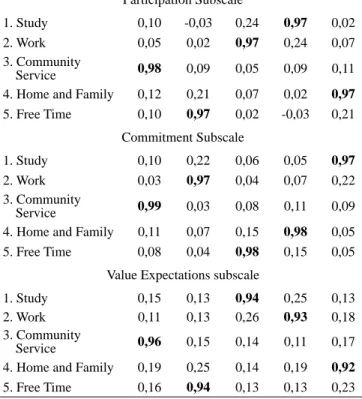
Besides this, a further analysis of components was performed, not with the items, but with the mean scores of Participation, Commitment and Value Expectations in each role. This was performed in order to compare the result with the WIS, which undertook this type of anal-ysis. Regarding this ascertainment, the Kayser-Meyer-Olkin (KMO) index of sampling adequacy of 0.59 was obtained, considered as minimally acceptable, and the test of sphericity was signifi cant (p < 0.01). Table 2 shows the distribution of componential loadings, considering the means for each role for each of the subscales. The fi ve factors resulting from the analysis again correspond to the fi ve roles, with higher loadings than those obtained in the original study.
Participation subscale, 0.92; for the Commitment sub-scale, 0.91; and for the Value Expectations subsub-scale, 0.95. These indices are similar to those found in the original study of the WIS (0.93, 0.92 and 0.87 respectively). Re-garding the indices for the roles, it should be noted that they also presented good levels, indicating the adequacy of the subscales for all fi ve roles.
Comparisons with the original study of the WIS
The results of the WIS (Super & Sverko, 1995) with the adult samples from the 11 participating countries indi-cated that the most salient role was that of Work, followed by Home and Family, Free Time, Study and Community Ser-vice. For this study, the order of salience altered: the role of Work remained the most salient, followed by Home and Family, Study, Free Time and Community Service.
Table 3 shows the order of salience, in the WIS and in the present study, presenting the means and standard de-viations for the sum of the scores. It is worth emphasizing that, in the present study, Work is the role of greater par-ticipation and the role in which the participants expected to realize more values, and Home and Family the role of greater commitment (with values extremely close to the Work role), and third in participation. The Study role is that which presents greater differences. For the three sub-scales, while in the WIS the Study role was in fourth place in salience, in the present study it was in second place in Participation and third in Commitment and Value Ex-pectations, with little difference in relation to the Work, and Home and Family roles. However, it should be noted that this comparison refers to a general result for all the samples of the WIS and the national studies showed dif-ferences between the various roles in the subscales, these differences are explained by the cultural characteristics (for a more accurate analysis of these patterns, consult Super & Sverko, 1995).
Discussion
This article sought to perform a fi rst adaptation and validation study of the Salience Inventory (SI) for the Bra-zilian population, from a sample of adult men and women, workers with higher level education. Salience was defi ned (Super, 1980) as the relative importance of one role in re-lation to the others that the individuals performs. The SI operationalizes the importance of work model used in the Work Importance Study (Super & Sverko, 1995) and conceives salience through three subscales: Participation (which evaluates the time devoted to one role), Commit-ment (which evaluates attitudes related to a role) and Value Expectations (which assesses how the individual perceives opportunities to realize values in each role) for fi ve central roles relating to study, work, community service, home and family, and free time activities.
Table 2
Distribution of Componential Loadings as a Function of the Means for each Role, for each of the subscales of the Salience Inventory
Fator 1 Fator 2 Fator 3 Fator 4 Fator 5
Participation Subscale
1. Study 0,10 -0,03 0,24 0,97 0,02
2. Work 0,05 0,02 0,97 0,24 0,07
3. Community
Service 0,98 0,09 0,05 0,09 0,11
4. Home and Family 0,12 0,21 0,07 0,02 0,97
5. Free Time 0,10 0,97 0,02 -0,03 0,21
Commitment Subscale
1. Study 0,10 0,22 0,06 0,05 0,97
2. Work 0,03 0,97 0,04 0,07 0,22
3. Community
Service 0,99 0,03 0,08 0,11 0,09
4. Home and Family 0,11 0,07 0,15 0,98 0,05
5. Free Time 0,08 0,04 0,98 0,15 0,05
Value Expectations subscale
1. Study 0,15 0,13 0,94 0,25 0,13
2. Work 0,11 0,13 0,26 0,93 0,18
3. Community
Service 0,96 0,15 0,14 0,11 0,17
4. Home and Family 0,19 0,25 0,14 0,19 0,92
5. Free Time 0,16 0,94 0,13 0,13 0,23
Confi dence
Despite its importance, the concept of salience is absent in career studies in Brazil and the present study aims to provide an instrument for measuring salience for research and counsel-ing. For intervention, the SI was also created with the purpose of its use in counseling, the result being comprehended with-in the personal context of the client (Nevill & Super, 1986b), and in many previously described intervention techniques for the qualitative evaluation of salience (for a brief description of these techniques, consult Lassance and Sarriera, 2009). Further-more, valid and reliable research instruments are important to establish comparisons between different contexts and samples, which is recommended when an evaluation of the validity of an instrument is required, as this validation is achieved through continuing research on the issue (Urbina, 2007).
Previous studies have shown that the SI is reliable and valid (Duarte, 1995; Farmer, 1983; Luzzo, 1994; Munson, 1992; Nevill & Super, 1986b; Perrone et al., 2006; Wat-son et al., 1995). To be considered a useful measure for the Brazilian population, the Brazilian version of the SI should also display adequate reliability and validity and the pres-ent study provides evidence of this. The alpha coeffi cipres-ents
obtained indicate that the SI has adequate reliability, the factorial analysis revealed fi ve components, relative to the fi ve roles, as expected, and the items for each subscale gen-erally presented good factor loadings in the components. These pieces of evidence support the use of the SI in the evaluation of salience for purposes of counseling and es-pecially research.
The Participation and Commitment subscales present good discrimination for the fi ve roles, however, the sub-scale Value Expectations showed wide distribution of fac-tor loadings of the items in relation to the various roles. Values are defi ned as a general guide for behavior. “Gener-al v“Gener-alues guide specifi c person“Gener-al v“Gener-alues related to the world of work, being that, the more the general values are impor-tant to the person, the more they will seek these values in the work context” (Porto & Tamayo, 2007, p. 69). Thus, as the subscale uses a list of values which are for the most part general, it can be assumed that they underlie the behavior in more than one role.
The differences between the WIS and the present study, in terms of results obtained in the adult samples, indicates Table 3
Means, Standard deviations and Order of Salience for a General Measure of Salience for each Role and for each of the Subs-cales by Role in the WIS and in the Present Study
WIS
n = 8.581
Brazilian adult sample
n = 499
Média (DP) Order of salience Order of salience Mean (SD)
General Salience
Study – 4 3 103,35 (22,03)
Work – 1 1 110,51 (15,77)
Community S. – 5 5 76,37 (22,23)
Home and Family – 2 2 103,65 (19,52)
Free Time – 3 4 92,02 (20,04)
Participation
Study 23,2 (7,49) 4 2 29,1 (7,75)
Work 28,8 (6,13) 1 1 32,5 (5,32)
Community S. 18,0 (7,33) 5 5 17,4 (6,90)
Home and Family 26,8 (6,71) 2 3 26,5 (6,81)
Free Time 26,1 (6,54) 3 4 23,6 (7,01)
Commitment
Study 25,5 (7,87) 4 3 32,4 (6,10)
Work 33,0 (6,09) 2 2 33,7 (4,85)
Community S. 22,0 (8,05) 5 5 25,3 (7,39)
Home and Family 33,2 (7,32) 1 1 33,9 (6,04)
Free Time 28,4 (6,94) 3 4 29,2 (6,37)
Value Expectations
Study 33,8 (10,62) 4 3 42,8 (8,96)
Work 42,9 (8,82) 2 1 44,9 (7,66)
Community S. 30,1 (11,18) 5 5 34,4 (10,61)
Home and Family 43,5 (9,25) 1 2 44,0 (8,69)
the sensitivity of the instrument to identify cultural changes. Firstly, the greater salience in the Study role refl ects the im-portance that ongoing education has acquired for Brazilian working adults with higher education in recent years. Study-ing is now considered an integral part of the Work role, in that career management has become mainly through quali-fi cation (Coimbra et al., 2001). The greater participation in Work and Study and lesser participation in Free Time, to-gether with Work as the role in which these adults hope to realize more values, especially the values of material provi-sion (M = 3.55, SD = 0.73), prestige (M = 3.54, SD = 0.68) and use of skills (M = 3.53, SD = 0.70), refl ect the centrality of work in their lives. Home and Family, although not being the role of greater participation, remains as the role of greater commitment, which can suggest an increase in the diffi cul-ties of dealing with the work-family interface, a theme that is gaining increasing relevance in the literature that intends to comprehend more clearly life styles and their effect on the health conditions and quality of life of the social actors. Specifi c studies should be conducted in the context of the Brazilian population in order to verify these effects, not only in the work and family interface, but in the multiplicity of roles that individuals are now called upon to perform.
Although there is greater absolute salience in Work, Home and Family, and Study, and it is important to emphasize that the roles of Free Time and Community Service were also identifi ed as important, showing that, for this population, there was a certain balance between the roles. For adults with higher education and good economic conditions, the idea of personal fulfi llment through the multiplicity of roles seems pertinent (Super, 1980, 1990), since this population presents a higher possibility of enjoying the goods and services that help them to manage the demands of the central roles, especially Work, and Home and Family, allowing a better distribution of time between roles and therefore a better quality of life.
Final Considerations
The results of the present study require some care in their generalization, since limitations are presented, especially in re-lation to the characteristics of the sample, comprised by work-ers with higher level education, with incomes well above the average of the Brazilian population, conditions that favor the possibility of occupational choice, more and better job oppor-tunities, and with the possibility of personal and professional fulfi llment. Thus, salience should be evaluated in populations with different characteristics, for example, in those with lower socioeconomic levels, who have diffi culty entering and stay-ing in the labor market, and in adults and adolescents with high-school or even elementary education, for whom occu-pational choice is still a distant alternative and professional achievement a goal that can be disregarded. Different contexts such as these require specifi c studies.
Role salience is a key concept for both research and intervention in the area of career development, since to
make professional choices or even to construct a profes-sional project, a minimum of salience in the Work role is fundamental (Super, 1980), and, in so much as the con-temporary literature of the fi eld presumes the absence of divisions between “life” and work, this role must be seen as part of the construction of the people’s integral life proj-ects (Duarte et al., 2010). Thus, it is hoped that this study will stimulate further studies with the Salience Inventory, aiming to establish higher quality standards in research and intervention in counseling and career development in the Brazilian context.
References
Amatea, E. S., Cross, E. G., Clark, J. E., & Bobby, C. L. (1986). Assessing the work and family role expectations of career-oriented men and women: The Life Role Salience Scales. Journal of Marriage and Family, 48(4), 831-838. doi: 10.2307/352576
Barnett, R. C. (1994). Home-to-work spillover revisited: A study of full-time employed women in dual-earner couples. Journal of Marriage and Family, 56(3), 647-656. doi: 10.2307/352875
Biggs, A., & Brough, P. (2005). Investigating the moderating infl uences of gender upon role salience and work-family confl ict. Equal Opportunities International, 24(2), 30-41. doi: 10.1108/02610150510787999
Campbell, K. M., & Campbell, D. J. (1995). Psychometric properties of the Life Role Salience Scales: Some construct validation evidence from a sample of nonprofession women. Educational and Psychological Measurement,
55(2), 317-328. doi: 10.1177/0013164495055002016
Chi-Ching, Y. (1995). The effects of career salience and life-cycle variables on perceptions of work-family interfaces. Human Relations, 48(3), 265-284. doi: 10.1177/001872679504800303
Coimbra, J. L., Parada, F., & Imaginário, L. (2001).
Formação ao longo da vida e gestão da carreira. Lisboa:
Direcção-Geral do Emprego e Formação Profi ssional. Duarte, M. E. (1995). Career concerns, values, and role
salience in employed men. The Career Development
Quarterly, 43(4), 338-349. doi:
10.1002/j.2161-0045.1995.tb00438.x
Duarte, M. E., Lassance, M. C., Savickas, M. L., Nota, L., Rossier, J., Dauwalder, J.-P., Guichard, J., Soresi, S., Van Esbroeck, R., & Vianen, A. E. M. (2010). A construção da vida: Um novo paradigma para entender a carreira no século XXI. Revista
Interamericana de Psicología, 44(2), 392-406.
Farmer, H. S. (1983). Career and homemaking plans for high school youth. Journal of Counseling Psychology, 30(1), 40-45.doi: 10.1037/0022-0167.30.1.40
Frone, M. R., Russel, M., & Barnes, G. M. (1996). Work-family confl ict, gender, and health-related outcomes: A study of employed parents in two community samples.
Journal of Occupational Health Psychology, 1(1), 57-69.
doi: 10.1037/1076-8998.1.1.57
Greenhaus, J. H. (1973). A factorial investigation of career salience. Journal of Vocational Behavior, 3(1), 95-98. doi: 10.1016/0001-8791(73)90050-X
Grönlund, A. (2007). More control, less confl ict? Job demand-control, gender and work-family confl ict.
Gender, Work and Organization, 14(5), 476-497. doi:
10.1111/j.1468-0432.2007.00361.x
Hackett, G., Esposito, D., & O’Halloran, M. S. (1989). The relationship of role model infl uences to the career salience and educational and career plans of college women. Journal of Vocational Behavior, 35(2), 164-180. doi: 10.1016/0001-8791(89)90038-9
Kush, K., & Cochran, L. (1993). Enhancing a sense of agency through career planning. Journal of Counseling
Psychology, 40(4), 434-439. doi:
10.1037/0022-0167.40.4.434
Kulenovic, A., & Super, D. E. (1995). The fi ve major life roles viewed cross-nationally. In D. E. Super & B. Sverko (Eds.), Life roles, values, and careers: International
fi ndings of the work importance study (pp. 252-277). San
Francisco, CA: Jossey-Bass.
Lassance, M. C., & Sarriera, J. C. (2009). Carreira e saliência dos papéis: Integrando o desenvolvimento pessoal e profi ssional. Revista Brasileira de Orientação
Profi ssional, 10(2), 15-31.
Luzzo, D. A. (1994). An analysis of gender and ethnic differences in college student’s commitment to work.
Journal of Employment Counseling, 31(1), 38-45. doi:
10.1002/j.2161-1920.1994.tb00411.x
Moya, M., Expósito, F., & Ruiz, J. (2000). Close relationships, gender, and career salience. Sex Roles, 42(9-10), 825-846.doi: 10.1023/A:1007094232453
Munson, W. M. (1992). Self-steem, vocational identity, and career salience in high school students. The Career
Development Quarterly, 40(4), 361-368. doi: 10.1002/
j.2161-0045.1992.tb00343.x
Nevill, D. D., & Super, D. E. (1986a). The values scale:
Theory, application, and research: Manual. Palo Alto,
CA: Consulting Psychologists.
Nevill, D. D., & Super, D. E. (1986b). The salience inventory:
Theory, application, and research: Manual. Palo Alto,
CA: Consulting Psychologists.
Ng, T. W. H., & Feldman, D. C. (2007). The school-to-work transition: A role identity perspective. Journal of
Vocational Behavior, 71(1), 114-134. doi: 10.1016/j. jvb.2007.04.004
O’Neil, R., & Greenberger, E. (1994). Patterns of commitment to work and parenting: Implications for role strain. Journal of Marriage and Family, 56(1), 101-118. doi: 10.2307/352705
Perrone, K. M., AEgisdóttir, S., Webb, L. K., & Blalock, R. H. (2006). Work-family interface: Commitment, confl ict, coping, and satisfaction.
Journal of Career Development, 32(3), 286-300. doi:
10.1177/0894845305283002
Perrone, K. M., & Civiletto, C. L. (2004). The impact of life role salience on life satisfaction. Journal of Employment
Counseling, 41(3), 105-116. doi:
10.1002/j.2161-1920.2004.tb00884.x
Porto, J. B., & Tamayo, A. (2007). Estrutura dos valores pessoais: A relação entre valores gerais e laborais.
Psicologia: Teoria e Pesquisa, 23(1), 63-70. doi:
10.1590/S0102-37722007000100008
Possatti, K. M., & Di as, M. R. (2001). Parâmetros psicométricos das escalas de qualidade dos papéis de mãe e do trabalho [Resumos], Congresso Norte Nordeste
de Psicologia, 2, 171.
Possatti, I. C., & Dias, M. R. (2002). Multiplicidade de papéis da mulher e seus efeitos para o bem-estar psicológico.
Psicologia: Refl exão e Crítica, 15(2), 293-301. doi:
10.1590/S0102-79722002000200007
Raskin, P. M. (2006). Women, work and family: Three studies of roles and identity among working mothers.
American Behavioral Scientist, 49(10), 1354-1381. doi:
10.1177/0002764206286560
Savickas, M. L. (2002). Career construction: A developmental theory of vocational behavior. In D. Brown & Associates,
Career choice and development (4th ed., pp. 149-205).
San Francisco, CA: Jossey-Bass.
Super, D. E. (1980). A life-span, life-space approach to career development. Journal of Vocational Behavior,
16(3), 282-298. doi: 10.1016/0001-8791(80)90056-1
Super, D. E. (1990). A life-span, life-space to career development. In D. Brown, L. Brooks et al. (Eds.),
Career choice and development: Applying contemporary theories to practice (2nd ed., pp. 197-261). San Francisco,
CA: Jossey-Bass.
Super, D. E., & Sverko, B. (Eds.). (1995). Life roles,
values, and careers: International fi ndings of the work importance study. San Francisco, CA: Jossey Bass.
Super, D. E., Savickas, M. L., & Super, C. M. (1996). The life-span, life-space approach to careers. In D. Brown, L. Brooks et al. (Eds.), Career choice and development (3rd ed., pp. 121-178). San Francisco, CA: Jossey-Bass. Thoits, P. A. (1983). Multiple identities and psychological
well-being: A reformulation and test of the social isolation hypothesis. American Sociological Review,
48(2), 174-187. doi: 10.2307/2095103
Urbina, S. (2007). Fundamentos da testagem psicológica (C. Dornelles, Trad.). Porto Alegre: Artmed.
Watson, M. B., Stead, G. B., & De Jager, A. C. (1995). The career development of black and white South African university students. International Journal for the
Advancement Counselling, 18(1), 39-47. doi: 10.1007/
Maria Celia Lassance is a Professor of the Instituto de Psico-logia of the Universidade Federal do Rio Grande do Sul Jorge Castellá Sarriera is a Professor of the Instituto de Psi-cologia of the Universidade Federal do Rio Grande do Sul
Received: Sep. 26th 2010 1st revision: Jul. 24th 2011 Approved: Oct. 15th 2011
How to cite this article: