www.atmos-chem-phys.net/10/463/2010/ © Author(s) 2010. This work is distributed under the Creative Commons Attribution 3.0 License.
Chemistry
and Physics
Kinetics and mechanisms of heterogeneous reaction of NO
2
on CaCO
3
surfaces under dry and wet conditions
H. J. Li, T. Zhu, D. F. Zhao, Z. F. Zhang, and Z. M. Chen
State Key Joint Laboratory of Environmental Simulation and Pollution Control, College of Environmental Sciences and Engineering, Peking University, Beijing, 100871, China
Received: 7 January 2009 – Published in Atmos. Chem. Phys. Discuss.: 17 March 2009 Revised: 15 December 2009 – Accepted: 16 December 2009 – Published: 20 January 2010
Abstract. With increasing NO2concentration in the tropo-sphere, the importance of NO2 reaction with mineral dust in the atmosphere needs to be evaluated. Until now, lit-tle is known about the reaction of NO2 with CaCO3. In this study, the heterogeneous reaction of NO2 on the sur-face of CaCO3 particles was investigated at 296 K and NO2 concentrations between 4.58×10¹⁵molecules cm−3 to 1.68×10¹⁶molecules cm−3, using diffuse reflectance in-frared Fourier transform spectroscopy (DRIFTS) combined with X-ray photoelectron spectroscopy (XPS) and scanning electron microscopy (SEM), under wet and dry conditions. Nitrate formation was observed under both conditions, while nitrite was observed under wet conditions, indicating the re-action of NO2 on the CaCO3surface produced nitrate and probably nitrous acid (HONO). Relative humidity (RH) in-fluences both the initial uptake coefficient and the reaction mechanism. At low RH, surface−OH is formed through dis-sociation of the surface adsorbed water via oxygen vacancy, thus determining the reaction order. As RH increases, wa-ter starts to condense on the surface and the gas-liquid re-action of NO2with the condensed water begins. With high enough RH (>52% in our experiment), the gas-liquid reac-tion of NO2with condensed water becomes dominant, form-ing HNO3and HONO. The initial uptake coefficientγ0was determined to be (4.25±1.18)×10−9 under dry conditions and up to (6.56±0.34)×10−8under wet conditions. These results suggest that the reaction of NO2 on CaCO3particle
Correspondence to:T. Zhu ([email protected])
is unable to compete with that of HNO3in the atmosphere. Further studies at lower NO2concentrations and with a more accurate assessment of the surface area for calculating the uptake coefficient of the reaction of NO2on CaCO3particle and to examine its importance as a source of HONO in the atmosphere are needed.
1 Introduction
It has been estimated that 1000–3000 Tg of mineral aerosols are emitted into the atmosphere annually (Jonas et al., 1995). The main components of mineral dust include quartz, feldspar, carbonate (e.g. calcite, dolomite) and clay. Each of these components provides surfaces and reactants for hetero-geneous reactions in the atmosphere. Many gas phase species in the atmosphere could also condense or adsorb onto min-eral dust during long-range transport to impact atmospheric chemistry and climate change (Chen, 1985; Quan, 1993; Carmichael et al., 1996; Zhang et al., 2000). Modeling stud-ies suggested that approximately 40% of nitrate formation is associated with mineral aerosols (Dentener et al., 1996). Aerosol samples taken in East Asia showed a good correla-tion between nitrate and calcium (Zhuang et al., 1999; Song and Carmichael, 2001; Sullivan et al., 2007).
to calcium nitrate, which in turn can change the composition and morphology of calcium-containing aerosols and enhance their hygroscopicity and the rates of heterogeneous reactions, thus influence atmospheric chemistry. Calcium nitrate can also alter the optical properties of aerosols to impact radia-tion, cloud formaradia-tion, and global climate change.
Laboratory studies have demonstrated that nitric acid (HNO3) can react with CaCO3to form calcium nitrate (Fen-ter et al., 1995; Goodman et al., 2000; Hanisch and Crowley, 2001; Krueger et al., 2003a, b). The measured uptake coeffi-cient accounting for the BET area of the samples was deter-mined to be (2.5±1)×10−4for HNO3on CaCO3under dry conditions (Goodman et al., 2000). Johnson et al. (2005) de-termined the initial uptake coefficient of HNO3on CaCO3to be (2±0.4)×10−3. The net reaction probability of HNO3on CaCO3particles was found to increase with increasing rela-tive humidity, from 0.003 at RH=10% to 0.21 at 80% (Liu et al., 2008a). Vlasenko et al. (2006) reported an uptake coeffi-cient of HNO3on CaCO3to be 0.11 at 33% relative humidity and a humidity dependence on Arizona Test Dust.
Compared to nitric acid, little is known about the reaction of NO2on CaCO3. The uptake coefficients of NO2on min-eral oxide particles, such as Al2O3, Fe2O3, TiO2, have been determined to be on the order of 10−7 (Underwood et al., 1999), which is consistent with the results of the reaction of NO2 on mineral dust samples from the Cape Verde Islands (Ullerstam et al., 2003). Boerensen et al. (2000) reported the reactive uptake coefficient of NO2on Al2O3at levels of 10−9.
No literature report about the uptake coefficient of NO2on CaCO3has been found. Considering that the concentration of NO2in the atmosphere is at least an order of magnitude higher than that of HNO3, the reaction of CaCO3 particles with NO2may comprise an important atmospheric reaction that lead to the formation of calcium nitrate during the long range transport of mineral dust. This reaction could be even more important in East Asia, where industrial regions with high NO2 emissions are located in the path of long range transport of Asian Dust.
To understand the importance of the heterogeneous reac-tion of NO2 on mineral dust, it is important to measure the uptake coefficient of NO2on CaCO3particles. Similar to the reaction of HNO3on CaCO3, the reaction of NO2on CaCO3 may also change under the influence of surface water. There-fore, it is interesting to study the reaction mechanisms and to measure the uptake coefficient of the reaction of NO2on CaCO3particles under dry and wet conditions.
In this study, the reactions of NO2on CaCO3surfaces was investigated in situ using diffuse reflectance infrared Fourier transform spectroscopy (DRIFTS) in combination with X-ray photoelectron spectroscopy (XPS), ion chromatography (IC), and scanning electron microscopy (SEM). Initial up-take coefficients were measured and the reaction mechanisms were studied under different relative humidity (RH).
2 Experimental
The infrared (IR) spectrum of the particle surface was inves-tigated on line with DRIFTS during the reaction. The reac-tor of DRIFTS is a vacuum reaction chamber (Model HVC-DR2) surrounding a Harrick Scientific diffuse reflectance ac-cessory (Model DRA-2CS) located in the sampling compart-ment of a Nicolet Nexus FTIR Spectrometer equipped with a mercury cadmium telluride (MCT) detector. Data from 128 scans, 4 cm−1resolution, taken over about 80 s were av-eraged for one spectrum.
Besides online infrared spectroscopy measurements, for a number of selected experiments, the reaction products on the particle surface and extractable soluble components were also measured off line using X-ray photoelectron spec-troscopy (XPS) and Ion Chromatography (IC), respectively. The morphological changes were observed using SEM. Fur-ther details of the instruments have been described previously (Li et al., 2006).
CaCO3 (>99.999%, Alfa Aesar) powder was pre-pared by grinding and the size of the ground particle was about 1-10 µm with a mean value of 5.6 µm, as measured with a laser particle sizer (MasterSizer 2000, Malvern). The size and morphology of the ground CaCO3 particles was also measured with SEM (KYKY1000B, KYKY Technology Development LTD., Beijing, China) (Fig. S1: http://www.atmos-chem-phys.net/10/463/2010/ acp-10-463-2010-supplement.pdf). The ground CaCO3 par-ticles have various shapes; to simplify the estimation of surface area, we assumed the CaCO3 particles have cubic shape. Using the size distribution measured with the laser particle sizer and using cubic shape for all CaCO3particles, the specific geometric surface area of the CaCO3 particles (Ap) was calculated to be 0.19 m2g−1. The volumetric BET (Brunauer, Emmett and Teller model) surface area of parti-cles was measured with an ASAP2010 BET apparatus (Mi-cromeritics Co., USA). The BET surface area,ABET, was de-termined to be 4.91 m2g−1, which is 25.8 times the specific geometric surface area Ap of CaCO3particles.
we use SiO2particles to react with NO2as a control experi-ment under dry conditions, we did not detect NO−3 formation. Humidity was regulated by mixing dry nitrogen with wa-ter vapor by bubbling through two glass grits in pure wawa-ter (Millipore Corporation, Billerica, MA, USA). Humidity was monitored using a temperature sensor (PT100; Vaisala, Van-taa, Finland) and a humidity sensor (HM1500; Vaisala).
After the reactions, the absolute numbers of nitrate and ni-trite ions formed during the reaction were determined with IC. The reacted CaCO3particles were sonicated in 10 mL of pure water (Millipore Corporation), and then the filtered so-lution was analyzed using an IC (Dionex DX-500 system), which was equipped with an Ionpac AS-11HC-4 mm analyt-ical column and a conductivity detector. Details of analyzing conditions can be found in a previous paper (Li et al., 2006). The XPS spectra were taken on an AXIS-Ultra instrument from Kratos Analytical using monochromator Al Kα radia-tion (225 W, 15 mA, 15 kV) and low-energy electron flooding for charge compensation. To compensate for surface charges effects, binding energies were calibrated using C1s hydrocar-bon peak at 284.80 eV. The data were converted into VAMAS file format and imported into CasaXPS software package for data processing and curve-fitting.
3 Results
3.1 Reaction under dry conditions
Experiments under dry conditions were carried out by first heating the CaCO3at 623 K for 2 h, thus eliminating nearly all of the adsorbed water. A mixture of NO2and N2with no water vapor was admitted at 296 K.
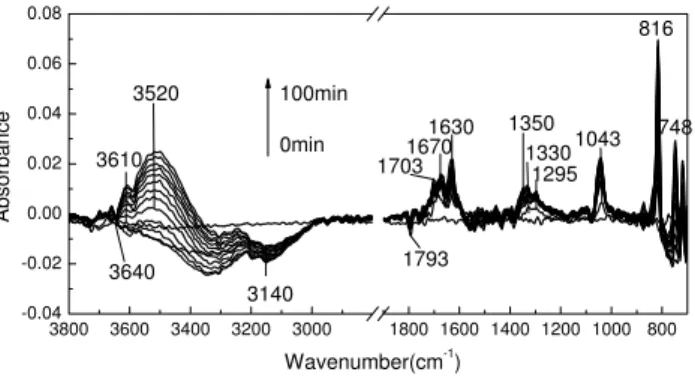
Figure 1 shows typical IR spectra of CaCO3when reacted with NO2 under dry conditions for 0 to 100 min. Nitrate was clearly observed on the CaCO3 surface. The peak at 816 cm−1 was assigned to the out-of-plane bending of ni-trateν2. The peak at 1043 cm−1was assigned to the sym-metric stretching of nitrate ν1 and the peak at 748 cm−1 was assigned to the in-plane bending of nitrateν4. Peaks at 1295, 1330, and 1350 cm−1 were assigned to the asym-metric stretching of nitrateν3. Theν3mode of nitrate on the CaCO3surface has many peaks, which is different from that of the nitrate ions in Ca(NO3)2. This can be attributable to the degenerateν3mode of adsorbed nitrate of different coor-dination with surface (monodentate, bidentate, and bridging) (Underwood et al., 1999).
The asymmetric stretching of adsorbed nitric acid has been reported to be at 1710/1680 cm−1 (Nakamoto, 1997; Finlayson-Pitts et al., 2003). In our study, to confirm the vibration frequency of the adsorbed HNO3, calcium sulfate (CaSO4) particles were exposed to gas phase HNO3. The IR absorption peaks of adsorbed HNO3 were observed at 1670, and 1720 cm−1; therefore, we can assign the peaks at
3800 3600 3400 3200 3000 1800 1600 1400 1200 1000 800 -0.04
-0.02 0.00 0.02 0.04 0.06 0.08
Absor
banc
e
Wavenumber(cm-1) 3610
3640 3520
3140
1793 1630 1670
1703 1330
1043 816
748
1295 1350 100min
0min
Fig. 1. Typical IR spectra of CaCO3 particles after
reac-tion with NO2 under dry conditions (RH<10%) at 296◦K
and reaction times of 0 to 100 min, NO2 concentration was
1.22×10¹⁶molecule cm−3.
1670 and 1703 cm−1to adsorbed HNO3, which suggests that HNO3was formed when NO2reacted with CaCO3.
The peaks at 1630 and 3520 cm−1 were assigned to the bending and asymmetric stretching of crystal hydrate water. Compared with the vibration frequencies of the crystallized water in Ca(NO3)2·4H2O at 1640 cm−1 and 3490 cm−1, a shift of both peaks occurred, due to the decreased hydrogen bonding. The asymmetric stretching shifted to the higher wave number, and the bending shifted to the lower wave number. The peaks at 3140 and 3330 cm−1were assigned to surface adsorbed water, both peaks decreased as the re-action proceeded until the peaks for crystal hydrate water at 1630 cm−1and 3520 cm−1appeared.
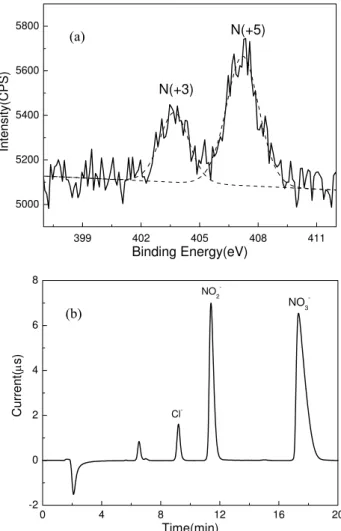
The XPS spectrum of CaCO3 particle that reacted with 1.06×10¹⁵molecules cm−3NO2for 626 min (Fig. S3, panel a: http://www.atmos-chem-phys.net/10/463/2010/ acp-10-463-2010-supplement.pdf) showed the peak of ni-trogen of +5 valence at 407.3 eV, confirmed the for-mation of nitrate. The formation of nitrate was fur-ther confirmed by IC analysis of reacted CaCO3 particles (Fig. S3, panel b: http://www.atmos-chem-phys.net/10/463/ 2010/acp-10-463-2010-supplement.pdf). However, no ni-trite was detected with both XPS and IC, this is probably due to the reason that HONO formed in the reaction was released into the gas phase and carried away by N2.
Fig. 2. Nitrate formation as a function of time during the
reac-tion of CaCO3with NO2. The nitrate concentration is represented
by the integrated absorbance of the peak area between 1077 and
1013 cm−1. The NO2concentration was changed from 4.81×10¹⁵
to 1.22×10¹⁶molecule m−3. The data points and the error bars are
the average value and the standard deviation of three duplicate ex-periments.
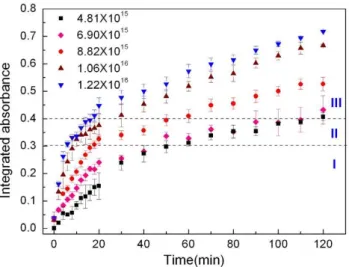
the growth stage when IAwas increasing at a constant rate, smaller than that of stage I.
The amount of nitrate ions formed on the particles{NO−3} was determined with a linear relationship between IA in the range of 1073–1013 cm−1 and the amount of nitrate deter-mined by ion chromatography{NO−3}:
{NO−3} =f ×IA (1)
The conversion factorf was found to be independent of reaction time and NO2 concentration as long as the experi-ment was completed at a stage when the absorption of the nitrate band was still growing. For our study,f was calcu-lated to be 1.89×10¹⁸molecules/IA.
Using f, the formation rate of nitrate d{NO−3}/dt was calculated, and the reaction order of NO2 on CaCO3 parti-cles were obtained from the slope of the double-log plots of
d{NO−3}/dt versus NO2 concentrations (Fig. 3). Using the slope of the initial linear portion (0–10 min) to determine ln{dNO3−}/dt}, the reaction order of NO2in stage I was de-termined as 1.69±0.19 and in stage II 0.49±0.36 in the range of NO2concentration in this study.
3.2 Reaction under wet conditions
Experiments of CaCO3 reaction with NO2 under wet con-ditions were carried out using non-heat-treated CaCO3 parti-cles at 296◦K with RH=60–71%. Figure 4a shows typical IR spectra of CaCO3 when NO2 entered the reactor under wet conditions, at reaction times from 0 to 60 min.
The peak at 1048 cm−1 was assigned to the symmet-ric stretching ν1 of nitrate, the peak at 1344 cm−1 to the
Fig. 3.Double-log curves of nitrate-producing rate versus NO2 con-centration. The data points and error bars are the average values and standard deviations of three replicate experiments. The
reac-tion order was of NO21.69±0.19 in initial stage I (0–10 min), and
0.49±0.36 in transition stage II.
asymmetric stretchingν3of nitrate. The peak at 1251 cm−1 was assigned to the asymmetric stretchingν3of nitrite. The peak at 1688 cm−1 was assigned to the adsorption peak of HNO3and the peak at 1636 cm−1to the bending of the sur-face adsorbed water; the peak at 1472 cm−1appeared in the range of peaks for the asymmetric stretching of carbonate and was assigned to the carbonate vibration peak. Compared to the corresponding peak observed under dry conditions, these peaks had all shifted more or less. We attributed these shifts to the changed environment caused by increased sur-face adsorbed water under wet conditions.
The peaks at 1525 and 1540 cm−1 were in the range of asymmetric stretching of bicarbonate and were assigned to the bicarbonate vibration peaks (Al-Hosney and Gras-sian, 2004; Al-Abadleh et al., 2005). Negative peaks at 1472, 1525, and 1540 cm−1 were similar to the neg-ative peaks from the reaction of HNO3 with CaCO3 (Fig. S4: http://www.atmos-chem-phys.net/10/463/2010/ acp-10-463-2010-supplement.pdf). This indicated that the intermediate products HCO−3 and H2CO3were formed dur-ing the reaction of NO2 with CaCO3. The result is consis-tent with the findings of (Al-Hosney and Grassian, 2004) that H2CO3was the intermediate product when HNO3, SO2, HCOOH and CH3COOH reacted with CaCO3.
The formation of nitrate and nitrite was further con-firmed by the XPS spectrum of CaCO3 particles react-ing with 1.06×10¹⁵molecules cm−3 of NO2 for 30 min at RH=80±2%, which demonstrated distinctly the existence of N of +5 valence and +3 valence as shown in Fig. 5a, and the clear formation of nitrate and nitrite shown in IC chro-matogram of Fig. 5b.
3800 3600 3400 3200 1800 1600 1400 1200 1000 800 -0.05
0.00 0.05 0.10 0.15 0.20
Abs
o
rban
ce
Wavenumber(cm-1) 60min
50min 40min 30min 20min 16min 12min 8min 4min 0min 3500
1650
1540 1525
1472 1344
1248 1048 1688
(a)
0 10 20 30 40 50 60
-2 -1 0 1 2
3 1048*10
1248
1472+1525+1540 3500/20
In
tegrat
ed Absorbance
time (min)
(b)
Fig. 4. (a)IR spectrum of H2O (3500 cm−1), nitrate (1048 cm−1),
nitrite (1248 cm−1), and CaCO3 (1472, 1525, 1540 cm−1)
dur-ing the CaCO3particles reaction with 1.06×10¹⁶molecules cm−3
NO2 from 0 to 60 min, with RH=60–71%. (b) Change in
inte-grated absorbance of 1048 cm−1for nitrate, 1248 cm−1for nitrite,
1472+1525+1540 cm−1for CaCO3, and 3500 cm−1for H2O.
1525, 1540 cm−1) during the CaCO3particles reaction with 1.06×10¹⁶molecules cm−3 NO2 from 0 to 60 min, with RH=60–71%.
Figure 4b shows the time curves of integrated ab-sorbance of 1048 cm−1 for nitrate, 1248 cm−1 for nitrite, 1472+1525+1540 cm−1for CaCO3, and 3500 cm−1for H2O. During the first 10 min it shows clearly the fast increases in the concentrations of H2O and nitrites, and the fast decrease in CaCO3, while the absorbance of nitrate increase gradually. After 10 min, the nitrite concentration started to decrease, while the increase in the concentrations of H2O and nitrate, and the decrease in the concentrations of CaCO3maintained
399 402 405 408 411
5000 5200 5400 5600 5800
N(+3)
N(+5)
Intens
ity
(CPS)
Binding Energy(eV)
0 4 8 12 16 20
-2 0 2 4 6 8
Curr
ent(
μ
s)
Time(min)
NO
2
-NO3
-Cl
-± (b)
(a)
Fig. 5. XPS spectrum (a)and IC chromatogram(b) analysis of
CaCO3particles after reaction with 1.06×10¹⁶molecules cm−3of
NO2 at RH=80±2% for 30 min. The dashed line in (a) was the
Lorentzian peak fit.
at relative slow and steady rates. It was inferred that the in-crease of adsorbed nitric acid caused the release of nitrite in the form of gaseous HONO which led to the decrease of the concentration of nitrite ions.
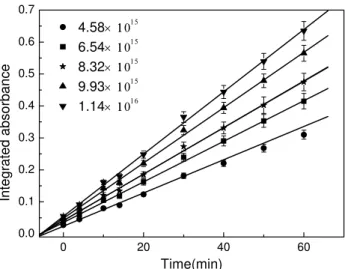
Figure 6 shows the nitrate formation as a function of time at different NO2concentrations during the reaction of CaCO3 with NO2 under wet conditions (RH=60–71%). The inte-grated absorbance was in the range of 1077 and 1013 cm−1. Unlike the reaction under dry conditions, under wet condi-tions, the nitrate on the CaCO3 surface increased linearly with time but did not become saturated during the experi-mental period, and the nitrate formation rate increased with increasing NO2concentration.
0 20 40 60 0.0
0.1 0.2 0.3 0.4 0.5 0.6 0.7
4.58× 11015 6.54× 11015
8.32× 11015
9.93× 11015
1.14× 11016
In
te
gr
at
ed abs
o
rb
anc
e
Time(min)
Fig. 6. Nitrate formation as a function of time during the reaction
of CaCO3 with NO2at 60–71% RH. The nitrate concentration is
represented by the integrated absorbance of the peak area between
1077 and 1013 cm−1. The NO2concentration was changed from
4.58×10¹⁵ to 1.14×10¹⁶molecule m−3. The data points and the
error bars are the average value and the standard deviation of three duplicate experiments.
plot of the nitrate formation rated{NO−3}/dt versus the NO2 concentration (Fig. 7). Slope of the curve was 0.94±0.10, this means that under wet conditions, the NO2 reaction on CaCO3particles is first order with respect to NO2in the NO2 concentration range of this study.
Here we assumed that the conversion factorf is the same under both wet and dry conditions, this assumption may cause bias in NO−3 concentrations, because the spectra un-der dry and wet conditions could be different, which may influence the conversion factorf. We tried our best to re-duce this possible bias: (1) the peak we used for quantitative analysis was the symmetric stretching of nitrateν1(with an integration range of 1073–1013 cm−1), where there is no in-terference from other peaks. When changed from dry to wet conditions, the peak maintained the same shape and shifted slightly, from 1043 cm−1 to 1048 cm−1; (2) the conversion factor is also related to the sample property such as sample stack density and particle size; in our experiment the same sample preparation procedure were used for both the dry and wet experiment this should minimize the difference caused by sample property. In a future study, the relationship of the conversion factor and RH should be verified.
3.3 The influence of water vapor
Calcite is the main form of CaCO3in the environment and its (1014) crystal plane has the lowest energy state (de Leeuw and Parker, 1998). Both laboratory and computer model-ing studies have demonstrated that at certain relative hu-midity, a hydrated layer on CaCO3could be dissociated by
36.0 36.2 36.4 36.6 36.8 37.0 32.4
32.7 33.0 33.3 33.6
ln{{dNO
3
- /dt}/ion s
-1 }
ln{[NO2]/molecule cm-3} n=0.94+0.10
R=0.9902
Fig. 7.Double-log plot of the nitrate formation rate versus the NO2
concentration. The reaction was at 296◦K and RH=66±2%. The
data points and error bars are the average values and standard devi-ations of two or three replicate experiments.
oxygen vacancy to form stable−OH that remained surface-bound even in a high vacuum (Stipp et al., 1996; Mc-Coy and LaFemina, 1997; de Leeuw and Parker, 1998). The results of Kuriyavar et al. (2000) and Stipp (1999) demonstrated that the dissociation of water could produce surface hydroxyl on CaCO3 surfaces. Species including H+, OH+, HCO−3, Ca(OH)−, and Ca(HCO3)− can ex-ist on the surfaces of calcite and alter its surface proper-ties (Thompson and Pownall, 1989). XPS analysis of our CaCO3particle sample showed two peaks of O1s at 531.3 eV and 533.1 eV (Fig. S5: http://www.atmos-chem-phys.net/10/ 463/2010/acp-10-463-2010-supplement.pdf), corresponding to the oxygen atoms of CaCO3and−Ca(OH) (Stipp, 1999). The oxygen atoms of−Ca(OH) accounted for 3.4–3.6% of the total number of atoms, and the oxygen atom ratio of Ca(OH):CaCO3was 7.3:100. The presence of−Ca(OH) im-plied that water can have a major effect on the CaCO3 sur-face properties. Therefore, understanding water adsorption on surfaces of CaCO3particles is very important.
From the IR spectra of the CaCO3particle samples, we in-tegrated the area of the stretching vibration of−OH from 3644 to 2983 cm−1 and plotted it as a function of RH at 296 K (Fig. S6, left axis: http://www.atmos-chem-phys.net/ 10/463/2010/acp-10-463-2010-supplement.pdf), it demon-strated that the proportion of surface bound water increased with RH. The NO−3 formation rate on the CaCO3 particle samples can be expressed as:
initial stage of the reaction, the number of NO−3 ions formed on the surface of CaCO3 is small compared to the surface active site,{CaCO3}can be considered constant.
The reaction rate of NO2on CaCO3particle was investi-gated as a function of RH (Fig. 8a). The nitrate formation rate decreases initially with RH and then increases slightly with the increasing RH.
The reaction order of H2O was obtained from slope double-log curve of the NO−3 formation rate versus the wa-ter concentration at a constant NO2concentration (Fig. 8b). The reaction order of H2O(g) was−0.44 with RH<50%, and 0.20 with RH>50%.
The change of nitrate formation rate with RH indicates the influence of water vapor on the reaction mechanism of NO2on CaCO3particles. At low RH, the surface−OH de-termines the reaction rate and water competes with NO2for the active sites (surface−OH), and the uptake coefficient de-creases with the increase in RH.
As RH increases, water starts to condense on the surface to form micro-puddles of water (Krueger et al., 2005), and gas-liquid reaction of NO2 with condensed water may be-come feasible. With RH high enough (>52% in our experi-ment), the gas-liquid reaction of NO2with condensed water may become rate limiting, and the nitrate formation rate in-creases with RH. This is consistent with the observation that at low RH, the formation of the active site on the surface of the CaCO3, e.g.−OH, involved the adsorbed water, which can alter the reactivity of the particle surface (Elam et al., 1998; Hass et al., 1998; Eng et al., 2000; Hass et al., 2000). Water could easily adsorb onto the surface−OH, and com-pete with the adsorption of NO2(Stumm, 1992). At high RH, as more condensed water forms on the surface of CaCO3, the reaction on the calcite surface can change from gas-solid to gas-liquid reaction. Thus, water plays an important role in determining the mechanism of the heterogeneous reactions of NO2with CaCO3. Details of the mechanism will be dis-cussed below.
3.4 Uptake coefficient
The reactive uptake coefficient or reaction probability,γ, is defined as the ratio of the reactive gas-surface collision rate to the total gas-surface collision rate. The reactive uptake coefficient of NO2by the surface of the CaCO3particles is
γ= dN(NO2)/dt
Z (3)
Z= 1
4Aω n (4)
where N(NO2) is the number of reactive NO2collisions with the surface,Zis the total gas-surface collision rate of NO2 on the surface of CaCO3,A is the surface area of CaCO3 particles (BET surface area was used here),ω is the mean
0.0 0.5 1.0 1.5 2.0 2.5 3.0 3.5 4.0
0 20 40 60 80 100
RH(%)
R(
NO
3
-)(
1
0
14
ions
s
-1)
(a)
(b)
Fig. 8. Nitrate formation rate during the reaction of CaCO3
with NO2(a) and double-log curve of NO−3 formation rate
ver-sus [H2O](b)at different RH and a constant NO2concentration
of 6.88×10¹⁵molecules cm−3.
speed of the gas molecule, and n is the concentration of gas phase species. The rate of reactive collisions can be obtained from the formation rate of nitrate d{NO3−}/dt, the reactive uptake coefficient then becomes:
γ=d
NO−3 /dt
Z (5)
Previous studies show that the reaction of NO2with particles was through N2O4(Finlayson-Pitts et al., 2003), then the re-active NO2 loss rate in the gas phase is twice of the nitrate formation rate.
(a)
(b)
Water layer
NO2
CaCO3
NO2
H2O…NO2
slow HONO
HNO3
H2CO3
CO2
Ca(NO3)2·nH2O
H2O
Ca2+, NO
3
-Ca(NO3)2
CaCO3
CaCO3
O2N…NO2
H2O H2O
HONO
HNO3
HONO H2O
HO…NO2
H…ONO
N2O4 2NO2
CaCO3
H2O
-OH
Ca(NO3)2 Ca(NO3)2·nH2O
H2O
Initial stage
Growth
H2O
HO-
HONO
Fig. 9.Schematics of the mechanism of NO2reaction on the surface
of CaCO3particles under(a)dry and(b)wet conditions.
was used for calculating the initial uptake coefficientγ0. Ta-ble 1 lists the initial uptake coefficient of NO2 on CaCO3 particles under both dry (RH<10%) and wet (RH=60–71%) conditions. The initial uptake coefficient under dry condi-tions was (4.25±1.18)×10−9, while under wet conditions, it is slightly lower, with a value of (2.54±0.13)×10−9. These values are at the same level as those reported by Boerensen et al. (2000) about the reactive uptake coefficient of NO2on Al2O3.
4 Discussion
We conclude from the above results that water vapor has an important influence on the heterogeneous reaction mecha-nism of NO2with CaCO3. The reaction mechanism is dif-ferent under dry and wet conditions. Under dry conditions, −OH is produced on the calcite surface via the dissociation of water by oxygen vacancy and this seems to be the rate de-termining factor for the reaction. As RH increases and more water condenses on CaCO3surface, surface condensed water participates in the reaction. We discuss the reaction mecha-nisms for both of these two conditions below.
Table 1.Initial uptake coefficient of NO2on CaCO3particles under dry and wet conditions. The RH was measured at 296 K.
replicate [NO2] γ0±2σ(10−9) RH (%)
time (1015molecule cm−3)
14 6.90∼16.84 4.25±1.18 dry
5 4.58∼11.40 2.54±0.13 60-71
4.1 Mechanism under dry conditions
Under dry conditions, the reaction mechanism proceeded as shown in Fig. 9a. At low RH, there was still some wa-ter vapor remaining and the surface adsorbed wawa-ter on the CaCO3 surface equilibrated with water vapor, as shown in Reaction (R1):
H2O(g)−−↽k−−⇀1 k−1
H2O(a) (R1)
Surface-adsorbed water existed on the CaCO3 surface de-spite heating at 623◦K for 2 h. The adsorbed water on the CaCO3 surface was dissociated by an oxygen vacancy site(O) to form the active siteS·(OH)H that was stable even at high temperature and high vacuum:
site(O)+H2O(a)−→k2 S·(OH)H (R2) Finlayson-Pitts et al. (2003) found NO2 was likely to form nitrogen dioxide dimers (nitrogen tetroxide, N2O4) at high concentrations,
2NO2(g)−−↽k−−⇀3 k−3
N2O4(g) (R3)
NO2was in equilibrium with N2O4in the gas phase, [N2O4]= k3
k−3
[NO2]2=K3[NO2]2 (6) then N2O4was adsorbed to the particle surface:
N2O4(g)−−↽k−−⇀4 k−4
N2O4(a) (R4)
N2O4reacted with the surface active site forming adsorbed nitric acid HNO3 and nitrous acid HONO, as illustrated in Reaction (R5):
N2O4(a)+S·(OH)H−→k5 site(O) (R5) −HNO3(a)+HONO(g)
d{HNO3}
Compared to “sticky” HNO3, HONO was unlikely to adsorb onto surface, but rather being released into the gas phase (Goodman et al., 1999; Borensen et al., 2000). Although we could not detect gas phase HONO, we did detect adsorbed HNO3with DRIFTS.
No adsorbed N2O4 was observed on the particle surface, suggesting N2O4could be treated as an intermediate in the reaction:
d{N2O4}
dt =k4[N2O4]−k−4{N2O4} (8)
−k5{N2O4}{S·(OH)H} =0
Assuming the HNO3formed was quickly converted to NO−3 on the surface of CaCO3. Then
d{NO−3}
dt = d{HNO3}
dt =k5{N2O4}{S·(OH)H} (9)
Combining Eqs. (6), (7), (8), and (9), one can get
d{NO−3}
dt =
k4k5K3[NO2]2{S·(OH)H}
k−4+k5{S·(OH)H}
(10)
Equation (10) shows that, at the initial stage of the reaction, the amount of surface active sites was relatively large and for-mation of HNO3on the CaCO3surface was a second-order reaction with respect to NO2. This is consistent with the measured reaction order of 1.69±0.19 as illustrated in Fig. 3, even though the NO2concentration range is small due to the limits from experiment conditions.
Underwood et al. (1999, 2001) suggested that under dry conditions NO2 might first react to form a surface nitrite, which was then oxidized by NO2. However, in our exper-iment, we did not detected surface nitrite under dry condi-tions, the reason for this is likely the high NO2concentration used in our experiment compared to the studies Underwood et al. (1999, 2001), and this confirms the mechanism involv-ing the reaction of N2O4 at the high NO2 pressure of the present study.
Based on the mechanism discussed above, under dry con-ditions, surface nitrate should increase exponentially and reach saturation due to the depletion of surface reactive sites; which is consistent with the experimental observation at the stage I and II (Fig. 2). However, at the third stage, the nitrate was found grow continuously instead of leveling off gradu-ally. This indicates the rate law may not work at the stage III. Other reaction process, such as the reaction of NO2with wa-ter in newly formed Ca(NO3)2may contribute to the contin-uous formation of surface nitrate at this stage. Further study is needed to understand the mechanism at stage III.
4.2 Mechanism under wet conditions
Here, the wet conditions refer to the conditions when RH>52%. The reaction mechanism under wet conditions
was illustrated by the general scheme in Fig. 9b. NO2was adsorbed on CaCO3to form adsorbed NO2(a):
NO2(g)−−↽k−−⇀6 k−6
NO2(a) (R6)
Previous studies have demonstrated that the disproportion-ation reaction of NO2 with surface adsorbed water was a first-order reaction, with the adsorption of NO2 being the rate-limiting step (Svensson et al., 1987; Jenkin et al., 1988). The nitrite and nitrate formed on the particle surface was at-tributed to the reaction of surface-adsorbed water with NO2; i.e., adsorbed NO2(a) reacted with condensed water H2O(a) to form adsorbed HNO3(a) and gaseous HONO(g).
H2O(a)+2 NO2(a)−→k7 HNO3(a)+HONO(g) (R7) At the initial stage, HONO dissolved in adsorbed water to form nitrite. As the concentration of HNO3(a) increased, the surface pH decreased and nitrite escaped from the sur-face as gaseous HONO. Meanwhile, HNO3(a) reacted with CaCO3to form H2CO3and Ca(NO3)2(Al-Hosney and Gras-sian, 2004).
2HNO3(a)+CaCO3(s)−→k8 Ca(NO3)2(s)+H2CO3(a) (R8) Afterwards, H2CO3decomposed in adsorbed water to form H2O and CO2, resulting in the decrease of HCO−3 and CO23− on the surface.
H2CO3(a)−→H2O(g)+CO2(g) (R9) Ca(NO3)2 has strong hygroscopic property and the Ca(NO3)2particles were in the form of solution droplets at RH>10% (Liu et al., 2008b), this caused the broadened peak for adsorbed water in the IR spectrum.
Ca(NO3)2(s)+nH2O(a)⇋Ca(NO3)2·nH2O (R10)
Since the adsorption of NO2 was the rate-limiting step and HNO3(a) was the intermediate product, the rate of nitrate formation in the presence of excess surface water could be expressed as the following.
d{NO−3}
dt =
1
2k6[NO2] (11)
Equation (11) shows the surface nitrate formation with re-spect to NO2as a first order reaction; this is consistent with the experimental result of 0.94±0.10.
of N2O4 in solution is also a factor determining the appar-ent reaction order in NO2. Under convective mass transport conditions, the NO2reaction order should be 1. Our experi-ments found that the NO2reaction order is 0.94±0.10. How-ever, the surface/volume ratio in our experimental was about 106m−1, this is much higher than the 100–800 m−1 inter-facial area per unit liquid volume in the study of Lee and Schwartz (1981). Thus the reaction under our experimental conditions is unlikely limited by the convective mass trans-port; further analysis is needed to explain the reason for re-action order of 0.94±0.10 in NO2.
In our experiments, the NO2 concentration range was narrow for reaction order determination: 4.81×10¹⁵ to 1.22×10¹⁶molecule m−3 under dry conditions, and 4.58×10¹⁵ to 1.14×10¹⁶molecules m−3 under wet condi-tions. This is unfortunately limited by the current experi-mental setup. With DRIFTS system the gas concentration can neither be too low due to the detection limit of the in-strument nor too high because of the fast nitrate formation in the initial stage of the reaction, which may hinder obtaining exact reaction rate from the kinetic curve. However, this nar-row range should not prevent us from discussing the reaction order, as long as we do not extrapolate the results outside the range of NO2concentration. Moreover, the correlation coef-ficient is high in Fig. 3 (R=0.98) which implies the reaction order is reliable within the NO2concentration range. If fu-ture experimental conditions allowed, one should expand the range of NO2concentrations for rate order determination.
4.3 Implications for the troposphere
Under dry conditions (RH<10%), formation of N2O4is the first reaction step. In the troposphere, the NO2 concen-trations are orders of magnitude smaller than that used in our experiments, the N2O4concentrations in the troposphere should be even lower than our experiment conditions, with aγ0of (4.25±1.18)×10−9, the reaction of NO2 on CaCO3 under dry conditions may not have important implication in the atmosphere.
Table 1 shows that under dry and wet conditions,γ0were varied within a range of 2.5–4.3×10⁻⁹, which is narrower than we anticipated. At RH>52%, with the increase of wa-ter condensed on the surface of CaCO3 particles, theγ0 of NO2on CaCO3particles calculated using BET surface area could have been underestimated. As significant amount of condensed water could make the surface of CaCO3particles smoother and less pores, the available surface area for the reaction should be close to the geometric surface area of a cubic shape particle.
When calculating the uptake coefficient, to use which type of surface area depends on the surface properties of the par-ticles. For our experiment, at wet conditions and with signif-icant amount of condensed water on the surface, we should use geometric surface area to calculateγ0.
Using 0.19 m2g−1as the specific geometric surface area of CaCO3 particle samples, from Table 1 we calculatedγ0 at RH=60–71% to be (6.56±0.34)×10−8; this is more than twenty times higher than the value calculated with BET sur-face area.
The uptake coefficient of HNO3on CaCO3has been mea-sured by many researchers using different methods, it was found to increase with RH (Vlasenko et al., 2006; Liu et al., 2008) and varies from 10−5∼10−4 (Goodman et al., 2000; Underwood et al., 2000; Johnson et al., 2005) at 0% RH to 0.01–0.1 at>20% RH. The large variation of the uptake co-efficient of HNO3on CaCO3may due to different methods as well as the different surface areas used in calculating up-take coefficient (Fenter et al., 1995; Hanisch and Crowley, 2001). Even considering that NO2concentrations in the at-mosphere is orders of magnitude higher than that of HNO3, our experimental results suggest that the reaction of NO2on CaCO3 particle is unable to compete with that of HNO3 in the atmosphere.
However, under wet conditions or RH>52%, in order to obtain reliable uptake coefficients, one needs to carefully choose the type the surface area and determine it accurately. Moreover, under wet conditions, the IR, XPS, and IC ev-idences for the formation of nitrite and its subsequent de-crease on CaCO3particle suggests the reaction of NO2with CaCO3could be a source of HONO in the atmosphere.
5 Conclusions
At high RH, condensed water could make the surface smoother with less pores, other than the BET surface area, the geometric surface area should be used to calculateγ0. Using 0.19 m2g−1as the specific geometric surface area of CaCO3particle samples, we calculatedγ0at RH=60–71% to be (6.56±0.34)×10−8; this is more than twenty times higher than that under dry conditions. Moreover, CaCO3 is alka-line and can react with NO2to form calcium nitrate which has strong hygroscopicity and could deliquesce at RH>10%. This will help exposing CaCO3to NO2, until CaCO3is fully reacted.
The uptake coefficient of HNO3on CaCO3ranged from 10−4to 0.1, depending on RH. Our results show that the het-erogeneous reaction of NO2on CaCO3is unable to compete with that of HNO3in producing calcium nitrate on mineral aerosol in the atmosphere. However, the NO2reaction with water adsorbed on CaCO3could be a source of HONO in the atmosphere. Further efforts to detect HONO formed in the reaction of NO2on CaCO3particles are necessary.
Acknowledgements. This work was supported by the National Basic Research Priorities Program (Grant No. 2002CB410802) and National Natural Science Foundation of China (Grant No. 40490265, 20637020).
Edited by: M. Ammann
References
Al-Abadleh, H. A., Al-Hosney, H. A., and Grassian, V. H.: Oxide and carbonate surfaces as environmental interfaces: the impor-tance of water in surface composition and surface reactivity, J. Mol. Catal. A-Chem., 228, 47–54, 2005.
Al-Hosney, H. A. and Grassian, V. H.: Carbonic acid: An important intermediate in the surface chemistry of calcium carbonate, J. Am. Chem. Soc., 126, 8068–8069, 2004.
Boerensen, C., Kirchner, U., Scheer, V., Vogt, R., and Zellner, R.:
Mechanism and kinetics of the reactions of NO2or HNO3with
alumina as a mineral dust model compound, J. Phys. Chem. A, 104, 5036–5045, 2000.
Carmichael, G. R., Zhang, Y., Chen, L. L., Hong, M. S., and Ueda, H.: Seasonal variation of aerosol composition at Cheju Island, Korea, Atmos. Environ., 30, 2407–2416, 1996.
Chen, L. Q.: Long range atmospheric transport of China desert aerosol to north Pacific Ocean, Acta Oceanol. Sin., 7, 554–560, 1985.
de Leeuw, N. H. and Parker, S. C.: Surface structure and morphol-ogy of calcium carbonate polymorphs calcite, aragonite, and va-terite: an atomistic approach, J. Phys. Chem. B, 102, 2914–2922, 1998.
Dentener, F. J., Carmichael, G. R., Zhang, Y., Lelieveld, J., and Crutzen, P. J.: Role of mineral aerosol as a reactive surface in the global troposphere, J. Geophys. Res.-Atmos., 101, 22869– 22889, 1996.
Elam, J. W., Nelson, C. E., Cameron, M. A., Tolbert, M. A., and
George, S. M.: Adsorption of H2O on a single-crystal
alpha-Al2O3(0001) surface, J. Phys. Chem. B, 102, 7008–7015, 1998.
Eng, P. J., Trainor, T. P., Brown Jr., G. E., Waychunas, G. A., Newville, M., Sutton, S. R., and Rivers, M. L.: Structure of the
hydrated alpha-Al2O3(0001) surface, Science, 288, 1029–1033,
2000.
Fenter, F. F., Caloz, F., and Rossi, M. J.: Experimental-Evidence for the Efficient Dry Deposition of Nitric-Acid on Calcite, Atmos. Environ., 29, 3365–3372, 1995.
Finlayson-Pitts, B. J., Wingen, L. M., Sumner, A. L., Syomin, D.,
and Ramazan, K. A.: The heterogeneous hydrolysis of NO2in
laboratory systems and in outdoor and indoor atmospheres: An integrated mechanism, Phys. Chem. Chem. Phys., 5, 223–242, 2003.
Goodman, A. L.: A spectroscopic study of heterogeneous reac-tions of nitrogen oxides and sulfur oxides on solid particles of atmospheric relevance, Chemistry Department, The University of Iowa, Iowa, 276, 2000.
Goodman, A. L., Underwood, G. M., and Grassian, V. H.:
Het-erogeneous Reaction of NO2: Characterization of Gas-Phase
and Adsorbed Products from the Reaction, 2NO2(g)+H2O(a)f
HONO(g)+HNO3(a) on Hydrated Silica Particles, J. Phys.
Chem. A, 103, 7217–7223, 1999.
Goodman, A. L., Underwood, G. M., and Grassian, V. H.: A labo-ratory study of the heterogeneous reaction of nitric acid on cal-cium carbonate particles, J. Geophys. Res.-Atmos., 105, 29053– 29064, 2000.
Hanisch, F. and Crowley, J. N.: Heterogeneous reactivity of gaseous
nitric acid on Al2O3, CaCO3, and atmospheric dust samples: A
Knudsen cell study, J. Phys. Chem. A, 105, 3096–3106, 2001. Hass, K. C., Schneider, W. F., Curioni, A., and Andreoni, W.: The
chemistry of water on alumina surfaces: Reaction dynamics from first principles, Science, 282, 265–268, 1998.
Hass, K. C., Schneider, W. F., Curioni, A., and Andreoni, W.:
First-principles molecular dynamics simulations of H2O on
alpha-Al2O3(0001), J. Phys. Chem. B, 104, 5527–5540, 2000.
Jenkin, M. E., Cox, R. A., and Williams, D. J.: Laboratory Stud-ies of the kinetics of formation of nitrous-acid from the thermal-reaction of nitrogen-dioxide and water-vapor, Atmos. Environ., 22, 487–498, 1988.
Johnson, E. R., Sciegienka, J., Carlos-Cuellar, S., and Grassian, V. H.: Heterogeneous Uptake of Gaseous Nitric Acid on Dolomite
(CaMg(CO3)2) and Calcite (CaCO3) Particles: A Knudsen Cell
Study Using Multiple, Single, and Fractional Particle Layers, J. Phys. Chem. A, 109, 6901–6911, 2005.
Jonas, P. R., Charlson, R. J., Rodhe, H., Anderson, T. L., Andreae, M. O., Dutton, E., Graf, H., Fouquart, Y., Grassl, H., Heintzen-berg, J., Hobbs, P. V., Hofmann, D., Hubert, B., et al.: Aerosols, in Climate Change 1994: Radiative Forcing of Climate Change, edited by: Houghton, J. T., Meira Filho, L. G., Bruce, J., Lee, H., Callander, B. A., Haites, E., Harris, N., and Maskell, K., Cam-bridge University Press, CamCam-bridge, UK, 127–162, 1995. Krueger, B. J., Ross, J. L., and Grassian, V. H.: Formation of
mi-crocrystals, micropuddles, and other spatial inhomogenieties in surface reactions under ambient conditions: An atomic force mi-croscopy study of water and nitric acid adsorption on MgO(100)
and CaCO3(1014), Langmuir, 21, 8793–8801, 2005.
Krueger, B. J., Grassian, V. H., Laskin, A., and Cowin, J. P.: The transformation of solid atmospheric particles into liq-uid droplets through heterogeneous chemistry: Laboratory in-sights into the processing of calcium containing mineral dust aerosol in the troposphere, Geophys. Res. Lett., 30, 1148, doi:10.1029/2002GL016563, 2003b.
Kuriyavar, S. I., Vetrivel, R., Hegde, S. G., Ramaswamy, A. V., Chakrabarty, D., and Mahapatra, S.: Insights into the forma-tion of hydroxyl ions in calcium carbonate: temperature depen-dent FTIR and molecular modelling studies, J. Mater. Chem., 10, 1835–1840, 2000.
Lee, Y. N. and Schwartz, S. E.: Reaction kinetics of nitrogen diox-ide with liquid water at low partial pressure, J. Phys. Chem., 85, 840–848, 1981.
Li, H. J., Zhu, T., Ding, J., Chen, Q., and Xu, B. Y.: Heterogeneous
reaction of NO2 on the surface of NaCl particles, Sci. China
Ser. B, 49, 371–378, 2006.
Liu, Y., Gibson, E. R., Cain, J. P., Wang, H., Grassian, V. H., and
Laskin A.: Kinetics of Heterogeneous Reaction of CaCO3
Par-ticles with Gaseous HNO3over a Wide Range of Humidity, J.
Phys. Chem. A, 112, 1561–1571, 2008a.
Liu, Y. J., Zhu, T., Zhao, D. F., and Zhang, Z. F.: Investigation
of the hygroscopic properties of Ca(NO3)2and internally mixed
Ca(NO3)2/CaCO3particles by micro-Raman spectrometry,
At-mos. Chem. Phys., 8, 7205–7215, 2008, http://www.atmos-chem-phys.net/8/7205/2008/.
McCoy, J. M. and LaFemina, J. P.: Kinetic Monte Carlo
investiga-tion of pit formainvestiga-tion at the CaCO3(10(1)over-bar4) surface-water
interface, Surf. Sci., 373, 288–299, 1997.
Nakamoto, K.: Infrared and Raman Spectra of Inorganic and Co-ordination Compounds Part A, New York, John Wiley & Sons, 1997.
Okada, K., Qin, Y., and Kai, K.: Elemental composition and mixing properties of atmospheric mineral particles collected in Hohhot, China, Atmos. Res., 73, 45–67, 2005.
Quan, H.: Discussion of the transport route of dust storm and loess aerosol from Northwest China at the high altitude, Environ. Sci., 14, 60–65, 1993.
Song, C. H. and Carmichael, G. R.: Gas-particle partitioning of nitric acid modulated by alkaline aerosol, J. Atmos. Chem., 40, 1–22, 2001.
Song, C. H., Maxwell-Meier, K., Weber, R. J., Kapustin, V., and Clarke, A.: Dust composition and mixing state inferred from airborne composition measurements during ACE-Asia C130 Flight #6, Atmos. Environ., 39, 359–369, 2005.
Stipp, S. L. S., Gutmannsbauer, W., and Lehmann, T.: The dynamic nature of calcite surfaces in air, Am. Mineral., 81, 1–8, 1996. Stipp, S. L. S.: Toward a conceptual model of the calcite
sur-face: Hydration, hydrolysis, and surface potential, Geochim. Cosmochim. Ac., 63, 3121–3131, 1999.
Stumm, W.: Chemistry of the solid-water interface: processes at the mineral-water and particle-water interface in natural systems, New York, John Wiley & Sons, 1992.
Sullivan, R. C., Guazzotti, S. A., Sodeman, D. A., and Prather, K. A.: Direct observations of the atmospheric processing of Asian mineral dust, Atmos. Chem. Phys., 7, 1213–1236, 2007, http://www.atmos-chem-phys.net/7/1213/2007/.
Svensson, R., Ljungstrom, E., and Lindqvist, O.: Kinetics of the Reaction between Nitrogen Dioxide and Water Vapor, Atmos. Environ., 21, 1529–1539, 1987.
Thompson, D. W. and Pownall, P. G.: Surface Electrical-Properties of Calcite, J. Colloid Interf. Sci., 131, 74–82, 1989.
Ullerstam, M., Johnson, M. S., Vogt, R., and Ljungstr¨om, E.: DRIFTS and Knudsen cell study of the heterogeneous
reactiv-ity of SO2and NO2on mineral dust, Atmos. Chem. Phys., 3,
2043–2051, 2003,
http://www.atmos-chem-phys.net/3/2043/2003/.
Underwood, G. M., Li, P., Usher, C. R., and Grassian, V. H.: Deter-mining accurate kinetic parameters of potentially important het-erogeneous atmospheric reactions on solid particle surfaces with a Knudsen cell reactor, J. Phys. Chem. A, 104, 819–829, 2000. Underwood, G. M., Miller, T. M., and Grassian, V. H.:
Transmis-sion FT-IR and Knudsen Cell Study of the Heterogeneous Reac-tivity of Gaseous Nitrogen Dioxide on Mineral Oxide Particles, J. Phys. Chem. A, 103, 6184–6190, 1999.
Vlasenko, A., Sjogren, S., Weingartner, E., Stemmler, K., G¨aggeler, H. W., and Ammann, M.: Effect of humidity on nitric acid uptake to mineral dust aerosol particles, Atmos. Chem. Phys., 6, 2147– 2160, 2006,
http://www.atmos-chem-phys.net/6/2147/2006/.
Zhang, D. Z., Shi, G. Y., Iwasaka, Y., and Hu, M.: Mixture of sul-fate and nitrate in coastal atmosphere aerosol :individual particle studies in Qingdao, China, Atmos. Environ., 374, 2669–2679, 2000.
![Fig. 8. Nitrate formation rate during the reaction of CaCO 3 with NO 2 (a) and double-log curve of NO − 3 formation rate ver-sus [H 2 O] (b) at different RH and a constant NO 2 concentration of 6.88×10 15 molecules cm −3 .](https://thumb-eu.123doks.com/thumbv2/123dok_br/18273993.344839/7.892.466.811.94.687/nitrate-formation-reaction-formation-different-constant-concentration-molecules.webp)