Fluorescence Correlation Spectroscopy (FCS)
Susana A. Sanchez1,2, Enrico Gratton1, Antonio L. Zanocco3, Else Lemp3, German Gunther3*
1Laboratory for Fluorescence Dynamics, University of California Irvine, Irvine, California, United States of America,2Microscopy and Dynamic Imaging Unit, Fundacio´n Carlos-III-CNIC, Madrid, Spain,3Laboratorio de Cine´tica y Fotoquı´mica, Facultad de Ciencias Quı´micas y Farmace´uticas, Universidad de Chile, Santiago, Chile
Abstract
One of the several uses of sucrose detergents, as well as other micelle forming detergents, is the solubilization of different membrane proteins. Accurate knowledge of the micelle properties, including size and shape, are needed to optimize the surfactant conditions for protein purification and membrane characterization. We synthesized sucrose esters having different numbers of methylene subunits on the substituent to correlate the number of methylene groups with the size of the corresponding micelles. We used Fluorescence Correlation Spectroscopy (FCS) and two photon excitation to determine the translational D of the micelles and calculate their corresponding hydrodynamic radius, Rh. As a fluorescent probe we
used LAURDAN (6-dodecanoyl-2-dimethylaminonaphthalene), a dye highly fluorescent when integrated in the micelle and non-fluorescent in aqueous media. We found a linear correlation between the size of the tail and the hydrodynamic radius of the micelle for the series of detergents measured.
Citation:Sanchez SA, Gratton E, Zanocco AL, Lemp E, Gunther G (2011) Sucrose Monoester Micelles Size Determined by Fluorescence Correlation Spectroscopy (FCS). PLoS ONE 6(12): e29278. doi:10.1371/journal.pone.0029278
Editor:Giuseppe Chirico, University of Milano-Bicocca, Italy
ReceivedAugust 2, 2011;AcceptedNovember 23, 2011;PublishedDecember 28, 2011
Copyright:ß2011 Sanchez et al. This is an open-access article distributed under the terms of the Creative Commons Attribution License, which permits unrestricted use, distribution, and reproduction in any medium, provided the original author and source are credited.
Funding:GG gratefully thanks Fondecyt grant 1080412. SAS and EG thank the Division of Research Resources of the National Institutes of Health (Grant PHS 5 P41 RR-03155). The funders had no role in study design, data collection and analysis, decision to publish, or preparation of the manuscript.
Competing Interests:The authors have declared that no competing interests exist.
* E-mail: [email protected]
Introduction
The interest on sugar fatty acid esters (SFAE) started in the mid-1950s, and experienced a renewed attention in the last two decades evidenced by a noteworthy increase of studies in the literature [1–6]. These investigations have been motivated by the outstanding surface-active properties (surface tension-reducing capacity, penetrability into lipid bilayers, easiness of dispersion, and remarkable emulsifying power among others) of the SFAE and their environmental friendliness when compared to surfactants derived from petrochemical industry [7,8]. SFAE are nontoxic and non-allergenic surfactants, readily biodegradable in aqueous environments [8,9]. Additionally, the raw materials involved in their synthesis (fatty acids or their derivatives and sucrose) are low cost, simple, easily accessible and renewable [10–13]. SFAE have a broad range of applications going from technological fields such as cosmetic and health care [2,14] to food additives [2].
These non-ionic carbohydrate-based surfactants can contain among others sucrose [3] as hydrophilic head. The hydrophobic tail of these compounds corresponds to a hydrocarbon chain (of different length and degree of insaturations) substituting one or more specific hydroxylic groups on the sucrose moiety. The substitution and purity of these compounds usually depends on the synthetic method and separation techniques employed.
Micelle forming surfactants are used frequently in biochemical studies to solubilize integral membrane proteins, SFAE are not an exception. Derivatives of stearic acid had been employed for the extraction of cytochrome and lysozyme [15–17]. Size and shape of micelles are determinant in the packing of the surfactant tails, and consequently in the conformation of proteins incorporated in their hydrophobic core and in the protein-surfactant interactions [18].
The micelle properties determine the optimal surfactant conditions for extraction, purification, structural and functional character-ization of membrane proteins.
Surfactants are also used to obtain supramolecular mesoporous materials utilized as templates for other applications [19]. The characteristic of the formed mesostructure will depend on the length of the hydrocarbon chain and the surfactant tail, according the ‘liquid crystal templating mechanism’’ [19]. The mesophase formation is directly related with the packing of hydrocarbon tails, property related with the surfactant packing parameter, (V/a0l),
where V is overall volume of the surfactant, aois the effective head
group area, and l is the surfactant chain length [19]. The dimensional values involved in the mesophase formation can be achieved by knowing the size and the physicochemical properties of the micelles formed by the surfactants.
aggregation numbers under the actual experimental conditions without being affected neither by intermicellar interactions nor by the micelle shape [28].
On the other side, one of the disadvantages reported for the fluorescence based methods is the overestimation of Nagg when
compared with the ones determined by NMR procedures, probably, due to the incorporation of fluorescent probes (usually big in size). This disadvantage becomes more dramatic when the fluorescent probe used has also surfactant properties, in such a case, even at low concentration of the probe, the microaggregate formed by a mixture of surfactants (the fluorescent probe and the surfactant under study) would have significantly different physico-chemical properties when compared with micelles of the single surfactant [29,30]. However, different fluorescent dyes have been used for the determination of aggregation number in similar systems and the results showed to be consistent and independent of the dye used, for instance: the translational diffusion coefficients, hydrodynamic volumes and aggregation numbers for micelles of several surfactants (deoxycholate, CTAB, SDS, Tween 80 and Triton X-100) reported by Hink et al., using FCS and octadecyl rhodamine B chloride (ODRB) or NBD derivative were similar and in the same range than the one recently determined by FCS for Tween 20 micelles loaded with 9,10-bis (phenylethynyl) anthracene (BPEA) [27]. These results are in good agreement with the values reported in the literature using pyrene in SSFQ and TRFQ studies [23]. Gapinski et al. [22], compared the advantages of different techniques (SANS, PCS and FCS) to evaluate the properties of the hexaethylene glycol monododecyl ether (C12E6)/water system (rod-like micelles with elliptical cross
section) in the isotropic phase, and they reported the valuable contribution of FCS measurements to the study of micellar behavior. Meng and Russel [21] described a theory to predict the Nagg and the radius of spherical micelles formed by telechelic
associative polymers using the molecular structure and a few parameters like the surface tension of hydrophilic and hydropho-bic blocks of the polymer and of the solvent. Although the values predicted by this theory agreed with the measured data reported in the literature, the method is limited by the availability of parameters for polymers with other hydrophobic blocks.
Fluorescence correlation spectroscopy (FCS) uses the temporal fluctuations of fluorescence to determine several physical or chemical parameters of the particle producing the fluctuations. Translational diffusion coefficients, flow rates, chemical kinetic rate constants, molecular weights and aggregation have been determined using FCS [28].
In our previous studies, physico-chemical information (critical micelar concentration, and several properties such as micropolar-ity, microfluidmicropolar-ity, shape and aggregation number) of the micellar aggregates formed by pure 6-O sucrose esters has been reported [3,6,31]. In this work we report the translational diffusion coe-fficients of a complete series of sucrose esters as a function of chain length using FCS and Laurdan (6-dodecanoyl-2-dimethylamino-naphthalene). We discuss the data and compare them with the data obtained employing diffusional NMR methods [6]. Our results show a linear relationship between the size of the micelle and the tail length for the series of sucrose surfactants used and confirms the strength of FCS in the study of micro-heterogeneous systems.
Results and Discussion
Sucrose esters with different hydrocarbon tail length have particular physicochemical properties such as membrane solubi-lization capacity, or partition coefficient [32,33], relevant for
applications in protein extraction [15–17] and mesomorphic surfaces formation studies [19]. One of this properties is the size of the micelle which is determined in some extent by the number of methylene units in the hydrophobic tail. We have synthesized a series of sucrose esters with different tail size and determined the effect of the chain length on the size of the micelle formed by the detergent using Fluorescence Correlation Spectroscopy and two-photon excitation.
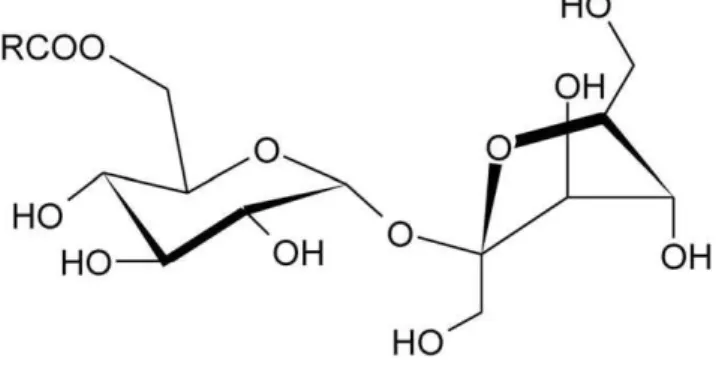
Fig. 1 shows the chemical structure of the different sucrose esters used in these experiments, the nonionic head group corresponds to a sucrose moiety (highly substituted with hydroxyl groups) and the hydrophobic tail is a hydrocarbon chain of increasing length in the series. The series go from 10–18 methylene units. The fluorescent probe employed, Laurdan, has the advantage of having a high partition coefficient into the organic phase, (i.e. low water solubility), and so observed fluorescence arises exclusively from micelles without the interference of the free dye [34]. The results were not influenced by sucrose ester concentration indicating that micelles maintain their aggregation number and shape in the working concentration range. For most amphiphile solutions morphological transformations take place over certain concentra-tion range, and the behavior observed when the sample is constituted by more than one surfactant deserves special attention. The changes in the interactions between components affect the free energy of micellization and hence, aggregation parameters like Naggand size are very different from the ones predicted by an
ideal behavior (even at low compositions). Also changes in the mixed micelle composition have been observed as a function of total surfactant concentration [29,30]. Size and shape of the micelles can also be modified when additives are inserted in the interphase, for example, the incorporation of catechol on CTAB micelles changed head interactions and packing parameters, inducing an increase in the size of the aggregates and the sphere-to-rod morphological change [35].
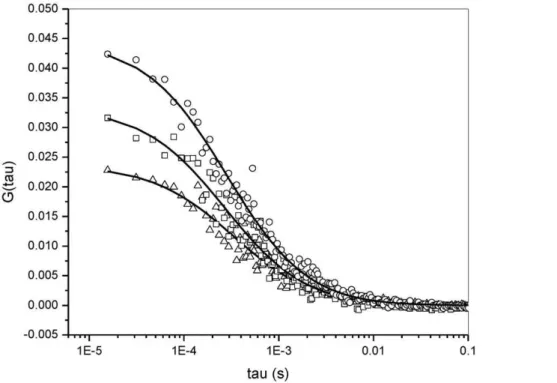
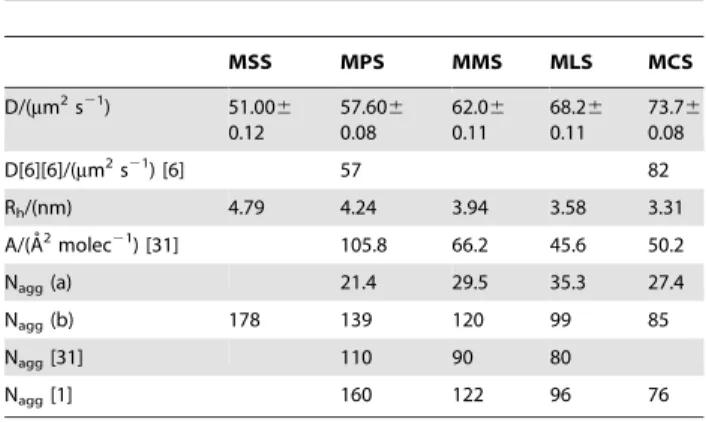
Fig. 2 shows an example of the experimental autocorrelation curves obtained from micelles samples of different sucrose esters loaded with Laurdan 20 nM. In those experiments the surfactant concentration for the different sucrose esters was kept over their corresponding cmc [31]. The diffusion coefficient (D) for the different samples was obtained by fitting of the experimental autocorrelation curves to a Gaussian-Lorentzian model for dif-fusion (see methods) and they are reported in Table 1. The values for the D for the series go from 51.0060.12 (MSS) to 73.760.08 (MCS)mm2/s. Our data are similar to the ones reported for MPS
Figure 1. Chemical structure of studied sucrose monoesters, R = C7H15 Octyl acid derivative (MOS), R = C9H19 Capric acid
derivative (MCS), R = C11H23 Lauric acid derivative (MLS),
R = C13H27Myristic acid derivative (MMS), R = C15H31Palmitic
acid derivative (MPS), R = C17H35Stearic acid derivative (MSS).
and MCS by Molinier et Al. using NMR procedure (see Table 1) [6]. For the set of surfactants studied, the dependence of D with the number of carbon units in the hydrophobic tail (methylene units plus carbonyl) shows a linear correlation (Fig. 3) and consequently there is a linear dependency of the hydrodynamic radius with the length of the alkyl chain (Fig. 3). Linear fit of the Rhdata in Fig. 3 gives a slope equal to 181 pm (in the range of a
C-C bond (154 pm)) and an intercept of 1.44 nm. This last value corresponds to the length of the region occupied by the sucrose moiety plus the structured water, and it is 20–40% overestimated when compared with the reported hydrodynamic diameter for sucrose in water (1.00–1.12 nm) [36]. Our result showing the micelle hydrodynamic radius changing linearly with the length of alkyl chain, can be interpreted as follows: when the chain increases (longer sucrose ester derivative), a new volume is available in the structure and it is occupied by an additional surfactant molecule (increasing the aggregation number and the surface area of micelles). Thus, additional surfactant molecules will fill up the increased surface area maintaining the density of the micelle.
When protein-detergent complexes are to be separated based on the molecular size of the protein, smaller micelles are more easily removed and hence are usually desirable. The parameter evaluated for downstream removal is the micelle molecular weight, directly related with the size of micelle. The micelle molecular weight is simply the product of the aggregation number (Nagg) and the monomer molecular weight. The determination of
the aggregation number Nagg (the average number of detergent
molecules in a micellar unit) is therefore of great significance. A relatively simple method for calculating mean aggregation numbers of surfactant solutions uing fluorescent procedures, requires a hydrophobic probe and a quencher greatly partitioned in the micelle [37]. To calculate Naggfrom diffusional parameters,
Hink et al. [28] used some geometrical considerations (assuming spherical micelles) and Eq 1
Nagg~ 4prr3
N
3m ð1Þ
where r is the mean density of the micelle (g cm23), m is the molecular mass of a surfactant molecule (g mol21) and N is Avogadro’s number. However, this approach yields poor results when compared with traditional static or dynamic fluorescence determinations [37].
Another equivalent approach (method A) to achieve Naggfrom
diffusional data, avoiding the use of density, is the use of the cross-sectional area per molecule of each ester determined by surface tension measurements [31] and the micellar spherical volume from the diffusional data. Table 1 presents the Nagg calculated using
method A. For comparison we have included in the same Table 1 Nagg determined by time resolved and static fluorescence
quenching methods [31] and by X-ray scattering [1]. The values determined using the diffusion parameters are, on the contrary of Hink determinations, between two and four times smaller than the ones previously reported. The origin of this difference is probably in the use of cross-sectional area per molecule obtained from monolayers.
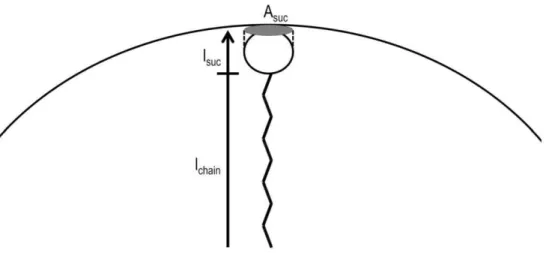
We propose a self-consistent calculation of Nagg (method B)
based on the geometrical assumptions shown in Fig. 4 and using the values obtained by FCS measurements. The micelle hydrodynamic radius, Rh, corresponds to the contribution of
two components: the length of the alkyl chain (lchain) and the
sucrose hydrodynamic diameter (lsuc), obtained from intercept of
plot shown in Fig. 3:
Rh~lsuczlchain ð2Þ
The micelar surface occupied by one polar head can be calculated
Figure 2. Plot showing the autocorrelation functions obtained from the samples of different sucrose esters loaded with Laurdan 20 nM.The symbols show the experimental autocorrelation (#MMLS%MMCSeMPS) and the solid line the fitting of the data using a
Gaussian-Lorentzian model for diffusion. The diffusion coefficient obtained were 38.9, 39.9 and 34.3mm2/s for MMLS, MMCS and MPC respectively.
as the circular projection of sucrose head (supposed spherical). Under these considerations:
Nagg~ Amic Asuc
~ 4pR2
h
p lsuc
2
2 ð3Þ
Replacing Eq 2 on Eq 3 we obtain the aggregation number from:
Nagg~16 1z2 lsuc lchain
z lsuc lchain
2!
ð4Þ
The Naggdetermined for the series of detergents using our method
(method B in Table 1) are in good agreement with the data determined using other experimental methods [1,31], however, the values for lchain obtained using eq 3 are 30% larger than the
values obtained with Tanford equation (lchain= (0.154+0.1256 n)
nm [38]), relationship normally used for lchain calculation in
micellar systems. It will be interesting to test our method with other micellar systems, in fact this method may be also an improved method to measure lchain for specific surfactants, then,
careful comparative studies will be needed to clarify this point. Finally, diffusion coefficient values determined at several ester concentrations, for all the studied compounds show no depen-dence on ester concentration, indicating that micelles do not aggregate and remained as individual entities in the studied range (1–20 mM). At this point it must be stated that the relation of micelar volume with the number of methylene units of hydrophobic tail is polynomial, involving the size of the polar head, so the experimental observation of an apparently linear dependence of diffusion coefficients, probably has its origin in the range of lengths involved in the measurement.
In previous reports FCS technique has been used in combination with other measurements as a useful tool for estimating micelar size and shape, now we can state that when measurements are performed for a series of surfactants, self-consistent results related with micellar size and Nagg can be
achieved with FCS determinations alone. The data analysis we propose (method B) involves a simple and reliable procedure which yields results fully comparable with the ones obtained by other procedures.
Materials and Methods
Chemicals
Sucrose monoesters b-d-fructofuranosyl-6-O-capryl-a -d-gluco-pyranoside (Mono capryl sucrose, C10),b -d-fructofuranosyl-6-O-lauryl-a-d-glucopyranoside (Mono lauryl sucrose, C12), b
-d-Figure 3. Plot showing the dependence of translational diffusion coefficients, D#, and the hydrodynamic radius, Rh
N
, for micelles of alkyl sucrose esters against the length of the alkyl substituent.doi:10.1371/journal.pone.0029278.g003
Table 1.Experimental diffusion coefficients and calculated
values hydrodynamic radius and aggregation numbers for micelles of sucrose 6-O monoesters with different length of alkyl chain.
MSS MPS MMS MLS MCS
D/(mm2s21) 51.00
6
0.12
57.606
0.08
62.06
0.11
68.26
0.11
73.76
0.08
D[6][6]/(mm2s21) [6] 57 82
Rh/(nm) 4.79 4.24 3.94 3.58 3.31
A/(A˚2molec21) [31] 105.8 66.2 45.6 50.2
Nagg(a) 21.4 29.5 35.3 27.4
Nagg(b) 178 139 120 99 85
Nagg[31] 110 90 80
Nagg[1] 160 122 96 76
fructofuranosyl-6-O-miristyl-a-d-glucopyranoside (Mono miristyl sucrose, C14),b-d-fructofuranosyl-6-O-palmityl-a -d-glucopyrano-side (Mono palmityl sucrose, C16) and b -d-fructofuranosyl-6-O-stearyl-a-d-glucopyranoside (Mono stearyl sucrose, C18), were synthesized under Mitsunobu conditions, according the procedure reported by Molinier et al. [13], by using sucrose (Merck) and the corresponding carboxylic acid (from Sigma). The reaction yields a relatively complex mixture of two monoesters (6-O and 6-O’), one diester (6-O, 6-O’) and two monoesters of anhydrosucrose. Semipreparative chromatography on silica and amino modified C18 silica column were employed to isolate the pure 6-O monoesters. Briefly, the reaction mixture was solubilized in chloroform and eluted from a semipreparative silica gel column by using chloroform:methanol mixtures as mobile phase (the proportions were dependent on the specific sucrose monoester isolated). The final purification of the fraction containing monoesters was made in the C18 amino column with acetonitrile:-water mixtures as a mobile phase. Thin layer chromatography (using the first mobile phase and staining with a butanolic solution of urea-orthophosphoric acid) showed mainly one compound in the purified sample. The NMR spectra, obtained in a Bruker ADX 300 spectrometer, in DMSOd-6containing 5% of CH3OD
to avoid micellization, are in good agreement with previously reported spectra for several monoesters [10,39].
6-Dodecanoyl-2-dimethylaminonaphthalene (Laurdan) from Invitrogen was used as received. Fluorescein standard was obtained from Sigma. All solvents employed were from Merck and HPLC quality.
Sample preparation
Surfactant solutions were prepared by weighting the appropri-ate amount of the corresponding sucrose ester, dissolving in wappropri-ater to final concentration around 0.1–20 mmol L21 and sonicating them during at least one hour. After sonication, Laurdan was added from an Stock solution (1.0mmol L21in DMSO) to a final
concentration 10–20 nM and stirred gently for 1 hour at room temperature. With the concentrations of surfactant and dye employed, low mean numbers of occupation are assured.
Fluorescence Correlation Spectroscopy
FCS measurements were performed in a two-photon fluores-cence microscope designed at the Laboratory for Fluoresfluores-cence
Dynamics [40,41]. A mode-locked titanium-sapphire laser (Mira 900, Coherent, Palo Alto, CA) pumped by a frequency-doubled Nd:vanadate laser (Verdi, Coherent) and set to 780 nm was used as the two-photon excitation light source. For all measurements, the average power used at the sample ranged from 10–18 mW. A miniature photomultiplier (R5600-P, Hamamatsu, Bridgewater, NJ) was used for light detection in the photon counting mode and counts were acquired using a ISS card (ISS, Inc., Champaign, IL). Data acquisition was performed using the SimFCS program (Laboratory for Fluorescence Dynamics, UCI, CA). A UPlan Apo/IR 60X/1,20 (Olympus, Japan) water objective was used for all the measurements.
Experimental autocorrelation functions were fitted assuming a Gaussian-Lorentzian intensity profile, as described in a previous work which contains the explicit formulas for the point spread function and the definition of the beam waist used [42]. The beam waist of the Gaussian-Lorentzian function depends on the instrument setup and must be calibrated each time the system is aligned. For this purpose a substance with a known concentration and diffusion coefficient (D) was used to calibrate the excitation volume. In this work, fluorescein (20 nM in Tris, pH.9), with a diffusion constant of 300mm2/s was used as a standard [43]. The recovered beam waist value (W0= 0.35mm) was used to perform
the analysis with each set of data.
From the fitted D values it is possible to calculate the hydrodynamic radius (Rh) of the molecule responsible of the
detected intensity fluctuations using the Stokes-Einstein relation:
Rh~ kT 6pgD
Where, k is the Boltzmann constant, T the temperature, gthe media viscosity (considering the low concentrations employed, solutions viscosity was considered to be equal to the one of water) and finally, D corresponds to the diffusion coefficient of the species in motion.
Author Contributions
Conceived and designed the experiments: GG SAS. Performed the experiments: GG SAS. Analyzed the data: GG SAS. Contributed reagents/materials/analysis tools: GG SAS EG. Wrote the paper: GG SAS ALZ EL EG.
Figure 4. Scheme showing the geometrical considerations to obtain aggregation numbers of micelles from FCS data.Open circle represent the sucrose moiety and the zig-zag tail a carbon tail.
References
1. Kawaguchi T, Hamanaka T, Kito Y, Machida H (1991) Structural Studies of a Homologous Series of Alkyl Sucrose Ester Micelle by X-Ray-Scattering. Journal of Physical Chemistry 95: 3837–3846.
2. Hill K, Rhode O (1999) Sugar-based surfactants for consumer products and technical applications. Fett-Lipid 101: 25–33.
3. Garofalakis G, Murray BS, Sarney DB (2000) Surface Activity and Critical Aggregation Concentration of Pure Sugar Esters with Different Sugar Head-groups. Journal of Colloid and Interface Science 229: 391–398.
4. Soultani S, Ognier S, Engasser JM, Ghoul M (2003) Comparative study of some surface active properties of fructose esters and commercial sucrose esters. Colloids and Surfaces A: Physicochem Eng Aspects 227: 35–44.
5. Youan BBC, Hussain A, Nguyen NT (2003) Evaluation of sucrose esters as alternative surfactants in microencapsulation of proteins by the solvent evaporation method. AAPS PharmSci 5: article 22.
6. Molinier V, Fenet B, Fitremann J, Bouchu A, Queneau Y (2005) PFGSE-NMR study of the self-diffusion of sucrose fatty acid monoesters in water. Journal of Colloid and Interface Science 286: 360–368.
7. Ferrer M, Comelles F, Plou FJ, Cruces MA, Fuentes G, et al. (2002) Comparative surface activities of di- and trisaccharide fatty acid esters. Langmuir 18: 667–673.
8. Baker IJA, Matthews B, Suares H, Krodkiewska I, Furlong DN, et al. (2000) Sugar fatty acid ester surfactants: Structure and ultimate aerobic biodegrad-ability. Journal of Surfactants and Detergents 3: 1–11.
9. Garcia MT, Ribosa I, Campos E, Leal JS (1997) Ecological properties of alkylglucosides. Chemosphere 35: 545–556.
10. Vlahov IR, Vlahova PI, Lindhart RJ (1997) Regioselective synthesis of sucrose monoesters as surfactants. Journal of Carbohydrate Chemistry 16: 1–10. 11. Johansson I, Svensson M (2001) Surfactants based on fatty acids and other
natural hydrophobes. Current Opinion in Colloid & Interface Science 6: 178–188.
12. Pedersen NRl, Wimmer R, Matthiesen R, Pedersen LH, Gessesse A (2003) Synthesis of sucrose laurate using a new alkaline protease. Tetrahedron Asym 14: 667–673.
13. Molinier V, Fitremann J, Bouchu A, Queneau Y (2004) Sucrose esterification under Mitsunobu conditions: evidence for the formation of 6-O-acyl-39,69 -anhydrosucrose besides mono and diesters of fatty acids. Tetrahedron Asym 15: 1753–1762.
14. Ahsan F, Arnold JJ, Meezan E, Pillion DJ (2003) Sucrose cocoate, a component of cosmetic preparations,enhances nasal and ocular peptide absorption. International Journal of Pharmaceutics 251: 195–203.
15. Noritomi H, Ito S, Kojima N, Kato S, Nagahama K (2006) Forward and backward extractions of cytochrome c using reverse micellar system of sucrose fatty acid ester. Colloids and Polymer Science 284: 604–610.
16. Noritomi H, Kowata H, Kojima N, Kato S, Nagahama K (2006) Application of sucrose fatty acid ester to reverse micellar extraction of lysozyme. Colloids and Polymer Science 284: 677–682.
17. Noritomi H, Kojima N, Kato S, Nagahama K (2006) How can temperature affect reverse micellar extraction using sucrose fatty acid ester? Colloids and Polymer Science 284: 683–687.
18. Lipfert J, Columbus L, Chu VB, Lesley SA, Doniach S (2007) Size and Shape of Detergent Micelles Determined by Small-Angle X-ray Scattering. Journal of Physical Chemistry B 111: 12427–12438.
19. Ying JY, Mehnert CP, Wong MS (1999) Synthesis and applications of supramolecular-templated mesoporous materials. Angewandte Chemie-Interna-tional Edition 38: 56–77.
20. Ghosh S (2011) Comparative studies on brij reverse micelles prepared in benzene/surfactant/ethylammonium nitrate systems: Effect of head group size and polarity of the hydrocarbon chain. Journal of Colloid and Interface Science 360: 672–680.
21. Meng XX, Russel WB (2005) Structure and size of spherical micelles of telechelic polymers. Macromolecules 38: 593–600.
22. Gapinski J, Szymanski J, Wilk A, Kohlbrecher J, Patkowski A, et al. (2010) Size and Shape of Micelles Studied by Means of SANS, PCS, and FCS. Langmuir 26: 9304–9314.
23. Alargova RG, Kochijashky II, Sierra ML, Zana R (1998) Micelle Aggregation Numbers of Surfactants in Aqueous Solutions: A Comparison between Results
from Steady-State and Time-Resolved Fluorescence Quenching. Langmuir 14: 5412–5418.
24. Hohner A, Bayer J, Radler JO (2006) Wormlike lipid/DNA micelles in a non-polar solvent. European Physical Journal E 21: 41–48.
25. Yu LL, Tan MY, Ho B, Ding JL, Wohland T (2006) Determination of critical micelle concentrations and aggregation numbers by fluorescence correlation spectroscopy: Aggregation of a lipopolysaccharide. Analytica Chimica Acta 556: 216–225.
26. Schuch H, Klingler J, Rossmanith P, Frechen T, Gerst M, et al. (2000) Characterization of micelles of polyisobutylene-block-poly(methacrylic acid) in aqueous medium. Macromolecules 33: 1734–1740.
27. Luschtinetz F, Dosche C (2009) Determination of micelle diffusion coefficients with fluorescence correlation spectroscopy (FCS). Journal of Colloid and Interface Science 338: 312–315.
28. Hink MA, Visser AJWG (1999) Characterization of Membrane Mimetic Systems with Fluorescence. In: Rettig W, ed. Applied Fluorescence in Chemistry, Biology and Medicine. Berlin: Springer Verlag. pp 101–108. 29. Hierrezuelo JM, Aguiar J, Ruiz CC (2004) Stability, interaction, size, and
microenvironmental properties of mixed micelles of decanoyl-N-methylgluca-mide and sodium dodecyl sulfate. Langmuir 20: 10419–10426.
30. Miraglia DB, Schulz EN, Rodriguez JLM, Schulz PC, Salinas D (2011) Effect of the concentration and composition on the size and shape of micelles of sodium oleate-cetyltrimethylammonium bromide mixtures. Journal of Colloid and Interface Science 351: 197–202.
31. Becerra N, Toro C, Zanocco AL, Lemp E, Gu¨nther G (2008) Characterization of micelles formed by sucrose 6-O-monoesters. Colloids and Surfaces A: Physicochemical and Engineering Aspects 327: 134–139.
32. Becerra N, de la Nuez LR, Zanocco AL, Lemp E, Gunther G (2006) Solubilization of dodac small unilamellar vesicles by sucrose esters - A fluorescence study. Colloids and Surfaces a-Physicochemical and Engineering Aspects 272: 2–7.
33. Berrios E, Zanocco AL, Lemp E, Gunther G (2008) Solubilization of DPPC Small Unilamellar Liposomes by Sucrose Esters. A Fluorescence Study. Journal of the Chilean Chemical Society 53: 1728–1731.
34. Sanchez SA, Chen Y, Muller JD, Gratton E, Hazlett TL (2001) Solution and interface aggregation states of Crotalus atrox venom phospholipase A(2) by two-photon excitation fluorescence correlation spectroscopy. Biochemistry 40: 6903–6911.
35. Meng J, Lu Y, Li L, Wu HJ, Zhang X (2009) Effect of Catechol on the Size and Shape of CTAB Micelles in Aqueous Solutions. Zeitschrift Fur Physikalische Chemie-International Journal of Research in Physical Chemistry & Chemical Physics 223: 689–699.
36. Schultz SG, Solomon AK (1961) Determination of the Effective Hydrodynamic Radii of Small Molecules by Viscometry. The Journal of General Physiology 44: 1189–1199.
37. Alargova R, Kochijashky I, Zana R (1998) Fluorescence study of the aggregation behavior of different surfactants in aqueous solutions in the presence and in the absence of gas. Langmuir 14: 1575–1579.
38. Tanford C (1972) Micelle shape and size. Journal of Physical Chemistry 76: 3020–3024.
39. Thevenet S, Wernicke A, Belniak S, Descotes G, Bouchu A, et al. (1999) Esterification of unprotected sucrose with acid chlorides in aqueous medium: kinetic reactivity versus acyl- or alkyloxycarbonyl-group migrations. Carbohy-drate Research 318: 52–66.
40. So PTC, French T, Yu WM, Berland KM, Dong CY, et al. (1995) Time resolved fluorescence microscopy using two-photon excitation. Bioimaging 3: 49–63.
41. So PTC, French T, Yu WM, Berland KM, Dong CY, et al. (1996) Two-photon fluorescence microscopy: time-resolved andintensity imaging. In Fluorescence Imaging Spectroscopy and Microscopy XF. Wang, B. Herman, eds. New York: John Wiley & Sons. pp 351–374.
42. Berland KM, So PTC, Gratton E (1995) Two-Photon fluorescence correlation spectroscopy: method and applications to the intracellular environment. Biophysical Journal 68: 694–701.