www.atmos-chem-phys.net/12/4117/2012/ doi:10.5194/acp-12-4117-2012
© Author(s) 2012. CC Attribution 3.0 License.
Chemistry
and Physics
Atmospheric sulphuric acid and neutral cluster
measurements using CI-APi-TOF
T. Jokinen1, M. Sipil¨a1, H. Junninen1, M. Ehn2, G. L¨onn1, J. Hakala1, T. Pet¨aj¨a1, R. L. Mauldin III1,3, M. Kulmala1, and D. R. Worsnop1,4,5,6
1Department of Physics, P.O. Box 64, 00014, University of Helsinki, Finland 2Institute for Energy and Climate Research, Forschungszentrum J¨ulich, Germany
3Institute for Arctic and Alpine Research, University of Colorado, Boulder, CO 80309, USA 4University of Eastern Finland, P.O. Box 1627, 70211 Kuopio, Finland
5Finnish Meteorological Institute, 00880 Helsinki, Finland 6Aerodyne Research Inc., Billerica, MA 01821, USA
Correspondence to:T. Jokinen ([email protected])
Received: 20 October 2011 – Published in Atmos. Chem. Phys. Discuss.: 6 December 2011 Revised: 17 April 2012 – Accepted: 23 April 2012 – Published: 9 May 2012
Abstract.The first ambient measurements using nitrate ion based Chemical Ionization with the Atmospheric Pressure interface Time-Of-Flight mass spectrometer (CI-APi-TOF) for sulphuric acid and neutral cluster detection are pre-sented. We have found CI-APi-TOF a highly stable and sen-sitive tool for molecular sulphuric acid detection. The low-est limit of detection for sulphuric acid was determined to be 3.6×10⁴molecules cm−3 for 15 min averaging. Signals
from sulphuric acid clusters up to tetramer containing am-monia were also obtained but these were found to result from naturally charged clusters formed by ion induced clustering in the atmosphere during nucleation. Opposite to earlier stud-ies with cluster mass spectrometers, we had no indication of neutral clusters. The reason is either less efficient charging of clusters in comparison to molecular sulphuric acid, or the low concentration of neutral clusters at our measurement site dur-ing these particular nucleation events. We show that utilizdur-ing high resolution mass spectrometry is crucial in separating the weak sulfuric acid cluster signal from other compounds.
1 Introduction
Nucleation of new particles is one of the main sources of cloud condensation nuclei in the Earth’s atmosphere con-tributing up to∼50 % to the global CCN budget (Merikanto et al., 2010). With the exception of certain coastal areas
(O’Dowd et al., 2002), the initial steps of nucleation require the presence of sulphuric acid (Paasonen et al., 2010; Sipil¨a et al., 2010; Zhao et al., 2010). Sulphuric acid (H2SO4),
how-ever, does not nucleate itself under typical atmospheric con-ditions, requiring additional vapours. Based on recent labo-ratory experiments (Kirkby et al., 2011), at ambient H2SO4
4118 T. Jokinen et al.: Measurements using CI-APi-TOF
to the presence of sulphuric acid (e.g. Paasonen et al., 2010 and Weber et al., 1996). Suggested mechanisms of nucleation include both neutral and ion assisted pathways. Kulmala et al. (2007) suggested nucleation processes to be initiated by activation of neutral clusters while modelling studies by Yu and Turco (2008, 2011) suggest that ions play a crucial role in boreal forest nucleation. Recent studies by Manninen et al. (2009) and Kulmala et al. (2010) find neutral nucleation dominant in the atmosphere, while laboratory experiments by Sipil¨a et al. (2010) support the conclusion that neutral nu-cleation involving sulphuric acid can proceed fast enough to account for atmospheric observations. On the other hand, the experiments by Pet¨aj¨a et al. (2011) and Kirkby et al. (2011) demonstrated that besides sulphuric acid, ternary vapours are required. Kirkby et al. (2011) also confirmed the existence of a physical nucleation mechanism involving ions. That exper-iment was, however, performed under conditions not repre-sentative of the boreal forest boundary layer. Recent progress in mass spectrometry has made direct measurements of ion induced nucleation possible (Ehn et al., 2010; Junninen et al., 2010; Kirkby et al., 2011). With our new instrument, the CI-APi-TOF, we aim to investigate the initial steps of neutral nucleation and elucidate the role of sulphuric acid, ions and stabilizing compounds in atmospheric aerosol nucleation.
The problem in understanding the molecular steps control-ling neutral nucleation is that, while the detection of neutral clusters is made possible by the recent development of con-densation particle counting technology (Kulmala et al., 2007; Sipil¨a et al., 2008; Iida et al., 2009; Vanhanen et al., 2011), the measurement of their chemical composition is extremely difficult. For a mass spectrometer, the neutral cluster needs to be charged and that charging process initiates several prob-lems. First, typical ion sources generate a vast amount of ions and ion clusters from atmospheric trace gases (Asmi et al., 2009). These artificially generated ion clusters obscure the signal from ambient neutral clusters charged upon colli-sions with the charger ions, thereby hindering their identifi-cation. This problem can be partially solved by utilizing the highly selective chemical ionization technique (Eisele and Hanson, 2000; Hanson and Eisele, 2002; Hanson and Love-joy, 2006; Zhao et al., 2010; Jiang et al., 2011; Pet¨aj¨a et al., 2011). This is also the approach used in the present study. A problem associated with selective ionization is that the pro-ton affinity of a neutral cluster, composed of sulphuric acid and stabilizing compounds, can be very different from that of a pure sulphuric acid molecule. Therefore those clusters do not necessarily charge exchange upon collision with charger ions (Kurt´en et al., 2011). Nevertheless, if a cluster becomes charged, its stability may change and it can lose, depend-ing on its size, partially or completely it’s binary or ternary constituents. In experiments by Junninen et al. (2010) and Kirkby et al. (2011) it was found that negatively charged clusters containing less than three molecules of sulphuric acid associated with the bisulphate ion (HSO−4)did not ac-commodate any other species while clusters containing more
than four sulphuric acid molecules always contained base molecules at lower tropospheric temperatures. Therefore, di-rect measurement of the true molecular composition of neu-tral clusters is not possible by means of chemical ionization as some information will be lost upon charging. Neverthe-less, such measurements can still yield significant new infor-mation on the mechanics of nucleation in the atmosphere.
Imbued with the first successful field measurements by Zhao et al. (2010) and Jiang et al. (2011) who were able to detect up to tetramer clusters of sulphuric acid during nu-cleation events, we constructed a Chemical Ionization (CI) source and combined it with an Atmospheric Pressure inter-face Time-Of-Flight mass spectrometer (APi-TOF, Tofwerk AG, Thun, Switzerland and Aerodyne Research Inc., USA). The aim of this study was to apply this instrument, the CI-APi-TOF, to measure molecular sulphuric acid as well as sul-phuric acid containing clusters in ambient air at the Hyyti¨al¨a boreal forest field site, in southern Finland.
2 Methods
2.1 Instrumentation
The CI-APi-TOF instrument consists of three main compo-nents. These components are
1. a specially designed inlet for chemical ionization at the ambient pressure (CI),
2. an atmospheric pressure interface (APi) and 3. a time-of-flight mass spectrometer (TOF).
The APi-TOF is well described elsewhere (Junninen et al., 2010). The design of the CI-inlet is similar to one described by Eisele and Tanner (1993), and by Kurt´en et al. (2011). The sample is drawn in though a 3/4′′ stainless steel tube with a flow rate of 10 lpm. Nitrate ions are created by expos-ing clean air containexpos-ing nitric acid (20 lpm) to alpha radiation from 10 MBq241Am source. This sheath flow is then intro-duced in an ion reaction tube concentric to the sample flow. Nitrate ions in the sheath flow are directed into the sample flow by means of an electric field. The interaction time be-tween ions and sample gas is approximately 200 ms.
Ionization in the CI-system occurs at ambient pressure via proton transfer between nitrate ions or its cluster with nitric acid (NO−3 ·(HNO3)n)and sulphuric acid (H2SO4)
produc-ing bisulphate ion – nitric acid clusters (HSO−4 ·HNO3)and
neutral nitric acid ((HNO3)n): H2SO4+NO−3 ·(HNO3)n,n=0−2
→HSO−4 ·HNO3+(HNO3)n,n=0−2 (R1)
T. Jokinen et al.: Measurements using CI-APi-TOF 4119
sta dard ali ratio oeffi ie t C= ∙
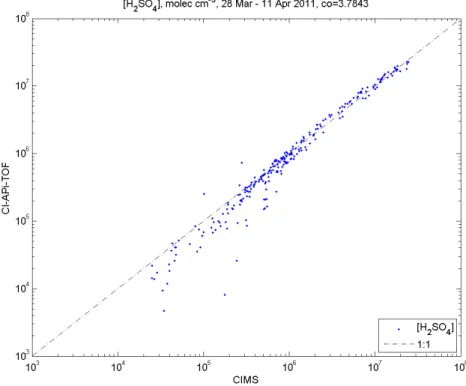
Fig. 1.Correlation between sulphuric acid concentrations measured with the CI-APi-TOF (using a standard calibration coefficientC= 5×10⁹, Mauldin III et al., 1999) and calibrated CIMS from 28 March to 11 April 2011. Data sets are 60 min averages. The CI-APi-TOF data have been multiplied by the average ratio between the two data sets, 3.78. This factor includes diffusion losses in the CI-APi-TOF sample line, and is used when converting the CI-APi-TOF signals to concentrations.
then guided through the differentially pumped APi and fur-ther to the TOF for separation according to theirm/z. The final pressure inside the TOF is typically 10−6mbar.
Clusters in Reaction (R1) partially decompose in the vac-uum of the APi-TOF. The sulphuric acid concentration (in molec cm−3) measured with the CI-APi-TOF is calculated from the measured ion signals according to:
[H2SO4] =
HSO−4 +HSO−4 ·HNO3
NO−3 +HNO3·NO−3 +HNO3·(HNO3)NO−3
·C, (1) whereCis the calibration coefficient. Unfortunately, the cur-rent system has not been directly calibrated, however the cal-ibration coefficient of 5×10⁹molec cm−3 determined for a CI-source similar to the present one (Mauldin III et al., 1999) was applied at the first stage of the data conversion. We also performed an indirect calibration by running our instru-ment next to a calibrated CIMS in Hyyti¨al¨a for ca. 2 weeks (Fig. 1). From this inter-comparison an additional factor of 3.78 was obtained yielding a final calibration coefficient of C=1.89×10¹⁰molec cm−3. As the inter-comparison was performed with CI-APi-TOF having a 60 cm long 3/4′′ sam-ple tube in front of it, the diffusion losses in the samsam-ple tube are absorbed in the final calibration coefficient.
The sensitivity of the instrument was also studied. The CI-APi-TOF provides a high signal-to-noise ratio and therefore
it can achieve very low detection limits. Most of the back-ground originates from electronic noise but a minor con-tribution can result from heavier particles with high m/z (>3000 Th) having longer time-of-flight than the recipro-cal of the pulsing frequency (12 000 Hz). The limit of de-tection (LOD) for sulfuric acid monomer measured with the CI-APi-TOF is 3.60×10⁴molec cm−3 (15 min integration) and it is defined as three times the standard deviation of the background. This LOD is equivalent to that of earlier CIMS instruments. As this value incorporates the diffusion losses in the sample tube, the loss corrected LOD is closer to 2×10⁴molec cm−3.
2.2 Field site
The measurements presented here were carried out at Hyyti¨al¨a Forestry Field Station (SMEAR II) located in Juu-pajoki, Southern Finland during HydeSpring2011 field cam-paign. Both neutral cluster and naturally charged sulphuric acid measurements were conducted simultaneously between 14 March and 11 April 2011.
2.3 Experimental setup and ambient measurements
4120 T. Jokinen et al.: Measurements using CI-APi-TOF
clusters. The second APi-TOF at the site was set up to mea-sure naturally charged ambient molecules and clusters with-out the use of any ionizing method. In the atmosphere, cos-mic radiation and radioactive decay produce primary ions such as N+2, O+2, O−2 and H3O+which subsequently collide
with trace gases resulting in charge transfer reactions. Charge will cascade in a series of collisions towards lowest proton affinities (negative ions). In atmosphere this charge transfer process effectively stops at the bisulphate ion (HSO−4). Bisul-phate ions immediately form clusters with H2SO4. Clusters
containing three or more sulphuric acid molecules associ-ated with the bisulphate ion can also contain e.g. ammonia or amines (Ehn et al., 2010; Kirkby et al., 2011). As natu-rally charged ions and ion clusters are also sampled with the CI-APi-TOF, measurements from the normal APi-TOF op-erating in parallel provide information on the contribution of these naturally charged ions to the signals measured with the CI-APi-TOF. In addition, to quantifying the effect of nat-urally charged ions, the CI-APi-TOF was operated without the 241Am source installed for a few days and the spectra between the two instruments were compared. Introduction of nitrate ions should not affect the penetration of naturally charged ions.
Aerosol size distributions were measured with a Differen-tial Mobility Particle Sizer (DMPS). The system (Aalto et al., 2001) measures particles from 3 nm to about 950 nm in diameter. The aerosol size distribution was used to classify the days in terms of new particle formation.
2.4 Data analysis
Data analysis was performed using Matlab (version 7.10.0.499, R2010a) based program tofTools (Junninen et al., 2010). Before mass calibration signals were averaged over 60 min. Mass calibration was performed using three known masses that are always dominant in the spectrum, nitrate ion (or its isotope) and it’s dimer and trimer (NO−3, HNO3·NO−3, (HNO3)2·NO−3). The resolving power is
ap-proximately 3600 Th Th−1for over 45 Th and in lower
mass-to-charge ratios it is slightly lower for ideal peak fitting.
3 Results and discussion
3.1 Peak identification
The CI-APi-TOF signals are identified by defining the ex-act mass of the compounds of interest and their possible iso-topic patterns. The advantage of the CI-APi-TOF is that even at extremely low sulphuric acid cluster concentrations, the high resolution makes it possible to separate the cluster sig-nal from other closely located peaks. This means the cluster signal can be reliably separated from residual peaks possibly overlapping the original cluster signal, giving more accurate
information of the existence and concentrations of clusters in the atmosphere.
The high resolution spectrum for deprotonated sul-phuric acid monomer HSO−4, dimer H2SO4·HSO−4, trimer
(H2SO4)2·HSO−4, and tetramer (H2SO4)3·HSO−4 measured
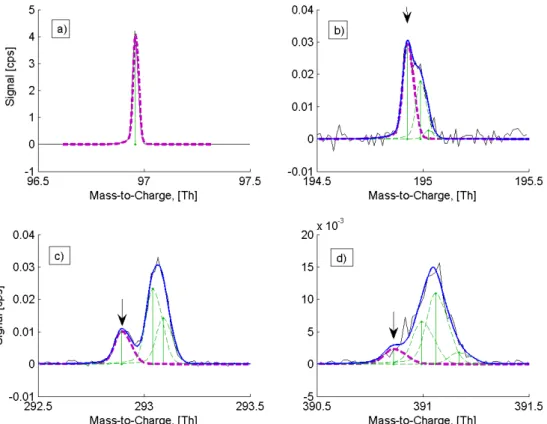
with the CI-APi-TOF on 30 March 2011 at 10:00 a.m. is presented in Fig. 2. The most abundant signal is sul-phuric acid monomer at 96.9601 Th, followed by the dimer (194.9275 Th), trimer (292.8949 Th) and tetramer (390.8622 Th), respectively. At integerm/z 97 Th only the monomear signal is detected with no interfering compounds. The sulphuric acid dimer is the dominant ion present at in-tegerm/z195 Th, but almost half of the signal consists of other compounds partly extending over the dimer signal. In case of the trimer and the tetramer these other compounds are already predominant. Sulphuric acid trimer can still be dependably separated but in case of the tetramer longer inte-gration time (>2 h) is needed to reliably separate it from the interfering signals.
Identification of the compounds overlapping the cluster signals of interest is challenging but we are able to narrow down a group of possible candidates with certain elemen-tal compositions. Fluorinated compounds are one possibil-ity that may originate from the PTFE-tubing used to carry sheath flow to the inlet. An example of this is the contaminant peak atm/z195 Th. This peak has no diurnal cycle (Fig. 3) and it has the same exact mass than a fluorinated compound C4HF6O−2, (possibly hexafluorobutanoate). When moving to
higher m/z’s the number of possible combinations of ele-mental compositions increases rapidly. At 293 Th, potential elemental compositions for the largest peak are for exam-ple C6H8F7O−5, C9H7O4F−6 or C8H9O10N−2. This peak has
a strong diurnal cycle (Fig. 3) and therefore the signal more likely originates from atmosphere (C8H9O10N−2)rather than
the instrument’s surfaces that are kept at constant tempera-ture. For the peaks at 391 Th there are already dozens of pos-sibilities, from simple carbohydrates to complicated fluori-nated or nitrogen containing compounds, within±0.001 Th.
3.2 Neutral cluster concentration
As an example of neutral sulphuric acid and sulphuric acid cluster concentrations we chose two strong new particle for-mation event days observed on 29 and 30 March 2011. Since sulphuric acid is mainly produced photochemically, a distinct diurnal pattern is apparent with maximum measured values reaching up to 7×10⁶molec cm−3. We measured naturally
charged sulphuric acid using a second APi-TOF without any additional ionization method for comparison with the CI-APi-TOF neutral cluster measurements. The DMPS instru-ment was used to measure particle size distribution to detect new particle formation.
Fig. 2.Peak fitting for sulphuric acid monomer(a), dimer(b), trimer(c)and tetramer(d)clusters at integer mass 97 Th, 195 Th, 293 Th and 391 Th on 30 March 2011 at 10:00 a.m. measured with the CI-APi-TOF. The dashed purple lines correspond to the sulphuric acid signals. Isotopic patterns are not provided in the figure but were used to confirm accurate peak identification in addition to the exact masses. Signals are averaged over 120 min.
compared with naturally charged ion spectra measured on 29 and 30 March. Figure 3 presents results when only in-teger mass resolution data considered (green), the total sig-nal intensity of identified sulphuric acid clusters (blue) and the contribution of naturally charged ions to the total signal (red). Also the signal from the main interfering compound at the integer mass is presented (black). When only one single peak is present, as in the case of sulphuric acid monomer, in-teger mass data could be used for determination of concentra-tions. But as seen in Fig. 2, the impact of non-sulphuric com-pounds overlapping nearly all cluster signalsis major. Indeed, reliable separation of the ammonia containing sulphuric acid tetramer (integerm/z408 Th) was rarely possible. However, though the signals from 408 Th should be taken with a grain of salt, they are presented to illustrate a clear ion signal was observed with the APi-TOF. Using integer mass data only (Fig. 3), one could say that neutral sulphuric acid clusters are present at all times since the CI-APi-TOF cluster signal ex-ceeds the signal estimated to originate from naturally charged ions. The presence of neutral clusters becomes highly unclear when peak fitting is done using the exact mass and the cluster signal has been separated from overlapping peaks.
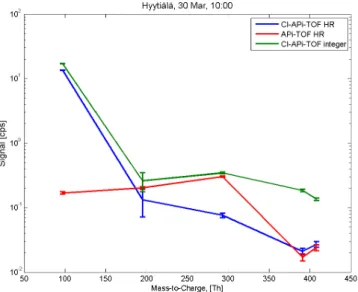
Figure 4 demonstrates this effect even further by present-ing sulphuric acid cluster signals in the beginnpresent-ing of the
event on 30 March at 10:00 a.m. when all cluster signals were clearly visible. The figure shows that the only neutral com-pound that becomes charged using NO−3 as the reagent ion is the sulphuric acid monomer which produces a clearly larger signal than the corresponding natural ion signal. Neutral sul-phuric acid clusters do not produce strong enough signals to be separable from the signals from naturally charged clus-ters. In all cases the expected ion contribution to the signal is, within measurement accuracy, equal to the signal from the CI-APi-TOF.
These data are contradictory to the results presented by Zhao et al. (2010) and Jiang et al. (2011) who reported ob-servations of neutral sulphuric acid clusters during nucle-ation up to the tetramer with concentrnucle-ations ranging around 104cm−3. One reason for the disagreement could be that in our casethe signal from naturally charged ions, if converted to concentration (assuming the same calibration coefficient as for monomer) would be around 5×104cm−3for both the dimer and trimer. For the tetramer and its cluster with ammo-nia, the concentration would be in the sub-104cm−3range. If
4122 T. Jokinen et al.: Measurements using CI-APi-TOF
Fig. 3.Particle and ion concentrations (cm−3)measured at Hyyti¨al¨a site on 29 and 30 March 2011. Particle size distribution measured with DMPS is shown in the upper left. Other pictures correspond to sulphuric acid monomer (97 Th), dimer (195 Th), trimer (293 Th), tetramer (391 Th) and ammonia-tetramer (408 Th). In case of ammonia-tetramer, the overlapping peaks were such numerous that the reliability of the determination of the signal is most of the time questionable. The blue lines represent neutral sulphuric acid measurements using the CI-APi-TOF. The red lines represent naturally charged sulphuric acid measurements using the APi-TOF without accessory ionizing method. The green lines represent the integer mass measured with the CI-APi-TOF that includes both the sulphuric acid and the overlapping compound signals. The black lines represent the signal originating from the strongest overlapping signal at the same integer mass. Most of the CI-APi-TOF signal can clearly be explained by the sampled naturally charged ions.
Our results cannot be explained by the findings of Pet¨aj¨a et al. (2011) either who, as a result of a laboratory exper-iments, reported close to collision limit formation of sul-phuric acid dimers. To explain that observation they sug-gested that a stabilizing compound X with binding properties similar to dimethyl amine and a concentration on the order
of 107–108molec cm−3 needs to be present in the system.
Fig. 4.Total sulphuric acid and cluster high resolution (HR) signals (blue, CI-APi-TOF HR), the contribution of naturally charged ions to the total signal (red, APi-TOF) and CI-APi-TOF integer mass sig-nals (green, CI-APi-TOF integer) are present in this figure. Mass-to-charge ratios in the picture correspond to sulphuric acid monomer (97 Th), dimer (195 Th), trimer (293 Th), tetramer (391 Th) and sul-phuric acid tetramer-ammonia cluster (408 Th). Error is calculated using counting statistics. It should be noted that the tetramer CI-APi-TOF values represent an upper limit due to overlapping signals (see text and Fig. 2). Neutral sulphuric acid monomer is the only compound to clearly being charged in the CI-APi-TOF.
monomer concentration reaches 7×10⁶molec cm−3 both days. The coagulation sink (CoagS) for sulphuric acid dimers (calculated from DMPS data with RH-correction and as-suming 1.2 nm mobility diameter, Ku and Fernandez de la Mora, 2009) during the times of maximum sulphuric acid concentrations on 29 and 30 March is 1.5×10⁻³s−1 and
0.9×10⁻³s−1, respectively, assuming that the evaporation
rate of dimers is negligible (Pet¨aj¨a et al., 2011) and that, be-sides coagulation, the second sink for dimers is the collision limited growth to trimers. In a steady state the production of dimers equals the loss:
k11· [monomer]2=CoagS· [dimer] +k21· [dimer] · [monomer] (2)
Using collision rates of k11=3.34×10⁻¹⁰cm3s−1 and
k21=3.69×10⁻¹⁰cm3s−1for dimer and trimer formation
would result in dimer concentration on the order of 4– 5×106cm−3which is significantly higher than one could
es-timate from the data. This discrepancy indicates that though a laboratory system can be saturated with respect to stabi-lizing compounds leading to near zero evaporation rate of dimers, Hyyti¨al¨a air is not necessarily and thus the varia-tion in observed nucleavaria-tion rates can partly also result from changing concentrations of ternary species. Other possibili-ties could be that in the ambient atmosphere the oxidized
or-ganics rapidly condense on dimers forming compounds that cannot be detected using the present technique.
4 Conclusions
We have constructed a nitrate ion based Chemical Ioniza-tion Atmospheric Pressure interface Time-Of-Flight mass spectrometer (CI-APi-TOF) and presented ambient measure-ments of neutral sulphuric acid and its clusters from the at-mosphere. We found the CI-APi-TOF a reliable and highly sensitive tool for measurements of low concentrations of atmospheric molecular sulphuric acid. We also measured signals from clusters containing sulphuric acid up to the tetramer with a fraction of tetramers containing one molecule of ammonia. All of the observed cluster peaks were associ-ated with one or more peaks at the same integer mass, and therefore the high mass resolution of the APi-TOF was cru-cial in the separation of the cluster signal from unknown con-stituents. Furthermore, most of the observed masses followed a similar diurnal cycle as sulphuric acid, possibly indicating photochemical production pathways. Therefore diurnal be-haviour alone could not have been used straightforwardly for concluding the chemical composition and further informa-tion is required.
4124 T. Jokinen et al.: Measurements using CI-APi-TOF
neutrals is obviously somewhat larger. In future studies the sensitivity of the system will be increased by incorporating an ion filter in front of the instrument to remove the influence of ion clusters.
In terms of sensitivity the performance of our system is comparable to that of Zhao et al. (2010) and Jiang et al. (2011), as well as the system of Pet¨aj¨a et al. (2011) but the results are contradictory. The reason for this discrepancy is not clear, but certainly the measurement site and environ-mental parameters as well as the mass spectrometer differed between the experiments. As no reliable signal from neutral sulphuric acid dimers was obtained, it is plausible that, un-like many laboratory systems, atmospheric air is not satu-rated with respect to stabilizing compounds. This observa-tion will hopefully boost future work on elucidating these stabilizing compounds.
Acknowledgements. Jenni Kontkanen is acknowledged for cal-culating the coagulation sink and Pauli Paasonen for useful discussions. Mikhail Paramonov, Jonathan Duplissy, Siegfried Schobesberger, Alessandro Franchin, Katrianne Lehtipalo, Hanna Manninen, Pasi Aalto, Silja H¨akkinen, St´ephanie Gagn´e, Mikko
¨
Aij¨al¨a, Juha Kangasluoma, Emma J¨arvinen, Erik Herrmann and the personnel of the Hyyti¨al¨a forestry field station are acknowledged for help during field measurements. This work was partially funded by Academy of Finland (1251427, 1139656, Finnish centre of ex-cellence 1141135) and European Research Council (ATMNUCLE).
Edited by: F. Yu
References
Aalto, P., H¨ameri, K., Becker, E., Weber, R., Salm, J., M¨akel¨a, J., Hoell, C., O’Dowd, C., Karlsson, H., Hansson, H.-C., V¨akev¨a, M., Koponen, I. K., Busorius, G., and Kulmala, M.: Physical characterization of aerosol particles during nucleation events, Tellus B, 53B, 344–358, 2001.
Asmi, E., Sipil¨a, M., Manninen, H. E., Vanhanen, J., Lehtipalo, K., Gagn´e, S., Neitola, K., Mirme, A., Mirme, S., Tamm, E., Uin, J., Komsaare, K., Attoui, M., and Kulmala, M.: Results of the first air ion spectrometer calibration and intercomparison workshop, Atmos. Chem. Phys., 9, 141–154, doi:10.5194/acp-9-141-2009, 2009.
Benson, D. R., Yu, J. H., Markovich, A., and Lee, S.-H.: Ternary homogeneous nucleation of H2SO4, NH3, and H2O under
con-ditions relevant to the lower troposphere, Atmos. Chem. Phys., 11, 4755–4766, doi:10.5194/acp-11-4755-2011, 2011.
Berndt, T., Stratmann, F., Sipil¨a, M., Vanhanen, J., Pet¨aj¨a, T., Mikkil¨a, J., Gr¨uner, A., Spindler, G., Lee Mauldin III, R., Cur-tius, J., Kulmala, M., and Heintzenberg, J.: Laboratory study on new particle formation from the reaction OH + SO2: influence
of experimental conditions, H2O vapour, NH3 and the amine
tert-butylamine on the overall process, Atmos. Chem. Phys., 10, 7101–7116, doi:10.5194/acp-10-7101-2010, 2010.
Ehn, M., Junninen, H., Pet¨aj¨a, T., Kurt´en, T., Kerminen, V.-M., Schobesberger, S., Manninen, H. E., Ortega, I. K., Vehkam¨aki,
H., Kulmala, M., and Worsnop, D. R.: Composition and tempo-ral behavior of ambient ions in the boreal forest, Atmos. Chem. Phys., 10, 8513–8530, doi:10.5194/acp-10-8513-2010, 2010. Eisele, F. L. and Hanson, D. R.: First results of prenucleation
molec-ular clusters, J. Phys. Chem. A, 104, 830–836, 2000.
Eisele, F. L. and Tanner, D. J.: Measurement of the gas phase con-centration of H2SO4and methane sulfonic acid and estimates of
H2SO4production and loss in the atmosphere, J. Geophys. Res., 98, 9001–9010, 1993.
Hanson, D. R. and Eisele, F. L.: Measurement of prenucleation molecular clusters in the NH3, H2SO4, H2O system, J. Geophys.
Res., 107, 4158, doi:10.1029/2001JD001100, 2002.
Hanson, D. R. and Lovejoy, E. R.: Measurement of the thermody-namics of the hydrated dimer and trimer of sulfuric acid, J. Phys. Chem. A., 110, 9525–9528, 2006.
Iida, K., Stolzenburg, M., and McMurry, P. H.: Effect of Working Fluid on Sub-2 nm Particle Detection with a Laminar Flow Ul-trafine Condensation Particle Counter, Aerosol Sci. Technol., 43, 81–96, 2009.
Jiang, J. K., Chen, M. D. Kuang, C. A., Attoui, M., and McMurry, P. H.: Electrical Mobility Spectrometer Using a Diethylene Glycol Condensation Particle Counter for Measurement of Aerosol Size Distributions Down to 1 nm, Aerosol Sci. Technol., 45, 510–521, 2011.
Junninen, H., Ehn, M., Pet¨aj¨a, T., Luosuj¨arvi, L., Kotiaho, T., Kos-tiainen, R., Rohner, U., Gonin, M., Fuhrer, K., Kulmala, M., and Worsnop, D. R.: A high-resolution mass spectrometer to mea-sure atmospheric ion composition, Atmos. Meas. Tech., 3, 1039– 1053, doi:10.5194/amt-3-1039-2010, 2010.
Kirkby, J., Curtius, J., Almeida, J., Dunne, E., Duplissy, J., Ehrhart, S., Franchin, A., Gagn´e, S., Ickes, L., K¨urten, A., Kupc, A., Met-zger, A., Riccobono, F., Rondo, L., Schobesberger, S., Tsagkoge-orgas, G., Wimmer, D., Amorim, A., Bianchi, F., Breitenlechner, M., David, A., Dommen, J., Downard, A., Ehn, M., Flagan, R. C., Haider, S., Hansel, A., Hauser, D., Jud, W., Junninen, H., Kreissl, F., Kvashin, A., Laaksonen, A., Lehtipalo, K., Lima, J., Love-joy, E. R., Makhmutov, V., Mathot, S., Mikkil¨a, J., Minginette, P., Mogo, S., Nieminen, T., Onnela, A., Pereira, P., Pet¨aj¨a, T., Schnitzhofer, R., Seinfeld, J. H., Sipil¨a, M., Stozhkov, Y., Strat-mann, F., Tome, A., Vanhanen, J., Viisanen, Y., Vrtala, A., Wag-ner, P. E., Walther, H., WeingartWag-ner, E., Wex, H., Winkler, P. M., Carslaw, K. S., Worsnop, D. R., Baltensperger, U., and Kulmala, M.: Role of sulphuric acid, ammonia and galactic cosmic rays in atmospheric aerosol nucleation, Nature, 476, 429–433, 2011. Ku, B. K. and Fernandez de la Mora, J.: Relation between electrical
mobility, mass and size for nanodrops 1–6.5 nm in diameter in air, Aerosol Sci. Technol., 43, 241–249, 2009.
Kulmala, M., Riipinen, I., Sipil¨a, M., Manninen, H. E., Pet¨aj¨a, T., Junninen, H., Dal Maso, M., Modras, G., Mirme, A., Vana, M., Hirsikko, A., Laakso, L., Harrison, R. M., Hanson, I., Leung, C., Lehtinen, K. E. J., and Kerminen, V.-M.: Toward direct measure-ment of atmospheric nucleation, Science, 318, 89–92, 2007. Kulmala, M., Riipinen, I., Nieminen, T., Hulkkonen, M.,
doi:10.5194/acp-10-1885-2010, 2010.
Kurt´en, T., Loukonen, V., Vehkam¨aki, H., and Kulmala, M.: Amines are likely to enhance neutral and ion-induced sulfuric acid-water nucleation in the atmosphere more effectively than ammonia, At-mos. Chem. Phys., 8, 4095–4103, doi:10.5194/acp-8-4095-2008, 2008.
Kurt´en, T., Pet¨aj¨a, T., Smith, J., Ortega, I. K., Sipil¨a, M., Junni-nen, H., Ehn, M., Vehkam¨aki, H., Mauldin, L., Worsnop, D. R., and Kulmala, M.: The effect of H2SO4– amine clustering on
chemical ionization mass spectrometry (CIMS) measurements of gas-phase sulfuric acid, Atmos. Chem. Phys., 11, 3007–3019, doi:10.5194/acp-11-3007-2011, 2011.
Manninen, H. E., Nieminen, T., Riipinen, I., Yli-Juuti, T., Gagn´e, S., Asmi, E., Aalto, P. P., Pet¨aj¨a, T., Kerminen, V.-M., and Kulmala, M.: Charged and total particle formation and growth rates during EUCAARI 2007 campaign in Hyyti¨al¨a, Atmos. Chem. Phys., 9, 4077–4089, doi:10.5194/acp-9-4077-2009, 2009.
Mauldin III, R. L., Tanner, D., Heath, J., Huebert, B., and Eisele, F.: Observations of H2SO4and MSA during PEM-Tropics-A, J. Geophys. Res., 104, 5801–5816, 1999.
Merikanto, J., Spracklen, D. V., Pringle, K. J., and Carslaw, K. S.: Effects of boundary layer particle formation on cloud droplet number and changes in cloud albedo from 1850 to 2000, Atmos. Chem. Phys., 10, 695–705, doi:10.5194/acp-10-695-2010, 2010. O’Dowd, C. D., Jimenez, J. L., Bahreini, R., Flagan, R. C., Seinfeld, J. H., H¨ameri, K., Pirjola, L., Kulmala, M., Jennings, S. G., and Hoffmann, T.: Marine aerosol formation from biogenic iodine emissions, Nature, 417, 632–636, 2002.
Paasonen, P., Nieminen, T., Asmi, E., Manninen, H. E., Pet¨aj¨a, T., Plass-D¨ulmer, C., Flentje, H., Birmili, W., Wiedensohler, A., H˜orrak, U., Metzger, A., Hamed, A., Laaksonen, A., Facchini, M. C., Kerminen, V.-M., and Kulmala, M.: On the roles of sul-phuric acid and low-volatility organic vapours in the initial steps of atmospheric new particle formation, Atmos. Chem. Phys., 10, 11223–11242, doi:10.5194/acp-10-11223-2010, 2010.
Pet¨aj¨a, T., Sipil¨a, M., Paasonen, P., Nieminen, T., Kurt´en, T., Ortega, I. K., Stratmann, F., Vehkam¨aki, H., Berndt, T., and Kulmala, M.: Experimental Observation of Strongly Bound Dimers of Sulfuric Acid: Application to Nucleation in the Atmosphere, Phys. Rev. Lett., 106, 228302, doi:10.1103/PhysRevLett.106.228302, 2011. Sipil¨a, M., Lehtipalo, K., Kulmala, M., Pet¨aj¨a, T., Junninen, H., Aalto, P. P., Manninen, H. E., Kyr¨o, E.-M., Asmi, E., Riip-inen, I., Curtius, J., K¨urten, A., Borrmann, S., and O’Dowd, C. D.: Applicability of condensation particle counters to mea-sure atmospheric clusters, Atmos. Chem. Phys., 8, 4049–4060, doi:10.5194/acp-8-4049-2008, 2008.
Sipil¨a, M., Berndt, T., Pet¨aj¨a, T., Brus, D., Vanhanen, J., Strat-mann, F., Patokoski, J., Mauldin III, R. L., Hyv¨arinen, A.-P., Li-havainen, H., and Kulmala, M.: The role of sulphuric acid in at-mospheric nucleation, Science, 327, 1243–1246, 2010.
Vanhanen, J., Mikkil¨a, J., Lehtipalo, K., Sipil¨a, M., Manninen, H. E., Siivola, E., Pet¨aj¨a, T. and Kulmala, M.: Particle size magni-fier for nano-CN detection, Aerosol Sci. Technol., 45, 533–542, 2011.
Weber, R. J., Marti, J. J., McMurry, P. H., Eisele, F. L., Tanner, D. J., and Jefferson, A.: Measured atmospheric new particle forma-tion rates: Implicaforma-tion for nucleaforma-tion mechanisms, Chem. Eng. Commun., 151, 53–64, doi:10.1080/00986449608936541, 1996. Yu, F. and Turco, R.: Case studies of particle formation events observed in boreal forests: implications for nucleation mecha-nisms, Atmos. Chem. Phys., 8, 6085–6102, doi:10.5194/acp-8-6085-2008, 2008.
Yu, F. and Turco, R. P.: The size-dependent charge fraction of sub-3-nm particles as a key diagnostic of competitive nucleation mech-anisms under atmospheric conditions, Atmos. Chem. Phys., 11, 9451–9463, doi:10.5194/acp-11-9451-2011, 2011.