Note
POTENTIAL OF ELEVEN
EUCALYPTUS
SPECIES FOR
THE PRODUCTION OF ESSENTIAL OILS
Paulo Henrique Müller da Silva1; José Otávio Brito1*; Francides Gomes da Silva Junior1
1
USP/ESALQ - Departamento de Ciências Florestais, C.P. 09 - 13418-900 - Piracicaba, SP - Brasil. *Corresponding author <[email protected]>
ABSTRACT: Most Eucalyptus plantations in Brazil aim the production of paper and charcoal, but the use of the species for lumbering, construction and extraction of essential oil has increased. Eleven species of
Eucalyptus were assessed in regard to their essential oil production potential, nine never used before for commercial, essential oil extraction. Assessements were compared with Eucalyptus citriodora and
Eucalyptus globulus, already explored in oil production for perfume and medical purposes, aiming to increase the availability of commercial species and the relationship between oil production and climatic conditions. Eucalyptus leaves were seasonally sampled (three months interval) for distillation and determination of productivity and chemical composition of oil – contents of oils main components.
Eucalyptus viminalis showed the highest potential for cineol, and standed out among the species not yet used commercially. Influenced by soil moisture contents and air temperature, the lowest and the highest oil production happened respectively in Spring and Summer. Water deficiency in Spring caused the lowest oil production. In the Summer, on the other hand, the highest oil production was observed when temperatures were higher and no water deficiency registered. There was no climatic influence on the main oil chemical component.
Key words: Eucalyptus spp., essential oil, yield, climatic influence
POTENCIAL DE ONZE ESPÉCIES DE EUCALIPTO
PARA A PRODUÇÃO DE ÓLEOS ESSENCIAIS
RESUMO: A maioria das plantações de Eucalyptus brasileiras tem como objetivo a produção de papel e carvão, mas o uso das espécies para madeira, construção e extração de óleo essencial tem aumentado. Neste trabalho foram estudadas onze espécies de eucalipto quanto ao potencial para a obtenção de óleo essencial. Entre as espécies estudadas, nove não têm sido utilizadas na obtenção comercial de óleo. Para efeito comparativo, avaliou-se também duas outras espécies, o Eucalyptus citriodora e o Eucalyptus globulus, as quais são amplamente utilizadas, respectivamente, para a obtenção de óleo aromatizante e óleo para fins medicinais. Os objetivos do estudo foram ampliar o leque de materiais disponibilizados para os produtores de óleo essencial e correlacionar o rendimento de óleo com as variações climáticas existentes ao longo do ano. Foram realizadas coletas sazonais (cada 3 meses) de folhas para a destilação e determinação do rendimento e avaliação da composição química do óleo. Dentre as espécies ainda não utilizadas comercialmente, considerando-se o rendimento do óleo e os teores dos componentes principais, o Eucalyptus viminalis revelou-se aqueal de maior potencial para a exploração de óleo essencial rico em cineol, para uso medicinal. O menor e o maior rendimento de óleo foram obtidos, respectivamente, na primavera e no verão. A disponibilidade de água no solo e a temperatura do ar influenciaram o rendimento de óleo. Sob condições de deficiência hídrica, observada na primavera, ocorreu o menor rendimento de óleo. No verão, quando a temperatura foi mais elevada e não ocorreu deficiência hídrica, registrou-se o maior rendimento de óleo. Não foi observada influência das condições climáticas sobre o teor do componente químico principal do óleo, que se manteve constante nas quatro estações.
Palavras chave: Eucalyptus spp., rendimento, óleo essencial, influência climática
INTRODUCTION
Because of its silvicultural characteristics Eu-calyptus is widely used for reforestation in Brazil; plan-tations fo from the Southern most Rio Grande do Sul
extracted from Eucalyptus are used in cleaning prod-ucts, food, perfume, medicine, etc (Penfold & Willis 1961).
Essential oils are volatile, aromatic products that can be carried by steam, containing variable amounts of different classes of organic compounds (Boland et al., 1991; Vitti, 1999). According to Brilho (1967), the presence of these components in a prod-uct – in higher or lower quantities – directly affects its quality. Moreover, Penfold & Willis (1961) report that the oil is found in many parts of the plants, but concentrate in the leaves, flowers, glandular hair, and secretion glands. This may introduce sources of varia-tion in the products’ final quality.
Brazil holds a large share in the international market, being one of the main producers of Eucalyp-tus essential oil (Vitti & Brito 1999). However, little research is still available regarding the yield and qual-ity improvement of such products (Xavier et al., 1996), most of references related to Eucayptus citriodora. However, because of Brazilian forestry development, several other Eucalyptus species were introduced, and many show potential for the essential oil extraction (Silva et al., 2002). This study evaluates the potential of Eucalyptus species for the production of essential oil and assess the correlation between oil production and the climate conditions.
MATERIAL AND METHODS
Leaves samples were obtained at Itatinga, SP, Brazil (23°10’S, 48°40’W; altitude 860 m). Soil in the area varies from Oxisol Ultisol; climate is Cwa (Koeppe), annual average temperature 20.0°C, and av-erage annual rainfall 1,500 mm. The temperature in the coldest month is around 4.0°C and the average
tem-perature of the warmest month is circa 35.0ºC. The sdudied forest stand was planted in January, 1997, spaced 3.0m × 1.8m, a total of 450 plants per species.
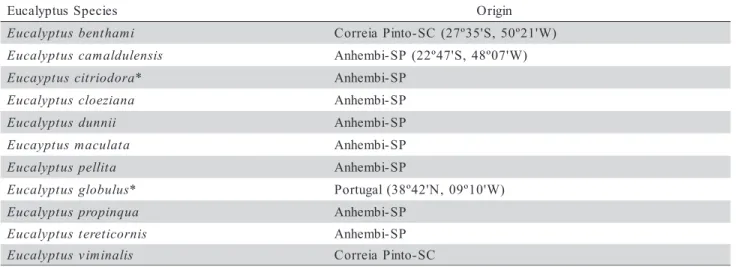
The crop received furrow fertilization, with a 10-20-10 formulae at 150 kg ha-1 (Table 1).
Leaves sampling
Trees that showed the best silviculture charac-teristics (diameter, height, trunk shape, visual crown appearance, etc) were selected, and the 10 best ones were chosen. Leaves were sampled from those trees in April (Fall), July (Winter), October (Spring), and Janu-ary (Summer). Approximately 1.0 kg of green mate-rial from the crown of each tree, per each species, in-cluding leaves and branches was randomly collected, mixed, and a 500-g leaves composite sample was drawn, and taken to distilation.
Leaves distillation
Repetitive distillations were carried out using a Clevenger MA553 distillator, nominal volume 2.0 L. Leaves were distilled by immersion for one hour in a volume of 1.4 L. The procedure was repeated 3 times per species. After distillation, the oil was collected and a small fraction of anhydrous sodium sulphate was added to eliminate aqueous residue, and the oil mass yield was determined.
Gas chromatography
A HP 5890 series II gas chromatographer, equiped with HP 20M (carbowax 20M) cappillary col-umn, was used to determine the main components of the oil.
Climatic comparisons
The relationship between oil production and water balance data in the forest stand was assessed. Water balance data were collected from January 1st,
s e i c e p S s u t p y l a c u
E Origin
i m a h t n e b s u t p y l a c u
E CorreiaPinto-SC (27º35'S, 50º21'W)
s i s n e l u d l a m a c s u t p y l a c u
E Anhembi-SP(22º47'S, 48º07'W)
* a r o d o i r t i c s u t p y a c u
E Anhembi-SP
a n a i z e o l c s u t p y l a c u
E Anhembi-SP
i i n n u d s u t p y l a c u
E Anhembi-SP
a t a l u c a m s u t p y a c u
E Anhembi-SP
a t i l l e p s u t p y l a c u
E Anhembi-SP
* s u l u b o l g s u t p y l a c u
E Portugal(38º42'N, 09º10'W)
a u q n i p o r p s u t p y l a c u
E Anhembi-SP
s i n r o c i t e r e t s u t p y l a c u
E Anhembi-SP
s i l a n i m i v s u t p y l a c u
E CorreiaPinto-SC
Table 1- Selected Eucalyptus species used in the study.
2003 to January 14th, 2004, to cover the whole sam-pling period.
RESULTS AND DISCUSSION
Distillation
Distillation results are presented in Table 2 and Figure 1. E. citriodora, E. viminalis and E. globulus had the highest yields along the year. Results confirm E. citriodora and E. globulus as the most important eucaplyptus oil source. That strengthens the existing references about the use and economic feasibility of such species (Maffeis et al., 2000). E. viminalis stood out among the other species assessed, showing high potential for oil production, far-followed by E. propinqua.
Nine out of the eleven species assessed pre-sented reduction of oil yield during Spring, the excep-tion being E. viminalis. The best production was reg-istered for Summer, especially E. citriodora, E. maculata, and E. viminalis.
Main oil chemical components
Main chemical components of the essential oils and its contents (in comparison to compounds) are pre-sented in Table 3 and Figure 2. Most species had cin-eol as the main component. Both E. benthami and E. cloeziana showed a-pynene as their main chemical component. As expected, E. citriodora showed cit-ronellal as the main component.
Climatic comparisons
Table 4 shows the Water Balance of the forest stand; water deficiency is observed mainly in the Spring. The rain season started on October and sam-pling was carried out on the beginning of this month. Therefore, October sampling was carried at the peak of the dry season. Figure 3 depicts the climate influ-ence on the production of oil. The period in which the lowest production from the distillation was obtained is related especially to the water deficiency (Spring sampling). That has happened to all the species, ex-cept E. viminalis.The best production of all the
spe-s e i c e p
S Fall Winter Spring Summer Average
-%
-i m a h t n e b .
E 0.40 0.20 0.15 0.35 0.27
s i s n e l u d l a m a c .
E 0.40 0.33 0.13 0.41 0.32
a r o d o i r t i c .
E 1.59 1.70 1.35 2.15 1.70
a n a i z e o l c .
E 0.17 0.10 0.09 0.12 0.12
i n n u d .
E 0.86 0.43 0.35 0.41 0.51
a t a l u c a m .
E 0.10 0.33 0.11 0.95 0.37
a t i l e p .
E 0.00 0.00 0.00 0.00 0.00
s u l u b o l g .
E 1.06 1.16 0.77 1.29 1.07
a u q n i p o r p .
E 0.53 0.64 0.32 0.93 0.61
s i n r o c i t n e r e t .
E 0.57 0.50 0.27 0.38 0.43
s i l a n i m i v .
E 1.46 1.33 1.64 1.80 1.56
Table 2 - Oil yield of selected Eucalyptus species.
Table 3 - Main oil chemical component contents.
s e i c e p
S Fall Winter Spring Summer Average Maincomponent
-%
-i m a h t n e b .
E 47.6 26.4 24.2 34.7 33.2 α-pynene
s i s n e l u d l a m a c .
E 28.0 52.1 33.2 50.0 40.8 Cineol
a r o d o i r t i c .
E 62.8 77.0 82.0 82.4 76.1 Citronellal
a n a i z e o l c .
E 67.8 ND ND 81.9 74.9 α-pynene
i n n u d .
E 61.8 69.4 72.0 64.7 67.0 Cineol
a t a l u c a m .
E 31.6 30.0 20.0 33.1 28.7 Cineol
a t i l e p .
E ND ND ND ND ND ND
s u l u b o l g .
E 83.0 85.0 84.8 89.0 85.5 Cineol
a u q n i p o r p .
E 59.5 64.4 50.1 68.1 60.5 Cineol
s i n r o c i t n e r e t .
E 53.4 42.2 61.4 62.0 54.8 Cineol
s i l a n i m i v .
E 87.3 83.8 85.8 85.7 85.6 Cineol
ND - not detectable.
cies happened in the Summer, when climatic conditions showed the highest real evapotranspiration rate, with higher temperatures and no water deficiency. No cor-relation between chemical component and climatic variations was found.
ACKNOWLEDGEMENTS
Authors thank co-ordinators and employees of Estação Experimental de Ciências Florestais de Itatinga for their support. Thanks are also due to Fundação de Amparo à Pesquisa do Estado de São Paulo (FAPESP) for the scholarship granted to the first author.
REFERENCES
BOLAND, D.J.; BROPHY, J.J.; HOUSE, A.P.N. Eucalyptus leaf oils – use, chemistry, distillation and marketing. Melbourne: INKATA; ACIAR; CSIRO, 1991. 247p.
BRILHO R.C. A destilação de óleos essenciais. Campinas: CETREC, 1967. 20p.
MAFFEIS, A.R.; Silveira, R.L.V.A.; Brito, J.O. Reflexos das deficiências de macronutrientes e boro no crescimento de plantas, produção e qualidade de Óleo essencial em Eucalyptus citriodora. Scientia Forestalis, v.57, p.87-98, 2000.
s h t n o
M Days Temp Precip. Hours I a
P T E
e t i a w h t n r o h T
8 4 9 1
P T E
-P NEG-AC STOR ALT ETR DEF Surplus
oC mm mm --------------- mm--------------
-n a
J 31 22.9 256.9 13.5 10.0 2.1 109.8 147.1 0.0 100.0 0.0 109.8 0.0 147.1
b e
F 28 24.5 166.1 13.1 11.1 2.1 120.0 46.1 0.0 100.0 0.0 120.0 0.0 46.1
r a
M 31 24.7 167.2 12.5 11.2 2.1 116.8 50.4 0.0 100.0 0.0 116.8 0.0 50.4
r p
A 30 20.8 110.8 11.8 8.6 2.1 78.5 32.3 0.0 100.0 0.0 78.6 0.0 32.3
y a
M 31 17.2 60.6 11.1 6.4 2.1 46.3 14.3 0.0 100.0 0.0 46.3 0.0 14.3
n u
J 30 18.5 44.7 10.6 7.2 2.1 55.8 -11.1 -11.1 89.5 -10.4 55.2 0.6 00
y l u
J 31 18.0 30.2 10.5 6.9 2.1 49.1 -18.9 -30.0 74.1 -15.4 45.7 3.5 0.0
g u
A 31 17.5 30.8 10.9 6.6 2.1 48.0 -17.2 -47.2 62.4 -11.6 42.6 5.5 0.0
t p e
S 30 20.0 26.2 11.5 8.1 2.1 67.6 -41.4 -88.5 41.2 -21.1 47.4 20.2 0.0
t c
O 31 20.9 101.2 12.2 8.7 2.1 81.5 20.4 -68.2 50.5 9.3 81.6 0.0 0.0
v o
N 30 22.4 184.7 12.9 9.7 2.1 85.5 99.1 0.0 100.0 49.4 85.6 0.0 49.7
c e
D 31 24.1 139.2 13.4 10.8 2.1 122.6 16.6 0.0 100.0 0.0 122.6 0.0 16.6
* n a
J 30 22.7 135.0 13.5 9.8 2.1 110.0 25.0 0.0 100.0 0.0 110.0 0.0 25.0
l a t o
t 274.6 1454.8 157.5 115.9 27.8 1092.0 362.8 1117.8 0.0 1062.2 29.8 381.5
e g a r e v
a 21.1 111.6 12.1 8.9 2.1 83.8 27.9 85.9 81.5 2.3 29.3
Table 4 - Water balance in the forest stand.
*Data corresponding to the first 13 days of the month.
PENFOLD, A.R.; WILLIS, J.L. The eucalypts – botany, cultivation, chemistry and utilization. Lodon: Leonard Hill, 1961. 550p. SILVA, P.H.M.; BRITO, J.O.; WAGEMAKER, T.A.L.; GABRIEL, M.V.
Estudo preliminar de novas espécies de Eucalyptus para produção de óleo essencial no Brasil. In: SIMPÓSIO INTERNACIONAL DE INICIAÇÃO CIENTIFICA DA UNIVERSIDADE DE SÃO PAULO, 10., Piracicaba, 2002. Resumos. São Paulo: USP, 2002.
SOARES,V.P.; PAULA, F.; SCOLFORO, J.R.S. Analise da relação hipsometrica diametro-altura e das alturas médias, em povoamentos jovens de Eucalyptus grandis no município de Lassance - MG.
Silvicultura, v.8, p.702-704, 1983.
VITTI, A.M.S. Avaliação do crescimento e do rendimento e qualidade do óleo essencial de procedência de Eucalyptus citriodora. Piracicaba: USP/ESALQ, 1999. 71p. (Dissertação-Mestrado). VITTI, A.M.S.; BRITO, J.O. Avaliação do rendimento e do teor de
citronelal do óleo essencial de procedências e raças locais de Eucalyptus citriodora.Scientia Forestalis, v.56, p.145-154, 1999. XAVIER, A.; SILVEIRA, A.M.; BRITO, J.O. Melhoramento de
Eucalyptus spp. na produção de óleo essencial. In: SIMPOSIO IPEF, 6., São Pedro, 1996. Anais. Piracicaba: IPEF, 1996. v.3, p.21-28.