PARTIAL DIALLEL CROSS BETWEEN EXOTIC AND ADAPTED
MAIZE POPULATIONS EVALUATED IN ACID SOIL
1Camilo de Lellis Morello2; José Branco de Miranda Filho3*; Eliana Patrícia Gorgulho4
2
Universidade de Tocantins - UNITINS, C.P. 66 - CEP: 77410-000 - Gurupi, TO.
3
Depto. de Genética - USP/ESALQ, C.P. 83 - CEP: 13400-970 - Piracicaba, SP.
4
Pós-Doutorando do Depto. de Genética, USP/ESALQ. *Corresponding author <[email protected]>
ABSTRACT: In Brazil, acid soils represent a large portion of the agricultural area and the development of cultivars with tolerance to acidity has shown to be feasible. The identification of germoplasm potentially tolerant to acidity was the purpose of this work. Two distinct groups of maize (Zea mays L.) populations were crossed according to the partial diallel mating scheme: Group [1] with six adapted populations and Group [2] with seven exotic varieties. All varieties and crosses were evaluated under the condition of acid and low fertility soil. Traits analyzed were: EY- ear yield, PH- plant height and EH- ear height. Outstanding varieties per se,
with yield higher than 3 t ha-1, were SUWAN-2, TAITINGA, TAIÚBA and IUBATÃ in Group [1]; and CUPURICO
DMR, TUXPEÑO AMARILLO, and AMARILLO DENTADO in Group [2]. Heterosis and its components showed no significant variation for PH and EH; and only average heterosis was significant for EY. The general combining
ability effects (gi and gj) showed significant variation (P<0.01) for all traits and were due mainly to the variation
of variety effects. The higher estimates gi for EY were exhibited by WP 12 (0.178 t ha-1), TAIÚBA (0.176) and
TAITINGA (0.161) in Group [1]; and for gj by CUPURICO DMR (0.300), TAITINGA TUXPEÑO AMARILLO
(0.280) in Group [2], respectively. The variety cross TAITINGA x TUXPEÑO AMARILLO with mean yield of
4.34 t ha-1 and 25% of mid-parent heterosis may be indicated as an heterotic pattern. PH and EH were not
considered as limiting to preclude the use of the outstanding populations. The varieties SUWAN 2, CUPURICO DMR, and TAITINGA were suggested to be used in maize breeding programs for acid soils.
Key words: Zea mays, partial diallel, heterosis, acid soil, aluminum tolerance
CRUZAMENTO DIALÉLICO PARCIAL ENTRE POPULAÇÕES EXÓTICAS
E ADAPTADAS DE MILHO AVALIADO EM SOLO ÁCIDO
RESUMO: No Brasil os solos ácidos representam uma grande parte da área agricultável e o desenvolvimento de cultivares com tolerância à acidez tem-se mostrado exequível. A identificação de germoplasma potencialmente tolerante à acidez foi o propósito deste trabalho. Dois grupos distintos de populações de milho (Zea mays L.) foram cruzados segundo o esquema de dialelo parcial: Grupo [1] com seis populações adaptadas e Grupo [2] com sete exóticas. As populações e seus híbridos foram avaliados sob condição de solo ácido e de baixa fertilidade. Os caracteres analisados foram: EY- peso de espigas, PH- altura da planta
e EH- altura da espiga. As populações que sobressaíram, com produtividade per se acima de 3 t ha-1 foram
SUWAN-2, TAITINGA, TAIÚBA e IUBATÃ no Grupo [1]; e CUPURICO DMR, TUXPEÑO AMARILLO, e AMARILLO DENTADO no Grupo [2]. A heterose e seus componentes mostraram variação não significativa para PH e EH; e somente a heterose média foi significativa para EY. Os efeitos de capacidade geral de
combinação (gi e gj) mostraram variação significativa (P<0,01) para todos os caracteres e foram devidos
principalmente à variação dos efeitos de variedades. As maiores estimativas de gi no Grupo [1] para EY (t ha-1)
foram exibidas por WP 12 (0,178 t ha-1), TAIÚBA (0,176) and TAITINGA (0.161) no Grupo [1]; e para g
j por
CUPURICO DMR (0.300), TAITINGA TUXPEÑO AMARILLO (0.280) no Grupo [2], respectivamente. O híbrido
interpopulacional TAITINGA x TUXPEÑO AMARILLO com produção média de 4,34 t ha-1 e 25% de heterose
pode ser indicado como um padrão heterótico. A altura da planta e da espiga não foram consideradas limitantes para impedir o uso das populações mais promissoras. As variedades SUWAN 2, CUPURICO DMR e TAITINGA foram as mais promissoras para programas de mehoramento visando adaptação às condições de solo ácidos. Palavras chave: Zea mays, dialelo parcial, heterose, solo ácido, tolerância ao alumínio
1Part of the Thesis (Ph.D) of the first author submitted to USP/ESALQ - Piracicaba, SP.
INTRODUCTION
Acid soils represent about 1,660 million hectares of agricultural areas around the world (CIMMYT, 1997). In Brazil, soils under the vegetation known as “cerrado” in general show high acidity and low fertility and represent
first action toward the development of varieties and hybrids with tolerance to this kind of stress.
For the development of base populations to be used in breeding programs, the combination of adapted germplasm with exotic germplasm is viewed as an interesting alternative because it allows the exploitation of heterosis and the introgression of alleles of interest that were not present in the local populations (Crossa et al., 1987; Hallauer & Miranda Filho, 1995). Under the Brazilian conditions, the introduction of exotic germplasm has greatly contributed for the enhancement of the yield potential of the local cultivars as well as for the incorporation of alleles for resistance to pest and diseases (Moro et al., 1981; Miranda Filho & Vencovsky, 1984; Miranda Filho, 1992; Regitano Neto et al., 1997).
The diallel cross mating schemes have been extensively used in breeding programs for the evaluation of the genetic potential of populations or genotypes (Vencovsky, 1970; Miranda Filho & Vencovsky, 1984; Gonçalves, 1987). When two distinct groups of varieties or populations (e.g., local vs exotic, dent type vs. flint type, late flowering vs. early flowering, etc) are available the intergroup partial diallel cross can be used (Miranda Filho & Geraldi, 1984; Geraldi & Miranda Filho, 1988). Those models allow the analysis of variance and estimation of effects for varieties within groups and heterosis and its components between groups. In this work, two groups of populations (adapted and exotic) were used and their genetic potentials were studied through the intergroup partial diallel scheme (Miranda Filho & Geraldi, 1984), aiming at the identification of new sources of genes for tolerance to the acid soil conditions.
MATERIAL AND METHODS
Two distinct groups of maize (Zea mays L.)
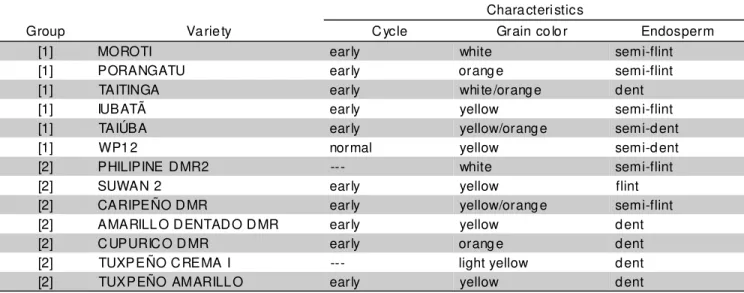
varieties were used in this study: Group [1] with six syntetic varieties developed by Instituto Agronômico for São Paulo State, and Group [2] with seven exotic varieties (TABLE 1). Both groups came from the germplasm collection of the Instituto Agronômico de Campinas (IAC, Campinas, SP).
Crosses between varieties and sib-crosses within varieties were made in Piracicaba (Department of Genetics, ESALQ/USP), using paired line 10 m long. Minimums of 30 pollinated ears were obtained in each paired row. Crosses and parent varieties were evaluated in 1997/98 at the Anhembi Experimental Station (SP), Brazil. The experiment comprised 13 parent varieties, 42 variety crosses and two commercial double cross hybrids as checks, which were “a priori” considered as sensitive (AG 6601) and tolerant (AG 5011) to acid soil. Checks were intercalated as single rows after each sub-set of 14 plots within blocks. A completely randomized block design with four replications was used. Each plot was represented by a double-row 4.0 m long spaced 0.90 m apart with 40 plants after thinning. An experimental area
characterized by acid soil and low fertility was used. The characteristics of the soil in the experimental area are shown in TABLE 2. Before planting, fertilization followed
approximately the quantities (kg ha-1): 16 kg N, 56 kg
P2O5, and 32 kg K2O. Other cultural practices and
procedures followed technical recommendations for the maize crop.
Means (over four replications) of varieties and variety crosses were analyzed according to the model for the intergroup partial diallel cross, which is represented by (Miranda Filho & Geraldi, 1984)
Yij = µ + αd +
2 1 (v
i + vj) + θ (h+ hi + hj + sij) +eij)
In this model Yij is the observed mean of varieties
(Yii in Group [1] or Yjj in Group [2]; α = 1, and θ = 0) or hybrid crosses (i ≠ j; α = 0, and θ = 1); µ is the overall mean of varieties; d is a measure of the difference
between groups; vi and vj are the variety effects for Group
[1] or Yjj in Group [2], respectively; h is the average
heterosis of the ij variety crosses; hi and hj are the
variety heterosis effects for Group [1] or Yjj in Group [2],
respectively; sij is the specific heterosis expressed in the
i x j cross; eij is the error term associated with the
respective mean. Definitions of the effects in the model are analogous to the model of Gardner & Eberhart (1966) for diallel cross involving only one group of varieties.
The effects of general combining ability (GCA) for varieties within groups were further included; estimates of effects and tests of hypothesis in the analysis of variance followed the model given by Geraldi & Miranda Filho (1988), that is a factorial analysis adapted from Method 4 of Griffing (1956).
The following traits were analyzed: PH- plant height (cm), EH- ear height (cm), and EY- ear yield
(t ha-1), after adjustment to stand variation; adjustment
was for the expected stand (40 plants) through the analysis of covariance as suggested by Miranda Filho cited by Vencovsky & Barriga, 1992.
RESULTS AND DISCUSSION
Mean yields (ear yield) in the whole set of parent
varieties were in the range of 3.31 t ha-1 to 3.86 t ha-1.
Varieties SUWAN 2, TAITINGA, CUPURICO DMR, TAIÚBA, IUBATÃ, TUXPEÑO AMARILLO and AMARILLO DENTADO, in this order, expressed the highest yield (over
3 t ha-1). The average yield of parent varieties were close
TABLE 1 - Identification and characterization of 13 populations divided into two groups.ψ
ψSource: Lima et al. (1988); Gorgulho (1997).
Characteristics
Group Variety C ycle Grain color Endosperm
[1] MOROTI early white semi-flint
[1] PORANGATU early orang e semi-flint
[1] TAITINGA early white/orange dent
[1] IUBATÃ early yellow semi-flint
[1] TAIÚBA early yellow/orange semi-dent
[1] WP12 normal yellow semi-dent
[2] PHILIPINE DMR2 --- white semi-flint
[2] SUWAN 2 early yellow flint
[2] CARIPEÑO D MR early yellow/orange semi-flint
[2] AMARILLO DENTADO DMR early yellow dent
[2] C UPURICO D MR early orang e dent
[2] TUXPEÑO CREMA I --- light yellow dent
[2] TUXPEÑO AMARILLO early yellow dent
TABLE 2 - Average chemical and physical composition of the soil at layers 0-20 cm and 20-40 cm at the Anhembi Experimental Station (SP).
1SB: sum of bases; 2T: CEC, cation exchange capacity; 3V: base saturation; 4m: aluminum saturation
Layer CaClpH
2
OM P K Ca Mg Al H+Al SB1 T2 V3 m4
cm g dm-3 mg dm-3 --- mmol
c dm-3 --- %
---0-20 4.2 22 6 2.2 18 11 10 52 31.2 83.2 38 24
20-40 4.0 16 4 1.3 14 8 18 80 23.3 103.3 23 44
Micronutrients
Layer B Cu Fe Mn Zn Na
cm --- mg dm-3
---0-20 0.33 0.9 174.0 6.5 0.5 4.6
20-40 0.36 0.8 91.6 3.3 0.4 4.6
TABLE 3 - Parent variety means for plant height (PH), ear height (EH) and total ear yield (EY). Anhembi (SP), 1997/98.
*Double cross hybrid
PH EH EY EY EY
Symbology Variety CH 1 CH 2
--- cm --- t ha-1 --- %
V1 MOROTI 206 114 2.86 62.9 65.6
V2 PORANGATU 186 104 3.00 65.9 68.8
V3 TAITINGA 206 113 3.65 80.2 83.7
V4 IUBATÃ 191 97 3.35 73.6 76.8
V5 TAIÚBA 179 93 3.40 74.7 78.0
V6 WP12 218 136 2.98 65.5 68.4
V7 PHILIPINE DMR2 188 103 2.51 55.2 57.6
V8 SUWAN 2 180 97 3.86 84.8 88.5
V9 CARIPEÑO DMR 183 105 2.31 50.8 53.0
V10 AMARILLO DENTAD O DMR 188 98 3.01 66.2 69.0
V11 CUPURIC O D MR 172 87 3.52 77.4 80.7
V12 TUXPEÑO CREMA I 183 101 3.00 65.9 68.8
V13 TUXPEÑO AMARILLO 155 79 3.29 72.3 75.5
Average 187 102 3.13 68.6 71.8
C HEC K 1 *AG 6601 159 84 4.55 ---
---Variety crosses TAITINGA x TUXPEÑO AMARILLO, MOROTI x TUXPEÑO AMARILLO, TAITINGA x CARIPEÑO DMR, TAIÚBA x SUWAN 2, and TAIÚBA x CUPURICO DMR, exhibited the highest yields,
over 4 t ha-1 (TABLE 4). Yields of variety crosses were
also not higher than check yields, but some crosses reached relatively high yields, as for example, TAITINGA x TUXPEÑO AMARILLO that yielded 95.4% and 99.5% in relation to the hybrid checks AG 6601 and AG 5011, respectively (TABLE 4). Means for PH and EH in the variety crosses were in the ranges of 164 cm to 203 cm and 86 cm to 126 cm, respectively (TABLE 4).
In general, the relatively low yield of varieties, variety crosses and hybrid checks are attributed to the condition of acidity and low fertility of the soil in the experimental area. In corrected soil, in the same experiment area, Gorgulho (1997) evaluated the same set of varieties and variety crosses and
observed average EY of 6.52 t ha-1, with an increase of
approximately 3.1 t ha-1 in relation to the results presented in
this work. For PH and EH, there was a difference of approximately 20 cm for both traits. Difference between years of evaluation may be partly accounted for the explanation of those differences, but larger effect is attributed to differences in soil characteristics. In fact, high acidity and low cation exchange capacity (V%) (TABLE 2) may limit yield and plant development, as detected in other studies by Clark (1977), Gonzalez-Erico et al. (1979), Naspolini et al. (1981), Bennet et al. (1986), among others.
When comparing the condition of acid soil in the present study and the condition of corrected soil (Gorgulho, 1997), the outstanding varieties and variety crosses in both situations were TAITINGA, TAIÚBA, IUBATÃ, PORANGATU x PHILIPINE DMR2, PORANGATU x TUXPEÑO CREMA I, TAITINGA x CUPURICO DMR, and CUPURICO DMR x CARIPEÑO DMR for EY. For PH and EH, varieties TUXPEÑO AMARILLO and WP 12 also showed the lowest and highest means in both situations.
When focusing the parent varieties “per se”, it
was observed that yield above 3 t ha-1 under the
conditions of acid soil was reached by three varieties of Group [1] (adapted) and by four varieties of Group [2] (exotic). A better performance of the adapted varieties should be expected, but the stressed condition may increase the genotype x environment interaction so that a less adapted variety for normal soil can express a relatively higher yield under the stress condition.
Some variety crosses showed mid-parent heterosis higher than 30% and the most heterotic crosses were, TAITINGA x CARIPEÑO DMR, WP 12 x CARIPEÑO and MOROTI x TUXPEÑO AMARILLO;
these crosses also showed yield levels above 3.5 t ha-1
(TABLE 4). Some negative estimates of heterosis for EY did occur and the most negative values were for crosses IUBATÃ x SUWAN 2 and IUBATÃ x TUXPEÑO CREMA I. In both instances, yield was lower than the lower yield parent (IUBATÃ), probably as a consequence of a
particular genetic combination that led to a less adapted genotype to the condition of acid soil.
The identification of heterotic combinations is important for the exploitation of genetic divergence between parents for the development of outstanding hybrids from inbred lines or for the synthesis of pairs of composites identified as heterotic groups (Hallauer & Miranda Filho, 1995). Heterosis in crosses between adapted and exotic germplasm have been reported by some authors (Miranda Filho & Vencovsky, 1984; Crossa et al., 1987; Santos et al., 1994).
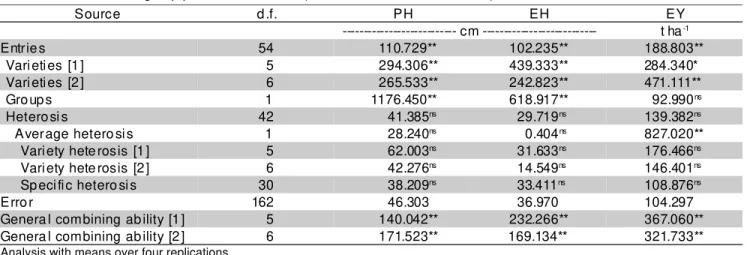
The analysis of variance according to the diallel model (TABLE 5) showed significance for all traits in both groups and the difference between groups was non significant only for EY. Heterosis and its components showed no significant differences except average heterosis for EY. The effects of general combining ability (Method 4; Griffing, 1956) were significantly different for all traits in both groups, and the differences were attributed mainly to variety effects. The non-significance for heterosis and its components for PH and EH suggests that selection among varieties can be based only on the performance of varieties “per se”. For EY, the non-significance for variety heterosis and specific heterosis indicates that the expression of the total heterosis shown no great variation among crosses around the average heterosis. In fact, the range for heterosis
expression was from –0.86 to 1.09 t ha-1 averaging 0.29 t
ha-1; in percent of mid-parent, those values are –26.9 to
36.6%, averaging 9.8%. In percent of mid-parent, the range for heterosis seems to be large as compared with other reports. Nevertheless, when considering the absolute values
1 t ha-1 can not be considered a high heterosis expression
despite the stressed condition of the acid soil. The precision of an experiment under stress tends to be substantially lower than in normal conditions and may difficult the detection of significant differences through the usual tests of hypothesis. When choosing the two groups of varieties for this study, a superiority of the adapted group over the exotic group was expected. Nevertheless, the non significance for the contrast between group means for yield leads to the conclusion that their yield potential are very similar under the conditions of acid soil. When comparing our results with those reported by Gorgulho (1997), working with the same groups of varieties in corrected soil, the existence of the genotype x environment interaction is evident, because in normal conditions yield of the adapted group was significantly higher than the exotic group in two locations (Anhembi, SP; Rio Verde, GO); the contrasts were 5.54 vs 4.79 t ha-1 and 4.02 vs. 3.67 t ha-1, respectively.
PH EH EY EY EY EY EY
CrossesΦ CH 1 CH 2
--- cm --- t ha-1 --- % --- h h %
V1 x V7 179 97 3.18 69.9 72.9 0.495 18.4
V1 x V8 191 111 3.40 74.7 78.0 0.040 1.2
V1 x V9 191 107 3.21 70.6 73.6 0.625 24.2
V1 x V10 190 107 3.07 67.5 70.4 0.135 4.6
V1 x V11 189 101 3.88 85.3 89.0 0.690 21.6
V1 x V12 193 107 3.02 66.4 69.3 0.090 3.1
V1 x V13 183 90 4.10 90.1 94.0 1.025 33.3
V2 x V7 196 104 3.50 76.9 80.3 0.745 27.0
V2 x V8 179 96 3.47 76.3 79.6 0.040 1.2
V2 x V9 198 108 2.80 61.5 64.2 0.145 5.5
V2 x V10 179 91 3.41 75.0 78.2 0.405 13.5
V2 x V11 178 95 3.27 71.9 75.0 0.010 0.3
V2 x V12 186 100 3.60 79.1 82.6 0.600 20.0
V2 x V13 172 94 3.31 72.8 75.9 0.165 5.2
V3 x V7 193 100 3.34 73.4 76.6 0.260 8.4
V3 x V8 188 108 3.35 73.6 76.8 -0.405 -10.8
V3 x V9 183 101 4.07 89.5 93.4 1.090 36.6
V3 x V10 183 107 3.13 68.8 71.8 -0.200 -6.0
V3 x V11 178 95 3.58 78.7 82.1 -0.005 -0.1
V3 x V12 183 105 3.32 73.0 76.2 -0.005 -0.2
V3 x V13 181 95 4.34 95.4 99.5 0.870 25.1
V4 x V7 185 106 2.93 64.4 67.2 0.000 0.0
V4 x V8 189 103 2.85 62.6 65.4 -0.755 -20.9
V4 x V9 195 114 2.89 63.5 66.3 0.060 2.1
V4 x V10 183 106 3.38 74.3 77.5 0.200 6.3
V4 x V11 188 104 3.63 79.8 83.3 0.195 5.7
V4 x V12 174 91 2.32 51.0 53.2 -0.855 -26.9
V4 x V13 164 86 3.16 69.5 72.5 -0.160 -4.8
V5 x V7 195 104 3.27 71.9 75.0 0.315 10.7
V5 x V8 190 109 4.03 88.6 92.4 0.400 11.0
V5 x V9 192 105 3.65 80.2 83.7 0.795 27.8
V5 x V10 171 86 3.53 77.6 81.0 0.325 10.1
V5 x V11 184 92 4.02 88.4 92.2 0.560 16.2
V5 x V12 186 105 2.86 62.9 65.6 -0.340 -10.6
V5 x V13 175 90 3.87 85.1 88.8 0.525 15.7
V6 x V7 201 116 3.32 73.0 76.2 0.575 20.9
V6 x V8 191 114 3.68 80.9 84.4 0.260 7.6
V6 x V9 203 126 3.53 77.6 81.0 0.885 33.5
V6 x V10 196 116 3.86 84.8 88.5 0.865 28.9
V6 x V11 193 112 3.99 87.7 91.5 0.740 22.8
V6 x V12 189 108 3.40 74.7 78.0 0.410 13.7
V6 x V13 190 106 3.47 76.3 79.6 0.335 10.7
Average 186 102 3.42 75.2 78.4
CHECK 1 159 84 4.55 --- --- ---
---CHECK 2 181 108 4.36 --- --- ---
---in magnitude. When compar---ing with estimates reported by Gorgulho (1997), varieties TAITINGA, SUWAN 2 and TUXPEÑO AMARILLO also exhibited good patterns of plant architecture under the condition of corrected soil (Gorgulho, 1997). Variety TAIÚBA has been mentioned by their
adaptation to acid soils (Lima et al., 1992) and its germplasm represents 87.5% of the variety TAITINGA (Lima et al., 1988). Santos et al. (1994) detected variety effect estimate
of SUWAN 2 as one of the largest (1.29 t ha-1) in a diallel
analysis of 28 varieties.
TABLE 4 - Means of variety crosses for plant height (PH), ear height (EH) and ear yield (EY) and estimates of mid-parent heterosis (h) and percentage of heterosis (h%).
No significance was detected for variety heterosis effects in both groups; their ranges of variation were –0.477
to 0.292 t ha-1 and –0.359 to 0.310 t ha-1, respectively
(TABLE 6). For general combining ability (GCA), varieties WP12, TAIÚBA and TAITINGA in Group [1] and CUPURICO DMR and TUXPEÑO AMARILLO in Group [2] showed significant and positive estimates (TABLE 6). Variety WP12 in Group [1] also showed positive GCA estimates for PH and EH that can be seen as unfavorable traits if the objectives of the program is toward the development of short architecture cultivars. The outstanding varieties for GCA under the conditions of acid soil, as identified above, are not the same as those with better performance in corrected soil, which were PORANGATU and IUBATÃ in Group [1] and TUXPEÑO CREMA I and CARIPEÑO DMR in Group [2], as identified by Gorgulho (1997).
Following the objectives of this study, one can
foresee wide possibilities for the use of the germplasm evaluated under the conditions of acid soil. The positive variety effects, mainly referring to varieties SUWAN 2, CUPURICO DMR and TAITINGA, may suggest their use as a base for intrapopulation recurrent selection under the specified conditions. On the other hand, outstanding varieties for yield with positive GCA effects may be used for the synthesis of pairs of composites, toward the exploitation of heterosis and reciprocal recurrent selection. Also, a specific variety cross can be identified as a heterotic group aiming at the exploitation of both general and specific combining ability through the extraction of inbred lines and the development of outstanding hybrids. This is the case of TAITINGA x TUXPEÑO AMARILLO,
which yielded 4.34 t ha-1, representing 95.4% and 99.5%
of checks AG 6601 and AG 5011, respectively, including a mid-parent heterosis of 25%.
Source d.f. PH EH EY
--- cm --- t ha-1
Entries 54 110.729** 102.235** 188.803**
Varieties [1] 5 294.306** 439.333** 284.340*
Varieties [2] 6 265.533** 242.823** 471.111**
Groups 1 1176.450** 618.917** 92.990ns
Heterosi s 42 41.385ns 29.719ns 139.382ns
Average hetero sis 1 28.240ns 0.404ns 827.020**
Variety hete rosis [1] 5 62.003ns 31.633ns 176.466ns
Variety hete rosis [2] 6 42.276ns 14.549ns 146.401ns
Specific hetero sis 30 38.209ns 33.411ns 108.876ns
Error 162 46.303 36.970 104.297
Genera l combining ability [1] 5 140.042** 232.266** 367.060**
Genera l combining ability [2] 6 171.523** 169.134** 321.733**
TABLE 5 - Mean squaresℜ in the analysis of variance for plant height (PH), ear height (EH) and ear yield (EY) following the
model of intergroup parcial diallel cross (Miranda Filho & Geraldi, 1984).
ℜAnalysis with means over four replications.
TABLE 6 - Estimates of the effects of varieties (vi and vj), variety heterosis (hi and hj) and general combining ability (gi and gj)
for plant height (PH), ear height (EH) and ear yield (EY) following the model of intergroup partial diallel (Miranda Filho & Geraldi, 1984; Geraldi & Miranda Filho, 1988).
PH EH EY
Group [1]
--- cm --- --- t ha-1
---MOROTI 8,3 -2,5 1,6 4,5 -2,2 0,0 -0,346 0,153 -0,019
PORANGATU -11,7 3,5 -2,4 -5,5 -1,8 -4,5 -0,206 0,012 -0,091
TAITINGA 8,3 -6,4 -2,2 3,5 -3,0 -1,2 0,443 -0,06 0,161
IUBATÃ -6,7 -0,5 -3,8 -12,5 4,9 -1,4 -0,226 -0,292 -0,405
TAIÚBA -18,7 7,7 -1,6 -16,5 4,2 -4,1 0,193 0,079 0,176
WP12 20,3 -1,8 8,4 26,5 -2,1 11,2 0,143 0,107 0,178
Group [2]
PHILIPINE DMR2 9,6 0,4 5,1 7,3 -2,0 1,7 -0,561 0,109 -0,171
SUWAN 2 1,6 0,9 1,6 1,3 3,4 4,0 0,788 -0,359 0,035
CARIPEÑO DMR 4,6 5,0 7,3 9,3 2,7 7,4 -0,761 0,310 -0,070
AMARILLO DENTADO DMR 9,6 -7,5 -2,7 2,3 -1,8 -0,6 -0,061 -0,001 -0,031
CUPURICO DMR -6,4 1,9 -1,4 -8,7 1,4 -3,0 0,448 0,075 0,300
TUXPEÑO CREMA I 4,6 -3,5 -1,2 5,3 -2,8 -0,1 -0,071 -0,306 -0,341
TUXPEÑO AMARILLO -23,4 2,9 -8,9 -16,7 -1,0 -9,3 0,218 0,170 0,280
188.0 102.6 3.129
-1.69 0.2 0.289
9.6 6.9 0.067
i
v hi gi vi hi gi vi hi gi
j
v hj gj vj hj gj vj hj gj
Received August 07, 1999
REFERENCES
BENNET, R.J.; BREEN, C.M.; FEY, M.V. Aluminum toxicity and induced nutrient disorders involving the uptake and transport of P, K, Ca and Mg in Zea mays L. South African Journal Plant Soil, v.3, p.11-17, 1986.
CIMMYT. Development of new stress-resistant maize genetics resources: Maize Program Special Report. México, 1997. 210p. (UNDP Project GLO/90/003)
CLARK, R.B. Effect of aluminum on growth and mineral elements of Al-tolerant and Al-intolerant corn. Plant and Soil, v.47, p.653-662, 1977.
CROSSA, J.; GARDNER, C.O.; MUMM, R.F. Heterosis among populations of maize (Zea mays L.) with different levels of exotic germplasm. Theoretical and Applied Genetics, v.73, p.445-450, 1987.
EMBRAPA. Centro de Pesquisa Agropecuária do Cerrado. Relatório técnico anual do Centro Nacional de Pesquisa do Cerrado 1976-1977. Planaltina: EMBRAPA,CPAC, 1978. 183p.
GARDNER, C.O.; EBERHART, S.A. Analysis and interpretation of the variety cross diallel and related populations. Biometrics, v.22, p.439-452, 1966.
GERALDI, I.O.; MIRANDA FILHO, J.B. Adapted models for the analysis of combining ability of varieties in partial diallel crosses. Revista Brasileira de Genética, v.11, p. 419-430, 1988.
GONÇALVES, P.S. Esquema circulante de cruzamentos para avaliação de linhagens de milho (Zea mays L.) ao nível interpopulacional. Piracicaba, 1987. 140p. Tese (Doutorado) – Escola Superior de Agricultura “Luiz de Queiroz”, Universidade de São Paulo.
GONZALEZ-ERICO, E.; KAMPRATH, E.J.; NADERMAN, G.C.; SOARES W.V. Effect of depth of lime incorporation on the growth of corn on na oxisol of central Brasil. Soil Science Society of America Journal, v.43, p.1155-1158, 1979. GORGULHO, E.P. Avaliação de variedades de milho (Zea mays
L.) sob dois esquemas de cruzamento: dialélico parcial e “top-cross” intergrupos. Piracicaba, 1997. 94p. Tese (Doutorado) - Escola Superior de Agricultura “Luiz de Queiroz”, Universidade de São Paulo.
GRIFFING, B. Concept of general and specific combining ability in relation to diallel crossing systems. Australian Journal of Biological Science, v.9, p.463-493, 1956.
HALLAUER, A.R.; MIRANDA FILHO, J.B. Quantitative genetics in maize breeding. 2ed. Iowa: Iowa State University Press, 1995. 468p.
LIMA, M.; VITTI, P.; GALLO, P.B. Populações de milho: características agronômicas e tecnológicas. Bragantia, v.47, p.55-62, 1988.
LIMA, M.; FURLANI, P.R.; MIRANDA FILHO, J.B. Divergent selection for aluminum tolerance in a maize (Zea mays L.) population. Maydica, v.37, p.123-132, 1992.
MIRANDA FILHO, J.B. Exotic germoplasm introduced in a Brasilian maize breeding program. Brazilian Journal of Genetics, v.15, p.631-642, 1992.
MIRANDA FILHO, J.B.; GERALDI, I.O. An adapted model for the analysis of partial diallel crosses. Revista Brasileira de Genética, v.7, p.677-688, 1984.
MIRANDA FILHO, J.B.; VENCOVSKY, R. Analysis of diallel crosses among open-pollinated varieties of maize (Zea mays
L.). Maydica, v.29, p.217-234, 1984.
MORO, J.R.; NASPOLINI FILHO, V.; VIANNA, R.T.; GAMA, E.E.G. Introdução de novos germoplasmas de milho no Brasil. Pesquisa Agropecuária Brasileira, v.16, p.867-882, 1981. NASPOLINI FILHO, V.; BAHIA FILHO, A.F.C.; VIANNA, R.T.; GAMA, E.E.G.; VASCONCELOS, C.A.; MAGNAVACA, R. Comportamento de linhagens e de híbridos simples de milho
(Zea mays L.) em solos sob vegetação de cerrado. Ciência e
Cultura, v.33, p.722-727, 1981.
REGITANO NETO, A.; NASS, L.L.; MIRANDA FILHO, J.B. Potential of twenty germplasms to improve Brazilian maize architecture. Brazilian Journal of Genetics, v.20, p.691-696, 1997.
SANTOS, M.X.; PACHECO, C.A.P.; GUIMARÃES, P.E.; GAMA, E.E.G.; SILVA, A.E. OLIVEIRA, A.C. Dillel among twenty eight varieties of maize. Brazilian Journal of Genetics, v.17, p.277-282, 1994.
VENCOVSKY, R. Alguns aspectos teóricos e aplicados relativos a cruzamentos dialélicos de variedades. Piracicaba, 1970. 59p. Tese (Livre-Docência) – Escola Superior de Agricultura “Luiz de Queiroz”, Universidade de São Paulo.