ABSTRACT:Objective: To identify factors associated with breastfeeding in the irst hour of life. Methods: A cross-sectional study conducted among mothers and children under one year of age, who attended the second stage of the polio vaccination campaign in the Federal District, Brazil, in 2011. The sample was composed of 1,027 pairs of mothers and children. Breastfeeding in the irst hour of life was considered as the dependent variable; and the independent variables were: socio-demographic characteristics of the mother, prenatal, delivery and postpartum care, reference to physical or verbal violence/neglect during delivery, and children health. Unadjusted and adjusted prevalence ratios (PR) were used as measures of association, calculated by Poisson regression. Results: The prevalence of breastfeeding in the irst hour of life was 77.3%. Inadequate prenatal care (PR = 0.72), cesarean section (PR = 0.88) and no access to rooming-in after birth (PR = 0.28) were factors that interfered negatively in breastfeeding in the irst hour of life. No factor was associated with breastfeeding in the irst hour of life for mother and children. Conclusions: Factors related to health services such as prenatal care, type of delivery and postpartum rooming-in interfered with breastfeeding in the irst hour of life, indicating that health services, as well health professional practices were major determinants the breastfeeding in the irst hour of life.
Keywords: Breast feeding. Mass vaccination. Health services. Maternal and child health. Prenatal care. Rooming-in care.
Factors related to health services determine
breastfeeding within one hour of birth in the
Federal District of Brazil, 2011
Fatores ligados aos serviços de saúde determinam o aleitamento materno
na primeira hora de vida no Distrito Federal, Brasil, 2011
Naíza Nayla Bandeira de SáI , Muriel Bauermann GubertII, Wallace dos SantosIII, Leonor Maria Pacheco SantosIV
I GraduateProgram in Health Sciences, Universidade de Brasília - Brasília (DF), Brazil.
IIPost-doc Program at Yale School of Public Health – New Haven (CT), United States of America. III GraduateProgram in Public Health, Universidade de Brasília - Brasília (DF), Brazil.
IVDepartment of Public Health, Universidade de Brasília – Brasília (DF), Brazil.
Corresponding author: Naíza Nayla Bandeira de Sá. Estrada da Vila Nova, Chácara Rosa do Campo, 9, apto. 304, bloco F, Cidade Nova, Zip Code: 67130-600, Ananindeua, PA, Brazil. E-mail: [email protected]
Conlict of interests: nothing to declare – Financial support: Research Support Foundation of the Federal District.
INTRODUCTION
The World Health Organization (WHO) recommends that immediately after delivery the mother and child skin to skin contact should be allowed. In this opportunity, mothers should be oriented on how to recognize the moment when their children are ready for breastfeeding for the irst time1,2.
Breastfeeding (BF) guarantees children the nutrients necessary for their healthy growth and development and its beneits can be seen beyond early childhood. A recent study con-ducted in Pelotas, Rio Grande do Sul - Brazil, showed that children who were breastfed for 12 months or more presented higher intelligence quotient, educational level and income at 30 years of age, compared to children who were breastfed for less than one month3.
Early initiation of breastfeeding in the irst hour of life provides the newborn immu-nological and psychosocial beneits, strengthens the mother-child bond4, and increases the child’s chance to receive colostrum, which is highly nutritious, easily digestible and presents substantial immunological properties for this phase of life5. Therefore, breastfeeding within one hour of birth is considered an important protective factor against newborn mortality6. The main indings of a study conducted in Ghana, Africa, from 2003 to 2004, showed that 16.3% of neonatal deaths could be prevented if breastfeeding initiated on the irst day of life and 22.3% if breastfeeding occurred in the irst hour of life7.
Systematic literature review, conducted by Esteves et al.8 indicated that the prevalence of breastfeeding within one hour of birth ranged from 11.4% in one province in Saudi Arabia9 to 83.3% in Sri Lanka10. Data from the 2nd Research on the Prevalence of Breastfeeding in Brazilian State Capitals and in the Federal District (DF) showed that 67.7% of children breastfed in the irst hour of life in the Brazilian cities in 200811. The Research Born in Brazil, conducted in the
RESUMO:Objetivo: Identiicar os fatores associados ao aleitamento materno na primeira hora de vida. Métodos: Estudo transversal, realizado junto às mães e crianças menores de um ano de idade, que compareceram à segunda etapa da campanha de poliomielite no Distrito Federal, Brasil, em 2011. A amostra estudada foi de 1.027 pares (mães e ilhos). Considerou-se como variável dependente o aleitamento materno na primeira hora de vida e, como variáveis independentes, as características sociodemográicas da mãe, assistência ao pré-natal, parto e puerpério, referência à violência física, verbal e negligência no momento do parto e saúde da criança. As razões de prevalência (RP), brutas e ajustadas, foram utilizadas como medida de associação, calculadas por regressão de Poisson. Resultados: Foi encontrada prevalência de 77,3% de aleitamento materno na primeira hora de vida. Não ter realizado pré-natal de forma adequada (RP = 0,72), ter feito parto cesáreo (RP = 0,88) e mãe e ilho não permanecerem em alojamento conjunto após o parto (RP = 0,28) foram fatores que interferiram negativamente no aleitamento materno na primeira hora. Nenhuma característica materna e da criança esteve associada ao aleitamento materno na primeira hora. Conclusão: Fatores ligados aos serviços de saúde, como assistência ao pré-natal, tipo de parto e alojamento conjunto, interferiram no aleitamento materno na primeira hora, indicando que as práticas dos serviços e dos proissionais de saúde foram os principais determinantes do aleitamento materno na primeira hora.
ive geographical regions of the country in 2011 and 2012, found a prevalence of 50.4% of breastfeeding within one hour of birth among newborns in the Midwest region12.
The health team’s role is to assist and support the mother and the child in order to guar-antee that the breastfeeding within one hour of birth occurs adequately1,2. The literature has indicated that the practices of health professionals8,13-18, as well as the organization and man-agement of health services, are essential to the initiation of breastfeeding immediately after childbirth12. Mothers who got the prenatal care13, who were counseled during prenatal about breastfeeding18 and who received postpartum assistance from health professionals for breast-feeding were more likely to breastfeed their children in the irst hour16,17. With regard to health services, allowing companion in childbirth, having deliveries paid by the Uniied Health System (SUS) and in hospitals that received the title of Child Friendly Hospital Initiative (IHAC)12 were appointed as stimulating factor for the breastfeeding within one hour of birth.
Few studies have investigated the factors associated with breastfeeding within one hour of birth in the Brazilian population15,18-22 and none of them were conducted in the Midwest region. This study aimed at investigating the prevalence of breastfeeding in the irst hour of life, as well as the factors that interfered in this practice in the Federal District, the country capital, in 2011.
METHODS
STUDY DESIGN
This is a cross-sectional study, conducted in August 2011, during the second phase of the polio campaign in the Federal District. The research subjects were mother-child pairs, aged 0 to 12 months, who attended health units selected as the sample design.
The sample was applied by conglomerate with selection in two stages and probability proportional to cluster size. A conservative prevalence of 50% was considered to calculate the sample size, due to the various investigated indicators, in addition to the conidence level of 95% and maximum sampling error of 4%. The calculation resulted in a sample size of 1,170 mother-child pairs, after adjusting for a sample loss of up to 30% and correcting the design efect (def ) equal to 1.5.
The selection of the irst sampling stage (vaccination units) has been carried out in order to have represented all administrative regions of the Federal District (DF) that had health cen-ters eligible to participate in the survey according to the following:
1. be located in urban area; 2. be stationary vaccination units;
3. hold the data from June 2010 multi-vaccination campaign in Federal District.
The selection of the eligible vaccination units resulted in a total of 25 units to be analyzed, distributed in 21 of the 30 administrative regions of the Federal District in 2011.
unit was calculated according to the attendance estimate based on the number of chil-dren vaccinated at that unit in the previous year’s campaign. The pre-determined interval ranged from 1:2 to 1:10 children, to achieve the target sample in each vaccination unit. The coordinating team monitored, throughout the data collection day, the achievement of the sample size in each surveyed unit. In cases where the search for vaccination was lower than expected, the selection range was lowered to reach the target sample at shorter intervals to the pre-determined, which occurred in 9 of 25 vaccination units (36.0 %). However, the inclusion criteria and the randomness of the sample were preserved.
The mother-child pairs eligible for this study were those whose children were younger than one year and was accompanied by his or her mother; must have been resident in the administrative region where the vaccination unit was located; should not have presented disease or immobilization that interfered with measurement of weight and height of both; should not be twin and or an adopted son or daughter. If the eligible mother took more than one child under one year old to the vaccination unit, the eldest was selected to partic-ipate in the study. For the analysis, 143 mother-child pairs were excluded due to inconsis-tent or inexisinconsis-tent data about the breastfeeding within one hour of birth. Mother-child pairs remaining in the study was equivalent to 1,027.
The weighting factor was calculated according to the number of children under one year of age vaccinated in the second phase of the polio campaign in the Federal District, consid-ering the data provided by the Federal District Health Department, in addition to the sam-ple design, which considered the vaccination units as the primary sampling units. The cov-erage of the second phase of the polio vaccination campaign for the child under 12 months, held in 2011 in the Federal District when the data was collected, was equivalent to 97.9%, ranging from 67, 1% in the administrative region Asa Norte (North Wing) to 151.1% in the administrative region Lago Norte (North Lake)23. The high coverage ratio contributes to the reduction of the selection bias in such data collection strategy24.
DATA COLLECTION
CLASSIFICATION OF STUDY VARIABLES
The dependent variable of this study was breastfeeding in the irst hour of life. It was identiied by the mother’s answer to the following question: “Was the child placed in the chest to breastfeed in the irst hour of life, soon after birth?”. The responses should be classiied in “no” or “yes”.
Maternal age was classiied into four age groups: 14 to 19, 20 to 29, 30 to 34 and ≥ 35 years of age. Maternal education was classiied into three levels: 0 to 8, 9 to 11 and ≥ 12 years of schooling. Race or skin color was classiied into three categories: white, black or yellow / indian and was considered a representative of the socioeconomic status.
Conformity of assistance in prenatal care was classified as the model proposed by Leal et al.27, which were based on process indicators of the National Program of Prenatal Humanization (PHPN). Thus, prenatal care has been classiied into two categories. Adequate prenatal care was considered when the woman met the 11 established criteria as follows:
1. have started prenatal care in the irst trimester; 2. have completed six or more consultations; 3. weight was measured at every visit; 4. blood pressure was checked at every visit; 5. urine test was conducted;
6. underwent a complete blood count (CBC) test; 7. blood glucose test was conducted;
8. test for syphilis was performed and the result was available within 15 days;
9. underwent a test for acquired immunodeiciency syndrome (AIDS) and received the result within 15 days;
10. was counseled about breastfeeding; and 11. received guidance on the place for delivery.
Prenatal care was considered inadequate in the absence of any of these items. The eval-uation of the mother about the quality of prenatal care and childbirth was classiied as very good/good, satisfactory or poor/very poor. The type of birth was categorized as the type of delivery in two categories: vaginal or cesarean.
The indicators of violence on parturient women by health professionals were analyzed according to the method used by Souza26. Physical violence was considered when the inter-viewed mother answered ‘yes’ to one of the following questions: During labor any of the health professionals:
• Conducted the internal pelvic exam painfully?;
• Hit you?;
• Pushed you?;
• Tied you?
• Yelled at you?;
• Said something like: stop crying! Will i see you again next year?;
• When you got laid you did not cry, nor called mom. Why are you crying now?;
• If you continue screaming i will leave!;
• If you continue screaming you will harm your baby. Will he or she be born deaf ?
Neglect was identiied if the mother answered ‘yes’ to one of the following questions: Any of the health professionals:
• Failed to provide relief for your pain?;
• Denied care?;
• Did not inform you about procedures you underwent?
Physical and verbal violence and neglect were characterized as ‘no’, when the mother answered ‘no’ to all questions of each block.
With regard to the characteristics of the children, they were classiied as underweight children when the birth weight was < 2,500 g; gestational age was classiied into three cat-egories: pre-term, when the child was born before the 37th week of pregnancy; term, when the child was born between the 37th and 41st week of pregnancy; post-term, in case the birth have occurred after the 42nd week28. The Apgar score at 5 minutes was classiied into two categories: 8-10 (without asphyxia) and less than 8 (with asphyxia in some degree)29.
DATA ANALYSIS
All estimates were calculated with post-stratiication weights. Initially, we calculated the distribution of population according to the variables studied with a 95% conidence interval (95%CI). The prevalence of breastfeeding within one hour of birth was calculated according to the socio-demographic characteristics of the mother, prenatal care, childbirth and post-partum, reference to physical, verbal violence and neglect during childbirth and child health. We then calculated the prevalence ratios (PR) for all study variables, crude and adjusted, by log-linear model (Poisson regression) considering 95%CI and p < 0.05. In the ratio of adjusted prevalence, we have included all study variables in the model. For the calculation of the adjusted rations, breastfeeding within one hour of birth was considered as the dependent variable and all other variables as independent, establishing as reference category the category presenting greater protection for breastfeeding in the irst hour of life. Data analysis was performed in the statisti-cal software Stata, version 12.0, using survey commands that consider the sample complexity.
ETHICAL ASPECTS
approved by the Ethics Committee of the Universidade de Brasília, Protocol number 130/10 of February 9, 2011. All mothers participating in the survey signed the Informed Consent form.
RESULTS
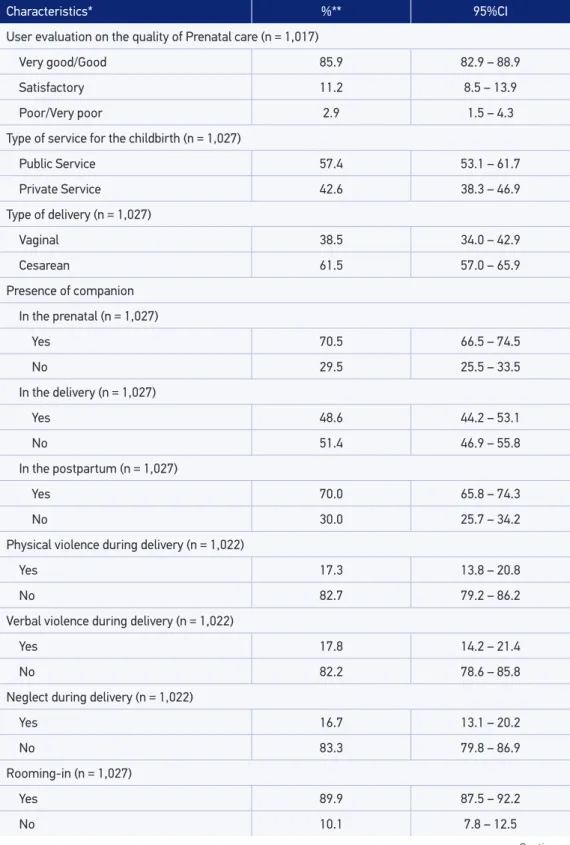
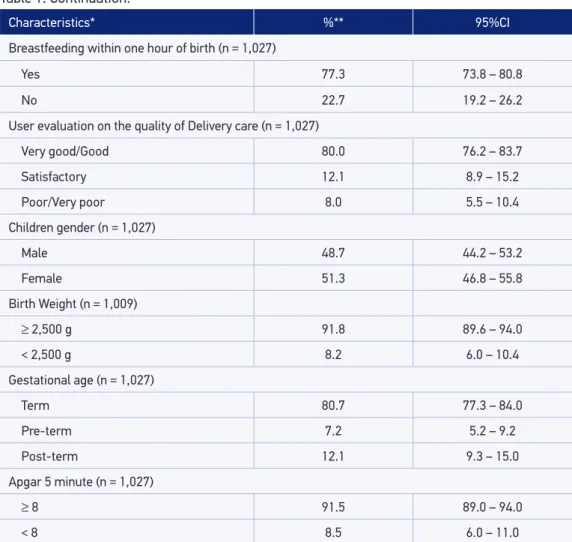
Among the 1,027 mothers interviewed, 77.3% breastfed in the irst hour of life. The majority of the sample did prenatal non-appropriately (78.4%), but assessed the qual-ity of their prenatal care as good and very good (85.9%). With regard to the care during birth, 61.5% of deliveries were cesarean. Verbal violence by health professionals during childbirth was reported by 17.8% of the mothers, followed by physical violence (17.3%) and neglect (16.7%); On the other hand, 80.0% of women rated the quality of delivery care as good and very good. Regarding the characteristics of children under 1 year of age, 91.8% were born with weight equal or greater than 2,500 g and the majority born at term (80.7%) (Table 1). All the women who had appropriate prenatal care, breastfed
Table 1. Mother’s socio-demographic characteristics, prenatal, delivery, postpartum health assistance, reference to violence at delivery and child health. Federal District, Brazil, in 2011.
Continue...
Characteristics* %** 95%CI
Maternal Age (in years) (n = 1,027)
≥ 35 21.7 17.8 – 25.6
30 to 34 23.2 19.6 – 26.9
20 to 29 40.9 36.6 – 45.2
14 to 19 14.1 10.6 – 17.7
Maternal Educational Level (in years) (n = 1,027)
≥ 12 37.6 33.4 – 41.9
9 to 11 43.3 38.9 – 47.8
0 to 8 19.0 15.3 – 22.8
Maternal Race/Color (n = 1,027)
White 35.2 31.0 – 39.4
Black 59.9 55.6 – 64.3
Yellow/Indian 4.9 2.9 – 6.9
Adequate Prenatal (n = 1,027)
Yes 21.6 18.2 – 25.1
Table 1. Continuation.
Characteristics* %** 95%CI
User evaluation on the quality of Prenatal care (n = 1,017)
Very good/Good 85.9 82.9 – 88.9
Satisfactory 11.2 8.5 – 13.9
Poor/Very poor 2.9 1.5 – 4.3
Type of service for the childbirth (n = 1,027)
Public Service 57.4 53.1 – 61.7
Private Service 42.6 38.3 – 46.9
Type of delivery (n = 1,027)
Vaginal 38.5 34.0 – 42.9
Cesarean 61.5 57.0 – 65.9
Presence of companion In the prenatal (n = 1,027)
Yes 70.5 66.5 – 74.5
No 29.5 25.5 – 33.5
In the delivery (n = 1,027)
Yes 48.6 44.2 – 53.1
No 51.4 46.9 – 55.8
In the postpartum (n = 1,027)
Yes 70.0 65.8 – 74.3
No 30.0 25.7 – 34.2
Physical violence during delivery (n = 1,022)
Yes 17.3 13.8 – 20.8
No 82.7 79.2 – 86.2
Verbal violence during delivery (n = 1,022)
Yes 17.8 14.2 – 21.4
No 82.2 78.6 – 85.8
Neglect during delivery (n = 1,022)
Yes 16.7 13.1 – 20.2
No 83.3 79.8 – 86.9
Rooming-in (n = 1,027)
Yes 89.9 87.5 – 92.2
No 10.1 7.8 – 12.5
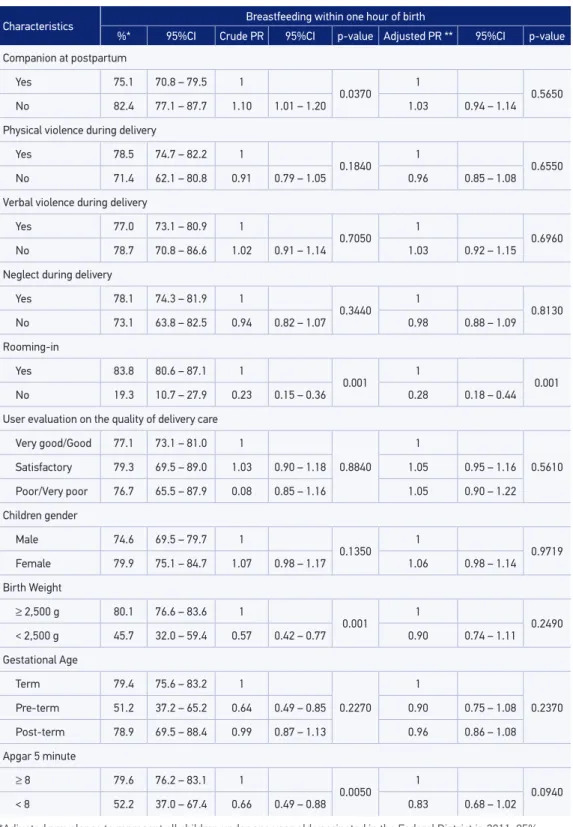
within one hour of birth. The prevalence of breastfeeding within the irst hour of life was also signiicantly higher among women who had vaginal delivery (84.4%), which stayed rooming-in with their children in the postpartum (83.8%) and among those with lower education (82.0%). Children born with weight equal or greater than 2,500 g had a higher prevalence of breastfeeding within one hour of birth, as well as those who had a com-panion in the postpartum. After adjusting for all variables of the study, it was observed that a non-proper prenatal and cesarean delivery decreased the probability of breast-feeding within one hour of birth by 28 and 12%, respectively. Standard care for newborn after delivery (no rooming-in) reduced by 72% the probability of breastfeeding within one hour of birth (Table 2).
*Unweighted sample; **prevalence adjusted to represent all children under one year of age vaccinated in the Federal District in 2011; 95%CI: 95% conidence interval.
Table 1. Continuation.
Characteristics* %** 95%CI
Breastfeeding within one hour of birth (n = 1,027)
Yes 77.3 73.8 – 80.8
No 22.7 19.2 – 26.2
User evaluation on the quality of Delivery care (n = 1,027)
Very good/Good 80.0 76.2 – 83.7
Satisfactory 12.1 8.9 – 15.2
Poor/Very poor 8.0 5.5 – 10.4
Children gender (n = 1,027)
Male 48.7 44.2 – 53.2
Female 51.3 46.8 – 55.8
Birth Weight (n = 1,009)
≥ 2,500 g 91.8 89.6 – 94.0
< 2,500 g 8.2 6.0 – 10.4
Gestational age (n = 1,027)
Term 80.7 77.3 – 84.0
Pre-term 7.2 5.2 – 9.2
Post-term 12.1 9.3 – 15.0
Apgar 5 minute (n = 1,027)
≥ 8 91.5 89.0 – 94.0
Table 2. Prevalence and prevalence ratio of breastfeeding in the irst hour of life according to socio-demographic characteristics of the mother, prenatal care, delivery, postpartum health assistance, reference to violence at delivery and child health. Federal District, Brazil, in 2011.
Continue... Characteristics Breastfeeding within one hour of birth
%* 95%CI Crude PR 95%CI p-value Adjusted PR ** 95%CI p-value
Maternal Age (in years)
≥ 35 79.0 70.1 – 87.9 1
0.6540 1
0.0750
30 to 34 75.9 70.3 – 81.6 0.96 0.84 – 1.10 0.97 0.85 – 1.10
20 to 29 75.7 68.6 – 82.8 0.96 0.83 – 1.11 1.00 0.88 – 1.15
14 to 19 80.5 73.5 – 87.4 1.02 0.88 – 1.17 1.09 0.96 – 1.25
Maternal Educationallevel (in years)
≥ 12 72.6 66.3 – 78.9 1
0.0380 1
0.0310 9 to 11 79.3 74.6 – 84.1 1.09 0.98 – 1.21 1.10 0.97 – 1.26
0 to 8 82.0 75.1 – 89.0 1.13 1.00 – 1.28 1.16 0.99 – 1.36
Maternal Race/Color
White 72.7 66.1 – 79.3 1
0.4090 1
0.4880 Black 81.2 77.3 – 85.0 1.12 1.01 – 1.24 1.08 0.99 – 1.19
Yellow/Indian 63.3 43.5 – 83.1 0.87 0.63 – 1.21 0.92 0.74 – 1.16
Adequate Prenatal
Yes 100.0 0.0 – 0.0 1
< 0.001 1 < 0.001
No 71.0 66.7 – 75.4 0.71 0.67 – 0.76 0.72 0.67 – 0.78
User evaluation on the quality of prenatal care
Very good/Good 78.7 75.0 – 82.4 1
0.1200 1
0.2590
Satisfactory 69.2 57.4 – 80.9 1.08 0.98 – 1.19 0.88 0.75 – 1.03
Poor/Very poor 69.1 48.2 – 90.0 1.08 0.92 – 1.27 1.06 0.89 – 1.27
Type of Service for childbirht
Public 79.6 75.0 – 84.1 1
0.1370 1 0.5780
Private 74.2 68.9 – 79.6 0.93 0.85 – 1.02 0.97 0.83 – 1.12
Type of delivery
Vaginal 84.4 79.7 – 89.1 1
0.0010 1 0.0100
Caesarean 72.9 68.1 – 77.6 0.86 0.79 – 0.94 0.88 0.80 – 0.97
Companion at prenatal
Yes 77.2 73.0 – 81.5 1
0.9370 1 0.1390
No 77.5 71.5 – 83.5 1.00 0.91 – 1.10 0.93 0.84 – 1.03
Companion at delivery
Yes 76.4 71.4 – 81.3 1
0.6050 1 0.6640
Table 2. Continuation.
*Adjusted prevalence to represent all children under one year old vaccinated in the Federal District in 2011; 95% conidence interval; PR: prevalence ratio; **prevalence ratio adjusted for all variables of the model.
Characteristics Breastfeeding within one hour of birth
%* 95%CI Crude PR 95%CI p-value Adjusted PR ** 95%CI p-value
Companion at postpartum
Yes 75.1 70.8 – 79.5 1
0.0370 1 0.5650
No 82.4 77.1 – 87.7 1.10 1.01 – 1.20 1.03 0.94 – 1.14
Physical violence during delivery
Yes 78.5 74.7 – 82.2 1
0.1840 1 0.6550
No 71.4 62.1 – 80.8 0.91 0.79 – 1.05 0.96 0.85 – 1.08
Verbal violence during delivery
Yes 77.0 73.1 – 80.9 1
0.7050 1 0.6960
No 78.7 70.8 – 86.6 1.02 0.91 – 1.14 1.03 0.92 – 1.15
Neglect during delivery
Yes 78.1 74.3 – 81.9 1
0.3440 1 0.8130
No 73.1 63.8 – 82.5 0.94 0.82 – 1.07 0.98 0.88 – 1.09
Rooming-in
Yes 83.8 80.6 – 87.1 1
0.001 1 0.001
No 19.3 10.7 – 27.9 0.23 0.15 – 0.36 0.28 0.18 – 0.44
User evaluation on the quality of delivery care
Very good/Good 77.1 73.1 – 81.0 1
0.8840 1
0.5610
Satisfactory 79.3 69.5 – 89.0 1.03 0.90 – 1.18 1.05 0.95 – 1.16
Poor/Very poor 76.7 65.5 – 87.9 0.08 0.85 – 1.16 1.05 0.90 – 1.22
Children gender
Male 74.6 69.5 – 79.7 1
0.1350 1 0.9719
Female 79.9 75.1 – 84.7 1.07 0.98 – 1.17 1.06 0.98 – 1.14
Birth Weight
≥ 2,500 g 80.1 76.6 – 83.6 1
0.001 1 0.2490
< 2,500 g 45.7 32.0 – 59.4 0.57 0.42 – 0.77 0.90 0.74 – 1.11
Gestational Age
Term 79.4 75.6 – 83.2 1
0.2270 1
0.2370 Pre-term 51.2 37.2 – 65.2 0.64 0.49 – 0.85 0.90 0.75 – 1.08
Post-term 78.9 69.5 – 88.4 0.99 0.87 – 1.13 0.96 0.86 – 1.08
Apgar 5 minute
≥ 8 79.6 76.2 – 83.1 1
0.0050 1 0.0940
DISCUSSION
In this study, the factors that negatively interfere in the breastfeeding within the irst hour of life, after adjusting for all variables in the model, are related to the prenatal care (not hav-ing received prenatal care appropriately), the delivery (Caesarean section) and postpartum (standard care for newborn instead of rooming-in).
The prevalence of breastfeeding within one hour of birth in this study in the Federal District (77.3%) is above the prevalence found in Brazil, in the Midwest region and in the Federal District itself in previous studies. The 2nd Research on Breastfeeding Prevalence, conducted in 2008, showed that 67.7% of all children were breastfed in the irst hour of life. In the Federal District the observed prevalence was 72.5%30. Data from the 2006 National Demographic and Health Survey (PNDS) showed that 43.0% of children breastfed in the irst hour of life in Brazil. In the Midwest, this prevalence was 39.7%. However, a compari-son of data from this study with the PNDS is limited, since the age of the children included in the two studies are diferent31.
Among the women interviewed in this study, 21.6% did not undergo prenatal properly, according to National Program of Prenatal Humanization (PHPN) criteria. However, 85.9% of respondents assessed the quality of care for prenatal care as very good or good. Leal et al.27, in a study conducted in the Legal Amazon region and in the Northeast of Brazil, showed that only 3.4% of respondents had access to prenatal classiied as appropriate. In a research in Rio de Janeiro, Domingues et al.32 found adequacy of prenatal care in only 38.5% of the investigated pregnant women. The diference between the two studies may be explained, partially, by diferences related to sampling, to access to health services and to diferent criteria for classifying prenatal care as adequate or not. With regard to the degree of satisfaction with the assistance received during the prenatal, it is known that the individ-ual expectation about the care inluences its evaluation, which often does not relect the quality of care. However, is considered an important indicator for social control33. The lit-erature has shown that women’s satisfaction with the quality of prenatal care is related to the number of doctor’s visits during prenatal34, as well as to the efective communication, attention given, conidence and respect of health professionals for them35.
All respondents classiied as receiving adequate prenatal care, breastfed in the irst hour of life. Access to medical appointments during prenatal has been identiied in the litera-ture as a protective factor for breastfeeding within one hour of birth13,36. Data from Uganda PNDS, conducted in 2006, showed that women who sought prenatal care were more likely to breastfeed within the irst hour (6 to 7%) when compared to those who did not seek pre-natal care37. Cross-sectional study conducted in Rio de Janeiro indicated that get prenatal care was a protective factor for non-breastfeeding within one hour of birth (PR = 0.23) 19.
no power to make decisions about breastfeeding their children in the irst hour of life, and shall be subject to the practices and actions of the professionals involved in the delivery, as well as to the institutional procedures in place in maternity wards. Inadequate hospital pro-cedures in healthy newborns, such as aspiration of air and gastric tract immediately after birth5 and providing food before breastfeeding9 have also been identiied in the literature as factors that may interfere in the early breastfeeding, which reinforces the importance of the WHO’s recommendation that mother and baby should not be separated in the delivery room, except if there is a medical reason to justify such action1. Therefore, the professional practice at delivery becomes crucial for breastfeeding within one hour of birth.
Cesarean section was also a factor associated to a lower prevalence of breastfeeding in the irst hour. Boccolini et al.20 observed this same trend in Rio de Janeiro. Cesarean section inluences the postponement of the irst breastfeeding40,41 due to several factors, including those related to anesthesia and the surgical procedure itself20. The prevalence of cesarean delivery in this study was high (61.5%), and also higher than that observed in Brazil (55.4%)41, which indicates the need to review the current professional practice that elects caesarean section as a routine procedure, since Brazil accounted for 15% of the unnecessary cesare-ans occurred globally in 200842.
The prevalence of breastfeeding within one hour of birth was higher among moth-er-child pairs who remained rooming-in (83.8%), maintaining the association (PR = 0.28) even after adjusting for all study variables. Rooming-in is a hospital environment that enables the mother and her baby to remain together during the whole postpartum hospital stay43. Several studies have demonstrated the importance of the rooming-in for breastfeeding, providing greater conidence to the mother in relation to the latch-on and proper position-ing for breastfeeding, autonomy to understand and care for the child, in addition to providing increased interaction between mothers and health professionals, which can take advantage of this environment to address essential aspects to enhancing the efectiveness of breast-feeding44,45. Cochrane systematic review found that the prevalence of exclusive breastfeed-ing until the fourth day before hospital discharge was higher among women who remained rooming-in than among those who were separated from their child46.
1. Children’s Rights & Emergency Relief Organization (UNICEF), World Health Organization (WHO). Baby-friendly hospital initiative: revised, updated and expanded for integrated care. Section 4, Hospital self-appraisal and monitoring. Geneva: UNICEF/ WHO; 2009.
2. World Health Organization (WHO). Maternal, newborn, child and adolescent health approved by the WHO Guidelines Review Committee. Handbook for guideline development. Geneva: WHO; 2012.
3. Victora CG, Horta BL, Mola CL, Quevedo L, Pinheiro RT, Gigante DP, et al. Association between breastfeeding and intelligence, educational attainment, and income at 30 years of age: a prospective birth cohort study from Brazil. Lancet 2015; 3(4): 199-205.
4. World Health Organization (WHO). Global strategy for infant and young child feeding. A joint WHO/ UNICEF statement. Geneve: WHO; 2003.
5. Children’s Rights & Emergency Relief Organization (UNICEF), World Health Organization (WHO). Baby-friendly hospital initiative: revised, updated and expanded for integrated care. Section 3, Breastfeeding promotion
and support in a baby-friendly hospital: a 20-hour course for maternity staf. Geneve: WHO; 2009.
6. Boccolini CS, Carvalho ML, Oliveira MIC, Pérez-Escamilla R. Breastfeeding during the irst hour of life and neonatal mortality. J Pediatr 2013; 89(2): 131-6.
7. Edmond KM, Zandoh C, Quigley MA, Amenga-Etego S, Owusu-Agyei S, Kirkwood BR. Delayed breastfeeding initiation increases risk of neonatal mortality. Pediatrics 2006; 117(3): 380-6.
8. Esteves TMB, Daumas RP, Oliveira MIC, Andrade CAF, Leite IC. Fatores associados à amamentação na primeira hora de vida: revisão sistemática. Rev Saúde Pública 2014; 48(4): 697-703.
9. El-Gilany AH, Sarraf B, Al-Wehady A. Factors associated with timely initiation of breastfeeding in Al- Hassa province, Saudi Arabia. East Mediterr Health J 2012; 18(3): 250-4.
10. Senarath U, Siriwardena I, Godakandage SS, Jayawickr ama H, Fer nando DN, Dibley MJ. Determinants of breastfeeding practices: an analysis of the Sri Lanka Demographic and Health Survey 2006-2007. Matern Child Nutr 2012; 8(3): 315-29.
REFERENCES
CONCLUSION
The conduction of researches during the vaccination campaigns has been a widely employed strategy in Brazil due to the following advantages: data is obtained quickly, sur-vey is conducted with a relatively low cost, it allows the mobilization and involvement of local managers11,24,27. However, this type of research can only be performed if the National Immunization Program maintains the continuity of the “D-Day” in vaccination campaigns.
With regard to the limitations of this study, we can mention that the main investigation objec-tive of the Federal District Call was not the factors associated with breastfeeding within one hour of birth, which limited the inclusion of other important information that could be associated with this outcome such as: if the mother received help while positioning the child for breast-feeding, if breastfeeding was initiated at the delivery room, if inadequate hospital procedures were performed in healthy newborns as aspiration in upper airways and pharynx, among other aspects, in addition to the inclusion of the population living in rural areas of the Federal District.
11. Brasil. Ministério da Saúde. Secretaria de Atenção à Saúde. Departamento de Ações Programáticas e Estratégicas. II Pesquisa de Prevalência de Aleitamento Materno nas Capitais Brasileiras e Distrito Federal. Brasília: Ministério da Saúde; 2009.
12. Moreira MEL, Gama SGN, Pereira APE, Silva AAM, Lansky S, Pinheiro RS, et al. Práticas de atenção
hospitalar ao recém-nascido saudável no Brasil. Cad Saúde Pública 2014; 30(Suppl 1): 128-39.
13. Patel A, Badhoniya N, Khadse S, Senarath U, Agho KE, Dibley MJ, et al. Infant and young child feeding indicators and determinants of poor feeding practices in India: secondary data analysis of National Family Health Survey 2005-06. Food Nutr Bull 2010; 31(2): 314-33.
14. Oliveira MI, Silva KS, Gomes Junior SC, Fonseca VM. Delivering rapid HIV tests results after delivery: a threat to breastfeeding at birth. Rev Saúde Pública 2010; 44(1): 60-9.
15. Will TK, Arndt JG, Torres GG, Andrade JR, Pereira TSS, Molina MCB. Fatores de proteção para a amamentação na primeira hora de vida. Rev Bras Promoc Saúde 2013; 26(2): 274-80.
16. Adugna DT. Women’s perception and risk factors for delayed initiation of breastfeeding in Arba Minch Zuria, Southern Ethiopia. Int Breastfeed J 2014; 9: 8.
17. Setegn T, Gerbaba M, Belachew T. Determinants of timely initiation of breasftfeeding among mothers in Goba Woreda, South East Ethiopia: a cross sectional study. BMC Public Health 2011; 11: 217.
18. Vieira TO, Vieira GO, Giugliani ER, Mendes CM, Martins CC, Silva LR. Determinants of breastfeeding initiation within the irst hour of life in a Brazilian population: cross-sectional study. BMC Public Health 2010; 10: 760.
19. Pereira CRVR, Fonseca VM, Oliveira MIC, Souza IEO, Mello RR. Avaliação de fatores que interferem na amamentação na primeira hora de vida. Rev Bras Epidemiol 2013; 16(2): 525-34.
20. Boccolini CS, Carvalho ML, Oliveira MIC, Vasconcelos AGG. Fatores associados à amamentação na primeira hora de vida. Rev Saúde Pública 2011; 45(1): 69-78.
21. Boccolini CS, Carvalho ML, Oliveira MIC, Leal MC, Carvalho MS. Fatores que interferem no tempo entre o nascimento e a primeira mamada. Cad Saúde Pública 2008; 24(11): 2681-94.
22. Silveira RB, Albernaz E, Zuccheto LM. Fatores associados ao início da amamentação em uma cidade do sul do Brasil. Rev Bras Saúde Mater Infant 2008; 8(1): 35-43.
23. Governo do Distrito Federal. Secretaria de Estado de Saúde. Relatório estatístico da Secretaria de Estado de saúde do Distrito Federal e Hospital Universitário de Brasília. Brasília: Secretaria de Estado de Saúde; 2011.
24. Santos LM, Paes-Sousa R, Silva Junior JB, Victora CG. National Immunization Day: a strategy to monitor health and nutrition indicators. Bull World Health Organ 2008; 86(6): 474-9.
25. Brasil. Ministério da Saúde. Secretaria de Ciência, Tecnologia e Insumos Estratégicos. Departamento de Ciência e Tecnologia. Avaliação da atenção ao pré-natal, ao parto e aos menores de um ano na Amazônia Legal e no Nordeste, Brasil, 2010. Brasília: Ministério da Saúde; 2013.
26. Souza KJ. Violência institucional na atenção obstétrica: proposta de modelo preditivo para depressão pós-parto [dissertação de mestrado]. Brasília: Universidade de Brasília; 2014.
27. Leal MC, Theme-Filha MM, Moura EC, Cecatti JG, Santos LMP. Atenção ao pré-natal e parto em mulheres usuárias do sistema público de saúde residentes na Amazônia Legal e no Nordeste, Brasil 2010. Rev Bras
Saúde Mater Infant 2015; 15(1): 91-104.
28. Ballard JL, Khoury JC, Weding K, Wang L, Eilers-Ealsman BL, Lipp R. New Ballard Score, expanded to include extremely premature infants. J Pediatr 1991; 119(3): 417-23.
29. Apgar V. A proposal for a new method of evaluation of the newborn infant. Curr Res Anesth Analg 1953; 32(4): 260-7.
30. Venancio SI, Escuder MML, Saldiva SRDM, Giugliani ERJ. A prática do aleitamento materno nas capitais brasileiras e Distrito Federal: situação atual e avanços. J Pediatr 2010; 86(4): 317-24.
31. Brasil. Ministério da Saúde. Pesquisa Nacional de Demograia e Saúde da Criança e da Mulher – PNDS 2006. Brasília: Ministério da Saúde; 2008.
32. Domingues RMSM, Hartz ZMA, Dias MAB, Leal MC. Avaliação da adequação da assistência pré-natal na rede SUS do Município do Rio de Janeiro, Brasil. Cad Saúde Pública 2012; 28(3): 425-37.
33. Espiridião MA, Trad LAB. Avaliação de satisfação de usuários: considerações teórico-conceituais. Cad Saúde Pública 2006; 22(6): 1267-76.
34. Vieira SM, Bock LF, Zocche DA, Pessota CU. Percepção das puérperas sobre a assistência prestada pela equipe de saúde no pré-natal. Texto Contexto Enferm 2011; 20(Esp): 255-62.
35. Queiroz MVO, Jorge MSB, Marques JF, Cavalcante AM, Moreira KAP. Indicadores de qualidade da assistência ao nascimento baseados na satisfação de puérperas. Texto Contexto Enferm 2007; 16(3): 479-87.
37. Bbaale E. Determinants of early initiation, exclusiveness, and duration of breastfeeding in Uganda. J Health Popul Nutr 2014; 32(2): 249-60.
38. Regan J, Thompson A, DeFranco E. The inluence of mode of delivery on breastfeeding initiation in women with a prior cesarean delivery: a population-based study. Breastfeed Med 2013; 8(2): 181-6.
39. Holbrook KE, White MC, Heyman MB, Wojcicki J. Maternal sociodemograic characteristics and the use of the Iowa Infant Attitude Feeding Scale to describe breastfeeding initiation and duration in a population of urban, Latina mothers: a prospective cohort study. Int Breastfeed J 2013; 8(1): 7-14.
40. Zanardo V, Svegliado G, Cavallin F, Giustardi A, Cosmi E, Litta P, et al. Elective cesarean delivery: does it have a negative efect on breastfeeding? Birth 2010; 37(4): 275-79.
41. Domingues RMSM, Dias MAB, Nak amur a-Pereira M, Torres JA, D’Orsi E, a-Pereira APE, et al. Processo de decisão pelo tipo de parto no Brasil: da preferência inicial das mulheres à via de parto final. Cad Saúde Pública 2014; 30(Suppl 1): 101-16.
42. Gibbons L, Belizán JM, Lauer JA, Betrán AP, Merialdi M, Althabe F. World Health Report. Health systems inancing. The global numbers and costs of additionally needed and unnecessary caesarean sections performed per year: overuse as a barrier to universal coverage. Geneve; 2010.
43. Brasil. Ministério da Saúde. Portaria nº 1016, de 26 de agosto de 1993. Normas básicas de alojamento conjunto. Brasília: Diário Oicial da União.
44. Beck AMO, Assunção KO, Barbosa LR, Gomes E. Influência do ambiente hospitalar nos aspectos relacionados ao aleitamento materno. Rev Soc Bras Fonoaudiol 2012; 17(4): 464-8.
45. Rodrigues AP, Padoin SMM, Guido LA, Lopes LLD. Fatores do pré-natal e do puerpério que interferem na autoeicácia em amamentação. Esc Anna Nery 2014; 18(2): 257-61.
46. Jaafar SH , Lee KS , Ho JJ. Separate care for new mother and infant versus rooming-in for increasing the duration of breastfeeding. Cochrane Database Syst Rev 2012; CD006641.
47. D’Orsi E, Brüggemann OM, Diniz CSG, Aguiar JM, Gusman CR, Torres TA, et al. Desigualdades sociais e satisfação das mulheres com o atendimento ao parto no Brasil: estudo nacional de base hospitalar. Cad Saúde Pública 2014; 30(Suppl 1): 154-68
48. Aquino EML. Para reinventar o parto e o nascimento no Brasil: de volta ao futuro. Cad Saúde Pública 2014; 30 (Suppl): S8-10.
49. Foster DA, McLachalan HL. Breastfeeding initiation and birth setting practices: a review of the literature. J Midwifery Womens Health 2007; 52(3): 273-80.
Received on: 05/29/2015