REV BRAS HEMATOL HEMOTER. 2014;36(1):1-2
Revista Brasileira de Hematologia e Hemoterapia
Brazilian Journal of Hematology and Hemotherapy
www.rbhh.org
The Guidelines Project of the Associação Médica Brasileira (AMB) and of the Conselho Federal de Medicina (CFM) began in 2000 with specialist societies participating in the preparation of the texts. The guidelines are based on research and contain solid advice on the diagnosis, therapy, and prevention of diseases. Grounded in evidence-based medicine, they seek to answer specific or crucial questions regarding the disease. A review of the literature is performed and, using pre-established criteria, studies on the disease are selected and graded according to their characteristics and type. Randomized clinical trials and meta-analyses have the highest value (A). Second in importance are observational and clinical studies (B), then case reports and case series (C), and finally, publications of consensuses and opinions (D). Due to the methodology employed, current systematic reviews are clearly more relevant when compared to those written in the past. Historically, reviews were much more based on personal opinions and subject to the author’s interest, that is, more concerned with the individual point of view and based on personal experience.1
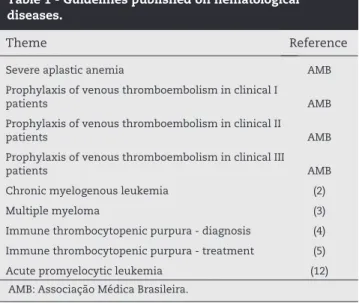
The Associação Brasileira de Hematologia, Hemoterapia e Terapia Celular (ABHH) began to participate effectively in the development of the guidelines of the AMB in 2009, with contributions by several experts as shown in Table 1; previously, the collection was limited, with fewer themes. After 2012, guidelines on several diseases were completed and published in the Revista Brasileira de Hematologia e Hemoterapia (RBHH); chronic myelogenous leukemia,2 multiple myeloma,3 and diagnosis4 and treatment of immune thrombocytopenic
Editorial
The Guidelines Project: Brazilian guidelines for acute
promyelocytic leukemia
Milton Artur Ruiz*
Editor-in-chief Revista Brasileira de Hematologia e Hemoterapia (RBHH), São José do Rio Preto, SP, Brazil
*Corresponding author at: Rua Catarina Nucci Parise, 760, Jardim Vivendas, 15090-470 São José do Rio Preto, SP, Brazil. E-mail address: [email protected] (M.A. Ruiz).
1516-8484/$ - see front matter © 2014 Associação Brasileira de Hematologia, Hemoterapia e Terapia Celular. Published by Elsevier Editora Ltda. All rights reserved.
DOI: 10.5581/1516-8484.20140001
purpura.5 It is also important to quote other systematic reviews published in the RBHH, such as preventive practices in long-term hematopoietic stem cell transplantation survivors, with the participation of experts from several different countries.6 The consensus of the Sociedade Brasileira de Transplante de Medula Óssea (SBTMO) produced the famous ‘Pink Book’; this was rounded out with two publications on transplantation in acute myeloid leukemia7 and autoimmune diseases.8
Theme Reference
Severe aplastic anemia AMB
Prophylaxis of venous thromboembolism in clinical I
patients AMB
Prophylaxis of venous thromboembolism in clinical II
patients AMB
Prophylaxis of venous thromboembolism in clinical III
patients AMB
Chronic myelogenous leukemia (2)
Multiple myeloma (3)
Immune thrombocytopenic purpura - diagnosis (4) Immune thrombocytopenic purpura - treatment (5)
Acute promyelocytic leukemia (12)
AMB: Associação Médica Brasileira.
Table 1 - Guidelines published on hematological diseases.
2
REV BRAS HEMATOL HEMOTER. 2014;36(1):1-2encompasses 10% to 15% of all myeloid-type leukemias. Its molecular bases are well defined, with different variations influencing the treatment of patients.9 The results, as reported by the International Consortium on APL, established the treatment strategies and the conduct for the disease in developing countries.10,11
The guidelines for the diagnosis and treatment of APL12 are published in this issue of the RBHH, the first in 2014, thereby adding to those already published. Hopefully, this will stimulate other experts to continue this hard work, aiming to contribute to medical practice and to solidify the knowledge on the diagnoses and treatment of hematologic diseases.
R E F E R E N C E S
1. Ruiz MA. Reviews and guidelines: Evidence of progress and a starting point for standardization and changes. Rev Bras Hematol Hemoter. 2013;35(2):75-6.
2. Souza CA, Pagnano KB, Bendit I, Conchon M, Freitas CM,et al. Chronic myeloid leukemia treatment guidelines: Brazilian Association of Hematology, Hemotherapy and Cell Therapy. Brazilian Medical Association Guidelines Project – 2012. Rev Bras Hematol Hemoter. 2012;34(5):367-82.
3. Hungria VT, Crusoe ET, Quero AA, Sampaio M, Maiolino A, Bernardo WM. Guidelines on the diagnosis and management of multiple myeloma treatment: Associação Brasileira de Hematologia e Hemoterapia e Terapia Celular. Project guidelines: Associação Médica Brasileira – 2012. Rev Bras Hematol Hemoter. 2013;35(3):201-17.
4. Braga JA, Loggetto SR, Hoepers AT, Bernardo WM, Medeiros L, Veríssimo MP. Guidelines on the diagnosis of primary immune thrombocytopenia in children and adolescents: Associação Brasileira de Hematologia, Hemoterapia e Terapia Celular. Guidelines Project: Associação Médica Brasileira – 2012. Rev Bras Hematol Hemoter. 2013;35(5):358-65.
5. Loggetto SR, Braga JA, Veríssimo MP, Bernardo WM, Medeiros L, Hoepers AT. Guidelines on the treatment of primary
immune thrombocytopenia in children and adolescents: Associação Brasileira de Hematologia, Hemoterapia e Terapia Celular. Guidelines Project: Associação Médica Brasileira – 2012. Rev Bras Hematol Hemoter. 2013;35(6):417-27. 6. Majhail NS, Rizzo JD, Lee SJ, Aljurf M, Atsuta Y, Bonfim C,
et al. Recommended screening and preventive practices for long-term survivors after hematopoietic cell transplantation. Rev Bras Hematol Hemoter. 2012;34(2):109-33.
7. Silla LM, Dulley F, Saboya R, Paton E, Kerbauy F, Arantes AM, Hamerschlak N. Bone marrow transplantation and acute myeloid leukemia: Brazilian guidelines. Rev Bras Hematol Hemoter. 2013;35(1):56-61.
8. Rodrigues MC, Hamerschlak N, Moraes DA, Simões BP, Rodrigues M, Ribeiro AA, Voltarelli JC. Guidelines of the Brazilian Society of Bone Marrow Transplantation on hematopoietic stem cell transplantation as a treatment for the autoimmune diseases systemic sclerosis and multiple sclerosis. Rev Bras Hematol Hemoter. 2013;35(2):134-43. 9. Bassi SC, Rego EM. Molecular basis for the diagnosis and
treatment of acute promyelocytic leukemia. Rev Bras Hematol Hemoter. 2012;34(2):134-9.
10. Rego EM, Kim HT, Ruiz-Argüelles GJ, Undurraga MS, Uriarte Mdel R, Jacomo RH, et al. Improving acute promyelocytic leukemia (APL) outcome in developing countries through networking, results of the International Consortium on APL. Blood. 2013;121(11):1935-43.
11. Rego EM. The results of the International Consortium on Acute Promyelocytic Leukemia: a ‘proof of concept’ of networking as a strategy to improve the outcome of treatment of hematological malignancies in developing countries. Rev Bras Hematol Hemoter. 2013;35(1):1-2. 12. Pagnano KB, Rego EM, Rohr S, Chauffaille ML, Jacomo