Excessive daytime sleepiness
in the elderly: association with
cardiovascular risk, obesity
and depression
Sonolência diurna excessiva em
idosos: associação com risco de
disfunção cardiovascular, depressão
e obesidade
Johnnatas Mikael LopesI Fábio Galvão DantasII
Jovany Luis Alves de MedeirosIII
IPhysical Therapy course at School of Health Sciences of Trairi at at Universidade
Federal do Rio Grande do Norte – Santa Cruz (RN), Brazil.
IIDepartmanet of Physical Therapy at Universidade Estadual da Paraíba –
Campinas Grande (PB), Brazil.
IIIMaster’s Public Health Program of Universidade Estadual da Paraíba;
Neurologist – Campina Grande (PB), Brazil.
Corresponding author: Johnnatas Mikael Lopes. Faculdade de Ciências da Saúde do Trairi da Universidade Federal do Rio Grande do Norte. Avenida Rio Branco, s/n, Centro, CEP: 59200-000, Santa Cruz, RN, Brazil. E-mail: [email protected]
Conlict of interests: nothing to declare.
Abstract
Objective: To observe the relationship between Excessive Daytime Sleepiness (EDS) and the presence of risk factors for cardiovascu-lar dysfunction, depression and obesity in the elderly. Methods: We interviewed 168 elderly from the community of Campina Grande, Paraíba. hey were selected accord-ing to health districts in the period of 2010. We used the Epworth Sleepiness Scale to diagnose excessive daytime sleepiness (> 10 points); waist circumference for the risk of cardiovascular dysfunction (> 94 or > 80 cm); Geriatric Depression Scale for depression (>10 points) and body mass index for obesity (> 25 kg/m2). Association analysis was performed
by the Chi-square test adjusted for sex and age group, adopting α ≤ 0.05. Results: One hundred and sixty eight elderly individuals with mean age of 72.34 ± 7.8 years old par-ticipated in this study, being 122 (72.6%) women. EDS was identiied in 53 (31.5%) of them; depression, in 72 (42.9%); overweight/ obesity, in 95 (64.46%); and risk of cardiovas-cular dysfunction, in 129 (79.6%). Depressed men (78.6%, p = 0.0005) and risk of cardio-vascular dysfunction (57.1%, p = 0.02) were more prone to EDS. In women, only obesity was related to sleepiness (42.1%, p = 0.01). Only those aged between 70 – 79 years old showed association between sleepiness and obesity. Conclusion: It was found that obesity for women, and depression and cardiovascu-lar dysfunction risking for men were associ-ated with EDS in the elderly. he variable sex is a confusion condition for the association with sleepiness.
Resumo
Objetivo: Observar a relação entre a Sonolência Diurna Excessiva (SDE) e a presença de fatores de risco de disfunção cardiovascular, depressão e obesidade em idosos. Métodos: Foram entre-vistados 168 idosos comunitários em Campina Grande, Paraíba. Eles foram selecionados alea-toriamente de acordo com os distritos sanitários no ano de 2010. O diagnóstico da sonolência diurna excessiva era dado pela Escala de Sonolência de Epworth (> 10 pontos), risco de disfunção cardiovascular pela circunferên-cia da cintura (> 94 ou > 80 cm), a depressão pela Escala de Depressão Geriátrica (> 10 pon-tos) e a obesidade através do índice de massa corpórea (> 25 kg/m2). Foi realizada análise de
associação por meio do Teste do χ2 com
ajus-tamento para o sexo e a faixa etária, adotando--se um α ≤ 0,05. Resultados: Participaram 168 idosos com média de idade de 72,34 ± 7,8 anos, sendo 122 (72,6%) mulheres. A SDE foi identiicada em 53 (31,5%) idosos, depres-são em 72 (42,9%), sobrepeso/obesidade em 95 (64,46%) e risco de disfunção cardiovascu-lar em 129 (79,6%). Homens depressivos (78,6%; p = 0,0005) e com risco de disfunção cardiovas-cular (57,1%; p = 0,02) estavam mais propensos a apresentar SDE. Nas mulheres, apenas a obe-sidade mostrou-se relacionada com a sonolência (42,1%; p = 0,01). Somente idosas entre 70 – 79 anos apresentaram associação entre sonolên-cia e obesidade. Conclusão:Veriicou-se que a obesidade em mulheres, depressão e risco de disfunção cardiovascular em homens revela-ram associação com a SDE em idosos. A variável sexo é uma condição de confundimento para as associações com a sonolência.
Palavras-chave: Sono. Distúrbios do sono por sonolência excessiva. Idoso. Obesidade. Doenças cardiovasculares. Depressão.
Introduction
Excessive daytime sleepiness (EDS) is char-acterized by the increased need to take naps during the day at times when the individual should be alert and active1. It is subjacent
to sleep fragmentation and its reduced ei-ciency2,3, composing the scope of symptoms
of sleep respiratory disorders, such as the Obstructive Sleep Apnea Syndrome (OSAS). However, there is evidence that EDS is not only a result of OSAS, since it can be an indepen-dent variable of this disease4. For these cases,
it is possible that obesity4-6, the metabolic
syn-drome4,7, heart diseases8-10, and depression11-13
can be related to EDS.
here is an association between EDS and the changes in the autonomic cardiovascular con-trol, which could predispose to heart disease14.
Empana et al.9 observed that EDS inluenced
the 33% increase in the risk of death for heart disease among the elderly, thus indicating to be an independent cardiovascular risk factor. Studies show that the reduced sleep duration can also be involved in the increased mortality due to cardiovascular dysfunction2,8,10. he risk
for this condition can be indirectly estimated by waist circumference15.
Psychiatric disorders also presented asso-ciation with EDS, especially depression11,16, since
this condition is considered to be a major pub-lic health issue among the elderly17. Jaussent et
al.18 observed that the EDS is an independent risk
factor for the occurrence of depression. Chellapa and Araújo12 found a strong association between
EDS and severe depression. Lessov-Schlagga et al.11 veriied a relationship between depression
symptoms and EDS among men. On the other hand, Calati et al.13 did not ind any association
between depression and EDS among women. here seems to be an association between obesity and EDS4-7,19. Vorona6 observed that
individuals with overweight/obesity slept less than people with BMI lower to that established by the World Health Organization. Carmelli et al.20 veriied the correlation between
Several studies have shown that EDS is an independent risk factor for accidents2 and
mor-tality for heart disease9, and, when associated to
respiratory sleep disorders it increases general mortality among the elderly23. herefore, it is
necessary to observe to what point the presence of EDS is afected by or afects variables such as obesity6,7, depression11 and cardiovascular
morbidity8-10; this theme is widely discussed
in literature, and there is disagreement among specialists.
We conducted this study with an elderly population with the objective of assessing pos-sible associations between EDS and obesity, depression and risk of cardiovascular dysfunc-tion, and also to ind out if these relations are diferent among men and women or in relation to aging.
Methods
Study design and variables
It is a cross-sectional population-based study carried out in the city of Campina Grande, Paraíba, in 2010, including elderly inhabitants of the urban zone. Individuals from the community aged more than 60 years old with mental and physical skills to perform the assigned tests were included. Elderly in institutional environment and unskilled to answer to the methodologies of the study were excluded from the research.
EDS was diagnosed by the Epworth Sleepiness Scale. EDS was diagnosed by more than 10 points in that scale24. he depression
diagnosis was determined by the Geriatric Depression Scale, which classiied as medium depression scores from 11 to 20, and moderate/ severe depression scores higher than 21 points25.
BMI was an indicator of nutritional status: values lower than 18.4 kg/m2 are considered as
low weight; between 18.5 and 24.9 kg/m2,
eutro-phy; between 25 and 29.9 kg/m2, overweight;
and 30 kg/m2 or higher, obesity26,27.
he risk of cardiovascular dysfunction was estimated by waist circumference, in which for men values between 94 and 101 were classified as increased, and values higher than 102 cm were substantially increased;
for women, values from 80 and 87 cm were considered as increased and those higher than 88 cm were considered as substantially increased27,28. Gender and age of the
partici-pants were also collected as identiication. Height was measured in centimeters by a wall-mounted stadiometer from WISO
®
, with 0.1 cm precision, while the mass of the elderly participants was measured by a GEOM®
digital scale, with 150 kg capacity and 100 g precision. Finally, waist circumference was measured by a non-elastic metric tape in the mid-region between the last rib and the iliac crest28. All ofthe anthropometric measures and the appli-cation of the instruments were conducted by trained students of the Physical herapy and Psychology courses, and the concordance of measurements was estimated.
Population and Sample
his study was part of a larger project that aimed at estimating the prevalence of EDS; therefore, the obtainment of an ideal sample was based on the following equation: {[µ2 x p
(1-p)] x c}/ε2, where µ is the conidence limit
for a 5% probability error (µ = 1.96), p is the estimated outcome prevalence (p = 20%), c is the correction coeicient of the sample (c = 1.2), considering that it is a conglomerate sample, and ε is the margin of error of the estimates for estimated prevalence (ε = 6%). herefore, the estimated sample is comprised of 205 participants. Besides, the elderly population of the city of Campina Grande, Paraíba, was considered to be ininite.
of households in the neighborhood and the number of elderly people to be visited. In case there were no elderly people in the selected household, the next house should be veri-ied and, if necessary, the previous one. If there was more than one elderly person in the house, data collection was conducted with all of them.
Statistical Analysis
In order to analyze the relationship between EDS and depression, overweight/ obesity and risk factor for cardiovascular dysfunction, the Pearson chi-square Test was used in 2x2 contingency situations and linear association, when contingency presented an ordinal characteristic. There was also adjustment for gender and age group (60 – 69 years old, 70 – 79 years old, and 80 years old or more), in the attempt to verify any influence of these variables on the relationship between EDS and over-weight/obesity, depression and increased and substantially increased waist circum-ference. Therefore, a 5% significance level was adopted in order to avoid the type I error. The Statistical Package for the Social Sciences (SPSS), version 17.0, was used.
Ethical Procedures
The study was approved by the Ethics Committee of Universidade Estadual da Paraíba, based on Resolution n. 196/96 of the National Health Council, with protocol 0299.0.133.000-09. he participants signed duplicates of the Informed Consent Form, which explicated the objectives of the research and those in charge of it. he authors declared there was no conlict of interests.
Results
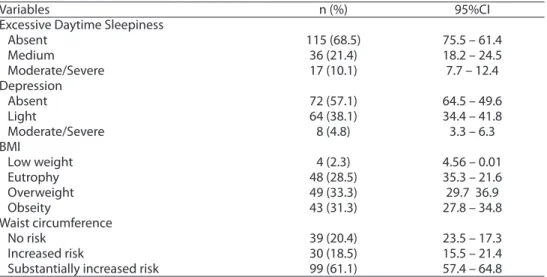
EDS was prevalent in 53 cases (31.5%; 95%CI; 27.9 – 35.0) among the 168 analyzed elderly people, which represent 81.9% of the estimated sample. he obtained loss is a result of refusals to participate in the study. Age ranged from 60 to 98 years old, mean of 72.34 ± 7.8 years, and 122 (72.6%) were women. Depression afected 72 participants (42.9%; 95%CI; 39.1 – 46.7). BMI was higher than 25 kg/m2 in 95 patients (64.6%;
95%CI; 60.9-68.3). Waist circumference was increased in 129 members of the sample (79.6%; 95%CI; 76.4 – 82.7) (Table 1).
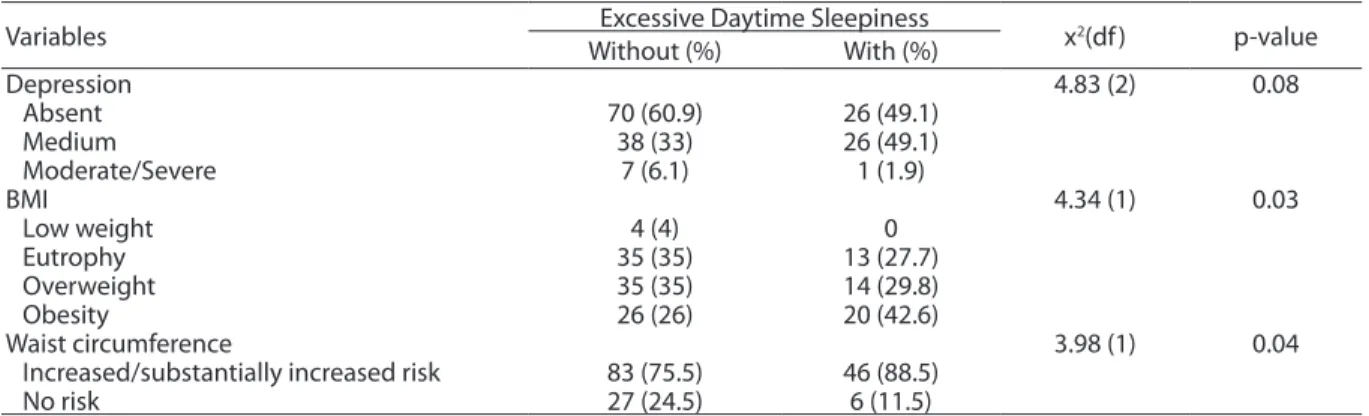
Table 2 presents the crude association between study variables and EDS. here was no diference in the frequency of depression
Table 1 - Prevalence of Excessive Daytime Sleepiness, depression, obesity and increased waist circumference in the elderly.
Tabela 1 - Prevalência de Sonolência Diurna Excessiva, depressão, obesidade e circunferência da
cintura aumentada em idosos.
BMI: Body mass index; 95%CI: Conidence interval 95%.
BMI: índice de massa corpórea; 95%CI: Intervalo de coniança de 95%.
Variables n (%) 95%CI
Excessive Daytime Sleepiness
Absent 115 (68.5) 75.5 – 61.4
Medium 36 (21.4) 18.2 – 24.5
Moderate/Severe 17 (10.1) 7.7 – 12.4
Depression
Absent 72 (57.1) 64.5 – 49.6
Light 64 (38.1) 34.4 – 41.8
Moderate/Severe 8 (4.8) 3.3 – 6.3
BMI
Low weight 4 (2.3) 4.56 – 0.01
Eutrophy 48 (28.5) 35.3 – 21.6
Overweight 49 (33.3) 29.7 36.9
Obseity 43 (31.3) 27.8 – 34.8
Waist circumference
No risk 39 (20.4) 23.5 – 17.3
Increased risk 30 (18.5) 15.5 – 21.4
Variables Excessive Daytime Sleepiness x2(df ) p-value Without (%) With (%)
Depression 4.83 (2) 0.08
Absent 70 (60.9) 26 (49.1)
Medium 38 (33) 26 (49.1)
Moderate/Severe 7 (6.1) 1 (1.9)
BMI 4.34 (1) 0.03
Low weight 4 (4) 0
Eutrophy 35 (35) 13 (27.7)
Overweight 35 (35) 14 (29.8)
Obesity 26 (26) 20 (42.6)
Waist circumference 3.98 (1) 0.04
Increased/substantially increased risk 83 (75.5) 46 (88.5)
No risk 27 (24.5) 6 (11.5)
Variables
Excessive Daytime Sleepiness
Male Female
Without (%)
With
(%) x
2(df ) p-value Without (%)
With
(%) x
2(df ) p-value
Depression 10.41 (2) 0.005 0.82 (2) 0.66
Absent 22 (71.0) 9 (29.0) 48 (73.8) 17 (26.2)
Medium 3 (21.4) 11 (78.6) 35 (70.0) 15 (30)
Moderate/Severe 1 (100.0) 0 6 (85.0) 1 (14.3)
BMI 0.12 (2) 0.93 6.7 (3) 0.01
Low weight 0 0 4 (100.0) 0
Eutrophy 8 (57.1) 6 (42.9) 27 (79.4) 7 (20.6)
Overweight 8 (57.1) 6 (42.9) 27 (77.1) 8 (22.9)
Obesity 4 (50.0) 4 (50.0) 22 (57.9) 16 (42.1)
Waist circumference 4.84 (1) 0.02 2.05 (1) 0.15
Increased/substantially
increased risck 12 (42.9) 16 (57.1) 71 (70.3) 30 (29.7)
No risk 13 (76.5) 4 (23.4) 14 (87.5) 2 (12.5)
Table 2 - Association of Excessive Daytime Sleepiness with depression, body mass index and waist circumference in the elderly.
Tabela 2 - Associação da Sonolência Diurna Excessiva com a depressão, índice de massa corpórea e circunferência da cintura em idosos.
df:degree of freedom; BMI: body mass index.
df: grau de liberdade; BMI: índice de massa corpórea.
df:degree of freedom; BMI: body mass index.
df: grau de liberdade; BMI: índice de massa corpórea.
among the elderly with EDS (50.1%) and without EDS (39.1%). Elderly with BMI higher than 30 kg/m2 presented more prevalence of
EDS than those with BMI below this thresh-old (p = 0.03), being 42.6% of obese people, which means 2.5 times more risk of developing EDS. he increased or substantially increased cardiovascular dysfunction was associated with the occurrence of EDS: elderly with EDS had 2.07 times more chances of having cardiovascular risk.
After gender adjustment, it was observed that depression is a variable associated with EDS only among men [11 (78.6%) and 9
(21.4%); p = 0.005], being depression 3.6 times more prevalent among the elderly with EDS (Table 3). Women presented rela-tionship between obesity and occurrence of EDS [16 (42.1%); p = 0.01]. he increased or substantially increased waist circumference was associated with EDS only among male participants [16 (57.1%); p = 0.02] (Tabela 3). Age group adjustment (data not shown) revealed association between overweight [7 (41.2%)] and obesity [10 (62.5%)] and EDS among the elderly women aged from 70 to 79 years old (p = 0.02); age group had no influence on the other found associations.
Table 3 - Association of Excessive Daytime Sleepiness with depression, body mass index and waist circumference in elderly sex adjusted.
Tabela 3 - Associação da Sonolência Diurna Excessiva com a depressão, índice de massa corpórea e circunferência da cintura em
Discussion
In this study, male elderly participants with depression and increased waist circum-ference had more prevalence of EDS. Elderly obese women were associated with EDS only for the age group of 70 – 79 years old. In this population study with elderly people living in a country city of Northeast Brazil, it was possible to ind: high prevalence of depres-sion, overweight/obesity and increased waist circumference, which are known as a risk factor for cardiovascular disease15.
EDS is a public health issue. his condition is an independent risk factor for morbidity and mortality resulting from cardiovascular disease9, as well as general mortality23. here
are reports that both the reduction and the excessive sleep can increase the risk of mortality due to cardiovascular disease8,10.
In this study, the increased circumference, which is an indirect measurement of the risk for cardiovascular dysfunction, was associ-ated with EDS, and was observed only among male participants.
Depression was considered as the main public health problem among the elderly17.
Duarte and Rego30 found a 23.4%
preva-lence of depression among the interviewed elderly, while Oliveira, Gomes and Oliveira31
observed the occurrence of depression in 31% of the elderly attending community centers. The association between depression and EDs has been previously reported12,18,
even though Calati et al.13 did not observe
significant frequency of depression among women with EDS. However, in their study, the analyzed women had mean age of 34.17 ± 11.37 years old. Bixler et al.4 investigated a
general population sample and concluded that depression is the main factor associated with EDS. Lessov-Schlaggar et al.11
stud-ied elderly twins in the United States and observed an association between depres-sion and EDS only among men. The authors believe that this superposition is owed to genes that determine both dysfunctions. The authors in this study do not entirely agree with this explanation, since there is great interaction between genes and
environmental factors; many times, genes are only active in specific circumstances of the environment, which is called norms of reaction, in genetics31.
Depression is the most frequent mood disorder among the elderly, affecting espe-cially women29, considering the negligence
in self-care, lack of self-esteem and wors-ening of pre-existing conditions. One of the most prominent symptoms of depres-sion is insomnia, which can lead to EDS. However, Jaussent et al.18 considered EDS
and insomnia as independent risk factors for depression.
Some authors report that obesity and EDS can be a result of the reduced quantity and eiciency of sleep6,19, and such variables
are not analyzed in this study. Watson et al.32 studied twins with different lifestyles
and observed that obesity was secondary to decreasing sleeping hours. Sleep restriction can lead to the decreased metabolism of sug-ars, and also change the sensation of satiety, causing obesity32. his is a possible
explana-tion for the increased prevalence of obesity and increased abdominal circumference in people with EDS.
In this study, the increased BMI linearly fol-lowed the increased proportion of EDs cases, especially among obese people (Table 2). his association occurred in women with obesity (Table 3). hese data are in accordance with the results by Bixler et al.4, who state that
depres-sion and obesity are usually present in cases of EDS when adjusted to gender, educational level and income. Carmelli et al.20 concluded
there is genetic relationship between obesity and EDS among women. On the contrary, Ng and Tan34 show that the increased BMI does
not increase the chances of EDS, even with odds ratio of 1.43 (0.99 – 2.04).
he relationship between EDS and the variables depression, obesity and risk of cardiovascular disease still seems to be unknown in literature, and some research-ers treat them as predictive factors5,7 of EDs,
while others see them as consequences of EDS6,9. Due to the type of sectional design
cardiovascular disease and depression cannot be conirmed yet. However, it is possible to observe there is an association between EDS and the aforementioned variables, being the gender of the individual a possible confusion variable of the studied relationships, which is not veriied for the age group variable.
Conclusion
In the studied sample of elderly people, an association between EDS and depression
was found only among men, and such a fact was also verified between EDS and risk for cardiovascular disease. On the other hand, EDs and obesity showed to be related only among women aged from 70 to 79 years old. It was also observed that the gender of the studied elderly was a confusion variable, which was not true for the age group vari-able. Therefore, the relationship between EDS and depression, obesity and risk for cardiovascular disease is not the same for elderly men and women.
References
1. Littner MR, Kushida C, Wise M, Davila DG, Morgenthaler T, Lee-Chiong T, et al. Practice parameters for clinical use of the multiple sleep latency test and the maintenance of wakefulness test. Sleep 2004; 28(1): 113-21.
2. Ensrud KE, Blackwell TL, Redline S, Ancoli-Israel S, Paudel ML, Cawthon PM, et al. Sleep disturbances and frailty status in older community-dwelling men. J Am Geriatr Soc 2009; 57(11): 2085-93.
3. Roehrs T, Zorick F, Sicklesteel J, Wittig R, Roth T. Excessive daytime sleepiness associated with insuicient sleep. Sleep 1983; 6(4): 319-25.
4. Bixler EO, Vgontzas AN, Lin HM, Vela-Bueno A, Calhoun SL, Kales A. Excessive daytime sleepiness in a general population sample : the role of sleep apnea, age, obesity, diabetes, and depression. J Clin Endocrinol Metab 2005; 90(8): 4510-5.
5. Patel SR, Blackwell T, Redline S, Ancoli-Israel S, Cauley JA, Hillier TA, et al. The association between sleep duration and obesity in older adults. Int J Obes (Lond) 2009; 32(12): 1825-34.
6. Vorona RD, Winn MP, Babineau TW, Eng BP, Feldman HR, Ware JC, et al. Overweight and obese patients in a primary care population report less sleep than patients with a normal body mass index. Arch Intern Med 2005; 165(1): 25-30.
7. Günes Z, Sahbaz M, Tuğrul E, Günes H. Prevalence and risk factors for excessive daytime of sleepiness in rural western Anotolia (Turkey): the role of obesity and metabolic syndrome. Southeast Asian J Trop Med Public Health 2012; 43(3): 747-55.
8. Sabanayagam C, Shankar A. Sleep duration and cardiovascular disease: results from the National Health Interview Survey. Sleep 2010; 33(8): 1037-42.
9. Empana JP, Dauvilliers Y, Dartigues JF, Ritchie K, Gariepy J, Jouven X, et al. Excessive daytime sleepiness is an independent risk indicator for cardiovascular mortality in
community-dwelling elderly: the three city study. Stroke 2009; 40(4): 1219-24.
10. Ikehara S, Iso H, Date C, Kikuchi S, Watanabe Y, Wada Y, et al. Association of sleep duration with mortality from cardiovascular disease and other causes for Japanese men and women: the JACC study. Sleep 2009;32(3): 295-301.
11. Lessov-Schlaggar CN, Bliwise DL, Krasnow RE, Swan GE, Reed T. Genetic association of daytime sleepiness and depressive symptoms in elderly men. Sleep 2008; 31(8): 1111-7.
12. Chellappa SL, Araújo JF. Excessive daytime sleepiness in patients with depressive disorder. Rev Bras Psiquiatr. 2006; 28(2): 126-9.
13. Calati R, Gaspar-Barba E, Cruz-Fuentes CS, Nenclares A, Jimenez-Genchi A, Ronchi DD, et al. Excessive daytime sleepiness in depressed women. Psychiatry Res 2010; 179(2): 171-5.
14. Lombardi C, Parati G, Provini F, Vetrugno R, Plazzi G, Vignatelli L, et al. Daytime sleepiness and neural cardiac modulation in sleep-related breathing disorders. J Sleep Res 2008; 17(3): 263-70.
15. Sarno F, Monteiro CA. Importância relativa do índice de massa corporal e da circunferência abdominal na predição da hipertensão arterial. Rev Saúde Pública 2007; 41(5): 788-96.
16. Tsuno N, Jaussent I, Dauvilliers Y. Determinants of excessive daytime sleepiness in a French community-dwelling elderly population. J Sleep Res 2007; 16(4): 364-71.
17. Chapman DP, Perry GS. Depression as a major component of public health for older adults. Prev Chronic Dis 2008; 5(1): A22.
19. heorell-Haglöw J, Berne C, Janson C, Sahlin C, Lindberg E. Associations between short sleep duration and central obesity in women. Sleep 2010; 33(5): 593-8.
20. Carmelli D, Cliwise DL, Swan GE, Reed T. genetic factors in self-reported snoring and excessive daytime sleepiness: a twin study. Am J Respir Crit Care Med 2001; 164(6): 949-52.
21. Rao MN, Blackwell T, Redline S, Stefanick ML, Ancoli-israel S, Stone KL, et al. Association between sleep architecture and measures of body composition. Sleep 2009; 32(4): 483-90.
22. Chen Y, Wu KC. Sleep habits and excessive daytime sleepiness correlate with injury risks in the general population in Taiwan. Inj Prev 2010; 16(3): 172-7.
23. Gooneratne NS, Richards KC, Jofe M, Lam RW, Pack F, Staley B, et al. Sleep disordered breathing with excessive daytime sleepiness is a risk factor for mortality in older adults. Sleep.2011; 34(4): 435-42.
24. Bertolazi AN, Fagondes SC, Hof LS, Pedro VD, Saldanha S, Barreto M, et al. Portuguese-language version of the Epworth sleepiness scale: validation for use in Brazil. J Bras Pneumol 2009; 35(9): 877-83.
25. Giavoni A, Melo GF, Parente I, Dantas G. Elaboração e validação da escala de depressão para idosos. Cad Saúde Pública 2008; 24(5): 975-82.
26. Cervi A, Franceschini CC, Priore E. Análise crítica do uso do índice de massa corporal para idosos. Rev Nutr 2005; 18(6): 765-75.
27. Santos DM, Sichieri R. Índice de massa corporal e
indicadoresantropométricos de adiposidade em idosos. Rev Saúde Pública 2005; 39(2): 163-8.
28. World Health Organization. Obesity: Preventing and Managing the Global Epidemic. Report. Geneva; 1997.
29. Gallo PR. Comparação dos indicadores de adiposidade escore Z do IMC, circunferência abdominal e razão cintura/ altura na identiicação de alterações cardiometabólicas [dissertação de mestrado]. São Paulo: Faculdade de Saúde Pública da USP; 2011.
30. Duarte MB, Rego M. Comorbidade entre depressão e doenças clínicas em um ambulatório de geriatria. Cad Saúde Pública 2007; 23(3): 691-700.
31. Oliveira DAAP, Gomes L, Oliveira RF. Prevalência de depressão em idosos que frequentam centros de convivência. Rev Saúde Pública 2006; 40(4): 734-36.
32. Lewontin RC. A tripla hélice – gene, organismo e ambiente. São Paulo: Companhia das Letras; 2002.
33. Watson NF, Harden KP, Buchwald D, Vitiello MV, Pack AI, Weigle DS, et al. Sleep duration and body mass index in twins: a gene-environment interaction. Sleep 2012; 35(5): 597-603.
34. Ng TP, Tan WC. Prevalence and determinants of excessive daytime sleepiness in an Asian multi-ethnic population. Sleep Med 2005; 6(6): 523-9.