Environmental pollution and deaths due to stroke in a city
with low levels of air pollution: ecological time series study
Poluição ambiental e óbitos devido a acidente vásculo-encefálico em uma cidade
com baixos níveis de poluentes: estudo ecológico de séries temporais
Camila Trolez Amancio
I, Luiz Fernando Nascimento
IIDepartment of Medicine, Universidade de Taubaté (Unitau), Taubaté, São Paulo, Brazil
ABSTRACT
CONTEXT AND OBJECTIVE: Little has been discussed about the increased risk of stroke after exposure to air pollutants, particularly in Brazil. The mechanisms through which air pollution can inluence occurrences of vascular events such as stroke are still poorly understood. The aim of this study was to estimate the as-sociation between exposure to some air pollutants and risk of death due to stroke.
DESIGN AND SETTING: Ecological time series study with data from São José dos Campos, Brazil.
METHODS: Data on deaths due to stroke among individuals of all ages living in São José dos Campos and on particulate matter, sulfur dioxide and ozone were used. Statistical analysis was performed using a generalized additive model of Poisson regression with the Statistica software, in unipollutant and multi-pollutant models. The percentage increase in the risk of increased interquartile diference was calculated.
RESULTS: There were 1,032 deaths due to stroke, ranging from 0 to 5 per day. The statistical signiicance of the exposure to particulate matter was ascertained in the unipollutant model and the importance of particulate matter and sulfur dioxide, in the multipollutant model. The increases in risk were 10% and 7%, for particulate matter and sulfur dioxide, respectively.
CONCLUSION: It was possible to identify exposure to air pollutants as a risk factor for death due to stroke, even in a city with low levels of air pollution.
RESUMO
CONTEXTO E OBJETIVO: Pouco se tem discutido sobre o aumento do risco de acidente vascular cerebral após exposição a poluentes do ar, principalmente no Brasil. Os mecanismos pelos quais a poluição pode inluenciar a ocorrência de eventos vasculares, tais como acidente vascular cerebral, ainda são pouco com-preendidos. O objetivo deste estudo foi estimar a associação entre exposição a alguns poluentes do ar e risco de morte por acidente vascular cerebral.
TIPO DE ESTUDO E LOCAL: Estudo ecológico de séries temporais com dados de São José dos Campos, Brasil.
MÉTODOS: Dados sobre mortes por acidente vascular cerebral em indivíduos de todas as idades que vivem em São José dos Campos e sobre material particulado, dióxido de enxofre e ozônio foram utilizados. A análise estatística utilizou modelo aditivo generalizado de regressão de Poisson com o software Statis-tica, em modelos “unipollutant” e “multipollutant”. Foi calculado o percentual de aumento no risco para o aumento da diferença interquartil.
RESULTADOS: Houve 1.032 mortes por acidente vascular cerebral, que variou de 0 a 5 por dia. A signiicân-cia estatística da exposição ao material particulado em modelo “unipoluente” e a importânsigniicân-cia do material particulado e dióxido de enxofre no modelo “multipoluente” foram veriicadas. O aumento do risco foi de 10% e 7%, respectivamente para material particulado e dióxido de enxofre.
CONCLUSÃO: Foi possível identiicar exposição a poluentes do ar como um fator de risco para morte por acidente vascular cerebral, mesmo em uma cidade com baixos níveis de poluição do ar.
IMedical Student. Department of Medicine,
Universidade de Taubaté (Unitau), Taubaté, São Paulo, Brazil.
IPhD. Assistant Professor, Department of
Medicine, Universidade de Taubaté (Unitau), Taubaté, São Paulo, Brazil.
KEY WORDS:
Stroke. Air pollutants. Particulate matter. Mortality. Sulfur dioxide.
PALAVRAS-CHAVE:
INTRODUCTION
he deleterious efects of exposure to environmental pollution have been studied recently in Brazil, focusing mainly on diseases of the respiratory and circulatory systems and the increased
risk of morbidity and mortality was conirmed.1-4 However, little
has been discussed about the increased risk of stroke, particularly in Brazil. An association between stroke and exposure to air pol-lutants has been shown, in Europe, Asia and Brazil, mainly
cover-ing hospitalization due to this cause.5-8 Recent studies have also
shown that the risk of stroke is also greater in regions with low
levels of pollutants.6,9
Stroke deserves special attention because it is the leading cause of disability worldwide, compromising the quality of life of those who fall ill as a consequence of it. hus, stroke, charac-terized by rapid loss of neurological function due to ischemia or hemorrhaging of brain vessels, is a serious public health
prob-lem.10 In 2009, in Brazil, about US$ 200 million were invested in
clinical treatments for afected patients.11
he pollutants studied and most commonly associated with deleterious efects on human health are particulate matter
(PM10), sulfur dioxide (SO2) and ozone (O3). PM10 is a mixture
of solid and liquid particles suspended in air; SO2 is generated
from combustion of fossil elements and O3 is formed by reaction
between ultraviolet radiation, nitrogen oxides and hydrocarbons
emitted by vehicles.12
However, the mechanisms through which air pollution may inluence occurrences of vascular events such as stroke remain poorly understood. It has been shown in relation to cardiovas-cular mortality that ine particulate matter acts through mech-anisms that include systemic inlammation, accelerated
athero-sclerosis and altered cardiac autonomic function.13
OBJECTIVE
Due to the uncertainties that still exist on this subject, the aim of the present study was to estimate the association between expo-sure to major air pollutants and risk of death due to stroke in a medium-sized city in Brazil, with low levels of air pollution.
METHODS
his was an ecological time series study covering a ive-year period (January 1, 2005, to December 31, 2009), using informa-tion on deaths due to stroke among individuals of all ages liv-ing in the city of São José dos Campos. Diagnoses were coded in
accordance with the 10th International Classiication of Diseases
(ICD-10), taking into account the deinitions I-60 to I-69. his information was obtained from the Mortality Information System (SIM).
São José dos Campos is located between São Paulo and Rio de Janeiro, at latitude 23º 11’ south and longitude 45º 53’ west,
600 meters above sea level. It is an important industrial and com-mercial center in this region and has approximately 600,000 inhab-itants. It has about 1100 industrial establishments with emphasis on automobile manufacturing, aerospace and pharmaceutical indus-tries, and an oil reinery (information available on www.ibge.gov.br). he city is crossed by the Dutra highway, which is the most impor-tant highway in Brazil, with heavy traic involving about 130,000 vehicles per day, including cars, trucks and buses.
he pollutants included in the analysis were particulate
mat-ter with an aerodynamic diamemat-ter < 10 μm (PM10), sulfur dioxide
(SO2) and ozone (O3). he data were obtained from the São Paulo
State Environmental Agency (CETESB), which has a measur-ing station in downtown São José dos Campos. Meteorological data such as relative humidity, average temperature and atmo-spheric pressure were obtained from the Foundation for Science, Technology and Space Applications (FUNCATE). he pollutant
concentration values used were taken from a CETESB report.14
We built distributed lag models covering the times of 0 to 5 days ater exposure, because the acute efects of exposure to air pollutants can manifest several days ater this exposure.
he analysis was adjusted for average temperature, humidity and atmospheric pressure. he pollutant data were analyzed in con-tinuous unipollutant and multipollutant models, such that all three pollutants were irstly studied separately, and subsequently together.
he statistical analysis used was the generalized additive model (GAM) of Poisson regression, with the Statistica sotware. he analysis yielded relative risks (RR) and 95% conidence inter-vals (CI) for each lag structure constructed.
In the multipollutant model, we calculated the percentage increase in risk caused by increases in the interquartile diference (IQD) in pollutant concentration, by means of the formula:
PI = [exp (coef VIQPOL *) - 1] * 100
where PI is the percentage increase in the risk of death due to stroke and VIQPOL is the diference between the third and irst quartiles of the pollutant concentration. A signiicance level of 5% was used for all the analyses.
RESULTS
During the study period, there were 1032 recorded deaths due to stroke among individuals of all ages living in São José dos Campos, thus generating a daily mean of 0.56 (SD = 0.77) and a range from 0 to 5.
In relation to air pollutants, the mean PM10 was 24 mg/m3
(SD = 12.4), without exceeding the established standard of an
acceptable annual mean of 50 μg/m3. he annual daily mean for
SO2 was 3.5 μg/m3 (SD = 2.6), without exceeding the established
value of 80 μg/m3. he maximum daily O
hour was 209 μg/m3, which exceeded the maximum acceptable
for this length of time per day, which is 80 μg/m3. he
interquar-tile diferences obtained were 15 μg/m3 for PM
10, 2 μg/m
3 for SO
2
and 41 μg/m3 for O
3. hese data are summarized in Table 1.
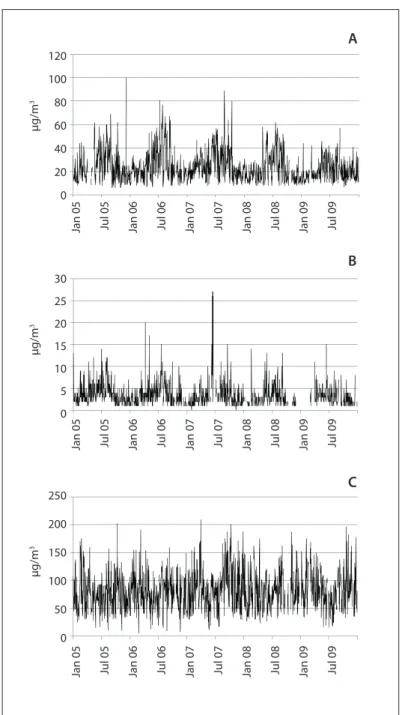
Figure 1 shows the variation in pollutant levels over the ive years of the study. It is interesting to note that there was seasonal variation of the pollutants particulate matter and sulfur dioxide, which increased in level during the colder periods of the year.
Regarding data gaps, there were data on the pollutant lev-els for particulate matter on 90 days (4.9%), sulfur dioxide on 332 days (18.1%) and ozone on 136 days (7.4%). However, these data gaps did not damage the inal outcome from the study.
A statistically signiicant association between exposure to particulate matter and death due to stroke (RR: 1.005; 95% CI: 1.000 to 1.011) on the same day as the exposure (lag 0) was noted in the unipollutant model. No signiicant association was found for the other pollutants.
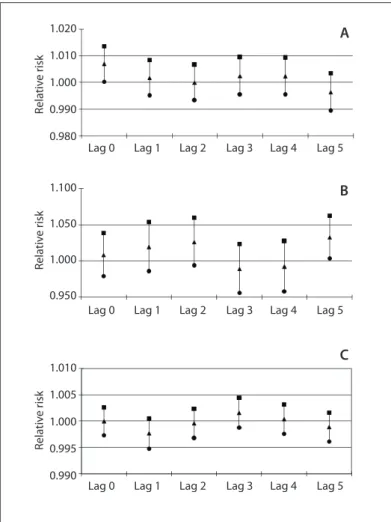
Figure 2 shows the relative risks for each lag structure and their respective 95% conidence intervals for death due to stroke in the multipollutant model. Deaths due to stroke were signii-cantly associated with exposure to particulate matter on the same day as the exposure (RR: 1.007; 95% CI: 1.000 to 1.014); and with exposure to sulfur dioxide on the ith day ater exposure (lag 5) (RR: 1.033; 95% CI: 1.004 to 1.063).
In relation to increases in the interquartile diference for the pollutant in the multipollutant model, we observed that there was a statistically signiicant increased risk of death of
approxi-mately 10% on the same day as the exposure to PM10 and 7% on
the ith day ater exposure to SO2, as shown in Figure 3.
DISCUSSION
An increased risk of hospitalization due to stroke was observed in the city of São José dos Campos. his is one of the irst cit-ies in Brazil for which estimates for the risk of death from this
cause have been made.8 his inding deserves attention because
little research has been conducted worldwide on the association between exposure to air pollutants and stroke.
he use of lags to estimate the risk of death is widely used in methodologies worldwide, while the number of lags analyzed has
varied.6,15 We chose to use ive days of lag because of the
possi-bility that this might produce a more comprehensive approach,
thereby agreeing with the Korean methodology.16
he statistical analysis for this approach was the general-ized additive model of Poisson regression, which had already been established for this type of analysis, since the variables under assessment are counted variables. However, some studies have addressed this issue by making use of a generalized linear
model.4,8 It has already been found that both the additive and the
linear model show consistent results.17
Table 1. Descriptive analysis on the variables under assessment. São José dos Campos, Brazil, 2005-2009
Mean SD Minimum Maximum IQD
Deaths 0.56 0.77 0 5
PM10 (μg/m
3) 23.96 12.41 6 100 15
SO2 (μg/m
3) 3.45 2.57 0.5 27 2
O3 (μg/m
3) 80.62 32.24 5 209 41
Humidity (%) 83.52 7.25 54.0 100 Temperature (ºC) 20.7 2.45 13.7 27.9 Pressure (mbar) 948.2 3.33 938 960
SD = standard deviation; IQD = interquartile diference.
120
100
80
60
40
20
0
30
25
20
15
10
5
0
250
200
150
100
50
0
µg/m
3
µg/m
3
µg/m
3
Jan 05 Jul 05 Jan 06 Jul 06 Jan 07 Jul 07 Jan 08 Jul 08 Jan 09 Jul 09
Jan 05 Jul 05 Jan 06 Jul 06 Jan 07 Jul 07 Jan 08 Jul 08 Jan 09 Jul 09
Jan 05 Jul 05 Jan 06 Jul 06 Jan 07 Jul 07 Jan 08 Jul 08 Jan 09 Jul 09
A
B
C
Figure 1. Pollutant levels in μg/m3: (A) particulate matter; (B) sulfur
he deaths due to stroke were not separated into ischemic or hemorrhagic types, which has been recommended in some
stud-ies,7,15 because most of the deaths recorded during the period
covered by this study were categorized as unspeciied stroke. his study showed that signiicant exposure to particu-late matter was a risk factor for death due to stroke both in the unipollutant and in the multipollutant model. here was a 10% higher risk of a greater interquartile diference, which was more than what was found by Wellenius et al. (1.03%) for ischemic
stroke.15 A positive association between stroke mortality and the
level of exposure to ine particulate matter (PM2.5) on the same
day and preceding day, and also to ultraine particles on the pre-ceding day, was reported in a study developed in Helsinki, during
the summer season.6
he activation of microglia in response to air pollution and identiication of particulate matter both in brain capillaries and in parenchyma suggest that particulate matter is capable of
interacting with cells and crossing the blood-brain barrier.18,19
Recent advances have shown that systemic inlammation has a signiicant impact on brain tissue. It has been accepted that air pollution causes proinlammatory signals originating in peripheral organs such as the lungs, which transfer inlammation
to the brain.20 As an example, one study showed that in response to
tumor necrosis factor alpha (TNF alpha) during inlammation of a peripheral organ, animals appeared to recruit larger quantities
of circulating monocytes to the brain.21
In the present, sulfur dioxide was signiicant in the multi-pollutant model only in relation to the ive-day lag, unlike the indings of another study, in which this pollutant was a signii-cant risk factor for exposure on the same day, for inclusion in
the unipollutant model (RR: 1029; 95% CI: 1.000-1.060).8 his
might be explained by the diferent focus of that study, since hos-pital admissions and not deaths were taken into consideration. In Seoul, Korea, there was a 2.9% higher risk of a greater interquar-tile diference, two days ater exposure in the unipollutant model,
with a mean SO2 concentration of 30 μg/m3, i.e. well above what
was found in the present study.16 Although it was expected that the
increased risk of mortality would be greater in the area where the pollutant concentration was highest, this was not observed in the present study, which showed a percentage increase of 7%. his might be explained by the diference in methodology, such that one used a unipollutant model and the other used adjustment by other pollutants. In another study, which used a generalized lin-ear model, sulfur dioxide was found to be a statistically signii-cant risk factor for death due to stroke in the ith and sixth
mov-ing means.4 his result is more similar to what was found in the
present study, thus showing the importance of exposure to sulfur dioxide on the ith day ater exposure when using both the mov-ing mean and the lag methodology.
A
B
C
1.0201.010
1.000
0.990
0.980
1.010
1.005
1.000
0.995
0.990 1.100
1.050
1.000
0.950
R
ela
tiv
e r
isk
R
ela
tiv
e r
isk
R
ela
tiv
e r
isk
Lag 0 Lag 1 Lag 2 Lag 3 Lag 4 Lag 5
Lag 0 Lag 1 Lag 2 Lag 3 Lag 4 Lag 5
Lag 0 Lag 1 Lag 2 Lag 3 Lag 4 Lag 5
Figure 2. Relative risks and 95% conidence intervals in relation to multipollutant model; (A) particulate matter; (B) sulfur dioxide; (C) ozone. São José dos Campos, Brazil, 2005-2009.
Figure 3. Percentage increase in relative risk, in multipollutant model according to lags. São José dos Campos, Brazil, 2005-2009.
Lag 0 Lag 1 Lag 2 Lag 3 Lag 4 Lag 5 15.00
10.00
5.00
0.00
-5.00
-10.00
-15.00
P
er
cen
tage incr
ease (%)
PM
SO2
Ozone
In turn, ozone was not a statistically signiicant risk factor in the present study, and this coincides with research using a
gener-alized linear model for hospital admissions.8 he 5% higher
inter-quartile diference in the third lag found in this study was close to what was found by Hong et al. (2.9% on the same day as the
expo-sure), but without statistical signiicance.16
It is important to remember that the present study only addressed stroke events that resulted in death. Another point to note is that the database used is susceptible to human error. On the other hand, this database (Datasus), which contains sec-ondary records, is greatly used in studies on air pollution and its health efects. Ecological studies like the present study may have limitations in terms of confounders and ecological bias; more-over, epidemiological studies do not identify causes.
here may be delays between symptoms and death, or misdiagnosis or error in codings used for deaths, since the diagnosis of this disease is clinical and there may not have been any autopsy or examination like tomography to provide conirmation. Moreover, we considered homogeneous concentrations of pollutants, rather than individual exposure. he present study did not include or analyze any interactions with risk factors inherent to human health that have already been established for stroke. It is important to emphasize that these results do not determine causality, but rather, they indicate a possible association between exposure to pollutants and deaths due to stroke.
he strength of this study lies in the fact that it demonstrates the efect of air pollutant exposure on human health, even at low concentrations. Another positive point to be highlighted is that studies in medium-sized cities in which air pollutant concen-trations are measured can use this methodology to assess these efects and to establish public health policies.
CONCLUSION
his study showed that there was an association between expo-sure to major air pollutants and deaths due to stroke, and it serves as an important tool for public health management.
REFERENCES
1. Arbex MA, Saldiva PH, Pereira LA, Braga AL. Impact of outdoor
biomass air pollution on hypertension hospital admissions. J
Epidemiol Community Health.2010;64(7):573-9.
2. Maheswaran R, Haining RP, Brindley P, et al. Outdoor air pollution,
mortality, and hospital admissions from coronary heart disease
in Sheield, UK: a small-area level ecological study. Eur Heart J.
2005;26(23):2543-9.
3. Nascimento LF, Pereira LA, Braga AL, Módolo MC, Carvalho JA.
Efeitos da poluição atmosférica na saúde infantil em São José dos
Campos, SP. [Efects of air pollution on children’s health in a city in
Southeastern Brazil]. Rev Saude Publica. 2006;40(1):77-82.
4. Amancio CT, Nascimento LF. Association of sulfur dioxide exposure
with circulatory system deaths in a medium-size city in Brazil. Braz J
Med Biol Res. 2012;45(11):1080-5.
5. Vidale S, Bonanomi A, Guidotti M, Arnaboldi M, Sterzi R. Air pollution
positively correlates with daily stroke admission and in hospital mortality:
a study in the urban area of Como, Italy. Neurol Sci. 2010;31(2):179-82.
6. Kettunen J, Lanki T, Tiittanen P, et al. Associations of ine and ultraine
particulate air pollution with stroke mortality in an area of low air
pollution levels. Stroke. 2007;38(3):918-22.
7. Tsai S, Goggins WB, Chiu HF, Yang CY. Evidence for an association
between air pollution and daily stroke admissions in Kaohsiung,
Taiwan. Stroke. 2003;34(11):2612-6.
8. Nascimento LF, Francisco JB, Patto MB, Antunes AM. Environmental
pollutants and stroke-related hospital admissions. Cad Saude Publica.
2012;28(7):1319-24.
9. Lisabeth LD, Escobar JD, Dvonch JT, et al. Ambient air pollution and
risk for ischemic stroke and transient ischemic attack. Ann Neurol.
2008;64(1):53-9.
10. Brasil. Ministério da Saúde. Portal da Saúde. Saúde lança consulta
pública para o aprimoramento da assistência a pacientes com
AVC. Available from: http://portal.saude.gov.br/portal/aplicacoes/
noticias/default.cfm?pg=dspDetalheNoticia&id_area=124&CO_
NOTICIA=11825. Accessed in 2013 (Oct 18).
11. Brasil. Ministério da Saúde. DATASUS. Informações de Saúde.
Epidemiológicas e morbidade. Morbidade hospitalar do SUS – por
local de residência - SP. Available from: http://tabnet.datasus.gov.br/
cgi/tabcgi.exe?sih/cnv/nrsp.def. Accessed in 2013 (Oct 18).
12. Cançado JE, Braga A, Pereira LA, et al. Repercussões clínicas da
exposição à poluição atmosférica [Clinical repercussions of exposure
to atmospheric pollution]. J Bras Pneumol. 2006;32 Suppl 2:S5-11.
13. Pope CA 3rd, Burnett RT, Thurston GD, et al. Cardiovascular mortality
and long-term exposure to particulate air pollution: epidemiological
evidence of general pathophysiological pathways of disease.
Circulation. 2004;109(1):71-7.
14. Companhia Ambiental do Estado de São Paulo. Qualidade do ar.
Available from:
http://www.cetesb.sp.gov.br/ar/qualidade-do-ar/31-publicacoes-e-relatorios. Accessed in 2013 (Nov 18).
15. Wellenius GA, Schwartz J, Mittleman MA. Air pollution and hospital
admissions for ischemic and hemorrhagic stroke among Medicare
beneiciaries. Stroke. 2005;36(12):2549-53.
16. Hong YC, Lee JT, Kim H, et al. Efects of air pollutants on acute stroke
mortality. Environ Health Perspect.2002;110(2):187-91.
17. Conceição GMS, Saldiva PHN, Singer JM. Modelos MLG e MAG para
análise da associação entre poluição atmosférica e marcadores de
morbi-mortalidade: uma introduçäo baseada em dados da cidade
de São Paulo [GLM and GAM model for analyzing the association
between atmospheric pollution and morbidity-mortality markers:
an introduction based on data from the city of São Paulo. Rev Bras
18. Blasko I, Stampfer-Kountchev M, Robatscher P, et al. How chronic
inlammation can afect the brain and support the development of
Alzheimer’s disease in old age: the role of microglia and astrocytes.
Aging Cell. 2004; 3(4):169-76.
19. Calderón-Garcidueñas L, Solt AC, Henríquez-Roldán C, et al.
Long-term air pollution exposure is associated with neuroinlammation,
an altered innate immune response, disruption of the blood-brain
barrier, ultraine particulate deposition, and accumulation of amyloid
beta-42 and alpha-synuclein in children and young adults. Toxicol
Pathol. 2008;36(2):289-310.
20. Tamagawa E, van Eeden SF. Impaired lung function and risk for stroke:
role of the systemic inlammation response? Chest. 2006;130(6):1631-3.
21. D’Mello C, Le T, Swain MG. Cerebral microglia recruit monocytes into
the brain in response to tumor necrosis factoralpha signaling during
peripheral organ inlammation. J Neurosci. 2009;29(7):2089-102.
Sources of funding: São Paulo Research Foundation (Fapesp), grant number 2012/09371-9
Conlict of interests: None
Date of irst submission: June 12, 2013
Last received: November 7, 2013
Accepted: November 18, 2013
Address for correspondence: Luiz Fernando Nascimento
Avenida Tiradentes, 500
Bom Conselho — Taubaté (SP) — Brasil
CEP 12030-180
Tel. (+55 12) 3625-4271
E-mail: [email protected]