ABSTRACT
ORIGINAL AR
INTRODUCTION In view of the need to standardize labora-tory techniques and determine normal semen parameters, the World Heath Organization (WHO) published its Laboratory Manual for Examination of Human Semen and Se-men-Cervical Mucus Interaction, in 1980.1
Subsequently, revisions were published in 1987,2 19923 and 1999.4 However, due to
the differences between populations, the WHO itself recommends that each labora-tory should establish its own reference values (WHO, 1999).4
The importance of each laboratory determining its own values lies in the fact that fertile individuals may occasionally be considered subfertile or even incapable of establishing pregnancy when the semen analysis is compared with values established for other populations.5 This may give rise
to unnecessary treatment and embarrassing situations for couples in which the woman has a spontaneous pregnancy by a man who was considered subfertile according to the WHO parameters.6,7 Furthermore, for
as-sisted reproduction techniques, and especially intracytoplasmic sperm injection (ICSI) into the oocyte, semen analysis should address the factors responsible for failure of such tech-niques. The traditional parameters are thus merely descriptive.8
Various factors may be associated with variations in sperm characteristics among fertile individuals. These include increasing age, which is associated with diminution of semen volume, sperm motility and sperm morphology.9,10 A meta-analysis study has
demonstrated that smokers present an average reduction of 13% in sperm concentration, 10% in sperm motility and 3% in sperm morphology.11 Seasonal variations in sperm
quality, with greater concentration, motility and morphology in winter than in summer,
have also been reported.12 The length of
sexual abstinence preceding the collection of sperm for analysis is an important variable for the quality of the test. Very short or very long periods of abstinence are associated with dis-torted semen analysis results (WHO, 1999).4
Individuals who drink coffee every day present increased sperm motility, although they pres-ent no significant alterations in the concpres-entra- concentra-tion or morphology of the sperm.13
The present study had the objectives of establishing reference values for semen analysis for a population of fertile individuals in the city of São Paulo, and identifying variations in semen characteristics according to age, length of sexual abstinence, seasonality, smoking habits and coffee consumption.
METHODS Five hundred fertile candidates for volun-tary sterilization by vasectomy were included in this study project between September 1999 and August 2002. Their average age was 35.04 ± 6.1 years (range: 24 to 63).
In the hospital, a sperm sample was col-lected in the morning, from each individual by masturbation, after two to five days of sexual abstinence. A wide-necked sterile non-toxic flask was utilized for sample col-lection. The sample was protected from extremes of temperature (< 20º C or > 40º C) during the laboratory process. Liquefac-tion was performed, followed immediately by an assessment of semen color, volume (using a graduated pipette), viscosity and pH. Ten microliters of semen were deposited in a Makler sperm-count chamber and the sperm concentration (expressed as 106/ml)
was determined by phase microscopy, at 200 x magnification. The sperm motility assessment was carried out by making two counts of 100 spermatozoa. In the event of a discrepancy of more than 10% between the two readings, a
Kelly Silveira Athayde Sami Arap
values and variations according to age,
length of sexual abstinence, seasonality,
smoking habits and caffeine intake
Division of Urology, Hospital das Clínicas, Faculdade de Medicina da
Universidade de São Paulo, São Paulo, Brazil
CONTEXT AND OBJECTIVE: Recent studies have shown regional and population differences in semen characteristics. The objective was to establish reference values for semen analysis and to verify the effect that age, length of sexual abstinence, seasonality, smoking habits and coffee consumption have on fertile individuals’ semen characteristics.
DESIGN AND SETTING: Prospective study in the Urology Division, Hospital das Clínicas, Univer-sidade de São Paulo.
METHODS: Between September 1999 and August 2002, 500 fertile men requesting a vasectomy for sterilization purposes were asked to provide a semen sample before the vasectomy. We evaluated the effects of age, sexual abstinence, seasonality, smoking and coffee consumption on semen characteristics.
RESULTS: Compared with World Health Organi-zation values, 87.2% of the patients presented sperm morphology below the normal level. A significant decline in semen volume, sperm motil-ity and sperm morphology in patients over 45 years of age was observed. In patients with 5 days or more of abstinence, there was reduced sperm motility. The lowest values for sperm concentration, motility and morphology were observed in summer and the highest in winter. No differences in semen parameters relating to smoking were detected. Patients who drank six or more cups of coffee per day presented higher sperm motility.
CONCLUSIONS: Our sample had a very low percentage of normal sperm morphology. Only sperm morphology showed a high abnormal-ity rate. Differences in semen parameters with regard to age, length of sexual abstinence, seasonality and coffee consumption were identified. No differences relating to smoking were detected.
third analysis was made and the final result was taken to be the arithmetical mean of the three assessments. Sperm morphology was determined by the semen smear technique, using two smear samples of 10 ml of fresh
semen. Panoptic staining was utilized for the smear slides. At least 200 spermatozoa were studied under 1000 x magnification and were classified in accordance with the World Health Organization descriptions (1992).6 The
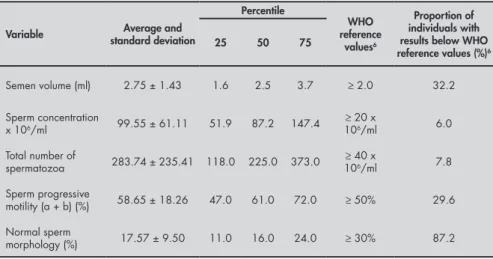
refer-Table 1. Semen characteristics among 500 fertile individuals and World Health Or-ganization (WHO) reference values
Variable standard deviationAverage and
Percentile
WHO reference
values6
Proportion of individuals with results below WHO reference values (%)6
25 50 75
Semen volume (ml) 2.75 ± 1.43 1.6 2.5 3.7 ≥ 2.0 32.2
Sperm concentration
x 106/ml 99.55 ± 61.11 51.9 87.2 147.4
≥ 20 x
106/ml 6.0
Total number of
spermatozoa 283.74 ± 235.41 118.0 225.0 373.0 ≥
40 x
106/ml 7.8
Sperm progressive
motility (a + b) (%) 58.65 ± 18.26 47.0 61.0 72.0 ≥ 50% 29.6
Normal sperm
morphology (%) 17.57 ± 9.50 11.0 16.0 24.0 ≥ 30% 87.2
a = fast; b = slow.
Table 2. Mean and standard deviation for semen volume, sperm concentration, sperm motility and normal sperm morphology among 500 fertile individuals, by age group
Age (years)
Semen volume (ml)*
Sperm concentration
(106/ml) Sperm progressive motility (%) morphology (%)Normal sperm
24 – 30 2.7 ± 1.3a 87.4 ± 60.1 60.3 ± 17.3a 17.9 ± 9.3a
31 – 35 2.9 ± 1.4a 98.6 ± 55.2 61.4 ± 14.1a 19.0 ± 8.8a
36 – 40 2.6 ± 1.5a 99.7 ± 61.8 61.9 ± 14.8a 18.7 ± 10.0a
41 – 45 2.3 ± 1.2b 113.8 ± 63.8 56.9 ± 12.5b 19.5 ± 9.9a
> 45 2.2 ± 1.1b 87.8 ± 68.6 53.5 ± 15.8c 14.3 ± 9.6b
p† 0.0189 0.1189 0.0369 0.0118
* The values for mean and standard deviation given are presented without logarithmic transformation.
† The p-value was established by analysis of variance (ANOVA) and was based on data with logarithmic transformation. Post-hoc Bonferroni test: no differences between groups with the same letter (test does not apply when p ANOVA > 0.05).
ence values for the semen parameters were expressed as arithmetical mean and standard deviation. The 25th, 50th and 75th percentiles
were determined for each variable.
To study the influence of the different variables on the semen parameters, the patients were divided into groups. For age, the groups were: 24-30 years (n = 117); 31-35 years (n = 166); 36-40 years (n = 127); 41-45 years (n = 59); and > 45 years (n = 31). For the length of sexual abstinence, the groups were: 2 days (n = 47); 3 days (n = 199); 4 days (n = 101); 5 days (n = 99); and > 5 days (n = 54). For the month of the year, the groups were: January (n = 58); February (n = 20); March (n = 62); April (n = 39); May (n = 38); June (n = 26); July (n = 29); August (n = 41); September (n = 35); October (n = 53); November (n = 52); and December (n = 47). For smoking habit, the groups were: non-smokers (n = 324); 1-10 cigarettes/day (n = 80); 11-20 cigarettes/day (n = 66); and > 20 cigarettes/day (n = 30). For coffee consumption, the groups were: no cof-fee consumption (n = 151); 1-3 cups of cofcof-fee per day (n = 249); 4-6 cups/day (n = 48); and > 6 cups/day (n = 52).
The distribution of the variables was “normalized” by logarithmic transformation. Variance analysis (ANOVA) and Bonferroni’s post-hoc test were used for the comparisons between the groups.
The level of statistical significance estab-lished was 5%. The data were analyzed by means of the Statistical Package for Social Sci-ences (SPSS), version 11.0, computer software (SPSS Inc., Chicago, United States).
RESULTS The reference values (mean and standard deviation, and 25th, 50th and 75th percentiles)
for the patients’ semen characteristics are presented in Table 1. It can be seen that, in 32% of the cases, the semen volume was be-low the level considered normal in the WHO descriptions. For other semen parameters, the percentages of patients below WHO levels were 16% for pH, 6% for sperm concentra-tion, 7.8% for total number of spermatozoa, 29.6% for sperm progressive motility and 87.2% for sperm morphology.
The variations in semen volume, sperm concentration, sperm progressive motility and sperm morphology in relation to patients’ ages are presented in Table 2. This shows that there was a decline in the values of these parameters among individuals over 45 years of age (p < 0.05). There were no statistically significant differences in sperm concentration between the age groups (p < 0.05).
Table 3. Mean and standard deviation for semen volume, sperm concentration, sperm motility and normal sperm morphology among 500 fertile individuals, according to length of sexual abstinence
Number of days of abstinence
Semen volume (%)*
Sperm concentration (106/ml)
Sperm progressive motility (%)
Normal sperm morphology (%)
2 2.3 ± 1.1a 105.1 ± 87.7a 55.2 ± 16.5a 16.4 ± 12.2
3 2.5 ± 1.3a 104.8 ± 85.6a 61.4 ± 15.3b 17.7 ± 9.3
4 2.7 ± 1.3b 105.4 ± 61.3a 61.6 ± 13.5b 18.4 ± 9.2
5 3.0 ± 1.6c 127.1 ± 84.7b 58.7 ± 15.6c 18.0 ± 8.8
>5 3.3 ± 1.7d 136.1 ± 82.1c 56.3 ± 16.0d 17.0 ± 9.1
p† 0.011 0.022 0.020 0.186
* The values for mean and standard deviation given are presented without logarithmic transformation.
Table 3 shows that the semen volume and sperm concentration increased according to how many days of sexual abstinence there were (p < 0.05). However, in patients with five or more days of sexual abstinence, a reduction in progressive motility (p < 0.05) was found. The sperm morphology did not vary with length of sexual abstinence (p < 0.05).
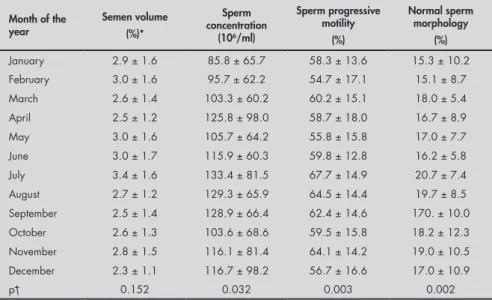
From Table 4, it can be seen that the variance analysis demonstrated statistically significant differences for sperm concentra-tion, progressive motility and normal sperm morphology percentage, in relation to the months of the year. When Bonferroni’s test was used, statistically significant lower sperm counts were observed in January (85.8 x 10⁶/ml)
and February (95.7 x 10⁶/ml), in relation to
July (133.4 x 10⁶/ml) and August (129.3 x
106/ml) (p < 0.05). The test did not show
any significant differences between the other months of the year. Similarly, it was found that sperm progressive motility was lower in February (54.7%) than in July (67.7%; p < 0.05). The normal sperm morphology per-centage was lower in the months of January (15.3%) and February (15.1%) than in July (20.7%; p < 0.05).
The semen parameter variations relating to smoking habits are set out in Table 5. No statistically significant differences were ob-served between smokers and non-smokers, or between the groups of smokers (p < 0.05).
Table 6 shows that, as coffee consump-tion increased, so did sperm motility. Among patients who were not in the habit of drinking coffee, progressive motility averaged 57.1%, whereas for the patients who consumed more than six cups of coffee per day, it averaged 62.4% (p < 0.05). There were no significant differences in semen volume, sperm concen-tration or sperm morphology in relation to coffee consumption (p < 0.05).
DISCUSSION
Reference standards for sperm analysis
Semen analysis is one of the most impor-tant diagnostic methods for the assessment of male infertility. The methodology for se-men analysis has been undergoing constant improvement, and new assessment criteria have been proposed.4Similarly, the
refer-ence values for each parameter have been the subject of debate. Modifications in sperm quality over the years have been reported and there has apparently been a decline, especially in sperm concentration.14,15 Regional
differ-ences in sperm parameters have frequently
Table 4. Mean and standard deviation for semen volume, sperm concentration, sperm motility and normal sperm morphology among 500 fertile individuals, by month of the year
Month of the year
Semen volume (%)*
Sperm concentration
(106/ml)
Sperm progressive motility
(%)
Normal sperm morphology
(%)
January 2.9 ± 1.6 85.8 ± 65.7 58.3 ± 13.6 15.3 ± 10.2
February 3.0 ± 1.6 95.7 ± 62.2 54.7 ± 17.1 15.1 ± 8.7
March 2.6 ± 1.4 103.3 ± 60.2 60.2 ± 15.1 18.0 ± 5.4
April 2.5 ± 1.2 125.8 ± 98.0 58.7 ± 18.0 16.7 ± 8.9
May 3.0 ± 1.6 105.7 ± 64.2 55.8 ± 15.8 17.0 ± 7.7
June 3.0 ± 1.7 115.9 ± 60.3 59.8 ± 12.8 16.2 ± 5.8
July 3.4 ± 1.6 133.4 ± 81.5 67.7 ± 14.9 20.7 ± 7.4
August 2.7 ± 1.2 129.3 ± 65.9 64.5 ± 14.4 19.7 ± 8.5
September 2.5 ± 1.4 128.9 ± 66.4 62.4 ± 14.6 170. ± 10.0
October 2.6 ± 1.3 103.6 ± 68.6 59.5 ± 15.8 18.2 ± 12.3
November 2.8 ± 1.5 116.1 ± 81.4 64.1 ± 14.2 19.0 ± 10.5
December 2.3 ± 1.1 116.7 ± 98.2 56.7 ± 16.6 17.0 ± 10.9
p† 0.152 0.032 0.003 0.002
* The values for mean and standard deviation given are presented without logarithmic transformation.
† The p-value was established by analysis of variance (ANOVA) and was based on data with logarithmic transformation. Post-hoc Bonferroni test does not apply when p ANOVA > 0.05.
Table 5. Mean and standard deviation for semen volume, sperm concentration, sperm motility and normal sperm morphology among 500 fertile individuals, according to smoking habit
Smoking habit
(cigarettes/day) Semen volume(%)* Sperm concentration (106/ml) Sperm progressive motility (%) morphology (%)Normal sperm
0 2.8 ± 1.5 107.9 ± 74.6 59.6 ± 15.3 18.1 ± 9.0
1-10 2.3 ± 1.2 106.6 ± 79.3 58.9 ± 16.7 14.5 ± 7.7
11-20 2.3 ± 1.2 127.9 ± 99.2 61.8 ± 15.8 16.8 ± 10.2
>20 2.1 ± 0.8 130.6 ± 74.9 55.6 ± 13.2 15.7 ± 13.8
p† 0.610 0.111 0.529 0.105
* The values for mean and standard deviation given are presented without logarithmic transformation.
† The p-value was established by analysis of variance (ANOVA) and was based on data with logarithmic transformation. Post-hoc Bonferroni test does not apply when p ANOVA > 0.05.
Table 6. Mean and standard deviation for semen volume, sperm concentration, sperm motility and normal sperm morphology among 500 fertile individuals, according to coffee consumption
Coffee consumption (cups/day)
Semen volume (%)*
Sperm concentration (106/ml)
Sperm progressive motility (%)
Normal sperm morphology (%)
0 2.7 ± 1.5 110.8 ± 79.7 57.1 ± 16.2a 17.3 ± 8.2
1 – 3 2.6 ± 1.4 113.6 ± 82.0 60.7 ± 14.6b 17.5 ± 10.0
4 – 6 2.7 ± 1.3 111.0 ± 94.8 61.2 ± 15.5b 17.9 ± 8.3
>6 2.7 ± 1.7 127.2 ± 8239 62.4 ± 16.0c 18.0 ± 9.2
p† 0.765 0.634 0.037 0.871
* The values for mean and standard deviation given are presented without logarithmic transformation.
come to light.16,17 Thus, it is necessary for
each laboratory to establish its own reference values for semen analysis and compare these with the WHO values. In the present study, it was found that only in relation to normal sperm morphology was there a high number of individuals below the WHO standard (87.2% of the individuals studied). For the other variables, the numbers of individuals below the WHO standards ranged from 6% to 32.2%. Further studies will be necessary to determine whether the values obtained are true figures for the sample studied, or whether there are discrepancies in the analysis.
Age
Various studies using animal models have reported reductions in fertility as age increases. Mice over 18 months of age undergo struc-tural alterations in their germinative cells, with significant reduction in their numbers. Mice aged more than 33 months present an almost total cessation of spermatogenesis.18
Testicular atrophy and degeneration of the somniferous epithelium has been observed in rats of advanced age.19
In human beings, there is an association between aging and functional decline in the Leydig cells.20 Smaller semen volumes and lower
sperm motility have been found to accompany advancing age among fertile individuals.21 There
does not, however, appear to be any reduction in sperm concentration in elderly individuals.22
In contrast with the feminine menopause, which is accompanied by a reduction in fertil-ity from the age of 35 years onwards, men may maintain their fertility into advanced old age. One birth of a child to a father aged 70 or over occurs for every 10,000 births of children to fathers aged 30 years.23 A large proportion of
the individuals who seek assistance in infertility clinics are aged over 65.24
The data produced by the present study demonstrate a reduction in semen volume, sperm progressive motility and sperm normal morphology percentage from the age of 45 years onwards, as already described.21,22 The
sperm concentration was lower in patients over 45 years of age, but this difference was not statistically significant. However, since the majority of the sample for our study consisted of young individuals seeking sterilization by vasectomy, the effect of age on sperm concen-tration could not be exhaustively assessed.
Length of sexual abstinence
In fertile individuals, the length of sexual abstinence affects all semen parameters. With abstinence, there is increasing sperm
concen-tration accompanied, however, by decreasing progressive motility and normal morphol-ogy percentage.25 Similar results have been
observed among infertile patients, for whom a prolonged period of sexual abstinence was associated with increased semen volume ejaculated and increased sperm concentra-tion, but with no reduction in progressive motility or normal morphology percentage.26
In particular situations, with the use of as-sisted reproduction techniques for infertile patients, prolonged sexual abstinence may be used for the purpose of obtaining a larger number of spermatozoa. Among 50 individu-als with nonobstructive azoospermia who were candidates for testicular biopsy and ICSI into the oocyte, there was an increase in the total number of spermatozoa, although with no change in progressive motility when the period of abstinence was increased from 4 to 14 days.27 In the present study, semen volume
and sperm concentration increased with the length of abstinence. Sperm progressive motil-ity presented a reduction from the fourth day onwards, and there was no modification of sperm normal morphology percentage with increased length of sexual abstinence.
Seasonal variation
Seasonal variation in conception rates for human beings has been described, with a reduction in the number of births in the spring as a consequence of a lower conception rate during the summer.28 Semen donors have
not been found to have any seasonal altera-tion in sperm motility. However, their sperm concentration has been found to be lower in the summer than in the winter.29 Individuals
assessed for infertility have presented lower sperm concentration and progressive motility during the summer, with an improvement in these parameters over the winter months.30
Lower sperm motility and higher rates of sperm tail defects and immature forms were discovered during the summer months in 2,065 fertile men.31 Initially, the variations
in semen parameters during the year were attributed to climatic differences. Thus, the high temperatures registered in the summer months were held responsible for the reduc-tion in sperm quality, while it was thought that the low temperatures of the winter months would favor spermatogenesis.32,33
However, subsequent studies suggested that temperature was not the only factor involved and that the length of daylight also needed to be considered.34,35
Most of the studies have been conducted in countries of the northern hemisphere
with large differences in climatic conditions between summer and winter. In Singapore, a tropical country in which the climatic dif-ferences are smaller, no difdif-ferences in semen parameters in relation to the months of the year were found for 7,656 sperm analyses.36
The present study, undertaken in the tropical region of Brazil, shows that there are seasonal differences in sperm quality. Factors such as population and climatic differences, and those related to the selection of samples (we studied fertile individuals), make any comparison with the results obtained in Singapore difficult. Generally speaking, the lower sperm concen-tration, progressive motility and normal mor-phology percentage found among individuals in São Paulo city during the summer months are similar to those described for populations in the northern hemisphere.
Smoking
Despite the anti-smoking campaigns car-ried out throughout the world, the smoking habit is still quite common, affecting 35% of all adult European men37 and 33% of the
individuals that we studied. It is estimated that, in Brazil, 42% of the population in the southern region smoke: Porto Alegre (capital of the State of Rio Grande do Sul) is the city with the highest figures for lung cancer.38 Even
though only 31% of the population smoke in the northeastern region of Brazil, this percent-age is still considered very high. In our coun-try, it is estimated that approximately 200,000 deaths/year are due to cigarette smoking.38
The association between smoking and infertility has already been described, and reductions in sperm concentration, motility and normal morphology percentage among infertile patients who smoke have been ob-served.39,40 In a meta-analysis covering 27
studies on sperm quality among smokers, an average reduction of 13% in sperm concen-tration, 10% in motility and 3% in normal morphology percentage was observed.11 The
mechanism whereby smoking leads to infertil-ity has still to be clarified. Hormone alterations are present in smokers, with an accompanying reduction in testosterone and an increase in the estradiol concentration in the blood.11,41
Genetic alterations in spermatozoa have also been described, since cigarettes contain more than 30 known mutagenic or carcinogenic chemical agents.41,42 However, the effects of
1. World Health Organization. WHO laboratory manual for the examination of human semen and semen-cervical mucus interaction. Singapore: Press Concern; 1980.
2. World Health Organization. WHO laboratory manual for the examination of human semen and semen-cervical mucus interac-tion. 2nd ed. Cambridge: Cambridge University Press; 1987. 3. World Health Organization. WHO laboratory manual for the
examination of human semen and semen-cervical mucus interac-tion. 3rd ed. Cambridge: Cambridge University Press; 1992. 4. World Health Organization. WHO laboratory manual for the
examination of human semen and semen-cervical mucus interac-tion. 4th ed. Cambridge: Cambridge University Press; 1999. 5. Menkveld R, Wong WY, Lombard CJ, et al. Semen parameters,
including WHO and strict criteria morphology, in a fertile and subfertile population: an effort towards standardization of in-vivo thresholds. Hum Reprod. 2001;16(6):1165-71. 6. Comhaire FH, Huysse S, Hinting A, Vermeulen L, Schoonjans
F. Objective semen analysis: has the target been reached? Hum Reprod. 1992;7(2):237-41.
7. Coetzee K, Kruge TF, Lombard CJ. Predictive value of normal sperm morphology: a structured literature review. Hum Reprod Update. 1998;4(1):73-82.
8. Moutel G, Christian-Herve, Adnet JJ. Has traditional sperm analysis lost its clinical relevance? Fertil Steril. 1997;67(3):583-4; author reply 584-5.
9. Lemcke B, Behre HM, Nieschlag E. Frequently subnormal se-men profiles of normal volunteers recruited over 17 years. Int J Androl. 1997;20(3):144-52.
10. Spandorfer SD, Avrech OM, Colombero LT, Palermo GD, Ros-enwaks Z. Effect of parental age on fertilization and pregnancy characteristics in couples treated by intracytoplasmic sperm injection. Hum Reprod. 1998;13(2):334-8.
11. Vine MF. Smoking and male reproduction: a review. Int J Androl. 1996;19(6):323-37.
12. Andolz P, Bielsa MA, Andolz A. Circannual variation in human semen parameters. Int J Androl. 2001;24(5):266-71.
13. Jensen TK, Henriksen TB, Hjollund NH, et al. Caffeine intake and fecundability: a follow-up study among 430 Danish couples planning their first pregnancy. Reprod Toxicol. 1998;12(3):289-95. 14. Carlsen E, Giwercman A, Keiding N, Skakkebaek NE. Evidence
for decreasing quality of semen during past 50 years. BMJ. 1992;305(6854):609-13.
15. Irvine S, Cawood E, Richardson D, MacDonald E, Aitken J. Evidence of deteriorating semen quality in the United Kingdom: birth cohort study in 577 men in Scotland over 11 years. BMJ.BMJ. 1996;312(7029):467-71.
16. Jorgensen N, Andersen AG, Eustache F, et al. Regional differences in semen quality in Europe. Hum Reprod.Hum Reprod. 2001;16(5):1012-9.
17. Auger J, Jouannet P. Evidence for regional differences of semen quality among fertile French men. Federation Française des Centres d’Étude et de Conservation des Oeufs et du Sperme humains. Hum Reprod. 1997;12(4):740-5.
18. Tanemura K, Kurohmaru M, Kuramoto K, Hayashi Y. Age-related morphological changes in the testis of the BDF1 mouse. J Vet Med Sci. 1993;55(5):703-10.
19. Parkening TA, Collins TJ, Au WW. Paternal age and its ef-fects on reproduction in C57BL/6NNia mice. J Gerontol. 1988;43(3):B79-84.
20. Gray A, Feldman HA, McKinlay JB, Longcope C. Age, disease, and changing sex hormone levels in middle-aged men: results of the Massachusetts Male Aging Study. J Clin Endocrinol Metab. 1991;73(5):1016-25.
21. Eskenazi B, Wyrobek AJ, Sloter E, et al. The association of age and semen quality in healthy men. Hum Reprod. 2003;18(2):447-54.
22. Kidd SA, Eskenazi B, Wyrobek AJ. Effects of male age on se-men quality and fertility: a review of the literature. Fertil Steril. 2001;75(2):237-48.
23. Rolf C, Behre HM, Nieschlag E. Reproductive parameters of older compared to younger men of infertile couples. Int J Androl. 1996;19(3):135-42.
24. Plas E, Berger P, Hermann M, Pfluger H. Effects of aging on male fertility? Exp Gerontol. 2000;35(5):543-51. 25. Pellestor F, Girardet A, Andreo B. Effect of long abstinence
periods on human sperm quality. Int J Fertil Menopausal Stud. 1994;39(5):278-82.
26. Mortimer D, Templeton AA, Lenton EA, Coleman RA. Influ-ence of abstinInflu-ence and ejaculation-to-analysis delay on semen analysis parameters of suspected infertile men. Arch Androl.Arch Androl. 1982;8(4):251-6.
27. Raziel A, Friedler S, Schachter M, et al. Influence of a short or longInfluence of a short or long abstinence period on semen parameters in the ejaculate of patients with nonobstructive azoospermia. Fertil Steril. 2001;76(3):485-90. 28. Krause A, Krause W. Seasonal variations in human seminal param-eters. Eur J Obstet Gynecol Reprod Biol. 2002;101(2):175-8. 29. Saint Pol P, Beuscart R, Leroy-Martin B, Hermand E, Jablonski
W. Circannual rhythms of sperm parameters of fertile men. Fertil Steril. 1989;51(6):1030-3.
30. Schalue TK, Webert SK, Rognsvoog LM, et al. Monthly variation among semen samples from 4114 infertility patients. Cincinnati: Annual Meeting of the American Society for Re-productive Medicine; 1997. [abstract].
31. Centola GM, Eberly S. Seasonal variations and age-related changes in human sperm count, motility, motion parameters, morphology, and white blood cell concentration. Fertil Steril. 1999;72(5):803-8. 32. Levine RJ, Bordson BL, Mathew RM, Brown MH, Stanley JM,
Star TB. Deterioration of semen quality during summer in New Orleans. Fertil Steril. 1988;49(5):900-7.
33. Politoff L, Birkhauser M, Almendral A, Zorn A. New data confirming a circannual rhythm in spermatogenesis. Fertil Steril. 1989;52(3):486-9.
34. Snyder PJ. Fewer sperm in the summer - it’s not heat, it’s… N Engl J Med. 1990;323(1):54-6.
35. Levine RJ, Brown MH, Bell M, Shue F, Greenberg GN, Bordson BL. Air-conditioned environments do not prevent deteriora-tion of human semen quality during the summer. Fertil Steril. 1992;57(5):1075-83.
It is important to bear in mind that, in the majority of cases, smoking is just one aspect of a lifestyle that may include the consump-tion of alcohol, illegal medicaconsump-tions or drugs, stress, dietary modifications and other factors that may have synergic or independent effects on sperm quality.
The multiplicity of variables leads to methodological problems that hinder the clear establishment of what impact smoking has on the fertility of the male population as a whole. In the present series, no statistically significant differences in the sperm quality were observed between smoking and non-smoking patients, or between the consumption groups in term of cigarettes/day. One possible explanation for these results is that we only studied fertile individuals, and cases of infertility associated with smoking were excluded from the sample
population. Another important matter is the sample size. The group that consumed more than 20 cigarettes/day consisted of only 30 patients. Thus, further studies involving both fertile and infertile men with a large numbers of cases are recommended.
Caffeine intake
Studies using animal models have suggested that caffeine, when added to the sperm, may increase the motility of the spermatozoa.43,44
However, in humans, the results are still in-conclusive, mainly because of the difficulty of quantifying the daily consumption of caffeine, in view of the fact that various foodstuffs contain this substance (chocolate and bottled soft drinks, for example). Another important question is the stratification or control of other variables that may increase or decrease sperm motility and thus
make it difficult to establish precisely the way in which caffeine affects sperm characteristics.13 In
our sample, after univariate statistical analysis, coffee consumption remained associated with increased sperm motility.
CONCLUSIONS Our sample had a very low percentage of normal sperm morphology, when judged by the WHO standards. Semen volume decreased with age but increased according to the length of sexual abstinence. Sperm concentration was lower in the summer. Sperm motility increased with coffee consumption, but decreased with age, sexual abstinence of greater than or equal to five days, and in the summer months. The normal sperm morphology percentage was lower in summer. Smoking had no influence on the parameters studied.
36. Chia SE, Lim ST, Ho LM, Tay SK. Monthly variation in human semen quality in male partners of infertile women in the tropics. Hum Reprod. 2001;16(2):277-81.
37. Trummer H, Habermann H, Haas J, Pummer K. The impact of cigarette smoking on human semen parameters and hormones. Hum Reprod. 2002;17(6):1554-9.
38. Apresentação OPAS. 1o Congresso Internacional de Prevenção de Tabagismo, Belo Horizonte, Minas Gerais; 2002. 39. Sofikitis N, Miyagawa I, Dimitriadis D, Zavos P, Sikka
S, Hellstrom W. Effects of smoking on testicular func-tion, semen quality and sperm fertilizing capacity. J Urol. 1995;154(3):1030-4.
40. Zinaman MJ, Brown CC, Selevan SG, Clegg ED. Semen quality and human fertility: a prospective study with healthy couples. J Androl. 2000;21(1):145-53.
41. Vogt HJ, Heller WD, Borelli S. Sperm quality of healthy smokers, ex-smokers, and never-smokers. Fertil Steril. 1986;45(1):106-10. 42. Rubes J, Lowe X, Moore D 2nd, Perreault S, et al. Smoking
cigarettes is associated with increased sperm disomy in teenage men. Fertil Steril. 1998;70(4):715-23.
43. Maxwell WM, Robinson SJ, Roca J, Molinia FC, Sanchez-Partida LG, Evans G. Motility, acrosome integrity and fertility of frozen ram spermatozoa treated with caffeine, pentoxifylline, cAMP, 2-deoxy-adenosine and kallikrein. Reprod Fertil Dev. 1995;7(5):1081-7.
44. Stachecki JJ, Ginsburg KA, Armant DR. Stimulation of cryopreserved epididymal spermatozoa of the domestic cat using the motility stimulants caffeine, pentoxifylline, and 2’-deoxyadenosine. J Androl. 1994;15(2):157-64.
Presented at the annual meeting of the European Society of Human Reproduction and Embryology (ESHRE), Madrid, Spain, July 2003.
Sources of funding: None Conflict of interest: None
Date of first submission: December 12, 2003 Last received: June 6, 2005
Accepted: June 9, 2005
AUTHOR INFORMATION Bernardo Passos Sobreiro, MD, MSc. Andrology fellow, Division of Urology, Hospital das Clínicas, Faculdade de Medicina da Universidade de São Paulo, São Paulo, Brazil.
Antonio Marmo Lucon, MD, PhD. Assistant professor of Urology, Division of Urology, Hospital das Clínicas, Faculdade de Medicina da Universidade de São Paulo, São Paulo, Brazil.
Fábio Firmbach Pasqualotto, MD, PhD. Professor ofProfessor of Anatomy and Embryology, Center of Biological and Health Sciences, Universidade de Caxias do Sul, Rio Grande do Sul, Brazil.
Jorge Hallak, MD, PhD. Urologist, Division of Urology, Hospi-tal das Clínicas, Faculdade de Medicina da Universidade de São Paulo, São Paulo, Brazil.
Kelly Silveira Athayde. Embryologist, Division of Urology, Hospital das Clínicas, Faculdade de Medicina da Univer-sidade de São Paulo, São Paulo, Brazil.
Sami Arap, MD. Full professor of Urology, Division of Urol-ogy, Hospital das Clínicas, Faculdade de Medicina da Universidade de São Paulo, São Paulo, Brazil.
Address for correspondence: Antonio Marmo Lucon
Rua Engenheiro Sá Rocha, 597 São Paulo (SP) — Brasil — CEP 05454-020 Tel. (+55 11) 3021-0833 — Fax (+55 11) 284-2780 E-mail: [email protected]
E-mail: [email protected]
Copyright © 2005, Associação Paulista de Medicina
RESUMO
Análise seminal em pacientes férteis a serem submetidos a vasectomia: valores de referência e variações de acordo com a idade, tempo de abstinência sexual, sazonalidade, hábito de fumar e consumo de cafeína CONTEXTO E OBJETIVO: Estudos recentes têm demonstrado diferenças regionais e populacionais quanto a características do sêmen. O objetivo foi estabelecer valores de referência para análise seminal e verificar o efeito da idade, tempo de abstinência sexual, sazonalidade, hábito de fumar e consumo de cafeína sobre as características do sêmen de indivíduos férteis.
TIPO DE ESTUDO E LOCAL: Estudo prospectivo, na Divisão de Clínica Urológica do Hospital das Clínicas, Universidade de São Paulo.
MÉTODOS: Entre setembro de 1999 e agosto de 2002, 500 homens férteis requisitando vasectomia com propósitos de esterilização voluntária foram solicitados a coletar uma amostra de sêmen antes da vasectomia. Avaliamos efeitos da idade, abstinência sexual, sazonalidade, consumo de cigarros e café nas características seminais.
RESULTADOS:Quando comparados aos valores da Organização Mundial de Saúde, 87,2% dos pacientes apresentavam morfologia espermática abaixo do normal. Foi observado declínio significativo do volume seminal, motilidade e morfologia em pacientes acima de 45 anos. Em pacientes com cinco dias ou mais de abstinência, houve redução da motilidade. Valores mais baixos para concentração, motilidade e mor-fologia espermática foram observados no verão e os mais elevados no inverno. Não houve diferenças nos parâmetros seminais estudados de acordo com o hábito de fumar. Com relação ao consumo de café, pacientes que ingeriam seis ou mais xícaras/dia apresentaram maior motilidade espermática.
CONCLUSÃO: Houve baixa porcentagem de morfologia espermática normal. Apenas a morfologia espermática apresentou alto percentual de anormalidade se levado em consideração o padrão descrito pela Organização Mundial de Saúde. Foram identificadas diferenças nos parâmetros seminais de acordo com a idade, tempo de abstinência sexual, sazonalidade e consumo de café. Não houve diferenças de acordo com o hábito de fumar.