Andreia Morales CascaesI Karen Glazer PeresII Marco Aurélio PeresII Flávio Fernando DemarcoI Iná SantosI
Alicia MatijasevichI Aluísio J D BarrosI
I Programa de Pós-Graduação em
Epidemiologia. Centro de Pesquisas Epidemiológicas. Universidade Federal de Pelotas. Pelotas, RS, Brasil
II Programa de Pós-Graduação em Saúde
Coletiva. Departamento de Saúde Pública. Universidade Federal de Santa Catarina. Florianópolis, SC, Brasil
Correspondence: Andreia Morales Cascaes
Centro de Pesquisas Epidemiológicas Coletiva de Pós-Graduação em Epidemiologia Universidade Federal de Pelotas - UFPel Rua Marechal Deodoro, nº 1160, 3º piso 96020-220 Pelotas, RS, Brasil
E-mail: [email protected] Received: 11/22/2010
Approved: 3/11/2011
Article available from: www.scielo.br/rsp
Validity of 5-year-old children’s
oral hygiene pattern referred by
mothers
ABSTRACT
OBJECTIVE: To determine the validity of oral hygiene questions for children, as commonly used in epidemiological studies, and assess their validity by family income and mother’s education.
METHODS: A subsample of 1122 children from the 2004 Pelotas Birth Cohort, Southern Brazil (who had participated in a 2009 oral health study) was analyzed. The children received dental examinations, and their mothers were interviewed at home. The gold standard for oral hygiene was the Simplifi ed Oral Hygiene Index; from its total score, the outcome was dichotomized into the absence (total score = 0) or presence (total score ≥ 1) of dental plaque. The mothers answered questions related to their child’s oral hygiene, including daily toothbrushing, toothbrushing before sleeping and the combination of the two (oral hygiene). These responses were dichotomized into regular and irregular. The validity was determined by calculating the percentages and respective 95% confi dence intervals for sensitivity, specifi city, positive predictive value and negative predictive value.
RESULTS: The overall prevalence of dental plaque was 37.0%. The following sensitivities, specifi cities, positive predictive values and negative predictive values were observed: 29.6%, 82.5%, 49.8% and 66.6%, respectively, for irregular daily toothbrushing; 41.8%, 64.6%, 40.9% and 65.5%, respectively, for irregular toothbrushing before sleeping; and 48.8%, 60.8%, 42.2% and 67.0%, respectively, for irregular oral hygiene. The validity of the oral hygiene reporting varied across different levels of family income and mother’s education. The sensitivity and positive predictive values were higher among children with lower incomes and less educated mothers, while opposite associations were observed for specifi city and negative predictive value. CONCLUSIONS: Oral hygiene questions answered by mothers of fi ve year-old children are not an appropriate substitute for direct oral hygiene assessment by the clinical examination of dental plaque.
DESCRIPTORS: Child. Toothbrushing. Diagnosis, Oral. Questionnaires, utilization. Oral Hygiene. Validation Studies.
INTRODUCTION
do Sistema de Vigilância de Fatores de Risco e Proteção
para Doenças Crônicas por Inquérito Telefônico 2009
(VIGITEL– System of Risk Assessment and Protection against Chronic Diseases by Telephone Survey –)a and
the Suplemento em Saúde da Pesquisa Nacional por
Amostra de Domicílio 2008 (PNAD – National Survey
by Domiciliary Sampling - Health Supplement).b
However, such strategies will only be useful if the questions are valid, i.e., if the individual self-assessment actually matches the epidemiological diagnose in most of the cases. In Brazil, researchers have investigated the validity of self-reported weight and height,21 as well as diagnoses for hypertension5 and diabetes.13 These measures have been used to assess morbidity in popula-tion surveys and have demonstrated adequate accuracies.
In the oral health fi eld, some studies have also focused on this theme. Evidence from the literature has indi-cated that the validity of some self-reported measures of gingivitis and periodontal disease,3 the presence of dental caries,17 restorative needs18 and orthodontic needs23 are undesirably low, whereas tooth counts and the use of partial dentures15 show acceptable validities. All of the oral health studies mentioned above were performed in adolescent, adult and elderly populations in developed countries. The validity of self-reported oral health measures in children has been poorly addressed,11 and studies of this nature have not been performed in developing countries.
Childhood is a critical period for acquiring knowledge and habits, where these may subsequently affect health and behavior patterns.4 Bacterial plaque control is recognized as a key factor for preventing dental caries, gingivitis and periodontitis, and it can be used to assess oral hygiene standards. Furthermore, such an assessment may aid in planning preventative and health-promotion educational programs, which commonly target school-children. In addition, it has been shown that oral hygiene standards in children are infl uenced by their socioeco-nomic factors and parents’ attitudes towards oral health.12
Clinical-epidemiological indicators, such as the Simplifi ed Oral Hygiene Index (OHI-S) proposed by Greene & Vermillion (1964),9 have traditionally been used to assess the oral hygiene levels of individuals or communities. Classic oral hygiene questions, such as the frequency of daily toothbrushing, have been extensively used in research and population surveys to assess oral hygiene levels and, in some instances, as substitutes for clinical examinations.11 However, the validity of such questions is not currently known, which makes them weak from a scientifi c point of view and compromises their use.
a Ministry of Health. VIGITEL Brazil 2009. System of Risk Assessment and Protection against Chronic Diseases by Telephone Survey. Brasília,
DF; 2010.
b Brazilian Geography and Statistics Institute. National Survey by Domiciliary Sampling (PNAD). Rio de Janeiro: IBGE; 2008.
The aim of this study was to determine the validity of questions commonly used in epidemiological studies of children’s oral hygiene to predict the presence of dental plaque, comparing overall validity with the results obtained by subgroups of socioeconomic status.
METHODS
This study used data obtained from an oral health study nested in the 2004 Pelotas Birth Cohort (Brazil). The mothers of all the children born in the urban zone of the town of Pelotas in 2004 were identifi ed and invited to participate in this cohort study. Approximately 99% of the 4,558 eligible children were included in the study soon after their births. At three months of age, the follow-up rate dropped to 96%, at 12 months to 94%, at 24 months to 93.5% and at 48 months to 92%. Further details of the cohort study’s procedures can be found in the report by Barros et al (2006).1
The oral health study commenced in August 2009. The parents/guardians of all the cohort members born between September and December of 2004 who had been followed up to the age of four years (n=1303) were invited to participate in the study. The children were aged fi ve (plus or minus a few weeks) and were in the deciduous stage of dentition (the scope of this study),22 as defi ned by the World Health Organization’s (WHO) criteria for epidemiological oral health studies.
A team of eight dentists and eight interviewers performed the fieldwork, which consisted of oral examinations for dental caries, occlusal problems, soft tissue lesions, the eruption patterns of fi rst permanent molars and the presence of dental plaque. The tested questions were presented in a structured interview with the mother that involved questions related to the child’s oral hygiene pattern. Information on the socio-economic status of the family was obtained during a subsequent follow-up of the cohort. Both the intraoral examination of the child and the interview with the mother were performed in a single home visit. The interview preceded the intraoral examination so that the questionnaire responses would not be infl uenced by the outcome of the examination.
assessed using simple and weighted kappa statistics; the intraclass correlation coeffi cient was also calculated. For dental caries, the lowest intraclass coeffi cient obtained was 0.93. The training for the dental plaque scoring was provided via a theoretical discussion that was illustrated with images of the various degrees of the condition. Because a plaque examination and gingival bleeding assessment modify the local environment, it was not possible to analyze their reproducibility. The children were examined while seated and under an artifi cial light (headlamp). The examiners wore the appropriate protective clothing and equipment and followed all the relevant health and safety guidelines.
The OHI-S (modifi ed for deciduous dentition) was used as the gold standard for oral hygiene assessment in this validation study. The presence of plaque was verifi ed on the buccal surface of 6 index teeth: the upper right second deciduous molar (tooth 55), the upper right central deciduous incisor (tooth 51), the upper left second deciduous molar (tooth 65), the lower right second deciduous molar (tooth 85), the lower left central deciduous incisor (tooth 71), and the lower left second deciduous molar (tooth 75). According to the OHI-S, dental plaque is defi ned as a soft organic material loosely adhering to the tooth surface. The tooth surface covered by plaque was estimated by visual examination according to the following criteria: 0 = no plaque present; 1 = plaque covering no more than 1/3 of the surface in question; 2 = plaque covering more than 1/3, but no more than 2/3 of the surface; 3 = plaque covering more than 2/3 of the surface; 9 = tooth excluded, no information. This last category was considered as missing data. The total OHI-S score was calculated and later dichotomized into plaque absent (total score = 0) or plaque present (total score ≥ 1).
The variables on the child’s oral hygiene were answered by the mothers and included: i) daily brushing frequency, by the question “In general, how many times a day does <child> brush <his/her> teeth?” The answer choices were never/not every day, once, twice and three times or more. These were later grouped into irregular (never or once) or regular (twice or more). ii) brushing before sleeping, by the question “Before bed, does <child> brush <his/her> teeth?” The possible answers were never, sometimes and always, which were later grouped into irregular (never or once) or regular (always). Oral hygiene was defi ned by the combined frequencies of daily brushing and brushing before bed. This was cate-gorized as good (regular brushing frequency and regular bedtime brushing), fair (irregular brushing frequency and regular bedtime brushing or vice-versa) or poor (irregular brushing frequency and irregular bedtime brushing). These categories were later narrowed into irregular (poor and fair) and regular (good). The cate-gorization of oral hygiene into regular and irregular patterns followed guidelines from the literature.20
The analyses were performed according to the family income at the child’s birth, which was categorized into quartiles. In addition, the education level of the mother was based on completed school years and categorized as 0 to 4, 5 to 8, 9 to 11 and 12 or more years.
The data were entered twice into the EpiInfo 6.04 statistical software and checked for consistency. The statistical analysis was performed using Stata 11.0. Absolute and relative frequencies were extracted for each variable. Plaque prevalence with its 95% confi dence interval (95%CI) for each subgroup was presented according to the studied variables. The vali-dity was determined by comparing the mother’s report of the child’s oral hygiene with the clinical examination
fi ndings by the dentists and calculating the percentage values and respective 95%CI for sensitivity (SE), specifi city (SP), positive predictive value (PPV) and negative predictive value (NPV). The SE consisted of the fraction of children with dental plaque (according to the gold standard) whose mothers reported an irre-gular oral hygiene pattern. The SP was obtained from the proportion of plaque-free children whose mothers reported a regular oral hygiene pattern. The PPV was obtained from the proportion of children with plaque (the true positives) whose mothers reported an irregular oral hygiene pattern. The NPV was obtained from the proportion of plaque-free children (true negatives) whose mothers reported a regular oral hygiene pattern.
The project was approved by the Ethics Committee of the Federal University of Pelotas (process number 100/2009 on 29/06/2009). Informed consent was obtained from all of the participants’ mothers.
RESULTS
The questionnaire response rate for this study was 86.6% (n=1129). The fi nal sample included only those subjects who also underwent the clinical examination for dental plaque (n=1122).
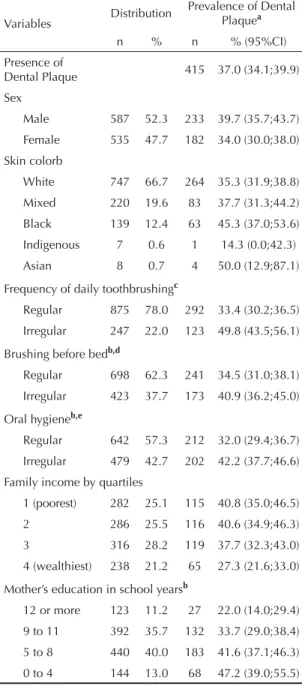
with families in the lowest income quartile (40.8%, 95%CI35.0;46.5) and less educated mothers (47.2%, 95%CI 39.0;55.5) than in those with higher income (27.3%, 95%CI 21.6;33.0) and 12 or more years of education (22.0%, 95%CI 14.0;29.4).
The validity in relation to the OHI-S of the maternal reporting of the children’s oral hygiene patterns is presented in Table 2. A low SE was observed for irregular daily brushing (29.6%, 95%CI 25.3;34.3); but when bedtime brushing was also considered (the variable denominated oral hygiene), the sensitivity increased to 48.8% (95%CI 43.9;53.7). The opposite occurred with the SP values, which showed higher values in the irregular daily brushing group (82.5%, 95%CI 79.5;85.2) and lower values for the oral hygiene variable (60.8%, 95%CI57.1;64.4). The brushing frequency variable had the highest PPV (49.8%, 95%CI 43.4;56.2), while the NPV for all three variables showed similar values, ranging from 65.0% to 67.0%.
Table 3 shows the validity of the oral hygiene patterns in relation to family income. The assessment of each question varied according to the level of family income. For all three variables, the SE values for the oral hygiene patterns reported by the mothers were higher among the individuals with lower family income. The oral hygiene variable was more sensitive than each of its components assessed separately. The proportion of children with plaque who were reported to have an irregular oral hygiene pattern was 54.8% (95%;CI 54.2;64.1) among those with lower family income, compared to 32.3% (95%CI 21.2;45.1) for those with a higher family income. However, the specifi city of the questions increased with family income, particularly in the case of brushing frequency. Among the higher-income families, 69.0% (95%CI 61.5;75.7) of the plaque-free children were reported to have a regular oral hygiene pattern, and this fi gure fell to 54.8% in lower-income families (95%CI 45.2;64.1).
The validity results grouped by the mother’s educa-tion level (Table 4) followed a pattern similar to that described for family income, i.e., higher SE for oral hygiene and higher SP for the frequency of daily brushing in all the education categories. The increase in the SE for the questions was inversely proportional to the number of years that the mother attended school, while the opposite effect was observed for the SP values. The PPV was higher among the children of less educated mothers, and the contrary was observed for the NPV.
DISCUSSION
The questionnaire on oral hygiene patterns, as answered by the mothers of 5-year-old children, showed an unsa-tisfactory performance in assessing actual oral hygiene; therefore its validity as a substitute for the intraoral examination of dental plaque is questionable. Although no universally accepted criteria for an accurate test exists, some authors have defi ned a test to be accurate if the sum of its SE and SP values is higher than 120%.3 In the present study, despite using the lowest summation, a desirable level of accuracy was not obtained.
Table 1. Dental plaque prevalence in the studied 5-year-old, according to socioeconomic factors and oral hygiene habits. Pelotas Birth Cohort, Southern Brazil 2009. (n=1122)
Variables Distribution
Prevalence of Dental Plaquea
n % n % (95%CI)
Presence of
Dental Plaque 415 37.0 (34.1;39.9)
Sex
Male 587 52.3 233 39.7 (35.7;43.7)
Female 535 47.7 182 34.0 (30.0;38.0)
Skin colorb
White 747 66.7 264 35.3 (31.9;38.8)
Mixed 220 19.6 83 37.7 (31.3;44.2)
Black 139 12.4 63 45.3 (37.0;53.6)
Indigenous 7 0.6 1 14.3 (0.0;42.3)
Asian 8 0.7 4 50.0 (12.9;87.1)
Frequency of daily toothbrushingc
Regular 875 78.0 292 33.4 (30.2;36.5)
Irregular 247 22.0 123 49.8 (43.5;56.1)
Brushing before bedb,d
Regular 698 62.3 241 34.5 (31.0;38.1)
Irregular 423 37.7 173 40.9 (36.2;45.0)
Oral hygieneb,e
Regular 642 57.3 212 32.0 (29.4;36.7)
Irregular 479 42.7 202 42.2 (37.7;46.6)
Family income by quartiles
1 (poorest) 282 25.1 115 40.8 (35.0;46.5)
2 286 25.5 116 40.6 (34.9;46.3)
3 316 28.2 119 37.7 (32.3;43.0)
4 (wealthiest) 238 21.2 65 27.3 (21.6;33.0)
Mother’s education in school yearsb
12 or more 123 11.2 27 22.0 (14.0;29.4)
9 to 11 392 35.7 132 33.7 (29.0;38.4)
5 to 8 440 40.0 183 41.6 (37.1;46.3)
0 to 4 144 13.0 68 47.2 (39.0;55.5)
a Dental plaque prevalence as measured by the Simplifi ed
Oral Hygiene Index.
b Variables with missing information. The highest number of
missing observations was 23.
c Never brushes, does not brush every day, or brushes only
once daily.
d Never or sometimes brushes before bed.
e Combination of irregular daily toothbrushing frequency and
Substituting more accurate measures for the presence of diseases or conditions by simpler tests, such as questionnaires, is acceptable, with the understanding that classifi cation errors may occur. The simpler tests are only useful when the risks are known and judged low based on a solid assessment of validity using the appropriate gold standard.8
The results of the present study must be interpreted with caution because limitations on the data collection for the gold standard may have occurred. The OHI-S advocates a visual examination with the aid of a dental probe to determine the extent of plaque. The use of a plaque-disclosing solution, although not recommended for epidemiological surveys, could facilitate visualizing the extent of plaque; this method would thus provide a
more accurate diagnosis, with a higher number of true positives observed. Another relevant point is that the OHI-S originally assessed the smooth surfaces of the teeth (buccal, palatal or lingual) in up to 12 readings. The OHI-S was modifi ed in the present study, and only the buccal surfaces were examined in a total of six readings. Once again, the evaluation of a lower number of dental surfaces may have reduced the number of true positives and caused a lower prevalence estimate. Such factors may have reduced the actual prevalence of dental plaque as identifi ed by the gold standard, which could consequently have led to a decrease in the PPV for the test questions.
In theory, the SE and SP of a test are independent from the prevalence of the outcome; in practice, however, a
Table 2 .The validity of oral hygiene patterns in relation to dental plaque (Simplifi ed Oral Hygiene Index )in 5-year-old children.
Pelotas Birth Cohort, Southern Brazil, 2009. (n=1122)
Validity Test
Irregular daily brushinga Irregular bedtime brushingb Irregular oral hygienec SE (95%CI) 29.6 (25.3; 34.3) 41.8 (37.0; 46.7) 48.8 (43.9; 53.7) SP (95%CI) 82.5 (79.5; 85.2) 64.6 (61.0; 68.2) 60.8 (57.1; 64.4)
PPV (95%CI) 49.8 (43.4; 56.2) 40.9 (36.2; 45.8) 42.2 (37.7; 46.7) NPV (95%CI) 66.6 (63.4; 69.7) 65.5 (61.8; 69.0) 67.0 (63.2; 70.6) SE= Sensitivity; SP= Specifi city; PPV= Positive Predictive Value; NPV= Negative Predictive Value.
a Never brushes, does not brush every day or brushes only once daily. b Never or sometimes brushes before bed.
c Combination of irregular daily toothbrushing frequency and irregular bedtime brushing.
Table 3. The validity of oral hygiene pattern in relation to dental plaque (Simplifi ed Oral Hygiene Index) in 5-year-old children
by family income quartiles. Pelotas Birth Cohort, Southern Brazil, 2009. (n=1122)
Test Validity Family Income Quartile
1 (poorest) 2º 3º 4 (wealthiest)
Irregular daily toothbrushing
SE (95%CI) 32.2 (23.8;41.5) 28.4 (20.5;37.6) 36.1 (27.5;45.4) 15.4 (7.63;26.5)
SP (95%CI) 77.2 (70.1;83.4) 81.7 (75.0;87.2) 81.7 (75.6;86.9) 89.1 (83.5;93.3) PPV (95%CI) 49.3 (37.6;61.1) 51.6 (38.7;64.2) 54.4 (42.8;65.7) 34.5 (17.9;54.3) NPV (95%CI) 62.3 (55.3;68.9) 62.4 (55.7;68.8) 67.9 (61.6;73.8) 73.8 (67.3;79.6) Irregular bedtime brushing
SE (95%CI) 48.7 (39.3;58.2) 43.5 (34.3;53.0) 42.9 (33.8;52.3) 24.6 (14.8;36.9)
SP (95%CI) 57.5 (49.6;65.1) 61.5 (53.8;68.9) 65.5 (58.4;72.1) 73.6 (66.4;79.9) PPV (95%CI) 44.1 (35.3;53.2) 43.5 (34.3;53.0) 42.9 (33.8;52.3) 25.8 (15.5;38.5) NPV (95%CI) 61.9 (53.8;69.6) 61.5 (53.8;68.9) 65.5 (58.4;72.1) 72.3 (65.1;78.8) Irregular oral hygiene
SE (95%CI) 54.8 (45.2;64.1) 47.8 (34.4;57.3) 52.9 (43.6;62.2) 32.3 (21.2;45.1) SP (95%CI) 54.5 (46.6;62.2) 58.6 (50.8;66.1) 60.9 (53.7;67.8) 69.0 (61.5;75.7) PPV (95%CI) 45.3 (36.9;54.0) 44.0 (35.1;53.2) 45.0 (36.6;53.6) 28.0 (18.2;39.6) NPV (95%CI) 63.6 (55.2;71.5) 62.3 (54.2;69.8) 68.2 (60.8;75.0) 73.2 (65.7;79.8) SE= Sensitivity; SP= Specifi city; PPV= Positive Predictive Value; NPV= Negative Predictive Value.
a Never brushes, does not brush every day or brushes only once daily. b Never or sometimes brushes before bed.
low prevalence estimate suggests a lower sensitivity and higher specifi city when compared to those obtained from a population with a higher prevalence.8 In the present study, the global prevalence of dental plaque was 37.0%, which is identical to that found in a preschool population in Belgium7 and is lower than the prevalence reported in other places, such as 83.0% for pre-school children in Jordan.19 Children with lower-income families, less-educated mothers12 and irregular oral hygiene habits16 have been found to have higher prevalence of dental plaque, consistent with findings of this study. The stratifi cation by family income and mother’s education revealed differences in the validity of the questions, which clearly distinguished the extremes of the strata.
In practical terms, what really matters is the PPV since it gives the probability of a positive individual actually having the outcome of interest. The PPV is heavily infl uenced by the prevalence of the outcome, unlike the SE or SP.8 According to this study, the probability of iden-tifying individuals with dental plaque in children whose mothers have reported an irregular oral hygiene pattern was, in general, lower than 50%. The prevalence diffe-rences between the income and education groups could explain the variations in performance of the tests used.
The twice-daily minimum toothbrushing frequency is the most accepted evidence of adequate levels of oral
hygiene. Additional factors, such as brushing time,6 the use of toothpaste, features of the toothbrush bristles, the use of dental fl oss, brushing technique and manual dexterity, can interfere with the effi cacy of good oral hygiene.10 In the case of children younger than six years, it is recommended that the brushing be performed by an adult until the child has developed suffi cient manual dexterity and cognitive skills to perform their toothbrushing independently.4 Therefore, children’s oral hygiene is also influenced by their mother’s attitudes towards this practice. The low validity of the oral hygiene questions in this study suggests that toothbrushing frequency per se is not the best predictor of oral hygiene in children.
Investigating the validity of self-reported oral health assessments in population surveys is highly rele-vant given the high costs of applying more accurate methods of clinical epidemiological diagnosis, such as intraoral examination. This study showed a high rate of false positives (52% to 70% overall), which suggests that reports from mothers on the oral hygiene of their 5-year-old children are not good substitutes for clinical intraoral examination; therefore, the presence of dental plaque should be directly assessed. More precise questions should be formulated and tested in future validation studies.
Table 4. The validity of oral hygiene pattern in relation to dental plaque (Simplifi ed Oral Hygiene Index )in 5-year-old children
by the mother’s education. Pelotas Birth Cohort, Southern Brazil, 2009. (n=1122)
Validity Mother’s education (in school years completed)
0 to 4 5 to 8 9 to 11 12 or more Irregular daily brushing
SE (95%CI) 39,7 (28,0;52,3) 33,9 (27,1;41,2) 25,0 (17,9;33,3) 3,72 (0,1;19,0) SP (95%CI) 71,1 (59,5;80,9) 79,3 (73,8;84,1) 85,4 (80,5;89,4) 90,6 (82,9;95,6) PPV (95%CI) 55,1 (40,2;69,3) 55,9 (44,4;63,2) 46,5 (34,5;58,7) 10,0 (0,3;44,5) NPV (95%CI) 56,8 (46,3;67,0) 62,7 (57,1;67,9) 69,2 (63,8;74,2) 77,0 (68,1;84,4)
Irregular bedtime brushing
SE (95%CI) 43,3 (31,2;56,0) 46,4 (39,1;54,0) 37,1 (28,9;46,0) 33,3 (16,5;54,0) SP (95%CI) 56,6 (44,7;67,9) 59,4 (53,1;65,4) 66,9 (60,8;72,6) 79,2 (69,7;86,8) PPV (95%CI) 46,8 (34,0;59,9) 45,0 (37,7;52,4) 36,3 (28,2;45,0) 31,0 (15,3;50,8) NPV (95%CI) 53,1 (41,7;64,3) 60,8 (54,4;66,9) 67,7 (61,6;73,4) 80,9 (71,4;88,2)
Irregular oral hygiene
SE (95%CI) 52,2 (39,7;64,6) 52,5 (45,0;59,9) 46,2 (37,5;55,1) 33,3 (16,5;54,0) SP (95%CI) 53,9 (42,1;65,5) 56,3 (49,9;62,4) 62,3 (56,1;68,2) 74,0 (64,0;82,4) PPV (95%CI) 50,0 (37,8;62,2) 46,2 (39,2;53,2) 38,4 (30,8;46,4) 26,5 (12,9;44,4)
NPV (95%CI) 56,2 (44,1;67,8) 62,3 (55,7;68,6) 69,5 (63,2;75,4) 79,8 (69,9;87,6) SE= Sensitivity; SP= Specifi city; PPV= Positive Predictive Value; NPV= Negative Predictive Value.
a Never brushes, does not brush every day or brushes only once daily. b Never or sometimes brushes before bed.
1. Barros AJD, Santos IS dos, Victora CG, Albernaz EP, Domingues MR, Timm IK, et al. Coorte de nascimentos de Pelotas, 2004: metodologia e descrição. Rev Saude Publica. 2006;40(3):402-13. DOI:10.1590/S0034-89102006000300007
2. Beltran-Aguilar ED, Barker LK, Canto MT, Dye BA, Gooch BF, Griffi n SO, et al. Surveillance for dental caries, dental sealants, tooth retention, edentulism, and enamel fl uorosis - United States, 1988-1994 and 1999-2002. MMWR Surveill Summ. 2005; 54(3):1-44.
3. Blicher B, Joshipura K, Eke P. Validation of self-reported periodontal disease: a systematic review. J Dent Res. 2005;84(10):881-90. DOI:10.1177/154405910508401003
4. Choo A, Delac DM, Messer LB. Oral hygiene measures and promotion: review and considerations. Aust Dent J. 2001;46(3):166-73.DOI:10.1111/j.1834-7819.2001. tb00277.x
5. Chrestani MAD, Santos SI, Matijasevich AM.
Hipertensão arterial sistêmica auto-referida: validação diagnóstica em estudo de base populacional. Cad Saude Publica. 2009;25(11):2395-406. DOI:10.1590/ S0102-311X2009001100010
6. Creeth JE, Gallagher A, Sowinski J, Bowman J, Barrett K, Lowe S, et al. The effect of brushing time and dentifrice on dental plaque removal in vivo. J Dent Hyg. 2009;83(3):111-6.
7. Declerck D, Leroy R, Martens L, Lesaffre E, Garcia-Zattera MJ, Vanden Broucke S, etal. Factors associated with prevalence and severity of caries experience in preschool children. Community Dent Oral Epidemiol. 2008; 36(2):168-78. DOI:10.1111/j.1600-0528.2007.00385.x
8. Fletcher RH, Fletcher SW. Epidemiologia clínica: elementos essenciais. Porto Alegre: Artmed; 2006.
9. Greene JC, Vermillion JR. The Simplifi ed Oral Hygiene Index. J Am Dent Assoc. 1964;68(1):7-13.
10. Honkala E, Nyyssönen V, Knuuttila M, Markkanen H. Effectiveness of children’s habitual toothbrushing. J Clin Periodontol. 1986;13(1):81-5.
11. Jamieson LM, Thomson WM, McGee R. An assessment of the validity and reliability of dental self-report items used in a National Child Nutrition Survey. Community Dent Oral Epidemiol. 2004;32(1):49-54. DOI:10.1111/j.1600-0528.2004.00126.x
12. Jerkovic K, Binnekade JM, van der Kruk JJ, van der Most JA, Talsma AC, van der Schans CP. Differences in oral health behaviour between children from high and children from low SES schools in The Netherlands. Community Dent Health. 2009;26(2):110-5.
13. Lima-Costa MF, Peixoto SV, Firmo JOA, Uchoa E. Validade do diabetes autoreferido e seus determinantes: evidências do projeto Bambuí. Rev Saude Publica. 2007;41(6):947-53. DOI:10.1590/ S0034-89102007000600009
14. Miller K, Eke PI, Schoua-Glusberg A. Cognitive evaluation of self-report questions for surveillance of periodontitis. J Periodontol. 2007;78(7 Suppl):1455-62. DOI:10.1902/jop.2007.060384
15. Palmqvist S, Söderfeldt B, Arnbjerg D. Self-assessment of dental conditions: validity of a questionnaire. Community Dent Oral Epidemiol. 1991; 19(5):249-51.
16. Peres MA, Peres KG, de Barros AJ, Victora CG. The relation between family socioeconomic trajectories from childhood to adolescence and dental caries and associated oral behaviours. J Epidemiol
Community Health. 2007; 61(2):141-5. DOI:10.1136/ jech.2005.044818
17. Pitiphat W, Garcia RI, Douglass CW, Joshipura KJ. Validation of self-reported oral health measures. J Public Health Dent. 2002;62(2):122-8.
18. Robinson PG, Nadanovsky P, Sheiham A. Can questionnaires replace clinical surveys to assess dental treatment needs of adults? J Public Health Dent. 1998; 58(3):250-3.
19. Sayegh A, Dini EL, Holt RD, Bedi R. Oral cleanliness, gingivitis, dental caries and oral health behaviours in Jordanian children. J Int Acad Periodontol. 2002;4(1):12-8.
20. Sheiham A. The prevention and control of periodontal disease. Dent Health (London). 1979;18(4):7-13.
21. Silveira EA, Araujo CL, Gigante DP, Barros AJD, Lima MS. Validação do peso e altura referidos para o diagnóstico do estado nutricional em uma população de adultos no Sul do Brasil. Cad Saude Publica. 2005;21(1):235-45. DOI:10.1590/S0102-311X2005000100026
22. World Health Organization. Oral health surveys: basic methods. Geneva: ORH/EPID; 1997.
23. Yazdani R, Vehkalahti MM, Nouri M, Murtomaa H. Validity of self-assessment of oral health among 15-year-olds in Tehran, Iran. Oral Health Prev Dent. 2008;6(4):263-9.
REFERENCES