* Extracted from the dissertation “Gerenciamento da segurança assistencial nos serviços de enfermagem”, School of Nursing of Ribeirão Preto, Universidade de São Paulo, 2013.
1 Quality Manager, Grupo São Lucas, Ribeirão
Preto, SP, Brazil.
2 Associate Professor, Department of General
and Specialized Nursing, School of Nursing of Ribeirão Preto, Universidade de São Paulo, Ribeirão Preto, SP, Brazil.
3 Professor, PhD, Faculty of Nursing,
Universidade Federal de Goiás, Goiânia, GO, Brasil.
4 PhD Student, School of Nursing of Ribeirão
Preto, Universidade de São Paulo, Ribeirão Preto, SP, Brazil.
5 Professor, PhD, Faculty of Nursing, Centro
Universitário Barão de Mauá, Ribeirão Preto, SP, Brazil.
ABSTRACT
Objective: To evaluate the actions of patient safety management developed in hospitals, from the perspective of nurses. Method: his is a cross-sectional, descriptive study of the survey type. Participants were seven hospitals, in which seven nurse managers and 49 sector coordinator nurses (n = 56) answered the instrument prepared by the author. Results: he results showed that 100% of hospitals have an adverse event reporting system, 71.4% have a Risk Management Committee and 80% have discussions about the events. here is agreement that these discussions lead to favorable changes for patient safety in the surveyed institutions. he employees’ fear of punishment for their faults, and the underreporting of events were the aspects of greatest weakness found. Conclusion: he institutions should develop organizational policies focused on stimulating event notiication and on the implementation of measures directed to a non-punitive organizational culture.
DESCRIPTORS
Patient Safety; Safety Management; Nursing.
Patient safety management from the perspective of nurses
*Gerenciamento da segurança do paciente sob a ótica dos enfermeiros
Gestión de la seguridad del paciente bajo el punto de vista de los enfermeros
Lucilena Françolin1, Carmen Silvia Gabriel2, Andrea Bernardes2, Ana Elisa Bauer de Camargo Silva3, Maria de Fatima Paiva Brito4, Juliana Pereira Machado5
Received: 04/29/2014 Approved: 11/30/2014
ORIGINAL ARTICLE DOI: 10.1590/S0080-623420150000200013
Correspondence Addressed to: Lucilena Françolin
INTRODUCTION
According to the World Health Organization
(WHO)(1), every year, around the world, tens of millions of
patients sufer disabling injuries or death related to errors and failures in health care. In developed countries, a patient in every ten sufers an adverse event while receiving health care in hospitals. In developing countries, the need for re-search to reveal the numbers on these events is noteworthy. he events can be classiied as: reportable circumstance, near-miss, no harm incident, or harmful incident that is also referred to as an adverse event (AE)(2-3).
he lack of patient safety causes 42.7 million incidents with injuries around the world each year. Among this total, two-thirds occur in developing countries and countries in transition, according to a study by the Harvard University(4).
In this context, the analysis of diferent studies carried out in several countries, such as England, Australia, Canada, Denmark, New Zealand, Portugal, France, Sweden, Spain, Holland and Brazil, showed a high number of cases of ad-verse events involving a signiicant portion of hospitalized patients, and concluding that approximately 10% of hospi-tal admissions result in some type of adverse event. Still in relation to the mentioned places, it was disclosed that the number of preventable adverse events in hospitalizations represent 50% of cases(5).
Data from the Agency for Healthcare Research and Quality (AHRQ), an organization designated by the US government as the lead agency in supporting research to reduce health gaps, show that more than a decade after its creation and publication of the report To err is human(6), the
US health care system has not evenly beneited from the little progress achieved on the issue of patient safety(7).
A study carried out in Spain has analyzed 245,320 epi-sodes of hospital care with a total cost of 1,308,791,871 euros. It reached the conclusion that among the total of pa-tients, 16,782 (6.8%) have experienced one or more adverse events. When analyzed by groups of diagnoses, the adverse events added average costs of between 5,260 and 11,905 euros in health expenses. hus, the total cost generated by adverse events was 88,268,906 euros or 6.7% of the total health costs. he study data show that adverse events repre-sent a very signiicant economic impact that can be reversed by improving the quality and safety of health systems(8).
hese data are disturbing and cause great impact both nationally and internationally, and justify that the issue of patient safety is considered a priority by the major health organizations around the world.
It is not possible to discuss patient safety without going through the issue of organizational culture of the health institutions, which can be deined as the way a group per-ceives, thinks and feels(9). If the organizational culture of
the institution regarding the management of adverse events is based on punishment and guilt, this may cause failure in reporting these events, making it diicult to build an insti-tutional culture focused on patient safety.
For implementing and incorporating the culture of pa-tient safety in any health institution, it is necessary that its
management and professionals have a high level of com-mitment, and a strong cohesion spirit among the various departments. hese factors are essential to ensure safe care for professionals and patients(10).
In health institutions, nurses act as facilitators in the identiication of risks for AE, which is a key element in this process due to their assistance role. As the nurses take their leadership roles with the team, there is evidence of improved care(11), therefore, they should report, compare and
measure the facts and consequences of AE. In addition, the nurses are technically responsible for the nursing staf with their class council, and will respond to potential lawsuits related to the occurrence of adverse events.
An event is more likely to be reported if it has caused harm to the patient. As the nurses are those with greater knowledge of the AE reporting system of the institution, they are also the professionals who most report the events(12).
All eforts to improve quality in health and the increas-ing research on patient safety corroborate what is presented in the National Patient Safety Program (PNSP - Programa Nacional de Segurança do Paciente), which lists the speciic objective of production, systematization and dissemination of knowledge on patient safety(13). hese facts justify this
study, which questions what safety management actions have been adopted in hospitals.
In this perspective, the present study aimed to evalu-ate the actions of patient safety management developed in hospitals, from the perspective of nurses.
METHOD
his is a descriptive study, with quantitative approach and cross-sectional design of the Survey type. Data were collected through the application of two structured instru-ments: one for the nurse managers (NM) and another one for the coordinators, prepared by the principal investigator, who sought to identify and evaluate the patient safety man-agement actions developed in the respective institutions.
he study was conducted in the city of Ribeirão Preto, state of São Paulo (SP) and proposed for all the 15 hospitals in the city, including governmental and private institutions and non-proit organizations. Among all of them, seven (46.7%) agreed to participate, of which six (85.7%) were general hospitals and one was a (14.3%) specialized hospi-tal. Regarding the care complexity, three (42.9%) are ranked as high complexity and four (57.1%) of medium complexity, accounting together for about 30% of the total hospital beds capacity in the city.
he research included the nurse managers of the in-stitutions and the nurse coordinators of the areas of care or support to care who were not on vacation or sick leave during the study period.
he invitation was addressed to the NM, who pointed the respective coordinators or leaders of the areas of care and support to participate in the study. After selection, the study had 56 participants, of which seven (12.5%) were NM and 49 (87.5%) were nurse coordinators.
Universidade de São Paulo, under protocol CAAE: 00803212.2.0000.5393. All participants voluntarily agreed to participate by signing the Free and Informed Consent. Each participant was interviewed once in the institution, during working hours, with prior appointment.
he data collection period was between August and September 2012, through interviews. he instrument went through face, content and semantics validation by ive judges, researchers and nurses working in the area of patient safety, who received the questionnaire, analyzed it and suggested adjustments, inclusion and exclusion of terms. Each evalu-ation was analyzed carefully by two researchers indepen-dently. he inal version of the instrument included closed questions concerning the characterization of profession-als and the theme of AE, its occurrence in the institution, causal factors, behaviors adopted and preventive measures.
he following variables related to patient safety man-agement directed at the NM were considered: the existence of notiication systems, the existence of a risk management committee, nurse participation in this committee, the pres-ence of discussions on AE in the committee, the form of identifying AE, and the description of the tools used to evaluate the risks of AE.
he listed variables directed to the coordinating nurses were the following: notiication frequency of AE or near miss; identiication of elements that promote the safety culture in the institutions and the fear of employees in face of the consequences of AE notiication; the existence of multidisciplinary discussions on ways to prevent AE and an understanding that discussions on AE promote positive changes in the teams.
A common variable to nurse managers and coordina-tors about the support of senior management to implement patient safety initiatives was analyzed.
he results were entered in a Microsoft Excel® version 2007 database and analyzed using descriptive statistics, with relative and absolute frequencies and percentage, using the
Statistical Package For he Social Science® (SPSS) version 15.0.
RESULTS
he study had 56 participants (seven NM and 49 co-ordinator nurses) for assessing the actions developed in hospitals from the perspective of nurses, guided by the management of patient safety, in relation to the notiica-tion system, the existence and presence of nurses in the risk management committee, and the tools used for identifying and preventing risks.
As for the characterization of the sample, there is a pre-dominance of females, a feature observed in six (85.7%) of the NM and 41 (87.7%) of the coordinator nurses. In relation to further training, six (85.7%) NM and 39 (79.6%) coordina-tor nurses have post-graduation courses, with predominance of the lato sensu modality (specialization) in ive (83.3%) of the NM and in 32 (82, 0%) of the coordinator nurses.
In relation to the proile of the hospitals, only two (28.6%) have some kind of quality program implemented. All hos-pitals have an internal system of AE notiication, with pre-dominance of the electronic form of notiication (Table 1).
Table 1 – AE notification system, risk management committee and AE agreements in the surveyed institutions, according to the reports of NM - Ribeirão Preto, SP, 2012.
Variables f %
There is an internal AE notiication system
Yes 07 100.0
Form of AE notiication
Electronic 04 57.1
Manual (written) 03 42.9
There is a risk management committee
Yes 05 71.4
No 02 28.6
There are nurses integrating the committee
Yes 05 71.4
There is no committee 02 28.6
The committee discusses the notiied AE
Yes 04 57.1
No 01 14.3
There is no committee 02 28.6
f: frequency of responses.
Note: (n= 7)
According to the NM, in relation to the way adopted for identifying care risks, six (85.7%) stated to adopt at least a tool for risk assessment, and only one professional (14.3%) reported not formally adopting any kind of tool.
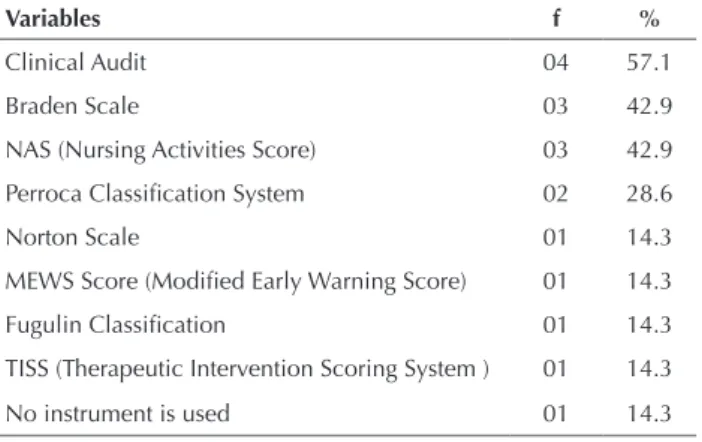
he following tools used for risk assessment stand out, according to the NM: the clinical audit, adopted by four (57.1%) institutions; the Braden Scale and the NAS (Nurs-ing Activities Score), both adopted by three (42.9%) institu-tions (Table 2).
Table 2 – Tools adopted for identification of risks and care com-plexity, according to the NM - Ribeirão Preto, SP, 2012.
Variables f %
Clinical Audit 04 57.1
Braden Scale 03 42.9
NAS (Nursing Activities Score) 03 42.9
Perroca Classiication System 02 28.6
Norton Scale 01 14.3
MEWS Score (Modiied Early Warning Score) 01 14.3
Fugulin Classiication 01 14.3
TISS (Therapeutic Intervention Scoring System ) 01 14.3
No instrument is used 01 14.3
f: frequency of responses.
Note: (n=7)
According to the coordinator nurses, 44 (89.8%) agree that most of the staf is afraid of the notiication con-sequences and 44 (89.8%) coordinators agree that dis-cussions about the errors have led to positive changes (Table 4).
DISCUSSION
he present study showed that in the sample, actions are being developed in hospitals, oriented by patient safety management from the perspective of nurses.
Data from the Federal Nursing Council(14) show that
nursing professionals are mostly female, conirming the re-sults of this study.
he results showed that all institutions have notiied the AE, and the majority uses the electronic system, revealing a very positive perspective, given the recommendations of the DRC resolution number 36 of July 25, 2013(15). It states that
establishing safety improvements is not possible without knowledge of the AE.
he results also showed the fear of professionals in rela-tion to punitive measures related to AE notiicarela-tion, which should be considered a point of attention and improvement. Individuals should be able to report errors without fear of punishment or embarrassment. hey must be convinced that the response to the event will not be Who failed? but rather
What happened?(16), emphasizing that notiications can
re-duce the incidence of errors. he existence of a non-punitive and supportive environment is essential for the notiication of situations of risk/errors and near misses, since the majority of errors are due to the system, and not just human errors(17).
his study showed that the discussions on AE were considered positive in seeking improvements, and by un-derstanding that the detection of these events can serve as a basis for decision making and planning of patient safety from the analysis, monitoring, minimization and preven-tion of incidents that may cause AE(18-19). In order to face
the AE, errors and incidents in health services that put pa-tient safety at risk, it is necessary to know the scope and magnitude of their occurrences(20), which go far beyond the
creation of a computerized system for notiication of events. In addition to analyzing risks, the identiication and re-port of AE may promote the adoption of preventive mea-sures by health professionals for possible corrections, aiming at minimizing or eliminating the occurrence of such events, and also follow the development of actions taken to im-prove the health practice(21).
he results showed that the notiications are resultant from AE that could afect patients, but did not afect. Simi-larly, another study(22) has demonstrated reports of AE in Table 3 – Notification of AE and near miss done by coordinator
nurses -Ribeirão Preto, SP, 2012.
Variables f %
Notiication of a near miss.
Never 01 2.0
Rarely 11 22.5
Sometimes 13 26.5
Almost always 17 34.7
Always 07 14.3
Notiication of an AE that affects the patient, but has no harmful potential.
Never 01 2.0
Rarely 02 4.1
Sometimes 06 12.2
Almost always 14 28.6
Always 26 53.1
Notiication of an AE that affects patients, has harmful potential, but does not cause them any harm.
Never 01 2.0
Rarely 03 6.3
f: frequency of responses.
Note: (n=49)
Table 4 – Coordinator nurses' perspective about the dissemina-tion of safety culture of the surveyed hospitals - Ribeirão Preto, SP, 2012.
Variables f %
Employees are afraid that their mistakes appear in their functional records
Disagree 04 8,2
Neutral 01 2,0
Agree 31 63,3
Strongly agree 13 26,5
The forms of preventing errors are discussed at the unit
Rarely 02 4,2
Sometimes 06 12,2
Almost always 22 44,9
Always 19 38,8
Discussions on the errors have led to positive changes
Strongly disagree 01 2,0
Neutral 04 8,2
Agree 29 59,2
Strongly agree 15 30,6
f: frequency of responses. Note: (n=49)
When asked if there is support from the administration for the implementation of safety management in the insti-tutions, there was unanimous agreement among the NM (Figure 1).
Figure 1 – Opinion of the nurse managers (n=7) and coordinator nurses (n=49) in relation to administration support to implement safety measures - Ribeirão Preto, SP, 2012.
P
er
cen
tage of r
esponden ts 80% 70% 60% 50% 40% 30% 20% 10% 0%
Nurse managers Coordinators
Disagree Neutral Agree Strongly agree 1(2.0%) 2(4.1%)
4(57.1%) 25(51.1%)
the occurrence of errors, mistakes or failures when there was no harm to patients. his fact conirms that workers are afraid of reporting errors when the patient is afected.
It is important that the institutions encourage notiica-tions with complete data. his way, control strategies can be developed to prevent new occurrences, directly inluencing the quality of care. For the efective occurrence of notiica-tions, professionals must be constantly oriented on the im-portance of the records, which should be correct and com-plete, with simple forms, easy to understand and ill out(23).
When identifying the risks that afect patient safety, arises the need to analyze them, which is a systematic pro-cess of identiication, analysis and treatment of causes(20). he
results of the present study converge in this sense by em-phasizing the actions related to the discussion of AE, with presence of nurses in risk management committees and the perception of positive changes resulting from such actions.
he discussion of AE in a risk management committee formed by a multidisciplinary team, with the objective of de-veloping strategies based on normative and regulatory require-ments, may favor the minimization of errors(24) and promote
health education actions in order to prevent damages related to assistance that afect patient safety. his is a strategy that health institutions should use in order to help the investigation of adverse events, for their anticipation and minimization(25).
he greatest contribution of this study is producing a diagnosis of the actions of patient safety management in a regional center for health related to hospital services.
he evaluation of actions of patient safety management restricted to the perspective of nurses with a leadership po-sition is considered a limitation of this study.
CONCLUSION
his study achieved its objectives because it evaluated the actions developed in hospitals from the perspective of nurses, guided by patient safety management and showing several positive and relevant aspects in the risk management processes of the surveyed institutions. One of such processes
refers to the presence of a notiication system of AE in all in-stitutions, which facilitates the identiication of weaknesses. he study also shows that most hospitals have an es-tablished Risk Management Committee with participating nurses. In addition, several nursing services already use scores and scales to predict care risks, which helps in care planning. Another important aspect is that most coordinators stated that the errors have led to positive changes in the institutions.
Among the weaknesses found, the culture of fear was evident. he employees fear their errors will appear in their professional records. Another evidence was the underreport-ing of AE, even the events that have afected the patients. Actions aimed at optimization of patient care shall be de-veloped urgently to reduce errors caused by system failures. In this respect, the quality programs can be tools to help health institutions to learn more about their services, identifying their weaknesses, implementing more consistent, safe and agile actions, and providing a better use of the available re-sources, avoiding waste and allowing their better application. he institutions should relect critically on the role played by managers, as their strategic decisions include people management, facility planning, developing opera-tional procedures, choice of equipment, and all other deci-sions that deine the system structure.
he improvement of the nurses’ skills and knowledge is a key factor to increase quality of care and consequently, patient safety. In this context, it is necessary to invest in professional training and safe care provision for health services users.
he high level of agreement about the senior adminis-tration support in safety management of institutions is an important factor. he correction of the weaknesses certainly involves not only procedural improvements, but also en-vironmental and technological improvements that require investments in order to happen.
he diagnostic of risk management presented can sup-port hospital service managers to implement measures ca-pable of improving safety management in institutions, since quality and safety are inseparable attributes.
RESUMO
Objetivo: Avaliar sob a ótica dos enfermeiros, as ações de gerenciamento da segurança dos pacientes desenvolvidas em instituições hospitalares. Método: Trata-se de um estudo transversal, descritivo, tipo Survey. Participaram do estudo sete hospitais nos quais sete enfermeiros responsáveis e 49 enfermeiros coordenadores de setores (n=56) responderam ao instrumento elaborado pelo autor. Resultados: Os resultados evidenciaram que 100% dos hospitais possuem sistema de notiicação de eventos adversos, 71,4% possuem Comissão de Gerenciamento de Riscos, 80% realizam discussão dos eventos, havendo consenso de que tais discussões levam a mudanças favoráveis à segurança do paciente nas instituições pesquisadas. O receio dos colaboradores por punição frente às suas falhas e a subnotiicação dos eventos foram os aspectos de maior fragilidade encontrados. Conclusão: As instituições devem desenvolver políticas organizacionais focadas no estímulo à notiicação de eventos e na implementação de medidas que direcionem para uma cultura organizacional não punitiva.
DESCRITORES
RESUMEN
Objetivo:Evaluar bajo el punto de vista de los enfermeros las acciones de gestión de la seguridad de los pacientes desarrolladas en instituciones hospitalarias. Método: Se trata de un estudio transversal, descriptivo, tipo Survey. Participaron del estudio siete hospitales en los que siete enfermeros responsables y 49 enfermeros coordinadores de sectores (n=56) respondieron al instrumento elaborado por el autor. Resultados: Los resultados evidenciaron que el 100% de los hospitales tiene sistema de notiicación de eventos adversos, el 71,4% tiene Comisión de Gestión de Riesgos, el 80% llevó a cabo la discusión de los eventos, habiendo consenso de que dichas discusiones conducen a cambios favorables a la seguridad del paciente en las instituciones investigadas. El recelo de los colaboradores por punición ante sus fallos y la subnotiicación de los eventos fueron los aspectos de mayor fragilidad encontrados. Conclusión: Las instituciones deben desarrollar políticas organizacionales enfocadas en el estímulo a la notiicación de eventos y la implantación de medidas que remitan a una cultura organizacional no punitiva.
DESCRIPTORES
Seguridad del Paciente; Administración de la Seguridad; Enfermería.
REFERENCES
1. World Health Organization. Summary of the evidence on patient safety: implications for research. Geneva: WHO; 2008.
2. World Health Organization. The conceptual framework for the international classiication for patient safety (ICPS). Geneva: WHO; 2009.
3. Runciman W, Hibbert P, Thomson R, Van Der Schaaf T, Sherman H, Lewalle P. Towards an International Classiication for Patient Safety: key concepts and terms. Int J Qual Health Care. 2009;21(1):18-26.
4. Jha AK, Larizgoitia I, Audera-Lopez C, Prasopa-Plaizier N, Waters H, Bates DW. The global burden of unsafe medical care: analytic model-The global burden of unsafe medical care: analytic model-ling of observational studies. BMJ Qual Saf [Internet]. 2013 [cited 2014 Mar 21];22(10):809-15. Available from: http//www.qualitysafety. bmj.com/content/22/10/809.full.pdf+html
5. de Vries EN, Ramrattan MA, Smorenburg SM, Gouma DJ, Boermeester MA. The incidence and nature of in-hospital adverse events: a systematic review. Qual Saf Health Care [internet]. 2008 [cited 2014 Mar 21];17(3):216-23. Available from: http://www.ncbi.nlm.nih. gov/pmc/articles/PMC2569153/
6. Kohn LT, Corrigan JM, Donaldson MS; Committee on Quality of Health Care in America; Institute of Medicine. To err is human: Building a Safer Health System. Washington: National Academy Press; 2000.
7. Agency for Healthcare Research and Quality. A decade of evidence, design, and implementation: advancing patient safety [Internet]. Rock-ville: AHRQ; 2012 [cited 2014 Mar 21]. Available from: http//www.ahrq.gov/professionals/quality-patient-safety/patient-safety-resources/ advancing-patient-safety/index.html
8. Allué N, Chiarello P, Bernal Delgado E, Castells X, Giraldo P, Martínez N, et al. Impacto económico de los eventos adversos em los hos-pitales españoles a partir del conjunto mínimo básico de datos. Gac Sanit. 2014;28(1):48-54.
9. Schein E. Organizational culture and leadership. 3nd ed. San Francisco: Jossey-Bass; 2004.
10. Carvalho RE, Cassiani SH. Cross-cultural adaptation of the Safety Attitudes Questionnaire - Short Form 2006 for Brazil. Rev Lat Am Enfer-magem. 2012;20(3):575-82.
11. Laschinger HK, Smith LM. The inluence of authentic leadership and empowerment on new-graduate nurses’ perceptions of interprofes-sional collaboration. J Nurs Adm. 2013;43(1):24-9.
12. Kreckler S, Catchpole K, McCulloch P, Handa A. Factors inluencing incident reporting in surgical care. Qual Saf Health Care. 2009;18(2):116-20.
13. Brasil. Ministério da Saúde. Portaria n. 529, de 1º de abril de 2013. Institui o Programa Nacional de Segurança do Paciente (PNSP) [Inter-net]. Brasília; 2013 [citado 2014 mar. 21]. Disponível em: http://bvsms.saude.gov.br/bvs/saudelegis/gm/2013/prt0529_01_04_2013.html
14. Conselho Federal de Enfermagem (COFEN). Análise de dados dos proissionais de enfermagem existentes nos Conselhos Regionais. Bra-Bra -sília: Departamento de Tecnologia da Informação; 2011.
15. Brasil. Ministério da Saúde. Resolução da Diretoria Colegiada n.36, de 25 de julho de 2013. Institui ações para a segurança do paciente em serviços de saúde e dá outras providências [Internet]. Brasília; 2013 [citado 2014 mar. 21]. Disponível em: http://bvsms.saude.gov.br/ bvs/saudelegis/anvisa/2013/rdc0036_25_07_2013.html
16. Leape L, Berwick D, Clancy C, Conway J, Gluck P, Guest J, et al. Transforming healthcare: a safety imperative. Qual Saf Health Care. 2009;18(6):424-8.
17. McCannon CJ, Hackbarth AD, Grifin FA. Miles to go: an introduction to the 5 Million Lives Campaign. Jt Comm J Qual Patient Saf. 2007;33(8):477-84.
18. Silva RC, Ferreira MA. Características dos enfermeiros de uma unidade tecnológica: implicações para o cuidado de enfermagem. Rev
Bras Enferm. 2011;64(1):98-105.
19. Hinrichsen SL, Oliveira CLF, Campos MA, Possas LCM, Sabino G, Vilella T. Gestão da qualidade e dos riscos na segurança do paciente: estudo-piloto. RAHIS. 2011(7):10-7.
20. Adhikari R, Tocher J, Smith P, Corcoran J, MacArthur J. A multi-disciplinary approach to medication safety and the implication for nursing education and practice. Nurse Educ Today. 2014;34(2):185-90.
22. Reis CT, Laguardia J, Martins M. Translation and cross-cultural adaptation of the Brazilian version of the Hospital Survey on Patient Safety Culture: initial stage. Cad Saúde Pública. 2012;28(11):2199-210.
23. Bezerra ALQ, Silva AEBC, Branquinho NCSS, Paranaguá TTB. Análise de queixas técnicas e eventos adversos notiicados em um hospital
sentinela. Rev Enferm UERJ. 2009;17(4):467-72.
24. Battaglia JN, Lis JE, Chui MA. Evaluation of a patient perspective module in a required medication safety and quality course at a college of pharmacy. Inov Pharm. 2013;4(1):102.