Ricardo Mendes Antas Jr.
Universidade de São Paulo. Faculdade de Filosofia, Letras e Ciên-cias Humanas. Departamento de Geografia. São Paulo, SP, Brasil. E-mail: [email protected]
Rafael da Silva Almeida
Universidade de São Paulo. Faculdade de Filosofia, Letras e Ciên-cias Humanas. Departamento de Geografia. São Paulo, SP, Brasil. E-mail: [email protected]
Medical diagnosis and corporate use of
Brazilian territory: an analysis of the spatial
productive circuit of diagnostic reagents
1
Diagnóstico médico e uso corporativo do território
brasileiro: uma análise do circuito espacial produtivo dos
reagentes para diagnóstico
Abstract
The formation of what Milton Santos called the technical-scientific and informational milieu is marked by the profound interaction between science and technique, both under shelter of the market. In this milieu, we see new technical objects arising, whose content is given by science. When dealing specifically with medicine, this trait is still more remarkable, which is evident, for instance, when we analyze technical diagnosis systems in the current period, for they come to configure specialized eco-nomic segments with high added value production. In this article, we discuss how a significant set of companies focused on diagnosis concurs to a new type of urbanization in Brazilian territory, consid-ering the Health Economy and the health-industry complex. Marked by the corporate use of territory, this urbanization is shaped by the establishment of spatial productive circuits and their respective circles of space cooperation, and one of its main characteristics has been the concentration and centralization of capital.
Keywords:Spatial Productive Circuit; Circles of Space Cooperation; Corporate Use of Territory; Hu-man Geography; Geographic Space.
1 This article was the result of research supported by the Fundação de Amparo à Pesquisa do Estado de São Paulo – FAPESP, process 2010/18.750-8.
Correspondence
Departamento de Geografia
Resumo
A formação daquilo que o geógrafo Milton Santos denominou meio técnico-científico-informacional é marcada pela profunda interação entre ciência e técnica, ambas sob a égide do mercado. Nesse meio, vemos surgirem novos objetos técnicos, cujo conteúdo é dado pela ciência. Quando tratamos espe-cificamente da medicina, essa característica é ainda mais marcante, o que fica manifesto, por exemplo, quando analisamos os atuais sistemas técnicos de diagnóstico, que acabam configurando segmentos econômicos especializados com produção de alto valor agregado. Neste artigo, buscou-se tratar da economia da saúde e do complexo industrial que a envolve discutindo como um conjunto significativo de empresas voltadas ao diagnóstico concorre para um novo tipo de urbanização no território brasileiro. Marcada pelo uso corporativo do território, essa urbanização se conforma pelo estabelecimento de circuitos espaciais produtivos, dos quais focaremos aqui os da saúde e seus respectivos círculos de coop-eração no espaço. Veremos, então, que entre suas principais características estão a concentração e a centralização do capital.
Palavras-chave:Circuito Espacial Produtivo; Círcu-los de Cooperação no Espaço; Uso Corporativo do Território; Geografia Humana; Espaço Geográfico.
Introduction
One of the most characteristic aspects of medicine nowadays is the exceptional specialized technologi-cal inventions and innovations combatting a variety of diseases and the way they have been rapidly, if not immediately, incorporated into medical practice. In this process the relationship between the actual productive structure and the health care system is clear, the latter frequently based on curative medi-cine, which has dictated the parameters for defining
illness and cure and, therefore, for treating diseases. Thus, this medicine, largely constituted of surgical interventions and making diagnoses about bodies, participates in structuring industrial complexes aimed at researching and producing medical sup-plies as well as a wide range of health care in Bra-zilian territories (Almeida; Antas Jr., 2011; Antas Jr., 2014).
Such industrial complexes, specializing in pro-viding a wide range of products, were first formed in the United States and in Europe – particularly in France, the UK and Germany – and are characterized as productive regional circuits, driven by the chemi-cal and electronics industries (Perroux, 1975). With the establishment of what Santos (2008) called the
technical-scientific-and informational milieu, the
material base of the globalization process, and shap-ing the technical-scientific-informational period
(Santos, 2008), we see such complexes, dedicated to encouraging medicine with a strongly technological component, going from regional dynamics to a glob-al integration. This cooperation extends between industry and other productive forms, including dif-ferent countries in one single technological system and is what we have called here spatial productive circuits, as proposed by Santos (1986, 1988).
Health oriented industrial complexes have ex-isted in Brazil since the 1980s (Cordeiro, 1980), but it is from the 2000s onwards that we can point out their integration with those of other countries, form-ing productive spatial circuits in health. The year 2008 was a milestone in this process, being when the Brazilian State created the Executive Group of Industrial Health Complexes - Grupo Executivo do
Complexo Industrial da Saúde (GECIS),
the National Bank for Economic and Social Develop-ment - Banco Nacional de Desenvolvimento
Econômi-co e Social (BNDES), integrating the Ministries of
Health, of Development, Industry and Foreign Trade and of Science Technology and Innovation, as well as creating laws to specifically encourage activities in the sector.
It is worth noting, therefore, the central role played by the Secretariat of Science, Technology and Strategic Supplies - Secretaria de Ciência, Tecnologia
e Insumos Estratégicos (SCTIE) in implementing
lines of investment for innovation, encouraging business in the sector to be created or to expand. Also noteworthy are the actions of the Department of Science and Technology - Departamento de Ciência e Tecnologia (DECIT) in developing health technolo-gies, establishing cooperative links between the dif-ferent productive agents.
The role of this Secretariat, then, was to direct a “national system of health innovations”, the im-portance of which has already been indicated in Gadelha, Quental and Fialho (2003), consolidating a health oriented industrial complex in Brazil. It coordinated the innovation processes, integrat-ing agents from industrial production, from high complexity services and from scientific production. Homma et al. (2011) highlight this strategic role when dealing with vaccines and immune-biological products, and this can be extended to producing di-agnostic reagents (Gadelha; Quental; Fialho, 2003). Another example of the coordinating role played by the SCTIE is in the creation of the National Agenda of Health Research Priorities - Agenda Nacional de
Prioridades de Pesquisa em Saúde (ANPPS), guiding
the research topics and lines necessary for the dif-ferent stages of which the industrial health complex is constituted.
The set of actions encouraging all types of pro-duction, as cited above, are denominated circles of space cooperation by Santos (1986), a concept that is inseparable from that of the spatial productive
circuits. It was in fact through the expansion and
institutionalization of circles of space cooperation (which may come from the State, but also from the market and/or organized society) that the regional circuits became spatial circuits in the different sec-tors of the capitalist economy.
It is important to note, however, that the network of health care services and the industrial complex have only expanded and concentrated themselves in the most dynamic parts of Brazil, mainly in the São Paulo metropolitan area, the command center of “socio-spatial formation” (Santos, 1977; Santos; Silveira, 2010). The spatial concentration of health care services and of the industrial complex, as well as the centralization of capital currently established by some companies in the sector, is configuring a new urbanization process, marked by corporate use of territory, in which “each company uses the terri-tory according to their own ends, and exclusively according to these ends” (Santos, 2009b, p. 85), seek-ing specific points or areas with a dense technical base to encourage the production, circulation and consumption of their products.
In the specific case of industries producing di-agnostic reagents and of laboratories, consumers of these reagents, we can see the establishment of logics specific to the sector and, conforming with the current dynamic of the capitalist system, func-tionalized by planet-wide flows and eager for ever greater accumulation. Meeting these demands for production, spatial productive circuits and their respective circles of space cooperation are estab-lished, consolidating new health oriented productive dynamics essential to contemporary technical-scientific development.
The state and city of São Paulo has been the privileged locus of action for these businesses, we therefore focus the spatial dynamics configured by this new use of territory here, calling attention to the process of spatial concentration and centralization of capital engendered by certain companies in the spatial productive circuit for diagnostic reagents. We seek, then, to consider the network of tangible and intangible flows of the companies in this circuit, highlighting laboratorial analysis services in the health care sector.
Diagnosis in the
technical-scientific-informational period
been making use of scientific-technical development and this becomes still more evident when talking of diagnosis based on laboratory tests. The preference for using technology in curative processes is due, among other factors, to modern society becoming increasingly convinced, at least since the early 20th
century, by the scientific community, including grand public presentations on scientific discover-ies (Latour, 2000), that knowledge developed in the laboratory is capable of curing all ills, so that such knowledge has been affirmed and legitimized by society as a collective (Stengers, 2006, p. 140). This process occurred in such a way that it those doctors who values modern means of diagnosis in the early 20th century achieved not only good fees
and technical-scientific knowledge regarding the patient’s state, but also a good reputation and pro-fessional respect among their peers (and patients) (Porter, 2004, p. 59-60). Thus, non-humans, as well as humans, came to be mobilized in order to confirm clinical diagnoses (Latour, 2000, p. 28-30).
The turn of the 20th century was an important
milestone for the development of diagnostic imag-ing and diagnostic reagents.2 There was a
prolifera-tion of countless technologies, ranging from simple blood testing, in the early days of that process, through to magnetic resonance imaging a few de-cades later. These technologies not only enabled diagnostic triage to be improved, but also conferred significant legitimacy on the doctors’ clinical diag-noses. According to Lilia Blima Schraiber, the diffu-sion of services and greater use of medicine “would change the conception of medicine itself, redefining it based on specialties which, in turn, would reflect the structural tendency towards technical division of labor” (Schraiber, 2008, p. 66).
Technical-scientific developments and the forma-tion of the diagnostic reagents industry began in earnest with the Second World War and reflected the first concerns about viral infections, motivated by incidents of hepatitis transmission through blood transfusions, although more exact studies on transfusion risks only appeared in the 1970s (Busch,
2006, p. 1624). And it was at the end of this decade, with the establishment of the technical-scientific and informational milieu, that technical affirma-tion became a central element of medical practice
[The] technical-scientific and informational milieu is the geographical space from the current period, in which technical objects are elaborated based on scientific commandments and serve as an infor-mational technique from which they obtain a high coefficient of intentionality and with which they serve the various modalities and stages of produc-tion (Santos, 2009c, p. 187).
In such medicine, anchored in technological innovation, elements belonging to modern science can be observed. According to Latour (2000), science as we know it today would be settled in the antago-nistic divide between nature and society and, thus, the world could only be understood through objects (nature pole) or though subjects (society and culture pole). This separation into two ontological zones would be broken down by the increasing emergence of objects that are not entirely of the subject nor of the object domain. They would be hybrids, insepa-rable mixtures of nature and culture (Latour, 2000). With the advent of globalization,3 a process
of multiplication of hybrids became evident in medicine, especially in clinical diagnosis, due to the ontological separation between subject and object. Le Breton (2011, p. 294) states that, in search of objectifying medical knowledge, Western medicine has, throughout history established “an absolute separation between the subject and the object of its knowledge, separating the sick person and their dis-ease in order to establish the latter as knowledge”. Corporative medicine induces technological in-novation, pursued by the productive sectors, operat-ing as the basis in this separation between the sick individual and the disease, or between subject and object. If this mechanism is promising for medical companies, the same cannot be said for profession-als, and much less so for public health, the crisis
of which has been going on for some time, as “the greater scientific knowledge and power, the greater the capacity to make diagnostic and treatment de-vices and the more difficult it is to find a good doc-tor, or even any doctor” (Jaspers, 1998, p. 42). Hand in hand with the greater development of diagnostic techniques came a simultaneous fall in the “prestige of medical professionals, and the growth of patient complaints about them” (Lopes, 2008, p. 110). Thus, “a devaluing of clinical exams was noticed. On the one hand, less was invested in acquiring the neces-sary skills, as it was thought that the machines could give the diagnosis” (Lopes, 2008, p. 110). The doctor, in turn, “was content to become a hyper-specialist interpreter of his diagnostic utensils, the doctor moved away from the patient, objectifying the dis-ease more, disconnected himself from the singular adventure and the parameters of the patient” (Le Breton, 2011, p. 341).
This characteristic is now so marked that diag-nostic reagents have come to be essential compo-nents in evaluating improvements in overall health and “contribute up to 94% of the information in meeting the objectives of clinical records, and more than 70% of medical decision making – from diagno-sis to treatment – is based on the results of labora-tory trials” (Paiva, 2009, p. 25). The importance of diagnostic reagents in the health care economy is evident in the figures presented by the main chemi-cal and biotechnology industries responsible for producing the wide ranges of reagents currently available in the market; annually, they shift around US$ 28 billion, with an “estimated 5% annual overall growth, varying between 4% and 10% within the segment” (Paiva, 2009, p. 55).
Together with the rationale of modern medicine, these economic factors lead to technologies being increasingly incorporated into medical practice, substituting the “doctor’s scientific eye” with “scien-tific knowledge”, leading to greater dependence on
instruments and intensifying the use of third party resources and new treatment instruments (Almeida, 2005, p. 552). This process can also be viewed as a change from “liberal medicine” to a “technological medicine” (Schraiber, 2008), characterized above all by the establishment of the “industrial health complex” (Gadelha, 2003).
This industrial complex is responsible for pro-ducing medical hospital supplies and significant investment has been made in mechanical diagno-sis equipment and biotechnological diagnostic reagents. Industries specializing in this technology become spatial productive circuits through new forms of cooperation. It is, then, the circles of space cooperation which, be expanding the corporations at the same time as they reinforce extended inter-company alliances, that establish new territorial use – corporate use. The diagnostic reagent spatial productive circuit is in competition, along with the others, for this process.
Producing health care supplies in
Brazil: from regional productive
structures to spatial productive
circuits
It is not an easy task to set the historical moment from which we can begin to speak of the industrial health complex in Brazil, as the structure of the different industrial sectors, in the territory, in the current complex did not appear at the same time or with the same technical and organizational capac-ity. The first which installed themselves here were, without a doubt, the pharmaceutical industries. Gabriel F. Santos (1996, p. 10) points out that the first to invest in the country was Bayer, in 1890, and, up to 1945, in addition to the many small and medium sized companies, 10 more large European and 6 American firms also installed themselves.
Between 1945 and 1975, a lot of new laboratories also came and the 40 largest European and American companies installed in Brazil were multinationals also present in the majority of capitalist countries.
These figures reveal that the importance of the health care industrial apparatus in Brazil since the 1970s, as well as the passage of regional circuits to spatial circuits (Santos, 1988, p. 50) is related to the accelerated integration in the countries to the north that began to coalesce with some strategic areas in southern countries. In this passage, we can see the strengthening (and formation) of not for profit organizations directed at encouraging cooperation between companies connected with health care from the 1960s and 1970s onwards, as is the case of the Brazilian Association of Medical, Dental, Hospital and Laboratory Equipment - Associação Brasileira da Indústria de Artigos e Equipamentos Médicos, Odontológicos, Hospitalares e de Laboratórios
(ABIMO), founded in 1962, and of the São Paulo State Union for Dental, Medical and Hospital Products and Equipment - Sindicato da Indústria de Artigos e Eq-uipamentos Odontológicos, Médicos e Hospitalares
do Estado de São Paulo (SINAEMO), in 1971, among
other. The foundation of the São Paulo State Union for Pharmaceutical Products - Sindicato da Indús-tria de Produtos Farmacêuticos no Estado de São Paulo (SINDUSFARMA), in 1933, was prior to that of the Brazilian Pharmaceutical Association - As-sociação Brasileira do Comércio Farmacêutico (AB-CFARMA), in 1959, corroborating the statement that pharmaceutical laboratories were the first and the strongest sector in the industrial health complex. It should be noted that, from the 1960s onwards, these institutions, linked to pharmaceutical laboratories and geared towards the market, began to be the protagonists in the cooperative ties between firms in the territory and the commercial and productive integration with foreign firms, especially American and European firms (Table 1).
Driven by the military industrial complex, the ex-pansion of pharmaceutical laboratories all over the world was what lead Dupuy and Karsenty (1980), in
The pharmaceutical invasion, and Ivan Illich (1984), in his celebrated Medical nemesis, to criticize the ac-celerated process of medicalizing society and trans-forming medical practices, growing increasingly
close to the market, through the adoption of new and advanced technologies, not always concerned with revolutionary cures, but with economizing the time spent per patient in order to achieve more profitable productivity (Cordeiro, 1980, p. 71).
In Brazil, the research by Hésio Cordeiro on the main relationships between the pharmaceutical industry and the development of medical practice is one of the milestones in analyzing the social consequences of an industrial complex oriented towards producing medical supplies. Thus, although it is preferable to leave human resource training, the links between medical school and the pharmaceuti-cal industry and the relationships with the medipharmaceuti-cal equipment sector to one side” (Cordeiro, 1980, p. 113), the author does not neglect to point out the forma-tion of a medical-industrial complex. This complex involves professional training, the industries and provision of medical services, especially the process of producing and consuming medication, medical and dental equipment companies formed since the 1950s and 1960s, as well as those of private medical care and if the bureaucratic and financial sectors. Finally, he points out that at that moment there was a fairly significant set of State companies, especially official laboratories (Santos, 1996), including the Instituto Biomanguinhos (Fiocruz) and the Instituto Butantan. However, most of them were privatized in the 1990s, with the neoliberal policies that par-ticularly favored large transnational laboratories:
the recent movement of the third technological revolution and of globalization, accompanied, at the level of power relations, by the clear hegemony of the capitalist system in the world and the wave of State reforms, which focused markedly on the health sector, this process became an overwhelm-ing planet-wide movement (Gadelha, 2003, p. 522).
Table 1 - The 20 largest American and European pharmaceutical laboratories in Brazil, according to the year founded, until 1975(*)
American firms European firms
01. Sidney Ross 02. Johnson-Johnson 03. Abbott
04. Merch-Sharp-Dohme 05. Bristol Myers 06. Schering 07. Wyeth 08. Squibb 09. Upjohn
l0. Cyanamid (Lederle) 11. Parke-Davis 12. Sintex 13. B. Nerrell 14. Searle 15. Ayerst 16. Need-Johnson 17. Eli Lilly 18. Pfizer 19. ICN
20. Smith Eline & French
1920 1936 1937 1941 1943 1944 1949** 1953 1954 1955 1955 1957 1958** 1959 1960 1961 1962 1965 1971** 1973** 01. Bayer 02. Rhodia 03. Decchar 04. Nerck 05. Androwaco 06. Roche 07. Roussei 08, Glaxo 09. Ciba 10. Organon 11. Recordati 12. Sandoz 13. Hoechst 14. De Angeli 15. Carla Erba 16. B. Brown 17. Berlimed 18. Wellcome 19. Boehringer 20. Byk 1890 1919 1922 1923 1928 1931 1936 ** 1936 1937 1940 1947 1947 1949 1950 1950 1954 1954 1955 1956 1969 *
Source: Associação Brasileira da Indústria Farmacêutica, ABIFARMA, Brazilian Pharmaceutical Industry Directory, Rio de Janeiro, 1975, from FINEP Research, apud “CPI da Indústria Farmacêutica”, 1980.
* Date of purchase of local laboratory. Source: Adapted based on Santos (1996, pp. 10 and 11).
circuits have emerged, breaking with the merely regional dynamics that characterized them until that time. This complex, however, is constituted by companies specializing in different supplies for clinics and hospitals, the production of which, being fairly specific, requires applied knowledge, such as research, strictly speaking, requiring the support of public and private institutions in order to establish links with the productive agents.
A flexible logistic enabling the specialized trans-port of these different supplies is also necessary (An-tas Jr., 2011, p. 2). Thus, as this industrial complex is founded on new scientific-technical paradigms and has a strong territorial and informational dynamic, it was only able to be consolidated in the late 1970s. But it was with globalization and conformation of the technical-scientific and informational milieu (Santos, 2008) that a deepening internationalized di-vision of labor was in fact observed. This consolida-tion of the industrial health complex in the territory “obeys the laws of combined international division of labor and the internal division of labor. This is
how to establish a territorial division of labor that is both international and internal to each country” (Santos, 2009b, p. 44).
territory of high technological and informational density then come to support the networks that transport the utilitarian rules and norms for the companies, irrespective of the places in which they are established, manifesting the networks’ capacity to work simultaneously in space and time, instru-ments of the hegemonic practice in the period.
The spatial productive circuit and
the circles of space cooperation of
diagnostic reagents
In order to grasp this new articulation between the various agents in the territory, and account for the entire geographic space, Santos (1986) and Santos and Silveira (2010) proposed the concepts of spatial productive circuits and circles of space cooperation, which can be used to study the companies in the industrial health complex as they reveal the dynam-ics and links with the economy, politdynam-ics, the law and culture, are not limited to the relationships between the companies involved in this capitalist coopera-tion, the privileged focus of analyses based on the concept of the production chain (Castillo; Frederico, 2010), as such complexes are normally analyzed. The idea of the spatial productive circuit:
Emphasizes the circulation (circuit), in the chain of the various stages of production; the condition of space (spatial) as an active variable in social re-production; and the focus centered on the branch, i.e. on the dominant productive activity (productive) (Castillo; Frederico, 2010, p. 463, italics as original).
Circles of space cooperation are understood as intangible stages of the production process in which a relationship is established between place and agents, connecting the various, spatially separate, stages of production (Santos, 1988; Silveira, 2010). The flows from the set of companies linked to pro-ducing diagnostic reagents go beyond the borders of the region and we therefore treat them as spatial circuits, as they demonstrate a “global circularity” (Moraes, 1989) in which different companies, dis-persed among various national locations all over the world exercise significant influence on their shape, which we shall now analyze.
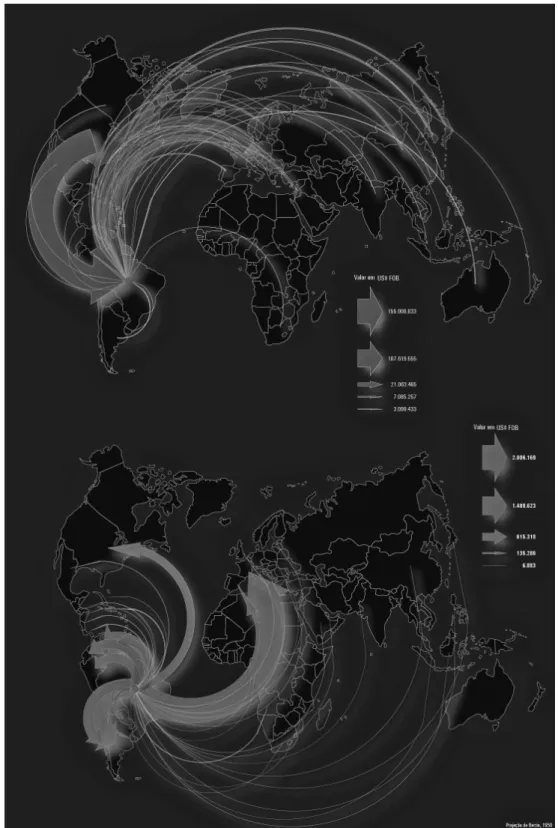
In Figure 1, the circularity of these spatial pro-ductive circuits for diagnostic reagents can be seen through the data on importations and exportations, showing that trade is not limited to a merely socio-spatial formation but is consolidated by global links selling intermediate (unfinished) products. Another datum to consider when analyzing these maps is the strength of trade between Brazilian territory and the two largest health industry complexes (in the USA and Germany), as well as the inequality between export and import volumes between Bra-zil and these countries. In 2011, we imported U$ 155 million from the USA and U$ 107 million from Germany, and exported U$ 615 thousand and U$ 14 thousand, respectively:
it is an extremely unequal trade and a territorial division between complexes that are more than just consumers. This pattern of trade is also clear in other spatial circuits of Brazil (Antas Jr., 2014, p. 7).
Notwithstanding the concentration of trade between the two aforementioned complexes – an un-surprising characteristic of the inequality between economic agents marking the current stage of the capitalist system–, it is essential that we also take into consideration the large number of countries that trade with the Brazilian industrial health com-plex, corroborating the existence of a planet-wide spatial productive circuit of diagnostic reagents.
The oligopolistic structure controlling the world-wide diagnostic reagent sector is also relevant, with the three largest companies standing out (Table 2) whose reagent production consists of produc-tive specializations from the large transnational pharmaceutical laboratories. A characteristic of the health spatial productive circuits that stands out is the capacity of different companies to par-ticipate in different yet related technical-scientific specializations, a fact that written observation of production chains often fails to take into account, taking an overall look at the company and its pro-duction volumes, without taking into account the ramifications such cooperation establishes in the technical-scientific and informational milieu and in its organizational dynamics.
Figure 1 - Import and export of diagnostic reagents in 2011
Source: Sistema de Análise das Informações de Comércio Exterior. ALICE-Web [http://aliceweb.desenvolvimento.gov.br/]. Data organized by: Rafael da Silva Almeida.
sector can largely be accredited to the connections between agents, previously separate or in competi-tion with each other, through the circles of space cooperation extending a territorial division of labor on a planetary scale and ensuring supply to vast regions. Once again, such cooperation circles can be seen as intangible essentials in the spatial division of production (Moraes, 1989, p. 11) which link com-panies, public authorities and not for profit organi-zations through a plural relationship, establishing partnerships between companies, universities and other research institutions (Antas Jr., 2014, p. 11).
When the scale of analysis moves to concentrate on the region and places in which production plants are effectively installed, we see how the companies and the specialties needed to manufacture the wide range of products of which this sector is made up multiply, revealing both the diversity of cooperation
to be established, as this is a branch with a sig-nificant set of companies oriented towards specific products to be used by others, before reaching the end user.
Table 3 shows the largest, most important com-panies in the in vitro diagnosis systems market, as the Administrative Council for Economic Defense - Conselho Administrativo de Defesa Econômica (CADE) denominates them, that is, the hegemonic firms in the spatial circuit (especially Siemens and Roche) who have relationships with the other, more specialized firms, and with suppliers of goods to be used in production, as shown in Table 4. It is impor-tant to highlight that a mere 7% of all the diagnostic reagents sold in Brazil are made there (Table 3), and that the reagent market is mainly controlled by companies that import and sell them (Table 4). It is also noteworthy that it is not possible to use
Table 3 - Structure of the in vitro diagnosis system market in Brazil – 2008
Company Estimated market share (%)
Siemens 20-30
Abbott 0-10
Roche 10-20
Biomerieux 0-10
Diasorin 0-10
Horiba 0-10
Johnson & Johnson 0-10
Labtest (nacional) 0-10
Others 20-30
Total 100
Source: Brasil, 2010
Table 4 - Structure of the Brazilian market for distribu-ting diagnostic reagents – 2011
Company Market share (%)
Applied Biosystems 22.1
Invitrogen 14.6
General Eletric Health Care 16
Sigma 14
Prodimol (nacional) 6
Bioeasy (nacional) 3.1
Others 24.2
Total 100
Source: (Brasil, 2011a).
Table 2 - The 5 largest companies in the IVD (in vitro diagnosis) market, worldwide
Company (country of origin) (US$ millions)IVD Sales Company total sales (US$ millions) Company IVD market share (%)
Roche Diagnostics (Swiss-US) $ 6,300 $ 27,000 23%
Bayer Diagnostics (Germany) $ 2,500 $ 32,000 8%
Beckman Coulter (US) $ 6,300 $ 27,000 79%
BioMerieux (France) $ 1,200 $ 1,200 100%
Diagnostic Products Corp. (US) $ 399 $ 399 100%
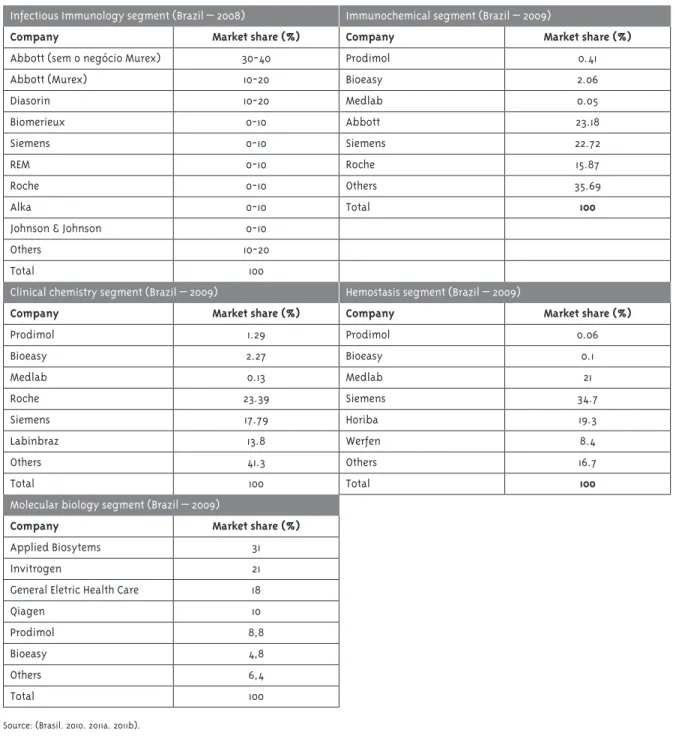
Table 5 - Structure of the in vitro diagnosis system market in Brazil 2008 and 2009
Infectious Immunology segment (Brazil – 2008) Immunochemical segment (Brazil – 2009)
Company Market share (%) Company Market share (%)
Abbott (sem o negócio Murex) 30-40 Prodimol 0.41
Abbott (Murex) 10-20 Bioeasy 2.06
Diasorin 10-20 Medlab 0.05
Biomerieux 0-10 Abbott 23.18
Siemens 0-10 Siemens 22.72
REM 0-10 Roche 15.87
Roche 0-10 Others 35.69
Alka 0-10 Total 100
Johnson & Johnson 0-10
Others 10-20
Total 100
Clinical chemistry segment (Brazil – 2009) Hemostasis segment (Brazil – 2009)
Company Market share (%) Company Market share (%)
Prodimol 1.29 Prodimol 0.06
Bioeasy 2.27 Bioeasy 0.1
Medlab 0.13 Medlab 21
Roche 23.39 Siemens 34.7
Siemens 17.79 Horiba 19.3
Labinbraz 13.8 Werfen 8.4
Others 41.3 Others 16.7
Total 100 Total 100
Molecular biology segment (Brazil – 2009)
Company Market share (%)
Applied Biosytems 31
Invitrogen 21
General Eletric Health Care 18
Qiagen 10
Prodimol 8,8
Bioeasy 4,8
Others 6,4
Total 100
diagnostic reagents at prices which are competitive on the international market, as in order to import them, special licenses are needed, which are only granted to importers and not to the end user, in this case laboratories, hospitals, outpatient clinics etc. Direct importation only takes place in special cases defined by the importers and are generally cases involving large foundations or private clients with a high volume of consumption.
Just as we can see the strong hold highly special-ized logistics companies have on the distribution of production, implementing electronic circulation and stock control systems (Table 4), forming a sec-tor with companies that are at times in competition and at others working together, we can also see how these sectors multiply in producing reagents based on molecular biology, immunochemistry, clinical chemistry, hemostasis, hematology, microbiologi-cal testing, genetic and molecular tests and renting medical equipment. Table 5 shows the productive segments associated with different products with the market breakdown, that is, by company for each sector, in which it is noteworthy how many compa-nies – usually transnationals – appear repeatedly, changing their position somewhat, but figuring among the main producers and suppliers in the market. These data were organized by the CADE for the purpose of analyzing the concentration process for Prodimol, the company which acquired Bioeasy and Medlab:
In this market, segmented by different compa-nies, the action of the State can also be seen, forming a strong circle of space cooperation in encouraging innovation, increasing the participation of private companies. One example of this was the creation of a new reagent kit, establishing various links between a company and other agents of the spatial produc-tive circuit. In 2010 Lifemed, a Brazilian company operating in the market of producing health care equipment and supplies for over 30 years, began to develop a new diagnostic device able to detect up to 20 different diseases (HIV, rubella, syphilis, toxo-plasmosis and hepatitis A, B and C, among others.). A partnership between Lifemed and the
Funda-ção Oswaldo Cruz (Fiocruz) undertook the devel-opment of this new device and its reagent disk, the latter being responsible for “researching and developing new diagnostic applications and devices and Lifemed was to research and produce all of the equipment needed for the platform to be used” (Valverde, 2010). According to the data organized by Silveira (2012), with the improvement of this re-search, other research bodies began to take part in the process of technological innovation, including the following institutes and universities: Instituto Carlos Chagas (ICC), Universidade Federal do Paraná (UFPR), Universidade Nacional de Ciência e Tecno-logia do Paraná (UNCTPR), Instituto Nacional de Ciência e Tecnologia (INCT), the Financiadora de Estudos e Projetos (FINEP) agency and the Instituto de Biologia Molecular do Paraná (IBMP). We can see, then, how the creation of this new reagent disk drove significant cooperation between different agents (above all public ones), dispersed throughout Brazil, in order to research and develop this new de-vice for the health care economy. Lifemed was also supplied with significant investment from BNDES which, from 2006 onwards, set up a link and invested around R$ 36 million in establishing a new plant in Pelotas (RS). There are currently three production units in Rio Grande do Sul and a commercial matrix in São Paulo4.
Finally, we reach another point in the process which connects the whole productive circuit. In order for each patient’s demand originating in medi-cal prescription to be met – an essential element in the entire productive logic structured into diverse interlinked markets -, we have the distribution of products for retail sale, a sector in which, in the case of Brazil, two central firms form an oligopoly that distributes most of the reagents produced by the spatial productive circuit.
Therefore, in laboratorial diagnostic services, the following companies stand out: Diagnósticos da América (DASA), the largest such company in Latin America (and the fourth largest in the world), it operates in the sector with 25 different brands and, in 2012, a gross turnover of R$ 2.5 billion; and
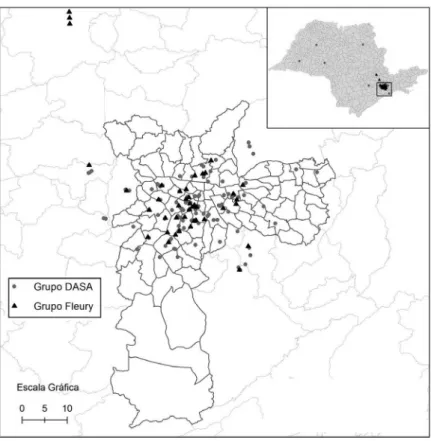
its main competitor, Fleury, also owning several dif-ferent brands and in the process of growing rapidly through mergers, with a turnover of R$ 485 billion in 2012. These are shining examples of this market in the spatial circuit of diagnostic reagents as, op-erating in outpatient, hospital and public support segments, they often have a direct relationship with patients, in addition to their sophisticated logistics. As can be seen in Figure 2, in the central areas of the capital of São Paulo state, the main market for these companies, there is a high concentration of lab-oratories linked to these groups. it can also be seen that, where such concentrations exist, we have the presence of other health fixtures, the Hospital das Clínicas complex belonging to the USP, the Faculty of Medicine (FMUSP), Faculty of Public Health (FSP-USP), the Escola Paulista de Medicina (UNIFESP), the Instituto do Coração (INCOR-HCFMUSP), Instituto
do Câncer, Instituto Adolfo Lutz, and the Instituto de Infectologia Emilio Ribas, to mention but a few, indicating the probable relationships between these institutions and DASA and Fleury.
Thus, corporate urbanism is imposing itself as health spatial productive circuits – as well as spatial productive circuits in general – install themselves in the territory, reorganizing the urban space accord-ing to the companies’ logic of private ownership. In the capital of São Paulo state, we can see the confirmation of what Milton Santos (1990) calls a “corporate and fragmented metropolis”, in which health care services such as diagnosis come to be controlled by large oligopolistic companies that even determine which products are to be used by patients/ clients and, above all by public and private hospitals, also conditioning a series of public health dynamics. This spatial concentration “enables mechanisms of
Figure 2 - Distribution of DASA and Fleury laboratories in the state of São Paulo in 2012
DASA Group Fleury Group Scale
controlling and administering capital to be clari-fied” (Lencione, 2008, p. 8), mechanisms that often bring with them “the destruction of one capital and a sharp increase in the valuation of another” (Smith, 1988, p. 179), culminating in reducing the number of companies controlling the sector.
Another item to take into account is the central-ization of capital engendered by the diverse agents in the complex: “it is part of the rationale of capi-talist accumulation to concentrate together a large population, income, high tech industry and qualified labor” (Lencione, 2008, p. 8) in certain points of the territory. This is what can be seen in the city of São Paulo, in the economic dynamic of large laboratories leading to the so-called “corporate and fragmented metropolis” logic (Santos, 1990).
The role of DASA in the centralization process has been of great relevance in the sector: over the last few years, it has acquired 22 laboratories and it has also incorporated a large diagnostic company (MDI Diagnósticos) from the health insurance pro-vider, Amil. Fleury has also centralized capitals. Incorporating more than 25 diagnostic laboratories in the last decade. Together, these two laboratories dominate more than 20% of the diagnosis sector in Brazil in terms of distribution and sales. Together with spatial selectivities, centralization and con-centration produce a real segmentation of tasks in the territories (Santos, 2009a), in which certain points come stand out as “specialized” in certain services and activities and/or concentrating certain infrastructure of interest to capital expansion. The concentration of activities in these points and the way in which the firms come to use public health infrastructure – as mentioned above, forming the Health Quad - Quadrilátero da Saúde, and the Paulista Arch5 – Arco da Paulista, and encourage
the construction of others are one face of so-called corporate urbanism, that is to say, large companies privately using existing plots of public investment in
order to promote health care services and specialist knowledge and technology, as has been happening since the early 20th century.
The extent and coverage of the cooperation in-volving the spatial productive circuit for diagnostic reagents can, then, be seen – with relationships be-tween agents ranging from actions on a worldwide scale, through industrial health complexes of a regional structure and down to the local dimension, in the daily life of individuals, implicated in the dominant concept of curative medicine, strongly anchored in technological innovation -, and thus capable of inducing profound changes in the spatial dynamics of the societies involved.
Final considerations
Throughout the 20th century and up until today, the
exercise of Western medicine reveals knowledge strongly tied to corporate interests, concentrat-ing on one sconcentrat-ingle idea about what “disease” is and how to combat it – the essence of so-called “cura-tive medicine”, to the detriment of “preventa“cura-tive medicine” - , we can see the historical technological development responding to the demands of such a concept. Controlled by hegemonic companies, the highly specialized technical-scientific structures today tend towards strong cooperation that extends worldwide and from which the health spatial produc-tive circuits emerge, of which we have only examined that of diagnostic reagents. Moreover, the way in which the companies in the complex are distributed in the territories clearly demonstrates the process of intense spatial concentration of these companies and laboratories.
In the early 20th century, Camille Vallaux (1914,
p. 164) had already warned that “when certain paths are controlled, it is impossible not to have influence on those countries that they connect. Thus, politics and economy are enmeshed in the gears of
tion”. It is possible to draw an important connection between circulation and political and economic issues of Brazilian socio-spatial formation, as the companies in the complex make great use of the networks that shape and dominate the territory.
In order to mitigate the harmful consequences of such use of territory, we must consider it as a whole, not just as a support network transporting the vec-tors of modernization unrelated to the wants of the places. The creation of large engineering systems, such as required for the diagnostic reagent circuit, must take into account the various possible uses that can be made of public health in the territory in which they operate. A regulatory public policy favoring the planning of national legislation - that health is everyone’s right and the duty of the state - requires current logic, which concentrates services and highly skilled professionals from the territory in just a few central points, to be reversed.
References
ALMEIDA, E. P. O uso do território brasileiro e a segmentação dos serviços de saúde. In: ENCONTRO DE GEÓGRAFOS DA AMÉRICA LATINA, 10., 2005, São Paulo. Anais... São Paulo: AGB-SP: USP, 2005. p. 552-565.
ALMEIDA, E. P.; ANTAS JR., R. M. Os serviços de saúde no estado de São Paulo: seletividades geográficas e fragmentação territorial. In: MOTA, A.; MARINHO, M. G. (Org.). Práticas médicas e de saúde nos municípios paulistas: a história e suas interfaces. São Paulo: CDG, 2011. p. 281-295.
ANTAS JR, R. M. Notas sobre o uso do conceito de circuitos espaciais produtivos para estabelecer o nexo entre a reestruturação urbana e as refuncionalizações do espaço: um estudo sobre os fixos de saúde no estado de São Paulo. In: ENCONTRO NACIONAL DA ASSOCIAÇÃO
NACIONAL DE PÓS-GRADUAÇÃO E PESQUISA EM PLANEJAMENTO URBANO E REGIONAL, 14., 2011, Rio de Janeiro. Anais... Rio de Janeiro: ANPUR, 2011. p. 1-15.
ANTAS JR., R. M. O complexo industrial da saúde no Brasil: uma abordagem a partir dos conceitos de circuito espacial produtivo e círculos de cooperação no espaço. GEOgraphia, Rio de Janeiro, v. 16, n. 32, p. 38-67, 2014.
BRASIL. Agência Nacional de Vigilância Sanitária. Diretoria Colegiada. Resolução nº 206, de 17 de novembro de 2006. Estabelece Regulamento Técnico de Produtos para Diagnóstico de uso
in vitro e seu Registro, Cadastramento, e suas alterações, revalidações e cancelamento. Diário Oficial da União, Brasília, DF, 17 nov. 2006. Seção 1, p. 36-38.
BRASIL. Ministério da Fazenda. Conselho Administrativo de Defesa Econômica. Ato de concentração nº 08012.002963, de 18 de agosto de 2010. Referente a operação de aquisição, pela DiaSorin S.P.A, de ativos da Abbott Laboratories.
Diário Oficial da União, Brasília, DF, 18 ago. 2010. Seção 1, p. 25-26.
BRASIL. Ministério da Fazenda. Conselho Administrativo de Defesa Econômica. Ato de concentração n.º 08012.000056, de 25 de março de 2011. Referente a operação de aquisição, pela Prodimol Biotecnologia S.A., da totalidade das quotas de capital social da Medlab Ltda. Diário Oficial da União, Brasília, DF, 25 mar. 2011a. Seção 1, p. 45-46.
BRASIL. Ministério da Fazenda. Conselho Administrativo de Defesa Econômica. Ato de concentração n.º 08012.000055, de 18 de maio de 2011. Referente a operação de aquisição, pela Prodimol Biotecnologia S.A., da totalidade das quotas de capital social da Bioeasy Diagnóstica Ltda. Diário Oficial da União, Brasília, DF, 18 maio 2011b. Seção 1, p. 56-57.
BUSCH, M. Transfusion-transmitted viral infections: building bridges to transfusion medicine to reduce risks and understand epidemiology and pathogenesis. Transfusion, Arlington, v. 46, n. 9, p. 1624-1640, 2006.
CORDEIRO, H. A indústria da saúde no Brasil. Rio de Janeiro: Graal, 1980.
DUPUY, J. P.; KARSENTY, S. A invasão farmacêutica. Rio de Janeiro: Graal, 1980.
GADELHA, C. A. G. O complexo industrial da saúde e a necessidade de um enfoque dinâmico na economia da saúde. Ciência & saúde coletiva, Rio de Janeiro, v. 8, n. 2, p. 521-535, 2003.
Disponível em: <http://dx.doi.org/10.1590/S1413-81232003000200015>. Acesso em: 10 dez. 2012.
GADELHA, C. A. G.; QUENTAL, C.; FIALHO, B. C. Saúde e inovação: uma abordagem sistêmica das indústrias da saúde. Cadernos de Saúde Pública, Rio de Janeiro, v. 19, n. 1, p. 47-59, fev. 2003. Disponível em: <http://dx.doi.org/10.1590/S0102-311X2003000100006>. Acesso em: 8 jul. 2014.
HOMMA, A. et al. Atualização em vacinas, imunizações e inovação tecnológica. Ciência & Saúde Coletiva, Rio de Janeiro, v. 16, n. 2, p. 445-458, 2011. Disponível em: <http://dx.doi. org/10.1590/S1413-81232011000200008>. Acesso em: 8 jul. 2014.
ILLICH, I. Némesis médica: la expropiación de la salud. Ciudad de México: Joaquín Mortiz, 1984.
JASPERS, K. O médico na era da técnica. Lisboa: Edições 70, 1998.
LATOUR, B. Jamais fomos modernos: ensaio de antropologia simétrica. Rio de Janeiro: Editora 34, 2000.
Le BRETON, D. Antropologia do corpo e
modernidade. Petrópolis: Vozes, 2011.
LENCIONE, S. Concentração e centralização das atividades urbanas: uma perspectiva multiescalar: reflexões a partir do caso de São Paulo. Revista de Geografia Norte Grande, Santiago, n. 39, p. 7-20, maio 2008.
LOPES, J. A. O médico e a tecnologia: reflexões com enfoque na cardiologia. Revista Médica de Minas Gerais, Belo Horizonte, v. 18, n. 2, p. 108-115, 2008. Disponível em: <http://rmmg.medicina. ufmg.br/index.php/rmmg/article/viewFile/9/8>. Acesso em: 18 dez. 2012.
MORAES, A. C. R. Los circuitos espaciales de la producción y los círculos de cooperación en el espacio. In: YANES, L. A.; LIBERALI, A. M. (Org.). Aportes para el estudio del espacio socio-economico. Buenos Aires: Editorial El Coloquio, 1989. v. 1. p. 151-177.
PAIVA, L. B. Análise estratégica da indústria brasileira de reagentes para diagnóstico e das potencialidades de atuação do Instituto de Tecnologia em Imunobiológicos frente aos
desafios da saúde no Brasil. 2009. Dissertação
(Mestrado em Tecnologia de Imunobiológicos) - Instituto de Tecnologia em Imunobiológicos, Fundação Oswaldo Cruz, Rio de Janeiro, 2009.
PERROUX, F. O conceito de polo produtivo. In: FAISSOL, S. Urbanização e regionalização. Rio de Janeiro: IBGE, 1975. p. 98-100.
PRED, A. Sistemas de cidades em economias
adiantadas:crescimento passado, processos
presentes e opções de desenvolvimento futuro. Rio de Janeiro: Zahar, 1979.
PORTER, R. Das tripas coração: uma breve história da medicina. Rio de Janeiro: Record, 2004.
SAIOTE, A. R. G. Centro de Medicina Molecular: diagnóstico in vitro. 2007. Dissertação (Mestrado em Engenharia Biomédica) - Departamento de Física Faculdade de Ciências e Tecnologia, Universidade de Coimbra, Coimbra, 2007.
SANTOS, G. F. Política de assistência farmacêutica e o setor produtivo estatal farmacêutico: o caso da Fundação para o Remédio Popular de São Paulo – FURP. 1996. Tese (Doutorado em Economia) - Instituto de Economia, Universidade Estadual de Campinas, 1996.
SANTOS, M. Sociedade e espaço: a formação social como teoria e como método. Boletim Paulista de Geografia, São Paulo, n. 54, p. 81-99, jun. 1977.
SANTOS, M. Circuitos espaciais da produção: um comentário. In: SANTOS, M.; SOUZA, M. A. (Org.).
A construção do espaço. São Paulo: Nobel, 1986. p. 121-134.
SANTOS, M. Metamorfoses do espaço habitado.
Authors’ contribution
Antas Jr. was responsible for the theoretical elaboration, structuring and writing of the article. Almeida was responsible for organizing the data, mapping and obtaining historical information.
Received: 18/11/2013 Resubmitted: 24/06/2014 Approved: 11/07/2014
SANTOS, M. Metrópole corporativa fragmentada: o caso de São Paulo. São Paulo: Nobel, 1990. SANTOS, M. Economia espacial:criticas e alternativas. São Paulo: EDUSP, 2003.
SANTOS, M. Técnica, espaço, tempo: globalização e meio técnico-cientifico-informacional. São Paulo: EDUSP, 2008.
SANTOS, M. A urbanização brasileira. São Paulo: EDUSP, 2009a.
SANTOS, M. Por uma economia política da cidade. São Paulo: EDUSP, 2009b.
SANTOS, M. A natureza do espaço: técnica e tempo, razão e emoção. São Paulo: EDUSP, 2009c.
SANTOS, M.; SILVEIRA, M. L. O Brasil: território e sociedade no início do século XXI. Rio de Janeiro: Record, 2010.
SCHRAIBER, L. B. O médico e suas interações: a crise dos vínculos de confiança. São Paulo: Hucitec, 2008.
SEADE - SISTEMA ESTADUAL DE ANÁLISE DE DADOS. Ciências da vida humana na cidade de São Paulo. São Paulo, 2010.
SILVEIRA, E. Diagnóstico fácil. Pesquisa Fapesp, São Paulo, n. 192, p. 62-65, fev. 2012.
SILVEIRA, M. L. Região e globalização: pensando um esquema de análise. Redes, Santa Cruz do Sul, v. 15, n. 1, p. 74-88, 2010.
SMITH, N. Desenvolvimento desigual: natureza, capital e a produção de espaço. Rio de Janeiro: Bertrand Brasil, 1988.
STENGERS, I. Para além da grande separação, tornarmo-nos civilizados? In: SANTOS, B. S. (Org.).
Conhecimento prudente para uma vida decente:
um discurso sobre as ciências revisado. São Paulo: Cortez, 2006. p. 131-149.
VALVERDE, R. Seminário anuncia duas parcerias inovadoras em produtos para diagnóstico.
Agência Fiocruz de Notícias, Rio de Janeiro, 29 nov. 2010. Disponível em: <http://www. agencia.fiocruz.br/semin%C3%A1rio-anuncia- duas-parcerias-inovadoras-em-produtos-para-diagn%C3%B3stico>. Acesso em: 7 jul. 2014.