ECOLOGY, BEHAVIOR AND BIONOMICS
A Comparison of the Leaf-Litter Ant Fauna in a Secondary Atlantic Forest
with an Adjacent Pine Plantation in Southeastern Brazil
R
ENATAP
ACHECO1, R
OGÉRIOR S
ILVA2, M
ARIAS
DEC M
ORINI3, C
ARLOSR F B
RANDÃO21Instituto de Biologia, Univ. Federal de Uberlândia, Programa de Pós-Graduação em Ecologia e Conservação de
Recursos Naturais, Campus Umuarama Bloco 2D Sala 28, 38400-902, Uberlândia, MG; 2Museu de Zoologia da USP, Av.
Nazaré 481, 04263-000, São Paulo, SP; [email protected]; [email protected]; 3Núcleo de Ciências Ambientais,
Univ. de Mogi das Cruzes, Av. Dr. Cândido Xavier de Almeida e Souza 200, 08780-911, Mogi das Cruzes, SP; [email protected]
Edited by Paulo Roberto V da S Pereira – EMBRAPA/Wheat Neotropical Entomology 38(1):055-065 (2009)
Comparação da Fauna de Formigas de Serapilheira entre Área de Floresta Atlântica Secundária e Plantação Adjacente de Pinus no Sudeste do Brasil
RESUMO - A infl uência do refl orestamento com Pinus na estrutura da fauna de formigas de serapilheira foi investigada, estudando uma fl oresta Atlântica secundária inalterada há 30 anos e uma área refl orestada com Pinus elliottii no Sudeste do Brasil. Em 50 amostras de 1 m2 tomadas em cada área, foram coletados 12.826 indivíduos, distribuídos em 95 espécies e 32 gêneros de formigas. Foram identifi cadas 60 espécies na área refl orestada com Pinus e 82 espécies na área de fl oresta secundária; aproximadamente 50% das espécies foram registradas nas duas áreas. A mediana do número de espécies por amostra foi maior na fl oresta secundária. Táxons com biologia especializada são responsáveis por grande parte das diferenças de composição de fauna, sendo a área de refl orestamento com Pinus mais rica em espécies onívoras e dominantes. Predadoras especializadas registradas na área de Pinus, como sete espécies de Dacetini, duas Basiceros, duas Attini e duas Discothyrea, têm ampla distribuição na Floresta Atlântica. A ordenação das amostras com o escalonamento multidimensional não-métrico (NMDS) indicou grande diferença na similaridade entre as amostras das áreas. Adicionalmente, essa análise sugere maior heterogeneidade na composição das amostras da fl oresta secundária, identifi cando dois agrupamentos de espécies, enquanto a área de Pinus apresenta um agrupamento apenas. Para investigar quais fatores podem explicar a heterogeneidade observada, testes de co-ocorrência e de autocorrelação espacial foram aplicados entre amostras de cada área. Nossa conclusão é que as diferenças observadas devem estar relacionadas com diferenças na qualidade e distribuição da serapilheira entre as áreas.
PALAVRAS-CHAVE: Pinus elliottii, modifi cação do habitat, riqueza de espécies
ABSTRACT - We investigated the infl uence of Pinus afforestation on the structure of leaf-litter ant communities inthe southeastern Brazilian Atlantic Forest, studying an old secondary forest and a nearly 30 year-old never managed Pinus elliottii reforested area. A total of 12,826 individual ants distributed among 95 species and 32 genera were obtained from 50 1 m2 samples/ habitat. Of these, 60 species were recorded in the pine plantation and 82 in the area of Atlantic forest; almost 50% of the species found in the secondary forest area were also present in the pine plantation. The number of species per sample was signifi cantly higher in the secondary forest than in the pine plantation. Forest-adapted taxa are the most responsible for ant species richness differences between areas, and the pine plantation is richer in species classifi ed as soil or litter omnivorous-dominants. The specialized ant predators registered in the pine plantation, as seven Dacetini, two Basiceros, two Attiniand two Discothyrea, belong to widely distributed species. The NMDS (non-metric multidimensional scaling) ordination also suggested strong differences in similarity among samples of the two areas. Furthermore, this analysis indicated higher sample heterogeneity in the secondary forest, with two clusters of species, while in the pine plantation the species belong to a single cluster. We applied the ant mosaic hypothesis to explain the distribution of the leaf-litter fauna and spatial autocorrelation tests among samples. We argue that the results are likely related to differences in quality and distribution of the leaf-litter between the pine plantation and the secondary area.
The importance of disturbed areas, such as secondary forests, for conservation purposes has been increasingly recognized by their ability to retain a reasonable proportion of species richness and composition of the original biome (Gascon et al 1999, Driscoll & Weir 2003, Dunn 2004). Recent scientifi c, governmental, and public interest in the use and maintenance of the biological diversity globally has stressed the need of comparative inventory efforts of different organisms in native, disturbed and man-made forests around the world to help devise sound sustainable management programs (Bestelmeyer & Wiens 2001, Mittermeier et al 2003, Philpott et al 2006).
Our previous studies aimed to evaluate patterns of litter-ant diversity along the Brazilian Atllitter-antic Forest, focusing on species richness, composition and guild structure of the leaf-litter ant fauna in pristine Atlantic Forest areas (Brandão et al 2005). Now we try to explore what happens with the leaf-litter ant fauna when a secondary Atlantic forest area is replaced by a pine plantation, examining and recording the effects of forest modifi cation on these communities in modifi ed Brazilian Atlantic Forest landscape.
Brazil has introduced massive plantations of exotic and fast-growing tree species, such as Eucalyptus spp. and Pinus spp., in order to supply wood for industry and energy production, holding one of the largest planted area in the world (Majer & Recher 1999). In the state of São Paulo, pine and eucalyptus afforestation (158,500 and 611,500 hectares, respectively) cover approximately 3.27% of the land area (Kronka 2005).
Pine was fi rst introduced in southern Brazil during the 1950s as a forestry experiment; from 1966 on with the promulgation of fi scal incentive laws, large areas of pine afforestation were established for the production of paper and cellulose. Pinus elliottii has great invasive capacity, and has been introduced even in conservation areas (Bechara 2003), causing environmental problems.
Afforestation does not require annual or constant tillage and cultivation, and it is normally considered as a system of conservation land use. Nevertheless, the alterations imposed on invertebrate communities through afforestation with fast-growing trees have not been fully described yet (Gunther & New 2003, Sinclair & New 2004, Corley et al 2006). This is especially true for areas covered by Atlantic rain forest, one of the most threatened tropical ecosystems in the world. The Atlantic Forest originally covered an area of 1.1 million km2 and is now reduced to only 7.6 percent of its original cover, with most remnants and fragments being small, disturbed in various degrees, and still under severe anthropogenic pressure (Morellato & Haddad 2000, Oliveira-Filho & Fontes 2000). In the state of São Paulo, the natural vegetation cover was estimated in 13.9% of the state area, of which 8.4% is formed by Atlantic rain forests remnants (ombrophylous dense forest) (Kronka 2005).
Ants are commonly used as a focal group of insect biodiversity studies (Wolters et al. 2006) and environmental monitoring work (Andersen et al 2004, Hoffmann & Andersen 2003, Yves et al 2004), because they are ubiquitous, diverse and abundant (Wilson & Hölldobler 2005), sensitive to habitat changes (Andersen et al 2002), have a straightforward taxonomy (Agosti et al 2000), and because of the general ease
with which they can be studied (Agosti et al 2000, Philpott & Armbrecht 2006).
This study describes the results of an analysis of the leaf-litter ant fauna found in an area reforested with Pinuselliottii in relation to an adjacent relatively old undisturbed secondary Atlantic Forest, both localized in southeastern Brazil. Our main goal was to assess how much of ant diversity is lost with habitat modifi cation and to describe which guilds are more susceptible to man-made disturbance and their relative importance in maintaining biodiversity.
Material and Methods
Study site. Research was carried out during the rainy season
in Salesópolis county, in the Serra do Mar, state of São Paulo, Brazil, representative of the southern section of Brazilian Atlantic rainforest. The mean annual rainfall in Salesópolis is circa 2000 mm. Ants were collected in two adjacent areas of comparable size, of approximately 30 ha: an old secondary forest (23°36’04” S; 45°58’10” W, 812 m above sea level), and an area logged from 1972 to 1973 (23°35’57” S; 45°58’07” W, 783 m above sea level) and now covered by P. elliottii (henceforth pine plantation). In the latter, the ground is permanently shaded and lacks shrub layers, and the litter is composed of a dense coverage of pine needles, with homogeneous distribution and approximately 30 cm of deep along the transect sampled.
The old secondary forest is located about 1 km away from the pine plantation, and is characterized by a canopy between 15 m to 20 m in height, a dense cover of young shrubs and trees in the understorey, and a well-developed leaf litter. The secondary forest has the same age of the pine plantation and was formed after timber extraction. Tree species richness in secondary forest is higher than in the pine plantation.
We took measures of litter depth for 50 leaf-litter samples collected in a near placed transect in this same secondary area, at the center of 1m2 plots. Because the transects (the one from where we took litter samples for ant extraction and the one we measured litter depth) established in the secondary area are roughly visually similar in terms of litter distribution, the depth of litter information was used as surrogate for secondary forest litter characteristic. The average litter depth was 3.94 cm (SD = 1.96; median = 4.0; range = 1.0-9.0). We ranked the litter quantity in the secondary area according to four arbitrary classes of amplitude: very shallow (0-2 cm), shallow (2-4 cm), deep (4-6 cm) and very deep (> 6 cm). The most frequent class of litter quantity was deep (40% of samples), followed by very shallow (32%), and shallow (22%); only 6% of samples have litter depth greater than 6 cm.
Ant sampling. At each area, a 1200 m long line transect with
mini-Winklers for 48h (Fisher 1999, Agosti & Alonso 2000, Bestelmeyer et al 2000).
The material was initially identifi edto genera and then into morphospecies. Identifi cation to species level was carried out by comparison with the Formicidae collection of the Museu de Zoologia da Universidade de São Paulo (MZUSP), and the pertinent literature. Classifi cation follows Bolton (2003) and Baroni-Urbani & Andrade (2007). Vouchers were deposited at the Universidade de Mogi das Cruzes (SP) and MZUSP.
Data analysis. In all analyses we treated each sample as a
statistical replicate. All samples come from points at least 50 m apart across transects; as the home range of most leaf-litter ant species covers less than few meters, the samples were considered independent unities. Species richness was defi ned as the number of ant species occurring in each litter sample. The total number of occurrences of each species, in 50 samples, was recorded as absence and presence data.
Species richness and ordination analysis. To estimate the
total ant species richness, EstimateS 7.5 (Colwell 2005) was used to compute cumulative species curves of the pooled samples, and the extrapolated incidence was based on Chao 2 calculations, which have performed well for low sample sizes and in moderate degree of patchiness (Chazdon et al 1998, Brose 2002). Chao and jackknife estimators usually perform better than other methods (Walther & Moore 2005). All calculations were randomized 100 times.
Free distribution statistical tests were applied to test for signifi cant differences between species richness in the samples (Mann-Whitney test). We used species rank-abundance plots (or Whittaker plots) to compare relative species abundance distributions between the ant communities and non-metric multidimensional scaling (NMDS) to graphically evaluate the similarity between the samples taken from the secondary forest area and the pine plantation.
Dissimilarities among samples were based on the Jaccard index of association, an index widely employed in multivariate analysis of assemblage data based on sound biological reasons (Anderson et al 2006, Clarke et al 2006). Dissimilarities matrices were calculated with the “vegdist” function, and NMDS with “metaMDS” function from the vegan library version 1.15-1 (Oksanen et al 2008), using the statistical software R 2.7.1 (R Development Core Team 2008).
Testing for the ant mosaic of leaf-litter. In order to test
whether species clusters revealed with NMDS ordination in the secondary forest leaf-litter resulted from an “ant mosaic”, we applied species co-occurrence analyses using the software EcoSim (Gotelli & Entsminger 2004), which tests for non-random patterns of species co-occurrences from a presence/absence matrix (Gotelli 2000). The analyses were performed separately for each cluster, using the whole matrix of species occurrence or using only the most common species (characterized here as those with more than four occurrences in each cluster). We used the default settings of the program for analyses (C-Score index, fi xed columns and rows, and 1000 random matrices; see Ribas & Schoereder 2002).
Testing for spatial autocorrelation. To determine whether
the homogeneity of conditions of the understorey leads to higher spatial autocorrelation in pine plantation samples, we conducted tests for spatial autocorrelation within the transects of the pine plantation and secondary forest area. The distance matrices were compared for (a) Bray-Curtis dissimilarities (presence/absence data), and (b) a matrix of the geographic distance (Euclidean, in meters) between pairs of leaf-litter samples. The dissimilarities matrices for each area (pine or secondary forest) were converted to a single vector. The “cor” function from the Base package of R 2.7.1 (R Development Core Team 2008) was used to correlate vectors of the species and distance dissimilarity values. The “boot” function from the Boot library was used to conduct a permutation test for whether the correlation coeffi cient is different than expected by chance with 999 different permutations of randomized reallocations of distances in the Euclidean distance vector. The Spearman Rank Correlation coeffi cient provided an estimate of the degree of spatial autocorrelation. Visual interpretation of the standard normal quantile plot and a plot of the distribution of correlation coeffi cients assessed the assumption of normality of the permuted correlation distribution (see Baker & Barmutta 2006).
Results
Species richness. We collected a total of 12,826 individuals
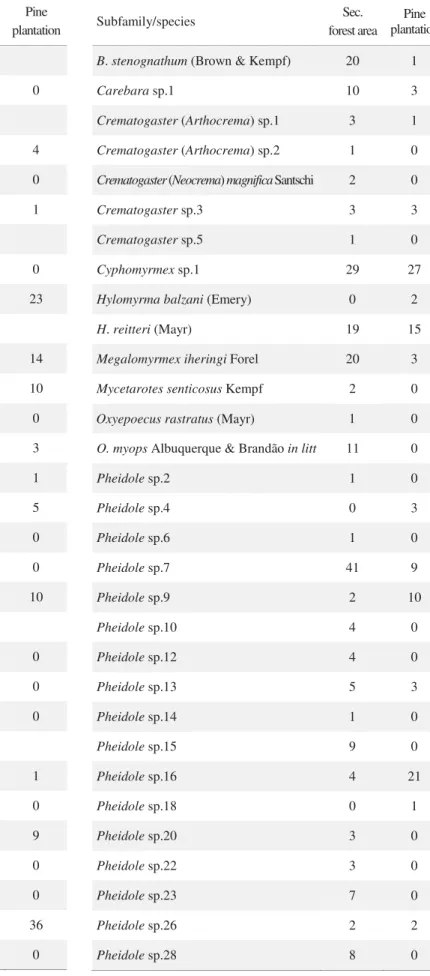
in the summed hundred 1 m2 of leaf litter samples in both studied communities, which were assigned to 95 species representing 32 genera. Of these, 60 species were found in the pine plantation and 82 in the area of secondary Atlantic Forest. Forty-seven ant species (49.5%) are shared by these two forest types, 13 species (13.5%) were found exclusively in the pine plantation, and 35 species (36.8%) exclusively in the secondary Atlantic Forest (Table 1).
Myrmicinae was the richest subfamily in the two forests, with 50 species in the secondary forest area and 35 in the pine plantation, followed by the Ponerinae, with 15 and 13 species, respectively. In the pine plantation, species with the highest number of occurrences in the 50 samples were Solenopsis (Diplorhoptrum) sp.1 (43 occurrences), Basiceros rugiferum (Mayr) (36), Hypoponera sp.1 (35), Strumigenys crassicornis Mayr (31) and Cyphomyrmex sp.1 (27);whereas in the area of secondary forest, Strumigenys denticulata Mayr (47), Solenopsis (Diplorhoptrum) sp.1 (45), Pheidole sp.7 (41), Solenopsis sp.4 (37) and Hypoponera sp.1 (35) were the most common species. The genera with the greatest richness were Pheidole, with 19 species in the secondary forest and 13 in the reforested area, and Hypoponera, with 10 and 9, respectively (Table 1).
Table 1Number of occurrences of each ant species collected in 50 1m2 samples of leaf-litter in the studied areas.
Subfamily/species Sec. forest area Pine plantation
Amblyoponinae
Prionopeltaantillana Forel 1 0
Dolichoderinae
Linepithema humile (Mayr) 2 4
Linepithema sp.2 2 0
Tapinoma melanocephalum (Fabricius) 0 1
Ectatomminae
Gnamptogenys continua (Mayr) 2 0
G. striatula Mayr 33 23
Formicinae
Brachymyrmex heeri Forel 18 14
B.incisus Forel 5 10
B. luederwaldti Santschi 1 0
B. pictus Mayr 4 3
Camponotus crassus Mayr 0 1
C. rufipes (Fabricius) 0 5
C. sericeiventris Guérin-Méneville 1 0
Myrmelachista sp.2 1 0
Paratrechina fulva (Mayr) 27 10
Heteroponerinae
Heteroponera dentinodis (Mayr) 2 0
H. dolo (Roger) 1 0
H. mayri Kempf 5 0
Myrmicinae
Acanthognathus ocellatus Mayr 4 1
Acromyrmex niger (Smith F.) 2 0
Apterostigma sp.1 0 9
Apterostigma sp.2 11 0
Atta cephalotes (L.) 2 0
Basiceros rugiferum (Mayr) 11 36
B. spectabile (Kempf) 2 0
Continue
Subfamily/species Sec. forest area
Pine plantation
B. stenognathum (Brown & Kempf) 20 1
Carebara sp.1 10 3
Crematogaster (Arthocrema) sp.1 3 1
Crematogaster (Arthocrema) sp.2 1 0
Crematogaster (Neocrema) magnifica Santschi 2 0
Crematogaster sp.3 3 3
Crematogaster sp.5 1 0
Cyphomyrmex sp.1 29 27
Hylomyrma balzani (Emery) 0 2
H. reitteri (Mayr) 19 15
Megalomyrmex iheringi Forel 20 3
Mycetarotes senticosus Kempf 2 0
Oxyepoecus rastratus (Mayr) 1 0
O. myops Albuquerque & Brandão in litt 11 0
Pheidole sp.2 1 0
Pheidole sp.4 0 3
Pheidole sp.6 1 0
Pheidole sp.7 41 9
Pheidole sp.9 2 10
Pheidole sp.10 4 0
Pheidole sp.12 4 0
Pheidole sp.13 5 3
Pheidole sp.14 1 0
Pheidole sp.15 9 0
Pheidole sp.16 4 21
Pheidole sp.18 0 1
Pheidole sp.20 3 0
Pheidole sp.22 3 0
Pheidole sp.23 7 0
Pheidole sp.26 2 2
Table 1Continuation.
Subfamily/species Sec. forest area
Pine plantation
Pheidole sp.30 1 22
Pheidole sp.31 6 5
Pheidole sp.36 1 4
Pheidole sp.37 0 3
Pheidole sp.38 0 2
Pheidole sp.39 3 1
Procryptocerus pr. schmalzi 1 0
Solenopsis saevissima (Smith) 0 5
S. wasmannii Emery 15 4
Solenopsis (Diplorhoptrum) sp.1 45 43
Solenopsis sp.4 37 22
Strumigenys crassicornis Mayr 20 31
S. denticulata Mayr 47 24
S. eggersi Emery 1 5
S. elongata Roger 11 5
S. louisianae Roger 1 22
S. schmalzi Emery 9 1
Strumigenys sp.13 1 0
Wasmannia sp.3 18 9
Ponerinae
Anochetus altisquamis Mayr 1 0
A. neglectus Emery 1 4
Subfamily/species Sec. forest area
Pine plantation
Hypoponera sp.1 35 35
Hypoponera sp.2 13 15
Hypoponera sp.3 6 0
Hypoponera sp.4 6 9
Hypoponera sp.5 3 0
Hypoponera sp.6 2 11
Hypoponera sp.7 5 3
Hypoponera sp.8 17 17
Hypoponera sp.9 6 2
Hypoponera sp.11 2 1
Hypoponera sp.15 0 2
Odontomachus affinis Guérin-Méneville 3 1
O. chelifer (Latreille) 0 1
O. meinerti Forel 1 0
Pachycondyla striata Smith 3 1
Proceratiinae
Discothyrea neotropica Bruch 2 1
D. sexarticulata Borgmeier 14 11
Pseudomyrmecinae
Pseudomyrmex gracilis (Fabricius) 0 1
Number of occurrences 691 544
Number of species 82 60
secondary forest area, and 17 (28%) for the Pinus area. Overall, we captured between 72% and 87% of the estimated species richness for the studied sites, which can be taken as an indication of the completeness of our sampling protocol.
The shape of species rank-abundance curves for the two areas is relatively similar and indicates that they are different in terms of rare species. The number of unique and duplicate species was respectively 1.4 and 2.8 higher in the forest area (Fig 2). Between 5 and 25 (median = 13.5) ant species were found per sample in the secondary forest, and between 3 and 24 (median = 10) in the reforested area. The median number of species per sample (alpha diversity) was signifi cantly different for the two habitats (Mann-Whitney U test = 762; N = 50; P < 0.05).
Community composition. The two-dimensional non-metric
Forest obs Forest Chao2 Pinus obs Pinus Chao2
100
0 200 300 400 500 600 700
Individuals
Species richness
120
100
80
60
40
20
0
Fig 1 Ant species accumulation curves in two sites (pine plantation and old secondary Atlantic forest area) for observed richness, and for species richness estimator (Chao2) created
with EstimateS. Richness was assessed with 50 1m2 leaf-litter
samples. For clarity, standard deviation curves are omitted.
Fig 2 Species rank-abundance relations for the leaf-litter ant species in the two sites studied.
0 20 40 60 80
Rank
Occurrences in the 1 m² samples
50
20
10
5
2
1
Forest Pinus
-0.2 0.0 0.2 0.4
Dimension 1
Dimension 2
0.3
0.2
0.1
0.0
-0.1
-0.2
-0.3 ForestPinus
Fig 3 Non-metric Multidimensional Scaling (NMDS) ordination in two dimensions of the leaf-litter ant community inhabiting a secondary forest area and a pine plantation in the southeast Atlantic Forest. Ordination was based on species presence/absence data (Jaccard dissimilarity index). Two samples cluster in the secondary forest were labelled and component samples linked by black lines. Stress in ordination: 6.80%.
species (Table 2). On average, the dissimilarities values among samples is higher in the pine plantation (average = 0.622; SD = 0.176) than those of the secondary forest area (average = 0.566; SD = 0.112).
Ant mosaic hypothesis of leaf-litter test results. In the
analyses of species co-occurrences performed for each species cluster observed in the secondary forest, using either the whole matrix or only the dominant species matrix, clusters could not be distinguished from randomly assembled ones. The observed index of species co-occurrence did not differ from the random pattern (Cluster 1: whole matrix C-score = 11.129, P = 0.585; dominant species matrix C-score = 24,153, P = 0.219; Cluster 2: whole matrix C-score = 5.706, P = 0.403; dominant species matrix C-score = 16.952, P = 0.586). Therefore, there is no evidence that interspecifi c competition is a factor that may explain the faunistic composition of these clusters.
Autocorrelation test results. Although weak, there is evidence
of spatial correlation within the 1200 m transects for secondary forest area (Bootstraped correlation coeffi cient r = 0.078; P= 0.008) and pine plantation (Bootstraped correlation coeffi cient r = 0.059; P= 0.021). Thus there is evidence of a slightly more similar community composition when plots are in closer proximity than between relatively distant plots.
Discussion
We are aware that the absence of replication areas in this study limits us from drawing strong conclusions about ant species loss and habitat modifi cation in the Brazilian Atlantic Forest. Although factors not evaluated in this study could have been responsible for our results (as for instance, surrounding matrix composition, topography and soil type), we selected two contrasting vegetations that had approximately the same size and the same age since habitat modifi cation. Our descriptive results show some important differences between the leaf-litter ant fauna of the pine plantation and the secondary forest. We describe some factors that could explain the observed differences at the transect scale.
Ant fauna in the secondary forest is more diverse and heterogeneous than in the pine afforestation area. The ant
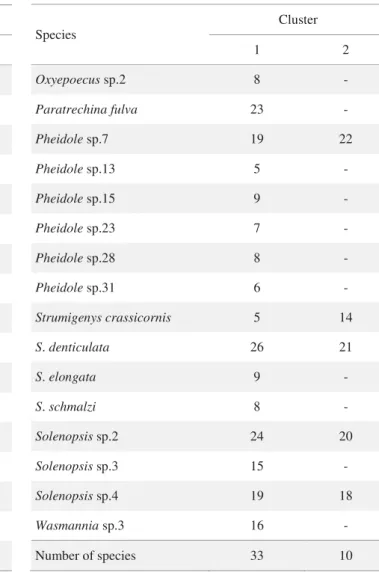
Species Cluster 1 2
Apterostigma sp.2 10 -
Basiceros rugiferum 8 -
B. stenognathum 13 7
Brachymyrmex heeri 13 5
B. incisus 5 -
Carebara sp.1 6 -
Cyphomyrmex sp.1 13 15
Discothyreasexarticulata 10 -
Gnamptogenysstriatula 15 17
Hylomyrma reitteri 15 -
Hypoponera sp.1 21 14
Hypoponera sp2 13 -
Hypoponera sp.3 5 -
Hypoponera sp.7 5 -
Hypoponera sp.8 13 -
Hypoponera sp.9 5 -
Megalomyrmex iheringi 20 -
Species Cluster 1 2
Oxyepoecus sp.2 8 -
Paratrechina fulva 23 -
Pheidole sp.7 19 22
Pheidole sp.13 5 -
Pheidole sp.15 9 -
Pheidole sp.23 7 -
Pheidole sp.28 8 -
Pheidole sp.31 6 -
Strumigenys crassicornis 5 14
S. denticulata 26 21
S. elongata 9 -
S. schmalzi 8 -
Solenopsis sp.2 24 20
Solenopsis sp.3 15 -
Solenopsis sp.4 19 18
Wasmannia sp.3 16 -
Number of species 33 10
Table 2 A list of the most common ant species and number of occurrences in each cluster identifi ed by NMDS analysis from secondary Atlantic forest area (see Fig 3).
cluster 1: n = 25 samples; cluster 2: n = 23 samples
The question of why the secondary forest area is richer than the pine plantation in our study could be answered by the fact that the secondary area has higher tree species richness, and possibly greater availability and better quality of nesting sites, food, and favorable abiotic and microclimatic conditions, which may support higher numbers of ant species in litter samples taken in this area. Sites with greater resources heterogeneity could shelter more species (Lassau & Hochuli 2004, Lassau et al. 2005) because of a higher number of partitionable niche dimensions (the “microhabitat specialization hypothesis”; Brose 2003, Cramer & Willig 2005). These resources are less accessible in monocultures, especially in areas covered by Pinus, by virtue of the allelopathic effects caused by the pine needles that form exclusively the understorey, composed of fatty acids, terpenes and a variety of phenols, preventing the regeneration of native plants. As a result of these allelopathic effects, pine plantations tend to have extremely simplifi ed understorey (Corley et al 2006), reduced microhabitat diversity and relatively high environmental uniformity
(Sinclair & New 2004).
In general, the plant composition of monoculture understorey is poor and a more homogeneous litter may support fewer species than a heterogeneous one, since homogeneity offers a lower variety of opportunities with respect to resources and microclimatic conditions which affect ant colony survival (Kaspari 1996, Campos et al 2003). In addition, the understorey in the studied pine plantation has little shade cover, and species richness of ants generally decreases with decreasing shade (Perfecto et al 2003, Philpott & Armbrecht 2006).
(Corley et al 2006) or south eastern Australia (Sinclair & New 2004), ant abundance within pine plantations is lower and species composition signifi cantly impoverished when compared to more pristine habitats. Ant diversity in tropical forest declines strongly with structural simplifi cation of the vegetation because the regional ant fauna consists largely of forest-habitat specialists (Brühl et al 2003).
The distinction between the species composition in the secondary Atlantic Forest area and the reforested area was indicated by two-dimensional NMDS. In addition, the analysis also suggests higher spatial heterogeneity in the species distribution in the leaf-litter of the secondary forest. The present study did not address which variables led to higher heterogeneity in the ant distribution in the Atlantic Forest area in comparison to the pine plantations, but it may suggest interspecifi c competition or clumped distribution of the leaf-litter ant fauna as the possible causal mechanisms.
The hypothesis of interspecifi c interaction as a structuring factor for the spatial distribution of species in the secondary forest involves the mosaic concept, defi ned as the distribution of dominant arboreal ant species in patches, so that their territories do not overlap (Ribas & Schoereder 2002). Also, distribution in mosaics has been described for leaf-litter ant communities resulting from the interactions of two groups of ants, one formed by ground-dwelling species with cryptic behavior and which generally interact with each other, and the second group, consisting of a few arboreal species that forage on the fl oor and interact with the ground ant fauna (Delabie et al 2000).
We have tested the application of the mosaic hypothesis in the secondary forest by means of an analysis of species co-occurrence (Ribas & Schoereder 2002). We applied the analyses for each cluster identifi ed in the secondary forest, using the whole matrix of species occurrence and using only the most common species (those with more than four occurrences). In both analyzed clusters and matrix of species occurrence (the entire set of species or only the dominant species), the observed species co-occurrence laid within the 95% limit of frequency distribution of the randomized matrices, suggesting the mosaic hypothesis is not the determinant of ant spatial distribution observed in the leaf-litter of the secondary forest. Therefore, the mosaic hypothesis was rejected by the species co-occurrence analysis.
We can also hypothesize that the cluster observed in the secondary forest can be explained by a clumped distribution of species along the sampled transect. The leaf-litter ant communities in tropical rain forests are characterized by a patchy distribution of colonies, due to both biotic (nest availability, food abundance, food distribution, frequent colony fi ssion, small home ranges) and abiotic constraints (microclimate and disturbance). All these factors may lead to nest aggregations in suitable zones (Soares & Schoereder 2001, Theunis et al 2005, McGlynn 2006).
Because there are more litter patches within the forest, we expected a higher heterogeneity in the spatial structure of the leaf-litter ant fauna in secondary forest in comparison to pine plantation. In contrast,the conditions of the understorey in pine plantations could have a homogenization effect on the leaf-litter ant fauna, resulting thus in increased taxonomic similarity among samples across the pine plantation (Olden
2006). However, on average, the dissimilarities values among samples in the secondary forest are higher than the pine plantation values. Further, the autocorrelation analysis showed that there is a very weak spatial correlation at the scale of our 1200 m transects and that it is unlikely to bias the interpretation of dissimilarities between the pine plantation and the secondary forest area.
Ultimately, whilst we can not confi rm what determined the species clusters in the secondary forest, we can not exclude that stochastic processes, such as the random placement of individuals, could produce the observed patterns of species distributions (Higgins et al 2006).
Which leaf-litter ant species are excluded with pine afforestation? A common effect of habitat modifi cation on
the ant fauna is a change in abundance and species richness across functional groups (Bestelmeyer & Wiens 1996). The pine plantation is richer in species classifi ed as soil or litter omnivorous-dominants that also forage in the vegetation (Delabie et al 2000), such as Brachymyrmex, Camponotus and Solenopsis. These species are in general opportunist taxa that indicate lower-quality or disturbed environments for ants (Andersen 1997). The Atlantic forest area, on the other hand, is richer in litter species that are classifi ed as omnivores and scavengers (Pheidole) and litter generalist predators (Heteroponera, Hypoponera and Gnamptogenys).
Some cryptic foraging species were also found in the leaf-litter of the pine plantation, including two species of Basicerotini (B. rugiferum and B. stenognathum) and seven species of Dacetini (A. ocellatus and Strumigenys spp.), generally considered to be specialized predators (Delabie et al 2000), and two egg-predators of spiders (D. neotropica and D. sexarticulata) (Brown 2000). However, most of these species have broad distribution ranges and are frequently found elsewhere. We termed them as “resilient specialized predators”.
Seemingly, species of Heteroponera and many species of Pheidole were excluded by Pinus afforestation. Heteroponera nests in small trunks and fallen branches (Brown 1958), not found in areas planted with Pinus; therefore, Heteroponera species have been excluded from Pinus afforestation by relatively low availability of nest sites. Limitation of nesting resources for leaf-litter and twig-nesting ants has been show as a diversity loss mechanism in agroecosystems (Armbrecht et al 2004, 2006, Philpott & Foster 2005). Pheidole are primarily generalist scavengers, but include also predator and granivore species. It is the dominant ant taxon of the New World ground assemblages and has been highlighted as an ideal focal group for the assessment of local ant biodiversity (Wilson 2003). The strong negative responses of Pheidole species to forest modification indicates that the genus should be also evaluated as a surrogate for assessment of ant community responses to habitat modifi cation, in the context of simplifying the protocol in studies on ecological change associated with human land-use (Andersen et al 2002).
can represent forest-adapted species that do not tolerate altered microclimate resulting from habitat modifi cation. Therefore, many of the ecologically more specialized ants are eliminated locally by the processes of forest clearing and plantation establishment, leaving a more generalist set which is suffi ciently tolerant to persist in the altered plantation conditions (Sinclair & New 2004).
The ant community of pine plantation is not a subset of the one collected in adjacent old secondary Atlantic forest. There are thirteen ant species in pine plantation not present in nearby secondary Atlantic forest. However, most of the taxa exclusively found in the pine plantation are omnivorous, opportunist (such as those of Camponotus, Pheidole, Solenopsis and Tapinoma) and present in relatively low frequencies in samples (mainly uniques and duplicates). It is possible that these species belong to a set of ant species characteristic of more open areas that invaded the pine plantation. We termed them as “opportunist edge species”.
Although we still have not compared the ant litter-diversity between primary and secondary areas of Atlantic forest, studies in other regions (e.g., Amazonia) suggest that the major changes occur in species richness, composition and population density, rather than in guild losses (Vasconcelos 1999, Vasconcelos et al 2000, Azevedo-Ramos et al 2006). In this case, the secondary forest is likely to conserve many ecological processes as well as species (Dunn 2004) of the pristine situation. In contrast, the monoculture nature of the pine plantations reduces microhabitat diversity and increase environmental uniformity, altering the ant assemblages with the elimination of many guilds characteristic of mature forests.
The consequences of Pinus afforestation in the Atlantic Forest leaf-litter ant fauna, examined in two adjacent areas in different stages of modifi cation, were profound, and correspond well to results found in previous studies on the effects of the conversion of native forests to more simplifi ed vegetation structures. Our results suggest a loss of ant biodiversity in the leaf-litter following Pinus afforestation in areas originally covered by the Atlantic Forest.
The more pristine studied forested area, despite being secondary, yielded a larger number of species and a spatially more heterogeneous fauna than in the reforested area. Differences in ant species richness between samples taken in the two study areas were signifi cant, with the reforested area being the poorer. Furthermore, the secondary forest showed a higher number of exclusive ant species. It is clear that many specialized ants were not able to colonize the pine plantation (or, at least, have not become established there) over periods of more than 30 years from planting, so that changes in ant assemblages appear to be relatively long-lasting.
Acknowledgments
We would like to thank the Fundação de Amparo à Pesquisa do Estado de São Paulo (FAPESP) and the Fundação de Amparo ao Ensino e Pesquisa (FAEP/UMC) for fi nancial support, and CNPq for the scholarship granted to the fi rst author.
References
Agosti D, Alonso L E (2000) The ALL Protocol: a standard protocol for the collection of ground-dwelling ants, p.204-206. In Agosti D, Majer J D, Alonso L E, Schultz T R (eds), Ants: standard methods for measuring and monitoring biodiversity. Washington, DC, Smithsonian Institution Press, 280p.
Agosti D, Majer J D, Alonso L E, Schultz T R (2000) (eds) Ants: standard methods for measuring and monitoring biodiversity. Washington, DC, USA, Smithsonian Institution Press, 280p.
Andersen A N (1997) Function groups and patterns of organization in North American ant communities: a comparison with Australia. J Biogeogr 24: 433-460.
Andersen A N, Fisher A, Hoffmann B D, Read J L, Richards R (2004) Use of terrestrial invertebrates for biodiversity monitoring in Australian rangelands, with particular reference to ants. Aust Ecol 29: 87-92.
Andersen A N, Hoffmann B D, Müller W J, Griffi ths A D (2002) Using ants as bioindicators in land management: simplifying assessment of ant community responses. J Appl Ecol 39: 8-17.
Anderson M J, Ellingsen K E, McArdle B H (2006) Multivariate dispersion as a measure of beta diversity. Ecol Lett 9: 683-693.
Armbrecht I, Perfecto I, Silverman E (2006) Limitation of nesting resources for ants in Colombian forests and coffee plantations. Ecol Entomol 31: 403-410.
Armbrecht I, Perfecto I, Vandermeer J (2004) Enigmatic biodiversity correlations: ant diversity responds to diverse resources. Science 304: 284-286.
Azevedo-Ramos C, Carvalho Jr O de, Amaral B D do (2006) Short-term effects of reduced-impact logging on eastern Amazon fauna. For Ecol Manage 232: 26-35.
Baker S C, Barmutta L A (2006) Evaluating spatial autocorrelation and depletion in pitfall-trap studies of environmental gradients. J Ins Conserv 10: 269-276.
Baroni-Urbani C, Andrade M L de (2007) The ant tribe Dacetini: limits and constituent genera, with descriptions of new species (Hymenoptera, Formicidae). Ann Mus Civ Stor Nat Giacomo Doria 99: 1-191.
Bechara F C (2003) Restauração ecológica de restingas contaminadas por Pinus no Parque Florestal do Rio Vermelho, SC. Dissertação
de mestrado. Universidade Federal de Santa Catarina, Florianópolis, 125p.
Bestelmeyer B T, Agosti D, Alonso L E, Brandão C R F, Brown Jr W L, Delabie J H C, Silvestre R (2000) Field techniques for the study of ground-dwelling ants, p.22-144. In Agosti D, Majer J D, Alonso L E, Schultz T R (eds) Ants: standard methods for measuring and monitoring biodiversity. Washington, DC, Smithsonian Institution Press, 280p.
Bestelmeyer B T, Wiens J A (1996) The effects of land use on the structure of ground-foraging ant communities in the Argentine Chaco. Ecol Appl 6: 1225-1240.
ladscape mosaics: the consequences of grazing vs. natural heterogeneity. Ecol Appl 11: 1123-1140.
Bolton B (2003) Synopsis and classifi cation of Formicidae. Mem Am Entomol Inst 71: 1-370.
Brandão C R F, Silva R R, Scott-Santos C (2005) Estratégias para avaliação da riqueza e diversidade de Hymenoptera e Isoptera ao longo de um gradiente latitudinal na Mata Atlântica: a fl oresta pluvial do leste do Brasil, p.469-483. In Bousquets J L, Morrone J J (eds) Regionalización biogeográfi ca en Iberoamérica y tópicos afi nes. (Jornadas Biogeográfi cas de la Red Iberoamericana de Biogeografía y Entomología Sistemática, 1). CYTED / UNAM / CONABIO, México, 577p.
Brose U (2002) Estimating species richness of pitfall catches by non-parametric estimators. Pedobiologia 46: 101-107.
Brose U (2003) Bottom-up control of carabid beetle communities in early successional wetlands: mediated by vegetation structure or plant diversity? Oecologia 135: 407-413.
Brown Jr W L (1958) Contributions toward a reclassifi cation of the Formicidae. II. Tribe Ectatommini (Hymenoptera). Bull Mus Comp Zool 118: 173-362.
Brown Jr W L (2000) Diversity of ants, p.45-79. In Agosti D, Majer J D, Alonso L E, Schultz T (eds) Ants: standard methods for measuring and monitoring biodiversity. Washington, DC, USA, Smithsonian Institution Press, 280p.
Brühl C A, Eltz T, Linsenmair K E (2003) Size does matter – effects of tropical rainforest fragmentation on the leaf litter ant community in Sabah, Malaysia. Biod Cons 12: 1371-1389.
Campos R B F, Schoereder J H, Sperber C F (2003) Local determinants of species richness in litter ant communities (Hymenoptera: Formicidade). Sociobiology 4: 357-367.
Chazdon R L, Colwell R K, Denslow J S, Guariguata M R (1998) Statistical methods for estimating species richness of woody regeneration in primary and secondary rain forests of NE Costa Rica, p.285-309. In Dallmeier F, Comiskey J A (eds) Forest biodiversity research, monitoring and modeling: conceptual background and Old World case studies. Paris, Parthenon Publishing, 696p.
Clarke K R, Somerfi eld P J, Chapman M G (2006) On resemblance measures for ecological studies, including taxonomic dissimilarities and a zero-adjusted Bray-Curtis coeffi cient for denuded assemblages. J Exp Mar Biol Ecol 330: 55-80.
Colwell R K (2005) Statistical estimation of species richness and shared species from samples. Version 7.5. University of Connecticut, USA. Persistent. http://purl.oclc.org/estimates.
Corley J, Sackmann P, Rusch V, Bettinelli J, Paritsis J (2006) Effects of pine silviculture on the ant assemblages (Hymenoptera: Formicidae) of the Patagonian steppe. For Ecol Manage 222: 162-166.
Cramer M J, Willig M R (2005) Habitat heterogeneity, species diversity, and null models. Oikos 108: 209-218.
Delabie J H C, Agosti D, Nascimento I C do (2000) Litter ant communities of the Brazilian Atlantic rain forest region, p.1-17.
In Agosti D, Majer J D, Alonso L E, Schultz T (eds) Sampling ground-dwelling ants: case studies from world’s rain forests. Perth, Curtin University School of Environmental Biology, Bulletin n 18, 75p.
Driscoll D A, Weir T (2003) Beetle responses to habitat fragmentation depend on ecological traits, habitat condition, and remnant size. Cons Biol 19: 182-194.
Dunn R R (2004) Recovery of faunal communities during tropical forest regeneration. Cons Biol 18: 302-309.
Fisher B L (1999) Improving inventory effi ciency: a case study of leaf-litter ant diversity in Madagascar. Ecol Appl 9: 714-731.
Gascon C, Lovejoy T E, Bierregaard R O, Malcolm J R, Stouffer P C, Vasconcelos H L, Laurance W F, Zimmerman B, Tocher M, Borges S (1999) Matrix habitat and species richness in tropical forest remnants. Biol Cons 91: 223-229.
Gotelli N J (2000) Null model analysis of species co-occurrence patterns. Ecology 81: 2606-2621.
Gotelli N J, Entsminger G L (2004) EcoSim: null models software for ecology. Version 7. Acquired Intelligence Inc., Kesey-Bear. http://garyentsminger.com/ecosim/index.htm.
Gunther M J, New T R (2003) Exotic pine plantations in Victoria, Australia: a threat to epigaeic beetle (Coleoptera) assemblages? J Ins Conserv 7: 73-84.
Higgins C L, Willig M R, Strauss R E (2006) The role of stochastic processes in producing nested patterns of species distributions. Oikos 114: 159-167.
Hoffmann B D, Andersen A N (2003) Responses of ants to disturbance in Australia, with particular reference to functional groups. Aust Ecol 28: 444-464.
Kaspari M (1996) Litter ant patchiness at the 1-m2 scale: disturbance
dynamics in three Neotropical forests. Oecologia 107: 265-273.
Kronka F J (2005) (coord) Inventário fl orestal da vegetação do estado de São Paulo. São Paulo, Instituto Florestal, 200p.
Lassau S A, Cassis G, Flemons P K J, Wilkie L, Hochuli D F (2005) Using high-resolution multi-spectral imagery to estimate habitat complexity in open-canopy forests: can we predict ant community patterns? Ecography 28: 495-504.
Lassau S A, Hochuli D F (2004) Effects of habitat complexity on ant assemblages. Ecography 27: 157-164.
Majer J D, Recher H F (1999) Are eucalypts Brazil’s friend or foe? An Entomological viewpoint. An Soc Entomol Brasil 28: 185-200.
Marinho C G S, Zanetti R, Delabie J H C, Schlindwein M N, Ramos L S (2002) Diversidade de formigas (Hymenoptera: Formicidae) da serapilheira em eucaliptais (Myrtaceae) e área de cerrado de Minas Gerais. Neotrop Entomol 31: 187-195.
McGlynn T P (2006) Ants on the move: resource limitation of a litter-nesting ant community in Costa Rica. Biotropica 38: 419-427.
Konstant W R, Fonseca G A B da, Kormos C (2003) Wilderness and biodiversity conservation. Proc Natl Acad Sci USA 100: 10309-10313.
Morellato L P C, Haddad C F B (2000) Introduction: the Brazilian Atlantic forest. Biotropica 32: 786-792.
Oksanen J, Kindt R, Legendre P, O’Hara R B, Simpson G L, Solymos P, Stevens M H H, Wagner H (2008) Vegan: community ecology package version 1.15-1. http://cran.r-project.org/
Olden J D (2006) Biotic homogenization: a new research agenda for conservation biogeography. J Biogeogr 33: 2027–2039.
Oliveira M A, Della-Lucia T M C, Araujo M S, Cruz A P (1995) A fauna de formigas em povoamentos de eucalipto e mata nativa no Estado do Amapá. Acta Amazonica 25: 117-126.
Oliveira-Filho A T, Fontes M A L (2000) Patterns of fl oristic differentiation among Atlantic forests in southeastern Brazil and the infl uence of climate. Biotropica 32: 793-810.
Perfecto I, Mas A, Dietsch T, Vandermeer J (2003) Conservation of biodiversity in coffee agroecosystems: a tri-taxa comparison in southern Mexico. Biod Cons 12: 1239-1252.
Philpott S M, Armbrecht I (2006) Biodiversity in tropical agroforests and the ecological role of ants and ant diversity in predatory function. Ecol Entomol 31: 369-377.
Philpott S M, Foster P F (2005) Nest-site limitation in coffee agroecosystems: artifi cial nests maintain diversity of arboreal ants. Ecol Appl 15, 1478-1485.
Philpott S M, Perfecto I, Vandermeer J (2006) Effects of management intensity and season on arboreal ant diversity and abundance in coffee agroecosystems. Biod Cons 15: 139-155.
R Development Core Team (2008) R: a language and environment for statistical computing. R Foundation for Statistical Computing, Vienna, Austria. ISBN 3-900051-00-3. http:// www.R-project.org.
Ribas C R, Schoereder J H (2002) Are all ant mosaics caused by competition? Oecologia 131: 606-611.
Sinclair J E, New T R (2004) Pine plantations in south eastern Australia support highly impoverished ant assemblages (Hymenoptera: Formicidae). J Ins Conserv 8: 277-286.
Soares S M, Schoereder J H (2001) Ant-nest distribution in a remnant of tropical rainforest in southeastern Brazil. Insectes Soc 48: 280-286.
Tavares A A, Bispo P C, Zanzini A C S (2001) Comunidades de formigas epigéicas (Hymenoptera: Formicidae) em áreas de
Eucaliptus cloeziana F. Muell. e de vegetação nativa numa região
de cerrado. Rev Bras Ent 45: 251-256.
Theunis L, Gilbert M, Roisin Y, Leponce M (2005) Spatial structure of litter-dwelling ant distribution in a subtropical dry forest. Insectes Soc 52: 366-377.
Vasconcelos H L (1999) Effects of forest disturbance on the structure of ground-foraging ant communities in central Amazonia. Biod Cons 8: 409-420.
Vasconcelos H L, Vilhena J M S, Caliri G J A (2000) Responses of ants to selective logging of a central Amazonian forest. J Appl Ecol 37: 508-514.
Watt A D, Stork N E, Bolton B (2002) The diversity and abundance of ants in relation to forest disturbance and plantation establishment in southern Cameroon. J Appl Ecol 39: 18-30.
Walther B A, Moore J L (2005) The concepts of bias, precision and accuracy, and their use in testing the performance of species richness estimators, with a literature review of estimator performance. Ecography 28: 815-829.
Wilson E O (2003) Pheidolein the New World: a dominant,
hyperdiverse ant genus. Cambridge, Harvard University Press, 794p.
Wilson E O, Hölldobler B (2005) Eusociality: origin and consequences. Proc Natl Acad Sci USA 102: 13367-13371.
Wolters V, Bengtsson J, Zaitsev A S (2006) Relationship among the species richness of different taxa. Ecology 87: 1886-1895.
Yves B, Mavoungou J F, Mikissa J B, Missa O, Miller S E, Kitching R L, Alonso A (2004) Discriminatory power of different arthropod data sets for the biological monitoring of anthropogenic disturbance in tropical forests. Biod Cons 13: 709-732.