Radiofrequency Catheter Ablation of Left Accessory
Pathways by Transeptal Approach
Márcio Augusto Silva, Elenir Nadalin, Alessandro Kraemmer, Gel Roberto Marmitt Berardi,
José Carlos Moura Jorge, Cláudio L. Pereira da Cunha
Hospital Universitário Cajuru – Pontifícia Universidade Católica do Paraná e Hospital de Clínicas -Universidade Federal do Paraná - Curitiba, PR - BrazilMailing Address: Márcio Augusto Silva • Rua Joaquim Lírio, 500/602 – Praia do Canto - 29055-460 – Vitória, ES - Brazil E-mail: [email protected] / [email protected] Recebido em 05/02/05 • Aceito em 25/07/05
O
BJECTIVETo study a series of patients submitted to radiofrequency catheter ablation (RFA) of left accessory pathways (AP) using the transeptal approach (TSA) as compared to the conventional retrograde arterial approach (RAA).
M
ETHODSOne hundred consecutive patients (56 male; mean age of 34.3 ± 11 years) with 100 left APs (62 overt and 38 concealed) underwent catheter ablation using the TS method (50 patients) and the RA method (50 patients) in an alternate fashion. The analysis was performed according to the intention-to-treat principle.
R
ESULTSThe transeptal puncture was successfully performed in 48 patients (96%). This access allowed primary success in the ablation in all the patients without any complication. When we compared this approach with the RAA there was no difference as regards the primary success (p = 0.2), recurrence rate (p = 1.0), fl uoroscopy time (p = 0.63) and total time (p = 0.47). One patient in the RAA group presented a vascular complication. The TSA allowed shorter ablation times (p=0.01) and smaller number of radiofrequency applications (p = 0.003) as compared to the conventional RAA. The patients who had recurrence and unsuccessful ablation in the fi rst session in each approach underwent another session with the opposite technique (cross-over), with a fi nal ablation success rate of 100%.
C
ONCLUSIONThe TS and RA approaches showed similar effi cacy and safety for the ablation of left accessory pathways. The TSA allowed shorter ablation times and smaller number of radiofrequency applications. When the techniques were used in a complementary fashion, they increased the fi nal effi cacy of the ablation
K
EY WORDSRadiofrequency ablation (RFA) is currently the treatment of choice for most patients with accessory pathway-mediated tachycardia. Left accessory pathways are the most commonly found in clinical practice and account for 40%-70% of all AP cases referred for catheter ablation1-4. Because of the inherent risks of the approach of the heart’s left chambers special technical skills are required for their [of the APs] mapping and ablation.
Two major methods have been described for the approach of APs in the mitral ring: the retrograde arterial approach (RAA) which involves a peripheral arterial access, with the manipulation of the catheter in the left ventricle to map the atrioventricular ring (in this approach the atrial connection may also be mapped using retrograde catheterization of the LA) and the transeptal approach (TSA) which consists in trespassing the interatrial septum with a special catheter introducer and place the ablation catheter directly in the LA to map preferably the atrial insertion of these APs.
The RA approach is the most widely used in most laboratories. However, with the advancements in ablation procedures for atrial arrhythmias, markedly for atrial fi brillation, the transeptal puncture has been incorporated to the routine of electrophysiologists. Retrospective studies have compared these two techniques and reported controversial results, usually related to the experience of each group5-13.
The objective of this study was to prospectively compare the effi cacy and safety of these techniques in a consecutive group of patients referred for catheter ablation of left APs.
M
ETHODSWe studied one hundred consecutive patients, in that 56 were male, with a mean age of 34.3 ± 11 years (ranging from 12 to 65 years) with one hundred left APs (62 overt and 38 concealed) referred for RF ablation. Only three patients presented structural cardiopathy: inferior wall myocardial infarction, with mild regional hypokinesia (P48), rheumatic valvulopathy with mild aortic and mitral insuffi ciency (P41) and moderate concentric left ventricle (LV) hypertrophy (P49).
The exclusion criteria were: children under twelve years of age; presence of multiple accessory pathways, complex congenital cardiomyopathies, patent oval foramen, repaired interatrial communication, peripheral arterial disease or aortic disease, mechanical prosthesis in the aortic or mitral valve position, catheter ablation prior to the beginning of the study.
After diagnostic confi rmation by electrophysiological study (EPS) the patients were systematically assigned the RAA or TSA in an alternate manner according to a data base with no prior knowledge on the part of the operator, thus ensuring the randomization of the sample studied. The unsuccessful cases or those which presented
recurrence were submitted to a second session with the other technique (cross-over).
Procedure - The procedure was performed after an 8-hour fast, upon written consent from the patient or other qualifi ed person, and after the interruption of antiarrhythmic drugs for fi ve half-lives and of amiodarone hypochloride for a month, under sedation and analgesia with intravenous midazolam and phentanyl. Two 7Fr quadripolar catheters were introduced through a puncture in the right femoral vein and guided by fl uoroscopy until they were placed in the high right atrium (RA) and the bundle of His region; through a puncture in the right internal jugular vein, right subclavian or right femoral vein a 7Fr multipolar (decapolar, octapolar or hexapolar) catheter was placed in the coronary sinus; in order to record the ventricular electrogram and the ventricular stimulation one of these catheters was introduced in the right ventricle (RV).
T h e P C - E M S s y s t e m ( Pe r s o n a l C o m p u t e r Electrophysiology Measurement System, version 4.2; University of Limburg, The Netherlands) was used, with a frequency cut-off between 50 and 500 Hz and a recording speed of up to 300 mm/s, in order to record intracavity signals and the peripheral ECG, as well as for programmed stimulation. For the ablation we used 7Fr catheters with defl ectable 4 mm-tips (EP Technologies) and an RF generator with temperature control (EP Technologies). In the applications we set the power threshold at 50 W with a maximum temperature of 70°C during sixty seconds. For the TS approach we used long introducers (SwartzTM Guiding Introducers, SL1, SL2, SL3 e SL4, DAIG, St. Jude Medical Company) and Brockenbrough needles.
Retrograde arterial technique - Guided by fl uoroscopy, we introduced the ablation catheter through a puncture in the right femoral artery up to the left ventricular cavity, where we started the mapping. As part of the routine, we used intravenous heparine (5000 UI bolus IV followed by 1000 UI per hour) for anticoagulation.
Echocardiogram-guided puncture was not used in any of the patients. All the punctures, arterial and transeptal alike, were performed exclusively by members of the electrophysiology team (three operators) randomly chosen according to their availability for each procedure. Operator 1 assisted the others in TS punctures since he was more experienced in this technique. All of them performed a similar number of TSA and RAA procedures (Operator 1 = 26/23; Operator 2 = 16/18; Operator 3 = 10/11). No hemodynamicists or other professionals were directly or indirectly involved in the procedures.
Ablation -The RF application was performed in sinus rhythm in overt APs and with ventricular stimulation in concealed APs. We interrupted the RF application in the event of catheter displacement, unsuccessful blocking of AP conduction in ten seconds or after sixty seconds of the effective RF application. After twenty seconds of the effective application, we performed the programmed atrial and ventricular stimulation to confi rm the absence of AP conduction. A test with adenosine (6 to 18 mg bolus IV) was carried out only in doubtful cases.
Variables studied - The following variables were analyzed and compared between the two groups: success rate, complications, recurrence rate, A/V ratio, ablation time (AT), puncture time (PT), fl uoroscopy time (FT), total time of procedure (TT) and number of RF applications. We defi ned PT as the time spent in performing the arterial or TS puncture and AT as the time elapsed from the beginning of the mapping through the effective application. These variables were also analyzed according to the location of the AP (septal or free wall), the characteristics of the AP (overt or concealed) and the operators (O1, O2 and O3).
Statistical analysis -For the comparison of dicotomic nominal variables (recurrence, complications and result) we adopted Fisher’s exact test. As regards continuous variables (PT, AT, TT, FT and the A/V ratio) we adopted Student’s t test for independent samples, considering the homogeneity of variances. For the counting variable (number of applications) we performed the transformation by squaring the results and applying Student’s t test on the values obtained from the transformation. In the analysis of subgroups we used the Mann-Whitney non-parametric test due to the small number of patients. For all tests we adopted the level of signifi cance of 5% (p < 0.05).
The results were analyzed according to the intention-to-treat principle, considering the initial approach chosen for each patient. Therefore, fi fty patients (64% male with a mean age of 37.6 ± 14.6 years) were included in the RAA group, and fi fty patients were included in the TSA group (48% male with a mean age of 33.2 ± 12 years). There was cross-over of two patients of the TSA group to the RAA during the procedure due to technical problems regarding the performance of the transeptal puncture; these patients were analyzed as part of the TSA group.
R
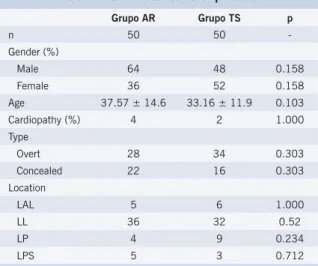
ESULTSThe patients of both groups had similar characteristics (table 1). There was no statistical difference as regards age, gender, characteristic (concealed or overt) or location of the AP. Overt APs (RAA = 62% and TSA = 63%) and left lateral APs (RAA = 71% and TSA = 62.5%) prevailed.
Table 1 – Characteristics of patients
Grupo AR Grupo TS p
n 50 50
-Gender (%)
Male 64 48 0.158
Female 36 52 0.158
Age 37.57 ± 14.6 33.16 ± 11.9 0.103 Cardiopathy (%) 4 2 1.000 Type
Overt 28 34 0.303
Concealed 22 16 0.303 Location
LAL 5 6 1.000
LL 36 32 0.52
LP 4 9 0.234
LPS 5 3 0.712
LAL- left anterolateral; LL- left lateral; LP- left posterior; LPS- left posteroseptal
The transeptal puncture was successfully performed in 96% (48/50) of the patients and the arterial puncture was successful in 100% of the patients.
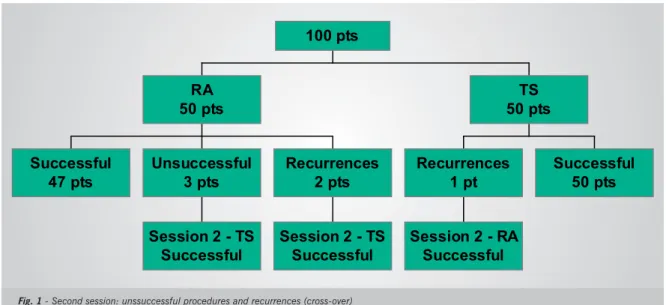
Primary success in the ablation (fi rst session) was achieved in 100% of the patients (50/50 patients) in the TSA group and in 94% (47/50 patients) in the RAA group (p = 0.24). There was AP recurrence in one patient (2%) of the TSA group and in two patients (4%) of the RAA group (p = 1.0).One patient of the TSA group (recurrence) was successfully submitted to a second session using the RAA approach, while fi ve patients of the RAA group (three unsuccessful procedures and two recurrences) were submitted to a second ablation session using the TS approach, with success, defi ning a total effi cacy of 100% (fi gure 1).
The time spent for arterial punctures (PT) was shorter than for TS punctures (p < 0.0001). However, in the TSA group the AT was shorter (p = 0.01) and the number of RF applications was smaller (p = 0.003). The A/V ratio in the ablation site was greater in the TSA group (p < 0.0001), thus indicating that the atrial AP insertion was preferably approached in this group. There was no signifi cant statistical difference between the TSA and RAA groups as regards TF and TT (table 2).
characteristics, we observed a smaller number of RF applications in concealed APs when the TSA technique was used (p = 0.047). The results were not infl uenced by the catheter operator.
Complications -One patient of the TSA group presented a femoral pseudoaneurysm which resolved spontaneously (thrombosis) within a week. The approach of this patient had to be changed to RAA during the procedure (failure in TS puncture) and the complication presented was related with the arterial puncture. No complications were observed which were directly related with the transeptal puncture. No complications occurred in the RAA group.
D
ISCUSSIONIn a set of 100 patients we prospectively compared the TSA technique with the conventional RAA used for catheter ablation of APs located in the left atrioventricular ring to test its effi cacy and safety. The results showed that the TSA technique is as safe and effective as the RAA technique. We also demonstrated that when used in a complementary fashion, they considerably increase the fi nal success rate (100% fi nal success rate).
Some studies compared both techniques in a
retrospec-tive manner5-13. Natale et al5achieved a higher success rate in TSA ablation (100% as compared to 88%; p < 0.03) in a series with 80 patients. Lesh et al6reported similar success rates (85% as compared to 85%; p = NS) for 106 patients, just like Manolis et al9 (86% as compared to 87%; p = NS) in 82 patients. In Brazil, Sternick et al11 found a trend of better results with the TS approach (92% as compared to 73%; p = 0.)
With the TS approach we had shorter ablation times (p = 0.01) and the number of applications was smaller (p = 0.003); however, the fl uoroscopy times (FT) and the total time of procedure (TT) were similar. This may be explained by the longer time spent in the transeptal puncture (PT) as compared with the arterial puncture as was confi rmed by the study (p < 0.0001) and as had been observed in a previous study6. In the latter the authors reported a higher success rate with the TSA method in left anterolateral and posterolateral APs, but with no statistical support; the comissures of the mitral valve in these locations supposedly make the ring less accessible through the ventricular surface according to the authors6. Natale et al stated their preference for TSA for concealed APs since it is easier to map them in the atrial electrogram, when this technique is used, during tachycardia or ventricular stimulation5.
In a more recent prospective and randomized study comparing the RAA and TSA techniques and using only one catheter, Katritsis et al17observed shorter procedure time, smaller exposure to radiation and number of RF applications with the TSA technique.
In our cases, when we analyzed the subgroups, we observed that the benefi ts (shorter ablation time and smaller number of RF applications) of the TSA technique were expressive only for APs located on free walls and not for septal APs.
As demonstrated by the A/V ratio measurement in the sites of application, the APs were approached preferably in their atrial insertions with the TSA technique and in Fig. 1 - Second session: unssuccessful procedures and recurrences (cross-over)
Table 2 – Results
RAA Group TSA Group p Success rate (%) 94 100 0,24 Recurrence (%) 4 2 1,0 PT (min) 5,5 ± 5,5 15,9 ± 9,8 <0,0001 AT (min) 39,5 ± 51,2 18,7 ± 20,2 0,01 FT (min) 36,1 ± 24,2 33,9 ± 16,2 0,63 TT (min) 121,9 ± 52,7 115,2 ± 35,8 0,47 A/V ratio 0,53 ± 0,6 2,2 ± 1,7 <0,0001 RF applications 4,04 ± 3,1 2,5 ± 2 0,003
PT- puncture time; AT- ablation time; FT- fl uoroscopy time; TT- total time of procedure
Successful
47 pts
Session 2 - TS
Successful
Unsuccessful
3 pts
Session 2 - TS
Successful
Recurrences
2 pts
RA
50 pts
Session 2 - RA
Successful
Recurrences
1 pt
Successful
50 pts
TS
their ventricular insertions with the RAA technique (p < 0.0001). Although we may reach the AP atrial insertion using both techniques with high effi cacy8,10, the mapping of the AP ventricular insertion using the RAA technique was preferred since this approach provides greater stability to the catheter. In a subjective analysis, the operators found more diffi culty in positioning the catheter via RAA in the anterolateral pathways.
With respect to children two studies stand out: Vora et al12 obtained a 100% success rate in the ablation of left APs in their atrial insertions using the RA access in 36 patients and the TS access in thirteen. They reported a shorter FT for the RAA technique (p = 0.05)12. Law et al13 studied 136 children and obtained shorter FT, TT and smaller numbers of catheters used with the TSA technique, but without differences relative to success rates and complications13.
Overall the studies suggest that the differences found between the techniques may be related to the learning curve and to the experience of the operator, rather than to the specifi c technique used12,13. When we began this study the group was more experienced with procedures via RA, and only one operator had received training in TS puncture. Even so the general trend was towards better results with the TSA approach. The transeptal puncture failed in only two patients. These results may be more expressive if a new study was carried out in the present, since the team now has a similar amount of experience with both approaches.
There is a consensus that the skill in the use of both techniques increases the fi nal rate of success as compared to the use of each technique isolatedly5,6,9,10. However, it is important to plan the procedure beforehand; Lesh et al6 suggest that TS puncture should be avoided in patients during systemic anticoagulation (initiated via RA), but it may be performed depending on the operator’s prior experience and, if possible, after the anticoagulation effect has been reversed (protamine and control of coagulation time activated in the room). This is the strategy currently used in our laboratory in case of failure in the RA approach.
And lastly it is worth considering economic aspects when choosing the technique. The TSA procedure entails higher costs in connection with the specifi c material to be used. This factor, in combination with the technical
diffi culty associated with the TS puncture may limit its use on a routine basis.
Complications -Isolated cases of complications have been described for both techniques, thus preventing a statistical analysis. The most common are vascular complications in connection with the arterial puncture5,9,13 and pericardial effusion resulting from the puncture of the atrial wall during the TS puncture9,10. Minich et al18 detected 30% new mild aortic regurgitation cases after procedures via RA. Kessler et al19demonstrated the presence of left-to-right shunt through the interatrial septum following ablation via TS in six out of twelve patients. However, the clinical signifi cance of these fi ndings has not yet been determined.
Formation of thrombus in the right atrium in the site of the transeptal puncture following left AP ablation has been recently reported in a patient20.
Greater complications were described by Calkins et al3 in six out of 158 patients submitted to the RA technique, including vascular complications, coronary thrombosis and aortic valve perforation Lesh et al6 reported a case of dissection of the left coronary artery during the RA technique followed by myocardial infarction. It is speculated that RF lesions in the ventricular insertion of an AP in children may be arrhythmogenic, which however remains unproven to date. Saul et al8 reported the sudden death of a fi ve-week old child two weeks after the ablation of a left AP, which was attributed to ventricular arrhythmia. In our study only one patient presented vascular complications in connection with the arterial puncture (in the TSA group), and it resolved spontaneously, leaving no sequelae.
We therefore conclude that catheter ablation of left APs using the TSA technique is as effective as the conventional approach (RAA). When used in a complementary fashion (cross-over) they may increase the fi nal success rate of ablation of left APs, which suggests that mastery of both on the part of the electrophysiologist is important for his/ her daily practice. The TS approach was better than the RA approach as regards the ablation time and the number of RF applications, which may translate into less morbidity for the procedure. The absence of major complications confi rms that both techniques are safe.
No potential confl ict of interest relevant to this article was reported.
R
EFERENCES1. Jackman WM, Xunzhang W, Friday KJ, Roman CR, Moulton KP, Beckman KJ, et al. Catheter ablation of accessory atrioventricular pathways (Wolff-Parkinson-White syndrome) by radiofrequency current. N Eng J Med.1991; 324: 1605-11.
2. Lesh MD, Van Hare GF, Schamp DJ, Chien W, Lee MA, Griffi n JC, et al. Curative percutaneous catheter ablation using radiofrequency energy for accessory pathways in all locations: results in 100 consecutive patients. J Am Coll Cardiol. 1992; 19: 1303-9.
3. Calkins H, Langberg J, Sousa J, el-Atassi R, Leon A, Kou W, et al. Radiofrequency catheter ablation of accessory atrioventricular connections in 250 patients: abbreviated therapeutic approach to Wollf-Parkinson-White Syndrome. Circulation. 1992; 85: 1337-49.
4. Calkins H, Kim Y-N, Schmaltz S, Sousa J, el –Atassi R, Leon A, et al. Eletrogram criteria for identifi cation of appropriated target sites for radiofrequency catheter ablation of accessory atrioventricular connections. Circulation. 1992; 85: 565-73.
5. Natale A, Wathen M, Yee R, Wolfe K, Klein G. Atrial and ventricular approaches for radiofrequency catheter ablation of left-sided accessory pathways. Am J Cardiol 1992; 70: 114-6.
7. Swartz JF, Tracy CM, Fletcher RD. Radiofrequency endocardial catheter ablation of accessory atrioventricular pathway atrial insertion sites. Circulation. 1993; 87: 487-99.
8. Saul JP, Hulse E, De W, Weber AT, Rhodes LA, Lock JE, et al. Catheter ablation of accessory atrioventricular pathway in young patients: use of long vascular sheats, the transseptal approach and a retrograde left posterior parallel approach. J Am Coll Cardiol. 1993; 21: 571-83. 9. Manolis AS, Wang PJ, Mark Estes 3rd NA, Dhala AA, Blanck Z, Bajwa
TK, et al. Radiofrequency ablation of left-sided accessory pathways: transaortic versus transseptal approach. Am Heart J. 1994; 128: 896-902.
10. Deshpande SS, Bremner S, Sra JS. Ablation of left free-wall accessory pathways using radiofrequency energy at the atrial insertion site: Transseptal versus transaortic approach. J Cardiovasc Electrophysiol. 1994; 5: 219-31.
11. Sternick EB, Gerken LM, Barbosa MR. Ablação por cateter com radiofrequência em vias acessórias esquerdas: Abordagem transaórtica versus transseptal. Reblampa. 1997; 10: 177-85.
12. Vora AM, McMahon S, Jazayeri MR, Dhala AA. Ablation of atrial insertion sites of left-sided accessory pathways in children: effi cacy and safety of transseptal versus transaortic approach. Pediatr Cardiol. 1997; 18: 332-8.
13. Law IH, Fischbach PS, Leroy S, Lloyd TR, Rocchini AP, Dick M. Access to left atrium for delivery of radiofrequency ablation in young patients: retrograde aortic vs transseptal approach. Pediatr Cardiol. 2001; 22: 204-9.
14. Brockenbrough E, Braunwald E. A new technique for left ventricular angiocardiography and transseptal left heart catheterization. Am J Cardiol. 1960; 6: 1602-7.
15. Mullins CE. Transseptal left heart catheterization: experience with a new technique in 520 pediatric and adult patients. Pediatr Cardiol. 1983; 4: 239-46.
16. De Ponti R, Zardini M, Storti C, Longobardi M, Salerno-Uriarte JÁ. Trans-septal catheterization for radiofrequency catheter ablation of cardiac arrhythmias: results and safety of a simplifi ed method. Eur Heart J. 1998; 19: 943-50.
17. Katritsis D, Giagitzoglou E, Korovesis S, Zambartas C. Comparison of the transseptal approach to the transaortic approach for ablation of left-sided accessory pathways in patients with Wolff-Parkinson-White Syndrome. Am J Cardiol. 2003; 91: 610-3.
18. Minich L, Snider A, Dick M II. Doppler detection of valvular regurgitation after radiofrequency ablation of accessory connections. Am J Cardiol. 1992; 70: 116-8.
19. Kessler DJ, Pirwitz MJ, Horton RP, Canby RC, Welch PJ, Joglar JÁ. Intracardiac shunts resulting from transseptal catheterization for ablation of accessory pathways in otherwise normal hearts. Am J Cardiol. 1998; 82: 391-2.