ECOLOGY, BEHAVIOR AND BIONOMICS
Response of the Galling Insect
Aciurina trixa
Curran (Diptera:
Tephritidae) to Host Plant Quality
GERALDO W. FERNANDES1, PETER W. PRICE2, SILMARY J. GONÇALVES-ALVIM1,
TIMOTY P. CRAIG3AND DOUGLAS YANEGA4
1Ecologia Evolutiva de Herbivoros Tropicais/DBG, ICB/Universidade Federal de Minas
Gerais, Caixa postal 486, 30161-970, Belo Horizonte, MG, Brazil.
2Department of Biological Sciences, PO Box 5640, Northern Arizona
University, Flagstaff, AZ 86011, USA.
3Life Sciences, Arizona State University West, PO Box 37100,
Phoenix, AZ 85069, USA.
4Departamento de Biologia Geral, ICB/Universidade Federal de Minas Gerais,
Caixa postal 486, 30161-970, Belo Horizonte, MG, Brazil.
An. Soc. Entomol. Brasil 29(3): 423-431 (2000)
Resposta do Inseto Galhador Aciurina trixa Curran (Diptera: Tephritidae) à Qualidade da Planta Hospedeira
RESUMO - A seleção da planta hospedeira pela fêmea, o comportamento de oviposição e o desempenho da prole do tefritídeo galhador Aciurina trixa Curran (Diptera: Tephritidae) em plantas de Chrysothamnus nauseosus hololeucus Pall. (Britton) (Asteraceae), fertilizadas com NPK e em um grupo controle, foram estudados no Norte do Arizona, EUA. Não houve diferença na proporção de fêmeas que selecionaram o grupo controle e as que selecionaram as plantas fertilizadas nem entre o tempo de aceite da planta hospedeira no grupo controle e o tempo de aceite das plantas fertilizadas. As fêmeas ovipositaram menor número de ovos e levaram mais tempo durante a oviposição em plantas do grupo controle do que em plantas que receberam tratamento. O desempenho larval (medido como o período do início do desenvolvimento da galha na planta, diâmetro da galha e peso larval) não apresentou diferenças estatisticamente significantes entre plantas fertilizadas e do grupo controle (P > 0,05).
(measured as time of first gall appearance on plant, gall diameter, and larval weight) was not statistically different between fertilized and control plants (P > 0.05).
KEY WORDS: Insecta, Chrysothamnus nauseosus, insect galls, insect behavior, feeding preference.
The relationship between the oviposition preference of a female and the growth, sur-vival, and reproduction of its offspring is vi-tal in understanding host associations between herbivore insects and plants (Thompson 1988, Stein & Price 1995). Studies on preference and performance in phytophagous insects have contributed to the testing and generation of hypothesis about the evolution of host specificity (Bush & Diehl 1982), selection for enemy-free space (Price et al. 1980), host shifts (Bush 1975, Jaenike 1981), and how insects are distributed among plant species over evolutionary time (Jaenike & Holt 1991). Host plant nutritional status affects the preference and performance of galling insects. Fernandes & Price (1988, 1991) have shown that the number of galling insect species in-creases with increasing habitat hygrothermal and nutritional stress in tropical and temper-ate regions. The mechanisms producing the patterns were the differential mortality of immatures in xeric and mesic habitats (Fernandes & Price 1992). Because plants liv-ing in xeric habitats may have a lower avail-ability of water and nutrients it was argued that unfavorable habitat condition negatively influences hormone balance, expression of induced defenses, and the energetic balance between defense and plant growth (Herms & Mattson 1992); thus reducing plant resistance to galling insects.
Anderson et al. (1989) indicated two im-portant components of plant resistance to gall-ing herbivores: host acceptability and host suitability. The acceptability of a host in-volves chemical and/or physical characteris-tics of the plant that are used by herbivores to determine whether or not oviposition will
oc-cur. Host suitability is a measurement of off-spring survival, growth or reproduction after attack.
This paper reports on a behavioral study of the response of a galling insect to plant quality. We studied female host selection, oviposition behavior, and offspring perform-ance of the gall-forming tephritid, Aciurina trixa Curran (Diptera: Tephritidae) on Chrysothamnus nauseosus hololeucus Pall. (Britton) (Asteraceae) in northern Arizona, USA. A. trixa induces galls on five C. nauseosus subspecies (Dodson 1987, Fernandes & Price 1994). Eggs are laid on axillary buds of stems that grew in the previ-ous year, and only one larva is found per gall. After hatching, the larva induces a spheroidal bud gall. A. trixa has three larval instars, and is multivoltine. More detailed life history parameters, courtship, and mating behavior of A. trixa can be found in Fernandes & Price (1994) and references therein.
This study aimed to answer the followings questions: 1. Does plant quality, i.e. nutri-tional status, influence female oviposition choice? 2. Does plant nutritional status in-fluence the length of time spent by a female during oviposition? 3. Is developmental time of the gall influenced by host plant quality? 4. Is larval performance (e.g., gall diameter and larval weight) influenced by host plant quality?
Material and Methods
Experimental Plants. Oviposition
the previous year) were dug from a popula-tion at Schultz Pass (2.4 km from highway I-89), north of Flagstaff, Arizona at elevation of 2,400 m. Plants were matched for approxi-mate size (range, 50-70 cm). Dug plants were placed in the center of 18.9 l pots which were filled until the roots were covered with soil from the site where plants were growing. Each potted plant received 7.6 l of water contain-ing 20 drops of a root hormone (Superthrive). All galls were removed from the plants so they would not influence female behavior during the experiments nor change the pattern of plant growth.
Plants were numbered from 1 to 60. Thirty plants, hereafter called "treatment plants" were selected at random to receive water and fertilizer (Peters fertilizer, NPK at a ratio of 1:1:1 available elements). The other thirty plants, hereafter called "control plants", re-ceived only water. Fertilizer was applied at a concentration of 3.4 g/l of water to the treat-ment plants every second week from 30 March to 31 August 1989. Each control and treat-ment plant received 3.8 l of water weekly. Stem length and internode length of galled and nearest ungalled stems were measured to the nearest millimeter for control and treatment plants.
Behavioral Observations. Adult behavior
was observed in cages at Northern Arizona University (Flagstaff, Arizona), and in the field at Schultz Pass, between 5 and 23 June 1989. Cylindrical nylon-mesh field cages (al-lowing penetration of > 80% of incident sun light) measuring 1.0 m diameter by 1.3 m height were used. Adult flies released into the field cage have been reared in the labora-tory from galls collected in the field from 15 May to 30 May 1989. Flies were kept in the laboratory at environment temperature (25ºC), and photoperiod of 12 hours. Trials were re-stricted to sunny days and appropriate times of day for oviposition (between 9:00 am and 5:00 pm; G. W. Fernandes pers. observation). The time a female took to accept the host plant, and the time from insertion to retrac-tion of the ovipositor, observed by eye, were
recorded to the nearest second.
Each oviposition may be preceded by a series of encounters and acceptance as the insect proceeds through a sequence of behaviors (Kennedy 1965). Thus, each time a decision is made to accept or reject a plant, or plant part, preference can be measured (see Singer 1986). We used sequential choice tri-als where the insects were allowed contact with more than one plant of C. nauseosus hololeucus, but only one plant was present at any given time. This was a realistic protocol because many insects encounter plants sequentially in their natural host-searching behavior (see Singer 1986).
(without oviposition) does not influence an insect's response to the same or other plants encountered subsequently (for detailed discus-sion see Jaenike 1982, Singer 1986).
After the preference experiment, females were returned to their first-choice plants and allowed to lay eggs for a period of 30 min. Then, females were allowed to lay eggs on the plant offered second for 30 min. The egg laying period, time elapsed to next oviposi-tion, the sites and number of eggs laid, and the sizes of selected and nearest neighbor non-selected stems were recorded. The number of eggs laid is here given by the number of times when the females' extruded ovipositor was inserted into the plant tissue attacked. Unfortunately, eggs could not be seen pass-ing through the ovipositor nor we could open the lacerated tissue as we could have de-stroyed the future gall. Gall diameter (mm), larval weight (mg), and survivorship were also recorded after the period of larval develop-ment.
The proportion of neutral females versus females that selected control or treatment plants was tested by Chi-square analysis. Differences in preference and performance were analyzed by paired t-tests, or Wilcoxon signed rank tests (Zar 1996). Means are given with standard errors.
Results
Host Plant Quality. Plants responded to ap-plication of fertilizer that influenced the growth of treatment plants. At the end of the treatment period, the total length of the stems of treatment plants averaged 218.5 ± 16.7 mm ( ± SE) while the stems of control plants av-eraged 156.9 ± 17.9 mm (t test = 2.499, n = 60, P < 0.02). The mean distance between internodes was also larger on treatment (28.3 ± 1.2 mm) compared to control plants (21.1 ± 1.2 mm) (t test = 4.131, n = 60, P < 0.0001).
Female Behavior. Soon after landing on a
plant, females started to walk up and down the stems in search of an oviposition site -with their wings frequently moving in several
distinctive ways (see Jenkins 1990, Fernandes & Price 1994). They concentrated the search on the distal third of the stem. When a stem was rejected, the female flew to another stem, or if the whole plant was rejected, the female flew to the cage walls, or to another plant when in the field. Females were frequently seen to touch the substrate with their mouthparts. The ovipositor was sometimes half-extruded to touch the stem during a walk. The fully ex-panded leaf of the chosen axillary bud was also inspected a few times. A female stopped to search the stem when it accepted an axil-lary bud as site of oviposition. We consid-ered a site as "accepted" when the female curled its abdomen and extruded its oviposi-tor.
During oviposition, the female may vig-orously move its ovipositor up and down, and some females moved their whole body back and forth and sideways during oviposition. Females' mouthparts were frequently seen touching the substrate during oviposition. Females generally were positioned facing the proximal end of the shoot during oviposition. Eggs were laid within leaf axillary buds on internodes 2 to 6 only. The ovipositor was vigorously cleaned with the female's poste-rior legs and no apparent scar was left after oviposition.
Some females searched for another ovi-position site in the same stem or flew to an-other stem. When they flew to an unaccept-able stem, they often returned to the stem pre-viously used for oviposition. Although not measured, winds did not seem to bother fe-males during oviposition. However, ant ac-tivity near the oviposition site disrupted the process, causing the female to search for an-other site or to fly to a different stem. Ants (Formica spp.) were seen frequently cutting open axillary buds as well as young galls to prey upon the galling larvae in the field. Other arthropods caused the female to interrupt site selection but not egg laying.
Host Acceptability. Females were more
trial: 82.1% (n = 23); second trial: 7.2% (n = 2); and third trial: 0%]. Only 10.7% (n = 3) of the tested females did not select any of the plants offered. When both plants were accepted (no preference = non-discriminating behavior), there was no difference between the elapsed time (time since placed on the plant) to select the first offered host and the elapsed time to select the second host offered ( = 195 ± 26 sec, n = 25; and = 248 ± 43 sec, n = 10, respectively; t test, P > 0.05).
The proportion of females that selected control (n = 5) over treatment (n = 10) plants, the number of females that showed no prefer-ence (n = 10), and the number of females that did not select any of the plants offered (n = 3) did not differ significantly (χ² = 0.70, n = 28, P > 0.05). In addition, there was no differ-ence between the time to accept control ( = 177 sec ± 51, n = 5) and treatment plants ( = 150 ± 51 sec, n = 10) by ovipositing females (P > 0.05).
Females selected the longest shoots for oviposition on both control and treatment plants. On control plants, attacked shoots averaged 195.5 ± 21.8 mm whereas nearest neighbor ungalled shoots averaged 118.4 ± 24 mm (paired t test = 2.341, n = 13, P < 0.02). On treatment plants, attacked shoots averaged 245.4 ± 7.8 mm whereas nearest ungalled stems averaged 169.9 ± 27.6 mm (paired t test = 2.707, n = 17, P < 0.05). Nevertheless, in-ternode length did not differ between galled and nearest neighbor ungalled shoots of both control and treatment plants (P > 0.05, both). All females laid fewer eggs on control than
on treatment plants (control: = 3.5 ± 0.7; treatment: = 5.7 ± 0.7; P < 0.05). There was also a difference in the time of oviposition (log base 10 transformed). The females spent a longer time ovipositing on control plants than on treatment plants (control: = 155 ± 2 seconds, n = 79; treatment: = 146 ± 3 sec-onds, n = 124, t test = 3.721, P < 0.0001).
Larval Performance. More eggs were laid
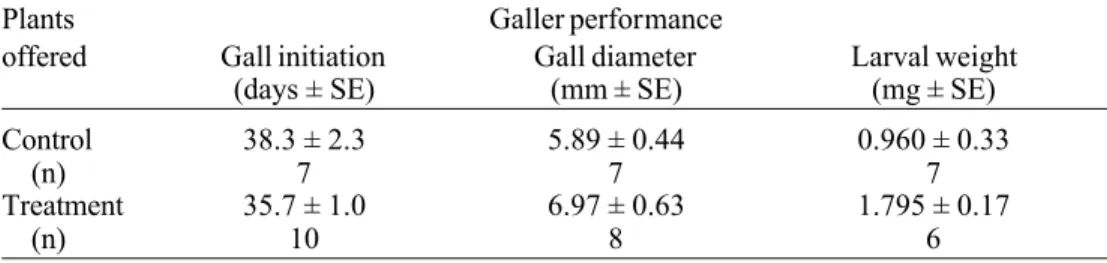
on treatment plants, but only 14% of the eggs produced galls (n =10), while on control plants, 24% developed galls (n = 9). There was no significant difference between the time to initiate a gall (time between egg deposi-tion in plant tissue and first appearance of the gall), gall diameter, and larval weight on con-trol versus treatment plants (Table 1).
Discussion
The discriminatory ability, female prefer-ence, and oviposition behavior have been studied in many fruit flies (Prokopy & Papaj 1988, Anderson et al. 1989, Fernandes-da-Silva & Zucoloto 1993, Chen et al. 1996, Fondriest & Price 1996). Chemoreceptors on the tarsi, labella, and ovipositor were found to be used in the differentiation among host species for oviposition in some tephritid spe-cies (Zacharuk et al. 1986, Stoffolano & Yin 1987), and host plant chemicals, pH, and pos-sibly water content can be distinguished by the sensilla of tephritid flies (Ritter & Vasey 1989).
Variation in host plant quality may exert
Table 1. Average time (days) spent for gall initiation, gall diameter (mm), and larval weight (mg) for A. trixa on control and treatment plants in laboratory (t test, P > 0.05 in all).
Plants Galler performance
offered Gall initiation Gall diameter Larval weight
(days ± SE) (mm ± SE) (mg ± SE)
Control 38.3 ± 2.3 5.89 ± 0.44 0.960 ± 0.33
(n) 7 7 7
Treatment 35.7 ± 1.0 6.97 ± 0.63 1.795 ± 0.17
(n) 10 8 6
X X
X X
X X
strong selection pressure on oviposition behavior, particularly on galling insects in which the newly hatched larvae are relatively immobile and must feed on the plant or host plant organ on which eggs were laid (see Thompson 1988, Price et al. 1990). In this case females are frequently very selective in choosing the best possible host plants or plant parts for larval survival (e.g., Craig et al. 1986, 1989, Price et al. 1990, Stein & Price 1996). Oviposition site preferences determine the microhabitats used by their offspring (Jaenike & Holt 1991), hence females will benefit from being able to sense microhabitat characteris-tics that enhance offspring performance. How-ever, although females tephritds have the abil-ity to select oviposition sites nonrandomly, A. trixa have not any preference for control or treatment plants.
Response to increase nutrients concentra-tions varies among insect species (Waring & Cobb 1992). Most herbivore insects benefit from higher nutrients levels in fertilizer plants (Slansky & Feeny 1977, Price et al. 1987, Craig et al. 1989, Feller 1995, Fondriest & Price 1996). In contrast, fertilization of some plants may exert negative impact on insects (Leigh et al. 1974, Singh & Agarwal 1983, Cobb et al. 1997) or have no effect on her-bivore insect population dynamics (Israel & Rao 1967, Prezler & Price 1995). Although fertilized plants had faster growth rates when compared with control plants, our results show that A. trixa female preference and galler per-formance were not affected by host plant qual-ity. These differences in behavior among in-sects may reflect from the variable forms in while plants store and metabolize nitrogen and the interactions between insect nutrients and other chemical in the plants (Auerbach & Strong 1981). Furthermore, resource quan-tity, host plant geographic distribution, plant phenology, seasons of plant growth, climate, parasites, and predators are other factors which can exert strong selective pressure on herbivore insects (Auerbach & Strong 1981, Fondriest & Price 1996, Mayhew 1997).
A larger proportion of larvae produced galls on control plants than on treatment
plants, but time to initiate the gall, gall diam-eter, and larval weight for control versus fer-tilized plants did not differ. These findings are corroborated by field experimental stud-ies (Fernandes 1992). Larval weight and gall diameter were similar across plant treatment groups within a habitat (Fernandes & Price, in preparation). However, natural enemies and plant resistance were strong mortality fac-tors on galls that developed on better quality plants. Differential mortality and survivorship of larvae caused by plant resistance and natu-ral enemies, rather than larval weight, and gall diameter, may explain the higher A. trixa gall-ing population size in dry habitats ( Fernandes & Price 1988).
Females took a longer time laying eggs on control plants than on treatment plants. Nevertheless, females have deposited more eggs in longer shoots within a plant. This fact may indicate that A. trixa has not become physiologically specialized for vigorous host plants as galler performance did not vary among plant groups (Prezler & Price 1995). Thus, further detailed studies on the physiol-ogy, the genetics and the phylogeny are needed to better understanding the host selection by A. trixa females, and its role on the offspring fitness.
Acknowledgments
We thank J. Itami, and two anonymous reviewers for their helpful criticisms in ear-lier drafts of this manuscript. Financial sup-port was provided by the U.S. National Sci-ence Foundation (Grants Nº BSR-8314594, and BSR-8705302), by the Conselho Nacional de Pesquisa (CNPq Nº 52.1772/95-8), and FAPEMIG (2519/95).
Literature Cited
Anderson, S.S., K.D. McCrea, W.G. Abrahamson & L.M. Hartzel. 1989.
Auerbach, M.J. & D.R. Strong. 1981.
Nutritional ecology of Heliconia herbivores: experiments with plant fertilization and alternatives hosts. Ecol. Monogr. 51: 63-83.
Bush, G.L. 1975. Sympatric speciation in phytophagous parasitic insects, p. 187-206. In P.W. Price (ed.), Evolutionary strategies of parasitic insects and mites. New York, Plenum. 420 p.
Bush, G.L. & S.R. Diehl. 1982. Host shifts, genetic models of sympatric speciation and the origin of parasitic insect species, p. 297-305. In J.H. Visser & A.K. Minks (eds.), Proc. 5th Int. Symp. Insect-Plant Relation. The Netherlands, Wageningen. 551 p.
Chen, C.C., Y.J. Dong, L.L. Cheng & R.F. Hou. 1996. Deterrent effect of neb seed kernel extract on oviposition of the oriental fruit fly (Diptera: Tephritidae) in guava. J. Econ. Entomol. 89: 462-466.
Cobb, N., S. Mopper, C.A. Gehring, K. Christensen & T.G. Whitham. 1997.
Increased moth herbivory associated with environmental stress of pinyon pine at local and regional levels. Oecologia 109: 389-397.
Craig, T.P., J.K. Itami & P.W. Price. 1986.
Resource regulation by a stem-galling sawfly on the arroyo willow. Ecology 67: 419-425.
Craig, T.P., J.K. Itami & P.W. Price. 1989.
A strong relationship between oviposition preference and larval performance in a shoot-galling sawfly. Ecology 70: 1691-1699.
Dodson, G. 1987. Biological observations on Aciurina trixa and Valentibulla dodsoni (Diptera: Tephritidae) in New Mexico. Ann. Entomol. Soc. Amer. 80: 494-500.
Feller, I. 1995. Effects of nutrient enrichment on growth and herbivory of dwarf red mangrove (Rhizophora mangle). Ecol. Monogr. 65: 477-505.
Fernandes, G.W. 1992. Adaptive distribu-tion of gall-forming insects: patterns and mechanisms. PhD. Dissertation, Northern Arizona University, Flagstaff, Arizona. 99 p.
Fernandes, G.W. & P.W. Price. 1988.
Biogeographical gradients in galling species richness: tests of hypotheses. Oecologia 76: 161-167.
Fernandes, G.W. & P.W. Price. 1991.
Comparison of tropical and temperate galling species richness: the roles of environmental harshness and plant nutrient status, p. 91-115. In P.W. Price, T.M. Lewinsohn, G.W. Fernandes & W.W. Benson (eds.), Plant-animal interactions: evolutionary ecology in tropical and temperate regions. New York, Wiley. 639 p.
Fernandes, G.W. & P.W. Price. 1992. The adaptive significance of insect gall distribution: survivorship of species in xeric and mesic habitats. Oecologia 90: 14-20.
Fernandes, G.W. & P.W. Price. 1994. Life history, courtship, and mating behavior of the gall-forming tephritid, Aciurina trixa, on Chrysothamnus nauseosus hololeucus (Asteraceae). Proc. Entomol. Soc. Wash. 96: 301-307.
Fernandes-da-Silva, P.G. & F.S. Zucoloto. 1993. The influence of host nutritive value on the performance and food selection in Ceratitis capitata (Diptera: Tephritidae). J. Ins. Physiol. 39: 883-887.
Fondriest, S.M. & P.W. Price. 1996.
occidentalis (Diptera: Tephritidae) on Cirsium wheeleri. Environ. Entomol. 25: 321-326.
Herms, D. A. & W. J. Mattson. 1992. The dilemma of plants: to grow or defend. The Quart. Rev. Biol. 67: 283-335.
Israel, P. & P.S.P. Rao. 1967. Influence of potash on gall-fly incidence on rice. Oryza 4: 85-97.
Jaenike, J. 1981. Criteria for ascertaining the existence of host races. Amer. Natur. 117: 830-834.
Jaenike, J. 1982. Environmental
modifi-cation of oviposition behavior in Drosophila. Amer. Natur. 119: 784-802.
Jaenike, J. & R.D. Holt. 1991. Genetic variation for habitat preference: evidence and explanations. Amer. Natur. 137: 67-90.
Jenkins, J. 1990. Mating behavior of
Aciurina mexicana (Aczél) (Diptera: Tephritidae). Proc. Entomol. Soc. Wash. 92: 66-75.
Kennedy, J.S. 1965. Mechanisms of
host-plant selection. Ann. Appl. Biol. 56: 317-322.
Leigh, T.F., D.W. Grimes, W.L. Dickens &
C.E. Jackson. 1974. Planting pattern,
plant population, irrigation and insect interactions in cotton. Envirom. Entomol. 3: 492-501.
Mayhew, P.J. 1997. Adaptive patterns of
host-plant selection by phytophagous insects. Oikos 79: 417-428.
Preszler, R. W. & P. W. Price. 1995. A test of plant-stress, and plant-genotype effects on leaf-miner oviposition and performance. Oikos 74: 485-492.
Price, P.W., C.E. Bouton, P. Gross, B.A. McPherson, J.N. Thompson & A.E. Weis. 1980. Interactions among three trophic levels: influence on plants on interactions between insect herbivores and natural enemies. Ann. Rev. Ecol. Syst.11: 41-65.
Price, P. W., H. Roininen & J. Tahvanainen.
1987. Why does bud-galling sawfly,
Euura mucronata, attack long shoots? Oecologia 74: 1-6.
Price, P.W., N. Cobb, T.P. Craig, G.W. Fernandes, J.K. Itami, S. Mopper & R.W. Preszler. 1990. Insect herbivore population dynamics on trees and shrubs: new approaches relevant to latent and eruptive species and life table development, p. 1-38. In E. A. Bernays (ed.), Insect-plant interactions. Boca Raton, CRC Press. 236 p.
Prokopy, R.J. & D.R. Papaj. 1988.
Learning of apple fruit biotypes by apple maggot flies. J. Insect Behav. 1: 67-74.
Ritter, E. & C.E. Vasey. 1989. Sensory structures on the ovipositor of the ball gall fly Eurosta solidaginis (Fitch) (Diptera: Tephritidae). J. N. Y. Entomol. Soc. 97: 341-346.
Singer, M.C. 1986. The definition and
measurement of oviposition preference in plant-feeding insects, p. 65-94. In J.R. Miller & T.A. Miller (eds.), Insect-plant interactions. New York, Springer-Verlag. 205 p.
Singh, R. & R.A. Agarwal. 1983. Fertilizers and pest incidence in India. Potash Rev. 23: 1-25.
47: 209-228.
Stein, S.J. & P.W. Price. 1995. Relative effects of plant resistance and natural enemies by plant development age on sawfly (Hymenoptera: Tenthredinidae) preference and performance. Environ. Entomol. 24: 909-916.
Stoffolano, J.G. & L.R.S. Yin. 1987.
Structure and function of the ovipositor and associated sensilla of the apple maggot, Rhagoletis pomonella (Walsh) (Diptera: Tephritidae). Int. J. Insect Morphol. Embryol. 16: 41-70.
Thompson, J.N. 1988. Evolutionary ecology of the relationship between oviposition preference of offspring in phytophagous
insects. Entomol. Exp. Appl. 47: 3-14.
Waring, G. L. & N. S. Cobb. 1992. The impact of plant stress on herbivore population dynamics, p: 1-38. In E. A. Bernays (ed.), Insect-plant interactions. Boca Raton, CRC Press. 187 p.
Zacharuk, R.Y., K.W. Lee & D.E. Berube. 1986. Fine structure of sensilla on the ovipositor of the tephritid fly Urophora affinis. Can. J. Zool. 64: 973-984.
Zar, J.H. 1996. Biostatistical analysis (2nd. edition). New Jersey, Prentice-Hall. 662 p.