Epidemiological proile of scalping victim-patients
treated at the Fundação Santa Casa de
Misericórdia do Pará
Peril epidemiológico de pacientes vítimas de escalpelamento tratados
na Fundação Santa Casa de Misericórdia do Pará
ABSTRACT
Background: Scalping is a trauma caused by partial or total avulsion of the scalp. It is
primarily due to accidental contact of long hair with the rotary shaft of a motor. Rotary shafts suck in the victim’s hair, causing traction and abruptly pulling the scalp off. Me-thods: A longitudinal, observational, retrospective, and descriptive study of 62 scalping
victim-patients treated at Fundação Santa Casa de Misericórdia do Pará was conducted.
Results: The most commonly affected patients were children between 7 and 16 years of
age (56.4%) and women (93.5%); 59.7% were students and 43.5% were Catholics. Con-clusions: Prophylactic campaigns about the risks of traveling in and maintaining a vessel
without motor shaft protection are essential because scalping is primarily caused by hair twisting around the motor shaft.
Keywords: Scalp. Wounds and injuries. Accident prevention.
RESUMO
Introdução: Escalpelamento é trauma causado por avulsão parcial ou total do couro
ca-beludo, decorrente, principalmente, de contato acidental dos cabelos longos com motor de eixo rotativo. A alta rotação desses motores gera uma força que suga os cabelos da vítima, tracionando e arrancando o couro cabeludo de forma abrupta. Método: Foi realizado um
estudo observacional transversal, retrospectivo, descritivo, incluindo 62 pacientes vítimas de escalpelamento tratados na Fundação Santa Casa de Misericórdia do Pará. Resultados:
Os pacientes mais acometidos foram crianças de 7 anos a 16 anos (56,4%), do gênero fe-minino (93,5%), sendo 59,7% estudantes e que, predominantemente, praticavam a religião católica (43,5%). Conclusões: Campanhas proiláticas sobre os riscos de se viajar e manter
uma embarcação sem proteção no eixo do motor são fundamentais, uma vez que a tragédia do escalpelamento é causada principalmente pelos cabelos que se enrolam no eixo do motor.
Descritores: Couro cabeludo. Ferimentos e lesões. Prevenção de acidentes.
Study conducted at the Fundação Santa Casa de Misericórdia do Pará, Belém, PA, Brazil. Submitted to SGP (Sistema de Gestão de Publicações/Manager Publications System) of RBCP (Revista Brasileira de Cirurgia Plástica/Brazilian Journal of Plastic Surgery). Article received: December 9, 2011 Article accepted: January 18, 2012
Caio BaCellar Cunha1
raquel de Maria
Maués saCraMento2
Bernardo Porto Maia3
renan Petta Marinho4
hilton loBato Ferreira3
dov Charles GoldenBerG5
Maria lastenia
ChaGas PriMo Menezes6
1. Medical Student, President of Liga Acadêmica de Cirurgia Plástica do Pará (Academic League for Plastic Surgery of Pará), Belém, PA, Brazil. 2. Medical Student, Belém, PA, Brazil.
3. Medical Student, Training Coordinator of Liga Acadêmica de Cirurgia Plástica do Pará (Academic League for Plastic Surgery of Pará), Belém, PA, Brazil. 4. Medical Student, Communication Coordinator of Liga Acadêmica de Cirurgia Plástica do Pará (Academic League for Plastic Surgery of Pará), Belém,
PA, Brazil.
5. Full Member of the Sociedade Brasileira de Cirurgia Plástica (Brazilian Plastic Surgery Society) – SBCP, Associate Professor in Plastic Surgery from Faculdade de Medicina da Universidade de São Paulo, Assistant Physician at the Hospital das Clínicas da Faculdade de Medicina da Universidade de São Paulo, São Paulo, SP, Brazil.
INTRODUCTION
Scalping is a common trauma in the northern region of Brazil that is caused by partial or total avulsion of the scalp. In this region, scalping occurs mainly due to long hair being accidentally caught in the motor rotary shaft of boats, gene-rating rotary traction force, leading to abrupt scalping1,2.
According to the data provided by the Fundação Santa Casa de Misericórdia do Pará (FSCMP), there were scalping cases in 44 municipalities of the State of Pará between 1979 and 2007; the areas with most reported scalping cases include the municipalities of Belém (and its islands) and the cities of Breves and Cametá3.
The high incidence of accidents in this region is due to so me factors. In general, boat motors here do not have safety devices preventing users from coming into contact with them. Thus, the fast rotation of the motor shaft sucks light elements into it4. In addition, the women in that region have a cultural preference for long and loose hair.
In general, scalping is a traumatic accident, causing he mo dynamic impairment and intense pain. The clinical pre sentation also involves secondary myalgia in adjacent regions; edema and hematomas in the facial region; restric ted movement of the face, neck, and scapular girdles; and tension hea dache1,2.
Such accidents generate physical sequelae as well as in -tense psychological and sociological suffering throughout the treatment and over patients’ lives since it can signiicantly damage their self-esteem, identity, body perception, humor, sociability, and affective relationships with others. In addi-tion, it can affect family dynamics and economic affairs3.
From an anatomic perspective, among the traction lines from which the scalp can be pulled off, the most common are the scalp junction lines with the facial and neck skin where the skin is thinner and more tightly adhered. Thus, if the hair is initially subjected to traction in the occipital region, the skin irst breaks at the forehead; the opposite occurs if it is irst subjected to traction in the forehead. If the whole hair is subjected to traction simultaneously, the skin ini tially breaks at the eyebrows followed by the zygoma line, above and around the ears or through them, and finishing at the nape (Figure 1). In addition to soft tissue involvement, the skullcap may be exposed, followed by ischemic necrosis, osteitis, and/or bone sequestration2.
At present, there are few data in the literature about the treatment of the consequences of this type of accident, which is relatively common in the Amazon region. In addition, it is im portant to update information to determine the incidence of scalping in this region.
This study aims to track the epidemiological profiles of individual scalping victims admitted at FSCMP from 2001 to 2010.
METHODS
A longitudinal, observational, retrospective, and descrip-tive study of 62 scalping victim-patients treated at FSCMP from 2001 to 2010 was conducted.
Several sociodemographic variables, injury aspects, com -plications, treatment, and scalping cause were collected and analyzed.
The study was conducted after approval by the Ethics in Hu man Beings Research Committee of the Institution. Da ta were collected from medical records, according to the re search protocol.
RESULTS
Epidemiological Aspects
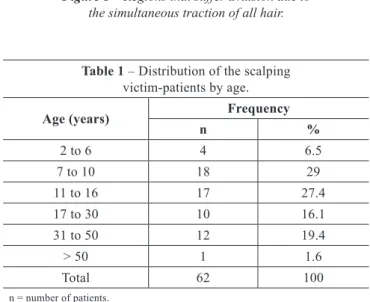
Of the 62 scalping victim-patients between 2001 and 2010, 58 (93.5%) were women. Fifteen (24.2%), 4 (6.5%), and 43 (69.3%) were Blacks, Whites, and of undeclared race, respec-tively. Table 1 presents the distribution of patients by age.
Regarding profession/occupation, 37 (59.7%), 7 (11.3%), 6 (9.7%), 1 (1.6%), and 11 (17.7%) were students, housewives, landsmen, teachers, and undeclared, respectively.
Table 1 – Distribution of the scalping victim-patients by age.
Age (years) Frequency
n %
2 to 6 4 6.5
7 to 10 18 29
11 to 16 17 27.4
17 to 30 10 16.1
31 to 50 12 19.4
> 50 1 1.6
Total 62 100
n = number of patients.
Figure 1 – Regions that suffer avulsion due to
Regarding religion, 27 (43.5%) and 20 (32.3%) declared being Catholic and Protestant, respectively; the religions of 15 (24.2%) patients were not in the medical records.
The distribution of patients by municipality is presented in Table 2.
Regarding irst attendance, 9 (14.5%) patients were ad -mitted to local hospitals near the accident site; meanwhile, in 37 (59.7%) patients, the admission to hospitals and the accident occurred at different locations. In all other cases, there was no relevant information in the medical records. In total, 26 (41.9%), 14 (22.6%), 3 (4.8%), 2 (3.2%), and 1 patient (1.6%) received primary care in Belém, Ananindeua,
Altamira, Itaituba, and Cametá, respectively; data were una -vailable for 16 (25.9%) patients.
Most scalping cases were due to accidents involving ves sels in addition to animal bites, wounds caused by sharp wea pons, work accidents, and vehicular collisions (Table 3).
Clinical and Surgical Aspects
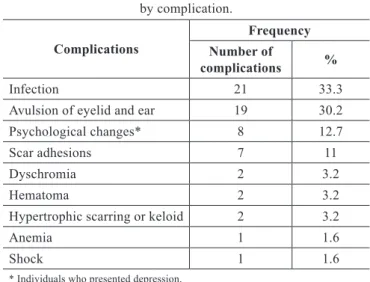
Regarding the wound characteristics upon initial admis-sion, 19 (30.6%), 15 (22.4%), 1 (1.6%), and 1 (1.6%) pa tient presented with bone tissue exposure, granulomatous tissue, necrotic tissue, and skull fracture, respectively; no initial wound characteristics were available for 35 (56.5%) patients. Table 4 presents the incidence of complications of the scalping victims.
Treatment Aspects
Table 5 presents the surgical procedures carried out and their frequency. Microsurgical reimplantation was not per -formed in any of the cases. Among the grafts, the thigh and retroauricular region were the donor regions in 42 (32.3%) and 3 (2.3%) cases, respectively; no data were available for the other cases (65.4%).
All patients were treated with analgesics, including di pi rona, paracetamol, tramal, and profenid in 49 (79%), 13 (21%), 8 (12.9%), and 7 (11.3%) patients, respectively. In addition, anti-biotics were prescribed to all patients: penicillin in 27 (43.5%), irst-generation cephalosporins in 24 (38.7%), second-gene-ration cephalosporins in 22 (35.5%), aminoglycosides in 11 (17.7%), glycopeptides in 7 (11.3%), lincosamide in 3 (4.8%), quinolone in 2 (3.2%), carbapenems in 2 (3.2%), and sulfona-mide in 1 (1.6%). Antiprotozoals were administered in 2 (3.2%) patients. Blood transfusion was performed in 1 (1.6%) patient.
DISCUSSION
Regarding the sociodemographic characteristics of the study population, children aged 7 to 10 years (29%) were
Table 2 – Distribution of scalping victim-patients by city of origin.
City of origin Frequency
n %
Abaetetuba 8 13
Altamira 5 8.2
Muaná 5 8.2
Ribeirinho 5 8.2
Curralinho 3 4.8
Castanhal 3 4.8
Carnetá 3 4.8
Melgaço 3 4.8
Portel 3 4.8
Santarém Novo 2 3.2
Gurupá 2 3.2
Ilha de Mosqueiro 2 3.2
Igarapé-Miri 2 3.2
Ociras do Pará 2 3.2
Tucuruí 2 3.2
São Sebastião da Boa Vista 1 1.6 Limoeiro de Ajuru 1 1.6
Breves 1 1.6
Benica 1 1.6
Belém 1 1.6
Itaituba 1 1.6
Rio Atuá 1 1.6
Moju 1 1.6
Mãe do Rio 1 1.6
Rio Campinas 1 1.6
Porto de Moz 1 1.6
São Domingos do Capim 1 1.6
Total 62 100
n = number of patients.
Table 3 – Distribution of scalping victim-patients according to the cause of accident.
Cause of the accident Frequency
n %
Boat motor shaft 41 66.1
Boat propeller 3 4.8
Animal bite 3 4.8
Non-iring weapon 1 1.6
Work accident 1 1.6
Not recorded* 13 21.1
Total 62 100
predominantly affected, which is concordant with the indings of a previous study conducted in the Amazon region5;
chil-dren commonly travel in boats not only as passengers, but as pilot assistants as well. Such accidents in children are life altering; children present several symptoms and are treated with prejudice, making it dificult to maintain their lives due to intense psychological suffering. Some victims stop studying and move away from their homes, isolating them-selves from family and friends.
With respect to gender, the present results are concordant with those of a previous study reporting the predominance of female victims (93.5%), which is likely due to cultural and religious factors; Amazonian women almost always have
long hair. However, the present data are not concordant those of with previous studies with respect to religion; 43.5% of patients were Catholic in the present study, while a previous study1 indicates a predominance of Protestant women due to the religious inluence toward having long hair.
The predominance of patients from the interiors of Bra zil, especially Abaetetuba with 13% of patients, is like ly due to the great number of rivers in the Amazon Basin and lack of roads in this region, making river transportation rou tine. In addition, inspection by competent agencies regarding the protection of the motor shafts of boats, which are generally unprotected4, is difficult due to the great dis tances between places as well as the large numbers of unins pected vessels6.
After their accidents, most patients usually went to me -tropolitan regions such as Belém and Ananindeua for primary care, meaning that 59.7% received primary care in locations other than the accident site. This is probably because peo ple from the interiors of Brazil have access to limited health infrastructure6.
Although it is the ideal treatment, it was impossible to per form microsurgical reimplantation of the scalp in all cases due to the delay in getting to specialized treatment centers7.
From a clinical/surgical perspective, bone exposure was the main characteristic of injuries and was present in 30.7% of the studied cases. Only 1 (1.6%) case of necrotic tissue was found; this differs from previous studies8,9 that reports it as a frequent characteristic in scalping injuries in addi tion to ischemic necrosis, osteitis, and bone sequestration2. In all recorded cases, patients underwent debridement during the first admission. The lack of recorded information is the reason for the poor characterization of wounds (56.5% of the cases).
The involvement of the frontal and lower facial regions as well as the detachment of the eyelids and ears are compli-cations arising from scalping4,10. Existing data corrobo rate the findings of the present study in that the main compli-cation of scalping is infection followed by avulsion of the eyelids and ears. As described in the literature, it is kno wn that together with scalp injuries, these complications frequently lead to motor impairment if they affect muscles and ligaments.
Among the patients in this study, 33.3% presented with an infectious outline. The dificulty many patients face getting to larger cities for effective treatment can be attributed to large intercity distances and limited access to roads. These factors likely contribute to the fact that patients arrive at the hospital with signs of infection, fever, and purulent secretion from the wound6.
Among the surgical procedures, 47.4% were grafts with the thigh being used most often (Figures 2 and 3); however,
Table 4 – Distribution of scalping victim-patients by complication.
Complications
Frequency
Number of
complications %
Infection 21 33.3
Avulsion of eyelid and ear 19 30.2 Psychological changes* 8 12.7
Scar adhesions 7 11
Dyschromia 2 3.2
Hematoma 2 3.2
Hypertrophic scarring or keloid 2 3.2
Anemia 1 1.6
Shock 1 1.6
* Individuals who presented depression. n = number of patients.
Table 5 – Distribution of surgical procedures performed on scalping victim-patients.
Surgical procedures
Frequency
Number of
procedures %
Grafting 130 47.4
Surgical dressing 102 37.2
Expander 16 5.8
Flap 9 3.3
Trepanation 9 3.3
Eyelid reconstruction 4 1.5 Pinn reconstruction 2 0.7
Canthoplasty 1 0.4
Brow reconstruction 1 0.4
in some cases such as partial avulsions, the remaining scalp itself was used as the donor region due to its rapid healing ability and better esthetic results6. In addition, the abdomen, upper eyelids, and legs and antecubital, inguinal, retroauri-cular, and supraclavicular lexor folds can be used as graft donor areas. Thick skin grafts offer better results than thin ones since they are more stable and resistant to trauma, although they require laborious ixation. Although very efi-cient for treating this type of trauma, laps were used only in 3.3% of the cases, possibly due to the large extent of the injuries. Rotation laps may eficiently distribute the tension and provide closure of small defects with no need for skin grafts in the donor area4.
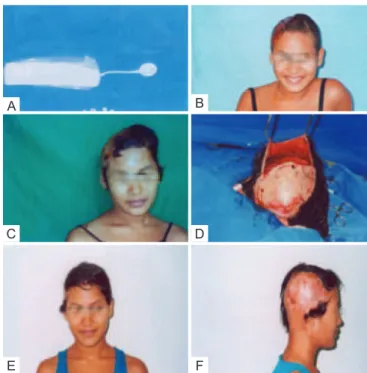
Some authors recommend the use of expanders in pa tients with partial scalping, which comprised 5.8% of the surgical procedures in this study11 (Figure 4). In children, expanders were applied to patients older than 3 years of age since their skull structures are already consolidated. Despite the good esthetic results, cases like these require longer and more expensive treatment12.
With respect to drug treatment, antibiotic therapy is re -commended as the initial procedure in addition to analgesics and anti-tetanus drugs1. Penicillin and irst- and second- generation cephalosporins were the most commonly used antibiotics. Antibiotics and analgesics were administered after hospitalization in all studied cases, usually continuing after discharge.
Eight patients exhibited depressive symptoms as acci-dent complications. Despite the relatively low percentage of these symptoms (12.9%), it requires attention because the psychological and social suffering of these patients is
often greater than the physical trauma and may even last after treatment; this can result in damage to the patient’s self-esteem and ability to socialize and maintain good affective relationships3,13. Moreover, income is related to the psychological trauma experienced by scalping victims, considering that such patients face difficulties participa-ting in society and the labor market due to their physical appearance.
CONCLUSIONS
In the Amazon region, since scalping is primarily cau sed by hair twisting around the motor shafts of boats, it is im portant to promote awareness of this issue through pro phylactic campaigns about the risks of traveling and main -taining a vessel without motor shaft protection, di rected toward boat owners and operators. When effective, the treat ment of scalping victims, who are mainly women and children, is long since; it involves several reparative surgeries in addition to psychological treatment due to es -thetic sequelae and resultant social problems. Therefore, it is extremely important that local governments take ini -tiatives to prevent such accidents and provide efficient primary care for victims.
Figure 4 – In A, tissue expander. In B, partial scalping after
grafting (previous view). In C, patient in the expansion period.
In D, expanded lap. In E, postoperative view of the expanded
lap (previous view). In F, postoperative view
of the expanded lap (side view).
A
C
E F
D B
Figure 2 – In A, total scalp avulsion.
In B, post-grafting aspect.
A B
Figure 3 – In A, partial scalp avulsion.
In B, post-grafting aspect.
REFERENCES
1. Britto CBL, Normando Júnior GR, Fonseca CCF, Aita V, Pinheiro Filho A. Escalpelamento na população amazônica. Rev Para Med. 2004; 18(2):35-8.
2. Freitas RS, Cruz GAO, Fagotti Filho A, Alonso N. Reconstrução de orelha utilizando uma única cartilagem costal: descrição modiicada da técnica. Rev Soc Bras Cir Craniomaxilofac. 2005;8(2):39-47. 3. Ribeiro NS. Necessidade e dilemas das famílias vítimas de
escalpela-mento atendidas na FSCMP: desaios para o serviço social [trabalho de conclusão de curso]. Belém: Universidade Federal do Pará; 2009. 4. Mota MA. A contribuição da isioterapia no tratamento das vitimas de
escalpelamento [trabalho de conclusão de curso]. Belém: Universidade Estadual do Pará; 2000.
5. Vale JCC. A compreensão do sofrimento no escalpelamento: um estudo utilizando o graismo e o teste das fábulas [dissertação de mestrado]. Belém: Universidade Federal do Pará; 2007.
6. Menezes MLCP. Análise epidemiológica e tratamento cirúrgico das avul-sões de couro cabeludo por acidente em barcos [trabalho apresentado ao
Correspondence to: Maria Lastenia Chagas Primo Menezes
Av. Conselheiro Furtado, 2.865 – Ed. Síntese 21, sobreloja 6 – Belém, PA, Brazil – CEP 66063-060 E-mail: [email protected]
exame de membro titular da Sociedade Brasileira de Cirurgia Plástica]. Belém: Sociedade Brasileira de Cirurgia Plástica; 2003. p. 34-9. 7. Milcheski DA, Cheroto Filho A, Goldenberg DC, Farias JC, Ferreira MC.
Reimplante microcirúrgico das avulsões de couro cabeludo: experiência de 7 anos. Rev Soc Bras Cir Plást. 2003;18(3):47-54.
8. Kazanjian VH, Webster RC. The treatment of extensive losses of the scalp. Plast Reconstr Surg. 1946;1(3):360-85.
9. Koss N, Robson MC, Krizek TJ. Scalping injury. Plast Reconstr Surg. 1975;55(4):439-44.
10. Burmann TG, Marcon Í, Rizzato T, Scheid K. Reconstrução marginal de pálpebras utilizando enxerto de palato duro. Arq Bras Oftalmol. 2008; 71(4):514-7.
11. Vale EA. Correção de escalpe com a expansão tecidual prévia: relato de caso. In: Tournieux AA, ed. Atualização em cirurgia plástica III. São Paulo: Robe Editorial; 1999. p. 81-2.
12. Hochberg J, Pereira K, Almeida MA. Expansores cutâneos. In: Hoch-berg J, ed. Retalhos. Rio de Janeiro: MEDSI; 1990. p. 845-74. 13. Beckman KAF, Santos NCM. Terapia ocupacional: relato de caso com