Article
Printed in Brazil - ©2013 Sociedade Brasileira de Química0103 - 5053 $6.00+0.00
A
*e-mail: [email protected]
Extractability of Copper and Application of Diffusive Gradients in Thin Films:
Metal Availability in Contaminated Soil by Biosolids
Tatiana Garrido Reyes,* Jorge Mendoza Crisosto and Yaris Velásquez Vergara
Departamento de Química Analítica, Facultad de Ciencias Químicas y Farmacéuticas, Universidad de Chile, Santiago, Chile
O objetivo deste estudo foi utilizar a técnica de difusão em filmes finos por gradiente de concentração (DGT) para a avaliação da disponibilidade de cobre em solos com elevados níveis do metal, que foi alterado com biossólidos, além de comparar esta técnica com procedimentos de extração simples e sequenciais, considerando a extractabilidade do metal. A ordem de importância das frações de cobre no solo foi: residual > reduzida > oxidável > solúvel. A aplicação do biossólido diminuiu as frações solúvel e reduzida, bem como aumentou a quantidade de metal associada à fração oxidada. A quantidade de cobre extraída por DGT da solução de solo foi 13% do metal total em solução. No caso do solo, esse valor foi inferior a 0,3% do total do metal. Também relacionou-se diretamente o metal extraído por DGT com o metal disponível com CaCl2 ou o metal ligado à matéria orgânica do solo.
The aim of this study was to use the technique of diffusion gradients in thin films (DGT) to evaluate the availability of copper in soil with high presence of this metal treated with biosolids, and to compare this technique, in terms of metal extractability, with simple and sequential extraction procedures. The order of importance of the copper fractions in the soil was: residual > oxidizable > reducible > soluble. Biosolid application decreased of both soluble and reducible fractions and increased the amount of metal attached to the oxidizable fraction. Copper amount extracted by DGT from the soil solution was 13% of total metal in solution. In the case of soil, this amount was less than 0.3% of total metal. Furthermore, it was possible to directly relate the metal extracted by DGT with the available metal with CaCl2 or the metal bound to organic matter.
Keywords: copper availability, DGT, sequential extraction, biosolid, metallic species
Introduction
The phytotoxicity of metallic species is not necessarily related to the total metal content since the metals can be found in various forms, such as interchangeable, associated with organic matter, or forming complexes, which together with soil properties like pH, ionic strength and cation exchange capacity determine the magnitude of processes such as adsorption, mobility across the soil profile and possible risk to humans and the environment presented by metallic species.1,2
The development of methods for the determination of the bioavailable fraction of different elements in different environmental scenarios has become very important. In that sense, biomimetic methods have been developed, such as the diffusion gradients in thin films (DGT) technique,
whose advantage lies in the simultaneous quantification of different metals, describing the kinetics of the processes involved and making in situ measurements.3
DGT devices have had various applications, among them the determination of metals in estuarine waters,4
in seawater5 or their use in the determination of
metallic species in soil,6,7 measuring approximately the
bioavailability of metals by the continuous removal of the species either from the soil or from soil solutions. Another application is the determination of metallic species in the rhizosphere and the correlation with their content in plants,8 as well as the determination of other elements like
phosphorus in water used in aquaculture.9 The influence
the diffusion of the metal as a complex decreases as the size of the ligand increases.10 Therefore, the application of
DGT to soils with high metal content that are also being subjected to various agronomic practices requires careful result interpretation.
The application of biosolids to soils as a way of disposing them is a practice that has been established for several decades at the international level,11 with regulations
that consider the physicochemical characteristics of the soils to which these materials are applied. Under these conditions, the bioavailability of the elements in the soil can be altered because biosolids contribute to the organic matter that can bind metals and form coordination complexes, implying in decrease of the element bioavailable to the plants or in mobilization of the element to deeper layers of the soil.12,13 In this context, one of the strategies used for
the recovery of soils contaminated with metallic species is the in situ application of high amounts of biosolids to increase the retention of the metals in the soil and favor the development of a compost layer.12,14 The repetitive
application of biosolids to soils may involve a gradual increase in metallic species content, as well as significant changes in the physicochemical properties, a fact that over time can pose risks to crops, environment and humans, depending of the interactions established between a metal and soil components.
Soils with high copper content have been described in Chile, in some cases with over 3000 mg kg−1,14,15 and many
of these soils are used for agricultural production activities. Together with this, most of the sewage treatment plants use activated sludge with an anaerobic digestion process that affects the level of degradation of the organic matter, so in the sludge from the anaerobic digestion ponds there was a higher content of total organic matter and soluble organic matter.
For that reason, it is necessary to develop tools that can allow a more accurate in situ estimation of the metal fraction available to the crops. In that sense, DGT devices are highly promising tools that must be evaluated for the copper availability in Chilean soils with high concentration of this metal, which in turn have been treated with biosolids.
Considering on the one hand that in some studies the bioavailable copper in soil solution or in natural water is estimated by DGT,16 and on the other hand that its direct
use in the soil has been described,6,7 the objective of this
work is to estimate the available copper by means of DGT devices in soil solution and in soil treated with biosolids and incubated for different times. The copper estimated by DGT would be related with the available metal obtained by simple extraction with different extractants and with metal forms through a sequential extraction procedure.
Experimental
Calculations involved in the use of DGT
The diffusion gradients in thin films technique uses an ion exchange resin (Chelex 100) embedded in a hydrogel that is covered by another hydrogel permeable to the ions, with a thickness called ∆g. These gels are assembled in such
a way that the diffusive gel is exposed only to the solution or the soil. The element diffuses through the hydrogel, and then is immobilized onto the resin gel, provided that the resin is not saturated. If the concentration remains constant over time, the flow of the metal (F) can be calculated by Fick’s first law of diffusion.
Another definition of flow is M/A × t, where M is the mass of metal that diffuses through an area (A) of the permeable gel in contact time (t). The value of M is obtained from the concentration of analyte in the eluate, after the analytical procedure, through equation 1:
M = Ce (Va + Vgel)/fe (1)
where Ce: concentration of analyte in the eluate from the
resin; Va: volume of acid added for the elution; Vgel: volume
of resin gel; and fe: elution factor.
Thus, the in situ concentration of the element can be calculated from equation 2.
CDGT = (M ∆g)/(D t A) (2)
This equation allows the determination of the actual concentration of the element in the soil solution, provided that the concentration gradient in the diffusion gel remains constant.17
Preparation and validation of DGT
The gels were prepared according to the procedure described by Zhang and Davison.18 Briefly, the hydrogel
solution was prepared from 15 mL of cross-linker derived from agarose,19 47.5 mL of Milli-Q water and 37.5 mL of
acrylamide (40%). To prepare the diffusive gel, 10 µL of
N,N,N’N’-tetramethylethylenediamine (TEMED, 99%) and 30 µL of 10% ammonium persulfate, which act as initiators and retardants, respectively, of polymer formation, were added to 5 mL of the hydrogel solution. The preparation of the resin gel considered the use of 2 g of Chelex-100, which was added to 5 mL of hydrogel solution, followed by the addition of 10 µL of TEMED and 30 µL of 10% ammonium persulfate. All materials were previously decontaminated with 0.01 mol L-1
The formation of both gels was made on glass plates with 0.3 mm thick spacers on which the diffusive gel or the resin gel suspension was poured, heating them in an oven at 43 °C for 1 h. The gels were then removed and transferred to beakers for their hydratation with Milli-Q water for 24 h, replacing the water approximately every 6 h. Once both diffusive and resin gels were hydrated, reaching a thickness of 0.73 mm, they were cut into 2.5 cm diameter circles that were stored in 0.01 mol L−1
NaNO3 at 4 °C.19
To ensure uniform distribution of the Chelex-100 resin particles for a correct operation of the model, each gel was observed under a stereomicroscope, discarding those batches in which the distribution was not uniform or which presented sections with more than one layer of particles. Similarly, the integrity of the diffusing gel was verified, discarding that which showed air microbubbles.
Once the DGT devices had been prepared, they had to be validated by applying a solution with a single cation or a mixture of cations under the pH and ionic strength conditions at which the cations are in their labile form, evaluating the amount of metal present in the device by elution with an acid medium. In the present case, a Cu(NO3)2 set of solutions with concentrations between
0.1 and 0.3 mg kg−1 of Cu2+, in 0.01 mol L−1 NaNO 3, at
pH 5 was used.
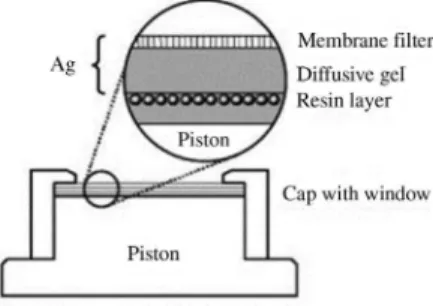
Both diffusive and resin gels were used to assemble the device as shown in Figure 1, placing a resin gel together with a diffusive gel, and over the latter a 0.2 µm cellulose
nitrate membrane filter, in a modified plastic filter holder, so that the surface of the filter exposed to the soil or solution corresponds to a 2 cm diameter circle.
Once the stirring time was over, the devices were disassembled, separating the resin gel, which was washed with Milli-Q water, to be transferred to a previously decontaminated glass tube, to carry out the elution with 1 mol L−1 HNO
3 for 12 h. Copper was quantified in the
eluate (Ce), in the initial (CInicial) and final (CFinal) solutions
by flame atomic absorption spectroscopy (FAAS). The
determination of CDGT was made using equation 2,
considering the used temperature and the elution volume. To obtain a representative result, it was suggested that the devices should not differ by more than 10% between CDGT and Cinitial.19
Preparation of soil and soil treated with biosolid
Agricultural soils near to Rancagua city in the Sixth Region of Chile was used for the study. The soil was collected from a zone with high copper levels15 due to
permanent irrigation with water contaminated by mining activities in the area. Field moisture was determined by the procedure described by Blakemore et al.,20 weighing 30 g of
moist soil, adding water until a homogeneous moist paste that crumbled readily was formed, and the amount of added water was determined by weight difference.21 The biosolid
was obtained from a domestic sewage treatment plant in the city of Santiago (Chile). The soil and the biosolid were physically and chemically characterized by standardized methods.20,22
Extraction of the soil solution was done using two soil:water ratios, 1:2 and 1:10, called S2 and S10, respectively,
in order to cover a wider range of Cu concentrations in solution for DGT test. In both solutions, total copper was quantified by FAAS, and then these solutions were used for deploying DGT.
The soil was treated with 200 t ha−1 of biosolid and
together with the untreated soil, it was moisturized until it reached the field moisture. One part of both substrates was allowed to dry in air, and this was substrate time 0 (not incubated). The remaining substrates were incubated for 130 days in darkness in half open containers at 25 ºC. At the end of that period, the samples were dried in air for the general and DGT analyses.
Determination of free Cu by ISE in soil solution
The concentration of free Cu in soil solution was potentiometrically determined with a Cu (II) ion selective electrode (ISE), using a method of standard additions. This methodology has been used in several studies with complex matrices,23 such as soil solution, to minimize the effect of
ionic strength of the sample on the electrode response. The linear response range of the electrode was established between 0.01 and 9 mg kg−1. The initial reading was made
on 50 mL of each extract (S2 and S10), to which were added
successive 500 mL aliquots of a 4 mg kg−1 Cu solution.
After each addition and an equilibration time, the voltage associated with the free Cu present in the solution was recorded. A linear correlation was established between log
added Cu and the reading in mV. The concentration of free Cu in the soil solution was then determined by extrapolation.
Procedure for simple and sequential extraction, and determination of total Cu in soil
Available copper in the soil, treated and untreated, was estimated by means of four simple extraction procedures, namely 0.01 mol L−1 CaCl
2,24 citric acid, tartaric acid25 and
DTPA (diethylenetriaminepentaacetic acid),26 while the metal
forms were estimated by the European Community Bureau of Reference (BCR) sequential extraction procedure.27 All
the procedures were applied as described by the authors, without any modification.
The sequential extraction procedure consisted of three stages. In the first stage, the water-soluble and exchangeable fraction (HOAc-soluble fraction) was obtained; in the second stage, the forms bound to manganese and iron oxides (reducible fraction) were obtained; and in the third step, organically bound metals and sulfides were extracted (oxidizable fraction). Finally, the difference between the sum of the fractions mentioned above and the total metal was considered as metal occluded in the crystal structures of the primary and secondary minerals (residual fraction). Total metal in the soil was determined by FAAS, after digestion of the samples in a 2:1:1 mixture of HNO3:H2O2:HF in a microwave oven.12,27
Use of DGT device in soil treated and untreated with biosolids and in the soil solution
For the application of the devices to the soil solutions, the DGT devices were placed in contact with 40 mL of each solution (S2 and S10) in duplicate, for 4 h, verifying that
there were no bubbles interfering with the contact between the gel and the solution, slowly stirring the system to avoid the vortex formation.19
After completing the contact time, the resin gel was removed to carry out the elution with 4 mL of 1 mol L-1
HNO3 for a period of 24 h. Finally, the total Cu was
determined in the resulting solution.
To apply the DGT method to the substrates, a suspension was made mixing 20 g of substrate and 15 mL of water. The suspension was stirred for 24 h and the DGT devices were installed, keeping them in contact with the suspension for 24 h at 26 ºC. After completing the contact time, Cu was determined as explained in the preceding paragraph. The analysis was carried out in duplicate because of the small amount of available material and because the relative standard deviations of the preliminary tests were less than 5%.
To estimate the effective concentration (CE), the
procedure of Zhang et al.6 was followed. The calculation
considered the diffusion coefficient (Do), diffusion coefficient in soil (Ds), soil particle concentration (Pc), diffusion layer thickness (∆g) and porosity (j), which
yield parameter Rdiff by means of the DIFS mathematical
computational model.28
The amount of Cu extracted with DGT was correlated with the amount extracted with the different extractants by means of a simple correlation analysis, getting the correlation coefficient and its significance. Data of simple and sequential extraction were subjected one-way analysis of variance, and the mean values of the different treatments were compared with Duncan’s multiple range test at a level of 5%. Analysis was carried out with Statgraphics statistical software, version 4.0 for Windows.
Results and Discussion
Characterization of soil and biosolids
Table 1 shows the general characteristics of the soil and biosolids used in this study. The soil from the Rancagua series is characterized by an almost neutral pH and a sandy loam texture, with an organic matter content of 2.2% and a total Cu content of 1227 mg kg-1. These results are similar
to those reported in other studies with soils from the same zone.14,15 An important part of the Cu (27%) was extracted
with DTPA, a fact that is consistent with an anthropic origin of this metal due to continuous irrigation with water contaminated by mining wastes. Several recent reports indicate that, regardless of the forms of anthropogenic copper, its availability to plants is significantly higher than that of natural origin.2
Copper extracted with DTPA has been considered by several authors26,29 as the fraction (bio)available to crops
in uncontaminated soils. But the use of DTPA in Chilean soils with high Cu content, like those in this study, would release large amounts of the metal that would reach levels that can be toxic to plants (Table 1). However, in the field there is no evidence of this happening to the crops in this area.12,30 This inconsistency between the chemical tests and
the biological response would support the search for more effective indicators to predict the bioavailability of Cu. In this respect, the DGT method would be a complementary tool that should be evaluated.
The amendment used was a biosolid with an organic carbon content of 22%, pH 6.6 and a total copper content of 377 mg kg−1.These biosolids comply with Chilean
Preparation of gels and validation of the DGT devices
The information given by Zhang et al.17 and
Zhang and Davison18 led to the successful preparation
of the DGT devices. The use of 0.3 mm spacers allowed
the gels to reach an average thickness of 0.8 mm after the hydratation and swelling process. The devices were validated for Cu before their use to ensure a response in agreement with that described in the literature.17,18 The
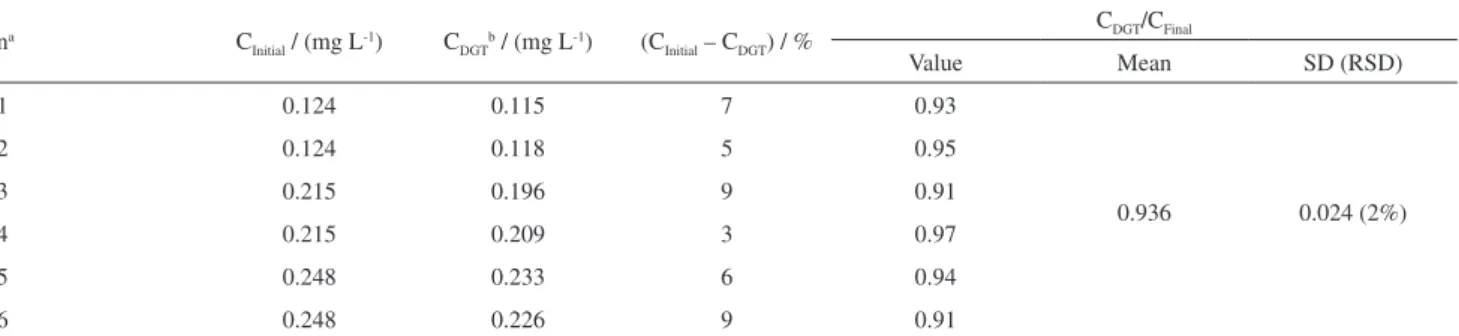
results of the validation of the gels are presented in Table 2. Differences between the concentration determined with the device (CDGT) (equation 2) and the concentration of the
initial solution (Cinitial) were less than 10%. Furthermore, for
each point, the quotient obtained between both parameters had relative standard deviations below 10%, reflecting the reproducibility of the results obtained for the used concentration range. Likewise, a good correlation was found between both parameters with equation 3 (Table 2):
CDGT = 0.0031 + 0.918 CInitial (r = 0.995; p-value < 0.01) (3)
Determinations in soil solution and soil treated with biosolid
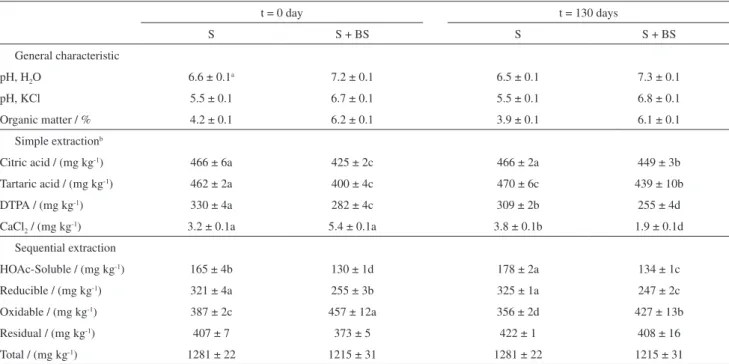
The addition of biosolids to the soil increased the pH significantly, approaching a neutral value, being this effect more evident for the pH determined with KCl (Table 3). Therefore, the biosolids had the capacity to decrease the potential acidity of the soil, regardless of incubation time. Similarly, an increase of about two percentage points in the content of soil organic matter was found, an increase that was maintained until the end of the incubation period. The rise in both parameters was probably due to the high amount of organic matter and alkaline metals added to the soil with the high dose of biosolids.32
The results of the simple extraction of Cu in the incubated soils showed a clear difference between the amount extracted with CaCl2 and that extracted with citric or
tartaric acid or with DTPA. In the former case, an average of 3.5 mg L−1 was extracted, and represents a small fraction of
the exchangeable Cu present in the soils that can be leached by a solution of pH, composition, and concentration similar to that of a soil solution, such as 0.01 mol L−1 CaCl
2.24 In
the second case, the use of complexing agents succeeds
Table 1. Physical and chemical properties of soil and biosolid
Analysis Rancagua soil Biosolid
Coordinates 34°12'29.1" S 70°53'10.8" W
–
UTM 326215 E
6213163 N
Texture sandy loam –
Classification fluventic, haploxerolls (mollisol)
–
pH, H2O 6.70a 6.57
pH, KCl 5.60 6.40
EC / (dS m−1) 0.91 1.7
Organic carbon / % 2.2 22
Organic matter / % 3.8 –
CEC / (cmol+ kg−1) 21 44
Total metal
Cd / (mg kg−1) 2.1 4.7
Cr / (mg kg−1) ndb 260
Cu / (mg kg−1) 1227 377
Mn / (mg kg−1) 910 442
Ni / (mg kg−1) 31 130
Pb / (mg kg−1) nd 66
Zn / (mg kg−1) 185 1214
Ca / (g kg−1) 7.7 42
Fe / (g kg−1) 52 25
Mg / (g kg−1) 0.7 6.8
Available Cu
DTPA / (mg kg−1) 331 –
aAll results in duplicate; bnd: not detected.
Table 2. Validation of results for DGT devices prepared in the laboratory
na C
Initial / (mg L-1) CDGTb / (mg L-1) (CInitial – CDGT) / %
CDGT/CFinal
Value Mean SD (RSD)
1 0.124 0.115 7 0.93
0.936 0.024 (2%)
2 0.124 0.118 5 0.95
3 0.215 0.196 9 0.91
4 0.215 0.209 3 0.97
5 0.248 0.233 6 0.94
6 0.248 0.226 9 0.91
in extracting more than 300 mg L−1 of metal which can
come from exchangeable forms such as metal bonded to carbonate. The amount extracted by complexing agents is frequently associated with the amount of metal available to plants,29 and those agents are widely used due to their ability
to form well defined, stable and water-soluble complexes with metal cations. Considering that low molecular weight organic acids (LMWOA) can represent the process of exudation through the roots, a process that is also simulated by DTPA, it can be stated that the amounts extracted with these agents represent the metal found in a bioaccesible form33 for the plant in the soil of the Rancagua series. This
contains a high Cu concentration due to the use of irrigation water contaminated with metal coming from the mining operations located in that region.12,14 On the other hand,
the application of biosolids always caused a decrease of the Cu extracted with any of the three complexing agents, regardless of incubation time.
Sequential extraction of Cu in the soil indicated that the order of importance of the metal forms was residual > oxidizable > reducible > soluble. This order did not change with incubation time, but the application of biosolids implied a change of the order, which in this case was oxidizable > residual > reducible > soluble. Incubation time caused a slight decrease of the oxidizable form and a slight increase of the residual form of both substrates. Comparison of the distribution of Cu forms in the soil treated and untreated with biosolids, at both incubation
times, shows that the biosolids produce a decrease of soluble Cu and Cu attached to the reducible fraction, as well as an increase of the metal bound to the oxidizable fraction. Such changes can be attributed, in part, to the increased metal binding capacity produced by the large input of organic matter from the biosolids, decreasing the soluble form and increasing the oxidizable form. Likewise, the decrease of Cu bound to Fe and Mn oxides (reducible form) might be due to a greater reducing environment1
generated by the large contribution of organic matter that takes place when biosolids are applied at a rate of 200 t ha−1.
This environment would favor the release of Cu, which would be incorporated in the organic matter, an effect that in this study was observed immediately, with no changes detected after the incubation time.
Application of DGT to soil solution and to soil treated with biosolids
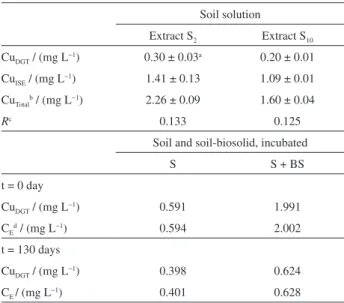
Regardless of the soil:water ratio used for the extraction (S2 or S10), the metal determined by DGT (Table 4)
corresponds to approximately 20% of the free metal determined by specific electrode and to 13% of the total metal present in the soil solution. This result is the opposite of what would be expected if there is free diffusion of the metal toward the resin gel as well as toward the electrode surface. However, the presence of the diffusing gel and of the organic components of the soil solution sets a barrier
Table 3. General characteristics and copper extracted from soil and soil-biosolid incubated for 0 and 130 days
t = 0 day t = 130 days
S S + BS S S + BS
General characteristic
pH, H2O 6.6 ± 0.1a 7.2 ± 0.1 6.5 ± 0.1 7.3 ± 0.1
pH, KCl 5.5 ± 0.1 6.7 ± 0.1 5.5 ± 0.1 6.8 ± 0.1
Organic matter / % 4.2 ± 0.1 6.2 ± 0.1 3.9 ± 0.1 6.1 ± 0.1
Simple extractionb
Citric acid / (mg kg-1) 466 ± 6a 425 ± 2c 466 ± 2a 449 ± 3b
Tartaric acid / (mg kg-1) 462 ± 2a 400 ± 4c 470 ± 6c 439 ± 10b
DTPA / (mg kg-1) 330 ± 4a 282 ± 4c 309 ± 2b 255 ± 4d
CaCl2 / (mg kg-1) 3.2 ± 0.1a 5.4 ± 0.1a 3.8 ± 0.1b 1.9 ± 0.1d
Sequential extraction
HOAc-Soluble / (mg kg-1) 165 ± 4b 130 ± 1d 178 ± 2a 134 ± 1c
Reducible / (mg kg-1) 321 ± 4a 255 ± 3b 325 ± 1a 247 ± 2c
Oxidable / (mg kg-1) 387 ± 2c 457 ± 12a 356 ± 2d 427 ± 13b
Residual / (mg kg-1) 407 ± 7 373 ± 5 422 ± 1 408 ± 16
Total / (mg kg-1) 1281 ± 22 1215 ± 31 1281 ± 22 1215 ± 31
that modifies the diffusion processes of the ion toward the device. This would not exist in the case of measurements with specific electrodes. It must be pointed out that the total metal concentration determined in the soil solution was equal to 97% of the saturation concentration of the resin gel, so it is not possible to attribute the lower value of CuDGT
compared to CuISE to saturation of the resin.
In this respect, it has been shown that Cu can form stronger complexes than other divalent cations, making the metal less available to be taken up by plants.34 On the other
hand, it has been described that biogeochemistry of Cu is controlled mainly by the interaction of the metal with natural organic matter (NOM), with the high affinity of NOM for Cu being more important than the metal abundance and polyfunctionality.35 NOM is composed mostly of humic
substances that can act as important chelating agents for Cu, with the formation of complexes being highly dependent on factors such as pH, ionic strength and competition with other ligands present in the medium.36
Based on the study of Scally et al.,37 our results can
be explained by the lability of the complexes formed between a metal and a ligand that is manifested in the diffusing gel. This, in our case, correspond to complexes formed by Cu and humic substances dissolved in the soil solution. The same authors37 developed an expression that
includes an exponential term that represents the kinetic limitation. The expression relates the amount of metal accumulated by the resin gel with the concentration, the diffusion coefficient of the free metal and the complex, and
the thickness of the diffusing gel. When the complex is partially labile, the measurement by DGT is controlled by the dissociation kinetics of the complex. Under this condition, a small thickness of the diffusion gel, like that used in our experiments, implies in insufficient time for the dissociation of the complex, and therefore its contribution to the measurement obtained by DGT is negligible. In this relation, Zhang et al.6 indicate that the thickness of
the diffusing gel is a factor that controls the path of the complexes formed with Cu (II), since as the thickness increases, the pore size varies, and it is therefore possible for the Cu complexes with the humic substances to pass through this barrier.
On the other hand, Scally et al.10 described changes in
the value of the diffusion coefficient when the size of the ligand changes, with the diffusion coefficient decreasing from 20 to 30% compared to that found for the free metal when ligands such as nitrilotriacetic acid (NTA) or diglycolic acid (DGA) were used, and between 75 and 90% when fulvic or humic acids were used. In the specific case of the formation of Cu-NTA complexes, the same authors37
report that the complex diffuses 14% more slowly than Cu(II), and this can be extrapolated to divalent cations of similar size.
The above information is in agreement with the low value determined for CuDGT in our experiments with soil
solution. Also, the low values of R (Table 4), as indicated by Cattani et al.38 (R = Cu
DGT/Cusol), agree with the values
obtained by the same authors in soils with high Cu content (vineyards). A low value of R would be indicative of slow sorption kinetics (desorption) of copper in soils contaminated with that metal, as well as Cu replenishment from the solid phase to the soil solution.38
Calculation of CE gave a result of the same magnitude
as CuDGT since parameter R had a similar magnitude (0.995)
regardless of biosolid application and incubation time. For that reason, the comparisons were made considering the CuDGT results. Therefore, this parameter in soil treated with
biosolids at time 0 was about four times greater than in untreated soil (Table 4), pointing to higher bioavailability of Cu in this substrate. At time 130 days, the same trend exists, but the difference becomes smaller.
The comparison of the incubation times for each treatment shows a decrease of CuDGT with the natural
aging of the soil, an effect that was more noticeable in soil treated with biosolid. At time 0, these results would be in agreement with a greater availability of labile Cu species contributed directly by the biosolid or by the solubilization of Cu from the soil due to the increased dissolved organic matter (DOM) contributed by the biosolid. After the incubation time, CuDGT drops noticeably, in agreement
Table 4. Determinations in soil solution and soil treated and untreated with biosolids and incubated
Soil solution
Extract S2 Extract S10 CuDGT / (mg L−1) 0.30 ± 0.03a 0.20 ± 0.01 CuISE / (mg L−1) 1.41 ± 0.13 1.09 ± 0.01
CuTotalb / (mg L−1) 2.26 ± 0.09 1.60 ± 0.04
Rc 0.133 0.125
Soil and soil-biosolid, incubated
S S + BS
t = 0 day
CuDGT / (mg L−1) 0.591 1.991
CEd / (mg L−1) 0.594 2.002
t = 130 days
CuDGT / (mg L−1) 0.398 0.624
CE / (mg L−1) 0.401 0.628
astandard deviation (n = 3); btotal Cu in solution, cR = Cu
with the lower availability observed with DTPA and CaCl2, corresponding to a stabilization of the fixation of
Cu on the organic matter supplied by the biosolid. In that respect, some works have described DOM provided by the biosolids as favoring both the mobility of Cu and its retention in the soil.39,40
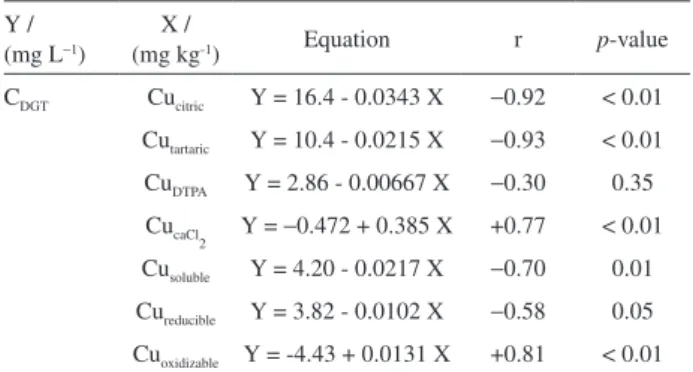
The CuDGT results were used to evaluate the correlation
with Cu forms obtained by simple and sequential extraction of soil (Table 5). Among the extractants, CaCl2 reflected
more closely the relation between CuDGT and available Cu
estimated by a chemical agent since a direct correlation between them was found (r = –0.77). This is in agreement with the diffusion process of Cu toward DGT from the soil solution of Cu linked weakly with the solid phase of the substrate. On the contrary, citric and tartaric acids correlate inversely, and DTPA did not correlate probably because those extractants can extract Cu from different less labile forms in the solid phase.14
As to the Cu forms estimated by sequential extraction, a direct relation was obtained only between CuDGT and Cu
linked with organic matter (r = 0.81) (Table 5). This result can be explained by the fact that Cu can interact with functional groups of the organic matter with interaction forces of variable magnitude, involving weaker or stronger attraction depending on the predominant functional group. If it is also considered that Cu easily tends to form complexes with organic matter and that the biosolid contributes a large amount of organic matter, there would be a substantial fraction of Cu bound weakly with organic matter that may control the replenishment of Cu in the soil solution.38
There are several studies linking DGT devices with the availability of copper, among these, a study by Scally et al.37 attempts to relate the Cu determined by
DGT with metal absorbed by corn plants. The authors37
conclude that this technique does not allow predicting bioavailability of copper in the metal-tolerant plants since
the values determined in the aerial part do not correlate with the concentration determined by DGT. This happens mainly because of the physicochemical changes produced by plants, which interfere with the bioavailable metal content. On the other hand, it has been shown that DGT is a useful tool for the prediction of copper content in soil, where the bioavailability of copper depends on its speciation and its interaction with other existing ions.41
In the specific case of the determination of metallic species in mine tailings, Conesa et al.42 showed that the
competition between the metals present in the resin is an important factor in the estimation of available metal, but the thickness of the gel was not significant. In our study, no high levels of other elements were detected that could lead to the assumption of competition between Cu and other divalent cations in the resin of DGT.
The studies mentioned above show that the results obtained from diffusion gradient in thin films present great variability, depending on the different scenarios in which it has been applied. This raises the need to evaluate a greater number of parameters that can influence the estimation of bioavailable copper. In this sense, the results of this study are a contribution because it applies the technique to a soil with high copper content of both natural and anthropogenic origin.
Conclusions
The bioavailability of Cu in soils with high levels of the metal, which have also been treated with biosolids, can be addressed through the application of DGT devices. In this sense, the preparation of the diffusive and resin gels in the lab as well as the assembly of a device to support the gels is possible. It can therefore be stated that the amount of copper extracted by the DGT devices applied to soil solution, for a time frequently described in the literature, corresponds to a small fraction of the total metal, in this case 13% of the total metal present in the soil solution. In the case of soil, this amount was less than 0.3%. Furthermore, it was possible to relate directly the metal extracted by DGT with the metal available with CaCl2 or the metal bound to the
organic matter estimated by sequential extraction. It can therefore be concluded that DGT devices as well as of sequential extraction methods are reliable tools to evaluate the concentration of available Cu in soils contaminated with this metal.
Acknowledgements
This study was supported by FONDECYT under Project 1080632.
Table 5. Simple correlation between available CuDGT and Cu obtained by simple or sequential extraction
Y / (mg L−1)
X /
(mg kg-1) Equation r p-value CDGT Cucitric Y = 16.4 - 0.0343 X −0.92 < 0.01
References
1. Sposito, G.; The Chemistry of Soils, 2nd ed.; Oxford University
Press Inc.: New York, USA, 2008.
2. Kabata-Pendias, A.; Mukherjee, A.; Trace Elements from Soil
to Human; Springer-Verlag: Berlin, Heidelberg, 2007. 3. Nolan, A.; Zhang, H.; McLaughlin, M.; J. Environ. Qual.2005,
34, 496.
4. Wallner-Kersanach, M.; de Andrade, C.; Zhang, H.; Milani, M.; Niencheski, L.; J. Braz. Chem. Soc.2009, 20, 333.
5. Dahlqvist, R.; Zhang, H.; Ingri, J.; Davison, W.; Anal. Chim.
Acta2002, 460, 247.
6. Zhang, H.; Zhao, F.; Sun, B.; Davison, W.; McGrath, S.; Environ.
Sci. Technol.2001, 35, 2602.
7. Almas, A.; Lombnaes, P.; Sogn, T.; Mulder, J.; Chemosphere
2006, 62, 1647.
8. Fischerová, Z.; Száková, J.; Pavlíková, D.; Tlustoš, P.; Plant
Soil Environ.2005, 51, 532.
9. Pichette, C.; Zhang, H.; Sauvé, S.; Aquaculture2009, 286, 198. 10. Scally, S.; Davison, W.; Zhang, H.; Anal. Chim. Acta2006, 558,
222.
11. Epstein, E.; Land Application of Sewage Sludge and Biosolids; CRC Press: Boca Raton, USA, 2003.
12. Mendoza, J.; Garrido, T.; Castillo, G.; San Martin, N.;
Chemosphere2006, 65, 2304.
13. Mirlean, N.; Baisch, P.; Medeanic, S.; Bull. Environ. Contam. Toxicol.2009, 82, 373.
14. Garrido, T.; Mendoza, J.; Arriagada, F.; J. Environ. Sci.2012,
24, 912.
15. Kelm, U.; Helle, S.; Matthies, R.; Morales, A.; Environ. Geol. 2009, 57, 365.
16. Buzier, R.; Tusseau-Vuillemin, M.; Mouchel, J.; Sci. Total Environ. 2006, 358, 277.
17. Zhang, H.; Davison, W.; Knight, B.; McGrath, S.; Environ. Sci. Technol. 1998, 32, 704.
18. Zhang, H.; Davison, W.; Anal. Chem. 1995, 67, 3391. 19. http://www.dgtresearch.com/dgtresearch/dgtresearch.pdf
accessed in January 2013.
20. Blakemore, L.; Searle, P.; Daly, B.; New Zealand Bureau
Scientific Report No. 80; NZ Soil Bureau: Lower Hutt, New Zealand, 1987.
21. Sadzawka, A.; Carrasco, M.; Grez, R.; Mora, M.; Rojas, C.; Saavedra, N.; Métodos de Análisis Recomendados para Suelos
Chilenos; Sociedad Chilena de la Ciencia del Suelo: Santiago, Chile, 2000.
22. Page, A.; Miller, R.; Keenes, D.; Methods of Soil Analysis,
Part 2, Agronomy 9; American Society of Agronomy: Madison, USA, 1982.
23. Kraal, P.; Jansen, B.; Nierop, K.; Verstraten, J.; Chemosphere 2006, 65, 2193.
24. Houba, V.; Lexmond, Th.; Novozamsky, I.; Van der Lee, J.; Sci. Total Environ. 1996, 178, 21.
25. Wuana, R.; Okieimen, F.; Imborvungu, J.; Int. J. Environ. Sci. Technol.2010, 7, 485.
26. Lindsay, W.; Norvell, W.; Soil Sci. Soc. Am. J.1978, 42, 421. 27. Luo, Y.; Christie, M.; J. Environ. Anal. Chem.1998, 72, 59. 28. http://www.es.lancs.ac.uk/wdgroup/difs.htm, accessed January
2013.
29. Feng, M.; Shan, X.; Zhang, S.; Wen, B.; Environ. Pollut.2005,
137, 231.
30. González, I.; Muena, V.; Cisternas, M.; Neaman, A.; Rev. Chil. Hist. Nat.2008, 81, 279.
31. Ministerio Secretaría General de la Presidencia; Reglamento para el Manejo de Lodos Generados en Plantas de Tratamiento
de Aguas Servidas, DS-004, Diario Oficial de la República de Chile, Clile, 2009.
32. Manh, N.; Quang, P.; Cong, N.; Petter, J.; Öborn, I.; VNUJ. Sci. Earth Sci. 2008, 24, 202.
33. Semple, T.; Doick, K.; Jones, K.; Burauel, P.; Craven, A.; Harms, H.; Environ. Sci. Technol.2004, 38, 228A.
34. Pandley, A.; Pandley, S.; Misral, V.; Ecotoxicol. Environ. Saf. 2000, 47, 195.
35. Manceau, A.; Matynia, A.; Geochim. Cosmochim. Acta2010,
74, 2556.
36. Oden, W.; Amy, G.; Conkline, M.; Environ. Scil. Technol.1993,
27, 1045.
37. Scally, S.; Davison, W.; Zhang, H.; Environ. Sci. Technol.2003,
37, 1379.
38. Cattani, I.; Fragoulis, G.; Boccelli, R.; Capri, E.; Chemosphere 2006, 64, 1972.
39. Ashworth, D.; Alloway, B.; Environ. Pollut.2004, 127, 137. 40. Vaca-Paulin, R.; Esteller-Alberich, M.; Lugo de la Fuente, J.;
Zavaleta-Mancera, H.; Waste Manage.2006, 26, 71.
41. Zhao, F.; Rooney, C.; Zhang, H.; McGrath, S.; Environ. Toxicol.
Chem. 2006, 25, 733.
42. Conesa, H.; Schulin, R.; Nowack, B.; Environ. Sci. Pollut. Res.
Int.2010, 17, 657.
Submitted: February 15, 2013