Fonoaudiologia Baseada
em Evidências
Ana Cristina Coelho
1Alcione Ghedini Brasolotto
2Maria Cecília Bevilacqua
2Descritores
Voz Qualidade da voz Distúrbios da voz Transtornos da audição Implante coclear
Keywords
Voice Voice quality Voice disorders Hearing disorders Cochlear implantation
Correspondence address:
Ana Cristina Coelho
Faculdade de Odontologia de Bauru, Clínica de Fonoaudiologia
Al. Dr. Octávio Pinheiro Brisolla, 09/75, Vl. Altinópolis, Bauru (SP), Brasil, CEP: 17012-901.
E-mail: [email protected]
Received: 3/5/2012
Accepted: 7/17/2012
Study performed at the Graduate Program in Speech-Language Pathology and Audiology, Bauru School of Dentistry, Universidade de São Paulo – USP – Bauru (SP), Brazil.
(1) Graduate Program (Master’s degree) in Speech-Language Pathology and Audiology, Bauru School of Dentistry, Universidade de São Paulo – USP – Bauru (SP), Brazil.
(2) Department of Speech-Language Pathology and Audiology, Bauru School of Dentistry, Universidade de São Paulo – USP – Bauru (SP), Brazil.
Conflict of interests: None
on voice production
Análise sistemática dos benefícios do uso do implante
coclear na produção vocal
ABSTRACT
Purpose: To perform a systematic analysis of the research regarding vocal characteristics of hearing impaired children or adults with cochlear implants. Research strategy: A literature search was conducted in the data-bases Web of Science,Bireme, and Universidade de São Paulo’s and CAPES’ thesis and dissertations databases using the keywords voice, voice quality, and cochlear implantation, and their respective correspondents in Brazilian Portuguese. Selection criteria: The selection criteria included: title consistent with the purpose of this review; participants necessarily being children or adults with severe to profound pre-lingual or post-lingual hearing loss using cochlear implants; and data regarding participants’ performance on perception and/or acous-tic analysis of the voice. Results: Twenty seven papers were classified according to the levels of evidence and quality indicators recommended by the American Speech-Language-Hearing Association (ASHA). The designs of the studies were considered of low and medium levels of evidence. Six papers were classified as IIb, 20 as III, and one as IV. Conclusion: The voice of hearing impaired children and adults with cochlear implants has been little studied. There is not an effective number of studies with high evidence levels which precisely show the effects of the cochlear implantation on the quality of voice of these individuals.
RESUMO
INTRODUCTION
The main focus of the speech-language pathologist’s work
with individuals who are deaf and hard of hearing does not
always include voice production. However, the vocal alteration
can represent a very negative impact, interfering on speech
intelligibility and decisively compromising social integration
(1).
The cochlear implant (CI) provides global benefits on
hea-ring perception, and consequently on expressive and receptive
language, including improved vocal quality. It results on the
optimization of speech perception, and therefore on the verbal
communication of its users. Hence, the CI is known to be one
of the most promising and effective technologies to remedy
hearing loss
(2,3).
Extensive literature shows that the cochlear implant, in
addition to all the hearing benefits, brings also great advantages
for voice production. The most reported findings are improved
noise and perturbation measures
(4-7), phonatory control
(4-7),
fundamental frequency
(5,8), roughness and strain
(9), and pitch
(10).
However, some studies did not find significant changes on
the voice production of individuals who are deaf and hard of
hearing and use cochlear implants
(11-13).
A literature review directed to the methodological aspects
of these papers may help to understand these results, and serve
as a guideline to what needs to be better explored. The present
investigation is a systematic review, which consists on the
ap-plication of scientific strategies that aim the critical evaluation
and synthesis of a large number of studies on a given topic. Its
relevance is the ability to condense and summarize results of
several studies, producing different quantitative and qualitative
indicators on the topic researched
(14-16).
OBJECTIVE
The purpose of this study was to perform a systematic
review of researches related to the vocal characteristics of
children and adults who are deaf or hard of hearing and use
cochlear implants.
RESEARCH STRATEGY
To perform this systematic review, we followed the concepts
of the online course promoted by the Brazilian Cochrane Center
and by the Laboratory of Distance Learning – LED-DIS of the
Department of Health Informatics of Universidade Federal
de São Paulo/Escola Paulista de Medicina, available at http://
www.virtual.epm.br/cursos/valida.php. The literature review
was based on the question “What are the effects of cochlear
implants on the voice of individuals who use this device?”
To search for studies, we used three key-words from the
Health Science Descriptors (DeCS) and four key-words from
the Medical Subject Heading Terms (MeSH). The DeCS terms
used were “
voz”
(voice), “
qualidade da voz”
(quality of voice)
and “
implante coclear”
(cochlear implant). The MeSH terms
were “voice”, “voice quality”, “cochlear implant” and “cochlear
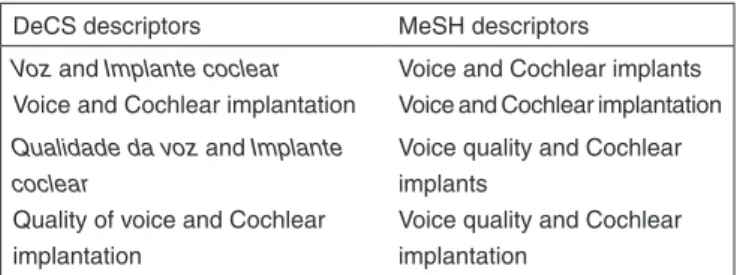
implantation”. We used different combinations of these terms
(Chart 1), with the connector “AND”.
The bibliographic research (Table 1) was performed in the
databases Web of Science (www.isiknowledge.com); Bireme
– Virtual Health Library - BVS (www.bireme.br), comprising
the databases LILACS, MEDLINE, Cochrane Library, SciELO
and IBECS; Digital library of theses and dissertations of the
Universidade de
São Paulo (http://www.teses.usp.br/); and
CAPES’s digital library of theses and dissertations (www.
capes.gov.br/servicos/banco-de-teses). There was no restriction
regarding the publication year.
SELECTION CRITERIA
A pre-selection of all the publications/studies whose title
seemed to be related to the question proposed in this
systema-tic review was performed. To be analyzed, the study should
Table 1. Number of publications found per database according to the descriptor
Descriptors
BVS (Lilacs, Medline, SciELO, Cochrane Library,
IBECS)
Web of Science
USP Database
CAPES
Database Total
Voz and Implante coclear 35 - 2 0 37
Qualidade da voz and Implante coclear 19 - 0 0 19
Quality of voice and Cochlear implantation 42 - 0 0 42
Voice and Cochlear implantation 76 605 0 0 681
Voice quality and Cochlear implantation - 362 - - 362
Voice and Cochlear implants - 964 - - 964
Voice quality and Cochlear implants - 566 - - 566
Chart 1. Combination of the DeCS and MeSH descriptors used in the bibliographic search
DeCS descriptors MeSH descriptors
Voz and Implante coclear Voice and Cochlear implantation
Voice and Cochlear implants Voice and Cochlear implantation
Qualidade da voz and Implante coclear
Quality of voice and Cochlear implantation
Voice quality and Cochlear implants
necessarily include children or adults with severe to profound
hearing loss, pre- or post-lingual, using cochlear implants.
Another selection criterion was the performance of
auditory--perceptual and/or acoustic analysis of the voice of the CI users.
We excluded duplicated publications (85), publications
whose full texts were not found (13), whose language was not
Portuguese or English (15) and whose content did not
corres-pond to the purpose of this review (2354). At the end of the
search, 27 relevant publications remained for the systematic
review, which included a letter to the editor and two master’s
thesis. The others referred to published studies, 2 performed
in Brazil and 22 in other countries.
DATA ANALYSIS
All the publications were analyzed and classified following
the levels of evidence employed by ASHA in 2004, adapted
from the Scottish Intercollegiate Guideline (Chart 2). Moreover,
the studies were analyzed based on a proposal
(16,17)of eight
quality indicators to evaluate studies, which include: the study
design, blinding, sampling/allocation, group/participant
compa-rability, outcomes, significance, precision and intention to treat.
RESULTS
Regarding the levels of evidence, six studies were classified
as IIb, 20 as III, and 1 as IV. The designs of the studies found
were considered of good and lower scientific levels, although
it is important to consider that non-experimental studies have
great value for understanding a certain subject.
Regarding the quality indicators, 23% of the studies are
quasi-experimental and 77% are non-experimental; 66.67%
present groups that are comparable and adequately described;
70.78% present valid and reliable outcomes; in 85%, the
con-fidence interval is calculable and the p-value is reported; there
are evidence of randomization and blinded assessors in 29.62%
of the publications. The intention to treat
(6,7)was not considered,
since this indicator applies only for controlled trials.
The heterogeneity of the methods used in the studies makes
it difficult to understand how the use of cochlear implants can
benefit the vocal quality of individuals who are deaf and hard
of hearing. The results of the studies are diverse and often
controversial (Chart 4). In many cases, the importance of
un-derstanding the voice of the individual with a CI is not clear.
Although all the studies unanimously report that the use of
the CI provide some benefit for voice production, the reports
of these benefits are inconsistent. Factors such as the
advan-tages provided by the CI for voice production, improving oral
communication and how these advantages can help in a
the-rapeutic process, or even how they can be considered as one
of the many criteria to decide which device will be used, are
not well described.
Chart 2. Levels of evidence (ASHA, 2004)
Level Description
Ia Well-designed meta-analysis of more than one randomized controlled trial
Ib Well-designed randomized controlled study
IIa Well-designed controlled study without randomization
IIb Well-designed quasi-experimental study
III Well-designed non-experimental studies, i.e., correlational and case studies
IV Expert committee report, consensus conference, clinical experience of respected authorities
Chart 3. List of the studies by title, authors, year, description and level of evidence
Title Authors Year Description LE
Clarion cochlear implant: short-term effects on voice parameters
Monini, Banci, Barbara, Argiro and
Filipo(18) 1997 Non-experimental study III
Effect of cochlear implantation on nasality in post-lingually deafened adults
Langereis, Dejonckere, van Olphen and
Smoorenburg(19) 1997 Non-experimental study III
Effect of cochlear implantation on voice fundamental frequency in post-lingually deafened adults
Langereis, Bosman, van Olphen and
Smoorenburg(20) 1998 Non-experimental study III
Evaluation of cochlear implanted children’s voices Perrin, Berger-Vachon, Topouzkhanian,
Truy and Morgon(21) 1999 Non-experimental study III
A case study of the speech, language and vocal skills of a set of monozygous twin girls: one twin with a cochlear implant
Bell, Hickson, Woodyatt and Dornan(22) 2001 Non-experimental study III
Changes of voice and articulation in children with cochlear implants
Seifert, Oswald, Bruns, Vischer,
Kompis and Haeusler(23) 2002 Non-experimental study III
Changes in vowel quality after cochlear implantation Schenk, Baumgartner and Hamzavi(24) 2003 Non-experimental study III
Comparison of overall intelligibility, articulation, resonance and voice characteristics between children using cochlear implants and those using bilateral hearing AIDS: a pilot study
Van Lierde, Vinck, Baudonck,
De Vel and Dhooge(25) 2005
Quasi-experimental
Chart 3. continuation
We noticed predominant use of Kay Elemetrics’ softwares
(48.14%) in case of acoustic analysis of the voice signal as
a part of the methodology. Eight studies (29.62%) involved
auditory-perceptual evaluation of the voice, all with evidence
of randomized samples and blinded raters. One study
consi-dered the different types of cochlear implants in the evaluated
population.
CONCLUSION
With this review, it was possible to observe that the quality
of voice of children and adults who are deaf and hard of hearing
and use cochlear implants has been studied on a small scale.
There is not an effective number of studies with high levels of
evidence that demonstrate precisely the effects of the cochlear
Title Authors Year Description LE
Acoustic analysis of the voice in pediatric cochlear implant recipients: a longitudinal study
Campisi, Low, Papsin, Mount R,
Cohen-Kerem and Harrison(5) 2005 Non-experimental study III
The influence of cochlear implantation on some voice parameters
Hocevar-Boltezar, Vatovec, Gros and
Zargi(4) 2005 Non-experimental study III
Acoustic and perceptual appraisal of speech
production in pediatric cochlear implant users Poissant, Peters and Robb
(11) 2006 Non-experimental study III
Change of phonation control after cochlear implantation
Hocevar-Boltezar, Radsel, Vatovec, Geczy, Cernelc, Gros, Zupancic, Battelino, Lavrencak and Zargi(26)
2006 Quasi-experimental
study III
Multidimensional voice program analysis in profoundly deaf children: quantifying frequency and amplitude control
Campisi, Low, Papsin, Mount and
Harrison(10) 2006 Non-experimental study III
Voice and pronunciation of cochlear implant speakers Horga and Liker(9) 2006 Non-experimental study III
Voice analysis in pediatric cochlear implant recipients Campisi(27) 2006 Clinical experience of
respected authorities IV
Prosody and voice characteristics of children with
cochlear implants Lenden and Flipsen Jr
(28) 2007 Non-experimental study III
Acoustic voice analysis of prelingually deaf adults
before and after cochlear implantation Evans and Deliyski
(8) 2007 Non-experimental study III
Relationship between voice and speech perception in children with cochlear implants
Coelho, Bevilacqua, Oliveira and
Behlau(1) 2009 Non-experimental study III
Vocal singing by prelingually-deafened children with
cochlear implants Xu, Zhou, Chen, Li, Scultz and Zhao
(29) 2009 Non-experimental study III
Acoustic analysis of voice in cochlear implant recipients with post-meningitic hearing loss
Allegro, Papsin, Harrinson and
Campisi(30) 2009 Non-experimental study III
Abnormal voicing in children using cochlear implants Holler, Campisi, Allegro and Chadha(31) 2010 Non-experimental study III
The influence of the auditory prosthesis type on deaf
children’s voice quality Valero, Rovira and Sanvicens
(12) 2010 Quasi-experimental
study IIb
Voice analysis of deaf before and after cochlear
implantation Ubrig-Zancanella
(6) 2010 Quasi-experimental
study IIb
Objective vocal quality in children using cochlear implants: a multiparameter approach
Baudonk, D’haeseller; Dhooge and Van
Lierde(13) 2011
Quasi-experimental
study IIb
Voice analysis of postlingually deaf adults pre- and postcochlear implantation
Ubrig, Goffi-Gomez; Weber; Menezes
and Nmer(7) 2011
Quasi-experimental
study IIb
Classification of voice disorder in children with cochlear implantation and hearing aid using multiple classifier fusion
Mahmoudi, Rahati, Ghasemi Asadpour
and Tayarani(32) 2011 Non-experimental study III
Effect of different speech processors coding strategies
on the voice of children with cochlear implants Coelho
(33) 2011 Quasi-experimental
study IIb
Chart 4. List of the publications by title, population, objectives and outcomes
Title Population Objectives Outcomes
Clarion cochlear implant: short-term effects on voice parameters(18)
6 adults and 3 children with CI
Evaluate the phonatory control immediately after the activation of Clarion implants
The participants showed a lowering of voice intonation, a better control of voice intensity and a reduction of the nasal quality
Effect of cochlear implantation on nasality in
postlingually deafened adults(19) 21 adults with CI
Access the nasality before the CI and after 3 and 12 months of use
The use of CI significantly improved nasality
Effect of cochlear implantation on voice fundamental frequency in post-lingually deafened adults(20)
20 adults with CI
Evaluate the fundamental frequency before, 3 months and 12 months after implantation
Mostly, the F0 values were reduced, reaching
normative ranges. However, the authors found large interindividual variability
Evaluation of cochlear implanted children’s voices(21)
4 children with CI and 4 normal hearing children
Compare the voice of CI children with the voice of corresponding normal children
The authors found differences only on vowel duration
A case study of the speech, language and vocal skills of a set of monozygous twin girls: one twin with a cochlear implant(22)
1 child with CI and 1 normal hearing child
Compare the communication skills of a set of monozygous twins: one with CI and the other with normal hearing
The analysis of the voice of the implanted twin indicated abnormalities in all the acoustic and perceptual parameters in comparison to the other
Changes of voice and articulation in children with cochlear implants(23)
20 children with CI
Investigate the fundamental frequency and formants of children with CI in comparison to normal hearing children
The authors found that the children who received a CI before their fourth birthday attain better acoustic control of speech, with normal F0 and improved vowel articulation
Changes in vowel quality after cochlear
implantation(24) 10 adults with CI
Investigate F0 and formants of
adults using CI
The authors found improvement of the parameters after 3 and 12 months of implantation
Comparison of the overall intelligibility, a r t i c u l a t i o n , r e s o n a n c e a n d vo i c e characteristics between children using cochlear implants and those using bilateral hearing AIDS: a pilot study(25)
9 children with CI and 6 children with hearing aids
C o m p a r e t h e o r a l communication of children with CI and conventional hearing aids
The authors found differences only in the articulation, which is better for users of CI
Acoustic analysis of the voice in pediatric cochlear implant recipients: a longitudinal study(5)
21 children with CI
Evaluate acoustic features of children with CI
The authors did not find differences on the F0 and on the control of frequency, however the control of amplitude was restored
The influence of cochlear implantation on some voice parameters(4)
31 children with CI
Investigate changes in some voice parameters after cochlear implantation
The F0 did not change significantly. However,
jitter and shimmer improved as early as 6 months after the implantation and the noise-to-harmonic ration improved 2 years after the implantation in children who had received the CI before reaching four years of age
Acoustic and perceptual appraisal of speech production in pediatric cochlear implant users(11)
6 children with CI
Examine chances in voice p r o d u c t i o n i m m e d i a t e l y following a disruption in auditory feedback provided by the CI
The authors observed changes in the F0,
formants and vowel articulation, which are better with the implant on
Change of phonation control after cochlear implantation(26)
29 children and 11 adults with CI
Access the influence of the use of CI on some voice parameters
The parameters analyzed were significantly more deviated in children, however they presented greater improvement of these parameters then the adults after using the implant
Multidimensional voice program analysis in profoundly deaf children: quantifying frequency and amplitude control(10)
21 children and teenagers with CI
Characterize the vocal profile of children with CI from an acoustic point of view
Chart 4. continuation
Title Population Objectives Outcomes
Voice and pronunciation of cochlear implant speakers(9)
10 children with hearing aids, 10 children with CI and 10 normal hearing children
Compare vocal features of normal hearing children with users of CI and conventional hearing aids
The vocal features of the CI users were closer to the normal hearing children’s, mainly regarding asthenia and breathiness
Voice analysis in pediatric cochlear implant
recipients(27) - -
-Prosody and voice characteristics of children
with cochlear implants(28) 6 children with CI
Describe vocal and prosodic characteristics of children with CI
The authors found alterations in speech rate, intonation, loudness and resonance
Acoustic voice analysis of prelingually deaf adults before and after cochlear implantation(8)
3 adults with CI and 3 normal hearing adults
E x p l o r e c h a n g e s o f voice and speech pre and postimplantation over 6 months
There was great variability among the participants, but the most striking features were reduction of the f0 and better resonance
Relationship between voice and speech perception in children with cochlear implants(1)
25 children with CI
To relate the speech perception a b i l i t i e s w i t h t h e v o c a l characteristics of children with CI
The authors found that the better the speech recognition, the better frequency control, intensity, overall severity and resonance
Vocal singing by prelingually-deafened children with cochlear implants(29)
7 children with CI and 14 normal hearing children
Evaluate the vocal control of children with CI during singing i n c o m p a r i s o n t o n o r m a l hearing children
The children with CI did not have difficulties with rhythm, but presented poor control of the frequency
Acoustic analysis of voice in cochlear implant recipients with post-meningitic hearing loss(30)
10 children with CI
Investigate the relationship between duration of auditory deprivation and the control of voice production in post-menigitic children
The long-term control of frequency was within normal limits for subjects with a period of auditory deprivation of less than four months. Measures of long-term amplitude was normal for all participants, except those with cochlear ossification
Abnormal voicing in children using cochlear implants(31)
27 children with bilateral CI
M e a s u r e a c o u s t i c v o i c e outcomes in children with bilateral CI and to compare these with established norms
The children presented poor control of long-term amplitude and long-long-term frequency perturbation
The influence of the auditory prosthesis type on deaf children’s voice quality(12)
54 normal hearing children,
35 with hearing aids and 35 with
CI
Compare the vocal quality of children with CI, hearing aids and normal hearing
The groups with hearing impair ment presented altered values of F0 and shimmer. The group with digital hearing aids presented better values of F0, jitter and shimmer in relation to the group with analogue hearing aids and the group with CI
Voice analysis of deaf before and after cochlear implantation(6)
40 adults with CI and 12 with hearing aids
Verify if there are changes in vocal parameters after cochlear implantation, without specific vocal rehabilitation
The authors found statistically significant reduction in overall severity, strain, loudness, instability, F0 and F0 variability. The hearing aid users showed no statistically significant changes in most of the parameters
Objective vocal quality in children using cochlear implants: a multiparameter approach(13)
36 children with CI, 25 with hearing aids and
25 with normal hearing
D e t e r m i n e t h e o b j e c t i ve vocal quality in users of CI and compare it with hearing aid users and normal hearing children
The authors found dysphonia severity index close to normality in CI users. The children with CI presented mild roughness, strain, high pitch and increased loudness in comparison to the normal hearing children. No differences were found regarding the acoustic measures between the groups
Voice analysis of postlingually deaf adults pre- and postcochlear implantation(7)
40 adults with CI and 12 with hearing aids
Longitudinally investigate whether the use of CI changes p e r c e p t u a l a n d a c o u s t i c parameters in adults, comparing them with users of hearing aids
Chart 4. continuation
implant on the quality of voice of children and adults who are
deaf and hard of hearing.
To improve the quality of the studies regarding scientific
evidence, the studies must be carefully designed, with a
signi-ficant number of participants, according the possibilities of the
centers in which they are performed. Moreover, a methodology
based on the quality indicators proposed by ASHA should be
adopted in future studies about the theme.
AKLOWLEDGEMENTS
The authors would like to thank the São Paulo Research
Foundation (FAPESP), for the financial support, process n
o.
2008/07948-1.
REFERENCES
1. Coelho AC, Bevilacqua MC, Oliveira G, Behlau M. Relationship between voice and speech perception in children with cochlear implants. Pró-Fono. 2009;21(1):7-12.
2. Danieli F. Reconhecimento de fala com e sem ruído competitivo em crianças usuárias de implante coclear utilizando dois diferentes processadores de fala [dissertação]. São Carlos: EESC/FMRP/IQSC; 2010.
3. Angelo, TC, Bevilacqua MC, Moret, AL. Percepção da fala em deficientes auditivos pré-linguais usuários de implante coclear. Pró-Fono. 2010;22(3):275-80.
4. Hocevar-Boltezar I, Vatovec J, Gros A, Zargi M. The influence of cochlear implantation on some voice parameters. Int J Pediatr Otorhinolaryngol. 2005;69(12):1635-40.
5. Campisi P, Low A, Papsin B, Mount R, Cohen-Kerem R, Harrison R. Acoustic analysis of the voice in pediatric cochlear implant recipients: a longitudinal study. Laryngoscope. 2005;115(6):1046-50.
6. Ubrig-Zancanella, MT. Análise da voz de deficientes auditivos pré e pós uso de implante coclear [dissertação]. São Paulo: Faculdade de Medicina da Universidade de São Paulo; 2010.
7. Ubrig MT, Goffi-Gomez MV, Weber R, Menezes MH, Nemr NK, Tsuji DH, et al. Voice analysis of postlingually deaf adults pre- and postcochlear implantation. J Voice. 2011;25(6):692-9.
8. Evans MK, Deliyski DD. Acoustic voice analysis of prelingually deaf adults before and after cochlear implantation. J Voice. 2007;21(6):669-82. 9. Horga D, Liker M. Voice and pronunciation of cochlear implant speakers.
Clin Linguist Phon. 2006;20(2-3):211-7.
10. Campisi P, Low AJ, Papsin BC, Mount RJ, Harrison RV. Multidimensional voice program analysis in profoundly deaf children: quantifying frequency and amplitude control. Percept Mot Skills. 2006;103(1):40-50.
11. Poissant SF, Peters KA, Robb MP. Acoustic and perceptual appraisal of speech production in pediatric cochlear implant users. Int J Pediatr Otorhinolaryngol. 2006;70(7):1195-203.
12. Valero Garcia J, Rovira JM, Sanvicens LG. The influence of the auditory prosthesis type on deaf children’s voice quality. Int J Pediatr Otorhinolaryngol. 2010;74(8):843-8.
13. Baudonck N, D’haeseleer E, Dhooge I, Van Lierde K. Objective vocal quality in children using cochlear implants: a multiparameter approach. J Voice. 2011;25(6):683-91.
14. Luna Filho B. A ciência e a arte de ler artigos médicos. São Paulo: Atheneu; 2010.
15. Andrade CR, Juste FS. Systematic review of delayed auditory feedback effectiveness for stuttering reduction. J Soc Bras Fonoaudiol. 2011;23(2):187-91.
16. Frymark T, Schooling T, Mullen R, Wheeler-Hegland K, Ashford J, McCabe D, et al. Evidence-based systematic review: oropharyngeal dysphagia behavioral treatments. Part I – Background and methodology. J Rehabil Res Dev. 2009;46(2):175-83.
17. Mullen R. The state of the evidence: ASHA develops levels of evidence for communication sciences and disorders. 6 de março de 2007. The ASHA Leader, pp. 8-9, 24-25. Disponível em: http://www.asha.org/ Publications/leader/2007/070306/f070306b.htm
18. Monini S, Banci G, Barbara M, Argiro MT, Filipo R. Clarion cochlear implant: short-term effects on voice parameters. Am J Otol. 1997;18(6):719-25.
19. Langereis MC, Dejonckere PH, van Olphen AF, Smoorenburg GF. Effect of cochlear implantation on nasality in post-lingually deafened adults. Folia Phoniatr Logop. 1997;49(6):308-14.
20. Langereis MC, Bosman AJ, van Olphen AF, Smoorenburg GF. Effect of cochlear implantation on voice fundamental frequency in post-lingually deafened adults. Audiology. 1998;37(4):219-30.
21. Perrin E, Berger-Vachon C, Topouzkhanian A, Truy E, Morgon A. Evaluation of cochlear implanted children’s voices. Int J Pediatr Otorhinolaryngol. 1999;47(2):181-6.
22. Bell M, Hickson L, Woodyatt G, Dornan D. A case study of the speech, language and vocal skills of a set of monozygous twin girls: one twin with a cochlear implant. Cochlear Implants Int. 2001;2(1):1-16. 23. Seifert E, Oswald M, Bruns U, Vischer M, Kompis M, Haeusler R.
Changes of voice and articulation in children with cochlear implants. Int J Pediatr Otorhinolaryngol. 2002;66(2):115-23.
24. Schenk BS, Baumgartner WD, Hamzavi JS. Changes in vowel quality after cochlear implantation. ORL J Otorhinolaryngol Relat Spec. 2003;65(3):184-8.
25. Van Lierde KM, Vinck BM, Baudonck N, De Vel E, Dhooge I. Comparison of the overall intelligibility, articulation, resonance, and voice characteristics between children using cochlear implants and those using bilateral hearing aids: a pilot study. Int J Audiol. 2005;44(8):452-65. 26. Hocevar-Boltezar I, Radsel Z, Vatovec J, Geczy B, Cernelc S, et al.
Change of phonation control after cochlear implantation. Otol Neurotol. 2006;27(4):499-503.
Title Population Objectives Outcomes
Classification of voice disorder in children with cochlear implantation and hearing aid using multiple classifier fusion(32)
18 children with CI or hearing aids
and 12 normal hearing children
D e v e l o p a n d e v a l u a t e automated classification of voice disorders in children with cochlear implantation and hearing aids
The protocol rated these children’s voices over time with nonlinear analysis, and demonstrated improvement of voice parameters with the hearing devices
Effect of different speech processors coding strategies on the voice of children with cochlear implants(33)
50 children with CI and 25 with normal hearing
Compare the voices of children who use different speech c o d i n g s t ra t e g i e s a m o n g themselves and with normal hearing children
27. Campisi P. Voice analysis in pediatric cochlear implant recipients. Int J Pediatr Otorhinolaryngol. 2006;70(4):760.
28. Lenden JM, Flipsen P Jr. Prosody and voice characteristics of children with cochlear implants. J Commun Disord. 2007;40(1):66-81.
29. Xu L, Zhou N, Chen X, Li Y, Schultz HM, et al. Vocal singing by prelingually-deafened children with cochlear implants. Hear Res. 2009;255(1-2):129-34.
30. Allegro J, Papsin BC, Harrison RV, Campisi P. Acoustic analysis of voice in cochlear implant recipients with post-meningitic hearing loss. Cochlear Implants Int. 2010;11(2):100-16.
31. Holler T, Campisi P, Allegro J, Chadha NK, Harrison RV, et al. Abnormal voicing in children using cochlear implants. Arch Otolaryngol Head Neck Surg. 2010;136(1):17-21.
32. Mahmoudi Z, Rahati S, Ghasemi MM, Asadpour V, Tayarani H, Rajati M. Classification of voice disorder in children with cochlear implantation and hearing aid using multiple classifier fusion. Biomed Eng Online. 2011;10:3.