S
CIENTIFICA
RTICLESEffects of an aerobic physical training program on
psychosocial characteristics, quality-of-life, symptoms
and exhaled nitric oxide in individuals with moderate
or severe persistent asthma
Efeito de um programa de condicionamento físico aeróbio nos aspectos
psicossociais, na qualidade de vida, nos sintomas e no óxido nítrico exalado
de portadores de asma persistente moderada ou grave
Gonçalves RC1, Nunes MPT2, Cukier A3, Stelmach R3, Martins MA2, Carvalho CRF1
Abstract
Objective: To evaluate the role of an aerobic physical training program on psychosocial characteristics, quality of life, symptoms and exhaled nitric oxide of adults with moderate or severe persistent asthma. Methods: Twenty patients were randomly assigned to a Control Group (CG, n= 10, education program and respiratory exercises) and a Trained Group (TG, n= 10, education program and respiratory exercises plus aerobic training at 70% of the maximum power obtained). The intervention took place twice a week for three months. Maximum aerobic capacity, pulmonary function, effort dyspnea, anxiety levels, depression levels and quality of life were assessed before and after the treatment. Exhaled nitric oxide at rest and the number of days without asthma symptoms were evaluated every month. Results: The TG presented increased numbers of symptom-free days (TG 24.8 days [95%CI= 23-27] versus CG 15.7 days [95%CI= 9-21]; p< 0.05), decreased exhaled nitric oxide levels (TG 25.8 ppb [95%CI= 15.3-44.0] versus CG 44.3 ppb [95%CI= 24-60]; p< 0.05), decreased anxiety scores (TG 39.3 [95%CI= 37-50] versus CG 40.9 [95%CI= 37-50]; p< 0.001), decreased depression scores (TG 6.6 [95%CI= 1-21] versus CG 9 [95%CI= 1-20]; p< 0.001), improved quality of life (TG 42.8% [95%CI= 34.3-71.7] versus CG 69.6% [95%CI= 45.1-87.9]; p< 0.001) and improved aerobic aptitude (TG 25.7 mL/kg/min [95%CI= 6.2-31.3]
versus CG 20.5 mL/kg/min [95%CI= 17.3-24.1]; p< 0.001). Conclusions: Our results suggest that physical training reduces exhaled nitric oxide and symptoms and improves the quality of life and psychosocial characteristics of adults with moderate or severe persistent asthma.
Key words: asthma; psychosocial characteristics; exhaled nitric oxide; quality of life; asthma symptoms; physical training.
Resumo
Objetivo: Avaliar o papel de um programa de condicionamento físico aeróbio nos aspectos psicossociais, qualidade de vida, sintomas e óxido nítrico exalado (NOe) de adultos com asma persistente moderada ou grave. Materiais e métodos: Vinte pacientes foram divididos aleatoriamente em Grupo Controle (GC, n= 10; programa de educação e exercícios respiratórios) e Grupo Treinado (GT, n= 10; programa de educação e exercícios respiratórios mais condicionamento aeróbio, 70% potência máxima obtida). A intervenção aconteceu duas vezes por semana durante três meses. Antes e após, foram avaliados a capacidade aeróbia máxima, a função pulmonar, a dispnéia ao esforço, os níveis de ansiedade e depressão e a qualidade de vida. Mensalmente, eram avaliados o NOe em repouso e o número de dias livres de sintomas. Resultados: Apenas o GT apresentou redução dos sintomas (GT 24,8 [IC95%= 23-27] versus GC 15,7 [IC95%= 9-21] dias livres de sintomas, p< 0,05), dos níveis de NOe (GT 25,8 [IC95%= 15,3-44] versus GC 44,3 [IC95%= 24-60] ppb, p< 0,05), da ansiedade (GT 39,3 [IC95%= 37-50] versus GC 40,9 [IC95%= 37-50] escore, p< 0,001) e da depressão (GT 6,6 [IC95%= 1-21] versus GC 9 [IC95%= 1-20] escore, p< 0,001), melhora da qualidade de vida (GT 42,8 [IC95%= 34,3-71,7] versus GC 69,7 [IC95%= 45,1-87,9] %, p< 0,001), e incremento da aptidão aeróbia (GT 25,7 [IC95%= 16,2-31,3] versus GC 20,5 [IC95%= 17,3-24,1] mL/kg/min, p< 0,001). Conclusões: Os resultados sugerem que o treinamento físico reduz o NOe, os sintomas e melhora a qualidade de vida e os aspectos psicossociais de adultos com asma persistente moderada ou grave.
Palavras-chave: asma; aspectos psicossociais; óxido nítrico exalado; qualidade de vida; sintomas de asma; treinamento físico.
Received: 12/07/2007 – Revised: 15/10/2007 – Accepted: 28/11/2007
1 Physical Therapy Department, School of Medicine, Universidade de São Paulo-USP – São Paulo (SP), Brazil
2 Medical Clinics Department, USP
3 Pneumology Department, USP
Correspondence to: Raquel Calvo Gonçalves, Rua Vigário João Alvares, 157, apto. 44, CEP 01551-040, São Paulo (SP), Brasil, e-mail: [email protected]
Financial support: Fundação de Amparo à Pesquisa do Estado de São Paulo (FAPESP) and Conselho Nacional de Pesquisa (CNPq).
Introduction
Although there are a great number of stimuli which cause acute asthma attack, physical activity is one of the most common precipitating factors1. The dyspnea
expe-rienced by the asthmatic patients during exercise, or the fear of experiencing it, is responsible for distancing them from sports practice and group physical activities2.
There-fore, asthmatic subjects tend to be less active and in poorer physical condition than healthy subjects3,4 and, hence, they
remain physically inactive5,6. Physical, emotional and social
restrictions imposed by asthma are capable of profoundly modifying patients’ lives, leading to depression, social isola-tion, low self-esteem, and loss of motivation7.
Physical conditioning has been considered an important part of rehabilitation programs for asthma patients8,
how-ever, a recent systematic review of the literature showed that the only proven ef ects are improvement of cardiovascular capacity, resistance to exercise, reduction of dyspnea related to exercise9, exercise-induced bronchospasm incidence and
corticoid administration10. On the other hand, physical
con-ditioning ef ects on factors related to quality of life, symptoms and psychosocial morbidity of asthma patients are still not well understood.
h e fact that physical training reduces corticoid adminis-tration necessity and asthma symptoms, suggests a modulator role in pulmonary inl ammation. However, the role of physical training on clinical management and pulmonary inl ammation of asthmatic patients has never been analyzed. Reduction of the number of days free of symptoms, level of exhaled nitric oxide (NOe) and number of eosinophils in the induced sputum have been the main targets of inl ammation management in asthmatic patients11,12.
Acute and unexpected shortness of breath episodes are constant threats to asthmatic patients and are associated with anxiety13. h e benei ts of physical conditioning for
re-duction of anxiety and depression levels in healthy adults and the elderly are widely recognized14 and, thus, it is
pos-sible that the regular practice of physical exercise can benei t asthmatic patients15. However, there are three studies which
evaluated the ef ects of physical conditioning on quality of life of asthmatic subjects. h e i rst one investigated adults with asthma and COPD16 and the other two evaluated the ef ects
on children10,17.
h e objective of the present study was to assess the ef ec-tiveness of an aerobic conditioning program on psychosocial aspects, quality of life and symptoms of adult patients with moderate or severe persistent asthma.
Methods
Subjects
Twenty adults were studied (14F), men and women, with moderate or severe persistent asthma, aged between 20 and 50 years and with a body mass index (BMI) ranging between 20 and 30 Kg/m2. h ey had a score of 50% or inferior in the
do-main of physical limitation of the quality of life questionnaire - Escola Paulista de Medicina (EPM)18. h e patients had to be
under outpatient medical treatment for at least six months and demonstrate clinical stability (without hospitalization episodes or need for emergency care for, at least, 30 days). h e diagno-sis and treatments were conducted according to the Global Initiative for Asthma (GINA)19. h e exclusion criteria included
presence of another pulmonary associated disease, clinical diagnosis of cardiopathy and/or pulmonary hypertension, and osteomuscular diseases which could interfere in the evalua-tions. h e patients were selected after a medical consultation and there were no medication changes during the whole pro-gram. Subjects with other diseases were excluded. h e study was approved by the Ethics in Research Committee of Hospital das Clínicas da Faculdade de Medicina da Universidade de São Paulo (HCFMUSP) with protocol number 0297/07 and the pa-tients signed an informed consent form. Costs of transport and medication were paid by the researchers.
Experimental design
h e subjects were randomly assigned to two groups: a con-trol group (CG) and a training group (TG). h e patients in the CG were submitted to an educational program and to a respira-tory exercise program. Patients of the TG were submitted to all procedures of CG and to an additional program of physical aerobic conditioning. h e training intensity was 70% of the maximal power obtained in the cardiopulmonary ef ort test carried out before the beginning of training. In the initiation and end of treatment period, all patients performed the pulmo-nary function test, cardiopulmopulmo-nary ef ort test and answered questionnaires which assessed factors related to quality of life and levels of anxiety and depression. NOe and days free of symptoms were recorded and registered monthly, by means of a symptoms diary.
• Education program: The program had a duration of four hours and was comprised of two interactive classes which aimed at explaining disease physiopathology, cor-rect use of medications, and an action plan in case of worsening of symptoms19.
• Respiratory exercise program: The program started the week after the education program. Patients of both
groups were submitted to the respiratory exercise pro-gram which was carried out for 30 minutes, twice a week, over three months. The respiratory exercise program was conducted as previously described20.
• Aerobic Conditioning Program: h e program started the week after the education program and each session had a duration of 30 minutes and was carried out after the CG performed the respiratory exercises. Patients were submitted to aerobic training on a treadmill (Imbramed Export Plus, RS, Brazil). h e heart rate (HR) and level of respiratory discomfort of the subjects were monitored. h e training intensity was 70% of maximum power obtained in the cardiopulmonary ef ort test, which was carried out before the beginning of the training and monitored by patients’ HR. During the i rst two weeks, the patients adapted to a program intensity level of 60% of the maximum power obtained10. h ere were no modii cations in
training intensity during the 12 weeks of treatment.
Analyzed variables
• Pulmonary function: Spirometric evaluations were conducted before and after the administration of 200ug of inhaled salbuta-mol (Kokko spirometer, Pulmonary Data System, USA). Techni-cal procedures and criteria of acceptability and reproducibility were the ones recommended by ATS21 and previewed normality
curves were the ones proposed by Knudson22. Increases of 12%
or 200ml in the forced expiratory volume (FEV1) were dei ned as a positive response to bronchodilator21.
• Cardiopulmonary test: h e test was performed on a tread-mill linked to a digital computer which included a system of exercise evaluation (Sensormedics, Vmax 229, CA, USA). h is system carried out analyses of metabolic, ventilatory and cardiovascular parameters of breathing patterns. h e modii ed protocol of Balke-Ware23 was used and according
to this protocol, the subject walked at the speed of 1.5 km/h on a non-inclined treadmill during a warm-up period and, after three minutes, an increase of 2.5 degrees occurred every two minutes. Values of VO2 peak were determined according to Cooper et al.24 and the lack of aerobic physical
conditioning was classii ed as mild (over 70% of previewed), moderate (70-50% of previewed), or severe (lower than 50% of previewed)24. h e values of VO
2 at the anaerobic
thresh-old (VO2AT) were determined by the gas exchange method through visualization of the point of inl exion of VCO2 ver-sus VO2 (modii ed V slope)25. h e values of VO
2 at the point
of respiratory compensation (VO2PCR) were detected through the exponential increases in CO2.
• Quality of life: h is was evaluated through the EPM ques-tionnaire of quality of life for asthmatic subjects. h is ques-tionnaire was translated and validated into the Portuguese
language and consists of four domains18: i) patients’
physical limitations due to asthma symptoms; ii) symptom frequency; iii) socioeconomic limitations; and iv) psycho-social limitations. Questionnaire scores were expressed in percentages, with a maximum value of 100%. Low scores indicated better quality of life whereas high scores indicate poorer quality of life.
• Evaluation of the levels of anxiety and depression: h e validated28,29 questionnaire of depression26 and State-trait
Anxiety Inventory (IDATE)27 were used. IDATE is a
ques-tionnaire which examines the levels of state-anxiety and trait-anxiety symptoms.
• Asthma symptoms: h ese symptoms were analyzed through a previously described diary30. h e diaries were i lled out
daily by patients and included questions about episodes of crises and symptoms (coughing, wheezing, shortness of breath, “waking up at night”, and the use of inhalers. h e days which were free of any of symptoms were summed and considered monthly. h e 20 days before the beginning of treatment of both groups were considered for the i rst evaluation.
• Evaluation of exhaled nitric oxide levels: h e fraction of NOe was measured over four occasions: before treatment and 30, 60 and 90 days after the termination of treatment. Patients were oriented to blow into a Mylar bag maintain-ing an expiratory pressure of 10 cmH2O, in order to avoid contamination of nasal cavity air. All collected samples were examined up to 24 hours after collection and analyzed by chemoluminescence (Sievers 280)31,32.
Statistical analyses
Sample size was calculated for an analysis of variance (ANOVA) with four groups (control and training, before and after training), and improvements of 40% for the domains related to quality of life (main variable), an expected within-group standard deviation of 30% and a statistical power of 80%. Normality of data was assessed through the Kolmogorov-Smirnov test. h e variables obtained be-fore training were compared with the Student t-test. Comparisons of the initial and i nal data on quality of life, anxiety, depression and aerobic capacity were analyzed using ANOVA. NOe and symptoms data were compared using repeated measures ANOVA. h e level of signii cance was set at 5% (p< 0.05).
Results
h ree patients (2CG/1TG) dropped out of the study during the i rst month of treatment (two patients due to work sched-ule changes and one due to moving to another city). Twenty
patients completed the study; 10 in the control group (6F) and 10 in the training group (7F). Before the beginning of the study, patients from the CG and TG were similar in relation to gender, age, body mass index, pulmonary functions and corticosteroid dose (Table 1). h ere were no dif erences related to aerobic capacity, factors related to quality of life and levels of anxiety and depression, number of days free of symptoms, and levels of NOe between subjects of CG and TG, before training.
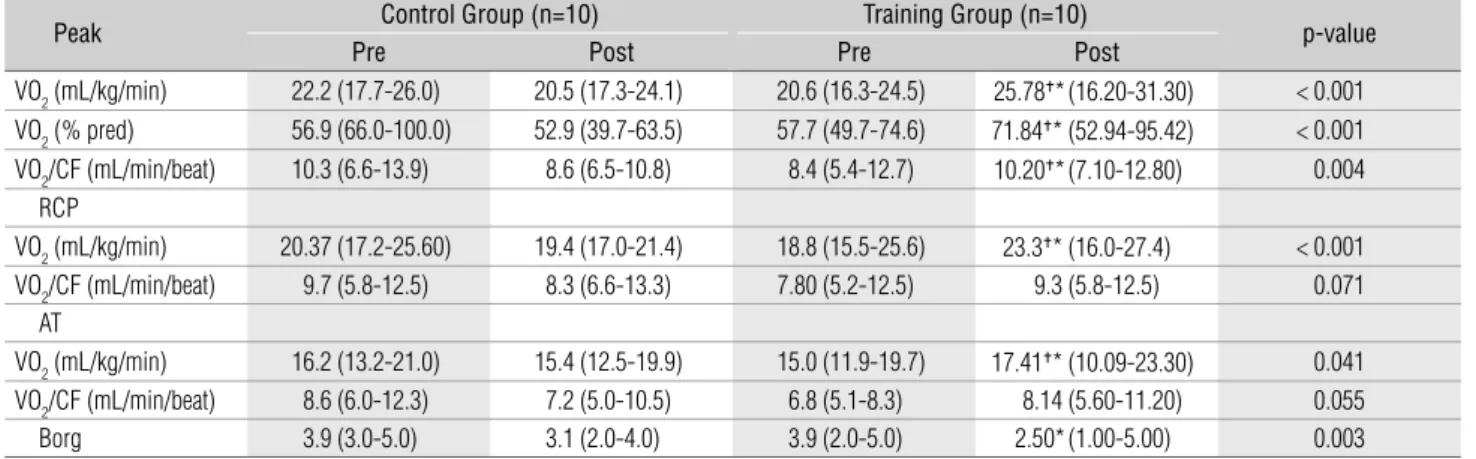
After three months of treatment, individuals in the TG showed increases in the physiological ef ort parameters in comparison to theCG (Table 2). Trained adults reported in-creases in VO2peak, predicted VO2 and oxygen pulse at exercise peak (p< 0.05). Patients in the TG also showed increases in VO2peak, and in submaximal parameters, such as anaerobic threshold and point of respiratory compensation (p< 0.05). Trained subjects (TG) showed a reduction of ef ort perception
at exercise peak in comparison to the values obtained before the physical training period (p< 0.05); however, ef ort perceptions of TG and CG were not dif erent at the end of treatment (p> 0.05). None of the training programs resulted in pulmonary function improvement (data not presented).
h e physical conditioning program improved the follow-ing domains: physical limitations, frequency of symptoms, psychosocial limitation, and the total score of quality of life questionnaire (p< 0.001) and there were no alterations in the socioeconomic domain (Table 3). Subjects who were not sub-mitted to physical training showed equal or worse values in the domains of the reported quality of life questionnaire.
At the beginning of the study, patients of both groups (10/10; 100%) showed moderate trait-anxiety scores (Table 3). Physical conditioning reduced trait-anxiety levels of the TG in comparison to the initial levels (p< 0.05), although there were
130
Table 2. Cardiopulmonary exercise testing and dyspnea of asthmatic adult patients before and after the training program.
Peak Control Group (n=10) Training Group (n=10) p-value
Pre Post Pre Post
VO2 (mL/kg/min) 22.2 (17.7-26.0) 20.5 (17.3-24.1) 20.6 (16.3-24.5) 25.78g*(16.20-31.30) < 0.001
VO2 (% pred) 56.9 (66.0-100.0) 52.9 (39.7-63.5) 57.7 (49.7-74.6) 71.84g* (52.94-95.42) < 0.001
VO2/CF (mL/min/beat) 10.3 (6.6-13.9) 8.6 (6.5-10.8) 8.4 (5.4-12.7) 10.20g*(7.10-12.80) 0.004
RCP
VO2 (mL/kg/min) 20.37 (17.2-25.60) 19.4 (17.0-21.4) 18.8 (15.5-25.6) 23.3g* (16.0-27.4) < 0.001
VO2/CF (mL/min/beat) 9.7 (5.8-12.5) 8.3 (6.6-13.3) 7.80 (5.2-12.5) 9.3 (5.8-12.5) 0.071 AT
VO2 (mL/kg/min) 16.2 (13.2-21.0) 15.4 (12.5-19.9) 15.0 (11.9-19.7) 17.41g* (10.09-23.30) 0.041
VO2/CF (mL/min/beat) 8.6 (6.0-12.3) 7.2 (5.0-10.5) 6.8 (5.1-8.3) 8.14 (5.60-11.20) 0.055
Borg 3.9 (3.0-5.0) 3.1 (2.0-4.0) 3.9 (2.0-5.0) 2.50*(1.00-5.00) 0.003
Data are expressed median and 95%CI; VO2= maximum consumption of O2; RCP= respiratory compensation point; AT= anaerobic threshold; CF= cardiac frequency. Borg= evaluation of stress perception by the modifi ed Borg scale. Pre= before the start of training; Post= after the training period; *p< 0.05 when compared to the intra-group value obtained before (pre); †p< 0.05 when compared to the Control group.
Table 1. Anthropometrical characterizistics, pulmonary function and corticoid doses of asthmatic adult patients before the training program. Control Group (n= 10) Training Group (n= 10) p-value Anthropometrical Data
Gender (W/M) 6/4 7/3
Age (yrs) 34.6 (21.0-47.0) 34.6 (21.0-47.0) 0.57
BMI (Kg/m2) 23.2 (18.0-29.0) 25.8 (24.0-27.0) 0.16
Pulmonary Function
FEV1 (L) 2.0 (1.4-2.7) 2.1 (1.2-3.4) 0.72
(% of predicted value) 71.8 (55.0-85.0) 76.7 (48.0-114.0) 0.44
FEVC (L) 3.2 (2.3-4.0) 3.0 (2.3-4.0) 0.48
(% of predicted value) 85.0 (71.0-107.0) 90.3 (76.0-117.0) 0.31
FEV1/FEVC 65.5 (52.0-83.0) 70.9 (52.0-85.0) 0.25
PEFR (L/s) 4.3 (3.6-5.0) 4.1 (1.0-6.6) 1.00
(% of predicted value) 60.6 (45.0-82.0) 64.8 (25.0-101.0) 0.60
Budesonide (mcg/day) 680 (400.0-800.0) 720 (400.0-800.0) 0.73
no dif erences in comparisons to the CG. On the other hand, there was no dif erence between initial and i nal levels of state-anxiety of the CG and TG.
It was observed that 50% of the patients in the CG (5/10) and in TG (5/10) had low scores of depression be-fore the beginning of the study (Table 3). At the end of the study, the trained subjects demonstrated a reduction in their depression levels when compared to non-trained subjects (p<0.05). There was a significant reduction in the number of individuals with low levels of depression only in the TG (1/10).
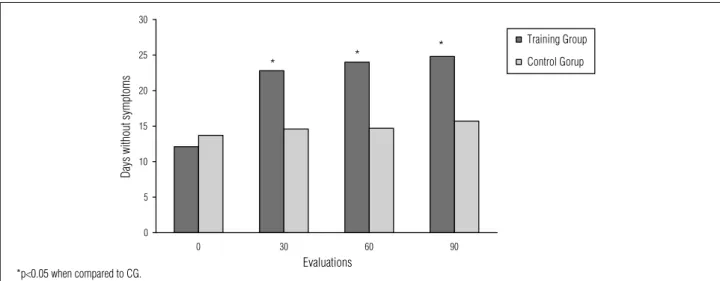
The frequency of symptoms of patients was assessed by means of the monthly sum of days free of symptoms, reported and registered in their diary. Subjects in the CG and TG showed a mean of 12.9 days free of symptoms during the month before training (respectively, 12.10 [95%CI 8.0-18.0] and 13.7 [95%CI 10.0-18.0] days free of
symptoms) (Figure 1). There was an increase in the num-ber of days free of symptoms of TG, 30 days after the be-ginning of physical training (22.8 [95%CI 20.0-25.0]) which remained after 60 (24.0 [95%CI 22.0-26.0]) and 90 (24.8 [95%CI 23.0-27.0]) days of training (p<0.05) (Figure 2). In contrast, there was no alteration in the number of days free of symptoms of CG after 30, 60 and 90 days of training (respectively, 14.6 [95%CI 10 to 18], 14.7 [95%CI 10-18] and 15.7 [95%CI 9-21]) (p<0.05).
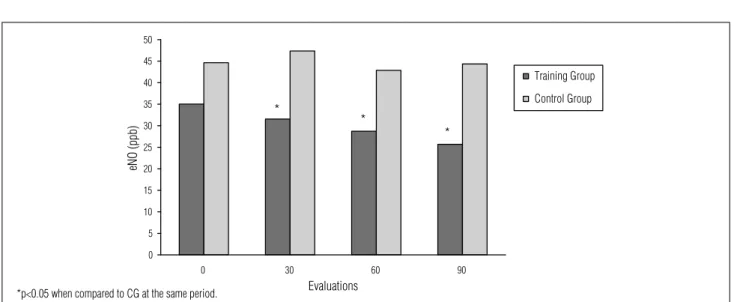
NOe measurements were conducted before the begin-ning of treatment and repeated every 30 days. There were no differences in NOe levels of TG and CG before the be-ginning of treatment (respectively, 35.03 [95%CI 22.4-59.2] vs 44.62 [95%CI 24.0-67.1] ppb). In contrast, NOe levels of CG patients were lower than the levels of TG patients at the evaluation carried out after 30 days (respectively, 31.5 [95%CI 14.0-62.0] vs 47.3 [95%CI 29.0-75.2] ppb) (p<0.05),
131 Table 3. Anxiety and depression levels and health related quality of life of asthmatic adult patients before and after the training program.
Control Group (n=10) Training Group (n=10)
p-value
Pre Post Pre Post
EPM HRQoL domains
Physical limitation 64.1 (51.5-90.9) 74.0 (57.5-90.9) 68.8 (50.0-93.9) 35.71*g (12.12-81.81) < 0.001 Symptom frequency 72.4 (50.0-83.3) 79.1 (25.0-100.0) 66.6 (41.6-83.3) 39.93*g(16.66-83.33) 0.002 Socioeconomic 66.2 (27.2-90.9) 69.9 (27.2-90.9) 69.9 (45.4-90.9) 67.23 (27.27-90.90) 0.455 Psychosocial 55.3 (42.8-85.7) 67.0 (28.5-100.0) 56.8 (28.5-100.0) 34.28*g(28.57-71.42) 0.003
Total score 63.7 (48.5-79.8) 69.6 (45.1-87.9) 63.8 (54.3-78.2) 42.86*g(34.30-71.72) < 0.001
Anxiety
Trace 44.30 (35.00-55.00) 40.90 (37.00-50.00) 43.8 (39.0-48.5) 39.3(37.0-50.0) < 0.001 State 44.10 (36.00-57.00) 41.00 (34.00-55.00) 44.1 (35.0-57.0) 41.0 (33.0-49.0) 0.489 Depression 12.45 (5.00-24.00) 9.05 (1.00-20.00) 11.0 (2.0-22.0) 6.6 (1.0-21.0) < 0.001
Data are expressed as median and 95% confi dence interval; HRQoL= health related quality of life; Pre= before the training program; Post= after the training program; *p< 0.05 when compared to the intra-group value obtained before the study (pre); †p< 0.05 when compared with Control Group.
0
0 30 60 90
5 10 15 20 25 30
Evaluations
Days without symptoms
Training Group
Control Gorup
* *
*
Figure 1. Asthma symptoms during the training period and expressed as number of symptom-free days per month. First evaluation was performed comprised of information obtained before the study (20 days), second evaluation was performed after 30 days, third evaluation was performed after 60 days and fourth evaluation at the end of the treatment period (90 days).
60 days (respectively, 28.7 [95%CI 18.0-50.0] vs 42.8 [95%CI 22.5-57.7] ppb) (p<0.05), and 90 days (respectively, 25.6 [95%CI 15.3-44.0] vs 44.35 [95%CI 24.0-60.0] ppb) (p<0.05) after the beginning of training (Figure 2).
Discussion
The results of the present study showed that patients with moderate or severe persistent asthma demonstrated improvements of aerobic capacity and quality of life and reduction of symptoms, anxiety and depression and in levels of exhaled NOe after 12 weeks of moderate physical conditioning. Consequently, these data suggested that a physical conditioning program may have played a key role as an adjunct intervention in the treatment of asthmatic patients who were clinically stable and under appropriate drug therapy.
It has been demonstrated that the prescription of physi-cal exercises for asthmatic patients produces an increase in aerobic capacity, leading these patients to achieve levels of physical activity which are within the normal range8.
Gener-ally, most patients (15/20, 75%) in the present study showed a maximal aerobic capacity (VO2peak) <70% of the predicted and, thus, a moderate physical limitation24. h is decreased
physical conditioning was related to an enhancement of the maximal and sub-maximal cardiovascular conditioning parameters (Table 2). Trained asthmatic patients showed an enhancement of VO2peak, anaerobic threshold and point of respiratory compensation. In fact, after training, all patients of TG, except one, showed an increase greater than 10% of their aerobic capacity. In contrast, all patients in the CG had
an unaltered or reduced VO2peak at the second evaluation. h ere are only i ve randomized controlled studies which investigated the ef ects of physical training on VO2max. h e improvements found were 5.5mLO2/kg/min ( from 3.9 to 7.1 mLO2/kg/min)9. h e results obtained in the present
study are in accordance with those previously described, since our patients demonstrated a mean VO2peak increase of 5.1 mLO2/kg/min ( from 0.1 to 10.7 mLO2/kg/min) (Table 2).
Quality of life is an individual perception which is inserted in the cultural context and value systems in which the sub-jects live. h e context and values are related to the objec-tives, expectations, criteria and interests of these subjects33.
Asthma causes negative ef ects on the quality of life to the extent that it causes anxiety related to the expectation of experiencing new crises. It also impairs sleep and makes par-ticipation in group and daily-living activities impossible34-36.
h e reduction in physical activity of asthmatic patients also contributes to obesity and low self-steam37. Studies which
investigated the role of physical conditioning in the quality of life of adult asthmatic patients are still scarce. Cambach16
demonstrated that physical exercise, practiced regularly, is responsible for improving the quality of life of patients with respiratory diseases, including asthma and COPD patients. h e results of the present study showed that physical condi-tioning lead to improvements of quality of life of asthmatic patients. Trained subjects showed reductions in their physical limitation scores, frequency of symptoms and psychosocial limitations, whereas none of these changes were observed in the untrained group.
Asthma can decrease quality of life and is consequently associated with psychosocial complications, such as high levels of depression and anxiety38. With asthmatic patients,
132
Figure 2. NOe levels were quantifi ed monthly during the training period in parts per billion (ppb). The fi rst evaluation was performed in the fi rst day of training program. Second, third and fourth evaluation was performed, respectively after 30, 60 and 90 days.
0 30 60 90
Evaluations
Training Group
Control Group
0 5 10 15 20 25 30 35 40 45 50
eNO (ppb)
*
*
*
psychosocial morbidity is associated with low adherence to drug treatment and to the worsening of the clinical disease picture39. Physical conditioning programs improve humor and
reduce levels of anxiety and depression in healthy adults and the elderly11. However, the ef ects of regular physical activity
practice on the psychosocial aspects of asthmatic patients are unknown. h e present results demonstrated that 50% of the subjects (10/20) showed low levels of depression before the beginning of treatment in comparison to Brazilian data for a healthy population measured with the Beck inventory26.
It is noteworthy that, after the physical conditioning period, patients in the TG showed improvements of the depression levels, suggesting that aerobic training programs can reduce depression in asthmatic subjects.
Anxiety levels were assessed using the Spielberger in-ventory which classifies anxiety as: trait-anxiety and state-anxiety27. State-anxiety refers to the fear of a subject facing
a situation or a specific stimulus, such as an acute asthma crisis. Trait-anxiety refers to subject’s perception of a situ-ation in its totality, that is, asthma as a chronic disease. Before the beginning of the study, our patients showed anxiety levels greater than those described for healthy Brazilian individuals38. The reduction of trait-anxiety
with-out modification in state-anxiety, observed in trained sub-jects, suggests that physical conditioning enhancement improved the perception of asthma as a chronic disease; however, it did not modify the fears of the patient facing acute asthma attacks (bronchoconstriction).
h e role of physical training in reducing asthma symptoms is controversial9. Non-controlled and non-randomized
stud-ies suggest that, after a patient has submitted to an aerobic physical training program, there is a reduction in the number of hospitalizations and in the demand for medical emer-gency services2,8. In addition, the ef ects of physical exercise
practice on exercise-induced bronchospasm, the necessity of control medication and symptoms of asthmatic patients remain controversial9. h e present study demonstrated that
the subjects who were submitted to a physical conditioning program demonstrated a reduction of asthma symptoms (coughing, wheezing, dyspnea, night awakening and need for relief medication).
Measurement of the levels of NOe is a simple and non-invasive means of evaluating pulmonary inl ammation and this measure is used to assess patients’ improvements in response to treatment with inhaled corticosteroids40. h e
results presented in this study suggest that moderate aerobic physical training for asthmatic patients lead to a reduction in the values of NOe, as well as in the presence of disease symp-toms, suggesting an adjunctive role of exercise in the reduc-tion of chronic allergic pulmonary inl ammareduc-tion (Figure 2).
It is important to stress that the decreases in NOe levels cannot be attributed to changes in medication, since the study was carried out during the period between two medical consultations, the two groups (control and training) received the same drug therapy, with inhaled corticosteroids, and the medication doses remained unaltered during the study.
Research involving asthmatic subjects and physical training relate cardiovascular capacity increases, quality of life improve-ment and symptom reduction in these patients, and hypoth-esize that their results are due to the reduction in pulmonary inl ammation5. Recent studies show that ovalbumin-sensitive
mice (experimental model of chronic allergic pulmonary in-l ammation) which were submitted to physicain-l conditioning, demonstrated reductions in mucus production and pulmonary inl ammations41 suggesting that aerobic training may cause
pulmonary inl ammation reductions.
NOe has been suggested as an inl ammatory marker in asthma, which responds to treatment with corticoid40;
how-ever, this is still controversial42. In the present study, quantii
ca-tion of NOe levels had the objective of verifying if there would be any variations in this parameter over the physical training period. However, the fact that NOe levels were reduced in con-junction with reduced reported symptoms in the trained group suggest to us that it could be a marker of patients’ clinical improvements due to physical training. h ese data were even more relevant when it is verii ed that there were no alterations in NOe levels for the CG and that both groups maintained cor-ticoid doses over the study.
Limitations of the study
A possible criticism to our study is the evaluation of pulmonary inflammation using NOe levels. Although these techniques are widely used in clinical practice to monitor pulmonary inflammation, some authors suggest that they have limitations and, thus, do not appropriately express pulmonary inflammatory processes42. However, NOe levels
and asthma symptoms are used to measure the treatment effectiveness of corticoids in patients with moderate persis-tent asthma43. One possible interference in the evaluation
of the behavior of NOe values of the subjects in this study could be modifications, made by the physician in charge of the patients, in corticoid doses. This limitation, however, was bypassed by conducting treatment during the period between two medical consultations, which made it impos-sible to change medication doses.
h e reduced number of patients evaluated is a relevant lim-itation of our study. h e authors, are aware of the importance of this issue and of the necessity of increasing the studied sample size, and are currently conducting a new study.
Conclusions
h e results of the present study suggest that physical train-ing reduced the values of exhaled NOe, the number of days
with asthmatic symptoms and psychosocial morbidity in pa-tients with moderate or severe persistent asthma. h ese results reinforce the importance of improving physical conditioning during clinical management of asthmatic patients.
134
References
1. V Diretrizes brasileiras para o manejo da asma. J Bras Pneumol. 2006;32 Supl 7:S447-74.
2. Disabella V, Sherman C. Exercise for asthma patients. Phys Sports Med. 1998;26:75-85.
3. Ludwick S, Jones T. Normalization of cardiorespiratory endurance in severely asthmatic children with asthma. J Pediat. 1986:106:556-80.
4. Clark C, Cochrane L. Assessment of work performance in asthma for determination of cardiorespiratory fi tness and training capacity. Thorax. 1988;43:745-9.
5. Emtner M, Herala M, Stålenheim G. High-intensity physical training in adults with asthma. Chest. 1996;109:323-30.
6. Neder JA, Nery LE, Silva AC, Cabral AL, Fernandes AL. Short term effects of aerobic training in the clinical management of moderate to severe asthma in children. Thorax. 1999;54:202-6.
7. Gift AG, Plaut SM, Jacox A. Psychologic and physiologic factors related to dyspnea in subjects with chronic obstructive pulmonary disease. Heart Lung. 1996;15:595-601.
8. Welsh L, Kemp JG, Roberts RGD. Effects of physical conditioning on children and adolescents with asthma. Sports Med. 2005;35(2):127-41.
9. Ram FS, Robinson SM, Black PN. Physical training for asthma. Cochrane Database Syst Rev (internet). 2005 Oct [date last accessed: 6 out 2006];19;(4):116. Available: http://medicine.plosjournals.org.
10. Fanelli A, Cabral ALB, Neder JA, Martins MA, Carvalho CRF. Exercise training on disease control and quality of life in asthmatic children. Med Sci Sports Exerc. 2007;39(9):1474-80.
11. Pijnenburg MW, Bakker EM, Hop WC, De Jongste JC. Titrating steroids on exhaled nitric oxide in children with asthma: a randomized controlled trial. Am J Respir Crit Care Med.2005;172:831-6.
12. Zacharasiewicz A, Wilson N, Lex C, Erin EM, Li AM, Hansel T, et al. Clinical use of non-invasive measurements of airway infl ammation in steroid reduction in children. Am J Respir Crit Care Med.2005;171:1077-82.
13. ten Thoren C, Petermann F. Reviewing asthma and anxiety. Resp Med. 2000;94:409-15.
14. Cox RH, Thomas TR, Hinton PS, Donahue OM. Effect of acute bout of aerobic exercise on anxiety of women of different ages. Med Sci Sports Exerc. 2002;34 Suppl 1:S239.
15. Bingöl Karakoç G, Yilmaz M, Sur S, Ufuk Altintas D, Sarpel T, Güneter Kendirli S. The effects of daily pulmonary rehabilitation program at home on childhood asthma. Allergol et Immunopathol. 2000;28:12-4.
16. Cambach W, Chadwick-Straver RVM, Wagenaar RC. The effects of a community-based pulmonary rehabilitation programme on exercise tolerance and quality of life: a randomized controlled trial. Eur Respir J. 1997;10:104-13.
17. Basaran S, Guler-Uysal F, Ergen N, Seydaoglu G, Bingöl Karakoç G, Ufuk Altintas D. Effects of physical exercise on quality of life, exercise capacity and pulmonary function in children with asthma. J Rehabil Med. 2006;38:130-5.
18. Oliveira MA, Barbieri A, Santos LA, Faresin SM, Fernandes ALG. Validation of a simplifi ed quality of life questionnaire for a socioeconomic deprived asthma patients. J Asthma. 2005;42:41-4.
19. Global Initiative for Asthma - GINA. GINA Workshop Report (Updated
2006) Global Strategy for Asthma Management and prevention [text on the Internet]. Ontario, Canadá; 2000. [updated 2006 Oct; cited 2007]. Available from: http://www.ginasthma.org/ Guidelineitem.asp??l1=2&l2=1&intId=60- Med Res Methodol. 2004;4:15.
20. Manocha R, Marks GB, Kenchington P, Peters D, Salome CM. Sahaja yoga in the management of moderate to severe asthma: a randomised controlled trial. Thorax. 2002;57:110.
21. American Thoracic Society. Lung function testing: selection of reference values and interpretative strategies. American Thoracic Society. Am J Respir Crit Care Med. 1991;144:1202-18.
22. Knudson RJ, Lebowitz MD, Holberg CJ, Burrows, B. Changes in the normal expiratory fl ow-volume curve with growth and aging. Am Rev Respir Dis. 1983;127:725-34.
23. Heyward VH. Advanced fi tness assessment and exercise prescription. 5th ed. Champaign: Humans kinetics; 1997.
24. Cooper DM, Weiler-Ravell D, Whipp BJ, Wasserman K. Aerobic parameters of exercise as a function of body size during growth in children. J Appl Physiol. 1984;56:628-34.
25. Beaver WL, Wasserman K, Whipp BJ. A new method for detecting the anaerobic threshold by gas exchange. J Appl Physiol. 1986;60:2020-7.
26. Beck AT, Ward CH, Mendelson MD, Mocck J, Erbaugh J. An inventory for measuring depression. Arch Gen Psych. 1961;4:53-63.
27. Spilberger CD, Goursuch RL, Lushene RE. Inventário de ansiedade traço-ansiedade – IDATE. In: Biaggio AM, Natalício L (ed). Psicologia aplicada. RJ: 1970. p. 60.
135 29. Gorenstein C, Pompéia S, Andrade L. Scores of a portuguese version of
the Beck depression inventory ans state-trait anxiety inventory in Brazilian subjects. Braz J Med Biol Res. 1996;29:453-7.
30. Robles PG. Efeito da fisioterapia na condição clínica, na qualidade de vida, nos aspectos psicológicos e no desempenho físico de pacientes asmáticos persistentes [dissertação]. São Paulo (SP): USP; 2003.
31. Mehta S, Lilly CM, Rollenhagen JE, Haley KJ, Asano K, Drazen JM. Acute and chronic effects of allergic airway infl ammation on pulmonary nitric oxide production. Am J Physiol. 1997;272:124-31.
32. Hadjikoumi I, Hassan A, Milner AD. Exhaled nitric oxide measurements in childhood asthma: comparison of two sampling techniques. Ped Res. 2002;52(5):745-9.
33. World Health Organization. Constitution of the World Health Organization. Geneva: WHO; 1947.
34. Gibson PG, HenrYGV, Vimpani JH. Asthma knowledge, attitudes, and quality of live in adolescents. Arch Dis Child. 1995;73;321-6.
35. Adams RJ, Wilson DH, Taylor AW, Daly A, Tursan d’Espaignet E, Dal Grande E, et al. Psychological factors and asthma quality of life: a population based study. Thorax. 2004;59:930-5.
36. Fitch KD, Morton AR, Blanksby BA. Effects of swimming training on children with asthma. Arch Dis Child. 1976;51:190-4.
37. Ford ES, Health GW, Mannino DM, Redd SC. Leisure-time physical activity patterns among US adults with asthma. Chest. 2003;124:431-7.
38. Goldney RD, Ruffi n R, Fisher LJ, Wilson DH. Asthma symptoms associated with depression and lower quality of life: a population survey. Med J Aust. 2003;178:437-41.
39. Bochner BS, Busse WW. Allergy and asthma. J Allergy Clin Immunol. 2005;115:953-9.
40. Pastva A, Estell K, Scoeb TR, Atkinson TP, Schwiehert LM. Aerobic Exercise Attenuates Airway Infl ammatory: Responses in a mouse model of atopic asthma. J Immunol. 2004;172:4520-6.
41. Scollo M, Zaconato S, Ongaro R, Zaramella C, Zacchello F, Baraldi E. Exhaled nitric oxide and exercise induced bronchoconstriction in asthmatic children. Am J Respir Crit Care Med. 2000;161:1047-50.
42. Buchvald F, Eiberg H, Bisgaard H. Heterogeneity of FeNO response to inhaled steroid in asthmatic children. Clin Exp Allergy. 2003;33:1735-40.